“A decision is a judgment. It is a choice between
alternatives. It is rarely a choice between right
and wrong. It is at best a choice between “almost
right” and “probably wrong”.

“A manager by profession is a decision maker;
Uncertainty is his opponent, overcoming it
is his mission.”
The decision making process describe the
element of an organization that accepts and
processes information inputs and transforms
them useful conclusions help in selecting a
desirable course of action which ,when
implemented ,will provide a solution to a
management problem. Decision making is a
process involving a series of steps
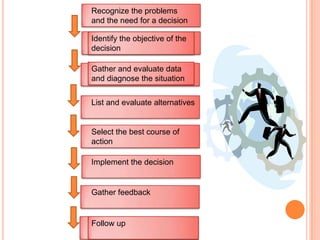
Recognize the problems
and the need for a decision
Identify the objective of the
decision
Gather and evaluate data
and diagnose the situation
List and evaluate alternatives

Select the best course of
action
Implement the decision

Gather feedback

Follow up
The first step in the decision making process is
recognizing a problem. Problems generally
arise because of disparity between what is and
what should look for problems that need
solving. Identification of the real problems is
important; otherwise ,the manager may be
reacting to symptoms and fire fighting rather
that dealing with the root cause of the
problems.
It is important at this stage to
identify the objection of the
decision . In other words the
manager must determines
what is to be accomplished by
the decision
This step of the decision making process
involves gathering information relevant to
problem. The manager must pull together
sufficient information about why the problem
occurred. This including conducting a
thorough diagnosis of the situation and
undertaking a fact-finding exercise
The fourth step is listing and evaluating
alternative courses of action. During this step ,a
thorough “what if” analysis should also be
conducted to determine the various factors that
influence the outcome. It is important to
generate a wide range of option and creative
solution in order to be able to move on to next
step.
In this step ,the decision maker tries to outline the
advantage and disadvantage of each alternative.
The consequences of each alternative would also
be considered. Sometime the alternative develop
may meet internal demand but may fail to meet the
environmental condition while evaluating the
available alternatives, the decision maker should try
t visualize both the desirable and undesirable
characteristics .all pertinent fact must be collected
they must be classified the process the cons must
be considered and the important points must be
distinguished from trivial or peripheral matter .the
attempt is made chiefly to limit the alternative to a
manageable and economically feasible number.
In this is step ,the decision maker merely
select the alternatives that will maximize the
result in terms of existing objectives .if the
problems has been diagnosed correctly
correctly and sufficient alternatives have
been identified ,this step is much easier.
Peter drucker has offered the following four
criteria for making the right choice among
available alternatives.
The decision maker has to weigh
the risk of each course of action
against the expected gains
The alternatives that will give the
greater output for the least inputs
in terms of material and human
resources is obviously the one to
be selected.
If the situation is extremely urgent, the best
alternatives is one that dramatizes the
decision and serves notices on the
organization that something important is
happening . On the other hand ,if consistent
effort is needed ,a slow start that gathers
momentum may be preferable
Physical ,financial and human resources
impose a limitation on choice of selection .
Of these, the most important resources
whose limitation have to be considered are
the human being who will carry out decision.
No decision can be better then the people
who have to carry out the decision.
Finally, the solution is implemented . The situation
must then be monitored to see whether the decision
meet its objectives . Consistent monitoring and
periodically feed is an essential part of the follow-up
process . Feed allow managers to become aware of
the recent problems associated with the solution .it
permits manager to monitors the effect of their
success . They can also take the opportunity to
evaluate their own decision-making abilities
Decision making can be stressful . Manager
must make decisions with significant risk and
uncertainty ,and often without full information.
The must trust rely on other in arriving at their
decision , but they are ultimately responsible
and often meet considerable criticism
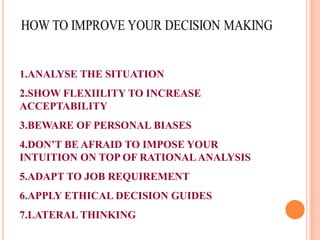
1.ANALYSE THE SITUATION

2.SHOW FLEXIILITY TO INCREASE
ACCEPTABILITY
3.BEWARE OF PERSONAL BIASES
4.DON’T BE AFRAID TO IMPOSE YOUR
INTUITION ON TOP OF RATIONAL ANALYSIS
5.ADAPT TO JOB REQUIREMENT
6.APPLY ETHICAL DECISION GUIDES
7.LATERAL THINKING
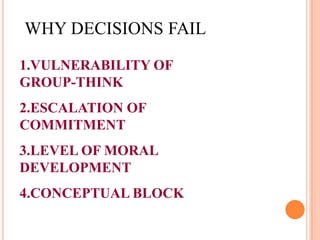
1.VULNERABILITY OF
GROUP-THINK
2.ESCALATION OF
COMMITMENT
3.LEVEL OF MORAL
DEVELOPMENT
4.CONCEPTUAL BLOCK
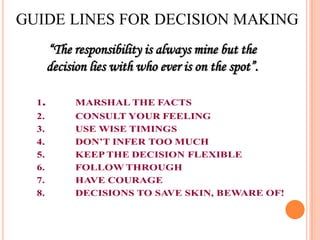
“The responsibility is always mine but the
decision lies with who ever is on the spot”.
Decision making process

Decision making process

  • 2.
    “A decision isa judgment. It is a choice between alternatives. It is rarely a choice between right and wrong. It is at best a choice between “almost right” and “probably wrong”. “A manager by profession is a decision maker; Uncertainty is his opponent, overcoming it is his mission.”
  • 3.
    The decision makingprocess describe the element of an organization that accepts and processes information inputs and transforms them useful conclusions help in selecting a desirable course of action which ,when implemented ,will provide a solution to a management problem. Decision making is a process involving a series of steps
  • 4.
    Recognize the problems andthe need for a decision Identify the objective of the decision Gather and evaluate data and diagnose the situation List and evaluate alternatives Select the best course of action Implement the decision Gather feedback Follow up
  • 5.
    The first stepin the decision making process is recognizing a problem. Problems generally arise because of disparity between what is and what should look for problems that need solving. Identification of the real problems is important; otherwise ,the manager may be reacting to symptoms and fire fighting rather that dealing with the root cause of the problems.
  • 6.
    It is importantat this stage to identify the objection of the decision . In other words the manager must determines what is to be accomplished by the decision
  • 7.
    This step ofthe decision making process involves gathering information relevant to problem. The manager must pull together sufficient information about why the problem occurred. This including conducting a thorough diagnosis of the situation and undertaking a fact-finding exercise
  • 8.
    The fourth stepis listing and evaluating alternative courses of action. During this step ,a thorough “what if” analysis should also be conducted to determine the various factors that influence the outcome. It is important to generate a wide range of option and creative solution in order to be able to move on to next step.
  • 9.
    In this step,the decision maker tries to outline the advantage and disadvantage of each alternative. The consequences of each alternative would also be considered. Sometime the alternative develop may meet internal demand but may fail to meet the environmental condition while evaluating the available alternatives, the decision maker should try t visualize both the desirable and undesirable characteristics .all pertinent fact must be collected they must be classified the process the cons must be considered and the important points must be distinguished from trivial or peripheral matter .the attempt is made chiefly to limit the alternative to a manageable and economically feasible number.
  • 10.
    In this isstep ,the decision maker merely select the alternatives that will maximize the result in terms of existing objectives .if the problems has been diagnosed correctly correctly and sufficient alternatives have been identified ,this step is much easier. Peter drucker has offered the following four criteria for making the right choice among available alternatives.
  • 11.
    The decision makerhas to weigh the risk of each course of action against the expected gains
  • 12.
    The alternatives thatwill give the greater output for the least inputs in terms of material and human resources is obviously the one to be selected.
  • 13.
    If the situationis extremely urgent, the best alternatives is one that dramatizes the decision and serves notices on the organization that something important is happening . On the other hand ,if consistent effort is needed ,a slow start that gathers momentum may be preferable
  • 14.
    Physical ,financial andhuman resources impose a limitation on choice of selection . Of these, the most important resources whose limitation have to be considered are the human being who will carry out decision. No decision can be better then the people who have to carry out the decision.
  • 15.
    Finally, the solutionis implemented . The situation must then be monitored to see whether the decision meet its objectives . Consistent monitoring and periodically feed is an essential part of the follow-up process . Feed allow managers to become aware of the recent problems associated with the solution .it permits manager to monitors the effect of their success . They can also take the opportunity to evaluate their own decision-making abilities
  • 16.
    Decision making canbe stressful . Manager must make decisions with significant risk and uncertainty ,and often without full information. The must trust rely on other in arriving at their decision , but they are ultimately responsible and often meet considerable criticism
  • 17.
    1.ANALYSE THE SITUATION 2.SHOWFLEXIILITY TO INCREASE ACCEPTABILITY 3.BEWARE OF PERSONAL BIASES 4.DON’T BE AFRAID TO IMPOSE YOUR INTUITION ON TOP OF RATIONAL ANALYSIS 5.ADAPT TO JOB REQUIREMENT 6.APPLY ETHICAL DECISION GUIDES 7.LATERAL THINKING
  • 18.
  • 19.
    “The responsibility isalways mine but the decision lies with who ever is on the spot”.