Decision theory 
 Decision-making means a process 
which results in the selection from a set 
of alternative courses of action, that 
course of action which is regarded to 
meet the objectives of the decision 
problem more satisfactorily as compared 
to others. 
 Process of decision making includes: 
Defining the problem, Analysis of the 
problem, Identification of alternatives, 
Evaluation of alternatives, Decision 
environment.
Terminology: 
 Acts or alternatives- denoted by a1,a2,a3. 
 Events- denoted by e1,e2,e3. 
 Pay off-measures the net benefit to 
decision maker, which results from a given 
combination. 
 Pay-off table- various pay-off can be put in 
a shape of table to form a pay off table. 
 Opportunity loss or regret-the difference 
between pay off realized and the maximum 
payoff which could have been realized if 
another strategy was chosen.
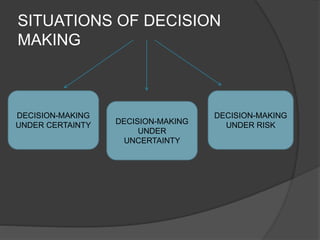
SITUATIONS OF DECISION 
MAKING 
DECISION-MAKING 
UNDER CERTAINTY DECISION-MAKING 
UNDER 
UNCERTAINTY 
DECISION-MAKING 
UNDER RISK
Decision making under 
certainty: 
 In decision making under certainty, the 
decision maker knows with certainty the 
consequences of every alternative. The 
decision maker has to choose the 
alternative with the maximum pay-off in 
terms of utility under event which will occur. 
The main techniques used in it : 
 Liner programming 
 Input-output analysis 
 Inventory models 
 Goal programming 
 Break-even analysis etc.
Decision making under 
uncertainty: 
 The choice of a decision is very largely 
based on company’s policy, experience and 
the judgment of the decision maker. The 
methods used in it are: 
 Maxi-max criterion: under this criterion it is 
assumed, the decision maker is optimistic. 
First the maximum outcome within every 
alternative is located and then the 
alternative with maximum pay-off is 
selected. 
 Maxi-min criterion: under this method it is 
assumed that the decision maker is 
pessimist and chooses the strategy which 
gives the highest minimum pay-off.
Contd.. 
 Mini-max criterion: under this criterion the 
decision maker would select the strategy in 
which the maximum regret is the lowest. 
 Coefficient of optimism criterion-Hurwicz 
criterion- under this criterion the decision 
maker’s degree of optimism is represented 
by α(alpha), the coefficient of optimism 
varying between 0 and 1. 
 Laplace criterion: under this criterion three 
steps are followed, assigning equal 
opportunity to each event, calculating the 
expected pay-offs, selecting the strategy 
with maximum expected pay-off.
Decision making under risk: 
Under this condition, the decision maker faces 
several events and he cannot predict the outcome 
of an event. Under this the following decision 
criterions are used: 
 Expected monetary value criterion(EMV):under this 
criterion the decision maker chooses that strategy 
which has highest EMV. 
 Expected opportunity loss criterion(EOL): under 
this criterion the expected opportunity loss is 
minimized. 
 Expected value of perfect information(EVPI):under 
this it is assumed that the decision maker has 
authentic and perfect information available. 
EVPI=EPPI-EMV=MINIMUM EOL
THANK YOU

Qt decision theory

  • 1.
    Decision theory Decision-making means a process which results in the selection from a set of alternative courses of action, that course of action which is regarded to meet the objectives of the decision problem more satisfactorily as compared to others.  Process of decision making includes: Defining the problem, Analysis of the problem, Identification of alternatives, Evaluation of alternatives, Decision environment.
  • 2.
    Terminology:  Actsor alternatives- denoted by a1,a2,a3.  Events- denoted by e1,e2,e3.  Pay off-measures the net benefit to decision maker, which results from a given combination.  Pay-off table- various pay-off can be put in a shape of table to form a pay off table.  Opportunity loss or regret-the difference between pay off realized and the maximum payoff which could have been realized if another strategy was chosen.
  • 3.
    SITUATIONS OF DECISION MAKING DECISION-MAKING UNDER CERTAINTY DECISION-MAKING UNDER UNCERTAINTY DECISION-MAKING UNDER RISK
  • 4.
    Decision making under certainty:  In decision making under certainty, the decision maker knows with certainty the consequences of every alternative. The decision maker has to choose the alternative with the maximum pay-off in terms of utility under event which will occur. The main techniques used in it :  Liner programming  Input-output analysis  Inventory models  Goal programming  Break-even analysis etc.
  • 5.
    Decision making under uncertainty:  The choice of a decision is very largely based on company’s policy, experience and the judgment of the decision maker. The methods used in it are:  Maxi-max criterion: under this criterion it is assumed, the decision maker is optimistic. First the maximum outcome within every alternative is located and then the alternative with maximum pay-off is selected.  Maxi-min criterion: under this method it is assumed that the decision maker is pessimist and chooses the strategy which gives the highest minimum pay-off.
  • 6.
    Contd..  Mini-maxcriterion: under this criterion the decision maker would select the strategy in which the maximum regret is the lowest.  Coefficient of optimism criterion-Hurwicz criterion- under this criterion the decision maker’s degree of optimism is represented by α(alpha), the coefficient of optimism varying between 0 and 1.  Laplace criterion: under this criterion three steps are followed, assigning equal opportunity to each event, calculating the expected pay-offs, selecting the strategy with maximum expected pay-off.
  • 7.
    Decision making underrisk: Under this condition, the decision maker faces several events and he cannot predict the outcome of an event. Under this the following decision criterions are used:  Expected monetary value criterion(EMV):under this criterion the decision maker chooses that strategy which has highest EMV.  Expected opportunity loss criterion(EOL): under this criterion the expected opportunity loss is minimized.  Expected value of perfect information(EVPI):under this it is assumed that the decision maker has authentic and perfect information available. EVPI=EPPI-EMV=MINIMUM EOL
  • 8.