QUANTITATIVE METHODS
IN MANAGEMENT
DECISION MAKING THEORY
By
Gokulakrishnan A – 19P615
Kavinraaj K R – 19P627
Nitish S – 19P634
Yuvaz S – 19P651
Obulinarashinman R – 20P908
Decision making theory
• Decision-making theory is a theory of how rational individuals should
behave under risk and uncertainty.
• The theory suggests that decision-making means the adoption and
application of rational choice for the management of a private,
business, or governmental organization in an efficient manner.
Three branches of decision theory:
1.Normative decision theory: Concerned with the identification
of optimal decision, where optimality is often determined by
considering an ideal decision-maker who is able to calculate with
perfect accuracy and is in some sense fully rational.
2.Perspective decision theory : Concerned with describing observed
behaviors through the use of conceptual model, under the assumption
that those making the decisions are behaving under some consistent
rules.
3.Descriptive decision theory : Analyzes how individuals actually
make the decisions that they do.
HISTORY
• Herbert A. Simon - American economist & popular scientist known for
in psychology, statistics and mathematics.
• Nobel Prize for Economics in 1978 - corporate decision making, also
called behaviorism.
• Herbert Simon Decision Making Theory - Administrative Behavior
(1947).
• He suggested that decisions were critical because if they weren’t taken
on time, it’ll negatively impact an organization’s objective.
• The concept can be divided into two parts:
• one is the decision that someone arrives at
• another is the process or actions taken.
DECISION MAKING UNDER CERTAINITY
• A condition of certainty exists when the decision-maker knows with
reasonable certainty what the alternatives are, what conditions are
associated with each alternative, and the outcome of each alternative.
Under conditions of certainty, accurate, measurable, and reliable
information on which to base decisions is available.
• The cause and effect relationships are known and the future is highly
predictable under conditions of certainty. Such conditions exist in case
of routine and repetitive decisions concerning the day-to-day
operations of the business.
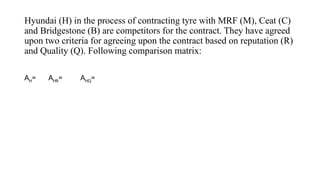
Hyundai (H) in the process of contracting tyre with MRF (M), Ceat (C)
and Bridgestone (B) are competitors for the contract. They have agreed
upon two criteria for agreeing upon the contract based on reputation (R)
and Quality (Q). Following comparison matrix:
AH= AHR= AHQ=
Decision-making under Risk
• The payoffs associated with each decision alternative are described by
probability distributions.
• Decision making under risk can be based on expected value criterion.
• Decision alternatives are compared based on the maximization of
expected profit or minimization of expected cost.
• Limitation – Expected value criterion can be modified to encompass
other situations.
Decision-making under Risk
• When a manager lacks perfect information or whenever an
information asymmetry exists, risk arises.
• Under a state of risk, the decision maker has incomplete information
about available alternatives but has a good idea of the probability of
outcomes for each alternative.
• While making decisions under a state of risk, managers must
determine the probability associated with each alternative on the basis
of the available information and his experience.
The owner of Warehouse is considering what to do with his business over the next five years. Sales growth over
the past couple of years has been good, but sales could grow substantially if a major proposed electronics firm is
built in his area. Hackers' owner sees three options. The first is to enlarge his warehouse, the second is to locate
at a new site, and the third is to simply wait and do nothing. The process of expanding or moving would take
little time and therefore, the store would not lose revenue. If nothing were done the first year and strong growth
occurred then the decision to expand could be reconsidered. Waiting longer than one year would allow
competition to move in and would make expansion no longer feasible. The assumptions and conditions are as
follows:
(i) Strong growth as a result of the increased sales for firm has a 55% probability.
(ii) Strong growth with a new site would give annual return of $195,000 per year. Weak growth with a new site
would mean annual returns of $115,000 per year.
(iii) Strong growth with an expansion would give annual returns of $190,000 per year. Weak growth with an
expansion would mean annual returns of $100,000.
(iv) At the existing store with no changes, there would be returns of $170,000 per year if there is a strong
growth and $105,000 per year if growth is weak.
(v) Expansion at the current site would cost $87,000
(vi) The move to the new site would cost $210,000.
(vii) If growth is strong and the existing site is enlarged during the second year, the cost would still be $87,000.
(viii) Operating costs for all options are equal
Decision tree
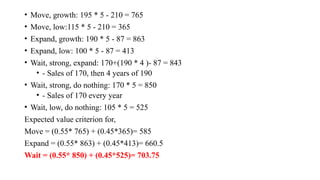
• Move, growth: 195 * 5 - 210 = 765
• Move, low:115 * 5 - 210 = 365
• Expand, growth: 190 * 5 - 87 = 863
• Expand, low: 100 * 5 - 87 = 413
• Wait, strong, expand: 170+(190 * 4 )- 87 = 843
• - Sales of 170, then 4 years of 190
• Wait, strong, do nothing: 170 * 5 = 850
• - Sales of 170 every year
• Wait, low, do nothing: 105 * 5 = 525
Expected value criterion for,
Move = (0.55* 765) + (0.45*365)= 585
Expand = (0.55* 863) + (0.45*413)= 660.5
Wait = (0.55* 850) + (0.45*525)= 703.75
Decision-making under Uncertainty
• Decisions made in today’s complex environment are formulated under a
state of uncertainty.
• Conditions of uncertainty exist - future environment is unpredictable and
everything is in state of flux.
• The decision-maker is not aware of all available alternatives, risks
associated with each, and consequences of each alternative probabilities.
• The manager does not possess complete information about the alternatives
and whatever information is available, may not be completely reliable.
• In the face of such uncertainty, managers need to make certain
assumptions about the situation in order to provide a reasonable
framework for decision-making.
• They have to depend upon their judgment and experience for making
decisions.
Decision-making under Uncertainty
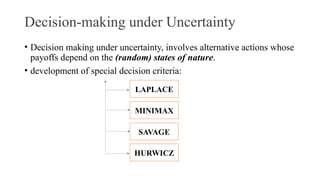
• Decision making under uncertainty, involves alternative actions whose
payoffs depend on the (random) states of nature.
• development of special decision criteria:
LAPLACE
MINIMAX
SAVAGE
HURWICZ
Laplace
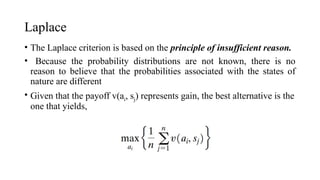
• The Laplace criterion is based on the principle of insufficient reason.
• Because the probability distributions are not known, there is no
reason to believe that the probabilities associated with the states of
nature are different
• Given that the payoff v(ai, sj) represents gain, the best alternative is the
one that yields,
Maximin/minimax
• The maximin (minimax) criterion is based on the conservative attitude
of making the best of the worst-possible conditions.
• If v(ai, sj) is loss, then we select the action that corresponds to the
following minimax criterion:
• If v(ai, sj) is gain, we use the maximin criterion given by,
Savage
• The Savage regret criterion aims at “moderating” the degree of
conservatism in the minimax (maximin) criterion by replacing the
(gain or loss) payoff matrix v(ai, sj) with a loss (or regret) matrix, r(ai,
sj), by using the following transformation:
Hurwicz
• The Hurwicz criterion is designed to represent different decision-
making attitudes, ranging from the most liberal (optimistic) to the
most conservative (pessimistic).
• The parameter α is the index of optimism.
Locations Future
availability
of water
Future
availability
of fuel
Possibility of
Transport
infrastructure
growth
Future regulations
related to
pollution
Skilled labor
movement to
pollution
Improvement in living
conditions
A 250 300 200 75 100 200
B 300 350 150 60 125 225
C 150 300 125 80 110 150
From the above data, it is very clear that on certain factors, one location, is better than the
other and on other factors, some other location is better with respect to others,
Soln:
 Laplace :
Ev1= 187.5
Ev2= 201.67
Ev3= 152.5
Since the rating is considered the maximum is Ev2, location B is chosen.
 Maximin
for the matrix location C is chosen.
• Savage:
Location B is chosen by minmax.
• Hurwicz:
α = 0.5
A = 187.5
B= 205
C= 190
Location B is chosen from Hurwicz method.
THANK YOU

QUANTITATIVE METHODS IN MANAGEMENTs.pptx

  • 1.
    QUANTITATIVE METHODS IN MANAGEMENT DECISIONMAKING THEORY By Gokulakrishnan A – 19P615 Kavinraaj K R – 19P627 Nitish S – 19P634 Yuvaz S – 19P651 Obulinarashinman R – 20P908
  • 2.
    Decision making theory •Decision-making theory is a theory of how rational individuals should behave under risk and uncertainty. • The theory suggests that decision-making means the adoption and application of rational choice for the management of a private, business, or governmental organization in an efficient manner.
  • 3.
    Three branches ofdecision theory: 1.Normative decision theory: Concerned with the identification of optimal decision, where optimality is often determined by considering an ideal decision-maker who is able to calculate with perfect accuracy and is in some sense fully rational. 2.Perspective decision theory : Concerned with describing observed behaviors through the use of conceptual model, under the assumption that those making the decisions are behaving under some consistent rules. 3.Descriptive decision theory : Analyzes how individuals actually make the decisions that they do.
  • 4.
    HISTORY • Herbert A.Simon - American economist & popular scientist known for in psychology, statistics and mathematics. • Nobel Prize for Economics in 1978 - corporate decision making, also called behaviorism. • Herbert Simon Decision Making Theory - Administrative Behavior (1947). • He suggested that decisions were critical because if they weren’t taken on time, it’ll negatively impact an organization’s objective. • The concept can be divided into two parts: • one is the decision that someone arrives at • another is the process or actions taken.
  • 5.
    DECISION MAKING UNDERCERTAINITY • A condition of certainty exists when the decision-maker knows with reasonable certainty what the alternatives are, what conditions are associated with each alternative, and the outcome of each alternative. Under conditions of certainty, accurate, measurable, and reliable information on which to base decisions is available. • The cause and effect relationships are known and the future is highly predictable under conditions of certainty. Such conditions exist in case of routine and repetitive decisions concerning the day-to-day operations of the business.
  • 6.
    Hyundai (H) inthe process of contracting tyre with MRF (M), Ceat (C) and Bridgestone (B) are competitors for the contract. They have agreed upon two criteria for agreeing upon the contract based on reputation (R) and Quality (Q). Following comparison matrix: AH= AHR= AHQ=
  • 7.
    Decision-making under Risk •The payoffs associated with each decision alternative are described by probability distributions. • Decision making under risk can be based on expected value criterion. • Decision alternatives are compared based on the maximization of expected profit or minimization of expected cost. • Limitation – Expected value criterion can be modified to encompass other situations.
  • 8.
    Decision-making under Risk •When a manager lacks perfect information or whenever an information asymmetry exists, risk arises. • Under a state of risk, the decision maker has incomplete information about available alternatives but has a good idea of the probability of outcomes for each alternative. • While making decisions under a state of risk, managers must determine the probability associated with each alternative on the basis of the available information and his experience.
  • 9.
    The owner ofWarehouse is considering what to do with his business over the next five years. Sales growth over the past couple of years has been good, but sales could grow substantially if a major proposed electronics firm is built in his area. Hackers' owner sees three options. The first is to enlarge his warehouse, the second is to locate at a new site, and the third is to simply wait and do nothing. The process of expanding or moving would take little time and therefore, the store would not lose revenue. If nothing were done the first year and strong growth occurred then the decision to expand could be reconsidered. Waiting longer than one year would allow competition to move in and would make expansion no longer feasible. The assumptions and conditions are as follows: (i) Strong growth as a result of the increased sales for firm has a 55% probability. (ii) Strong growth with a new site would give annual return of $195,000 per year. Weak growth with a new site would mean annual returns of $115,000 per year. (iii) Strong growth with an expansion would give annual returns of $190,000 per year. Weak growth with an expansion would mean annual returns of $100,000. (iv) At the existing store with no changes, there would be returns of $170,000 per year if there is a strong growth and $105,000 per year if growth is weak. (v) Expansion at the current site would cost $87,000 (vi) The move to the new site would cost $210,000. (vii) If growth is strong and the existing site is enlarged during the second year, the cost would still be $87,000. (viii) Operating costs for all options are equal
  • 10.
  • 11.
    • Move, growth:195 * 5 - 210 = 765 • Move, low:115 * 5 - 210 = 365 • Expand, growth: 190 * 5 - 87 = 863 • Expand, low: 100 * 5 - 87 = 413 • Wait, strong, expand: 170+(190 * 4 )- 87 = 843 • - Sales of 170, then 4 years of 190 • Wait, strong, do nothing: 170 * 5 = 850 • - Sales of 170 every year • Wait, low, do nothing: 105 * 5 = 525 Expected value criterion for, Move = (0.55* 765) + (0.45*365)= 585 Expand = (0.55* 863) + (0.45*413)= 660.5 Wait = (0.55* 850) + (0.45*525)= 703.75
  • 12.
    Decision-making under Uncertainty •Decisions made in today’s complex environment are formulated under a state of uncertainty. • Conditions of uncertainty exist - future environment is unpredictable and everything is in state of flux. • The decision-maker is not aware of all available alternatives, risks associated with each, and consequences of each alternative probabilities. • The manager does not possess complete information about the alternatives and whatever information is available, may not be completely reliable. • In the face of such uncertainty, managers need to make certain assumptions about the situation in order to provide a reasonable framework for decision-making. • They have to depend upon their judgment and experience for making decisions.
  • 13.
    Decision-making under Uncertainty •Decision making under uncertainty, involves alternative actions whose payoffs depend on the (random) states of nature. • development of special decision criteria: LAPLACE MINIMAX SAVAGE HURWICZ
  • 14.
    Laplace • The Laplacecriterion is based on the principle of insufficient reason. • Because the probability distributions are not known, there is no reason to believe that the probabilities associated with the states of nature are different • Given that the payoff v(ai, sj) represents gain, the best alternative is the one that yields,
  • 15.
    Maximin/minimax • The maximin(minimax) criterion is based on the conservative attitude of making the best of the worst-possible conditions. • If v(ai, sj) is loss, then we select the action that corresponds to the following minimax criterion: • If v(ai, sj) is gain, we use the maximin criterion given by,
  • 16.
    Savage • The Savageregret criterion aims at “moderating” the degree of conservatism in the minimax (maximin) criterion by replacing the (gain or loss) payoff matrix v(ai, sj) with a loss (or regret) matrix, r(ai, sj), by using the following transformation:
  • 17.
    Hurwicz • The Hurwiczcriterion is designed to represent different decision- making attitudes, ranging from the most liberal (optimistic) to the most conservative (pessimistic). • The parameter α is the index of optimism.
  • 18.
    Locations Future availability of water Future availability offuel Possibility of Transport infrastructure growth Future regulations related to pollution Skilled labor movement to pollution Improvement in living conditions A 250 300 200 75 100 200 B 300 350 150 60 125 225 C 150 300 125 80 110 150 From the above data, it is very clear that on certain factors, one location, is better than the other and on other factors, some other location is better with respect to others,
  • 19.
    Soln:  Laplace : Ev1=187.5 Ev2= 201.67 Ev3= 152.5 Since the rating is considered the maximum is Ev2, location B is chosen.  Maximin for the matrix location C is chosen.
  • 20.
    • Savage: Location Bis chosen by minmax. • Hurwicz: α = 0.5 A = 187.5 B= 205 C= 190 Location B is chosen from Hurwicz method.
  • 21.