Debugging At The Electronic System Level 1st Edition Frank Rogin
Debugging At The Electronic System Level 1st Edition Frank Rogin
Debugging At The Electronic System Level 1st Edition Frank Rogin
Debugging At The Electronic System Level 1st Edition Frank Rogin
Debugging At The Electronic System Level 1st Edition Frank Rogin
1.
Debugging At TheElectronic System Level 1st
Edition Frank Rogin download
https://ebookbell.com/product/debugging-at-the-electronic-system-
level-1st-edition-frank-rogin-1681916
Explore and download more ebooks at ebookbell.com
2.
Here are somerecommended products that we believe you will be
interested in. You can click the link to download.
Norm Contestation Sovereignty And Irresponsibility At The
International Criminal Court Debunking Liberal Antipolitics 1st
Edition Emanuela Piccolo Koskimies
https://ebookbell.com/product/norm-contestation-sovereignty-and-
irresponsibility-at-the-international-criminal-court-debunking-
liberal-antipolitics-1st-edition-emanuela-piccolo-koskimies-35985524
Why Density Debunking The Myth Of The Cubic Watermelon Javier Mozas
https://ebookbell.com/product/why-density-debunking-the-myth-of-the-
cubic-watermelon-javier-mozas-11023060
Practical Debugging At Scale Cloud Native Debugging In Kubernetes And
Production 1st Edition Shai Almog
https://ebookbell.com/product/practical-debugging-at-scale-cloud-
native-debugging-in-kubernetes-and-production-1st-edition-shai-
almog-47554290
Practical Debugging At Scale Cloud Native Debugging In Kubernetes And
Production 1st Edition Shai Almog
https://ebookbell.com/product/practical-debugging-at-scale-cloud-
native-debugging-in-kubernetes-and-production-1st-edition-shai-
almog-47528762
3.
Debugging Game HistoryA Critical Lexicon Henry Lowood Raiford Guins
https://ebookbell.com/product/debugging-game-history-a-critical-
lexicon-henry-lowood-raiford-guins-47323598
Debugging With Gdb The Gnu Sourcelevel Debugger Gnu Manuals By Richard
Stallman 20110503 10th Edition Richard Stallman
https://ebookbell.com/product/debugging-with-gdb-the-gnu-sourcelevel-
debugger-gnu-manuals-by-richard-stallman-20110503-10th-edition-
richard-stallman-49184166
Debugging Visual Foxpro Applications Nancy Folsom Kelly Conway Mike
Stewart
https://ebookbell.com/product/debugging-visual-foxpro-applications-
nancy-folsom-kelly-conway-mike-stewart-51388128
Debugging Machine Learning Models With Python Develop Highperformance
Lowbias And Explainable Machine Learning And Deep Learning Models
Teamira Ali Madani
https://ebookbell.com/product/debugging-machine-learning-models-with-
python-develop-highperformance-lowbias-and-explainable-machine-
learning-and-deep-learning-models-teamira-ali-madani-52016060
Debugging Applications For Microsoft Net And Microsoft Windows
Prodeveloper Robbins
https://ebookbell.com/product/debugging-applications-for-microsoft-
net-and-microsoft-windows-prodeveloper-robbins-55138052
Contents
List of Figures
Listof Tables
Preface
Acknowledgements
1. INTRODUCTION 1
1 General Objective of the Book 2
2 Summary of Contributions 5
3 Book Outline 7
2. ESL DESIGN AND VERIFICATION 9
1 ESL Design 9
1.1 ESL Design Flow 10
1.2 System Level Language SystemC 15
1.3 Transaction Level Modeling in SystemC 16
2 ESL Verification 18
2.1 Simulation 19
2.2 Formal Verification 19
2.3 Semi-Formal Verification 20
2.4 Verifying SystemC Models 21
2.4.1 Simulation in SystemC 21
2.4.2 Semi-Formal Verification in SystemC 22
2.4.3 Formal Verification in SystemC 24
3 Our Debugging Approach 25
3.1
3.2 General Debug Process 26
3.3 Hierarchy of Debugging Techniques 27
v
xi
xv
xvii
xix
Terms 25
11.
Debugging at theESL
3.4 SIMD Data Transfer Example
3. EARLY ERROR DETECTION 33
1 Deduction Techniques in a Nutshell 34
1.1 Preliminaries 34
1.2 Related Work 38
2 Static Analysis Framework 40
2.1 Requirements 41
2.2 General Architecture 41
2.3 Generic Framework Components 43
2.3.1 Generic Symbol Table 43
2.3.2 Generic Dataflow Analysis 45
2.3.3 Generic Structural Analysis 49
2.4 Configuration and Adaptation 51
2.4.1 Implementation of Analyses 51
2.4.2 Tailoring to the Analyzed Language 53
2.5 Approach Rating 55
2.5.1 General Benefits 55
2.5.2 General Limitations and Risks 56
2.5.3 Benefits of REGATTA 56
2.5.4 Limitations of REGATTA 57
3 SystemC Design Analysis System 57
3.1 Implementation Effort 58
3.2 Configuration and Adaption 58
3.3 Example Analysis Flow 61
4 Experimental Results 63
4.1 SIMD Data Transfer Example Continued 63
4.2 Industrial SystemC Verification Environment 65
5 Summary and Future Work 68
4. HIGH-LEVEL DEBUGGING AND EXPLORATION 71
1 Observation Techniques in a Nutshell 72
1.1 Overview 72
1.1.1 Logging 73
1.1.2 Debugging 73
1.1.3 Visualization 75
1.2 Related Work 75
2 System-Level Debugging 77
2.1 Requirements 77
2.2 Methodology 78
vi
28
12.
Contents
2.2.1 Debug Levels78
2.2.2 Debug Flow 80
2.2.3 Debugging Support 82
3 High-Level SystemC Debugging 83
3.1 General Architecture 83
3.2 Debug Pattern Support 84
3.2.1 Scenario-Based Guidance 84
3.2.2 Partially Automated Process 85
3.2.3 Supplied Debug Patterns 86
3.3 SystemC Debugger 86
3.3.1 User Layer 88
3.3.2 API Layer 88
3.3.3 Data Layer 88
3.4 SystemC Visualizer 91
3.5 Implementation Issues 93
4 Experimental Results 95
4.1 SIMD Data Transfer Example Continued 95
4.2 Industrial Examples 97
4.2.1 Efficiency Discussion 98
4.2.2 SHIELD in Practice 99
4.2.3 SHIELD Debugger vs. CoWare SystemC Shell 101
5 Summary and Future Work 103
5. LEARNING ABOUT THE DESIGN 105
1 Induction Techniques in a Nutshell 106
1.1 Overview 106
1.2 Related Work 108
2 Automatic Generation of Properties 110
2.1 Generation Methodology 110
2.2 Generation Algorithm 111
2.2.1 Preliminaries 111
2.2.2 Algorithm Description 112
2.2.3 Complexity and Termination 114
2.3 Design Flow Integration 115
3 Dynamic Invariant Analysis on Simulation Traces 116
3.1 General Architecture 117
3.2 Basic Property Generation 118
3.3 Property Filtering 122
3.4 Property Encoding 123
3.5 Complex Property Generation 123
vii
13.
Debugging at theESL
3.6 Property Selection 126
3.7 Implementation Issues 128
4 Experimental Results 128
4.1 SIMD Data Transfer Example Continued 129
4.1.1 Improve Design Understanding 130
4.1.2 Detect Abnormal Behavior 131
4.2 Industrial Hardware Designs 131
4.2.1 Generated Properties 132
4.2.2 Generation Statistics 135
4.2.3 Case Study: Traffic Light Control 138
4.2.4 Case Study: SIMD MP Design 139
5 Summary and Future Work 140
6. ISOLATING FAILURE CAUSES 143
1 Experimentation Techniques in a Nutshell 143
1.1 Overview 144
1.2 Related Work 145
2 Automatic Isolation of Failure Causes 147
2.1 Requirements 147
2.2 Methodology 148
2.3 Approach Rating 148
3 Automatic Isolation of Failure Causes in SystemC 150
3.1 Debugging Process Schedules 150
3.1.1 Deterministic Record/Replay Facility 152
3.1.2 Isolating Failure Causes 154
3.1.3 Root-Cause Analysis 156
3.2 Debugging Program Input 156
4 Experimental Results 157
4.1 SIMD Data Transfer Example Continued 157
4.2 Failure Causes in Process Schedules 160
4.2.1 Producer–Consumer Application 160
4.2.2 Deadlock Example 161
5 Summary and Future Work 162
7. SUMMARY AND CONCLUSION 165
Appendix A. FDC Language 169
1 FDC Syntax 169
2 FDC Semantic 169
viii
14.
Contents
Appendix B. DebugPattern Catalog 173
1 General Format 173
2 COMPETITION Pattern 174
3 TIMELOCK Pattern 177
References 181
List of Acronyms 193
Index of Symbols 195
Index 197
ix
16.
List of Figures
1.1Debugging techniques in a simplified ESL design flow 3
1.2 Verification efficiency using only late system level simulation
(chart trend according to [Fos06]) 4
1.3 Improved verification efficiency using static and dynamic
analysis techniques (chart trend according to [Fos06]) 4
1.4 Hierarchy of proposed debugging techniques 5
2.1 Idealized ESL design flow (taken from [BMP07]) 13
2.2 Designing the hardware part of an SoC 14
2.3 TLM notion in an example (taken from [TLM2]) 17
2.4 Reasoning hierarchy in a simplified ESL design flow 29
2.5 General architecture of the SIMD data transfer example 30
2.6 Example of a read/write data transfer sequence
3.1 Early error detection in system models 34
3.2 Structure of a front-end for static analysis 34
3.3 EST for the word “aa_bb_n” 36
3.4 General architecture of REGATTA 42
3.5 Extract of the generic symbol table class hierarchy 45
3.6 Control flow patterns recognized in REGATTA 47
3.7 Algorithm to determine the gen sets for each basic block 48
3.8 Algorithm to determine the kill sets for each basic block 48
3.9 gen and kill sets in an example graph 49
3.10 Algorithm to detect undefined variables (according to
Aho et al. [ASU03]) 49
xi
30
17.
Debugging at theESL
3.11 Detection of the Composite design pattern using CrocoPat 51
3.12 EBNF syntax of the FDC language 53
3.13 Abstract FDC specification counting arbitrary
language elements 54
3.14 Configuration of the FDC “ComponentCnt” 59
3.15 Symbol analysis in SystemC 60
3.16 CFG with annotated variable accesses 60
3.17 Detecting undefined variable accesses 61
3.18 Created relations in a SystemC design as used by CrocoPat 61
3.19 REGATTA exemplary analysis flow 62
3.20 Collect names of found SC_METHOD processes 63
3.21 Create a write transaction in the SIMD processor unit 64
3.22 SDAS error report indicating an undefined address
in case of write transactions 64
3.23 Number of analyzed files 65
3.24 Number of analyzed lines of code 66
3.25 Number of violations per month for selected coding checks 66
3.26 Violations per line of code for all coding checks 67
3.27 Number of coding violations existing from the beginning 68
4.1 Debugging and exploration of system models at a higher level 72
4.2 Static vs. dynamic slicing 74
4.3 Hierarchy of debug levels 79
4.4 Debug flow to guide debugging at the ESL 81
4.5 General architecture of SHIELD 83
4.6 lsb command at the API layer 89
4.7 Class hierarchy of the debug database 90
4.8 Dynamic slice for variable pl (code of the SIMD example) 92
4.9 Visualization debugging command vtrace_at 93
4.10 Visualization debugging command vlsb 94
4.11 Preloading a SystemC kernel method 94
4.12 96
5.1 Learning about the design using an induction technique 106
5.2 General property generation algorithm 113
5.3 Property generation in the design flow from Figure 2.2 115
xii
SHIELD screenshot of a SIMD debugging session
18.
List of Figures
5.4DIANOSIS property generation flow 116
5.5 DIANOSIS general architecture 118
5.6 Finite-state machine of the mutual exclusion checker 120
5.7 Property generation example 126
5.8 Example for a property generation report 127
5.9 Efficient storage of signal values 128
5.10 Optimization of the workload 129
5.11 Incompletely inferred Req_Grant1_Grant2 property 134
5.12 Valid binary property candidates for the SATA FIFO 136
5.13 Valid complex property candidates for the SATA FIFO 136
6.1 Automatic isolation of failure causes in system designs 144
6.2 General delta debugging algorithm according to [ZH02] 149
6.3 Isolation of failure-inducing process schedules 152
6.4 Extract of a recorded process schedule 153
6.5 Simple producer–consumer application 155
6.6 Isolating failure-inducing simulation input 157
6.7 Isolate the failure-inducing instruction in program 433 158
6.8 dd algorithm analysis result for Example 24 160
6.9 Architecture of the deadlock example 161
A.1 EBNF syntax of the FDC language 170
B.1 COMPETITION pattern flowchart 175
B.2 Exemplary race condition 176
B.3 TIMELOCK pattern flowchart 178
B.4 Exemplary TIMELOCK pattern 179
xiii
20.
List of Tables
3.1Comparison of REGATTA and SDAS 58
4.1 Selection of system-level debugging commands 87
4.2 Selection of visualization debugging commands 91
4.3 SystemC debugger setup times 98
4.4 Exemplary performance slow down due to tracing 99
4.5 Debugging effort in SHIELD and GDB 99
4.6 Comparing SHIELD debugger and CoWare’s scsh 102
5.1 Selection of basic property checkers 119
5.2 Test bench characteristics 132
5.3 Found basic properties 133
5.4 Found complex properties 135
5.5 Statistical evaluation 137
6.1 ISOC debugging commands 151
6.2 Illustrating the first steps of the dd algorithm 156
6.3 dd algorithm applied on 13 erroneous programs 159
6.4 Running dd on the deadlock example 162
xv
22.
Preface
Debugging becomes moreand more the bottleneck to chip design productiv-
ity, especially while developing modern complex and heterogenous integrated
circuits and systems at the Electronic System Level (ESL). Today, debugging is
still an unsystematic and lengthy process. Here, a simple reporting of a failure
is not enough, anymore. Rather, it becomes more and more important not only
to find many errors early during development but also to provide efficient
methods for their isolation. In this book the state-of-the-art of modeling and
verification of ESL designs is reviewed. There, a particular focus is taken
onto SystemC. Then, a reasoning hierarchy is introduced. The hierarchy
combines well-known debugging techniques with whole new techniques to
improve the verification efficiency at ESL. The proposed systematic debug-
ging approach is supported amongst others by static code analysis, debug
patterns, dynamic program slicing, design visualization, property generation,
and automatic failure isolation. All techniques were empirically evaluated
using real-world industrial designs. Summarized, the introduced approach
enables a systematic search for errors in ESL designs. Here, the debugging
techniques improve and accelerate error detection, observation, and isolation
as well as design understanding.
xvii
24.
Acknowledgements
We would liketo thank all colleagues of Division Design Automation of
Fraunhofer Institute for Integrated Circuits in Dresden and all members of the
research group for computer architecture in Bremen for the amazing atmo-
sphere during research and work and the many fruitful discussions.
Moreover, we are grateful to all our coauthors of the papers that make up
an important part of this book: Thomas Berndt, Erhard Fehlauer, Görschwin
Fey, Christian Genz, Christian Haufe, Thomas Klotz, Sebastian Ohnewald,
and Steffen Rülke. Additionally, we would like to thank our students who had
contributed many prototype implementations: Lars Ehrler, Dirk Linke, Domi-
nic Scharfe, Tom Schiekel, and Richard Wähner.
Erhard Fehlauer, Görschwin Fey, and Steffen Rülke helped us in proof-
reading and improving the presentation.
FRANK ROGIN AND ROLF DRECHSLER
Bremen, March 2010
xix
Debugging at theESL
2
Designing complex systems at ESL gets an increasing attention and applica-
tion in industry, especially driven and supported by system providers such as
ARM, or STMicroelectronics. At ESL the often textual specification of a SoC
is coded into an executable specification in terms of a system model providing
a virtual prototype. The system model enables an early system exploration
and verification, and the parallel development of hardware and (embedded)
software. Moreover, it acts as the common communication platform between
system architects, embedded software developers, and hardware engineers
along the value chain. Later, the system model is used as a golden reference
model for upcoming design stages. Transaction-Level Modeling (TLM) is a
promising modeling approach for ESL design. A TLM-based system model
consists of several blocks that are connected by communication channels. The
entire communication is described by function calls in terms of transactions.
A transaction delivers arbitrary data between two blocks where only the
needed functionality and the requested abstraction level (from untimed, pure
functional descriptions up to cycle-accurate, mixed structural and behavioral
descriptions) is implemented. A TLM description is accurate and fast enough
to execute production software on it. Thus, it enables an early exploration and
verification of the modeled system and its functionality.
Creating correct and reliable system models is an essential requirement for
successful ESL design and all subsequent design steps. Although design con-
cepts like object-orientation, borrowed from software development, and TLM
boost the design productivity, the verification productivity falls behind. How-
ever, a simple reporting of a failure is not enough, anymore. In fact, detecting
the failure-causing bug is an unsystematic and lengthy process that is increas-
ingly becoming a bottleneck to chip design productivity. The challenge for
successful ESL design is not only to find many errors during development
early but also to provide methods to debug designed systems efficiently.
1 GENERAL OBJECTIVE OF THE BOOK
In this book, we develop a systematic debugging approach that enables a
methodic search for errors while verifying ESL designs. Using this approach,
errors can be detected and located efficiently at the different development
stages of the system model. The proposed debugging techniques accompany
each development stage starting as soon as first modules are available and
continuing with subsystems until the entire system design is completed. In
contrast to ESL verification flows, that predominantly focus on a late system
level simulation, the presented approach allows to detect an error faster.
Figure 1.1 shows the link between the proposed techniques and the different
28.
Chapter 1 Introduction3
development stages of the system model in a simplified ESL design flow.
Static analysis starts as soon as first (non-simulatable) modules of the devel-
oped system are available. Removing an error in early development stages is
cheaper and can be done easier. During the ongoing integration of subsystems
to the system model, different simulation-centered dynamic analysis tech-
niques facilitate debugging. They accelerate error search by improving
controllability, observability, and evaluation of the simulation and the simula-
tion results. So, the time between the insertion of an error and its correction is
minimized, finally resulting in a reduced debugging time.
The systematic debugging approach supports the designer in a better utili-
zation of the available debug capacity. To illustrate this fact, Figure 1.2
sketches the ratio between the bug-rate and the available debug capacity in a
verification flow using only a late system level simulation. In contrast,
Figure 1.3 depicts the improved utilization of the available debug capacity if
static and dynamic analysis techniques are used during development, as pro-
posed in this book.
The proposed debugging approach is applicable to any system level design
language, such as SystemC [OSCI] or SpecC [GDPG01], and is independent
of the level of abstraction on which the system model is described. That
means that untimed as well as timed design descriptions could be used. How-
ever, some of the debugging techniques are better suited to a specific level
Figure 1.1: Debugging techniques in a simplified ESL design flow
6LPXODWLRQ
GLUHFWHG
FRQVWUDLQWEDVHG
UDQGRPL]HG
$VVHUWLRQ
EDVHG
9HULILFDWLRQ
)RUPDO
9HULILFDWLRQ
0RGHOKHFNLQJ
7KHRUHP3URYLQJ
6VWHP'HVLJQ
6SHFLILFDWLRQ
+:6:3DUWLWLRQLQJ
6WDWLF
$QDOVLV
6LPXODWLRQ
FHQWHUHG
'QDPLF
$QDOVLV
'HEXJJLQJ9HULILFDWLRQ
7HFKQLTXHV
0RGXOH
6XEVVWHP
,QWHJUDWHG
6VWHP
0RGHO
1RWIXUWKHUFRQVLGHUHG
29.
Debugging at theESL
4
than others. A further focus has been placed on the industrial adaptability of
the proposed techniques in terms of processible design sizes and complexities.
Figure 1.2: Verification efficiency using only late system level simulation
(chart trend according to [Fos06])
Figure 1.3: Improved verification efficiency using static and dynamic analysis techniques
(chart trend according to [Fos06])
0RGXOH 6XEVVWHP ,QWHJUDWHG6VWHP
7LPH
%XJ5DWHDSDFLW
667(0/(9(/
6,08/$7,21
3RVW6LOLFRQ
7HDP¶V'HEXJDSDFLW %XJ5DWH
7DSH2XW
1RWH%DVHGRQVXUYHRI$6,6R'HVLJQ)LUPV
0RGXOH 6XEVVWHP ,QWHJUDWHG6VWHP
7LPH
%XJ5DWHDSDFLW
6,08/$7,21
3RVW6LOLFRQ
7HDP¶V'HEXJDSDFLW %XJ5DWH
7DSH2XW
'1$0,
$1$/6,6
67$7,
$1$/6,6
1RWH%DVHGRQVXUYHRI$6,6R'HVLJQ)LUPV
30.
Chapter 1 Introduction5
2 SUMMARY OF CONTRIBUTIONS
Figure 1.4 correlates the introduced debugging techniques forming a hier-
archy of co-ordinated reasoning techniques. The techniques accompany the
development stages of a system model starting with deduction, i.e. early error
detection, followed by observation, i.e. high-level debugging and exploration,
next followed by induction, i.e. learning about the design, and closing with
experimentation, i.e. isolating failure causes. The diagram in Figure 1.4 sys-
temizes the utilization of each technique according to a set of defined
preconditions for their application. These preconditions focus on the imple-
mentation progress while developing the system model. In contrast, the
applicability of a particular debugging technique does not depend on the tar-
get architecture (e.g. processor, microcontroller), the communication design
(e.g. bus, protocol, memory-mapped), the system level design language (e.g.
SystemC, SpecC), or the abstraction level (e.g. untimed, timed). The imple-
mentation progress is judged by three classification criteria, i.e. the reached
Figure 1.4: Hierarchy of proposed debugging techniques
(DUO
(UURU'HWHFWLRQ
+LJKOHYHO
'HEXJJLQJDQG([SORUDWLRQ
/HDUQLQJ
DERXWWKH'HVLJQ
,VRODWLQJ
)DLOXUHDXVHV
6LPXODWLRQ
5XQV
RGLQJ
/HYHO
5HDOL]DWLRQ
/HYHO
VLPXODWDEOH
FRQWUROOHG
VLPXODWDEOH
,QWHJUDWHG
6VWHP
6XEVVWHP
Q
0RGXOH
VQWDFWLF
FRUUHFW
6WDWLF7HFKQLTXH
'QDPLF7HFKQLTXHV
31.
Debugging at theESL
6
realization level, the number of needed simulation runs, and the achieved
coding level:
„ Realization level. This level describes the degree of model complete-
ness that distinguishes between modules, subsystems, and the inte-
grated system.
„ Simulation runs. A different number of simulation runs allows to
apply different debugging techniques.
„ Coding level. The coding level defines whether a simulation and
which type of simulation (uncontrolled vs. controlled) is needed to
use a particular debugging technique.
Using the presented diagram in Figure 1.4, the system designer can deter-
mine which techniques are applicable at the current modeling state. At the
beginning of the development, static analysis can be applied to first syntacti-
cal correct design modules. There, a module does not necessarily have to be
executable and thus simulatable. Bit by bit, the realization level increases and
the system model becomes more complex and complete. Modules are integra-
ted to subsystems, and finally the model is completed at the actual abstraction
level. Once, first components of the model can be simulated, dynamic analysis
techniques enhance the analysis capabilities to locate and fix bugs that cannot
be found statically, otherwise.
„ Early error detection. An analysis framework, called REGATTA, facil-
itates the flexible and fast generation of tools that statically analyze
source code of arbitrary formal languages. The code quality is ensured
by coding standards. Design flaws can be detected using more sophis-
ticated analysis features, e.g. by using dataflow analysis techniques.
Parts of this work were presented in [RF04], [RFSH05]. Based upon
Example 1. We assume the designer has coded an simulatable subsystem of
the system model and wants to simulate (execute) it for the first time. Accord-
ing to Figure 1.4, two techniques, i.e. ‘early error detection’ and ‘high-level
debugging and exploration’, are applicable.
The proposed debugging techniques contribute to a systematic verification
process of ESL designs. Each technique is prototypically realized in a
demonstrates the particularities and strengths of each technique:
SystemC-based design flow and is (mostly) evaluated in the field using
industrial examples. Moreover, an example, that is used throughout the book,
32.
Chapter 1 Introduction7
the REGATTA framework a static analyzer for SystemC, called SDAS,
implements an industrial set of coding guidelines.
„ High-level debugging and exploration. A debug flow guides the
designer in debugging and exploration of system models at a higher
abstraction level. Based upon open source tools and standards, an
integrated debugging environment, called SHIELD, is proposed. It
allows to debug arbitrary SystemC designs systematically. The papers
[RFHO07], [RF+07], [RGDR08] are closely related to this chapter.
„ Learning about the design. A new methodology automatically gener-
ates complex design properties for a simulatable system model using
simulation traces. A prototypical tool, called DIANOSIS, deduces such
properties. Complex properties improve design understanding, can be
used as a starting point for formal verification, help to identify gaps in
the test suite, and ease error detection. In [RK+08], [RK+09] parts of
this chapter were published.
„ Isolating failure causes. Using a series of controlled simulation runs
allows to isolate the failure-inducing cause automatically in an erro-
neous system model. A prototype tool, called ISOC, adapts this auto-
mated debugging technique to SystemC, in order to narrow down
failure causes in process schedules. A further application is the isola-
tion of the minimal failure-causing difference in the simulation input.
The paper [RDR09] is closely related to this chapter.
This book proposes an integrated approach that assists the designer in a
systematic verification at the ESL. It combines and adapts existing and new
debugging techniques. The techniques improve and accelerate error detection,
observation, and isolation as well as design understanding. Hence, their con-
tinued application minimizes the number of errors that escape to the next
development stage.
3 BOOK OUTLINE
This book is structured as follows:
In Chapter 2, the state-of-the-art of ESL modeling and verification is
reviewed. Moreover, the system description language SystemC and a Sys-
temC TLM2 example design, that is used throughout the book, are introduced.
The rest of the book discusses each of the debugging techniques in a sepa-
rate chapter. Each chapter starts with the classification of the respective
technique followed by a summary of the related work in the particular field.
33.
Debugging at theESL
8
The main part details the specific technique in general and their specific real-
ization in a SystemC-based design flow. Each chapter closes with a demon-
stration of the particularities and strengths of the introduced techniques and is
followed by an experimental evaluation using industrial designs.
Chapter 3 introduces static analysis as a deductive reasoning technique for
error detection and code quality assurance of yet incomplete and non-simulat-
able system models. For this purpose, a static analysis framework is described
which is subsequently extended to create a full static analyzer for SystemC.
For the simulation of first completed subsystems, Chapter 4 puts forward
an observational reasoning technique which allows a systematic debugging
and exploration of system models at a higher level. An integrated debugging
environment is presented. This environment facilitates and accelerates error
search by using debug patterns, a debugger being aware of the used Specifica-
tion and Description Language (SDL), and a visualization component.
Multiple simulation runs form the basis for the introduction of an induc-
tive reasoning technique in Chapter 5. Hence, different aspects and properties
can be learned about the developed system model. Based upon a new method-
ology for automatic property generation, a practical implementation is shown.
Property generation has been applied successfully to different industrial
designs.
In Chapter 6 an experimental reasoning technique is proposed. This tech-
nique automatically isolates failure causes in system models using the delta
debugging algorithm. It is applied to narrow down the failure-inducing differ-
ence in process schedules. Moreover, it is used to report the minimal
difference in the simulation input that causes a SystemC simulation to fail.
Finally, Chapter 7 concludes and summarizes the contributions of this
book.
Debugging at theESL
10
Designing above RTL is called ESL design. Generally, abstraction aims at
the reduction of the effort to specify a desired functionality whereas unneces-
sary information is omitted. At the ESL designs are described by using higher
level concepts such as communicating processes exchanging more abstract
information. Here, the accurate timing or the parallelization of system func-
tionality is not initially taken into account. In fact, the designer starts to
specify the general function of the system and successively refines the specifi-
cation until the concrete system, consisting of hardware and software, is fully
implemented. Today, ESL design is supported by different SDLs where
C/C++-based programming languages play a major role.
IP reuse is an important opportunity to improve the design productivity.
The number of blocks to be defined from scratch becomes smaller if the
designer can reuse existing IP components. IP blocks are taken either from
former development projects or by using external IP providers. IP shall fulfill
a number of requirements to enable a successful reuse. First, they should be of
high-quality in terms of correctness and completeness. Second, the IP compo-
nent interfaces have to be clearly defined and documented. Third, IP blocks
should separate communication from behavioral parts to ease the integration
into an existing design architecture.
1.1 ESL Design Flow
Currently, in the literature no universal design and verification flow for
ESL design is documented. Rather, many different flow variants are stated.
They are geared by customer and product requirements. The flow variants dis-
tinguish among each other by means of the introduced abstraction levels, use
cases, and later application fields. The following section gives a short over-
view about important work that deal with the ESL design methodology.
Baileys et al. [BMP07] give a comprehensive summary.
According to Gajski et al. [GV+94] the general ESL flow can be described
by the three main steps: specifying, exploring, and refining. First of all, a
functional specification of the desired system is developed. During the subse-
quent exploration phase, different design alternatives are compared in order to
meet various requirements, e.g. performance, power consumption, or configu-
rability. In the refinement phase more and more functional behavior is
mapped onto a structural description consisting of hardware and software
components. Subsequent refinement steps repeat exploration and refinement
phases until the whole system is structurally specified. All other mentioned
approaches adhere to this general procedure.
Kogel [Kog06] refers to use cases in terms of views to overcome the diffi-
culties to specify an ESL flow at the level of abstractions. ESL modeling
gears to many different domains, e.g. communication, time, structure, or
36.
Chapter 2 ESLDesign and Verification 11
behavior. Each domain can be described at particular levels of abstraction,
e.g. the communication behavior can be modeled as transactions, bus func-
tional models, or pin-accurate descriptions. Kogel concentrates on the
purpose of the model by defining use cases. The Functional View (FV) use
case is intended to create an executable specification of the application. The
Architects View (AV) use case targets to the architectural exploration of the
developed system to meet the desired requirements such as performance,
power, or maintainability. The Programmers View (PV) use case provides a
virtual prototype platform which could be applied for early embedded soft-
ware development in parallel to the hardware design. Finally, the Verification
View (VV) use case targets at cycle-accurate system modeling. So, an accu-
rate performance evaluation prior to the design implementation or a TLM-
RTL co-verification can be performed.
Teich and Haubelt [TH07] introduce an approach which summarizes
important abstraction levels and views. These levels and views are passed
during embedded system design. This approach distinguishes between archi-
tecture and logic abstraction levels in case of hardware designs. The block and
module levels describe abstraction levels in the software development
domain. Beside the classification of system models according to their levels
of abstraction, two orthogonal views are defined. The behavioral view takes
only the functionality of the system into account while the structural view
details the communication between hardware and software components.
The SystemC TLM2 standard [TLM2] does not focus on abstraction
levels. In fact, the standard mentions particular use cases, such as software
development, software performance analysis, or hardware architecture analy-
sis. These use cases are supported by two different coding styles, i.e. loosely-
timed, and approximately-timed. Coding styles guide the designer in model
writing using particular programming interfaces.
Fujita et al. [FGP07] document a design flow for system level designs
based on C/C++-based system level languages. Starting with a textual specifi-
cation an executable specification, mostly in terms of a program, is created.
The resulting functional system model describes the general application and is
mainly used to explore different functional design alternatives. During the
architecture design phase, also known as hardware/software partitioning, the
designer decides which functionality is implemented either into dedicated
hardware components or software programs. Software plays an important role
to allow for reusability, i.e. easy reuse of software components in terms of IP,
maintainability, i.e. easy bug fixing and feature extension in the application
field, and flexibility, i.e. easy replacement of software components. The exact
communication between partitioned components, including processing order
and parallelism, is detailed in the subsequent communication design phase
37.
Debugging at theESL
12
resulting in the communication model. The software is usually implemented
using a standard software development process. However, the functions that
are assigned to hardware parts are further decomposed into structural units to
take the target hardware platform into account. Finally, within the implemen-
tation design phase, the hardware parts of the communication model are
synthesized into an RTL design using high-level ESL synthesis techniques.
Several tools automate this step. Nevertheless, in practice it is usually still a
manual or at most a semiautomatic step. Finally, the RTL design is imple-
mented which comprises well automated steps such as logic or layout
synthesis. The developed software descriptions can be directly extracted from
the communication model and are compiled into executable machine code.
Bailey et al. [BMP07] published one of the first books that summarizes
state-of-the-art in ESL design and verification methodology. One important
contribution is the definition of a taxonomy for the ESL design space and the
definition of common terms used in this domain. The proposed ESL taxon-
omy contains the five axes concurrency, communication, configurability,
temporal, and data. This taxonomy spans a space for the definition and classi-
fication of ESL specification languages, design flows, and tools. Bailey et al.
divides the ESL design flow into six main development steps: specification
and modeling, pre-partitioning analysis, partitioning, post-partitioning anal-
ysis and debug, post-partitioning verification, and HW/SW implementation. In
the specification and modeling step the designer translates the initial informal
specification document successively into various executable models. During
the pre-partitioning analysis step, the algorithmic design space is explored
taking different constraints into account, e.g. time, space, power, complexity,
or time-to-market. The partitioning process defines which parts of the func-
tionality are implemented either in software or hardware. The effect of
hardware/software partitioning is explored in the post-partitioning analysis
and debug step. If necessary, a re-partitioning takes place to better meet the
requirements. Then, the following post-partitioning verification step ensures
that the originally intended behavior of partitioned software and hardware
components is preserved. Finally, the HW/SW implementation step creates
synthesizable RTL models as well as the productive software that shall run on
the target hardware.
Summarized, all aforementioned work can be mapped more or less to the
idealized ESL design flow sketched in Figure 2.1. Rather than this idealized
and simplified linear top-down flow, a real flow is a mixture of bottom-up and
top-down procedures. Moreover, the development of an integrated system
consists of many refinement steps and backtracking paths that shall be not fur-
ther detailed here. In reality, parts of the model are usually implemented at
different abstraction levels at the same time. So, some parts could be specified
38.
Chapter 2 ESLDesign and Verification 13
at a more structural level while other parts are initially described at the behav-
ioral level. The model can also contain loosely-timed specified components as
well as cycle-accurate blocks in parallel. Nevertheless, a designed system
always passes different levels of abstraction starting from the most abstract
specification. Then, this specification is successively refined to the lowest
most accurate level.
Figure 2.2 illustrates the design levels while implementing the hardware
parts of a SoC design. It shows an idealized top-down procedure following a
SystemC TLM oriented design methodology:
Starting with a textual specification, the algorithmic design is specified.
Thus, the basic functionality of the developed system is explored while the
distinction between hardware and software components as well as the timing
is not yet taken into account.
Based upon the algorithmic specification, the design is refined to a TLM-
based system model. The model consists of different blocks that are con-
nected by communicating channels. Channels are used to exchange data
between these blocks in terms of transactions. During development, the sys-
tem is normally refined using different timing levels. At the loosely-timed
level, the system model consists of functionally accurate components describ-
ing the system platform. Synchronization between components is only sup-
ported at a coarse-grained synchronization level specifying the general sched-
uling procedure, e.g. the correct order between produced and consumed data.
Figure 2.1: Idealized ESL design flow (taken from [BMP07])
6VWHP'HVLJQ
,3 ,3
+:6:3DUWLWLRQLQJ
6RIWZDUH'HVLJQ +DUGZDUH'HVLJQ
6RIWZDUH'HYHORSPHQW +DUGZDUH,PSOHPHQWDWLRQ
,QWHJUDWLRQ
3KVLFDO'HVLJQ
6SHFLILFDWLRQ
39.
Debugging at theESL
14
Moreover, communication channels are used for synchronization purposes,
e.g. to handle interrupt signals. The loosely-timed abstraction level is the basis
for early embedded software development and debugging where unnecessary
implementation details are left out. The aforementioned PV use case relates to
models at this level. At the next level, i.e. approximately-timed, the timing is
refined which enables a preliminary performance estimation and a coarse
power analysis. A model at this level is available earlier than the RTL model
and can facilitate reasonable design decisions for the later RTL design. This
abstraction level corresponds to the PV plus Timing use case. A cycle-accurate
model describes the design behavior at the level of clock cycles. This abstrac-
tion level is used e.g. for final HW/SW partitioning, HW/SW co-verification,
or a TLM-RTL co-simulation.
Transferring a system model into an RTL design is accompanied by a
change of the design language. While system models are described using an
SDL such as SystemC or SpecC, RTL designs are usually implemented using
HDLs such as VHDL or Verilog. An RTL design contains all details of the
hardware components and can be automatically and efficiently synthesized.
Hardware synthesis comprises the design implementation, such as logic or
layout synthesis, and is well supported by state-of-the-art tools and design
flows. Detailed information to hardware design and synthesis can be found for
instance in [Ash06], [Pal03].
Figure 2.2: Designing the hardware part of an SoC
7/0
'HVLJQ
$OJRULWKPLF'HVLJQ
57/'HVLJQ
/RRVHOWLPHG
$SSUR[LPDWHOWLPHG
FOHDFFXUDWH
'HVLJQ,PSOHPHQWDWLRQ
/HYHORI
$EVWUDFWLRQ
6SHFLILFDWLRQ
40.
Chapter 2 ESLDesign and Verification 15
1.2 System Level Language SystemC
C/C++-based languages have been playing a major role in embedded soft-
ware development for a long time. So, it was apparent to use the same or some
similar language to specify the hardware parts of an ESL design and to write
test benches, as well. However, C/C++ do not provide constructs to deal with
concurrency, communication, or timing necessary for designing hardware.
Several extensions were proposed over the past few years to make C/C++
ready to be used in ESL design. Today, two C/C++-based SDLs are mainly
used: SystemC and SpecC. Both languages provide similar language con-
structs for hardware design. The major difference is the underlying language.
While SpecC bases upon C, SystemC is a C++ class library. Hence, SystemC
has an object-oriented nature which facilitates the implementation of abstract,
modular, and reusable system models. SpecC as well as SystemC are freely
available which ease their application and distribution. Additionally, IEEE
approved SystemC as a standard in 2005 [IE+06] which has increased the
acceptance of this language in industry. The standardization process has been
significantly driven by the OSCI. In this book, SystemC is used for demon-
stration purposes. However, the proposed debugging technique are applicable
to any other system level language.
SystemC extends C++ by notions of modules, concurrent processes, simu-
lation time, and communication mechanisms. These features support ESL
design while comprising the full power of C++. A SystemC design is created
by a hierarchy of (nested) modules which are instances of the class sc_module.
Modules communicate through ports, interfaces, and channels. An interface
provides several methods to access a channel whereas the methods are called
through a port. A channel separates communication and computation. SystemC
provides a number of predefined channel types ranging from simple wires to
more complex communication mechanisms like FIFOs. Furthermore, design-
ers can derive their own channel types. The main elements of computation are
represented by concurrent processes that are either method (SC_METHOD) or
thread processes (SC_THREAD). A process has to be specified inside a mod-
ule. A thread process terminates never and suspends its computation by
calling a wait statement. In contrast, a method process completely executes
in zero time, every time it is triggered.
An integral part of the SystemC library is the event-driven simulation ker-
nel which implements a cooperative multitasking approach and divides in two
main phases:
„ Elaboration. Execution starts at the sc_main function. First, all
modules are instantiated and bound together. After this phase a fur-
41.
Debugging at theESL
16
ther change of the model structure is not possible. Then, the call of
sc_start launches the simulation.
„ Simulation. During simulation the SystemC kernel executes each run-
nable process one by one in a non-preemptive fashion. A process sus-
pends again either when it was completely processed (method
process) or the process calls a time consuming statement (thread pro-
cess). There, the SystemC simulation kernel works like an HDL sim-
ulator using the notion of delta cycles. A delta cycle is orthogonal to
the simulation time where the time is only advanced, when no more
processes are runnable at the current time step, i.e. at the current delta
cycle. The use of delta cycles emulates the parallel execution of pro-
cesses. A process, running at the current delta cycle, can wake up
other processes through an immediate event. Another variant is a sig-
nal update which will be executed during the next delta cycle. Again,
these processes can trigger further ones at the subsequent delta cycle.
A detailed introduction into SystemC is given in the SystemC Language
Reference Manual [IE+06] or can be found in [BDBK08].
1.3 Transaction Level Modeling in SystemC
With the publication of the OSCI TLM2 standard in 2008 [TLM2], Sys-
temC took a major step forward to facilitate early system exploration, co-
design of hardware and software, and platform-based design and verification.
Moreover, a TLM modeling style improves the reusability of IP components
between different IP providers. A standardized Application Programming
Interface (API) allows the separation of computation inside components from
the communication among components. The communication is modeled by
channels where a transaction is released by calling interface methods of the
channel. Unwanted communication details are hidden in the channels that are
iteratively refined during modeling. Hence, system design starts with an
abstract TLM description which enables a faster simulation as a comparable
but more detailed RTL model. A predefined TLM interface is implemented by
a high-level communication model initially describing only the exchange of
messages or data between components. During development, the same inter-
face can be implemented by a cycle-accurate Bus Functional Model (BFM)
specifying the behavior of each pin later implemented in hardware. A BFM
enables the designer to write test cases in terms of abstract method calls at
TLM level. Then, the BFM translates the method call into particular input
stimuli at the RTL site.
42.
Chapter 2 ESLDesign and Verification 17
The SystemC TLM2 standard distinguishes between coding styles and
interfaces instead of defining abstraction levels for each particular use case. A
use case can be for instance software development, software performance
analysis, or hardware verification. The coding styles guide the designer in
system modeling where the interfaces define low-level programming mecha-
nisms. The TLM2 standard defines two coding styles: loosely-timed, and
approximately-timed that are supported by particular blocking and non-block-
ing transport interfaces. Figure 2.3 documents an exemplary TLM design.
A module can act in three different ways:
„ Initiator. This module type creates new transactions and passes them
to the channel by calling a predefined interface method.
„ Target. A module of this type receives transactions and executes them
according to the target module task.
„ Interconnect. This component type forwards a transaction and possi-
bly modifies it. So it acts as initiator and target at the same time.
The transportation path of a transaction that is going from an initiator to a
target, is also called the forward path. The opposite direction is named the
backward path. Over the backward path, the target informs the initiator about
the transportation state. Either the modified transaction object is returned or a
specific backward method is called explicitly. Two socket types encapsulate
the connection between components. The initiator socket enables interface
calls on the forward path by a port and on the backward path by an export.
The target socket offers the same mechanism in case of a backward path. For
a complete documentation of the TLM2 standard refer to [TLM2]. A compre-
hensive overview about the state-of-the-art of TLM design in SystemC can be
also found in [Ghe06].
Figure 2.3: TLM notion in an example (taken from [TLM2])
,QLWLDWRU
0RGXOH
,QWHUFRQQHFW
RPSRQHQW
7DUJHW
0RGXOH
)RUZDUG
3DWK
)RUZDUG
3DWK
%DFNZDUG
3DWK
,QLWLDWRU
6RFNHW
7DUJHW
6RFNHW
,QLWLDWRU
6RFNHW
7DUJHW
6RFNHW
7UDQVDFWLRQ
2EMHFW
%DFNZDUG
3DWK
5HIHUHQFHVWRWKHWUDQVDFWLRQREMHFW
43.
Debugging at theESL
18
2 ESL VERIFICATION
Verification of functional design correctness has become the dominating
cost and time factor in electronic system design, today. The correctness of a
system has to be checked at each design step to identify errors as early as pos-
sible during system development. The later an error is detected, the more the
costs for its correction increase. To cope with the rising verification complex-
ity, a wide range of advanced techniques is used such as static analysis,
debugging techniques, formal verification, assertion-based verification, con-
straint-random simulation, automatic test pattern generation, or model-based
specification approaches. As already discussed on page 9, each abstraction
level provides a defined degree of detail to fulfill a certain modeling or verifi-
cation task, e.g. to measure the software performance or to explore different
architectural choices. Starting with a system model, the model is refined step-
by-step until the system is completed in the final software and hardware. An
efficient abstraction mechanism for ESL design is provided by the introduc-
tion of SDLs together with a TLM design methodology. TLM facilitates the
design parts independently of each other (see Section 1.3 on page 16).
It is promising to extensively check higher level, less complex, descrip-
tions before refining them. So, the detection and correction of an error is more
efficient. A system design passes many refinement steps where in case of an
error the design has to be fixed. Sometimes taken refinements are backtracked
starting at a previous step, again. Equivalence checking ensures the equiva-
lence between the current implementation and the specification. Does the
implementation satisfy the specification, it will become the specification for
the following design step. Writing the initial specification is a time-consum-
ing and error-prone process. An imperfect specification increases the
probability for false positives, i.e. pointing out non-bugs as bugs, or false neg-
atives, i.e. failing to find real bugs. So, it is crucial to start with a correct and
preferably complete specification which describes all important and desired
aspects of the system.
The availability of an ESL design flow does not only allow the modeling
of complex hardware. Moreover, the system model enables the designer to
develop and to verify embedded software in parallel with the hardware.
There, the hardware blocks can be exercised from the software programmers
perspective. So, many functional errors can be found before the actual hard-
ware is available. A system model has a further advantage. During develop-
ment, parts of the system are replaced by their particular implementation (in
hardware) whereas the rest becomes the verification environment. Thus, the
hardware designer can be relieved from any additional writing of the verifica-
separation of computation and communication and allows to refine different
44.
Chapter 2 ESLDesign and Verification 19
tion environment. Such a verification approach is applicable to find system-
wide problems instead of verifying the correct function of a particular hard-
ware block. It is also known as golden reference model verification where the
system model defines the specification for the hardware components.
System correctness can be ensured by two different approaches: dynamic
techniques, i.e. simulation, and static techniques, i.e. formal verification. In
between, there is a third approach, that combines simulation and formal veri-
fication using assertions. It is called semi-formal verification. Moreover, there
are further verification techniques, such as prototyping or emulation, but these
techniques shall not be discussed in this book.
2.1 Simulation
Simulation is still the predominant verification technique in system and
hardware design. It is easy to use, scales very well with arbitrary complex
designs, and detects many functional errors very efficiently. As soon as an
executable specification is available, it can be simulated easily. Besides the
check of functional correctness, simulation is used to identify performance
problems, inconsistencies, or specification holes. Apart from these advan-
tages, the complexity of current designs prevents an exhaustive simulation to
prove system correctness in a limited time [ARL00], [ITRS07]. Here, an
increasing number of state variables let exponentially rise the number of input
patterns, and thus the number of required simulation runs. So, the quality of
simulation-based approaches highly depends on the quality of available input
patterns to gain a satisfying coverage of the design functionality. Due to its
incompleteness simulation is also named validation.
2.2 Formal Verification
To overcome the limitations of simulation, formal verification techniques
were developed [Kro99]. Formal verification proves the correctness of a sys-
tem using a mathematical model of the system behavior. This technique is
exhaustive, and thus ensures correctness. Three different approaches are used
in formal verification: theorem proving [WOLB92], equivalence checking
[KPKG02], and model checking, also called property checking [CGP00].
In theorem proving the verified system (the implementation) and the spec-
ification are described in a higher-order logic. With the help of axioms and
inference rules, a theorem prover supports the designer in reasoning that the
implementation implies the specification. Since higher-order logics are gener-
ally undecidable, a fully automated proving is not possible. The required
manual intervention has prevented a widespread application of theorem prov-
ing in the industrial field, so far.
45.
Debugging at theESL
20
Equivalence checking verifies the equivalence between implementation
and specification. Normally, this technique verifies the correctness of (auto-
matic) synthesis steps, e.g. by proving the equivalence between an RTL
design and the synthesized gate level description. A common approach uses a
miter circuit where two automata representations, one for the implementation
and one for the specification, are combined. Then, the outputs are checked for
equivalence while feeding in the same input data [Bra83]. The equivalence
checking problem can be solved by transforming the miter circuit into a SAT
instance. Today, equivalence checking enjoys a wide distribution in semicon-
ductor industry especially due to its good automation and easy handling.
Model checking bases upon a finite state space model of the verified sys-
tem, e.g. a labeled transition system or a finite state machine. The specifica-
tion is formulated in terms of a set of properties in some temporal logic. Then,
a model checker formally proves the validity of each (possibly unbounded)
property on the model. Bounded Model Checking (BMC) limits the number of
time frames a property is checked. Since a system usually responds after a
finite time limit, BMC is quite efficient. It is successfully applied in the semi-
conductor industry, e.g. [BB+07]. A restriction of model checking is the
limitation of a straightforward model translation (design abstraction) for large
designs due to the so called state space explosion problem. Assuming that an
example design consists of many thousand lines of code and for instance
5,000 32 bit integer variables. In that case, a Boolean reasoning technique has
to handle 5,000 * 32 = 160,000 Boolean signals over many thousand program
states. This is a potentially infeasible number to be currently handled by for-
mal verification tools. Hence, classical model checking cannot verify arbitrary
complex systems. New approaches try to use sophisticated abstraction tech-
niques to handle the state explosion problem. Satisfiability Modulo Theories
(SMT) solvers [NOT06] process word-level information directly. Another
problem of model checking results from verifying only an abstracted model of
the design. Hence, an erroneous abstraction process can produce false nega-
tives as well as false positives. Moreover, a wrong specification could show
that the system works as specified, but not as primarily intended. Finally,
there are problematic structures, such as multipliers, that cannot be formally
verified easily.
2.3 Semi-Formal Verification
Semi-formal verification combines simulation (see Section 2.1 on page 19)
and formal verification (see Section 2.2 on page 19) and is also known as
Assertion-Based Verification (ABV) [FKL03]. Assertions are temporal prop-
erties that concisely capture design intent. They are dynamically monitored
during simulation. Two languages gain importance for applying ABV tech-
46.
Chapter 2 ESLDesign and Verification 21
niques and allow the exact description of temporal-logic expressions:
SystemVerilog Assertions (SVA) [IE+05a] and the Property Specification
Language (PSL) [IE+05b]. To enable a fast and easy creation of an ABV test
suite, the Open Verification Library (OVL) [OVL] captures typical design
behavior in terms of assertion checkers.
ABV does not prove the specified property like in formal verification. For
this reason, ABV can be applied to arbitrary complex designs. Additionally,
assertions improve design observability, and thus facilitate the debugging pro-
cess. In case of an error, an assertion directly points to the location the
problem was recognized. This approach is also called white-box verification
instead of the simulation oriented black-box approach. In simulation the
response of a system is checked for correctness only at the output interfaces.
2.4 Verifying SystemC Models
SystemC only supports simulation natively while formal and semi-formal
verification approaches are subject to current research. The following section
summarizes important work in the particular fields.
2.4.1 Simulation in SystemC
The simulation-based validation is inherently supported by SystemC.
Every standard C++ compiler, e.g. the GNU C++ compiler, is able to compile
an arbitrary SystemC description into an executable program. Such a program
can be directly simulated since the simulation kernel is an integral part of the
SystemC library.
The processing of a SystemC simulation is particularly influenced by the
style of coding. Several coding styles allow a different modeling of communi-
cation and synchronization between concurrent processes. SystemC FIFOs
and semaphores introduce communication and synchronization points into the
application. This style is formalized by Communicating Sequential Processes
and Kahn Process Networks. It permits a completely untimed modeling style
without the need for advancing the time during simulation. A coding style
where each process yields control at a certain point in time is called timed.
There, different timing levels can be distinguished such as loosely-timed,
approximately timed, or cycle-accurate. A timed coding style is supported in
SystemC by explicit synchronization statements.
Simulation uses directed or randomized tests to compare the expected
results with the observed system behavior. A directed test validates only a
very certain functionality by using an explicitly specified stimulus pattern.
Usually, it is manually written by the designer which is a time-consuming and
erroneous task. A major improvement in test bench automation was achieved
47.
Debugging at theESL
22
by the introduction of constraint-based random simulation [YPA06]. Based
on a set of user-defined constraints, stimulus patterns are generated automati-
cally. Hence, in a short time many more scenarios can be created and tested if
compared to directed tests especially in case of corner cases. Constraint ran-
dom simulation is supported in SystemC by the SystemC Verification Library
(SCV) [SCV]. Moreover, this library provides other sophisticated verification
features such as transaction recording and monitoring, or data introspection
capabilities for arbitrary data types. Some work extents the SCV library.
Große et al. [GED07] add bit operators and improve the integrated constraint
solver to guarantee a uniform distribution of constraint solutions. Another
work [GWSD08] introduces an approach that resolves contradictions between
constraints automatically.
Based upon the SCV, various work propose verification frameworks or
methodologies which allow for an easy, fast, and reusable simulation-cen-
tered functional verification of SystemC designs, e.g. [SMA04], [PC05].
These frameworks provide a unique verification infrastructure. They facilitate
test bench creation and adaptation to a new design under verification, supply
sophisticated coverage mechanisms, or integrate a constraint-random stimulus
generator.
Functional code coverage techniques allow the designer to control simula-
tion effort. Here, metrics provide a basis for decision in order to determine
whether a SystemC design was simulated sufficiently. Various metrics mea-
sure code coverage using branch, statement, or condition coverage for
instance. Traditional software metric tools for C++, such as gcov [GCOV],
can be also applied to SystemC. The drawbacks of these tools are amongst
others that coverage analysis also includes the SystemC kernel library rou-
tines. Furthermore, a C++ coverage tool does not know the SystemC
semantics which requires a manual and tedious extraction of interesting cov-
erage data. Große et al. [GPKD08] propose an approach that measures the
quality of SystemC test benches in terms of a control flow metric. Therefore,
an instrumented SystemC description collects coverage information during
simulation. Subsequently, coverage information are analyzed whether the
defined coverage goal has been already reached.
2.4.2 Semi-Formal Verification in SystemC
Since the SystemC standard does not define a native support for ABV,
various approaches propose an integration of assertions into SystemC.
One of the first approaches was introduced by Ruf et al. [RHKR01]. It
uses finite linear temporal logic to specify properties. These properties are trans-
lated into a special kind of finite-state machine, i.e. a monitor, in a preprocessing
48.
Chapter 2 ESLDesign and Verification 23
phase. During simulation a monitor dynamically checks simulation behavior
and reports each violation immediately.
The integration of SVA into SystemC is proposed by Habibi and Tahar
[HT04]. An SVA expression is translated into an external SystemC module.
This module acts as a monitor to all signals involved in the formulated asser-
tion. Using the symbol table of a compiled SystemC design allows to connect
the external monitor component with the design automatically. A so called
design updater modifies the SystemC code in order to link design code and
assertion monitor. During simulation, all SVA expressions are checked on-
the-fly. A subsequent work [HT06] presents a model-driven design approach.
Here, properties are modeled by extending UML sequence diagrams in order
to check transaction properties of a SystemC TLM design. Therefore, the
UML model of a PSL property is translated to an Abstract State Machine
(ASM) description. Then, the ASM description is checked against the Sys-
temC model which has to be available as an ASM model, as well. Both
models are further translated to SystemC code where the property is compiled
into a C# monitor.
Große and Drechsler [GD04a] present a method where a property (asser-
tion) is translated into a synthesizable SystemC checker. The checker is
embedded into the original SystemC description. Due to the synthesizable
characteristics of checkers, they can be also evaluated after fabrication of the
system.
Bombieri et al. [BFF05] evaluate the adoption of PSL to a SystemC-based
TLM verification flow. They distinguish between two techniques, “properties
re-use” and “properties refinement”. Properties re-use is utilized to ensure the
functional equivalence of two different SoC descriptions. Properties refine-
ment denotes the process of translating a PSL property, written for a more
abstract design block, to the refined block. There, the PSL to SystemC
checker translation is based upon the approach described in [DG+05].
Niemann and Haubelt [NH06] allow the concise formulation of assertions
for TLM designs by using SVA expressions and interpret transactions as
Boolean signals. To prevent a modification of the original source code, an
aspect-oriented programming technique is used. Hence, transaction recording
statements are weaved into the original SystemC design applying the
AspectC++ compiler presented in [SLU05]. Then, the instrumented code is
compiled and simulated. Transaction activity is written into a Value Change
Dump (VCD) trace file. Subsequently, the VCD file is translated into a Ver-
ilog module which is simulated together with the formulated set of SVA
assertions in a classical HDL simulator.
Kasuya and Tesfaye [KT07] introduce a native assertion mechanism for
SystemC called NSCa. The designer creates assertions by using cycle-level
49.
Debugging at theESL
24
temporal primitives comparable with assertions written in SVA or PSL. NSCa
assertions are written either as a separate file or they are embedded into the
SystemC design. Moreover, the provided temporal primitives are applicable
for higher levels of design abstraction, i.e. at the algorithmic or the TLM level
using events and a simple queue model.
The largest problem for a widespread application of ABV techniques in
SystemC is the missing standardization. The application of the introduced
approaches
„ is limited to a subset of SystemC, e.g. synthesizable descriptions
[GD04a],
„ introduces a new proprietary assertion language [KT07],
„ integrates assertions only indirectly using additional tools [NH06],
[RHKR01], [BFF05], [HT04], or
„ does not completely support the underlying assertion language
[HT06].
2.4.3 Formal Verification in SystemC
Formal verification gets a rising interest in SystemC design. Apart from
the object-oriented nature of SystemC and its event-driven simulation seman-
tics, the integration of software and hardware modules in the same system
model makes the formal verification of SystemC designs a challenging task.
Various approaches provide a formal simulation semantic for SystemC, e.g.
[MR+01], [HT05], [Sal03]. However, a full formal semantics does not yet
exist which complicates the development of formal techniques.
In [DG02] Drechsler and Große propose a reachability algorithm for
sequential circuits described in SystemC. The algorithm bases upon Binary
Decision Diagrams (BDD). Due to the limitations to synchronous sequential
circuits, more abstract system descriptions are not supported by this approach.
Based on the presented symbolic reachability algorithm, an approach for the
formal verification of properties specified in Linear Temporal Logic (LTL) is
given in [GD03].
Kröning and Sharygina [KS05] introduce a technique that automatically
partitions a system model into a synchronous hardware part and an asynchro-
nous software part. Partitioning is performed by a syntactical distinction of
thread types (combinational vs. clocked threads). Labeled Kripke structures
formalize the semantics of SystemC. Due to the partitioning step, the verified
model contains fewer transitions, and thus is more efficiently verifiable.
Habibi and Tahar translate SystemC models into an intermediate represen-
tation using Abstract State Machines Language (AsmL) in order to support
50.
Chapter 2 ESLDesign and Verification 25
model checking [HT06]. Using AsmL, the complexity of a SystemC design
can be radically reduced which enables the verification of complex designs
such as a PCI bus [OHT04]. The correct mapping between SystemC and
AsmL is proven in [HT05].
Moy et al. enable the verification of SoCs described at transactional level.
In [MMM05a] they introduce their toolbox LusSy that translates a SystemC
design into a set of parallel automata that rely on a proprietary intermediate
representation called HPIOM. HPIOM defines an executable formal seman-
tics for TLM-based SystemC descriptions. Furthermore, it is connected to
various formal tools such as the symbolic model checker LESAR. The trans-
lation rules are integrated into the GNU C++ compiler front end.
Herber et al. [HFG08] present an approach that defines the semantics of
SystemC by a mapping from SystemC descriptions into Uppaal timed autom-
ata. These automata enables model checking in order to verify properties such
as liveness, deadlock freedom or compliance with timing constraints.
The weakness of all formal verification approaches is their limitation in
handling arbitrary complex SystemC designs. A missing formal semantics for
the full language restricts the application of formal techniques in an industrial
context. Mostly, the presented approaches support only a subset of SystemC
features. Especially the use of object-oriented software concepts and the
crucial pointer semantic cause the same problems model checking of C++
programs has. Although formal verification approaches promise to prove the
correctness of system designs, particularly the complexity combined with a
rising ratio of software prevent their widespread and straightforward usage.
So, classical simulation still remains the means of choice. Nevertheless, new
techniques, such as ABV, bridge the gap between simulation and formal veri-
fication, and try to combine the benefits of both worlds.
3 OUR DEBUGGING APPROACH
At first, this section defines common terms used in the context of debugging
in this book. Next, the general debugging process is sketched. Afterwards, our
debugging approach, consisting of various debugging techniques, is described.
Finally, an example which is used throughout the book is introduced.
3.1 Terms
Debugging is the process of detecting and fixing a defect that has caused
an observed failure. To clarify the different terms used in this context, i.e.
51.
Debugging at theESL
26
defect and failure, we want to define them in the same way as Zeller has done
in [Zel05]:
„ A defect, also known as bug or fault, is a faulty location in the pro-
gram code that can cause an infection.
„ An infection is an error in the program state that can cause a failure if
this state is propagated.
„ A failure is an externally visible situation in the program behavior
that differs from the expected behavior.
It should be noted that a failure can be produced by a combination of
defects where only the combination leads to an infection. Simultaneously, the
same defect can produce many different failures.
3.2 General Debug Process
Debugging in the hardware as well as in the software domain can be
mapped to the following general procedure:
1. Exactly describe the observed problem. Sometime, you can already
catch the problem cause while revising the erroneous situation in
detail.
2. Ask the question whether the problem could be a software failure?
a. If yes
reproduce the failure by simplifying and automating the failure-
causing test case,
locate the failure-causing bug, e.g. constitute a hypothesis and
test it, observe the program state, isolate the correlation between
cause and effect, and fix the bug.
b. If no,
Find the problem cause and fix it. The defect could be for
instance a hardware problem, a bug in the used compiler, or a
simple misunderstanding in handling the software.
3. Verify the effectiveness of the bug fix.
a. Could the entire problem be solved?
b. Are there new, formerly unknown problems?
52.
Chapter 2 ESLDesign and Verification 27
3.3 Hierarchy of Debugging Techniques
The main objective of the book is the development of a systematic debug-
ging approach that enables a methodic search for errors while verifying ESL
designs. So, errors can be detected and located efficiently at the different
development stages of the system model. As a result, the approach contributes
to an improvement of the overall verification productivity. It starts with first
testable modules. Here, static analysis identifies coding flaws and potential
failure causes. At the end, a controlled dynamic analysis automates debugging
of the completed system model. The application of one of the debugging tech-
niques does not depend on the current used abstraction level (see Figure 1.4).
So, static analysis can be utilized on untimed as well as cycle-accurate model
descriptions. Rather, the classification of the techniques is made by the num-
ber of needed simulation runs, the reached realization level, and the achieved
coding level (see Figure 1.4). The debugging techniques form a reasoning
hierarchy as proposed by Zeller [Zel05]. Zeller introduces a hierarchy of pro-
gram analysis techniques to provide a classification of debugging techniques
especially used for software programs. This hierarchy shall help the program-
mer to systemize the overall debugging process:
„ Deduction. Deduction denotes the reasoning from the statically ana-
lyzed program code to the concrete program run. Generally, it means
the reasoning from the general to the particular. This reasoning tech-
nique bases upon an abstraction of the program that is used to deduce
particular properties.
„ Observation. Observation is the first dynamic analysis technique.
There, a particular program run is used to explore arbitrary program
aspects. In contrast to deduction, this technique observes the results
of a single program run and tries to find approximations based on that
run.
„ Induction. In general, induction tries to infer from particular observa-
tions to the general program behavior. Actually this means, that many
program runs are merged to a general abstraction which holds for all
runs.
„ Experimentation. Experiments are used to search for the cause of an
observed failure systematically. A series of experiments is created
that tests a hypothesis with the goal to reject or confirm it. As a result,
a precise diagnosis shall be isolated using a number of controlled pro-
gram runs.
53.
Debugging at theESL
28
In this book, the reasoning hierarchy shall be adapted to the specific
requirements and conditions of debugging ESL designs in terms of SystemC
model descriptions:
„ Deduction. As soon as the designer has written syntactical correct
source code, hypotheses can be deduced from the code without the
need for simulating the model. A static analyzer for SystemC, which
is based on a generic static analysis framework, performs different
analyses, This concerns an analysis of coding standards and the check
for functional errors.
„ Observation. The observation of a particular simulation run of the
developed system model is supported by a high-level debug flow.
Various sophisticated debugging and exploration features support the
designer in exploring the actual simulation state. A SystemC debug-
ger, debug patterns, and visualization features allow a fast error
detection, location, and correction.
„ Induction. Multiple simulation runs generate a set of simulation
traces. The traces are used to deduce from a number of concrete runs
general abstractions by means of design properties. Properties, that
are generated on the golden reference model, can be later used to
check the functional correctness of more refined design models, e.g.
the hardware part at RTL.
„
Figure 2.4 illustrates the classification of the introduced debugging tech-
niques in an ESL design flow (see Figure 2.1). There, a technique shall be
used as soon as the preconditions for its usage are given (see Figure 1.4). Each
technique is implemented by a prototypical tool for SystemC to demonstrate
its effectiveness and efficiency. Generally, the techniques aim at a fast and
easy location of errors in the system model.
3.4 SIMD Data Transfer Example
An example, that is used throughout the book, shall demonstrate the par-
ticularities and strengths of each introduced debugging technique. The
example models the simplified data transfer between the cache of a Processor
Unit and a global Shared Memory of an Single Instruction Multiple Data
(SIMD) processor design. Figure 2.5 shows the general architecture of the
Experimentation. Using a set of controlled simulation runs allows
to SystemC to automate debugging of design descriptions.
to isolate failure-inducing causes in a system model. The delta
debugging algorithm of Zeller and Hildebrandt [ZH02] is adapted
54.
Chapter 2 ESLDesign and Verification 29
SIMD data transfer example. Here, only a single processor core of the entire
processor design is considered. The synchronization mechanisms between the
different cores are omitted for simplification reasons. The data transfer is rep-
resented by generic payload transactions conforming to the SystemC TLM2
standard [TLM2]. The memory access is handled by a Load/Store Controller
attached to the particular processor unit. Here, an integrated arbiter controls
and handles the read and write transfers from/to the shared memory. Data are
either read or written, i.e. there is a mutual exclusion between read and write
accesses due to a specified single port cache structure. An internal buffer in
the load/store controller decouples memory and cache. The external Monitor
component supports debugging tasks. It records the transaction activities and
writes them into a VCD dump file.
Figure 2.6 depicts an example read/write data transfer between the proces-
sor cache and the shared memory. Each data transfer starts with a read
Figure 2.4: Reasoning hierarchy in a simplified ESL design flow
'HGXFWLRQ
(DUO(UURU'HWHFWLRQ
2EVHUYDWLRQ
+LJKOHYHO 'HEXJJLQJDQG([SORUDWLRQ
,QGXFWLRQ
/HDUQLQJDERXWWKH'HVLJQ
([SHULPHQWDWLRQ
,VRODWLQJ)DLOXUHDXVHV
XVHGE
XVHGE
XVHGE
6RIWZDUH'HVLJQ
6SHFLILFDWLRQ
+:6:3DUWLWLRQLQJ
6VWHP'HVLJQ
+DUGZDUH'HVLJQ
8QWLPHG)XQFWLRQDO0RGHO
$SSUR[LPDWHOWLPHG7/00RGHO
FOHDFFXUDWH7/00RGHO
This ebook isfor the use of anyone anywhere in the United States
and most other parts of the world at no cost and with almost no
restrictions whatsoever. You may copy it, give it away or re-use it
under the terms of the Project Gutenberg License included with this
ebook or online at www.gutenberg.org. If you are not located in the
United States, you will have to check the laws of the country where
you are located before using this eBook.
Title: Cours familier de Littérature - Volume 21
Author: Alphonse de Lamartine
Release date: October 16, 2012 [eBook #41079]
Most recently updated: October 23, 2024
Language: French
Credits: Produced by Mireille Harmelin, Christine P. Travers and
the Online Distributed Proofreading Team at
http://www.pgdp.net (This file was produced from images
generously made available by the Bibliothèque nationale
de France (BnF/Gallica) at http://gallica.bnf.fr)
*** START OF THE PROJECT GUTENBERG EBOOK COURS FAMILIER
DE LITTÉRATURE - VOLUME 21 ***
PAR
M. A. DELAMARTINE
TOME VINGT ET UNIÈME
PARIS
ON S'ABONNE CHEZ L'AUTEUR,
RUE DE LA VILLE-L'ÉVÊQUE, 43.
1866
L'auteur se réserve le droit de traduction et de reproduction à l'étranger.
COURS FAMILIER
DE
LITTÉRATURE
REVUE MENSUELLE.
XXI
CXXIe ENTRETIEN.
CONVERSATIONS DEGŒTHE,
PAR ECKERMANN.
(TROISIÈME PARTIE.)
I
Ne nous étonnons pas de cette admiration minutieuse qu'un grand
esprit comme Gœthe inspire à ceux qui sont capables et dignes de
l'entendre dans le repos de sa vieillesse à la fin de ses jours. C'est la
loi du sort; et cette loi compensatrice est consolante à étudier. Les
grands hommes ont deux sortes de dénigrements systématiques à
combattre à la fin de leur carrière: premièrement, les ennemis de la
vérité qu'ils portent en eux et qui, en les tuant par la raillerie,
espèrent tuer la vérité elle-même; secondement, la jalousie et l'envie
de leurs rivaux, supérieurs ou médiocres, qui, en les ravalant,
espèrent les rabaisser ou les subordonner à leur orgueil. De là pour
les vraies supériorités humaines, poétiques, philosophiques,
politiques et religieuses, cet acharnement de leurs ennemis qui ne
pardonnent qu'à la mort.
Il faut donc, sous peine de forcer ces grandes natures à se
réfugier dans le tombeau avant l'heure marquée par le destin et à
chercher la paix dans le suicide, il faut que la Providence, dans sa
65.
bonté infinie pourtous les êtres, donne à cet homme d'élite la
goutte d'eau de l'éponge qu'on laisse tomber sur les lèvres pâles du
Nazaréen dans son agonie sur la croix; cette goutte d'eau, c'est le
culte fidèle de quelques rares et tendres admirateurs au-dessus du
monde par leur intelligence et leur dévouement, qui s'attachent aux
pas, aux malheurs même des hommes supérieurs et persécutés, et
qui les suivent de station en station jusqu'à leur supplice ou à leur
mort. Eckermann était pour Gœthe un de ces disciples. Pendant dix
ans il ne quitta plus le maître qu'il était venu chercher de Berlin à
Weimar; et, s'il y avait quelque exagération dans son apostolat, le
motif en était sublime.
II
Mais il n'y avait point exagération, et il ne pouvait pas y en avoir.
Gœthe, qui ne vieillissait que d'années, avait écrit dans sa vie assez
de pages d'immortalité. Il était, avons-nous dit, le Voltaire de
l'Allemagne. Comme Voltaire, il n'avait point de vieillesse, c'est-à-dire
de lassitude. Son âme aurait usé des milliers de corps. S'il me faut
dire toute ma pensée, Gœthe pour les grands repos de la pensée
était très-supérieur à Voltaire, si on excepte les parties purement
critiques de l'esprit humain, la clarté, la gaieté, la facétie,
l'épigramme, les contes amusants et la correspondance familière.
Son histoire que je viens de relire a déjà fini son temps. Son Siècle
de Louis XIV est léger, sans gravité, sans unité, adulateur; ce sont
des pages, ce n'est pas un livre. On y sent constamment
l'insuffisance de l'esprit même le plus étendu et le plus clair à se
mesurer avec les grandes âmes fécondes et créatrices. La Henriade
n'est qu'une chronique en bons vers que j'ai vue en soixante ans
seulement grandir et déchoir sans gloire et sans mémoire; Candide
et ses autres romans sont des facéties à peine philosophiques;
Jeanne d'Arc, qu'on ne lit plus, est une mauvaise plaisanterie que
son cynisme n'empêche pas d'être fade; ses Annales de l'Empire et
ses Mœurs des nations sont des ouvrages d'érudition laborieuse et
66.
de spirituelle critique,les commentaires de l'esprit humain écrit par
un ennemi des moines et du moyen âge. Ses tragédies sont de
belles déclamations en vers très-imparfaits, dont la scène française
n'a gardé que le nom. Il n'y a donc de véritablement immortel et
d'incomparable dans Voltaire que ses lettres et ses poésies légères;
là, il est grand, parce qu'il est naturel, et que l'artiste disparaît
devant l'homme.
Mais Cicéron était un autre artiste dans sa tribune et dans ses
œuvres philosophiques, et sa haute nature avait la gravité de son
sujet dans ses admirables correspondances. Voltaire n'a donc été
remarquable que dans le léger, et le léger n'est jamais que de
second ordre. Il a plus écrit, mais il ne s'est jamais élevé dans de
grandes œuvres à la hauteur de Gœthe, et surtout il n'a jamais
creusé à la même profondeur mystérieuse de sens. Comparez en fait
de sentiment Candide et Werther, et prononcez! Sans doute vous
trouverez dans Werther quelques sujets de raillerie malicieuse qui
prêtent à rire à la spirituelle malignité d'un esprit français, mais
l'âme ne rit pas quand elle est touchée; or Werther est un cri de la
torture de l'âme. Je me souviens de l'avoir lu et relu dans ma
première jeunesse pendant l'hiver, dans les âpres montagnes de
mon pays, et les impressions que ces lectures ont faites sur moi ne
se sont jamais ni effacées ni refroidies. La mélancolie des grandes
passions s'est inoculée en moi par ce livre. J'ai touché avec lui au
fond de l'abîme humain. Voyez ce que j'ai dit trente ans après dans
le poëme de Jocelyn. Il faut avoir dix âmes pour s'emparer ainsi de
celle de tout un siècle. J'aimerais mieux avoir écrit le seul Werther,
malgré l'inconvenance et le ridicule de quelques détails, que vingt
volumes des œuvres de Voltaire; car l'esprit n'est que le serviteur du
génie, qui marche derrière lui et qui se moque de son maître. Est-ce
qu'une pensée ne survit pas à des milliers d'épigrammes?
III
67.
Mais Werther, cetteconvulsion de l'âme humaine, n'est pas la
seule preuve de supériorité que Gœthe ait donnée au monde. Il a
écrit Faust, et il l'a écrit toute sa vie. Faust, c'est le poëme vital de
Gœthe, c'est la peinture de trois mondes à la fois dont se compose
la vie humaine: le bien et le beau dans Marguerite, le mal dans
Méphistophélès, la lutte du bien et du mal dans le drame tout entier.
Sans doute un sujet si immense, si complet, si universel et si
individuel à la fois, n'a pas été inventé tout ensemble par Gœthe.
Comme toutes les grandes créations artistiques, c'est une œuvre
traditionnelle, continue et successive, sortie précédemment des
flancs de la vieille muse allemande et venant peut-être de l'Inde
dont l'Allemagne est la fille. Toutes les antiques nations ont apporté
de leur migration un Juif errant quelconque, poésie à la fois
populaire et religieuse dont les premiers débris connus sont grossiers
et vulgaires, et dont le dernier venu, qui les perfectionne, fait le
chef-d'œuvre d'un peuple. Voyez Homère! voyez Virgile! voyez
Dante! on sent qu'ils puisent l'eau primitive du rocher. Il en est ainsi
du Faust de Gœthe. Faust existait avant lui, mais à l'état d'embryon
que le génie moderne n'avait pas encore regardé. Aussitôt que
Gœthe le regarde et le féconde de ce regard, l'embryon devient
géant, et l'amour, la philosophie, la poésie, réunis en un seul
faisceau, illuminent, enchantent, déifient le monde. L'épopée s'anime
et devient le drame le plus miraculeux, le plus naturel et le plus
surnaturel de tous les drames conçus par le génie religieux de
l'humanité. Faust, le véritable Satan des cours, s'empare de celui de
Marguerite; Marguerite, brillante et pure comme l'étoile du matin,
l'aime avec passion. D'abord candide et immaculée, puis
abandonnée par lui, elle roule d'abîme en abîme jusqu'à l'infanticide
et monte à l'échafaud sans le maudire. Méphistophélès, le flatteur de
Faust, fait naître les occasions, les tentations du mal, avec cette
indifférence du boucher qui enchaîne l'agneau et qui l'égorge en paix
pour l'offrir à son maître. Toutes les séductions de la vertu, tous les
délices de la vertu et du vice, tous les charmes de la nuit et du jour,
puis toutes les pudeurs de la femme, toutes les hontes de la
séduction consommée, et menée pas à pas de la félicité pure à la
corruption inévitable, au crime, au supplice, au repentir, à la peine,
68.
aux chastes joiesde l'expiation, sont les acteurs de ce lamentable
drame. Méphistophélès triomphe comme un homme qui n'a d'autre
loi que la satisfaction des désirs de son patron; Faust disparaît et
arrive trop tard pour secourir celle qu'il a perdue. Des chants
infernaux et des cantiques célestes invoquent tour à tour toute la
puissance de la nature, puis Marguerite expire, et le pire des maux,
le doute satanique, comme une dérision de l'homme, couvre tout. Le
vertige possède tout le monde, et la toile se baisse sur cet horrible
dénoûment. Puis elle se relève dans un autre âge, et le drame
devenu métaphysique et religieux se reprend avec Faust, Marguerite,
Méphistophélès et d'autres personnages, et la providence justifie
tout et pardonne à tous, même à Satan!
Sublime idée, détails plus touchants et plus sublimes encore:
Marguerite dépasse en tendresse, en innocence, en joie, en larmes,
tout ce que la poésie de tous les âges a jamais conçu. L'homme ne
va pas plus loin. Au delà il faut écrire comme sur les cartes des
passions: Terres inconnues. Qu'est-ce que Zaïre, Didon, Hélène
auprès de Marguerite? Qu'est-ce qu'un drame composé d'un
événement purement humain, auprès du drame ineffable de Faust,
de Méphistophélès, de Marguerite? Le drame du fini à côté du drame
de l'infini, voilà Gœthe. Qu'est-ce que Voltaire en comparaison? un
homme d'esprit railleur devant un génie inventeur, haut et profond
comme la nature. L'homme qui s'est appelé Gœthe dans Faust et
dans Werther a joué du cœur humain comme d'un instrument sacré
devant l'autel de Dieu; Voltaire n'a joué que de l'esprit humain pour
amuser les hommes de bon sens. Quelle différence!
On conçoit que les hommes de son temps se soient inclinés
devant Gœthe et consacrés à l'écouter dans le désert de sa
vieillesse, et que, plus ils étaient grands et forts eux-mêmes, plus ils
se sont volontairement abaissés devant lui. Il y a une obséquiosité
mâle qui n'est pas de la bassesse, mais de la religion. Ainsi était
saint Jean devant le Christ.—Telle était celle d'Eckermann, disciple de
Gœthe. Ne nous scandalisons pas, édifions-nous! S'il existait sur
69.
terre un hommecapable d'écrire Faust, et qui eût besoin d'un écho,
je me ferais muraille pour répercuter cette voix d'en haut!
IV
Revenons à Eckermann.
«Gœthe, en parlant, marchait à travers la chambre. Je m'étais
assis à la table qui déjà était desservie, mais sur laquelle se trouvait
un reste de vin avec quelques biscuits et des fruits.—Gœthe me
versa à boire, et me força à prendre du biscuit et des fruits.
«Vous avez, il est vrai, me dit-il, dédaigné d'être à midi notre hôte;
mais un verre de ce vin, présent d'amis aimés, vous fera du bien.»
«Je cédai à ses offres; Gœthe continua à parcourir la pièce en se
parlant à lui-même; il avait l'esprit excité, et j'entendais de temps en
temps ses lèvres jeter des mots inintelligibles.—Je cherchai à
ramener la conversation sur Napoléon, en disant:
«Je crois cependant que c'est surtout quand Napoléon était jeune,
et tant que sa force croissait, qu'il a joui de cette perpétuelle
illumination intérieure: alors une protection divine semblait veiller sur
lui, à son côté restait fidèlement la fortune; mais plus tard, cette
illumination intérieure, son bonheur, son étoile, tout paraît l'avoir
délaissé.
«—Que voulez-vous! répliqua Gœthe. Je n'ai pas non plus fait
deux fois mes chansons d'amour et mon Werther. Cette illumination
divine, cause des œuvres extraordinaires, est toujours liée au temps
de la jeunesse et de la fécondité. Napoléon, en effet, a été un des
hommes les plus féconds qui aient jamais vécu. Oui, oui, mon ami,
ce n'est pas seulement en faisant des poésies et des pièces de
théâtre que l'on est fécond; il y a aussi une fécondité d'actions qui
en maintes circonstances est la première de toutes. Le médecin lui-
70.
même, s'il veutdonner au malade une guérison vraie, cherche à être
fécond à sa manière, sinon ses guérisons ne sont que des accidents
heureux, et, dans leur ensemble, ses traitements ne valent rien.
«—Vous paraissez, dis-je, nommer fécondité ce que l'on nomme
ordinairement génie.
«—Génie et fécondité sont deux choses très-voisines en effet: car
qu'est-ce que le génie, sinon une puissance de fécondité, grâce à
laquelle naissent les œuvres qui peuvent se montrer avec honneur
devant Dieu et devant la nature, et qui, à cause de cela même,
produisent des résultats et ont de la durée?»
«Il se fit un silence, pendant lequel Gœthe continuait à marcher
dans la chambre. J'étais désireux de l'entendre encore parler sur ce
sujet important, je cherchais à ranimer sa parole, et je dis:
«—Cette fécondité du génie est-elle tout entière dans l'esprit d'un
grand homme ou bien dans son corps?
«—Le corps a du moins la plus grande influence, dit Gœthe. Il y a
eu, il est vrai, un temps en Allemagne où l'on se représentait un
génie comme petit, faible, voire même bossu; pour moi, j'aime un
génie bien constitué aussi de corps.»
«Gœthe, pendant cette soirée, me plaisait plus que jamais.—Tout
ce qu'il y avait de plus noble dans sa nature paraissait en
mouvement; les flammes les plus pures de la jeunesse semblaient
s'être ranimées toutes brillantes en lui, tant il y avait d'énergie dans
l'accent de sa voix, dans le feu de ses yeux. Il me semblait singulier
que lui, qui dans un âge si avancé occupait encore un poste
important, plaidât avec tant de force la cause de la jeunesse et
voulût que les premières places de l'État fussent données, sinon à
des adolescents, du moins à des hommes encore jeunes. Je ne pus
m'empêcher de lui rappeler quelques Allemands haut placés
auxquels, dans un âge avancé, n'avaient paru en aucune façon
manquer ni l'énergie ni la dextérité que la jeunesse possède, qualités
71.
qui leur étaientnécessaires pour diriger des affaires de toute sorte
très-importantes.
«Ces hommes, et ceux qui leur ressemblent, dit Gœthe, sont des
natures de génie, pour lesquelles tout est différent; ils ont dans leur
vie une seconde puberté, mais les autres hommes ne sont jeunes
qu'une fois.—Chaque âme est un fragment de l'éternité, et les
quelques années qu'elle passe unie avec le corps terrestre ne la
vieillissent pas.—Si cette âme est d'une nature inférieure, elle sera
peu souveraine pendant son obscurcissement corporel, et même le
corps la dominera; elle ne saura pas, quand il vieillira, le maintenir et
l'arrêter.—Mais si, au contraire, elle est d'une nature puissante,
comme c'est le cas chez tous les êtres de génie, non-seulement, en
se mêlant intimement au corps qu'elle anime, elle fortifiera et
ennoblira son organisme, mais encore, usant de la prééminence
qu'elle a comme esprit, elle cherchera à faire valoir toujours son
privilége d'éternelle jeunesse. De là vient que, chez les hommes
doués supérieurement, on voit, même pendant leur vieillesse, des
périodes nouvelles de grande fécondité; il semble toujours qu'il y a
eu en eux un rajeunissement momentané, et c'est là ce que
j'appellerais la seconde puberté.»
«Gœthe poussa un soupir, et se tut.
«Je pensais à la jeunesse de Gœthe, qui appartient à une époque
si heureuse du siècle précédent; je sentis passer sur mon âme le
souffle d'été de Sesenheim, et dans ma mémoire revinrent les vers:
«L'après-midi toute la bande de la jeunesse
«Allait s'asseoir sous les frais ombrages...
«Hélas! dit Gœthe en soupirant, oui, c'était là un beau temps!
Mais chassons-le de notre esprit pour que les jours brumeux et
ternes du temps présent ne nous deviennent pas tout à fait
insupportables.
72.
«—Il serait bon,dis-je, qu'un second Sauveur vînt nous délivrer de
l'austérité pesante qui écrase notre état social actuel.
«—J'ai eu dans ma jeunesse un temps où je pouvais exiger de moi
chaque jour la valeur d'une feuille d'impression, continua-t-il, et j'y
parvenais sans difficulté. J'ai écrit le Frère et la Sœur en trois jours;
Clavijo, comme vous le savez, en huit. Maintenant je n'essaye pas de
ces choses-là, et cependant, même dans ma vieillesse la plus
avancée, je n'ai pas du tout à me plaindre de stérilité; mais ce qui,
dans mes jeunes années, me réussissait tous les jours et au milieu
de n'importe quelles circonstances, ne me réussit plus maintenant
que par moments et demande des conditions favorables. Il y a dix
ou douze ans, dans ce temps heureux qui a suivi la guerre de la
Délivrance, lorsque les poésies du Divan me tenaient sous leur
puissance, j'étais assez fécond pour écrire souvent deux ou trois
pièces en un jour, et cela, dans les champs, ou en voiture, ou à
l'hôtel; cela m'était indifférent.—Mais maintenant, pour faire la
seconde partie de mon Faust, je ne peux plus travailler qu'aux
premières heures du jour, lorsque je me sens rafraîchi et fortifié par
le sommeil, et que les niaiseries de la vie quotidienne ne m'ont pas
encore dérouté. Et cependant, qu'est-ce que je parviens à faire?
Tout au plus une page de manuscrit, dans le jour le plus favorisé;
mais ordinairement ce que j'écris pourrait s'écrire dans la paume de
la main, et bien souvent, quand je suis dans une veine de stérilité,
j'en écris encore moins! Tout cela doit être considéré comme des
dons de Dieu.»
V
Ce fut le moment où sa vie fut coupée par la nouvelle de la mort
de l'ami de sa jeunesse, le grand-duc de Weimar. Voici comment
Eckermann raconte sa disparition:
«Dimanche, 15 juin 1828.
73.
«Nous venions denous mettre à table quand M. Seidel[1] entra
avec des chanteurs tyroliens. Ils furent installés dans le pavillon du
jardin; on pouvait les apercevoir par les portes ouvertes, et leur
chant à cette distance faisait bon effet. M. Seidel se mit avec nous à
table. Les chants et les cris joyeux des Tyroliens nous plurent, à
nous autres jeunes gens; Mlle
Ulrike et moi, nous fûmes surtout
contents du «Bouquet» et de: «Et toi, tu reposes sur mon cœur,» et
nous en demandâmes les paroles, Gœthe ne paraissait pas aussi
enthousiasmé que nous.
«Il faut demander aux oiseaux et aux enfants si les cerises sont
bonne[2],» dit-il.
«Entre les chants, les Tyroliens jouèrent différentes danses
nationales, sur une espèce de cithare couchée, avec un
accompagnement de flûte traversière d'un son clair.
«On appelle le jeune Gœthe; il sort, revient presque aussitôt, et
congédie les Tyroliens, s'assied de nouveau à table avec nous. Nous
parlons d'Obéron, et de la foule qui est arrivée à Weimar de tous
côtés pour assister à la représentation; déjà à midi il n'y avait plus
de billets. Le jeune Gœthe alors met fin au dîner en disant à son
père:
«Cher père, si nous nous levions? Ces dames et ces messieurs
désirent peut-être aller au théâtre de meilleure heure.»
«Cette hâte paraît singulière à Gœthe, puisqu'il était à peine
quatre heures; cependant il consent et se lève; nous nous
dispersons dans les différentes pièces de la maison. M. Seidel
s'approche de moi et de quelques autres personnes, et me dit tout
bas, le visage troublé:
«Votre joie à propos du théâtre est vaine; il n'y aura pas de
représentation; le grand-duc est mort!... il a succombé hier en
revenant de Berlin à Weimar.»
74.
«Nous restons tousconsternés.—Gœthe entre, nous faisons tous
comme si rien ne s'était passé et nous parlons de choses
indifférentes.—Gœthe s'avance près de la fenêtre avec moi et me
parle des Tyroliens et du théâtre.
«Vous allez aujourd'hui dans ma loge, me dit-il, vous avez donc le
temps jusqu'à six heures; laissons les autres et restez avec moi,
nous bavarderons encore un peu.»
«Le jeune Gœthe cherchait à renvoyer la compagnie pour préparer
son père à la nouvelle avant le retour du chancelier qui la lui avait
donnée le premier. Gœthe ne comprenait pas l'air pressé de son fils
et paraissait fâché.
«Ne prendrez-vous pas votre café? dit-il, il est à peine quatre
heures!»
«Cependant on s'en allait, et moi aussi je pris mon chapeau.
«—Eh bien! vous voulez vous en aller? me dit-il en me regardant
tout étonné.
«—Oui, dit le jeune Gœthe; Eckermann a aussi quelque chose à
faire avant la représentation.
«—Oui, dis-je, j'ai quelque chose à faire avant la représentation.
«—Partez donc, dit Gœthe en secouant la tête d'un air sérieux,
mais je ne vous comprends pas.»
«Nous montâmes dans les chambres du haut avec Mlle
Ulrike; le
jeune Gœthe resta en bas pour préparer son père à la triste
nouvelle.
«Je vis ensuite Gœthe le soir. Avant d'entrer dans la chambre, je
l'entendis soupirer et parler tout haut. Il paraissait sentir qu'un vide
75.
irréparable s'était creusédans son existence. Il éloigna toutes les
consolations et n'en voulut entendre d'aucune sorte.
«J'avais pensé, disait-il, que je partirais avant lui; mais Dieu
dispose tout comme il le trouve bien, et à nous autres pauvres
mortels il ne reste rien qu'à tout supporter, et à rester debout
comme il le veut et tant qu'il le veut.»
«La nouvelle funèbre trouva la grande-duchesse mère à son
château d'été de Wilhelmsthal; les jeunes princes étaient en Russie.
—Gœthe partit bientôt pour Dornbourg, afin de se soustraire aux
impressions troublantes qui l'auraient entouré chaque jour à Weimar,
et de se créer un genre d'activité nouveau et un entourage différent.
—Il lui était venu de France des nouvelles qui le touchaient de près
et qui avaient réveillé son attention; elles l'avaient ramené une fois
encore vers la théorie du développement des plantes.—Dans son
séjour champêtre il se trouvait très-bien placé pour ces études,
puisqu'à chaque pas qu'il faisait dehors il rencontrait la végétation la
plus luxuriante de vignes grimpantes et de plantes sarmenteuses.
Je lui fis là quelques visites, accompagné de sa belle-fille et de son
petit-fils.—Il paraissait très-heureux; il disait qu'il était très-bien
portant, et ne pouvait se lasser de vanter le site ravissant du
château et des jardins. Et, en effet, à cette hauteur, on a des
fenêtres le délicieux coup d'œil de la vallée, animée de tableaux
variés; la Saale serpente à travers les prairies; en face, du côté de
l'est, s'élèvent des collines boisées; le regard se perd au delà dans
un vague lointain; il est évident que de cette position on peut très-
facilement observer, pendant le jour, les nuages chargés de pluie qui
passent et vont se perdre à l'horizon, et, pendant la nuit, l'armée des
étoiles et le lever du soleil.
«Ici, disait Gœthe, nuit et jour j'ai du plaisir. Souvent, avant
l'apparition de la lumière, je suis éveillé, j'ouvre ma fenêtre; je
rassasie mes yeux de la splendeur des trois planètes qui sont dans
ce moment au-dessus de l'horizon; je me rafraîchis en voyant l'éclat
76.
grandissant de l'aurore.—Presquetoute la journée je reste en plein
air, j'ai des conversations muettes avec les pampres et les vignes;
elles me donnent de bonnes idées, et je pourrais vous en raconter
des choses étranges. Je fais aussi des poésies, et qui ne sont pas
mauvaises[3]. Je voudrais continuer partout la vie que je mène ici.»
«Jeudi, le 11 septembre 1828.
«Aujourd'hui à deux heures, par le plus beau temps, Gœthe est
revenu de Dornbourg. Il était très-bien portant et tout bruni par le
soleil. Nous nous mîmes bientôt à table dans la pièce qui donne sur
le jardin, et nous laissâmes les portes ouvertes. Il nous a parlé de
diverses visites qu'il a reçues, de présents qu'on lui a envoyés, et il
accueillait avec plaisir les plaisanteries légères qui se présentaient de
temps en temps dans la conversation. Mais, en regardant d'un œil
attentif, il était impossible de ne pas apercevoir en lui une gêne
semblable à celle d'une personne revenant dans une situation qui,
par un concours de diverses circonstances, se trouve changée. Nous
ne faisions que commencer, lorsqu'on vint de la part de la grande-
duchesse mère féliciter Gœthe de son retour et lui annoncer que la
grande-duchesse aurait le plaisir de lui faire sa visite le mardi
suivant.
«Si l'on réunit ensemble tous ces motifs, on me comprendra
quand je dirai que, malgré l'enjouement de Gœthe à table, il y avait
au fond de son âme une gêne visible.—Je donne tous ces détails
parce qu'ils se rattachent à une parole de Gœthe qui me parut très-
curieuse, et qui peint sa situation et sa nature dans son originalité
caractéristique. Le professeur Abeken d'Osnabrück[4], quelques jours
avant le 28 août, m'avait adressé avec une lettre un paquet qu'il me
priait de donner à Gœthe à son anniversaire de naissance: c'était un
souvenir qui se rapportait à Schiller, et qui certainement ferait plaisir.
—Aujourd'hui, quand Gœthe, à table, nous parla des divers présents
qui lui avaient été envoyés à Dornbourg pour son anniversaire, je lui
demandai ce que renfermait le paquet d'Abeken.
77.
«C'était un envoicurieux qui m'a fait grand plaisir, dit-il. Une
aimable dame chez laquelle Schiller avait pris le thé a eu l'idée
excellente d'écrire ce qu'il avait dit. Elle a tout vu et tout reproduit
très-fidèlement; après un si long espace de temps, cela se lit encore
très-bien, parce qu'on est replacé directement dans une situation qui
a disparu, avec tant d'autres grandes choses, mais qui a été saisie
avec toute sa vie et heureusement fixée à jamais dans ce récit.—Là,
comme toujours, Schiller paraît en pleine possession de sa haute
nature; il est aussi grand à la table à thé qu'il l'aurait été dans un
conseil d'État. Rien ne le gêne, rien ne resserre ou n'abaisse le vol
de sa pensée; les grandes vues qui vivent en lui s'échappent
toujours sans restrictions, sans vaines considérations.—C'était là un
vrai homme! et c'est ainsi que l'on devrait être! Mais nous autres,
nous avons toujours quelque chose qui nous arrête; les personnes,
les objets qui nous entourent, exercent sur nous leur influence; la
cuiller à thé nous gêne, si elle est d'or, et que nous croyions la
trouver d'argent, et c'est ainsi que, paralysés par mille
considérations, nous n'arrivons pas à exprimer librement ce qu'il y a
peut-être de grand en nous-même. Nous sommes les esclaves des
choses extérieures, et nous paraissons grands ou petits, suivant
qu'elles diminuent ou élargissent devant nous l'espace!»
«Gœthe se tut, la conversation changea, mais moi je gardai dans
mon cœur ces paroles qui exprimaient mes convictions intimes.»
VI
«Mes ouvrages ne peuvent pas devenir populaires, dit-il un autre
soir; celui qui pense le contraire et qui travaille à les rendre
populaires est dans l'erreur. Ils ne sont pas écrits pour la masse,
mais seulement pour ces hommes qui, voulant et cherchant ce que
j'ai voulu et cherché, marchent dans les mêmes voies que moi...»
78.
«Il voulait continuer;une jeune dame qui entra l'interrompit et se
mit à causer avec lui. J'allai avec d'autres personnes, et bientôt
après on se mit à table. Je ne saurais dire de quoi on causa, les
paroles de Gœthe me restaient dans l'esprit et m'occupaient tout
entier.—«C'est vrai, pensais-je, un écrivain comme lui, un esprit
d'une pareille élévation, une nature d'une étendue aussi infinie,
comment deviendraient-ils populaires?—Et, à bien regarder, est-ce
qu'il n'en est pas ainsi de toutes les œuvres extraordinaires? Est-ce
que Mozart est populaire? Et Raphaël, l'est-il? Les hommes ne
s'approchent parfois de ces sources immenses et inépuisables de vie
spirituelle que pour y venir saisir quelques gouttes précieuses qui
leur suffisent pendant longtemps.—Oui, Gœthe a raison! Il est trop
immense pour être populaire, et ses œuvres ne sont destinées qu'à
quelques hommes occupés des mêmes recherches, et marchant
dans les mêmes voies que lui. Elles sont pour les natures
contemplatives, qui veulent sur ses traces pénétrer dans les
profondeurs du monde et de l'humanité. Elles sont pour les êtres
passionnés qui demandent aux poëtes de leur faire éprouver toutes
les délices et toutes les souffrances du cœur. Elles sont pour les
jeunes poëtes, désireux d'apprendre comment on se représente,
comment on traite artistement un sujet. Elles sont pour les critiques,
qui trouvent là d'après quelles maximes on doit juger, et comment
on peut rendre intéressante et agréable la simple analyse d'un livre.
Elles sont pour l'artiste, parce qu'elles donnent de la clarté à ses
pensées et lui enseignent quels sujets ont un sens pour l'art, et par
conséquent quels sont ceux qu'il doit traiter et ceux qu'il doit laisser
de côté. Elles sont pour le naturaliste, non-seulement parce qu'elles
renferment les grandes lois que Gœthe a découvertes, mais aussi et
surtout parce qu'il y trouvera la méthode qu'un bon esprit doit suivre
pour que la nature lui livre ses secrets.—Ainsi tous les esprits
dévoués à la science, à l'art, seront reçus comme hôtes à la table
que garnissent richement les œuvres de Gœthe, et dans leurs
créations se reconnaîtra l'influence de cette source commune de
lumière et de vie à laquelle ils auront puisé!»
79.
VII
Eckermann l'ayant ramenésur ses souvenirs de jeunesse avec le
grand-duc de Weimar qu'il venait de perdre, Gœthe s'y complaît:
«Il était alors très-jeune, et nous faisions un peu les fous. C'était
comme un vin généreux, mais encore en fermentation énergique. Il
ne savait encore quel emploi faire de ses forces, et nous étions
souvent tout près de nous casser le cou.—Courir à cheval à bride
abattue par-dessus les haies, les fossés, les rivières, monter et
descendre les montagnes pendant des journées, camper la nuit en
plein vent, près d'un feu allumé au milieu des bois, c'étaient là ses
goûts. Être né héritier d'un duché, cela lui était fort égal, mais avoir
à le gagner, à le conquérir, à l'emporter d'assaut, cela lui aurait plu.
—La poésie d'Ilmenau peint une époque qui, en 1783, lorsque
j'écrivis la poésie, était déjà depuis plusieurs années derrière nous,
de sorte que je pus me dessiner moi-même comme une figure
historique et causer avec moi des années passées. C'est la peinture,
vous le savez, d'une scène de nuit, après une chasse dans les
montagnes comme celles dont je vous parlais. Nous nous étions
construit au pied d'un rocher de petites huttes, couvertes de
branches de sapin, pour y passer la nuit sur un sol sec. Devant les
huttes brûlaient plusieurs feux, où nous cuisions et faisions rôtir ce
que la chasse avait donné. Knebel, qui déjà alors ne laissait pas
refroidir sa pipe, était assis auprès du feu, et amusait la société avec
toute sorte de plaisanteries dites de son ton tranquille, pendant que
la bouteille passait de mains en mains. Seckendorf (c'est l'élancé aux
longs membres effilés) s'était commodément étendu au pied d'un
arbre et fredonnait des chansonnettes. De l'autre côté, dans une
petite hutte pareille, le duc était couché et dormait d'un profond
sommeil. Moi-même, j'étais assis devant, près des charbons
enflammés, dans de graves pensées, regrettant parfois le mal
qu'avaient fait çà et là mes écrits. Encore aujourd'hui Knebel et
Seckendorf ne me paraissent pas mal dessinés du tout, ainsi que le
80.
jeune prince, alorsdans la sombre impétuosité de sa vingtième
année:
«La témérité l'entraîne au loin; aucun rocher n'est pour lui trop
escarpé, aucun passage trop étroit; le désastre veille auprès de lui,
l'épie et le précipite dans les bras du tourment! Les mouvements
pénibles d'une âme violemment tendue le poussent tantôt ici, et
tantôt là; il passe d'une agitation inquiète à un repos inquiet; aux
jours de gaieté, il montrera une sombre violence, sans frein et
pourtant sans joie; abattu, brisé d'âme et de corps, il s'endort sur
une couche dure...»
«C'est absolument ainsi qu'il était; il n'y a pas là le moindre trait
exagéré. Mais le duc avait su bientôt se dégager de cette période
orageuse et tourmentée, et parvenir à un état d'esprit plus lucide et
plus doux; aussi, en 1783, à l'anniversaire de sa naissance, je
pouvais lui rappeler cet aspect de sa première jeunesse. Je ne le
cache pas, dans les commencements, il m'a donné bien du mal et
bien des inquiétudes. Mais son excellente nature s'est bientôt
épurée, et s'est si parfaitement façonnée que c'était un plaisir de
vivre et d'agir dans sa compagnie.
«—Vous avez fait, seuls ensemble, un voyage en Suisse, à cette
époque?
«—Il aimait beaucoup les voyages, mais non pas tant pour
s'amuser et se distraire que pour tenir ouverts partout les yeux et les
oreilles, et découvrir tout ce qu'il était possible d'introduire de bon et
d'utile dans son pays. L'agriculture, l'élève du bétail, l'industrie, lui
sont de cette façon très-redevables. Ses goûts n'avaient rien de
personnel, d'égoïste; ils tendaient tous à un but pratique d'intérêt
général. C'est ainsi qu'il s'est fait un nom qui s'étend bien au-delà de
cette petite principauté.
«—La simplicité et le laisser-aller de son extérieur, dis-je,
semblaient indiquer qu'il ne cherchait pas la gloire et qu'il n'en faisait
81.
pas grand cas.On aurait dit qu'il était devenu célèbre sans l'avoir
cherché, simplement par suite de sa tranquille activité.
«—La gloire est une chose singulière, dit Gœthe. Un morceau de
bois brûle, parce qu'il a du feu en lui-même; il en est de même pour
l'homme; il devient célèbre s'il a la gloire en lui. Courir après la
gloire, vouloir la forcer, vains efforts; on arrivera bien, si on est
adroit, à se faire par toutes sortes d'artifices une espèce de nom;
mais si le joyau intérieur manque, tout est inutile, tout tombe en
quelques jours.—Il en est exactement de même avec la popularité. Il
ne la cherchait pas et ne flattait personne, mais le peuple l'aimait
parce qu'il sentait que son cœur lui était dévoué.»
«Gœthe parla alors des autres membres de la famille grand-
ducale, disant que chez tous brillaient de nobles traits de caractère.
Il parla de la bonté du cœur de la régente actuelle, des grandes
espérances que faisait naître le jeune prince[5], et se répandit avec
une prédilection visible sur les rares qualités de la princesse
régnante, qui s'appliquait avec tant de noblesse à calmer partout les
souffrances et à faire prospérer tous les germes heureux.
«Elle a toujours été pour le pays un bon ange, dit-il, et le
deviendra davantage à mesure qu'elle lui sera plus attachée. Je
connais la grande-duchesse depuis 1805, et j'ai eu une foule
d'occasions d'admirer son esprit et son caractère. C'est une des
femmes les meilleures et les plus remarquables de notre temps, et
elle le serait même sans être princesse. C'est là le signe vrai: il faut
que, même en déposant la pourpre, il reste encore dans celui qui la
porte beaucoup de grandes qualités, les meilleures même.»
VIII
Gœthe lut une sublime inspiration qu'il venait de rédiger en vers
sibyllins, intitulée: Nul être ne peut retomber dans le néant. Sa
82.
Welcome to ourwebsite – the perfect destination for book lovers and
knowledge seekers. We believe that every book holds a new world,
offering opportunities for learning, discovery, and personal growth.
That’s why we are dedicated to bringing you a diverse collection of
books, ranging from classic literature and specialized publications to
self-development guides and children's books.
More than just a book-buying platform, we strive to be a bridge
connecting you with timeless cultural and intellectual values. With an
elegant, user-friendly interface and a smart search system, you can
quickly find the books that best suit your interests. Additionally,
our special promotions and home delivery services help you save time
and fully enjoy the joy of reading.
Join us on a journey of knowledge exploration, passion nurturing, and
personal growth every day!
ebookbell.com




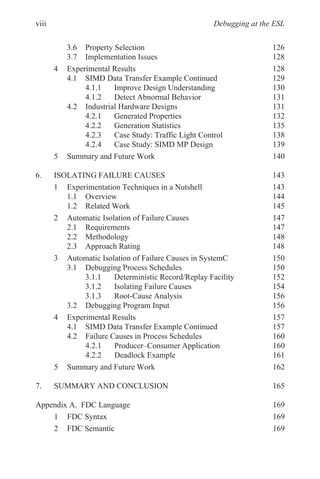
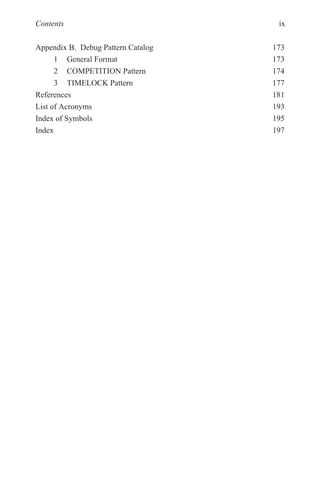

![List of Figures
1.1 Debugging techniques in a simplified ESL design flow 3
1.2 Verification efficiency using only late system level simulation
(chart trend according to [Fos06]) 4
1.3 Improved verification efficiency using static and dynamic
analysis techniques (chart trend according to [Fos06]) 4
1.4 Hierarchy of proposed debugging techniques 5
2.1 Idealized ESL design flow (taken from [BMP07]) 13
2.2 Designing the hardware part of an SoC 14
2.3 TLM notion in an example (taken from [TLM2]) 17
2.4 Reasoning hierarchy in a simplified ESL design flow 29
2.5 General architecture of the SIMD data transfer example 30
2.6 Example of a read/write data transfer sequence
3.1 Early error detection in system models 34
3.2 Structure of a front-end for static analysis 34
3.3 EST for the word “aa_bb_n” 36
3.4 General architecture of REGATTA 42
3.5 Extract of the generic symbol table class hierarchy 45
3.6 Control flow patterns recognized in REGATTA 47
3.7 Algorithm to determine the gen sets for each basic block 48
3.8 Algorithm to determine the kill sets for each basic block 48
3.9 gen and kill sets in an example graph 49
3.10 Algorithm to detect undefined variables (according to
Aho et al. [ASU03]) 49
xi
30](https://image.slidesharecdn.com/840958-250531013100-cb8b32c1/85/Debugging-At-The-Electronic-System-Level-1st-Edition-Frank-Rogin-16-320.jpg)
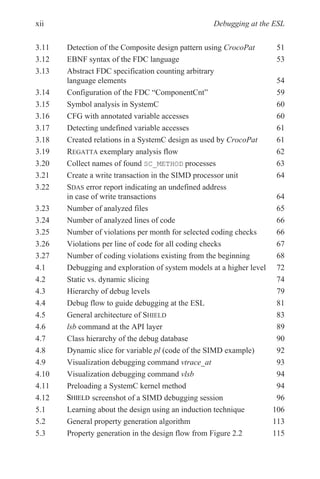
![List of Figures
5.4 DIANOSIS property generation flow 116
5.5 DIANOSIS general architecture 118
5.6 Finite-state machine of the mutual exclusion checker 120
5.7 Property generation example 126
5.8 Example for a property generation report 127
5.9 Efficient storage of signal values 128
5.10 Optimization of the workload 129
5.11 Incompletely inferred Req_Grant1_Grant2 property 134
5.12 Valid binary property candidates for the SATA FIFO 136
5.13 Valid complex property candidates for the SATA FIFO 136
6.1 Automatic isolation of failure causes in system designs 144
6.2 General delta debugging algorithm according to [ZH02] 149
6.3 Isolation of failure-inducing process schedules 152
6.4 Extract of a recorded process schedule 153
6.5 Simple producer–consumer application 155
6.6 Isolating failure-inducing simulation input 157
6.7 Isolate the failure-inducing instruction in program 433 158
6.8 dd algorithm analysis result for Example 24 160
6.9 Architecture of the deadlock example 161
A.1 EBNF syntax of the FDC language 170
B.1 COMPETITION pattern flowchart 175
B.2 Exemplary race condition 176
B.3 TIMELOCK pattern flowchart 178
B.4 Exemplary TIMELOCK pattern 179
xiii](https://image.slidesharecdn.com/840958-250531013100-cb8b32c1/85/Debugging-At-The-Electronic-System-Level-1st-Edition-Frank-Rogin-18-320.jpg)

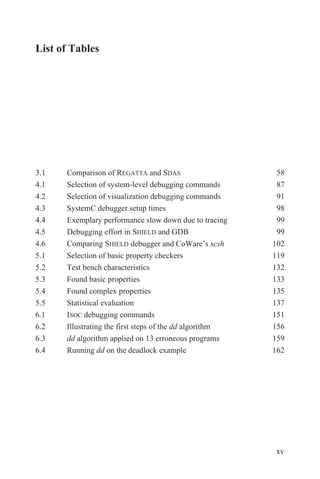



![Chapter 1
Introduction
Modern integrated circuits and systems consist of many different func-
tional blocks comprising multiple heterogeneous processor cores, dedicated
analog/mixed signal components, various on-chip busses and memories,
(third-party) Intellectual Property (IP), and most notably more and more
embedded software. Following “Moore’s Law”, the available chip capacity
grows exponentially. Currently, high-end processor designs reaches up to
2 billion transistors. A complete system can be integrated onto a single chip
which is then called System-on-a-Chip (SoC). The increasing design com-
plexity and scale of SoC designs combined with non-functional requirements
and constraints on the final product, e.g. low power, robustness, reliability,
and low cost, make the verification of the design correctness a complex and
crucial task. Functional errors are still the most important cause of design re-
spins. According to a study from Collett International Research [Cir04] nearly
40% of all chip designs require at least one re-spin. There, 75% of these
designs contain functional or logical bugs. The increasing amount of embedded
software implemented in integrated circuits further complicates verification.
Studies, e.g. [Hum04], implicate that software still contains about 10 to 20
defects per 1,000 lines of code after compiling and testing is done. Remark-
ably, software companies have to spend nearly the same cost and time efforts
on quality assurance like hardware manufacturers have to invest [Tas02].
Today, integrated circuits are mainly designed starting at the Register
Transfer Level (RTL) using classical Hardware Description Languages (HDL)
such as Verilog or VHDL. Studies have shown that up to 80% of the overall
design costs are caused by verification when designing at RTL. The discrep-
ancy between integrable design sizes and the actual verification productivity
causes the so called “verification gap”. This gap increases expo-nentially due
to more and more complex and heterogeneous designs, which cannot be
designed and verified efficiently at RTL anymore. Hence, today the Electronic
Design Automation community is faced with an insufficient and inefficient
approach for the design and the verification of SoCs.
One possible solution is a raising of the abstraction level towards the Elec-
tronic System Level (ESL). The ESL design paradigm has been developed
by the academic and research community over the last years providing new
design methodologies, proper tools, and special system design languages.
F. Rogin and R. Drechsler, Debugging at the Electronic System Level,
DOI 10.1007/978-90-481-9255-7_1, © Springer Science+Business Media B.V. 2010
1](https://image.slidesharecdn.com/840958-250531013100-cb8b32c1/85/Debugging-At-The-Electronic-System-Level-1st-Edition-Frank-Rogin-26-320.jpg)
![Chapter 1 Introduction 3
development stages of the system model in a simplified ESL design flow.
Static analysis starts as soon as first (non-simulatable) modules of the devel-
oped system are available. Removing an error in early development stages is
cheaper and can be done easier. During the ongoing integration of subsystems
to the system model, different simulation-centered dynamic analysis tech-
niques facilitate debugging. They accelerate error search by improving
controllability, observability, and evaluation of the simulation and the simula-
tion results. So, the time between the insertion of an error and its correction is
minimized, finally resulting in a reduced debugging time.
The systematic debugging approach supports the designer in a better utili-
zation of the available debug capacity. To illustrate this fact, Figure 1.2
sketches the ratio between the bug-rate and the available debug capacity in a
verification flow using only a late system level simulation. In contrast,
Figure 1.3 depicts the improved utilization of the available debug capacity if
static and dynamic analysis techniques are used during development, as pro-
posed in this book.
The proposed debugging approach is applicable to any system level design
language, such as SystemC [OSCI] or SpecC [GDPG01], and is independent
of the level of abstraction on which the system model is described. That
means that untimed as well as timed design descriptions could be used. How-
ever, some of the debugging techniques are better suited to a specific level
Figure 1.1: Debugging techniques in a simplified ESL design flow
6LPXODWLRQ
GLUHFWHG
FRQVWUDLQWEDVHG
UDQGRPL]HG
$VVHUWLRQ
EDVHG
9HULILFDWLRQ
)RUPDO
9HULILFDWLRQ
0RGHOKHFNLQJ
7KHRUHP3URYLQJ
6VWHP'HVLJQ
6SHFLILFDWLRQ
+:6:3DUWLWLRQLQJ
6WDWLF
$QDOVLV
6LPXODWLRQ
FHQWHUHG
'QDPLF
$QDOVLV
'HEXJJLQJ9HULILFDWLRQ
7HFKQLTXHV
0RGXOH
6XEVVWHP
,QWHJUDWHG
6VWHP
0RGHO
1RWIXUWKHUFRQVLGHUHG](https://image.slidesharecdn.com/840958-250531013100-cb8b32c1/85/Debugging-At-The-Electronic-System-Level-1st-Edition-Frank-Rogin-28-320.jpg)
![Debugging at the ESL
4
than others. A further focus has been placed on the industrial adaptability of
the proposed techniques in terms of processible design sizes and complexities.
Figure 1.2: Verification efficiency using only late system level simulation
(chart trend according to [Fos06])
Figure 1.3: Improved verification efficiency using static and dynamic analysis techniques
(chart trend according to [Fos06])
0RGXOH 6XEVVWHP ,QWHJUDWHG6VWHP
7LPH
%XJ5DWHDSDFLW
667(0/(9(/
6,08/$7,21
3RVW6LOLFRQ
7HDP¶V'HEXJDSDFLW %XJ5DWH
7DSH2XW
1RWH%DVHGRQVXUYHRI$6,6R'HVLJQ)LUPV
0RGXOH 6XEVVWHP ,QWHJUDWHG6VWHP
7LPH
%XJ5DWHDSDFLW
6,08/$7,21
3RVW6LOLFRQ
7HDP¶V'HEXJDSDFLW %XJ5DWH
7DSH2XW
'1$0,
$1$/6,6
67$7,
$1$/6,6
1RWH%DVHGRQVXUYHRI$6,6R'HVLJQ)LUPV](https://image.slidesharecdn.com/840958-250531013100-cb8b32c1/85/Debugging-At-The-Electronic-System-Level-1st-Edition-Frank-Rogin-29-320.jpg)
![Chapter 1 Introduction 5
2 SUMMARY OF CONTRIBUTIONS
Figure 1.4 correlates the introduced debugging techniques forming a hier-
archy of co-ordinated reasoning techniques. The techniques accompany the
development stages of a system model starting with deduction, i.e. early error
detection, followed by observation, i.e. high-level debugging and exploration,
next followed by induction, i.e. learning about the design, and closing with
experimentation, i.e. isolating failure causes. The diagram in Figure 1.4 sys-
temizes the utilization of each technique according to a set of defined
preconditions for their application. These preconditions focus on the imple-
mentation progress while developing the system model. In contrast, the
applicability of a particular debugging technique does not depend on the tar-
get architecture (e.g. processor, microcontroller), the communication design
(e.g. bus, protocol, memory-mapped), the system level design language (e.g.
SystemC, SpecC), or the abstraction level (e.g. untimed, timed). The imple-
mentation progress is judged by three classification criteria, i.e. the reached
Figure 1.4: Hierarchy of proposed debugging techniques
(DUO
(UURU'HWHFWLRQ
+LJKOHYHO
'HEXJJLQJDQG([SORUDWLRQ
/HDUQLQJ
DERXWWKH'HVLJQ
,VRODWLQJ
)DLOXUHDXVHV
6LPXODWLRQ
5XQV
RGLQJ
/HYHO
5HDOL]DWLRQ
/HYHO
VLPXODWDEOH
FRQWUROOHG
VLPXODWDEOH
,QWHJUDWHG
6VWHP
6XEVVWHP
Q
0RGXOH
VQWDFWLF
FRUUHFW
6WDWLF7HFKQLTXH
'QDPLF7HFKQLTXHV](https://image.slidesharecdn.com/840958-250531013100-cb8b32c1/85/Debugging-At-The-Electronic-System-Level-1st-Edition-Frank-Rogin-30-320.jpg)
![Debugging at the ESL
6
realization level, the number of needed simulation runs, and the achieved
coding level:
„ Realization level. This level describes the degree of model complete-
ness that distinguishes between modules, subsystems, and the inte-
grated system.
„ Simulation runs. A different number of simulation runs allows to
apply different debugging techniques.
„ Coding level. The coding level defines whether a simulation and
which type of simulation (uncontrolled vs. controlled) is needed to
use a particular debugging technique.
Using the presented diagram in Figure 1.4, the system designer can deter-
mine which techniques are applicable at the current modeling state. At the
beginning of the development, static analysis can be applied to first syntacti-
cal correct design modules. There, a module does not necessarily have to be
executable and thus simulatable. Bit by bit, the realization level increases and
the system model becomes more complex and complete. Modules are integra-
ted to subsystems, and finally the model is completed at the actual abstraction
level. Once, first components of the model can be simulated, dynamic analysis
techniques enhance the analysis capabilities to locate and fix bugs that cannot
be found statically, otherwise.
„ Early error detection. An analysis framework, called REGATTA, facil-
itates the flexible and fast generation of tools that statically analyze
source code of arbitrary formal languages. The code quality is ensured
by coding standards. Design flaws can be detected using more sophis-
ticated analysis features, e.g. by using dataflow analysis techniques.
Parts of this work were presented in [RF04], [RFSH05]. Based upon
Example 1. We assume the designer has coded an simulatable subsystem of
the system model and wants to simulate (execute) it for the first time. Accord-
ing to Figure 1.4, two techniques, i.e. ‘early error detection’ and ‘high-level
debugging and exploration’, are applicable.
The proposed debugging techniques contribute to a systematic verification
process of ESL designs. Each technique is prototypically realized in a
demonstrates the particularities and strengths of each technique:
SystemC-based design flow and is (mostly) evaluated in the field using
industrial examples. Moreover, an example, that is used throughout the book,](https://image.slidesharecdn.com/840958-250531013100-cb8b32c1/85/Debugging-At-The-Electronic-System-Level-1st-Edition-Frank-Rogin-31-320.jpg)
![Chapter 1 Introduction 7
the REGATTA framework a static analyzer for SystemC, called SDAS,
implements an industrial set of coding guidelines.
„ High-level debugging and exploration. A debug flow guides the
designer in debugging and exploration of system models at a higher
abstraction level. Based upon open source tools and standards, an
integrated debugging environment, called SHIELD, is proposed. It
allows to debug arbitrary SystemC designs systematically. The papers
[RFHO07], [RF+07], [RGDR08] are closely related to this chapter.
„ Learning about the design. A new methodology automatically gener-
ates complex design properties for a simulatable system model using
simulation traces. A prototypical tool, called DIANOSIS, deduces such
properties. Complex properties improve design understanding, can be
used as a starting point for formal verification, help to identify gaps in
the test suite, and ease error detection. In [RK+08], [RK+09] parts of
this chapter were published.
„ Isolating failure causes. Using a series of controlled simulation runs
allows to isolate the failure-inducing cause automatically in an erro-
neous system model. A prototype tool, called ISOC, adapts this auto-
mated debugging technique to SystemC, in order to narrow down
failure causes in process schedules. A further application is the isola-
tion of the minimal failure-causing difference in the simulation input.
The paper [RDR09] is closely related to this chapter.
This book proposes an integrated approach that assists the designer in a
systematic verification at the ESL. It combines and adapts existing and new
debugging techniques. The techniques improve and accelerate error detection,
observation, and isolation as well as design understanding. Hence, their con-
tinued application minimizes the number of errors that escape to the next
development stage.
3 BOOK OUTLINE
This book is structured as follows:
In Chapter 2, the state-of-the-art of ESL modeling and verification is
reviewed. Moreover, the system description language SystemC and a Sys-
temC TLM2 example design, that is used throughout the book, are introduced.
The rest of the book discusses each of the debugging techniques in a sepa-
rate chapter. Each chapter starts with the classification of the respective
technique followed by a summary of the related work in the particular field.](https://image.slidesharecdn.com/840958-250531013100-cb8b32c1/85/Debugging-At-The-Electronic-System-Level-1st-Edition-Frank-Rogin-32-320.jpg)
![Chapter 2
ESL Design and Verification
First, the state-of-the-art of modeling and verification at the ESL is briefly
summarized in this chapter. As SystemC has been developed as a de-facto
standard for system level design over the past few years, it is used for practical
demonstration purposes in this book. Next, the introduced ESL methodolo-
gies and techniques are discussed under the SystemC perspective. Finally, our
systematic debugging approach for ESL designs is described.
1 ESL DESIGN
The rising “design gap” demands for continuous improvements of the
design productivity. One of the most critical issues is, how the available chip
have to develop even more complex integrated circuits and systems under
fixed time-to-market and quality constraints. According to the ITRS report
[ITRS07], a designer has a productivity of 125k gates per design-year using a
state-of-the-art RTL-centered design and verification methodology. Here,
designers describe an integrated circuit with an HDL (e.g. Verilog or VHDL)
at RTL. There, the design is (almost) automatically synthesized down to circuit
tool suites are applied using techniques such as tracking and reporting infor-
mation about the code coverage, or performing a constraint random simulation.
Now, we naively assume that a 10 million gates circuit shall be created
from scratch. If the above mentioned design productivity of 125k gates is
taken into account, 80 designers have to work for one year to complete the
integrated circuit. Even more complex systems would require an unacceptable
high number of designers or an improper long design time. Moreover, time-
to-market, and rising cost and quality constraints demand for a new modeling
and verification methodology.
Two basic approaches could help to improve the design productivity: The
first one lifts the design level to a higher more abstract level above RTL. The
second approach introduces a design reuse methodology by means of (third-
party) IP components. Modern flows combine both approaches to maximize
benefits.
F. Rogin and R. Drechsler, Debugging at the Electronic System Level, 9
DOI 10.1007/978-90-481-9255-7_2, © Springer Science+Business Media B.V. 2010
capacity, following Moore’ s Law, can be utilized by the chip designers. They
layout ready for fabrication. On the verification side, sophisticated verification](https://image.slidesharecdn.com/840958-250531013100-cb8b32c1/85/Debugging-At-The-Electronic-System-Level-1st-Edition-Frank-Rogin-34-320.jpg)
![Debugging at the ESL
10
Designing above RTL is called ESL design. Generally, abstraction aims at
the reduction of the effort to specify a desired functionality whereas unneces-
sary information is omitted. At the ESL designs are described by using higher
level concepts such as communicating processes exchanging more abstract
information. Here, the accurate timing or the parallelization of system func-
tionality is not initially taken into account. In fact, the designer starts to
specify the general function of the system and successively refines the specifi-
cation until the concrete system, consisting of hardware and software, is fully
implemented. Today, ESL design is supported by different SDLs where
C/C++-based programming languages play a major role.
IP reuse is an important opportunity to improve the design productivity.
The number of blocks to be defined from scratch becomes smaller if the
designer can reuse existing IP components. IP blocks are taken either from
former development projects or by using external IP providers. IP shall fulfill
a number of requirements to enable a successful reuse. First, they should be of
high-quality in terms of correctness and completeness. Second, the IP compo-
nent interfaces have to be clearly defined and documented. Third, IP blocks
should separate communication from behavioral parts to ease the integration
into an existing design architecture.
1.1 ESL Design Flow
Currently, in the literature no universal design and verification flow for
ESL design is documented. Rather, many different flow variants are stated.
They are geared by customer and product requirements. The flow variants dis-
tinguish among each other by means of the introduced abstraction levels, use
cases, and later application fields. The following section gives a short over-
view about important work that deal with the ESL design methodology.
Baileys et al. [BMP07] give a comprehensive summary.
According to Gajski et al. [GV+94] the general ESL flow can be described
by the three main steps: specifying, exploring, and refining. First of all, a
functional specification of the desired system is developed. During the subse-
quent exploration phase, different design alternatives are compared in order to
meet various requirements, e.g. performance, power consumption, or configu-
rability. In the refinement phase more and more functional behavior is
mapped onto a structural description consisting of hardware and software
components. Subsequent refinement steps repeat exploration and refinement
phases until the whole system is structurally specified. All other mentioned
approaches adhere to this general procedure.
Kogel [Kog06] refers to use cases in terms of views to overcome the diffi-
culties to specify an ESL flow at the level of abstractions. ESL modeling
gears to many different domains, e.g. communication, time, structure, or](https://image.slidesharecdn.com/840958-250531013100-cb8b32c1/85/Debugging-At-The-Electronic-System-Level-1st-Edition-Frank-Rogin-35-320.jpg)
![Chapter 2 ESL Design and Verification 11
behavior. Each domain can be described at particular levels of abstraction,
e.g. the communication behavior can be modeled as transactions, bus func-
tional models, or pin-accurate descriptions. Kogel concentrates on the
purpose of the model by defining use cases. The Functional View (FV) use
case is intended to create an executable specification of the application. The
Architects View (AV) use case targets to the architectural exploration of the
developed system to meet the desired requirements such as performance,
power, or maintainability. The Programmers View (PV) use case provides a
virtual prototype platform which could be applied for early embedded soft-
ware development in parallel to the hardware design. Finally, the Verification
View (VV) use case targets at cycle-accurate system modeling. So, an accu-
rate performance evaluation prior to the design implementation or a TLM-
RTL co-verification can be performed.
Teich and Haubelt [TH07] introduce an approach which summarizes
important abstraction levels and views. These levels and views are passed
during embedded system design. This approach distinguishes between archi-
tecture and logic abstraction levels in case of hardware designs. The block and
module levels describe abstraction levels in the software development
domain. Beside the classification of system models according to their levels
of abstraction, two orthogonal views are defined. The behavioral view takes
only the functionality of the system into account while the structural view
details the communication between hardware and software components.
The SystemC TLM2 standard [TLM2] does not focus on abstraction
levels. In fact, the standard mentions particular use cases, such as software
development, software performance analysis, or hardware architecture analy-
sis. These use cases are supported by two different coding styles, i.e. loosely-
timed, and approximately-timed. Coding styles guide the designer in model
writing using particular programming interfaces.
Fujita et al. [FGP07] document a design flow for system level designs
based on C/C++-based system level languages. Starting with a textual specifi-
cation an executable specification, mostly in terms of a program, is created.
The resulting functional system model describes the general application and is
mainly used to explore different functional design alternatives. During the
architecture design phase, also known as hardware/software partitioning, the
designer decides which functionality is implemented either into dedicated
hardware components or software programs. Software plays an important role
to allow for reusability, i.e. easy reuse of software components in terms of IP,
maintainability, i.e. easy bug fixing and feature extension in the application
field, and flexibility, i.e. easy replacement of software components. The exact
communication between partitioned components, including processing order
and parallelism, is detailed in the subsequent communication design phase](https://image.slidesharecdn.com/840958-250531013100-cb8b32c1/85/Debugging-At-The-Electronic-System-Level-1st-Edition-Frank-Rogin-36-320.jpg)
![Debugging at the ESL
12
resulting in the communication model. The software is usually implemented
using a standard software development process. However, the functions that
are assigned to hardware parts are further decomposed into structural units to
take the target hardware platform into account. Finally, within the implemen-
tation design phase, the hardware parts of the communication model are
synthesized into an RTL design using high-level ESL synthesis techniques.
Several tools automate this step. Nevertheless, in practice it is usually still a
manual or at most a semiautomatic step. Finally, the RTL design is imple-
mented which comprises well automated steps such as logic or layout
synthesis. The developed software descriptions can be directly extracted from
the communication model and are compiled into executable machine code.
Bailey et al. [BMP07] published one of the first books that summarizes
state-of-the-art in ESL design and verification methodology. One important
contribution is the definition of a taxonomy for the ESL design space and the
definition of common terms used in this domain. The proposed ESL taxon-
omy contains the five axes concurrency, communication, configurability,
temporal, and data. This taxonomy spans a space for the definition and classi-
fication of ESL specification languages, design flows, and tools. Bailey et al.
divides the ESL design flow into six main development steps: specification
and modeling, pre-partitioning analysis, partitioning, post-partitioning anal-
ysis and debug, post-partitioning verification, and HW/SW implementation. In
the specification and modeling step the designer translates the initial informal
specification document successively into various executable models. During
the pre-partitioning analysis step, the algorithmic design space is explored
taking different constraints into account, e.g. time, space, power, complexity,
or time-to-market. The partitioning process defines which parts of the func-
tionality are implemented either in software or hardware. The effect of
hardware/software partitioning is explored in the post-partitioning analysis
and debug step. If necessary, a re-partitioning takes place to better meet the
requirements. Then, the following post-partitioning verification step ensures
that the originally intended behavior of partitioned software and hardware
components is preserved. Finally, the HW/SW implementation step creates
synthesizable RTL models as well as the productive software that shall run on
the target hardware.
Summarized, all aforementioned work can be mapped more or less to the
idealized ESL design flow sketched in Figure 2.1. Rather than this idealized
and simplified linear top-down flow, a real flow is a mixture of bottom-up and
top-down procedures. Moreover, the development of an integrated system
consists of many refinement steps and backtracking paths that shall be not fur-
ther detailed here. In reality, parts of the model are usually implemented at
different abstraction levels at the same time. So, some parts could be specified](https://image.slidesharecdn.com/840958-250531013100-cb8b32c1/85/Debugging-At-The-Electronic-System-Level-1st-Edition-Frank-Rogin-37-320.jpg)
![Chapter 2 ESL Design and Verification 13
at a more structural level while other parts are initially described at the behav-
ioral level. The model can also contain loosely-timed specified components as
well as cycle-accurate blocks in parallel. Nevertheless, a designed system
always passes different levels of abstraction starting from the most abstract
specification. Then, this specification is successively refined to the lowest
most accurate level.
Figure 2.2 illustrates the design levels while implementing the hardware
parts of a SoC design. It shows an idealized top-down procedure following a
SystemC TLM oriented design methodology:
Starting with a textual specification, the algorithmic design is specified.
Thus, the basic functionality of the developed system is explored while the
distinction between hardware and software components as well as the timing
is not yet taken into account.
Based upon the algorithmic specification, the design is refined to a TLM-
based system model. The model consists of different blocks that are con-
nected by communicating channels. Channels are used to exchange data
between these blocks in terms of transactions. During development, the sys-
tem is normally refined using different timing levels. At the loosely-timed
level, the system model consists of functionally accurate components describ-
ing the system platform. Synchronization between components is only sup-
ported at a coarse-grained synchronization level specifying the general sched-
uling procedure, e.g. the correct order between produced and consumed data.
Figure 2.1: Idealized ESL design flow (taken from [BMP07])
6VWHP'HVLJQ
,3 ,3
+:6:3DUWLWLRQLQJ
6RIWZDUH'HVLJQ +DUGZDUH'HVLJQ
6RIWZDUH'HYHORSPHQW +DUGZDUH,PSOHPHQWDWLRQ
,QWHJUDWLRQ
3KVLFDO'HVLJQ
6SHFLILFDWLRQ](https://image.slidesharecdn.com/840958-250531013100-cb8b32c1/85/Debugging-At-The-Electronic-System-Level-1st-Edition-Frank-Rogin-38-320.jpg)
![Debugging at the ESL
14
Moreover, communication channels are used for synchronization purposes,
e.g. to handle interrupt signals. The loosely-timed abstraction level is the basis
for early embedded software development and debugging where unnecessary
implementation details are left out. The aforementioned PV use case relates to
models at this level. At the next level, i.e. approximately-timed, the timing is
refined which enables a preliminary performance estimation and a coarse
power analysis. A model at this level is available earlier than the RTL model
and can facilitate reasonable design decisions for the later RTL design. This
abstraction level corresponds to the PV plus Timing use case. A cycle-accurate
model describes the design behavior at the level of clock cycles. This abstrac-
tion level is used e.g. for final HW/SW partitioning, HW/SW co-verification,
or a TLM-RTL co-simulation.
Transferring a system model into an RTL design is accompanied by a
change of the design language. While system models are described using an
SDL such as SystemC or SpecC, RTL designs are usually implemented using
HDLs such as VHDL or Verilog. An RTL design contains all details of the
hardware components and can be automatically and efficiently synthesized.
Hardware synthesis comprises the design implementation, such as logic or
layout synthesis, and is well supported by state-of-the-art tools and design
flows. Detailed information to hardware design and synthesis can be found for
instance in [Ash06], [Pal03].
Figure 2.2: Designing the hardware part of an SoC
7/0
'HVLJQ
$OJRULWKPLF'HVLJQ
57/'HVLJQ
/RRVHOWLPHG
$SSUR[LPDWHOWLPHG
FOHDFFXUDWH
'HVLJQ,PSOHPHQWDWLRQ
/HYHORI
$EVWUDFWLRQ
6SHFLILFDWLRQ](https://image.slidesharecdn.com/840958-250531013100-cb8b32c1/85/Debugging-At-The-Electronic-System-Level-1st-Edition-Frank-Rogin-39-320.jpg)
![Chapter 2 ESL Design and Verification 15
1.2 System Level Language SystemC
C/C++-based languages have been playing a major role in embedded soft-
ware development for a long time. So, it was apparent to use the same or some
similar language to specify the hardware parts of an ESL design and to write
test benches, as well. However, C/C++ do not provide constructs to deal with
concurrency, communication, or timing necessary for designing hardware.
Several extensions were proposed over the past few years to make C/C++
ready to be used in ESL design. Today, two C/C++-based SDLs are mainly
used: SystemC and SpecC. Both languages provide similar language con-
structs for hardware design. The major difference is the underlying language.
While SpecC bases upon C, SystemC is a C++ class library. Hence, SystemC
has an object-oriented nature which facilitates the implementation of abstract,
modular, and reusable system models. SpecC as well as SystemC are freely
available which ease their application and distribution. Additionally, IEEE
approved SystemC as a standard in 2005 [IE+06] which has increased the
acceptance of this language in industry. The standardization process has been
significantly driven by the OSCI. In this book, SystemC is used for demon-
stration purposes. However, the proposed debugging technique are applicable
to any other system level language.
SystemC extends C++ by notions of modules, concurrent processes, simu-
lation time, and communication mechanisms. These features support ESL
design while comprising the full power of C++. A SystemC design is created
by a hierarchy of (nested) modules which are instances of the class sc_module.
Modules communicate through ports, interfaces, and channels. An interface
provides several methods to access a channel whereas the methods are called
through a port. A channel separates communication and computation. SystemC
provides a number of predefined channel types ranging from simple wires to
more complex communication mechanisms like FIFOs. Furthermore, design-
ers can derive their own channel types. The main elements of computation are
represented by concurrent processes that are either method (SC_METHOD) or
thread processes (SC_THREAD). A process has to be specified inside a mod-
ule. A thread process terminates never and suspends its computation by
calling a wait statement. In contrast, a method process completely executes
in zero time, every time it is triggered.
An integral part of the SystemC library is the event-driven simulation ker-
nel which implements a cooperative multitasking approach and divides in two
main phases:
„ Elaboration. Execution starts at the sc_main function. First, all
modules are instantiated and bound together. After this phase a fur-](https://image.slidesharecdn.com/840958-250531013100-cb8b32c1/85/Debugging-At-The-Electronic-System-Level-1st-Edition-Frank-Rogin-40-320.jpg)
![Debugging at the ESL
16
ther change of the model structure is not possible. Then, the call of
sc_start launches the simulation.
„ Simulation. During simulation the SystemC kernel executes each run-
nable process one by one in a non-preemptive fashion. A process sus-
pends again either when it was completely processed (method
process) or the process calls a time consuming statement (thread pro-
cess). There, the SystemC simulation kernel works like an HDL sim-
ulator using the notion of delta cycles. A delta cycle is orthogonal to
the simulation time where the time is only advanced, when no more
processes are runnable at the current time step, i.e. at the current delta
cycle. The use of delta cycles emulates the parallel execution of pro-
cesses. A process, running at the current delta cycle, can wake up
other processes through an immediate event. Another variant is a sig-
nal update which will be executed during the next delta cycle. Again,
these processes can trigger further ones at the subsequent delta cycle.
A detailed introduction into SystemC is given in the SystemC Language
Reference Manual [IE+06] or can be found in [BDBK08].
1.3 Transaction Level Modeling in SystemC
With the publication of the OSCI TLM2 standard in 2008 [TLM2], Sys-
temC took a major step forward to facilitate early system exploration, co-
design of hardware and software, and platform-based design and verification.
Moreover, a TLM modeling style improves the reusability of IP components
between different IP providers. A standardized Application Programming
Interface (API) allows the separation of computation inside components from
the communication among components. The communication is modeled by
channels where a transaction is released by calling interface methods of the
channel. Unwanted communication details are hidden in the channels that are
iteratively refined during modeling. Hence, system design starts with an
abstract TLM description which enables a faster simulation as a comparable
but more detailed RTL model. A predefined TLM interface is implemented by
a high-level communication model initially describing only the exchange of
messages or data between components. During development, the same inter-
face can be implemented by a cycle-accurate Bus Functional Model (BFM)
specifying the behavior of each pin later implemented in hardware. A BFM
enables the designer to write test cases in terms of abstract method calls at
TLM level. Then, the BFM translates the method call into particular input
stimuli at the RTL site.](https://image.slidesharecdn.com/840958-250531013100-cb8b32c1/85/Debugging-At-The-Electronic-System-Level-1st-Edition-Frank-Rogin-41-320.jpg)
![Chapter 2 ESL Design and Verification 17
The SystemC TLM2 standard distinguishes between coding styles and
interfaces instead of defining abstraction levels for each particular use case. A
use case can be for instance software development, software performance
analysis, or hardware verification. The coding styles guide the designer in
system modeling where the interfaces define low-level programming mecha-
nisms. The TLM2 standard defines two coding styles: loosely-timed, and
approximately-timed that are supported by particular blocking and non-block-
ing transport interfaces. Figure 2.3 documents an exemplary TLM design.
A module can act in three different ways:
„ Initiator. This module type creates new transactions and passes them
to the channel by calling a predefined interface method.
„ Target. A module of this type receives transactions and executes them
according to the target module task.
„ Interconnect. This component type forwards a transaction and possi-
bly modifies it. So it acts as initiator and target at the same time.
The transportation path of a transaction that is going from an initiator to a
target, is also called the forward path. The opposite direction is named the
backward path. Over the backward path, the target informs the initiator about
the transportation state. Either the modified transaction object is returned or a
specific backward method is called explicitly. Two socket types encapsulate
the connection between components. The initiator socket enables interface
calls on the forward path by a port and on the backward path by an export.
The target socket offers the same mechanism in case of a backward path. For
a complete documentation of the TLM2 standard refer to [TLM2]. A compre-
hensive overview about the state-of-the-art of TLM design in SystemC can be
also found in [Ghe06].
Figure 2.3: TLM notion in an example (taken from [TLM2])
,QLWLDWRU
0RGXOH
,QWHUFRQQHFW
RPSRQHQW
7DUJHW
0RGXOH
)RUZDUG
3DWK
)RUZDUG
3DWK
%DFNZDUG
3DWK
,QLWLDWRU
6RFNHW
7DUJHW
6RFNHW
,QLWLDWRU
6RFNHW
7DUJHW
6RFNHW
7UDQVDFWLRQ
2EMHFW
%DFNZDUG
3DWK
5HIHUHQFHVWRWKHWUDQVDFWLRQREMHFW](https://image.slidesharecdn.com/840958-250531013100-cb8b32c1/85/Debugging-At-The-Electronic-System-Level-1st-Edition-Frank-Rogin-42-320.jpg)
![Chapter 2 ESL Design and Verification 19
tion environment. Such a verification approach is applicable to find system-
wide problems instead of verifying the correct function of a particular hard-
ware block. It is also known as golden reference model verification where the
system model defines the specification for the hardware components.
System correctness can be ensured by two different approaches: dynamic
techniques, i.e. simulation, and static techniques, i.e. formal verification. In
between, there is a third approach, that combines simulation and formal veri-
fication using assertions. It is called semi-formal verification. Moreover, there
are further verification techniques, such as prototyping or emulation, but these
techniques shall not be discussed in this book.
2.1 Simulation
Simulation is still the predominant verification technique in system and
hardware design. It is easy to use, scales very well with arbitrary complex
designs, and detects many functional errors very efficiently. As soon as an
executable specification is available, it can be simulated easily. Besides the
check of functional correctness, simulation is used to identify performance
problems, inconsistencies, or specification holes. Apart from these advan-
tages, the complexity of current designs prevents an exhaustive simulation to
prove system correctness in a limited time [ARL00], [ITRS07]. Here, an
increasing number of state variables let exponentially rise the number of input
patterns, and thus the number of required simulation runs. So, the quality of
simulation-based approaches highly depends on the quality of available input
patterns to gain a satisfying coverage of the design functionality. Due to its
incompleteness simulation is also named validation.
2.2 Formal Verification
To overcome the limitations of simulation, formal verification techniques
were developed [Kro99]. Formal verification proves the correctness of a sys-
tem using a mathematical model of the system behavior. This technique is
exhaustive, and thus ensures correctness. Three different approaches are used
in formal verification: theorem proving [WOLB92], equivalence checking
[KPKG02], and model checking, also called property checking [CGP00].
In theorem proving the verified system (the implementation) and the spec-
ification are described in a higher-order logic. With the help of axioms and
inference rules, a theorem prover supports the designer in reasoning that the
implementation implies the specification. Since higher-order logics are gener-
ally undecidable, a fully automated proving is not possible. The required
manual intervention has prevented a widespread application of theorem prov-
ing in the industrial field, so far.](https://image.slidesharecdn.com/840958-250531013100-cb8b32c1/85/Debugging-At-The-Electronic-System-Level-1st-Edition-Frank-Rogin-44-320.jpg)
![Debugging at the ESL
20
Equivalence checking verifies the equivalence between implementation
and specification. Normally, this technique verifies the correctness of (auto-
matic) synthesis steps, e.g. by proving the equivalence between an RTL
design and the synthesized gate level description. A common approach uses a
miter circuit where two automata representations, one for the implementation
and one for the specification, are combined. Then, the outputs are checked for
equivalence while feeding in the same input data [Bra83]. The equivalence
checking problem can be solved by transforming the miter circuit into a SAT
instance. Today, equivalence checking enjoys a wide distribution in semicon-
ductor industry especially due to its good automation and easy handling.
Model checking bases upon a finite state space model of the verified sys-
tem, e.g. a labeled transition system or a finite state machine. The specifica-
tion is formulated in terms of a set of properties in some temporal logic. Then,
a model checker formally proves the validity of each (possibly unbounded)
property on the model. Bounded Model Checking (BMC) limits the number of
time frames a property is checked. Since a system usually responds after a
finite time limit, BMC is quite efficient. It is successfully applied in the semi-
conductor industry, e.g. [BB+07]. A restriction of model checking is the
limitation of a straightforward model translation (design abstraction) for large
designs due to the so called state space explosion problem. Assuming that an
example design consists of many thousand lines of code and for instance
5,000 32 bit integer variables. In that case, a Boolean reasoning technique has
to handle 5,000 * 32 = 160,000 Boolean signals over many thousand program
states. This is a potentially infeasible number to be currently handled by for-
mal verification tools. Hence, classical model checking cannot verify arbitrary
complex systems. New approaches try to use sophisticated abstraction tech-
niques to handle the state explosion problem. Satisfiability Modulo Theories
(SMT) solvers [NOT06] process word-level information directly. Another
problem of model checking results from verifying only an abstracted model of
the design. Hence, an erroneous abstraction process can produce false nega-
tives as well as false positives. Moreover, a wrong specification could show
that the system works as specified, but not as primarily intended. Finally,
there are problematic structures, such as multipliers, that cannot be formally
verified easily.
2.3 Semi-Formal Verification
Semi-formal verification combines simulation (see Section 2.1 on page 19)
and formal verification (see Section 2.2 on page 19) and is also known as
Assertion-Based Verification (ABV) [FKL03]. Assertions are temporal prop-
erties that concisely capture design intent. They are dynamically monitored
during simulation. Two languages gain importance for applying ABV tech-](https://image.slidesharecdn.com/840958-250531013100-cb8b32c1/85/Debugging-At-The-Electronic-System-Level-1st-Edition-Frank-Rogin-45-320.jpg)
![Chapter 2 ESL Design and Verification 21
niques and allow the exact description of temporal-logic expressions:
SystemVerilog Assertions (SVA) [IE+05a] and the Property Specification
Language (PSL) [IE+05b]. To enable a fast and easy creation of an ABV test
suite, the Open Verification Library (OVL) [OVL] captures typical design
behavior in terms of assertion checkers.
ABV does not prove the specified property like in formal verification. For
this reason, ABV can be applied to arbitrary complex designs. Additionally,
assertions improve design observability, and thus facilitate the debugging pro-
cess. In case of an error, an assertion directly points to the location the
problem was recognized. This approach is also called white-box verification
instead of the simulation oriented black-box approach. In simulation the
response of a system is checked for correctness only at the output interfaces.
2.4 Verifying SystemC Models
SystemC only supports simulation natively while formal and semi-formal
verification approaches are subject to current research. The following section
summarizes important work in the particular fields.
2.4.1 Simulation in SystemC
The simulation-based validation is inherently supported by SystemC.
Every standard C++ compiler, e.g. the GNU C++ compiler, is able to compile
an arbitrary SystemC description into an executable program. Such a program
can be directly simulated since the simulation kernel is an integral part of the
SystemC library.
The processing of a SystemC simulation is particularly influenced by the
style of coding. Several coding styles allow a different modeling of communi-
cation and synchronization between concurrent processes. SystemC FIFOs
and semaphores introduce communication and synchronization points into the
application. This style is formalized by Communicating Sequential Processes
and Kahn Process Networks. It permits a completely untimed modeling style
without the need for advancing the time during simulation. A coding style
where each process yields control at a certain point in time is called timed.
There, different timing levels can be distinguished such as loosely-timed,
approximately timed, or cycle-accurate. A timed coding style is supported in
SystemC by explicit synchronization statements.
Simulation uses directed or randomized tests to compare the expected
results with the observed system behavior. A directed test validates only a
very certain functionality by using an explicitly specified stimulus pattern.
Usually, it is manually written by the designer which is a time-consuming and
erroneous task. A major improvement in test bench automation was achieved](https://image.slidesharecdn.com/840958-250531013100-cb8b32c1/85/Debugging-At-The-Electronic-System-Level-1st-Edition-Frank-Rogin-46-320.jpg)
![Debugging at the ESL
22
by the introduction of constraint-based random simulation [YPA06]. Based
on a set of user-defined constraints, stimulus patterns are generated automati-
cally. Hence, in a short time many more scenarios can be created and tested if
compared to directed tests especially in case of corner cases. Constraint ran-
dom simulation is supported in SystemC by the SystemC Verification Library
(SCV) [SCV]. Moreover, this library provides other sophisticated verification
features such as transaction recording and monitoring, or data introspection
capabilities for arbitrary data types. Some work extents the SCV library.
Große et al. [GED07] add bit operators and improve the integrated constraint
solver to guarantee a uniform distribution of constraint solutions. Another
work [GWSD08] introduces an approach that resolves contradictions between
constraints automatically.
Based upon the SCV, various work propose verification frameworks or
methodologies which allow for an easy, fast, and reusable simulation-cen-
tered functional verification of SystemC designs, e.g. [SMA04], [PC05].
These frameworks provide a unique verification infrastructure. They facilitate
test bench creation and adaptation to a new design under verification, supply
sophisticated coverage mechanisms, or integrate a constraint-random stimulus
generator.
Functional code coverage techniques allow the designer to control simula-
tion effort. Here, metrics provide a basis for decision in order to determine
whether a SystemC design was simulated sufficiently. Various metrics mea-
sure code coverage using branch, statement, or condition coverage for
instance. Traditional software metric tools for C++, such as gcov [GCOV],
can be also applied to SystemC. The drawbacks of these tools are amongst
others that coverage analysis also includes the SystemC kernel library rou-
tines. Furthermore, a C++ coverage tool does not know the SystemC
semantics which requires a manual and tedious extraction of interesting cov-
erage data. Große et al. [GPKD08] propose an approach that measures the
quality of SystemC test benches in terms of a control flow metric. Therefore,
an instrumented SystemC description collects coverage information during
simulation. Subsequently, coverage information are analyzed whether the
defined coverage goal has been already reached.
2.4.2 Semi-Formal Verification in SystemC
Since the SystemC standard does not define a native support for ABV,
various approaches propose an integration of assertions into SystemC.
One of the first approaches was introduced by Ruf et al. [RHKR01]. It
uses finite linear temporal logic to specify properties. These properties are trans-
lated into a special kind of finite-state machine, i.e. a monitor, in a preprocessing](https://image.slidesharecdn.com/840958-250531013100-cb8b32c1/85/Debugging-At-The-Electronic-System-Level-1st-Edition-Frank-Rogin-47-320.jpg)
![Chapter 2 ESL Design and Verification 23
phase. During simulation a monitor dynamically checks simulation behavior
and reports each violation immediately.
The integration of SVA into SystemC is proposed by Habibi and Tahar
[HT04]. An SVA expression is translated into an external SystemC module.
This module acts as a monitor to all signals involved in the formulated asser-
tion. Using the symbol table of a compiled SystemC design allows to connect
the external monitor component with the design automatically. A so called
design updater modifies the SystemC code in order to link design code and
assertion monitor. During simulation, all SVA expressions are checked on-
the-fly. A subsequent work [HT06] presents a model-driven design approach.
Here, properties are modeled by extending UML sequence diagrams in order
to check transaction properties of a SystemC TLM design. Therefore, the
UML model of a PSL property is translated to an Abstract State Machine
(ASM) description. Then, the ASM description is checked against the Sys-
temC model which has to be available as an ASM model, as well. Both
models are further translated to SystemC code where the property is compiled
into a C# monitor.
Große and Drechsler [GD04a] present a method where a property (asser-
tion) is translated into a synthesizable SystemC checker. The checker is
embedded into the original SystemC description. Due to the synthesizable
characteristics of checkers, they can be also evaluated after fabrication of the
system.
Bombieri et al. [BFF05] evaluate the adoption of PSL to a SystemC-based
TLM verification flow. They distinguish between two techniques, “properties
re-use” and “properties refinement”. Properties re-use is utilized to ensure the
functional equivalence of two different SoC descriptions. Properties refine-
ment denotes the process of translating a PSL property, written for a more
abstract design block, to the refined block. There, the PSL to SystemC
checker translation is based upon the approach described in [DG+05].
Niemann and Haubelt [NH06] allow the concise formulation of assertions
for TLM designs by using SVA expressions and interpret transactions as
Boolean signals. To prevent a modification of the original source code, an
aspect-oriented programming technique is used. Hence, transaction recording
statements are weaved into the original SystemC design applying the
AspectC++ compiler presented in [SLU05]. Then, the instrumented code is
compiled and simulated. Transaction activity is written into a Value Change
Dump (VCD) trace file. Subsequently, the VCD file is translated into a Ver-
ilog module which is simulated together with the formulated set of SVA
assertions in a classical HDL simulator.
Kasuya and Tesfaye [KT07] introduce a native assertion mechanism for
SystemC called NSCa. The designer creates assertions by using cycle-level](https://image.slidesharecdn.com/840958-250531013100-cb8b32c1/85/Debugging-At-The-Electronic-System-Level-1st-Edition-Frank-Rogin-48-320.jpg)
![Debugging at the ESL
24
temporal primitives comparable with assertions written in SVA or PSL. NSCa
assertions are written either as a separate file or they are embedded into the
SystemC design. Moreover, the provided temporal primitives are applicable
for higher levels of design abstraction, i.e. at the algorithmic or the TLM level
using events and a simple queue model.
The largest problem for a widespread application of ABV techniques in
SystemC is the missing standardization. The application of the introduced
approaches
„ is limited to a subset of SystemC, e.g. synthesizable descriptions
[GD04a],
„ introduces a new proprietary assertion language [KT07],
„ integrates assertions only indirectly using additional tools [NH06],
[RHKR01], [BFF05], [HT04], or
„ does not completely support the underlying assertion language
[HT06].
2.4.3 Formal Verification in SystemC
Formal verification gets a rising interest in SystemC design. Apart from
the object-oriented nature of SystemC and its event-driven simulation seman-
tics, the integration of software and hardware modules in the same system
model makes the formal verification of SystemC designs a challenging task.
Various approaches provide a formal simulation semantic for SystemC, e.g.
[MR+01], [HT05], [Sal03]. However, a full formal semantics does not yet
exist which complicates the development of formal techniques.
In [DG02] Drechsler and Große propose a reachability algorithm for
sequential circuits described in SystemC. The algorithm bases upon Binary
Decision Diagrams (BDD). Due to the limitations to synchronous sequential
circuits, more abstract system descriptions are not supported by this approach.
Based on the presented symbolic reachability algorithm, an approach for the
formal verification of properties specified in Linear Temporal Logic (LTL) is
given in [GD03].
Kröning and Sharygina [KS05] introduce a technique that automatically
partitions a system model into a synchronous hardware part and an asynchro-
nous software part. Partitioning is performed by a syntactical distinction of
thread types (combinational vs. clocked threads). Labeled Kripke structures
formalize the semantics of SystemC. Due to the partitioning step, the verified
model contains fewer transitions, and thus is more efficiently verifiable.
Habibi and Tahar translate SystemC models into an intermediate represen-
tation using Abstract State Machines Language (AsmL) in order to support](https://image.slidesharecdn.com/840958-250531013100-cb8b32c1/85/Debugging-At-The-Electronic-System-Level-1st-Edition-Frank-Rogin-49-320.jpg)
![Chapter 2 ESL Design and Verification 25
model checking [HT06]. Using AsmL, the complexity of a SystemC design
can be radically reduced which enables the verification of complex designs
such as a PCI bus [OHT04]. The correct mapping between SystemC and
AsmL is proven in [HT05].
Moy et al. enable the verification of SoCs described at transactional level.
In [MMM05a] they introduce their toolbox LusSy that translates a SystemC
design into a set of parallel automata that rely on a proprietary intermediate
representation called HPIOM. HPIOM defines an executable formal seman-
tics for TLM-based SystemC descriptions. Furthermore, it is connected to
various formal tools such as the symbolic model checker LESAR. The trans-
lation rules are integrated into the GNU C++ compiler front end.
Herber et al. [HFG08] present an approach that defines the semantics of
SystemC by a mapping from SystemC descriptions into Uppaal timed autom-
ata. These automata enables model checking in order to verify properties such
as liveness, deadlock freedom or compliance with timing constraints.
The weakness of all formal verification approaches is their limitation in
handling arbitrary complex SystemC designs. A missing formal semantics for
the full language restricts the application of formal techniques in an industrial
context. Mostly, the presented approaches support only a subset of SystemC
features. Especially the use of object-oriented software concepts and the
crucial pointer semantic cause the same problems model checking of C++
programs has. Although formal verification approaches promise to prove the
correctness of system designs, particularly the complexity combined with a
rising ratio of software prevent their widespread and straightforward usage.
So, classical simulation still remains the means of choice. Nevertheless, new
techniques, such as ABV, bridge the gap between simulation and formal veri-
fication, and try to combine the benefits of both worlds.
3 OUR DEBUGGING APPROACH
At first, this section defines common terms used in the context of debugging
in this book. Next, the general debugging process is sketched. Afterwards, our
debugging approach, consisting of various debugging techniques, is described.
Finally, an example which is used throughout the book is introduced.
3.1 Terms
Debugging is the process of detecting and fixing a defect that has caused
an observed failure. To clarify the different terms used in this context, i.e.](https://image.slidesharecdn.com/840958-250531013100-cb8b32c1/85/Debugging-At-The-Electronic-System-Level-1st-Edition-Frank-Rogin-50-320.jpg)
![Debugging at the ESL
26
defect and failure, we want to define them in the same way as Zeller has done
in [Zel05]:
„ A defect, also known as bug or fault, is a faulty location in the pro-
gram code that can cause an infection.
„ An infection is an error in the program state that can cause a failure if
this state is propagated.
„ A failure is an externally visible situation in the program behavior
that differs from the expected behavior.
It should be noted that a failure can be produced by a combination of
defects where only the combination leads to an infection. Simultaneously, the
same defect can produce many different failures.
3.2 General Debug Process
Debugging in the hardware as well as in the software domain can be
mapped to the following general procedure:
1. Exactly describe the observed problem. Sometime, you can already
catch the problem cause while revising the erroneous situation in
detail.
2. Ask the question whether the problem could be a software failure?
a. If yes
reproduce the failure by simplifying and automating the failure-
causing test case,
locate the failure-causing bug, e.g. constitute a hypothesis and
test it, observe the program state, isolate the correlation between
cause and effect, and fix the bug.
b. If no,
Find the problem cause and fix it. The defect could be for
instance a hardware problem, a bug in the used compiler, or a
simple misunderstanding in handling the software.
3. Verify the effectiveness of the bug fix.
a. Could the entire problem be solved?
b. Are there new, formerly unknown problems?](https://image.slidesharecdn.com/840958-250531013100-cb8b32c1/85/Debugging-At-The-Electronic-System-Level-1st-Edition-Frank-Rogin-51-320.jpg)
![Chapter 2 ESL Design and Verification 27
3.3 Hierarchy of Debugging Techniques
The main objective of the book is the development of a systematic debug-
ging approach that enables a methodic search for errors while verifying ESL
designs. So, errors can be detected and located efficiently at the different
development stages of the system model. As a result, the approach contributes
to an improvement of the overall verification productivity. It starts with first
testable modules. Here, static analysis identifies coding flaws and potential
failure causes. At the end, a controlled dynamic analysis automates debugging
of the completed system model. The application of one of the debugging tech-
niques does not depend on the current used abstraction level (see Figure 1.4).
So, static analysis can be utilized on untimed as well as cycle-accurate model
descriptions. Rather, the classification of the techniques is made by the num-
ber of needed simulation runs, the reached realization level, and the achieved
coding level (see Figure 1.4). The debugging techniques form a reasoning
hierarchy as proposed by Zeller [Zel05]. Zeller introduces a hierarchy of pro-
gram analysis techniques to provide a classification of debugging techniques
especially used for software programs. This hierarchy shall help the program-
mer to systemize the overall debugging process:
„ Deduction. Deduction denotes the reasoning from the statically ana-
lyzed program code to the concrete program run. Generally, it means
the reasoning from the general to the particular. This reasoning tech-
nique bases upon an abstraction of the program that is used to deduce
particular properties.
„ Observation. Observation is the first dynamic analysis technique.
There, a particular program run is used to explore arbitrary program
aspects. In contrast to deduction, this technique observes the results
of a single program run and tries to find approximations based on that
run.
„ Induction. In general, induction tries to infer from particular observa-
tions to the general program behavior. Actually this means, that many
program runs are merged to a general abstraction which holds for all
runs.
„ Experimentation. Experiments are used to search for the cause of an
observed failure systematically. A series of experiments is created
that tests a hypothesis with the goal to reject or confirm it. As a result,
a precise diagnosis shall be isolated using a number of controlled pro-
gram runs.](https://image.slidesharecdn.com/840958-250531013100-cb8b32c1/85/Debugging-At-The-Electronic-System-Level-1st-Edition-Frank-Rogin-52-320.jpg)
![Debugging at the ESL
28
In this book, the reasoning hierarchy shall be adapted to the specific
requirements and conditions of debugging ESL designs in terms of SystemC
model descriptions:
„ Deduction. As soon as the designer has written syntactical correct
source code, hypotheses can be deduced from the code without the
need for simulating the model. A static analyzer for SystemC, which
is based on a generic static analysis framework, performs different
analyses, This concerns an analysis of coding standards and the check
for functional errors.
„ Observation. The observation of a particular simulation run of the
developed system model is supported by a high-level debug flow.
Various sophisticated debugging and exploration features support the
designer in exploring the actual simulation state. A SystemC debug-
ger, debug patterns, and visualization features allow a fast error
detection, location, and correction.
„ Induction. Multiple simulation runs generate a set of simulation
traces. The traces are used to deduce from a number of concrete runs
general abstractions by means of design properties. Properties, that
are generated on the golden reference model, can be later used to
check the functional correctness of more refined design models, e.g.
the hardware part at RTL.
„
Figure 2.4 illustrates the classification of the introduced debugging tech-
niques in an ESL design flow (see Figure 2.1). There, a technique shall be
used as soon as the preconditions for its usage are given (see Figure 1.4). Each
technique is implemented by a prototypical tool for SystemC to demonstrate
its effectiveness and efficiency. Generally, the techniques aim at a fast and
easy location of errors in the system model.
3.4 SIMD Data Transfer Example
An example, that is used throughout the book, shall demonstrate the par-
ticularities and strengths of each introduced debugging technique. The
example models the simplified data transfer between the cache of a Processor
Unit and a global Shared Memory of an Single Instruction Multiple Data
(SIMD) processor design. Figure 2.5 shows the general architecture of the
Experimentation. Using a set of controlled simulation runs allows
to SystemC to automate debugging of design descriptions.
to isolate failure-inducing causes in a system model. The delta
debugging algorithm of Zeller and Hildebrandt [ZH02] is adapted](https://image.slidesharecdn.com/840958-250531013100-cb8b32c1/85/Debugging-At-The-Electronic-System-Level-1st-Edition-Frank-Rogin-53-320.jpg)
![Chapter 2 ESL Design and Verification 29
SIMD data transfer example. Here, only a single processor core of the entire
processor design is considered. The synchronization mechanisms between the
different cores are omitted for simplification reasons. The data transfer is rep-
resented by generic payload transactions conforming to the SystemC TLM2
standard [TLM2]. The memory access is handled by a Load/Store Controller
attached to the particular processor unit. Here, an integrated arbiter controls
and handles the read and write transfers from/to the shared memory. Data are
either read or written, i.e. there is a mutual exclusion between read and write
accesses due to a specified single port cache structure. An internal buffer in
the load/store controller decouples memory and cache. The external Monitor
component supports debugging tasks. It records the transaction activities and
writes them into a VCD dump file.
Figure 2.6 depicts an example read/write data transfer between the proces-
sor cache and the shared memory. Each data transfer starts with a read
Figure 2.4: Reasoning hierarchy in a simplified ESL design flow
'HGXFWLRQ
(DUO(UURU'HWHFWLRQ
2EVHUYDWLRQ
+LJKOHYHO 'HEXJJLQJDQG([SORUDWLRQ
,QGXFWLRQ
/HDUQLQJDERXWWKH'HVLJQ
([SHULPHQWDWLRQ
,VRODWLQJ)DLOXUHDXVHV
XVHGE
XVHGE
XVHGE
6RIWZDUH'HVLJQ
6SHFLILFDWLRQ
+:6:3DUWLWLRQLQJ
6VWHP'HVLJQ
+DUGZDUH'HVLJQ
8QWLPHG)XQFWLRQDO0RGHO
$SSUR[LPDWHOWLPHG7/00RGHO
FOHDFFXUDWH7/00RGHO](https://image.slidesharecdn.com/840958-250531013100-cb8b32c1/85/Debugging-At-The-Electronic-System-Level-1st-Edition-Frank-Rogin-54-320.jpg)




![This ebook is for the use of anyone anywhere in the United States
and most other parts of the world at no cost and with almost no
restrictions whatsoever. You may copy it, give it away or re-use it
under the terms of the Project Gutenberg License included with this
ebook or online at www.gutenberg.org. If you are not located in the
United States, you will have to check the laws of the country where
you are located before using this eBook.
Title: Cours familier de Littérature - Volume 21
Author: Alphonse de Lamartine
Release date: October 16, 2012 [eBook #41079]
Most recently updated: October 23, 2024
Language: French
Credits: Produced by Mireille Harmelin, Christine P. Travers and
the Online Distributed Proofreading Team at
http://www.pgdp.net (This file was produced from images
generously made available by the Bibliothèque nationale
de France (BnF/Gallica) at http://gallica.bnf.fr)
*** START OF THE PROJECT GUTENBERG EBOOK COURS FAMILIER
DE LITTÉRATURE - VOLUME 21 ***](https://image.slidesharecdn.com/840958-250531013100-cb8b32c1/85/Debugging-At-The-Electronic-System-Level-1st-Edition-Frank-Rogin-60-320.jpg)

![«Nous venions de nous mettre à table quand M. Seidel[1] entra
avec des chanteurs tyroliens. Ils furent installés dans le pavillon du
jardin; on pouvait les apercevoir par les portes ouvertes, et leur
chant à cette distance faisait bon effet. M. Seidel se mit avec nous à
table. Les chants et les cris joyeux des Tyroliens nous plurent, à
nous autres jeunes gens; Mlle
Ulrike et moi, nous fûmes surtout
contents du «Bouquet» et de: «Et toi, tu reposes sur mon cœur,» et
nous en demandâmes les paroles, Gœthe ne paraissait pas aussi
enthousiasmé que nous.
«Il faut demander aux oiseaux et aux enfants si les cerises sont
bonne[2],» dit-il.
«Entre les chants, les Tyroliens jouèrent différentes danses
nationales, sur une espèce de cithare couchée, avec un
accompagnement de flûte traversière d'un son clair.
«On appelle le jeune Gœthe; il sort, revient presque aussitôt, et
congédie les Tyroliens, s'assied de nouveau à table avec nous. Nous
parlons d'Obéron, et de la foule qui est arrivée à Weimar de tous
côtés pour assister à la représentation; déjà à midi il n'y avait plus
de billets. Le jeune Gœthe alors met fin au dîner en disant à son
père:
«Cher père, si nous nous levions? Ces dames et ces messieurs
désirent peut-être aller au théâtre de meilleure heure.»
«Cette hâte paraît singulière à Gœthe, puisqu'il était à peine
quatre heures; cependant il consent et se lève; nous nous
dispersons dans les différentes pièces de la maison. M. Seidel
s'approche de moi et de quelques autres personnes, et me dit tout
bas, le visage troublé:
«Votre joie à propos du théâtre est vaine; il n'y aura pas de
représentation; le grand-duc est mort!... il a succombé hier en
revenant de Berlin à Weimar.»](https://image.slidesharecdn.com/840958-250531013100-cb8b32c1/85/Debugging-At-The-Electronic-System-Level-1st-Edition-Frank-Rogin-73-320.jpg)
![grandissant de l'aurore.—Presque toute la journée je reste en plein
air, j'ai des conversations muettes avec les pampres et les vignes;
elles me donnent de bonnes idées, et je pourrais vous en raconter
des choses étranges. Je fais aussi des poésies, et qui ne sont pas
mauvaises[3]. Je voudrais continuer partout la vie que je mène ici.»
«Jeudi, le 11 septembre 1828.
«Aujourd'hui à deux heures, par le plus beau temps, Gœthe est
revenu de Dornbourg. Il était très-bien portant et tout bruni par le
soleil. Nous nous mîmes bientôt à table dans la pièce qui donne sur
le jardin, et nous laissâmes les portes ouvertes. Il nous a parlé de
diverses visites qu'il a reçues, de présents qu'on lui a envoyés, et il
accueillait avec plaisir les plaisanteries légères qui se présentaient de
temps en temps dans la conversation. Mais, en regardant d'un œil
attentif, il était impossible de ne pas apercevoir en lui une gêne
semblable à celle d'une personne revenant dans une situation qui,
par un concours de diverses circonstances, se trouve changée. Nous
ne faisions que commencer, lorsqu'on vint de la part de la grande-
duchesse mère féliciter Gœthe de son retour et lui annoncer que la
grande-duchesse aurait le plaisir de lui faire sa visite le mardi
suivant.
«Si l'on réunit ensemble tous ces motifs, on me comprendra
quand je dirai que, malgré l'enjouement de Gœthe à table, il y avait
au fond de son âme une gêne visible.—Je donne tous ces détails
parce qu'ils se rattachent à une parole de Gœthe qui me parut très-
curieuse, et qui peint sa situation et sa nature dans son originalité
caractéristique. Le professeur Abeken d'Osnabrück[4], quelques jours
avant le 28 août, m'avait adressé avec une lettre un paquet qu'il me
priait de donner à Gœthe à son anniversaire de naissance: c'était un
souvenir qui se rapportait à Schiller, et qui certainement ferait plaisir.
—Aujourd'hui, quand Gœthe, à table, nous parla des divers présents
qui lui avaient été envoyés à Dornbourg pour son anniversaire, je lui
demandai ce que renfermait le paquet d'Abeken.](https://image.slidesharecdn.com/840958-250531013100-cb8b32c1/85/Debugging-At-The-Electronic-System-Level-1st-Edition-Frank-Rogin-76-320.jpg)
![pas grand cas. On aurait dit qu'il était devenu célèbre sans l'avoir
cherché, simplement par suite de sa tranquille activité.
«—La gloire est une chose singulière, dit Gœthe. Un morceau de
bois brûle, parce qu'il a du feu en lui-même; il en est de même pour
l'homme; il devient célèbre s'il a la gloire en lui. Courir après la
gloire, vouloir la forcer, vains efforts; on arrivera bien, si on est
adroit, à se faire par toutes sortes d'artifices une espèce de nom;
mais si le joyau intérieur manque, tout est inutile, tout tombe en
quelques jours.—Il en est exactement de même avec la popularité. Il
ne la cherchait pas et ne flattait personne, mais le peuple l'aimait
parce qu'il sentait que son cœur lui était dévoué.»
«Gœthe parla alors des autres membres de la famille grand-
ducale, disant que chez tous brillaient de nobles traits de caractère.
Il parla de la bonté du cœur de la régente actuelle, des grandes
espérances que faisait naître le jeune prince[5], et se répandit avec
une prédilection visible sur les rares qualités de la princesse
régnante, qui s'appliquait avec tant de noblesse à calmer partout les
souffrances et à faire prospérer tous les germes heureux.
«Elle a toujours été pour le pays un bon ange, dit-il, et le
deviendra davantage à mesure qu'elle lui sera plus attachée. Je
connais la grande-duchesse depuis 1805, et j'ai eu une foule
d'occasions d'admirer son esprit et son caractère. C'est une des
femmes les meilleures et les plus remarquables de notre temps, et
elle le serait même sans être princesse. C'est là le signe vrai: il faut
que, même en déposant la pourpre, il reste encore dans celui qui la
porte beaucoup de grandes qualités, les meilleures même.»
VIII
Gœthe lut une sublime inspiration qu'il venait de rédiger en vers
sibyllins, intitulée: Nul être ne peut retomber dans le néant. Sa](https://image.slidesharecdn.com/840958-250531013100-cb8b32c1/85/Debugging-At-The-Electronic-System-Level-1st-Edition-Frank-Rogin-81-320.jpg)