A
Seminar
Presentation
On
PERVASIVE
COMPUTING
ABSTRACT
 The dissemination and use of modern
information and communication technologies
(ICT) are considered to be preconditions today
for dynamic economic growth and future
viability in global competition.
 Enormous change produced by the latest
technologies.
 Digital information and services are going
mobile.
 An emerging trend towards pervasive
computing- ubiquitous and invisible use,
creation, processing, transmission and storage of
information.
 Everyday objects are becoming “smart objects”,
which are linked together into networks, react to
their environment, and interact with their users.
 Includes the central trends in pervasive
computing, its relationship with distributed and
mobile computing, its issues and what
challenges are posed to computer systems
research by pervasive computing
What is Pervasive Computing
 “The most profound technologies are those
that disappear. They weave themselves into
the fabric of everyday life until they are
indistinguishable from it” , mentioned by
Mark Weiser in his seminal paper of 1991.
 The growing trend towards embedding
microprocessors in everyday objects so they
can communicate information.
 The word pervasive means "existing
everywhere."
 The goal is to create ambient intelligence
where network devices embedded in the
environment provide unobtrusive
connectivity and services all the time, thus
improving human experience and quality of
life without explicit awareness of the
underlying communications and computing
technologies.
 In this environment, the world around us is
interconnected as pervasive network of
intelligent devices that cooperatively and
autonomously collect, process and transport
information in order to adapt to the
associated context and activity
Characteristics
 Miniaturization: ICT components are
becoming smaller and more mobile.
 Embedding: Components are integrated
into everyday objects, they transform
them into smart objects.
 Networking: Components are linked to
each other and communicate generally via
radio.
 Ubiquity: Components are ubiquitous,
which makes them less noticeable.
 Context awareness : Components use
sensors and communication to collect
information about their users and
environment and adjust their behavior
accordingly.
Pervasive Computing is complementary to
virtual reality. It turns all objects in the
real world into part of an information and
communications system.
Distributed Computing
 With the arrival of networking, personal
computing evolved to distributed computing.
As computers became connected, they began
to share capabilities over the network.
 Seamless access to remote information
resources and communication with fault
tolerance, high availability and security.
 Many users now routinely refer to their point
of presence within the digital world—
typically, their homepages, portals, or e-mail
addresses. The computer they use to access
these “places” has become largely irrelevant.
Mobile Computing
 Mobile computing emerged from the integration
of cellular technology with the Web. Both the size
and price of mobile devices are falling everyday
and could eventually support Weiser’s vision of
pervasive inch-scale computing devices readily
available to users in any human environment.
 The “anytime anywhere” goal of mobile
computing is essentially a reactive approach to
information access, but it prepares the way for
pervasive computing proactive “all the time
everywhere” goal.
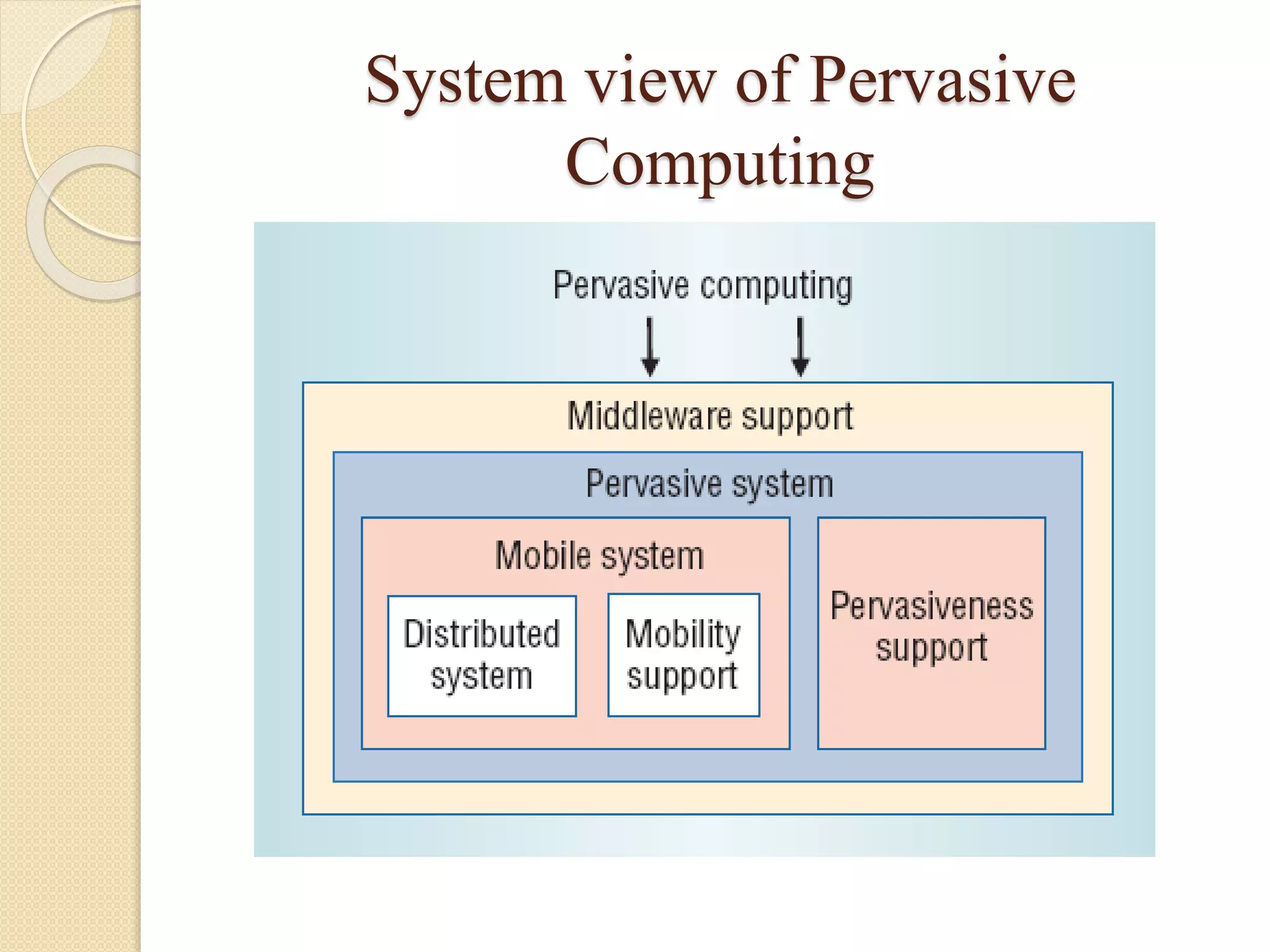
System view of Pervasive
Computing
ISSUES & CHALLENGES
 Scalability:
As environmental smartness grows so will
the number of devices connected to the
environment and the intensity of human-
machine interactions.
Traditional development requires recreating
the application for each new device.
Writing a single application logic for once,
that is independent of devices would solve
the scalability problem
 Heterogeneity:
 Conversion from one domain to another is integral
to computing and communication. Assuming that
uniform and compatible implementations of smart
environments are not achievable, pervasive
computing must find ways to mask this
heterogeneity or uneven conditioning
 Applications are typically developed for specific
device classes or system platforms, leading to
separate versions of the same application for
handhelds, desktops, and cluster-based servers. As
heterogeneity increases, developing applications
that run across all platforms will become
exceedingly difficult.
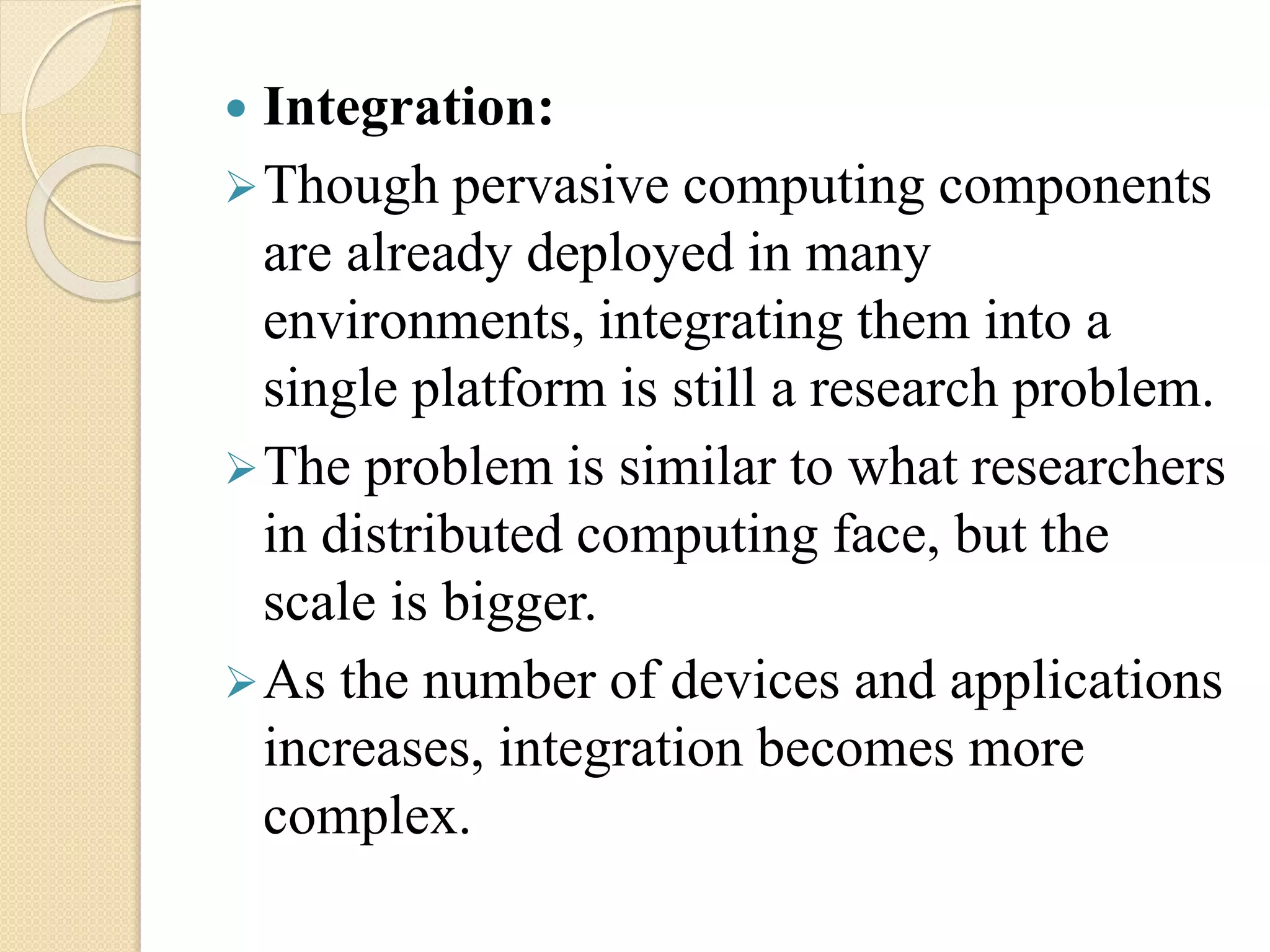
 Integration:
Though pervasive computing components
are already deployed in many
environments, integrating them into a
single platform is still a research problem.
The problem is similar to what researchers
in distributed computing face, but the
scale is bigger.
As the number of devices and applications
increases, integration becomes more
complex.
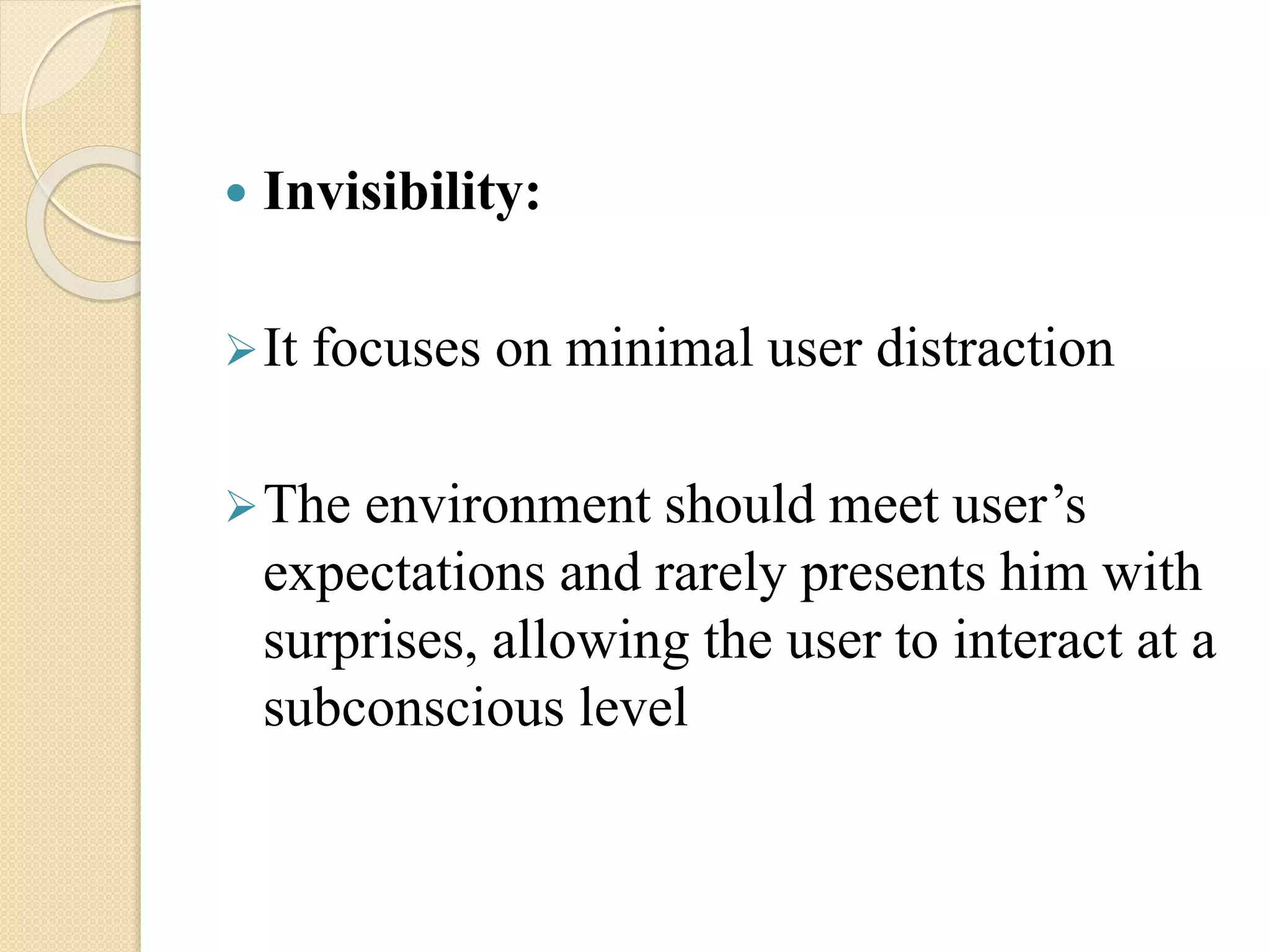
 Invisibility:
It focuses on minimal user distraction
The environment should meet user’s
expectations and rarely presents him with
surprises, allowing the user to interact at a
subconscious level
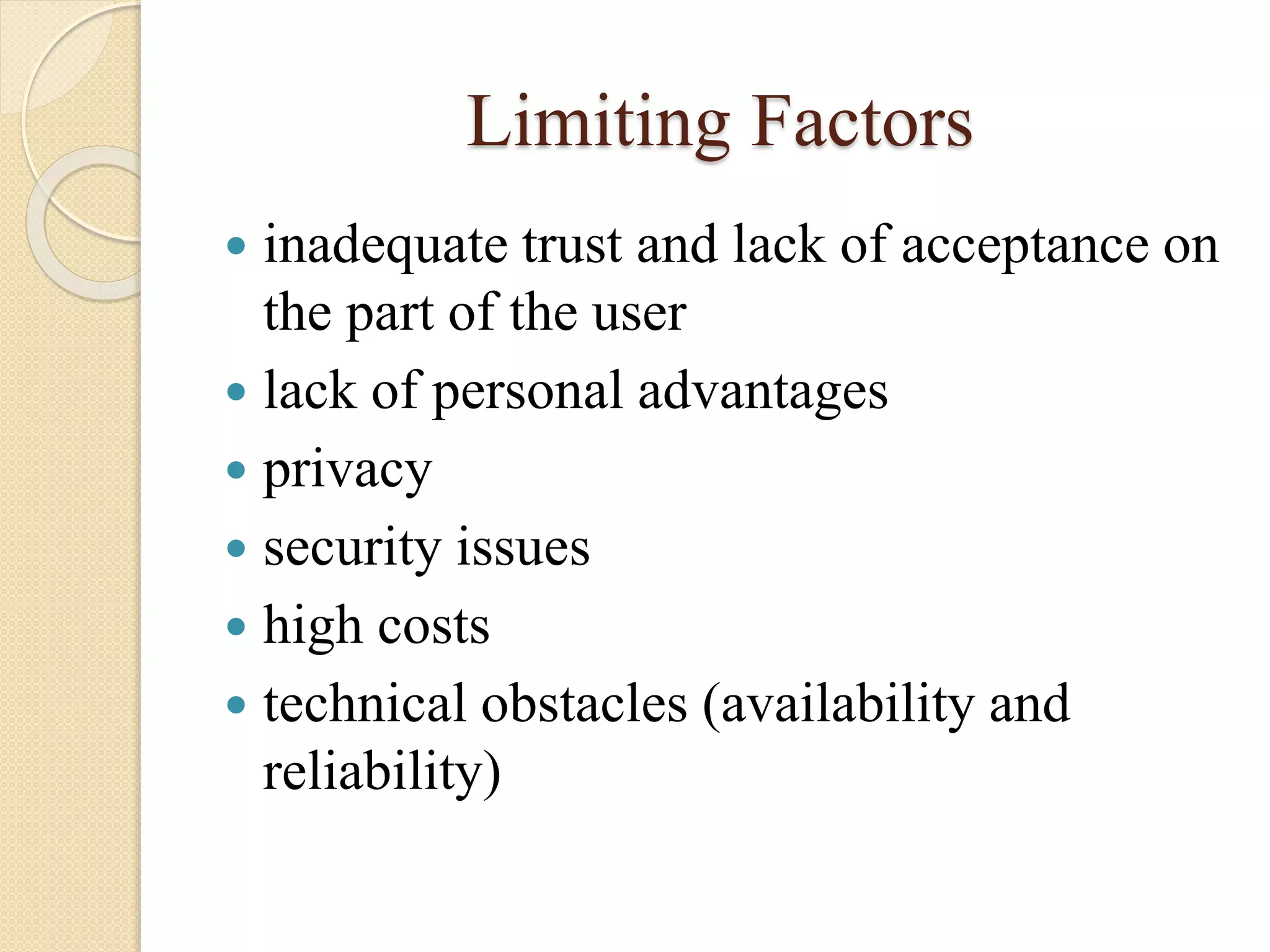
Limiting Factors
 inadequate trust and lack of acceptance on
the part of the user
 lack of personal advantages
 privacy
 security issues
 high costs
 technical obstacles (availability and
reliability)
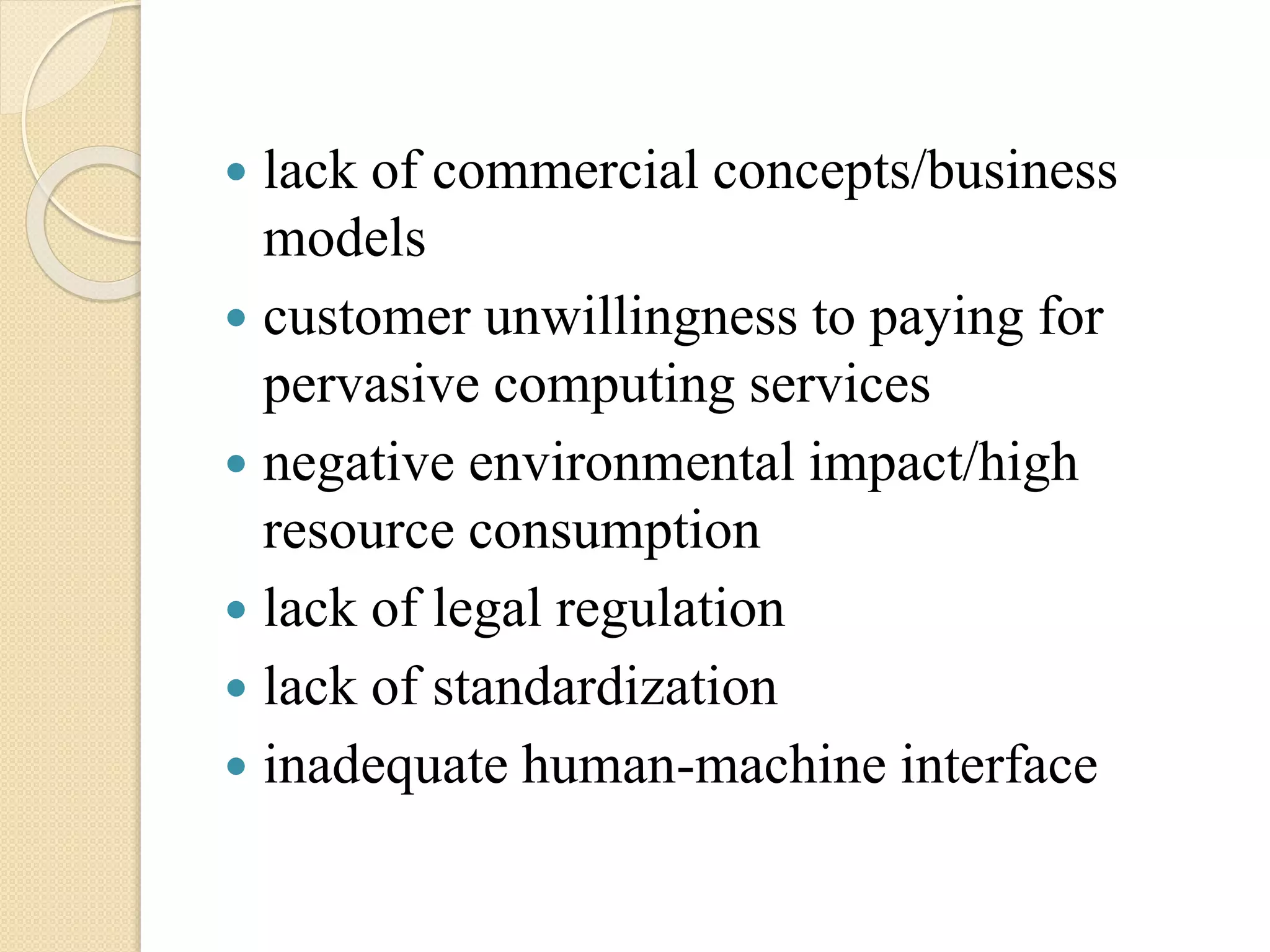
 lack of commercial concepts/business
models
 customer unwillingness to paying for
pervasive computing services
 negative environmental impact/high
resource consumption
 lack of legal regulation
 lack of standardization
 inadequate human-machine interface
Pervasive Initiatives
 Oxygen:
an MIT initiative, envisions a future in
which computation will be freely
available everywhere, like oxygen in the
air we breathe.
The project rests on an infrastructure of
mobile and stationary devices connected
by a self configuring network.
 Aura:
“distraction free ubiquitous computing.”
The project aims to design, implement,
deploy, and evaluate a large scale
computing system demonstrating a
“personal information aura” that spans
wearable, handheld, desktop, and
infrastructure computers.
 Cooltown:
Hewlett-Packard’s pervasive computing
initiative, focuses on extending Web
technology, wireless networks, and
portable devices to create a virtual bridge
between mobile users and physical entities
and electronic services.
CONCLUSION
 Pervasive computing is about making our
lives simpler through digital environments
that are sensitive, adaptive, and responsive
to human needs.
 Pervasive computing will be a fertile
source of challenging research problems
in computer systems for many years to
come.
 Research challenges in areas outside
computer systems need to be addressed.
 These areas include human-computer
interaction , software agents and expert
systems and artificial intelligence.
 Pervasive computing will thus be the
crucible in which many disjoint areas of
research are fused.
THANK YOU

Pervasive Computing

  • 1.
  • 2.
    ABSTRACT  The disseminationand use of modern information and communication technologies (ICT) are considered to be preconditions today for dynamic economic growth and future viability in global competition.  Enormous change produced by the latest technologies.  Digital information and services are going mobile.
  • 3.
     An emergingtrend towards pervasive computing- ubiquitous and invisible use, creation, processing, transmission and storage of information.  Everyday objects are becoming “smart objects”, which are linked together into networks, react to their environment, and interact with their users.  Includes the central trends in pervasive computing, its relationship with distributed and mobile computing, its issues and what challenges are posed to computer systems research by pervasive computing
  • 4.
    What is PervasiveComputing  “The most profound technologies are those that disappear. They weave themselves into the fabric of everyday life until they are indistinguishable from it” , mentioned by Mark Weiser in his seminal paper of 1991.  The growing trend towards embedding microprocessors in everyday objects so they can communicate information.  The word pervasive means "existing everywhere."
  • 5.
     The goalis to create ambient intelligence where network devices embedded in the environment provide unobtrusive connectivity and services all the time, thus improving human experience and quality of life without explicit awareness of the underlying communications and computing technologies.  In this environment, the world around us is interconnected as pervasive network of intelligent devices that cooperatively and autonomously collect, process and transport information in order to adapt to the associated context and activity
  • 6.
    Characteristics  Miniaturization: ICTcomponents are becoming smaller and more mobile.  Embedding: Components are integrated into everyday objects, they transform them into smart objects.  Networking: Components are linked to each other and communicate generally via radio.
  • 7.
     Ubiquity: Componentsare ubiquitous, which makes them less noticeable.  Context awareness : Components use sensors and communication to collect information about their users and environment and adjust their behavior accordingly. Pervasive Computing is complementary to virtual reality. It turns all objects in the real world into part of an information and communications system.
  • 8.
    Distributed Computing  Withthe arrival of networking, personal computing evolved to distributed computing. As computers became connected, they began to share capabilities over the network.  Seamless access to remote information resources and communication with fault tolerance, high availability and security.  Many users now routinely refer to their point of presence within the digital world— typically, their homepages, portals, or e-mail addresses. The computer they use to access these “places” has become largely irrelevant.
  • 9.
    Mobile Computing  Mobilecomputing emerged from the integration of cellular technology with the Web. Both the size and price of mobile devices are falling everyday and could eventually support Weiser’s vision of pervasive inch-scale computing devices readily available to users in any human environment.  The “anytime anywhere” goal of mobile computing is essentially a reactive approach to information access, but it prepares the way for pervasive computing proactive “all the time everywhere” goal.
  • 10.
    System view ofPervasive Computing
  • 11.
    ISSUES & CHALLENGES Scalability: As environmental smartness grows so will the number of devices connected to the environment and the intensity of human- machine interactions. Traditional development requires recreating the application for each new device. Writing a single application logic for once, that is independent of devices would solve the scalability problem
  • 12.
     Heterogeneity:  Conversionfrom one domain to another is integral to computing and communication. Assuming that uniform and compatible implementations of smart environments are not achievable, pervasive computing must find ways to mask this heterogeneity or uneven conditioning  Applications are typically developed for specific device classes or system platforms, leading to separate versions of the same application for handhelds, desktops, and cluster-based servers. As heterogeneity increases, developing applications that run across all platforms will become exceedingly difficult.
  • 13.
     Integration: Though pervasivecomputing components are already deployed in many environments, integrating them into a single platform is still a research problem. The problem is similar to what researchers in distributed computing face, but the scale is bigger. As the number of devices and applications increases, integration becomes more complex.
  • 14.
     Invisibility: It focuseson minimal user distraction The environment should meet user’s expectations and rarely presents him with surprises, allowing the user to interact at a subconscious level
  • 15.
    Limiting Factors  inadequatetrust and lack of acceptance on the part of the user  lack of personal advantages  privacy  security issues  high costs  technical obstacles (availability and reliability)
  • 16.
     lack ofcommercial concepts/business models  customer unwillingness to paying for pervasive computing services  negative environmental impact/high resource consumption  lack of legal regulation  lack of standardization  inadequate human-machine interface
  • 17.
    Pervasive Initiatives  Oxygen: anMIT initiative, envisions a future in which computation will be freely available everywhere, like oxygen in the air we breathe. The project rests on an infrastructure of mobile and stationary devices connected by a self configuring network.
  • 18.
     Aura: “distraction freeubiquitous computing.” The project aims to design, implement, deploy, and evaluate a large scale computing system demonstrating a “personal information aura” that spans wearable, handheld, desktop, and infrastructure computers.
  • 19.
     Cooltown: Hewlett-Packard’s pervasivecomputing initiative, focuses on extending Web technology, wireless networks, and portable devices to create a virtual bridge between mobile users and physical entities and electronic services.
  • 20.
    CONCLUSION  Pervasive computingis about making our lives simpler through digital environments that are sensitive, adaptive, and responsive to human needs.  Pervasive computing will be a fertile source of challenging research problems in computer systems for many years to come.  Research challenges in areas outside computer systems need to be addressed.
  • 21.
     These areasinclude human-computer interaction , software agents and expert systems and artificial intelligence.  Pervasive computing will thus be the crucible in which many disjoint areas of research are fused.
  • 22.