MODERN INSTITUTE OF
ENGINEERING & TECHNOLOGY
SUBJECT : Advanced Manufacturing Technology
TOPIC : Chemistry of EDM process
NAME : ATANU JANA
ROLL : 26900720064
Paper Code : PC-ME701
YEAR : 4th SEMESTER : 7th
ELECTRICAL DISCHARGE
MACHINING
WHAT IS EDM?
❑ Electrical Discharge Machining
❑ Used on hard metals
❑ works with electrically conductive materials
HISTORY OF EDM
❑ In1770s, discovered by Joseph Priestly.
❑ Developed in the mid 1970s
❑ In the mid 1980s, the EDM techniques were transferred to a machine tool
❑ Today,it is a viable technique that helped shape the metal working industry.
ACCESSORIES
❑ surface plate
❑ dial indicator
❑ surface gage
❑ drop indicators
❑ sine plate
❑ pin gage set
❑ gage block set
❑ tooling ball set
❑ precision vise
❑ and various electrode holders
❑ Workpiece
❑ Sparks
❑ Electrodes
❑ Dielectric liquid
Deionized water
Dielectric oil
❑ Cutting speed
❑ Accuracy
BASIC DEFINITIONS
TYPES OF EDM
❑ Wire Machining ❑ Ram Machinig
Other EDM Processes
❑ Electrical Discharge Milling
❑ Electrical Discharge Grinding
❑ Electrical Discharge Dressing
❑ Utrasonic Aided EDM
❑ Abrasive Electrical Discharge Grinding
❑ Micro Electrical Discharge Machining
❑ Micro Wire EDM
❑ Mole EDM
❑ Double Rotating Electrodes EDM
WHEN TO USE EDM
❑ Where deep cutting is required
❑ In unattended cutting
❑ For high-expertise parts
❑ Where EDM finish is specified
❑ For hard materials
❑ For sharp inside corners
❑ For the most complex geometry
HOW EDM WORKS?
o Uses very powerful sparks (~3x10⁶ V/m)
o Series of rapidly recurring
charges
o Electroerosion
o Remove excess by fluid
flow
SPARKS
❑ The phenomena “Breakdown” occurs
❑ A path for the current through dielectric
❑ Locally 10-15.000 ºC
❑ Ionize the fluid
❑ Metal melts or vaporizes
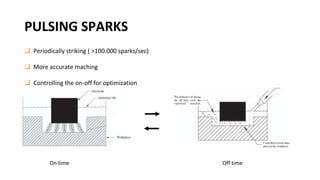
PULSING SPARKS
❑ Periodically striking ( >100.000 sparks/sec)
❑ More accurate maching
❑ Controlling the on-off for optimization
On time Off time
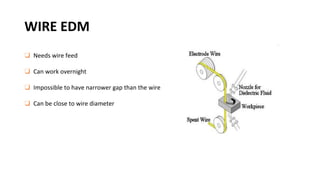
WIRE EDM
❑ Needs wire feed
❑ Can work overnight
❑ Impossible to have narrower gap than the wire
❑ Can be close to wire diameter
❑ Voltage changes with distance
❑ Distance must be controlled
❑ Manufacturer programs do all the work
❑ Promising method with oscilloscope
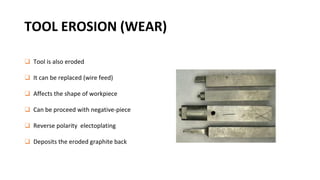
TOOL EROSION (WEAR)
❑ Tool is also eroded
❑ It can be replaced (wire feed)
❑ Affects the shape of workpiece
❑ Can be proceed with negative-piece
❑ Reverse polarity electoplating
❑ Deposits the eroded graphite back
EDM IS A MACHINING METHOD
TYPICALLYUSED FOR HARD METALS WHICH
ARE ELECTRICALLYCONDUCTIVE.
IT MAKES POSSIBLE TO WORK WITH
METALS FOR WHICH TRADITIONAL
MACHINING TECHNIQUESARE INEFFECTIVE.
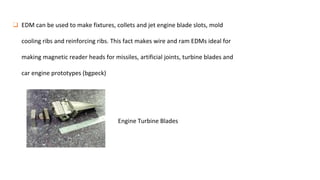
❑ EDM can be used to make fixtures, collets and jet engine blade slots, mold
cooling ribs and reinforcing ribs. This fact makes wire and ram EDMs ideal for
making magnetic reader heads for missiles, artificial joints, turbine blades and
car engine prototypes (bgpeck)
Engine Turbine Blades
APPLICATIONS
❑ Prototype production
The EDM process is most widely used by the mould-making tool and die industries,
but is becoming a common method of making prototype and production
parts,especially in the aerospace, automobile and electronics industries in which
production quantities are relatively low.
❑ Metal disintegration machining
Several manufacturers produce EDM machines for the specific purpose of removing
broken tools (drill bits or taps) from work pieces. In this application, the process is
termed "metal disintegration machining".
COINAGE DIE MAKING
This type of EDM is usually performed submerged in an oil-based dielectric. The
finished object may be further refined by hard (glass) or soft (paint) enameling
and/or electroplated with pure gold or nickel. Softer materials such as silver may
be hand engraved as a refinement.
Master at top, badge die workpiece at bottom,oil jets at left (oil has been
drained).Initial flat stamping will be"dapped" to give a curved surface.
Small hole drilling
On wire-cut EDM machines, small hole drilling EDM is used to make a through
hole in a workpiece in through which to thread the wire for the wire-cut EDM
operation. A separate EDM head specifically for small hole drilling is mounted
on a wire-cut machine and allows large hardened plates to have finished parts
eroded from them as needed and without pre-drilling.
A blade with internal cooling as applied in the highpressure turbine
EXAMPLES OF USE
❑ Slots, keyways, square & hex drives
❑ Gears, splines
❑ Small or deep holes, especially in hardened
❑ Removal of broken taps and drills
❑ Hard tapping
❑ Machining of carbide
❑ Application of textured surface finish
ADVANTAGES AND DISADVANTAGES
❑ EDM is a method of machining parts that cannot be done by
conventional machines.
❑ “Since the tool does not touch the workpiece, there are no cutting forces
generated; therefore, very fragile parts can be machined” .
❑ The shape and also the hardness of the materials being used make EDM
ideal.
SOME OF THE ADVANTAGES OF EDM
INCLUDE MACHINING OF:
❑ Complex shapes that would otherwise be difficult to produce with
conventional cutting tools
❑ Extremely hard material to very close tolerances
❑ Very small work pieces where conventional cutting tools may damage the
part from excess cutting tool pressure.
SOME OF THE ADVANTAGES OF EDM
INCLUDE MACHINING OF:
❑ Intricate & complex details are possible
❑ Internal corners down to R .001" [.025mm]
❑ Small features down to .004" [.10mm]
❑ Very high accuracy attainable
❑ Precise control of surface finish
❑ No cutting forces
❑ Virtually no geometric limitations
SOME OF THE DISADVANTAGES OF EDM
INCLUDE:
❑ The slow rate of material removal.
❑ The additional time and cost used for creating electrodes for ram/sinker
EDM.
❑ Specific power consumption is very high.
❑ Power consumption is high.
ADVANTAGES AND DISADVANTAGES OF EDM
VERSUS TRADITIONAL MACHINING
ohandles delicate tasks
omay cut or drill very hard
materials
ohighly accurate
overy small kerf for
owire EDM
oproduces complex, deep, or 3-D
shapes
ono burrs
oelectrode wear
oslow cutting rates
othin, brittle heat-
affected zone
Advantages Disadvantages

Advanced manufacturing technology pdf.pdf

  • 1.
    MODERN INSTITUTE OF ENGINEERING& TECHNOLOGY SUBJECT : Advanced Manufacturing Technology TOPIC : Chemistry of EDM process NAME : ATANU JANA ROLL : 26900720064 Paper Code : PC-ME701 YEAR : 4th SEMESTER : 7th
  • 2.
  • 3.
    WHAT IS EDM? ❑Electrical Discharge Machining ❑ Used on hard metals ❑ works with electrically conductive materials
  • 4.
    HISTORY OF EDM ❑In1770s, discovered by Joseph Priestly. ❑ Developed in the mid 1970s ❑ In the mid 1980s, the EDM techniques were transferred to a machine tool ❑ Today,it is a viable technique that helped shape the metal working industry.
  • 5.
    ACCESSORIES ❑ surface plate ❑dial indicator ❑ surface gage ❑ drop indicators ❑ sine plate ❑ pin gage set ❑ gage block set ❑ tooling ball set ❑ precision vise ❑ and various electrode holders
  • 6.
    ❑ Workpiece ❑ Sparks ❑Electrodes ❑ Dielectric liquid Deionized water Dielectric oil ❑ Cutting speed ❑ Accuracy BASIC DEFINITIONS
  • 7.
    TYPES OF EDM ❑Wire Machining ❑ Ram Machinig Other EDM Processes ❑ Electrical Discharge Milling ❑ Electrical Discharge Grinding ❑ Electrical Discharge Dressing ❑ Utrasonic Aided EDM ❑ Abrasive Electrical Discharge Grinding ❑ Micro Electrical Discharge Machining ❑ Micro Wire EDM ❑ Mole EDM ❑ Double Rotating Electrodes EDM
  • 8.
    WHEN TO USEEDM ❑ Where deep cutting is required ❑ In unattended cutting ❑ For high-expertise parts ❑ Where EDM finish is specified ❑ For hard materials ❑ For sharp inside corners ❑ For the most complex geometry
  • 9.
    HOW EDM WORKS? oUses very powerful sparks (~3x10⁶ V/m) o Series of rapidly recurring charges o Electroerosion o Remove excess by fluid flow
  • 10.
    SPARKS ❑ The phenomena“Breakdown” occurs ❑ A path for the current through dielectric ❑ Locally 10-15.000 ºC ❑ Ionize the fluid ❑ Metal melts or vaporizes
  • 11.
    PULSING SPARKS ❑ Periodicallystriking ( >100.000 sparks/sec) ❑ More accurate maching ❑ Controlling the on-off for optimization On time Off time
  • 12.
    WIRE EDM ❑ Needswire feed ❑ Can work overnight ❑ Impossible to have narrower gap than the wire ❑ Can be close to wire diameter
  • 13.
    ❑ Voltage changeswith distance ❑ Distance must be controlled ❑ Manufacturer programs do all the work ❑ Promising method with oscilloscope
  • 14.
    TOOL EROSION (WEAR) ❑Tool is also eroded ❑ It can be replaced (wire feed) ❑ Affects the shape of workpiece ❑ Can be proceed with negative-piece ❑ Reverse polarity electoplating ❑ Deposits the eroded graphite back
  • 15.
    EDM IS AMACHINING METHOD TYPICALLYUSED FOR HARD METALS WHICH ARE ELECTRICALLYCONDUCTIVE. IT MAKES POSSIBLE TO WORK WITH METALS FOR WHICH TRADITIONAL MACHINING TECHNIQUESARE INEFFECTIVE.
  • 16.
    ❑ EDM canbe used to make fixtures, collets and jet engine blade slots, mold cooling ribs and reinforcing ribs. This fact makes wire and ram EDMs ideal for making magnetic reader heads for missiles, artificial joints, turbine blades and car engine prototypes (bgpeck) Engine Turbine Blades
  • 17.
    APPLICATIONS ❑ Prototype production TheEDM process is most widely used by the mould-making tool and die industries, but is becoming a common method of making prototype and production parts,especially in the aerospace, automobile and electronics industries in which production quantities are relatively low. ❑ Metal disintegration machining Several manufacturers produce EDM machines for the specific purpose of removing broken tools (drill bits or taps) from work pieces. In this application, the process is termed "metal disintegration machining".
  • 18.
    COINAGE DIE MAKING Thistype of EDM is usually performed submerged in an oil-based dielectric. The finished object may be further refined by hard (glass) or soft (paint) enameling and/or electroplated with pure gold or nickel. Softer materials such as silver may be hand engraved as a refinement. Master at top, badge die workpiece at bottom,oil jets at left (oil has been drained).Initial flat stamping will be"dapped" to give a curved surface.
  • 19.
    Small hole drilling Onwire-cut EDM machines, small hole drilling EDM is used to make a through hole in a workpiece in through which to thread the wire for the wire-cut EDM operation. A separate EDM head specifically for small hole drilling is mounted on a wire-cut machine and allows large hardened plates to have finished parts eroded from them as needed and without pre-drilling. A blade with internal cooling as applied in the highpressure turbine
  • 20.
    EXAMPLES OF USE ❑Slots, keyways, square & hex drives ❑ Gears, splines ❑ Small or deep holes, especially in hardened ❑ Removal of broken taps and drills ❑ Hard tapping ❑ Machining of carbide ❑ Application of textured surface finish
  • 21.
    ADVANTAGES AND DISADVANTAGES ❑EDM is a method of machining parts that cannot be done by conventional machines. ❑ “Since the tool does not touch the workpiece, there are no cutting forces generated; therefore, very fragile parts can be machined” . ❑ The shape and also the hardness of the materials being used make EDM ideal.
  • 22.
    SOME OF THEADVANTAGES OF EDM INCLUDE MACHINING OF: ❑ Complex shapes that would otherwise be difficult to produce with conventional cutting tools ❑ Extremely hard material to very close tolerances ❑ Very small work pieces where conventional cutting tools may damage the part from excess cutting tool pressure.
  • 23.
    SOME OF THEADVANTAGES OF EDM INCLUDE MACHINING OF: ❑ Intricate & complex details are possible ❑ Internal corners down to R .001" [.025mm] ❑ Small features down to .004" [.10mm] ❑ Very high accuracy attainable ❑ Precise control of surface finish ❑ No cutting forces ❑ Virtually no geometric limitations
  • 24.
    SOME OF THEDISADVANTAGES OF EDM INCLUDE: ❑ The slow rate of material removal. ❑ The additional time and cost used for creating electrodes for ram/sinker EDM. ❑ Specific power consumption is very high. ❑ Power consumption is high.
  • 25.
    ADVANTAGES AND DISADVANTAGESOF EDM VERSUS TRADITIONAL MACHINING ohandles delicate tasks omay cut or drill very hard materials ohighly accurate overy small kerf for owire EDM oproduces complex, deep, or 3-D shapes ono burrs oelectrode wear oslow cutting rates othin, brittle heat- affected zone Advantages Disadvantages