Prof. Abdul Rasheed
Discounted Cash Flow
Topics Covered
Time Value of Money
Net Present Value (NPV)
Discounted Cash Flow (DCF)
Internal Rate of Return (IRR)
DiscountCashFlow | 1
Time Value of Money
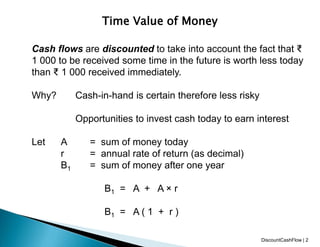
Cash flows are discounted to take into account the fact that ₹
1 000 to be received some time in the future is worth less today
than ₹ 1 000 received immediately.
Why? Cash-in-hand is certain therefore less risky
Opportunities to invest cash today to earn interest
Let A = sum of money today
r = annual rate of return (as decimal)
B1 = sum of money after one year
B1 = A + A × r
B1 = A ( 1 + r )
DiscountCashFlow | 2
Time Value of Money
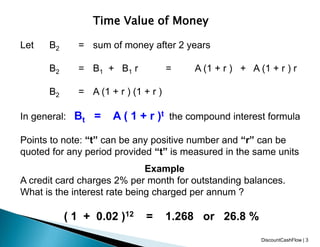
Let B2 = sum of money after 2 years
B2 = B1 + B1 r = A (1 + r ) + A (1 + r ) r
B2 = A (1 + r ) (1 + r )
In general: Bt = A ( 1 + r )t the compound interest formula
Points to note: “t” can be any positive number and “r” can be
quoted for any period provided “t” is measured in the same units
Example
A credit card charges 2% per month for outstanding balances.
What is the interest rate being charged per annum ?
( 1 + 0.02 )12 = 1.268 or 26.8 %
DiscountCashFlow | 3
Time Value of Money
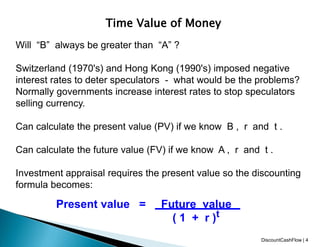
Will “B” always be greater than “A” ?
Switzerland (1970's) and Hong Kong (1990's) imposed negative
interest rates to deter speculators - what would be the problems?
Normally governments increase interest rates to stop speculators
selling currency.
Can calculate the present value (PV) if we know B , r and t .
Can calculate the future value (FV) if we know A , r and t .
Investment appraisal requires the present value so the discounting
formula becomes:
Present value = Future value
( 1 + r )t
DiscountCashFlow | 4
Net Present Value (NPV)
You have won ₹ 150 000 on the national lottery.
Option 1: Buy a piece of land which you know you could sell for
₹ 250 000 in a years time.
Option 2: Buy Government gilt-edged securities which offer a 10%
per annum return.
Present Value of Option 2 = ₹ 150 000
Present Value of Option 1 = Future value = ₹ 250 000
( 1 + r ) t ( 1 + 0.1)1
= ₹ 227 237
(the amount you would need to invest today )
DiscountCashFlow | 5
Net Present Value
Net Present Value for land purchase
= ₹ 227 237 - ₹ 150 000
= ₹ 77 273
The Investment Decision is:
If NPV is positive - accept the project
If NPV is negative - reject the project
And accept the project with the highest NPV
Therefore choose Option 1: Buy the land.
DiscountCashFlow | 6
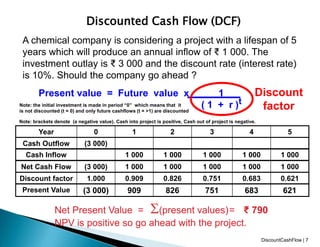
Discounted Cash Flow (DCF)
A chemical company is considering a project with a lifespan of 5
years which will produce an annual inflow of ₹ 1 000. The
investment outlay is ₹ 3 000 and the discount rate (interest rate)
is 10%. Should the company go ahead ?
Net Present Value = S(present values)= ₹ 790
NPV is positive so go ahead with the project.
Present value = Future value x 1
( 1 + r )t
Discount
factor
Year 0 1 2 3 4 5
Cash Outflow (3 000)
Cash Inflow 1 000 1 000 1 000 1 000 1 000
Net Cash Flow (3 000) 1 000 1 000 1 000 1 000 1 000
Discount factor 1.000 0.909 0.826 0.751 0.683 0.621
Present Value (3 000) 909 826 751 683 621
DiscountCashFlow | 7
Note: brackets denote (a negative value). Cash into project is positive, Cash out of project is negative.
Note: the initial investment is made in period “0” which means that it
is not discounted (t = 0) and only future cashflows (t = >1) are discounted
Discounted Cash Flow
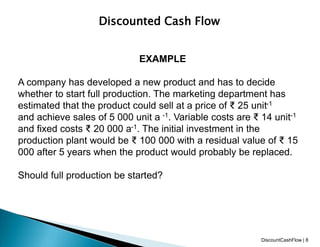
EXAMPLE
A company has developed a new product and has to decide
whether to start full production. The marketing department has
estimated that the product could sell at a price of ₹ 25 unit-1
and achieve sales of 5 000 unit a -1. Variable costs are ₹ 14 unit-1
and fixed costs ₹ 20 000 a-1. The initial investment in the
production plant would be ₹ 100 000 with a residual value of ₹ 15
000 after 5 years when the product would probably be replaced.
Should full production be started?
DiscountCashFlow | 8
Discounted Cash Flow
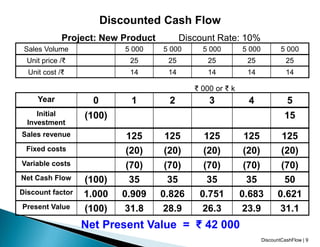
Project: New Product Discount Rate: 10%
Net Present Value = ₹ 42 000
Year 0 1 2 3 4 5
Initial
Investment
(100) 15
Fixed costs (20) (20) (20) (20) (20)
Net Cash Flow (100) 35 35 35 35 50
Discount factor 1.000 0.909 0.826 0.751 0.683 0.621
Present Value (100) 31.8 28.9 26.3 23.9 31.1
Variable costs (70) (70) (70) (70) (70)
Sales revenue 125 125 125 125 125
Sales Volume 5 000 5 000 5 000 5 000 5 000
Unit price /₹ 25 25 25 25 25
Unit cost /₹ 14 14 14 14 14
₹ 000 or ₹ k
DiscountCashFlow | 9
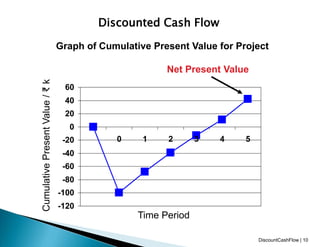
Discounted Cash Flow
Graph of Cumulative Present Value for Project
Net Present Value
-120
-100
-80
-60
-40
-20
0
20
40
60
0 1 2 3 4 5
Cumulative
Present
Value
/
₹
k
Time Period
DiscountCashFlow | 10
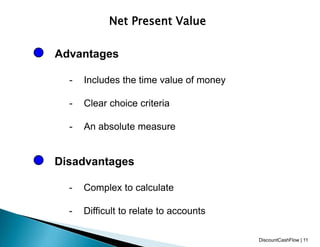
Net Present Value
Advantages
- Includes the time value of money
- Clear choice criteria
- An absolute measure
Disadvantages
- Complex to calculate
- Difficult to relate to accounts
DiscountCashFlow | 11
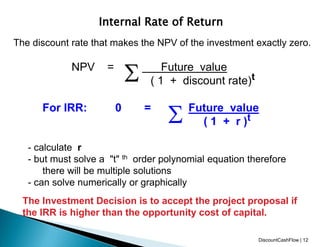
Internal Rate of Return
The discount rate that makes the NPV of the investment exactly zero.
NPV = Future value
( 1 + discount rate)t
For IRR: 0 = Future value
( 1 + r )t
- calculate r
- but must solve a "t" th order polynomial equation therefore
there will be multiple solutions
- can solve numerically or graphically
S
S
The Investment Decision is to accept the project proposal if
the IRR is higher than the opportunity cost of capital.
DiscountCashFlow | 12
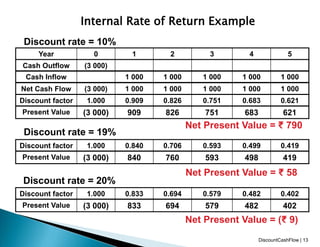
Internal Rate of Return Example
Discount rate = 10%
Net Present Value = ₹ 790
Discount rate = 19%
Net Present Value = ₹ 58
Discount rate = 20%
Net Present Value = (₹ 9)
Year 0 1 2 3 4 5
Cash Outflow (3 000)
Cash Inflow 1 000 1 000 1 000 1 000 1 000
Net Cash Flow (3 000) 1 000 1 000 1 000 1 000 1 000
Discount factor 1.000 0.909 0.826 0.751 0.683 0.621
Present Value (3 000) 909 826 751 683 621
Discount factor 1.000 0.833 0.694 0.579 0.482 0.402
Present Value (3 000) 833 694 579 482 402
Discount factor 1.000 0.840 0.706 0.593 0.499 0.419
Present Value (3 000) 840 760 593 498 419
DiscountCashFlow | 13
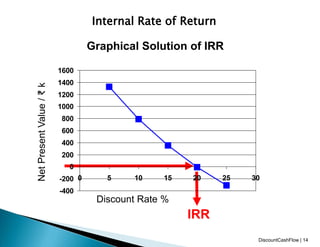
Internal Rate of Return
Graphical Solution of IRR
IRR
-400
-200
0
200
400
600
800
1000
1200
1400
1600
0 5 10 15 20 25 30
Net
Present
Value
/
₹
k
Discount Rate %
DiscountCashFlow | 14
Internal Rate of Return
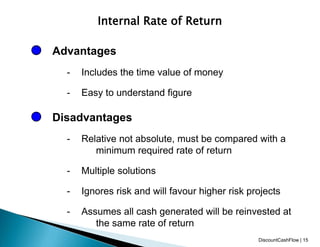
Advantages
- Includes the time value of money
- Easy to understand figure
Disadvantages
- Relative not absolute, must be compared with a
minimum required rate of return
- Multiple solutions
- Ignores risk and will favour higher risk projects
- Assumes all cash generated will be reinvested at
the same rate of return
DiscountCashFlow | 15
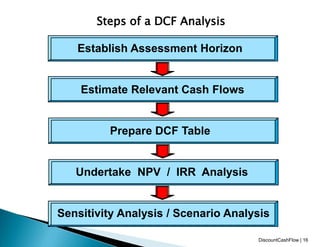
Steps of a DCF Analysis
Establish Assessment Horizon
Estimate Relevant Cash Flows
Prepare DCF Table
Undertake NPV / IRR Analysis
Sensitivity Analysis / Scenario Analysis
DiscountCashFlow | 16

DCF & NON DCF.ppt

  • 1.
  • 2.
    Discounted Cash Flow TopicsCovered Time Value of Money Net Present Value (NPV) Discounted Cash Flow (DCF) Internal Rate of Return (IRR) DiscountCashFlow | 1
  • 3.
    Time Value ofMoney Cash flows are discounted to take into account the fact that ₹ 1 000 to be received some time in the future is worth less today than ₹ 1 000 received immediately. Why? Cash-in-hand is certain therefore less risky Opportunities to invest cash today to earn interest Let A = sum of money today r = annual rate of return (as decimal) B1 = sum of money after one year B1 = A + A × r B1 = A ( 1 + r ) DiscountCashFlow | 2
  • 4.
    Time Value ofMoney Let B2 = sum of money after 2 years B2 = B1 + B1 r = A (1 + r ) + A (1 + r ) r B2 = A (1 + r ) (1 + r ) In general: Bt = A ( 1 + r )t the compound interest formula Points to note: “t” can be any positive number and “r” can be quoted for any period provided “t” is measured in the same units Example A credit card charges 2% per month for outstanding balances. What is the interest rate being charged per annum ? ( 1 + 0.02 )12 = 1.268 or 26.8 % DiscountCashFlow | 3
  • 5.
    Time Value ofMoney Will “B” always be greater than “A” ? Switzerland (1970's) and Hong Kong (1990's) imposed negative interest rates to deter speculators - what would be the problems? Normally governments increase interest rates to stop speculators selling currency. Can calculate the present value (PV) if we know B , r and t . Can calculate the future value (FV) if we know A , r and t . Investment appraisal requires the present value so the discounting formula becomes: Present value = Future value ( 1 + r )t DiscountCashFlow | 4
  • 6.
    Net Present Value(NPV) You have won ₹ 150 000 on the national lottery. Option 1: Buy a piece of land which you know you could sell for ₹ 250 000 in a years time. Option 2: Buy Government gilt-edged securities which offer a 10% per annum return. Present Value of Option 2 = ₹ 150 000 Present Value of Option 1 = Future value = ₹ 250 000 ( 1 + r ) t ( 1 + 0.1)1 = ₹ 227 237 (the amount you would need to invest today ) DiscountCashFlow | 5
  • 7.
    Net Present Value NetPresent Value for land purchase = ₹ 227 237 - ₹ 150 000 = ₹ 77 273 The Investment Decision is: If NPV is positive - accept the project If NPV is negative - reject the project And accept the project with the highest NPV Therefore choose Option 1: Buy the land. DiscountCashFlow | 6
  • 8.
    Discounted Cash Flow(DCF) A chemical company is considering a project with a lifespan of 5 years which will produce an annual inflow of ₹ 1 000. The investment outlay is ₹ 3 000 and the discount rate (interest rate) is 10%. Should the company go ahead ? Net Present Value = S(present values)= ₹ 790 NPV is positive so go ahead with the project. Present value = Future value x 1 ( 1 + r )t Discount factor Year 0 1 2 3 4 5 Cash Outflow (3 000) Cash Inflow 1 000 1 000 1 000 1 000 1 000 Net Cash Flow (3 000) 1 000 1 000 1 000 1 000 1 000 Discount factor 1.000 0.909 0.826 0.751 0.683 0.621 Present Value (3 000) 909 826 751 683 621 DiscountCashFlow | 7 Note: brackets denote (a negative value). Cash into project is positive, Cash out of project is negative. Note: the initial investment is made in period “0” which means that it is not discounted (t = 0) and only future cashflows (t = >1) are discounted
  • 9.
    Discounted Cash Flow EXAMPLE Acompany has developed a new product and has to decide whether to start full production. The marketing department has estimated that the product could sell at a price of ₹ 25 unit-1 and achieve sales of 5 000 unit a -1. Variable costs are ₹ 14 unit-1 and fixed costs ₹ 20 000 a-1. The initial investment in the production plant would be ₹ 100 000 with a residual value of ₹ 15 000 after 5 years when the product would probably be replaced. Should full production be started? DiscountCashFlow | 8
  • 10.
    Discounted Cash Flow Project:New Product Discount Rate: 10% Net Present Value = ₹ 42 000 Year 0 1 2 3 4 5 Initial Investment (100) 15 Fixed costs (20) (20) (20) (20) (20) Net Cash Flow (100) 35 35 35 35 50 Discount factor 1.000 0.909 0.826 0.751 0.683 0.621 Present Value (100) 31.8 28.9 26.3 23.9 31.1 Variable costs (70) (70) (70) (70) (70) Sales revenue 125 125 125 125 125 Sales Volume 5 000 5 000 5 000 5 000 5 000 Unit price /₹ 25 25 25 25 25 Unit cost /₹ 14 14 14 14 14 ₹ 000 or ₹ k DiscountCashFlow | 9
  • 11.
    Discounted Cash Flow Graphof Cumulative Present Value for Project Net Present Value -120 -100 -80 -60 -40 -20 0 20 40 60 0 1 2 3 4 5 Cumulative Present Value / ₹ k Time Period DiscountCashFlow | 10
  • 12.
    Net Present Value Advantages -Includes the time value of money - Clear choice criteria - An absolute measure Disadvantages - Complex to calculate - Difficult to relate to accounts DiscountCashFlow | 11
  • 13.
    Internal Rate ofReturn The discount rate that makes the NPV of the investment exactly zero. NPV = Future value ( 1 + discount rate)t For IRR: 0 = Future value ( 1 + r )t - calculate r - but must solve a "t" th order polynomial equation therefore there will be multiple solutions - can solve numerically or graphically S S The Investment Decision is to accept the project proposal if the IRR is higher than the opportunity cost of capital. DiscountCashFlow | 12
  • 14.
    Internal Rate ofReturn Example Discount rate = 10% Net Present Value = ₹ 790 Discount rate = 19% Net Present Value = ₹ 58 Discount rate = 20% Net Present Value = (₹ 9) Year 0 1 2 3 4 5 Cash Outflow (3 000) Cash Inflow 1 000 1 000 1 000 1 000 1 000 Net Cash Flow (3 000) 1 000 1 000 1 000 1 000 1 000 Discount factor 1.000 0.909 0.826 0.751 0.683 0.621 Present Value (3 000) 909 826 751 683 621 Discount factor 1.000 0.833 0.694 0.579 0.482 0.402 Present Value (3 000) 833 694 579 482 402 Discount factor 1.000 0.840 0.706 0.593 0.499 0.419 Present Value (3 000) 840 760 593 498 419 DiscountCashFlow | 13
  • 15.
    Internal Rate ofReturn Graphical Solution of IRR IRR -400 -200 0 200 400 600 800 1000 1200 1400 1600 0 5 10 15 20 25 30 Net Present Value / ₹ k Discount Rate % DiscountCashFlow | 14
  • 16.
    Internal Rate ofReturn Advantages - Includes the time value of money - Easy to understand figure Disadvantages - Relative not absolute, must be compared with a minimum required rate of return - Multiple solutions - Ignores risk and will favour higher risk projects - Assumes all cash generated will be reinvested at the same rate of return DiscountCashFlow | 15
  • 17.
    Steps of aDCF Analysis Establish Assessment Horizon Estimate Relevant Cash Flows Prepare DCF Table Undertake NPV / IRR Analysis Sensitivity Analysis / Scenario Analysis DiscountCashFlow | 16