Ogur, E. O et al Int. Journal of Engineering Research and Applications
ISSN : 2248-9622, Vol. 3, Issue 6, Nov-Dec 2013, pp.624-629

RESEARCH ARTICLE

www.ijera.com

OPEN ACCESS

Failure Analysis of a bar Soap Extrusion Machine
Ogur, E. O1 and Mburu, J. K2
1

Department of Mechanical and Mechatronic Engineering, Technical University of Kenya, P.O. Box 52428 –
00200, Nairobi
2

Department of Mechanical Engineering, National Youth Service Engineering Institute, P.O. Box 30397 –
00100, Nairobi

Abstract
Failure occurs where a component or structure ceases to function as intended. Failure analysis is the process of
collecting and analyzing data to determine the causes of failure. It is a vital tool used in the development of new
products and for the improvement of existing products. This study investigates, using failure analysis, a bar soap
extruding machine. The extruder shaft of the machine failed and the equipment ceased to function as intended.
The extruder had a spiral screw which was welded along the shaft. There were cracks on the welded point. In
this study, destructive and non-destructive tests were conducted to establish physical properties of the failed
component. Chemical analysis was performed to determine chemical composition of the failed parts. The
analysis of data led to the conclusion that failure occurred due to poor maintenance of the equipment. The
manufacturing processes had defects which acted as sites of crack initiation and the crack propagation was
accelerated by cyclic loading.
Keywords: failure mode and effects analysis, crack propagation, magnetic particle crack detection

I.

Introduction

A failure mode and effects analysis (FMEA)
is a procedure in product development and operations
management for analysis of potential failure modes
within a system. A successful FMEA activity helps a
team to identify potential failure modes based on past
experience with similar products or processes. This
helps the designer to design those failures out of the
system with minimum effort and resource expenditure,
thereby, reducing development time and costs. It is
widely used in manufacturing industries in various
phases of the product life cycle and is now
increasingly finding use in the service industry.
FMEA are any errors or defects in a process design or
item especially those that affect the customer and can
be potential or actual. Effects analysis refers to
studying the consequences of these failures. Although
initially developed by the military, FMEA
methodology is now extensively used in a variety of
industries including semiconductor processing, food
service, plastics, software and health care. It is
integrated into the Advanced Product Quality
Planning (APQP) process development phases. Each
potential cause must be considered for its effect on the
product or process and based on the risk, actions are

www.ijera.com

determined and risks revisited after actions are
complete. Failure analysis is used during the design
stage with an aim to avoid future failures [1,2]. Later,
it is used for process control before and during the
ongoing operation of the process and continuous
throughout the life of the product or service. The
outcome of this failure analysis will develop actions to
prevent or reduce the severity or likelihood of failure
of the bar soap extruding machine. It may be used to
evaluate risk management priorities for mitigating
known threat vulnerabilities.

II.

Statement of the Problem

During an exhibition, the bar soap extruding
machine failed and almost caused a fatal accident. The
extruding shaft of the machine developed a crack near
the coupling of the extruder and the drive motor shaft.
The spiral which was welded along the length of the
shaft developed cracks at the welded joint. The
purpose of this study was to establish the root causes
of failure of the bar soap machine so as to prevent
future occurrence. The study entailed completing a
conclusive failure analysis.
Investigations were
carried out using a systematic approach similar to that
outlined in Fig. 1.

624 | P a g e
Ogur, E. O et al Int. Journal of Engineering Research and Application
ISSN : 2248-9622, Vol. 3, Issue 6, Nov-Dec 2013, pp.01-05

www.ijera.com

Fig. 1: Flow diagram of failure analysis procedure [3]

III.

Objectives of the study

The overall objective of this study was to
investigate causes of failure of the bar soap extruding
machine.
The study addressed the following specific objectives:
1.
Investigating the factors that contributed to
failure of the bar soap machine
2.
Performing destructive and non-destructive
tests on the failed parts
3.
Examining failure modes by which the
machine failed

IV.

Significance of the Study

FMEA and prevention are important element
in every design consideration. It is important to
undertake failure analysis in order to improve on
performance of a component and improve its
reliability. Failure can be catastrophic and may lead
to loss of life and property. The study of failure modes
and their prevention is an important integral in safety

design. The findings of failure analysis can be used by
insurance companies to calculate the risks involved in
insuring various components and structures.
Metallurgical failure analysis plays a critical role in
determination of sequence of failure, and ultimately in
identification of the causes of failure of the bar soap
extruding machine.

V.

Materials and Methods

The study was conducted using an
experiment. The following activities were done to
achieve the objectives of this study. A preliminary
study of the use of machine was done on site with
photographs taken as shown in Fig. 2. A magnetic
particle crack detection test was performed and then a
dye penetrant test was then conducted. This was
followed was by a chemical analysis of the sample.
Mechanical tests including the Brinell, Charpy and
Tensile tests were performed.

Fig 2: The extruder shaft welded screw joint
www.ijera.com

625 | P a g e
Ogur, E. O et al Int. Journal of Engineering Research and Applications
ISSN : 2248-9622, Vol. 3, Issue 6, Nov-Dec 2013, pp.624-629
The magnetic particle crack detection test was used to
generate magnetic flux in the component to be
examined with the flux lines running the surface at
right angles to the suspected defect. When the flux
lines approached a discontinuity, they strayed out into
the air at the mouth of the crack. The crack edge
became magnetic attractive north and south poles.
These had the power to attract finely divided particles

www.ijera.com

of magnetic materials such as iron filings. If there was
a flaw or defect in the direction perpendicular to the
flow of magnetic fluxes, then, the magnetic flux flow
was interrupted. This was noted by magnetic powder
springing out of the surface of the defective area as
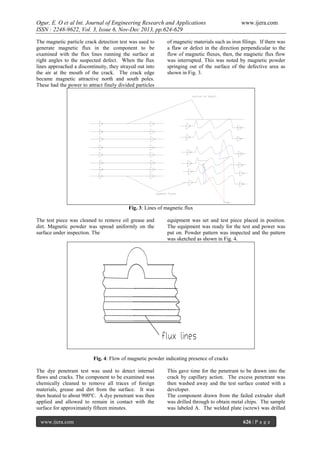
shown in Fig. 3.

Fig. 3: Lines of magnetic flux
The test piece was cleaned to remove oil grease and
dirt. Magnetic powder was spread uniformly on the
surface under inspection. The

equipment was set and test piece placed in position.
The equipment was ready for the test and power was
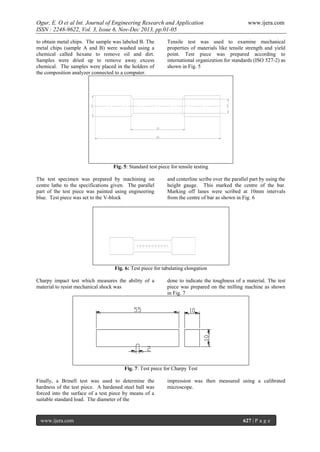
put on. Powder pattern was inspected and the pattern
was sketched as shown in Fig. 4.

Fig. 4: Flow of magnetic powder indicating presence of cracks
The dye penetrant test was used to detect internal
flaws and cracks. The component to be examined was
chemically cleaned to remove all traces of foreign
materials, grease and dirt from the surface. It was
then heated to about 900ºC. A dye penetrant was then
applied and allowed to remain in contact with the
surface for approximately fifteen minutes.
www.ijera.com

This gave time for the penetrant to be drawn into the
crack by capillary action. The excess penetrant was
then washed away and the test surface coated with a
developer.
The component drawn from the failed extruder shaft
was drilled through to obtain metal chips. The sample
was labeled A. The welded plate (screw) was drilled
626 | P a g e
Ogur, E. O et al Int. Journal of Engineering Research and Application
ISSN : 2248-9622, Vol. 3, Issue 6, Nov-Dec 2013, pp.01-05
to obtain metal chips. The sample was labeled B. The
metal chips (sample A and B) were washed using a
chemical called hexane to remove oil and dirt.
Samples were dried up to remove away excess
chemical. The samples were placed in the holders of
the composition analyzer connected to a computer.

www.ijera.com

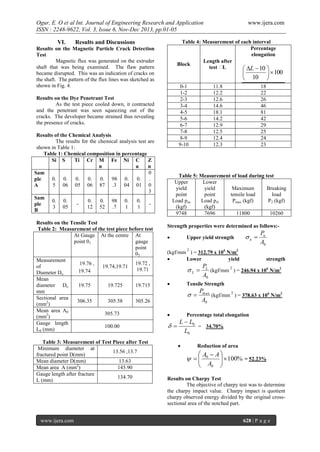
Tensile test was used to examine mechanical
properties of materials like tensile strength and yield
point. Test piece was prepared according to
international organization for standards (ISO 527-2) as
shown in Fig. 5

Fig. 5: Standard test piece for tensile testing
The test specimen was prepared by machining on
centre lathe to the specifications given. The parallel
part of the test piece was painted using engineering
blue. Test piece was set to the V-block

and centerline scribe over the parallel part by using the
height gauge. This marked the centre of the bar.
Marking off lanes were scribed at 10mm intervals
from the centre of bar as shown in Fig. 6

Fig. 6: Test piece for tabulating elongation
Charpy impact test which measures the ability of a
material to resist mechanical shock was

done to indicate the toughness of a material. The test
piece was prepared on the milling machine as shown
in Fig. 7

Fig. 7: Test piece for Charpy Test
Finally, a Brinell test was used to determine the
hardness of the test piece. A hardened steel ball was
forced into the surface of a test piece by means of a
suitable standard load. The diameter of the

www.ijera.com

impression was then measured using a calibrated
microscope.

627 | P a g e
Ogur, E. O et al Int. Journal of Engineering Research and Application
ISSN : 2248-9622, Vol. 3, Issue 6, Nov-Dec 2013, pp.01-05
VI.

Table 4: Measurement of each interval
Percentage
elongation
Length after
Block
test ΔL
 L  10 

Results and Discussions

Results on the Magnetic Particle Crack Detection
Test
Magnetic flux was generated on the extruder
shaft that was being examined. The flaw pattern
became disrupted. This was an indication of cracks on
the shaft. The pattern of the flux lines was sketched as
shown in Fig. 4.




0-1
1-2
2-3
3-4
4-5
5-6
6-7
7-8
8-9
9-10

Results on the Dye Penetrant Test
As the test piece cooled down, it contracted
and the penetrant was seen squeezing out of the
cracks. The developer became strained thus revealing
the presence of cracks.
Results of the Chemical Analysis
The results for the chemical analysis test are
shown in Table 1:
Table 1: Chemical composition in percentage
Si S
Ti Cr M Fe Ni C
Z
n
u
n
0
Sam
0. 0.
0.
0.
0. 98 0.
0.
.
ple
5 06 05 06 87 .3 04 01 0
A
3
Sam
0. 0.
0.
0. 98 0.
0.
ple
3 05
12 52 .7
1
1
B
Results on the Tensile Test
Table 2: Measurement of the test piece before test
At Gauge At the centre At
point 01
gauge
point
02
Measurement
19.72 ,
19.76 ,
of
19.74,19.71
19.71
19.74
Diameter Do
Mean
diameter Do
19.75
19.725
19.715
mm
Sectional area
306.35
305.58
305.26
(mm2)
Mean area A0
305.73
(mm2)
Gauge length
100.00
L0 (mm)
Table 3: Measurement of Test Piece after Test
Minimum diameter at
13.56 ,13.7
fractured point D(mm)
Mean diameter D(mm)
13.63
Mean area A (mm2)
145.90
Gauge length after fracture
134.70
L (mm)

www.ijera.com

www.ijera.com

  100


10

11.8
12.2
12.6
14.6
18.1
14.2
12.9
12.5
12.4
12.3

18
22
26
46
81
42
29
25
24
23

Table 5: Measurement of load during test
Upper
Lower
yield
yield
Maximum
Breaking
point
point
tensile load
load
Load psu
Load psl
Pmax (kgf)
P2 (kgf)
(kgf)
(kgf)
9748
7696
11800
10260
Strength properties were determined as follows:

Upper yield strength

u 

Pu
A0

2

(kgf/mm ) = 312.79 x 10⁶ N/m2

Lower
yield

strength

P
 L  L (kgf/mm 2 ) = 246.94 x 10⁶ N/m2
A0


Tensile Strength




Pm ax
2
(kgf/mm ) = 378.63 x 10⁶ N/m2
A0

Percentage total elongation

L  L0

= 34.70%
L0


Reduction of area

 A0  A 
  100% = 52.23%

 A0 

 


Results on Charpy Test
The objective of charpy test was to determine
the charpy impact value. Charpy impact is quotient
charpy observed energy divided by the original crosssectional area of the notched part.
628 | P a g e
Ogur, E. O et al Int. Journal of Engineering Research and Application
ISSN : 2248-9622, Vol. 3, Issue 6, Nov-Dec 2013, pp.01-05

P
where
value

P

Diameter of indentation d
Brinell hardness number HB

E
A

=

Charpy

impact

E
=
Energy used in
breaking test piece
A
=
Cross
sectional
area of the notched part
The value of the energy used in breaking the test piece
was determined by the expression;E
=
WL (cosβ
cos  )
Where
E
:
Energy
for
breaking test piece
W
:
Weight
of
pendulum
L
:
Distance from axis
of rotation to centre of gravity of
Pendulum

:
Angle of fall of
pendulum
β
:
Angle of rise of
pendulum in its swing after breaking
the pendulum
The above parameters were obtained as:
W
=
261.54N
L
=
0.75m
A
=
80mm2

=
141º
Β
=
119º
The value of
E
=
261.54 x 0.75
(cos119º – cos141º)
=
57.34 N-m


P

Charpy impact value

E
A

= 0.716 x 10⁶ N/m

VII.

where

HB

[2]

2P

D( D  D 2  d 2 )
:

Brinell hardness number
[3]

2

(kg/mm )
P
D
D
(mm)

:
:
:

Load (kg)
Diameter of steel ball (mm)
Diameter of indentation

These parameters obtained were:
Load
750kg
Diameter of steel ball
10mm
www.ijera.com

4.87mm
37.72

Conclusions and Recommendations

References
[1]

=

=

Based on the findings of this study, the
following conclusions are drawn:
 Failure is said to have occurred when a
component or structure ceases to function as
intended. Visual inspection on the failed extruder
shaft of the machine revealed that the shaft was
slightly bent at the centre. The screw which was
welded along the shaft had developed cracks at
the welded joints.
 The magnetic particle test performed on the failed
shaft revealed presence of cracks on the surface of
the shaft. This was confirmed by dye penetrant
testing. The developer was seen squeezing out of
the cracks. The cracks had started on the surface
and propagated through the shaft material.
 Inspection of the weld revealed flaws on welding.
Undercut was visible which meant welding
current was too high. There was an overlap on
the welded joint.
This indicated the weld
penetration of deposit metal was not enough.
Test on toughness and hardness conformed to
standard properties of mild steel. The chemical
analysis tests agreed with the chemical
composition of mild steel.
Based on the study findings, the following
recommendations were:
 The manufacturing and fabrication process of the
equipment should be improved.
 The extruder shaft should be machined with
higher degree of surface finish.
 The loading capacity should be specific to avoid
situations of either under-loading or over loading
the machine.

Determination of Brinell hardness number
Brinell hardness number HB was calculated using the
expression;HB

www.ijera.com

P

-

D

Bhaumik, S.K. (2000), Root Cause Analysis
in Engineering Failures, Transactions of the
Indian Institute of Metals, Vol. 63, No. 2-3,
pp. 297 – 299
Zamanzadeh, M, Larkin, E. and Gibbon, D,
A Re-Examination of Failure Analysis and
Root
Cause
Determination,
www.matcoinc.com (website accessed 20th
February 2013)
Davidson, T, An Introduction to Failure
Analysis for Metallurgical Engineers,
www.tms.org/students/winners/Davidson.htm
l (website accessed 20th February 2013)

-

629 | P a g e

Dc36624629

  • 1.
    Ogur, E. Oet al Int. Journal of Engineering Research and Applications ISSN : 2248-9622, Vol. 3, Issue 6, Nov-Dec 2013, pp.624-629 RESEARCH ARTICLE www.ijera.com OPEN ACCESS Failure Analysis of a bar Soap Extrusion Machine Ogur, E. O1 and Mburu, J. K2 1 Department of Mechanical and Mechatronic Engineering, Technical University of Kenya, P.O. Box 52428 – 00200, Nairobi 2 Department of Mechanical Engineering, National Youth Service Engineering Institute, P.O. Box 30397 – 00100, Nairobi Abstract Failure occurs where a component or structure ceases to function as intended. Failure analysis is the process of collecting and analyzing data to determine the causes of failure. It is a vital tool used in the development of new products and for the improvement of existing products. This study investigates, using failure analysis, a bar soap extruding machine. The extruder shaft of the machine failed and the equipment ceased to function as intended. The extruder had a spiral screw which was welded along the shaft. There were cracks on the welded point. In this study, destructive and non-destructive tests were conducted to establish physical properties of the failed component. Chemical analysis was performed to determine chemical composition of the failed parts. The analysis of data led to the conclusion that failure occurred due to poor maintenance of the equipment. The manufacturing processes had defects which acted as sites of crack initiation and the crack propagation was accelerated by cyclic loading. Keywords: failure mode and effects analysis, crack propagation, magnetic particle crack detection I. Introduction A failure mode and effects analysis (FMEA) is a procedure in product development and operations management for analysis of potential failure modes within a system. A successful FMEA activity helps a team to identify potential failure modes based on past experience with similar products or processes. This helps the designer to design those failures out of the system with minimum effort and resource expenditure, thereby, reducing development time and costs. It is widely used in manufacturing industries in various phases of the product life cycle and is now increasingly finding use in the service industry. FMEA are any errors or defects in a process design or item especially those that affect the customer and can be potential or actual. Effects analysis refers to studying the consequences of these failures. Although initially developed by the military, FMEA methodology is now extensively used in a variety of industries including semiconductor processing, food service, plastics, software and health care. It is integrated into the Advanced Product Quality Planning (APQP) process development phases. Each potential cause must be considered for its effect on the product or process and based on the risk, actions are www.ijera.com determined and risks revisited after actions are complete. Failure analysis is used during the design stage with an aim to avoid future failures [1,2]. Later, it is used for process control before and during the ongoing operation of the process and continuous throughout the life of the product or service. The outcome of this failure analysis will develop actions to prevent or reduce the severity or likelihood of failure of the bar soap extruding machine. It may be used to evaluate risk management priorities for mitigating known threat vulnerabilities. II. Statement of the Problem During an exhibition, the bar soap extruding machine failed and almost caused a fatal accident. The extruding shaft of the machine developed a crack near the coupling of the extruder and the drive motor shaft. The spiral which was welded along the length of the shaft developed cracks at the welded joint. The purpose of this study was to establish the root causes of failure of the bar soap machine so as to prevent future occurrence. The study entailed completing a conclusive failure analysis. Investigations were carried out using a systematic approach similar to that outlined in Fig. 1. 624 | P a g e
  • 2.
    Ogur, E. Oet al Int. Journal of Engineering Research and Application ISSN : 2248-9622, Vol. 3, Issue 6, Nov-Dec 2013, pp.01-05 www.ijera.com Fig. 1: Flow diagram of failure analysis procedure [3] III. Objectives of the study The overall objective of this study was to investigate causes of failure of the bar soap extruding machine. The study addressed the following specific objectives: 1. Investigating the factors that contributed to failure of the bar soap machine 2. Performing destructive and non-destructive tests on the failed parts 3. Examining failure modes by which the machine failed IV. Significance of the Study FMEA and prevention are important element in every design consideration. It is important to undertake failure analysis in order to improve on performance of a component and improve its reliability. Failure can be catastrophic and may lead to loss of life and property. The study of failure modes and their prevention is an important integral in safety design. The findings of failure analysis can be used by insurance companies to calculate the risks involved in insuring various components and structures. Metallurgical failure analysis plays a critical role in determination of sequence of failure, and ultimately in identification of the causes of failure of the bar soap extruding machine. V. Materials and Methods The study was conducted using an experiment. The following activities were done to achieve the objectives of this study. A preliminary study of the use of machine was done on site with photographs taken as shown in Fig. 2. A magnetic particle crack detection test was performed and then a dye penetrant test was then conducted. This was followed was by a chemical analysis of the sample. Mechanical tests including the Brinell, Charpy and Tensile tests were performed. Fig 2: The extruder shaft welded screw joint www.ijera.com 625 | P a g e
  • 3.
    Ogur, E. Oet al Int. Journal of Engineering Research and Applications ISSN : 2248-9622, Vol. 3, Issue 6, Nov-Dec 2013, pp.624-629 The magnetic particle crack detection test was used to generate magnetic flux in the component to be examined with the flux lines running the surface at right angles to the suspected defect. When the flux lines approached a discontinuity, they strayed out into the air at the mouth of the crack. The crack edge became magnetic attractive north and south poles. These had the power to attract finely divided particles www.ijera.com of magnetic materials such as iron filings. If there was a flaw or defect in the direction perpendicular to the flow of magnetic fluxes, then, the magnetic flux flow was interrupted. This was noted by magnetic powder springing out of the surface of the defective area as shown in Fig. 3. Fig. 3: Lines of magnetic flux The test piece was cleaned to remove oil grease and dirt. Magnetic powder was spread uniformly on the surface under inspection. The equipment was set and test piece placed in position. The equipment was ready for the test and power was put on. Powder pattern was inspected and the pattern was sketched as shown in Fig. 4. Fig. 4: Flow of magnetic powder indicating presence of cracks The dye penetrant test was used to detect internal flaws and cracks. The component to be examined was chemically cleaned to remove all traces of foreign materials, grease and dirt from the surface. It was then heated to about 900ºC. A dye penetrant was then applied and allowed to remain in contact with the surface for approximately fifteen minutes. www.ijera.com This gave time for the penetrant to be drawn into the crack by capillary action. The excess penetrant was then washed away and the test surface coated with a developer. The component drawn from the failed extruder shaft was drilled through to obtain metal chips. The sample was labeled A. The welded plate (screw) was drilled 626 | P a g e
  • 4.
    Ogur, E. Oet al Int. Journal of Engineering Research and Application ISSN : 2248-9622, Vol. 3, Issue 6, Nov-Dec 2013, pp.01-05 to obtain metal chips. The sample was labeled B. The metal chips (sample A and B) were washed using a chemical called hexane to remove oil and dirt. Samples were dried up to remove away excess chemical. The samples were placed in the holders of the composition analyzer connected to a computer. www.ijera.com Tensile test was used to examine mechanical properties of materials like tensile strength and yield point. Test piece was prepared according to international organization for standards (ISO 527-2) as shown in Fig. 5 Fig. 5: Standard test piece for tensile testing The test specimen was prepared by machining on centre lathe to the specifications given. The parallel part of the test piece was painted using engineering blue. Test piece was set to the V-block and centerline scribe over the parallel part by using the height gauge. This marked the centre of the bar. Marking off lanes were scribed at 10mm intervals from the centre of bar as shown in Fig. 6 Fig. 6: Test piece for tabulating elongation Charpy impact test which measures the ability of a material to resist mechanical shock was done to indicate the toughness of a material. The test piece was prepared on the milling machine as shown in Fig. 7 Fig. 7: Test piece for Charpy Test Finally, a Brinell test was used to determine the hardness of the test piece. A hardened steel ball was forced into the surface of a test piece by means of a suitable standard load. The diameter of the www.ijera.com impression was then measured using a calibrated microscope. 627 | P a g e
  • 5.
    Ogur, E. Oet al Int. Journal of Engineering Research and Application ISSN : 2248-9622, Vol. 3, Issue 6, Nov-Dec 2013, pp.01-05 VI. Table 4: Measurement of each interval Percentage elongation Length after Block test ΔL  L  10  Results and Discussions Results on the Magnetic Particle Crack Detection Test Magnetic flux was generated on the extruder shaft that was being examined. The flaw pattern became disrupted. This was an indication of cracks on the shaft. The pattern of the flux lines was sketched as shown in Fig. 4.   0-1 1-2 2-3 3-4 4-5 5-6 6-7 7-8 8-9 9-10 Results on the Dye Penetrant Test As the test piece cooled down, it contracted and the penetrant was seen squeezing out of the cracks. The developer became strained thus revealing the presence of cracks. Results of the Chemical Analysis The results for the chemical analysis test are shown in Table 1: Table 1: Chemical composition in percentage Si S Ti Cr M Fe Ni C Z n u n 0 Sam 0. 0. 0. 0. 0. 98 0. 0. . ple 5 06 05 06 87 .3 04 01 0 A 3 Sam 0. 0. 0. 0. 98 0. 0. ple 3 05 12 52 .7 1 1 B Results on the Tensile Test Table 2: Measurement of the test piece before test At Gauge At the centre At point 01 gauge point 02 Measurement 19.72 , 19.76 , of 19.74,19.71 19.71 19.74 Diameter Do Mean diameter Do 19.75 19.725 19.715 mm Sectional area 306.35 305.58 305.26 (mm2) Mean area A0 305.73 (mm2) Gauge length 100.00 L0 (mm) Table 3: Measurement of Test Piece after Test Minimum diameter at 13.56 ,13.7 fractured point D(mm) Mean diameter D(mm) 13.63 Mean area A (mm2) 145.90 Gauge length after fracture 134.70 L (mm) www.ijera.com www.ijera.com   100  10 11.8 12.2 12.6 14.6 18.1 14.2 12.9 12.5 12.4 12.3 18 22 26 46 81 42 29 25 24 23 Table 5: Measurement of load during test Upper Lower yield yield Maximum Breaking point point tensile load load Load psu Load psl Pmax (kgf) P2 (kgf) (kgf) (kgf) 9748 7696 11800 10260 Strength properties were determined as follows: Upper yield strength u  Pu A0 2 (kgf/mm ) = 312.79 x 10⁶ N/m2  Lower yield strength P  L  L (kgf/mm 2 ) = 246.94 x 10⁶ N/m2 A0  Tensile Strength   Pm ax 2 (kgf/mm ) = 378.63 x 10⁶ N/m2 A0 Percentage total elongation L  L0  = 34.70% L0  Reduction of area  A0  A    100% = 52.23%   A0     Results on Charpy Test The objective of charpy test was to determine the charpy impact value. Charpy impact is quotient charpy observed energy divided by the original crosssectional area of the notched part. 628 | P a g e
  • 6.
    Ogur, E. Oet al Int. Journal of Engineering Research and Application ISSN : 2248-9622, Vol. 3, Issue 6, Nov-Dec 2013, pp.01-05 P where value P Diameter of indentation d Brinell hardness number HB E A = Charpy impact E = Energy used in breaking test piece A = Cross sectional area of the notched part The value of the energy used in breaking the test piece was determined by the expression;E = WL (cosβ cos  ) Where E : Energy for breaking test piece W : Weight of pendulum L : Distance from axis of rotation to centre of gravity of Pendulum  : Angle of fall of pendulum β : Angle of rise of pendulum in its swing after breaking the pendulum The above parameters were obtained as: W = 261.54N L = 0.75m A = 80mm2  = 141º Β = 119º The value of E = 261.54 x 0.75 (cos119º – cos141º) = 57.34 N-m  P Charpy impact value E A = 0.716 x 10⁶ N/m VII. where HB [2] 2P D( D  D 2  d 2 ) : Brinell hardness number [3] 2 (kg/mm ) P D D (mm) : : : Load (kg) Diameter of steel ball (mm) Diameter of indentation These parameters obtained were: Load 750kg Diameter of steel ball 10mm www.ijera.com 4.87mm 37.72 Conclusions and Recommendations References [1] = = Based on the findings of this study, the following conclusions are drawn:  Failure is said to have occurred when a component or structure ceases to function as intended. Visual inspection on the failed extruder shaft of the machine revealed that the shaft was slightly bent at the centre. The screw which was welded along the shaft had developed cracks at the welded joints.  The magnetic particle test performed on the failed shaft revealed presence of cracks on the surface of the shaft. This was confirmed by dye penetrant testing. The developer was seen squeezing out of the cracks. The cracks had started on the surface and propagated through the shaft material.  Inspection of the weld revealed flaws on welding. Undercut was visible which meant welding current was too high. There was an overlap on the welded joint. This indicated the weld penetration of deposit metal was not enough. Test on toughness and hardness conformed to standard properties of mild steel. The chemical analysis tests agreed with the chemical composition of mild steel. Based on the study findings, the following recommendations were:  The manufacturing and fabrication process of the equipment should be improved.  The extruder shaft should be machined with higher degree of surface finish.  The loading capacity should be specific to avoid situations of either under-loading or over loading the machine. Determination of Brinell hardness number Brinell hardness number HB was calculated using the expression;HB www.ijera.com P - D Bhaumik, S.K. (2000), Root Cause Analysis in Engineering Failures, Transactions of the Indian Institute of Metals, Vol. 63, No. 2-3, pp. 297 – 299 Zamanzadeh, M, Larkin, E. and Gibbon, D, A Re-Examination of Failure Analysis and Root Cause Determination, www.matcoinc.com (website accessed 20th February 2013) Davidson, T, An Introduction to Failure Analysis for Metallurgical Engineers, www.tms.org/students/winners/Davidson.htm l (website accessed 20th February 2013) - 629 | P a g e