The UniProt SPARQL endpoint:
20 billion quads in production
© 2015 SIB
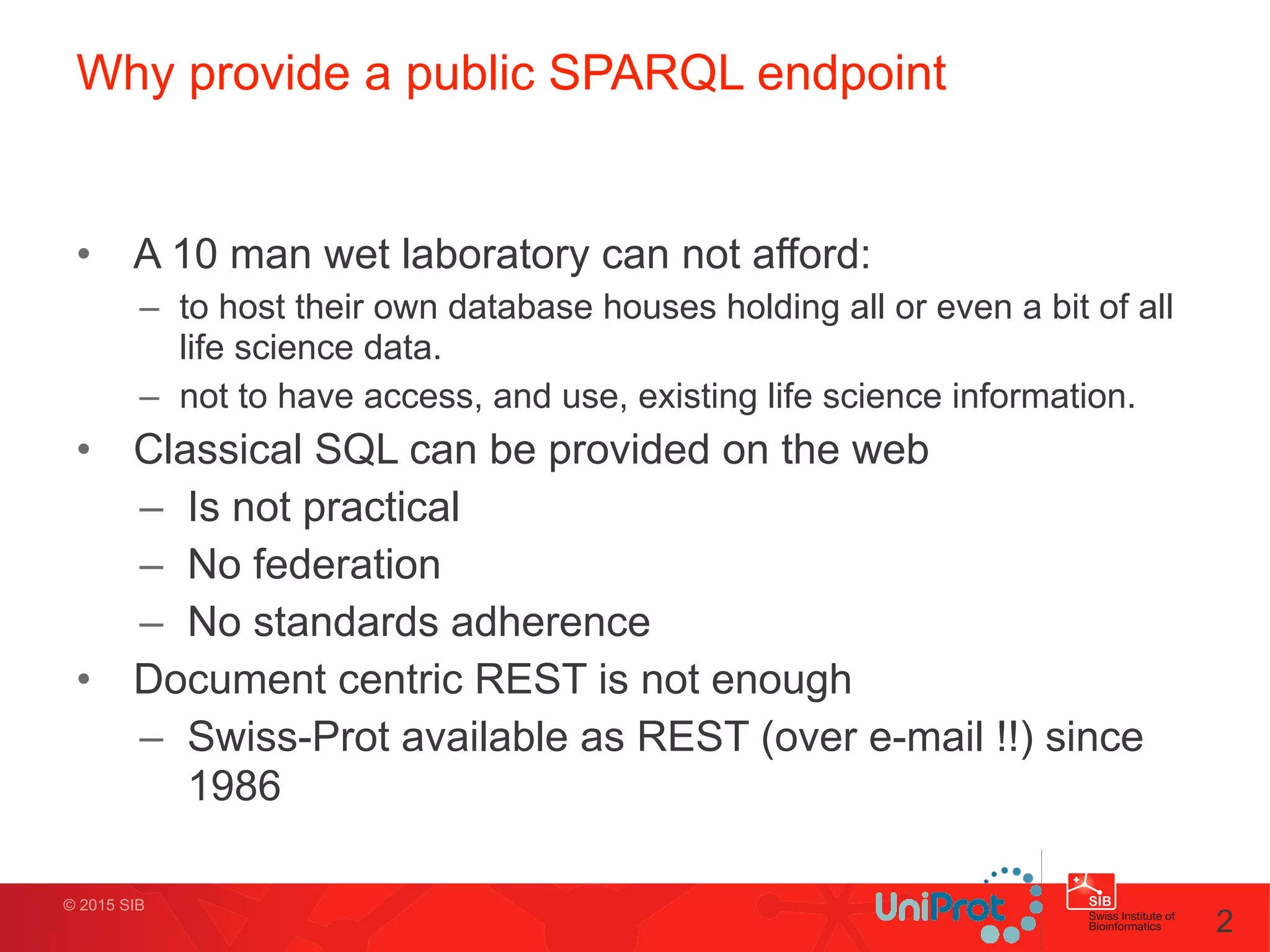
Why provide a public SPARQL endpoint
• A 10 man wet laboratory can not afford:
– to host their own database houses holding all or even a bit of all
life science data.
– not to have access, and use, existing life science information.
• Classical SQL can be provided on the web
– Is not practical
– No federation
– No standards adherence
• Document centric REST is not enough
– Swiss-Prot available as REST (over e-mail !!) since
1986
2
© 2015 SIB
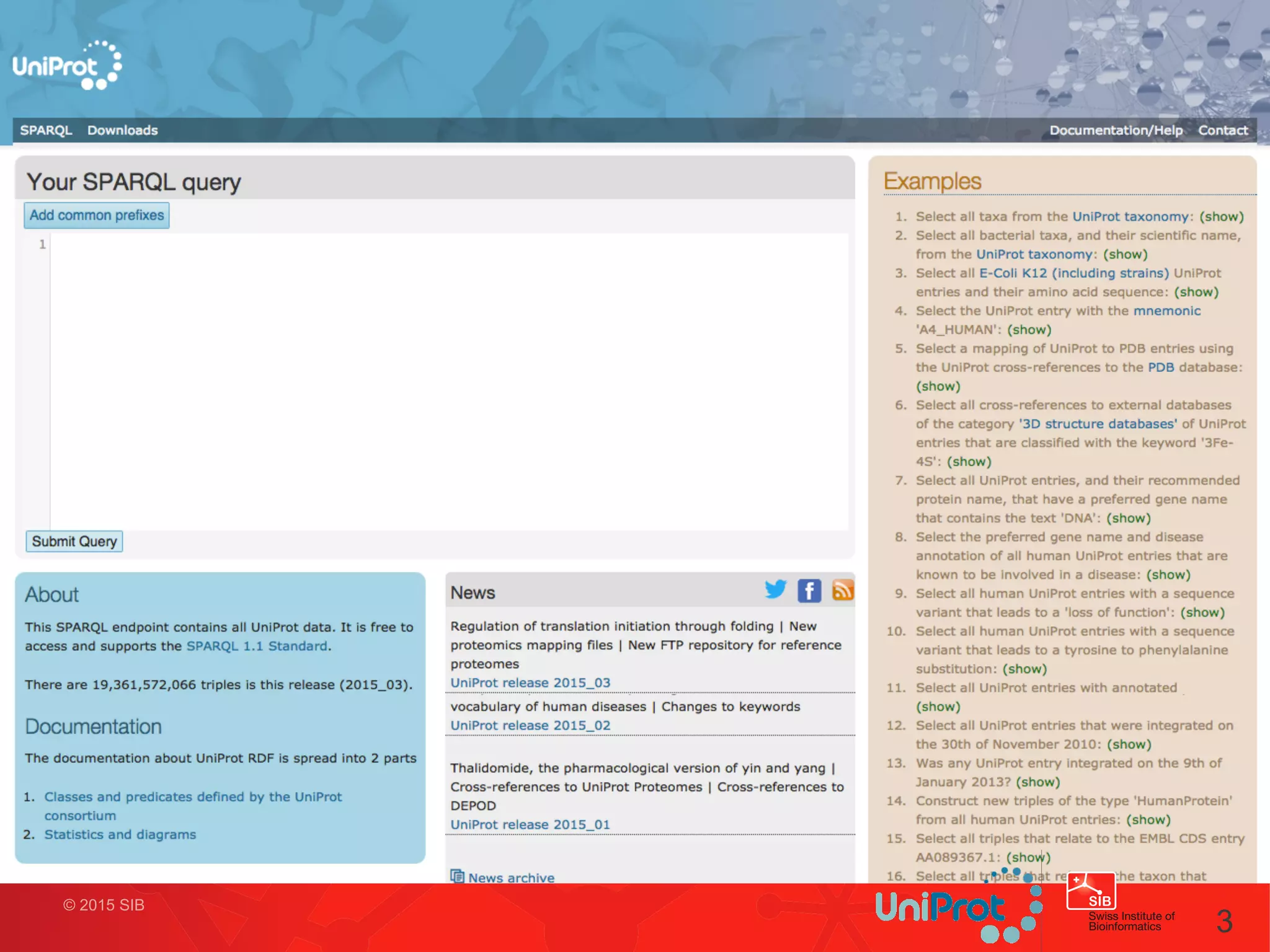
3
© 2015 SIB
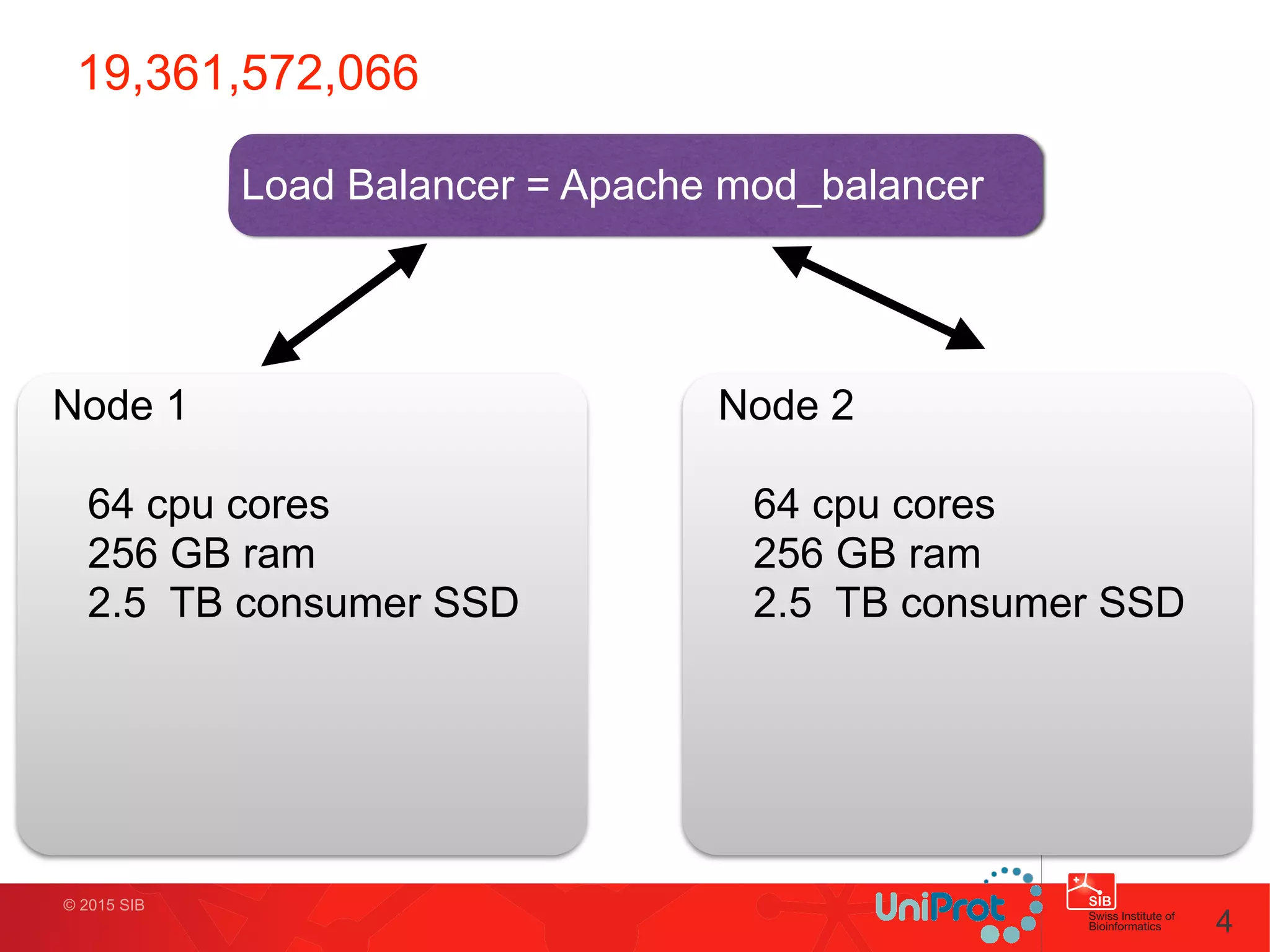
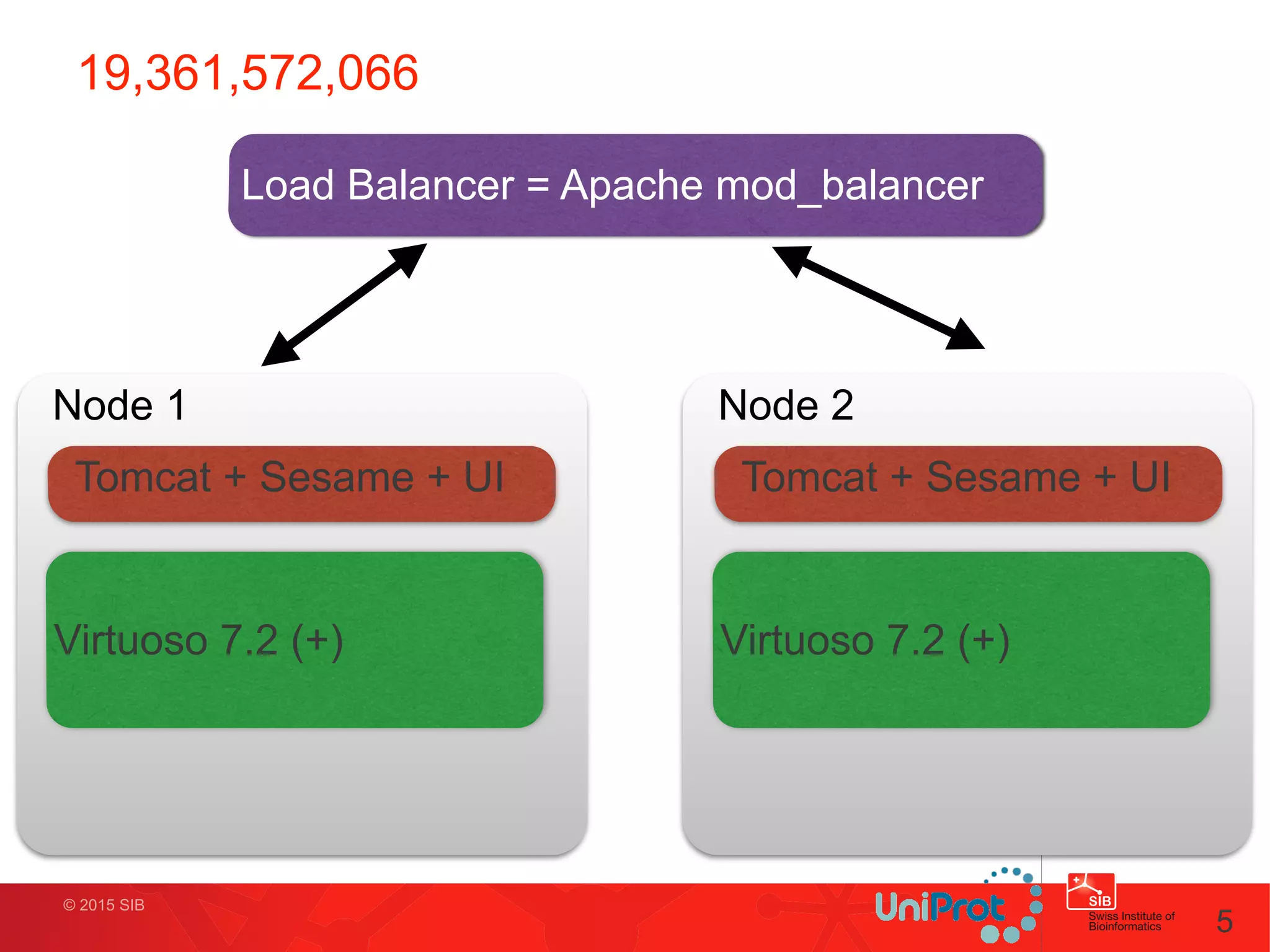
19,361,572,066
4
Node 1
!
64 cpu cores
256 GB ram
2.5 TB consumer SSD
Load Balancer = Apache mod_balancer
Node 2
!
64 cpu cores
256 GB ram
2.5 TB consumer SSD
© 2015 SIB
19,361,572,066
5
Node 1 Node 2
Tomcat + Sesame + UI
Virtuoso 7.2 (+)
Tomcat + Sesame + UI
Virtuoso 7.2 (+)
Load Balancer = Apache mod_balancer
© 2015 SIB
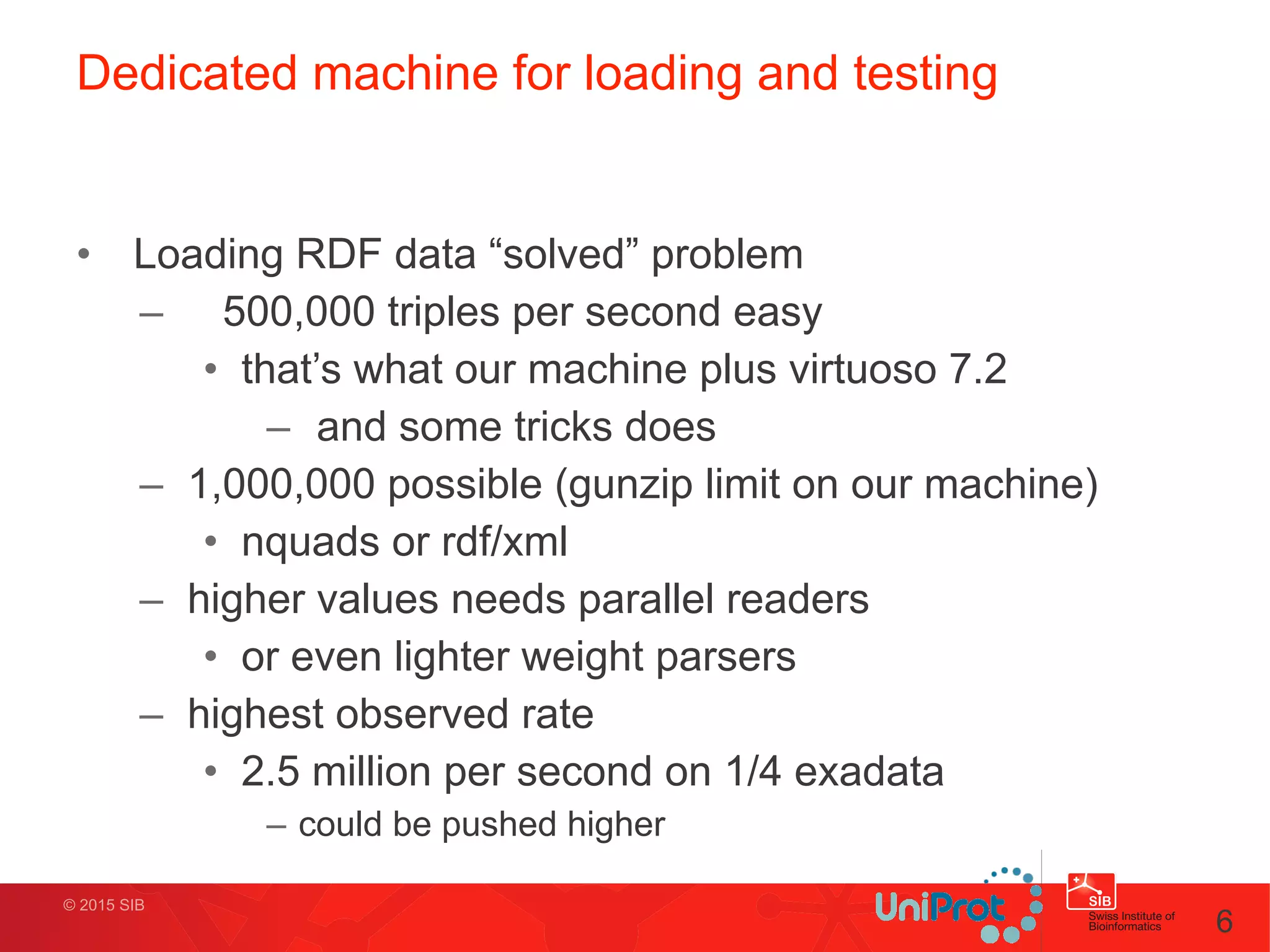
Dedicated machine for loading and testing
• Loading RDF data “solved” problem
– 500,000 triples per second easy
• that’s what our machine plus virtuoso 7.2
– and some tricks does
– 1,000,000 possible (gunzip limit on our machine)
• nquads or rdf/xml
– higher values needs parallel readers
• or even lighter weight parsers
– highest observed rate
• 2.5 million per second on 1/4 exadata
– could be pushed higher
6
© 2015 SIB
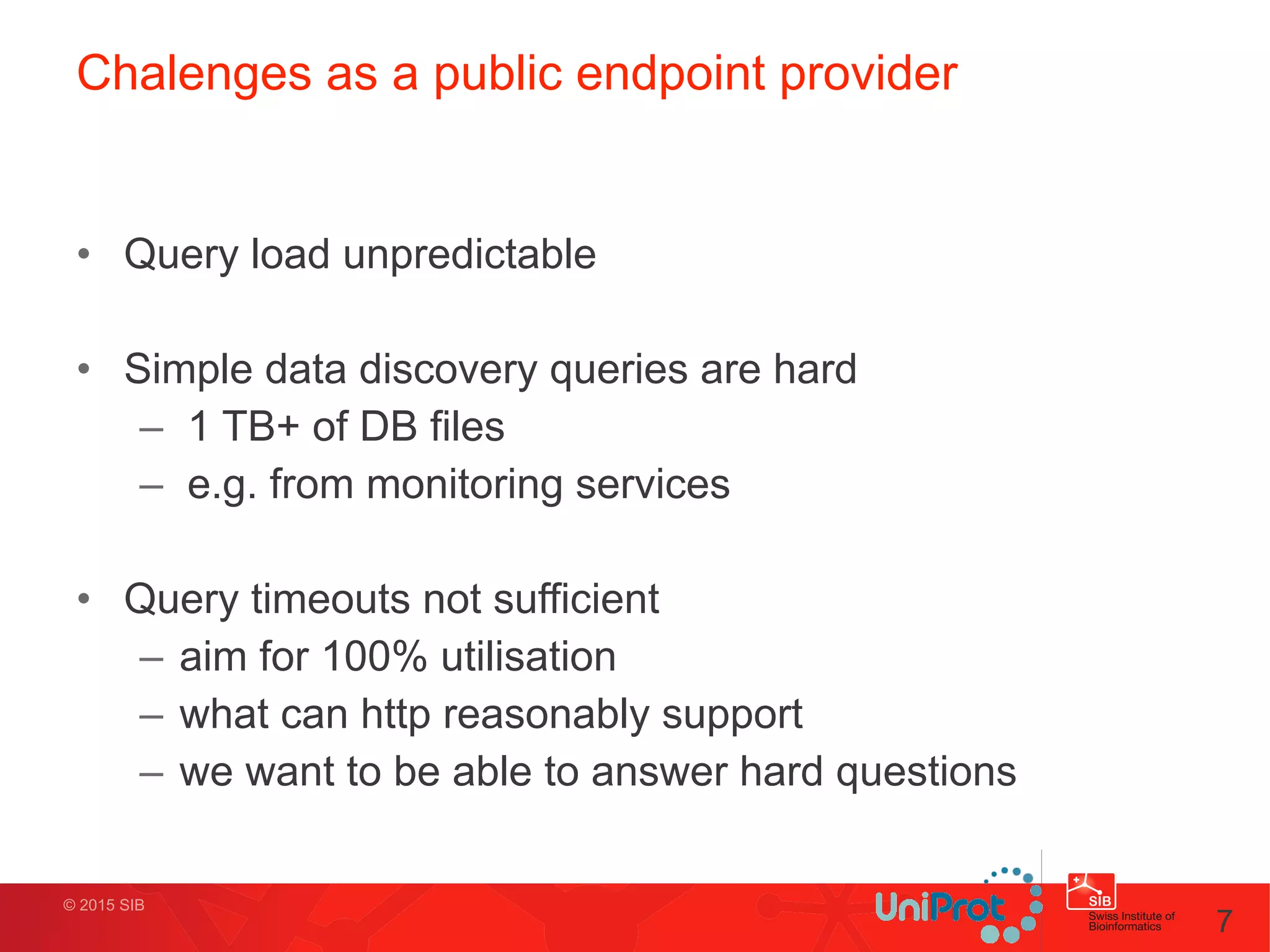
Chalenges as a public endpoint provider
• Query load unpredictable
!
• Simple data discovery queries are hard
– 1 TB+ of DB files
– e.g. from monitoring services
!
• Query timeouts not sufficient
– aim for 100% utilisation
– what can http reasonably support
– we want to be able to answer hard questions
7
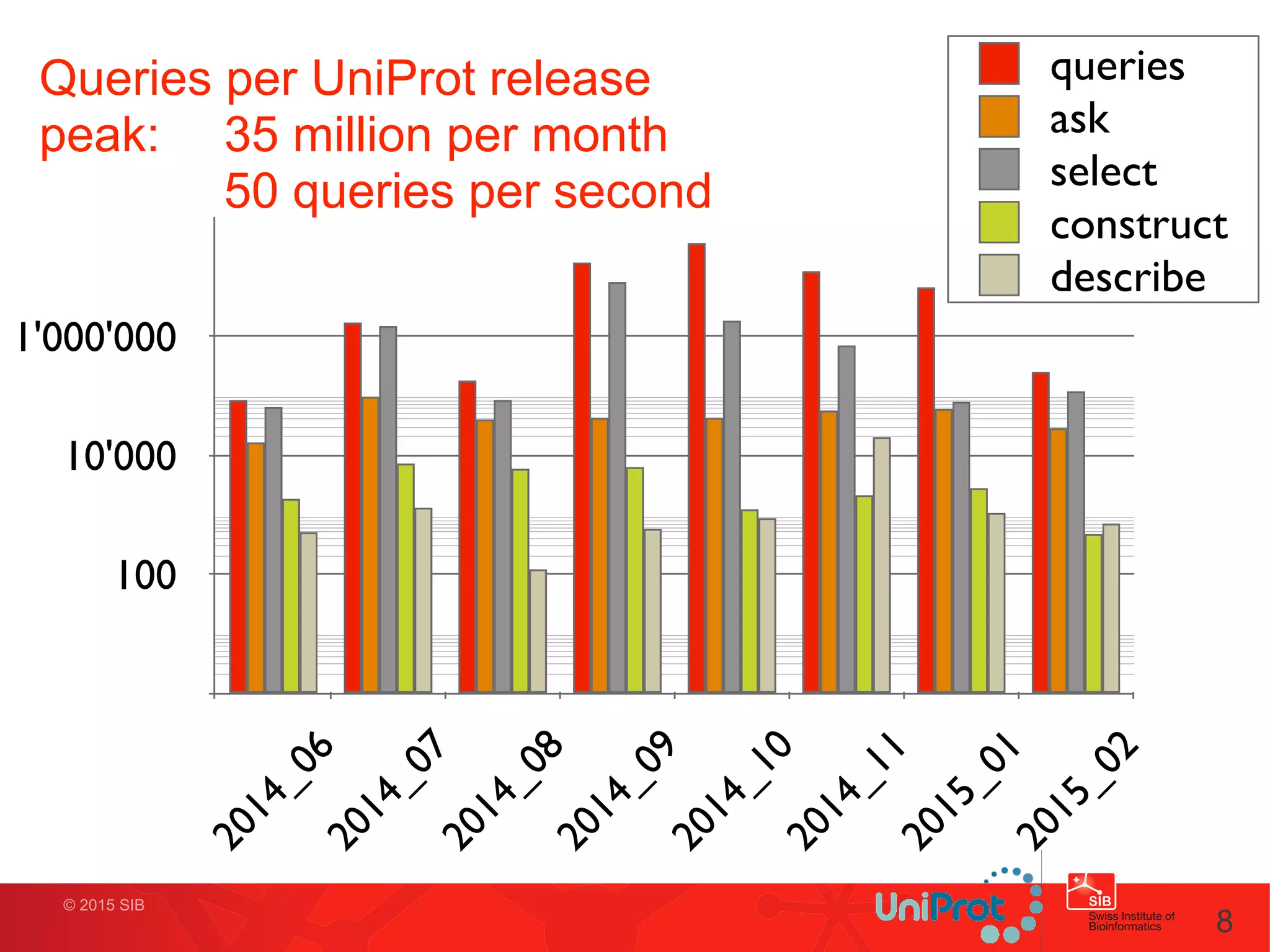
100
10'000
1'000'000
2014_06
2014_07
2014_08
2014_09
2014_10
2014_11
2015_01
2015_02
queries
ask
select
construct
describe
© 2015 SIB
Queries per UniProt release
peak: 35 million per month
50 queries per second
8
© 2015 SIB
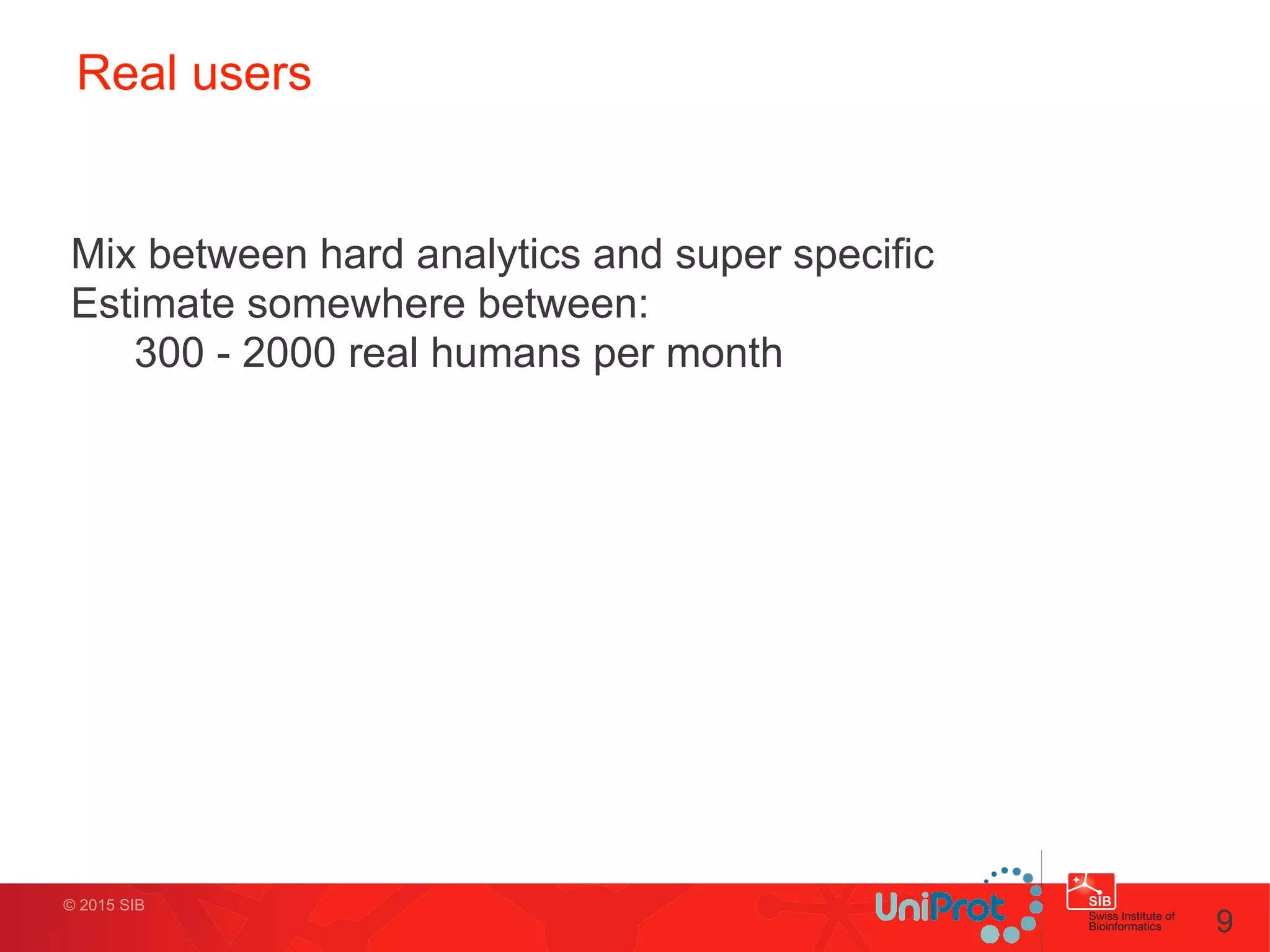
Real users
Mix between hard analytics and super specific
Estimate somewhere between:
300 - 2000 real humans per month
9
© 2015 SIB
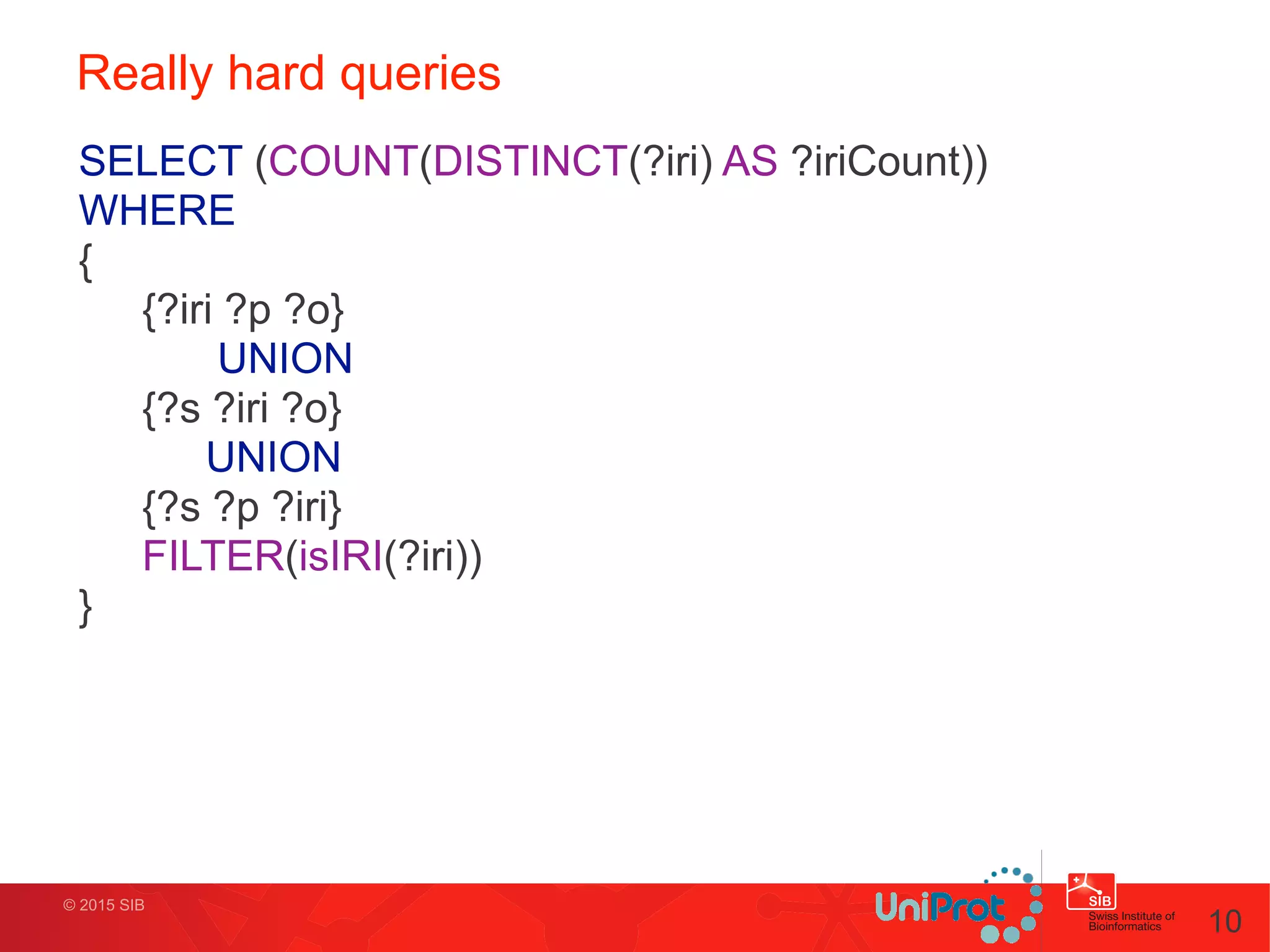
Really hard queries
10
SELECT (COUNT(DISTINCT(?iri) AS ?iriCount))
WHERE
{
{?iri ?p ?o}
UNION
{?s ?iri ?o}
UNION
{?s ?p ?iri}
FILTER(isIRI(?iri))
}
© 2014 SIB
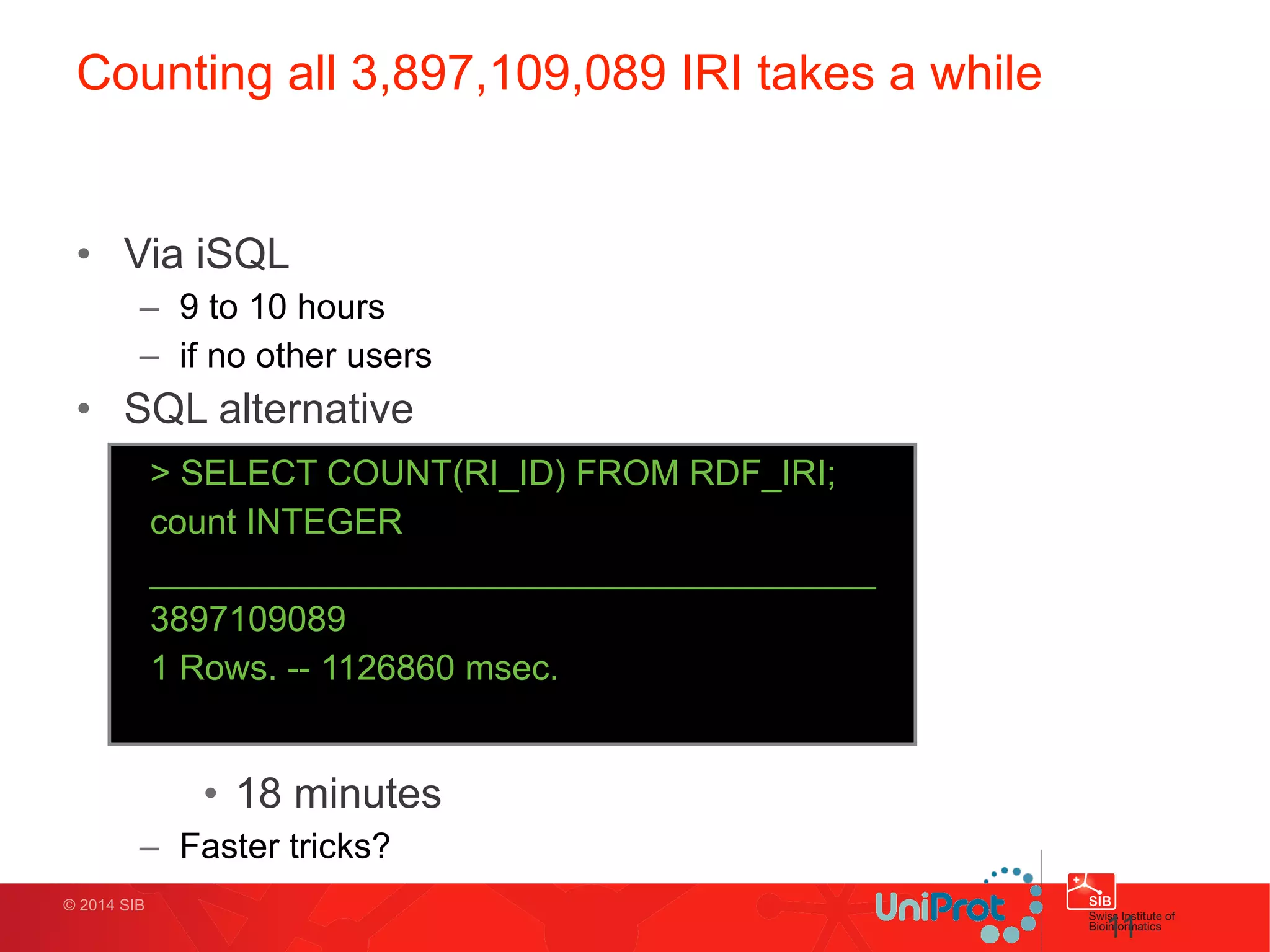
Counting all 3,897,109,089 IRI takes a while
• Via iSQL
– 9 to 10 hours
– if no other users
• SQL alternative
!
!
!
!
!
!
• 18 minutes
– Faster tricks?
11
> SELECT COUNT(RI_ID) FROM RDF_IRI;
count INTEGER
_____________________________________
3897109089
1 Rows. -- 1126860 msec.
© 2015 SIB
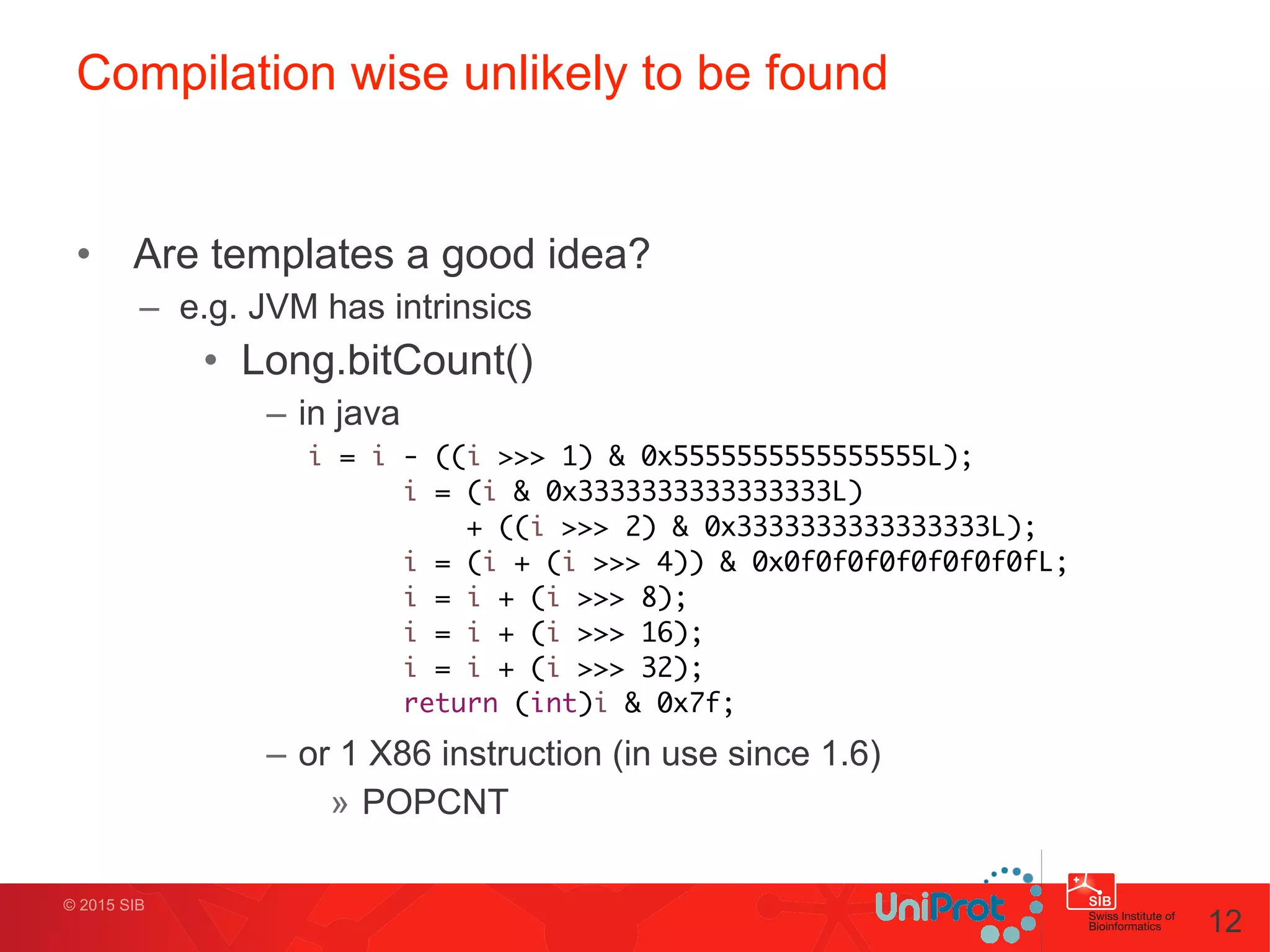
Compilation wise unlikely to be found
• Are templates a good idea?
– e.g. JVM has intrinsics
• Long.bitCount()
– in java
!
!
!
!
!
!
– or 1 X86 instruction (in use since 1.6)
» POPCNT
12
i = i - ((i >>> 1) & 0x5555555555555555L);	
i = (i & 0x3333333333333333L) 	
	 	 	 + ((i >>> 2) & 0x3333333333333333L);	
i = (i + (i >>> 4)) & 0x0f0f0f0f0f0f0f0fL;	
i = i + (i >>> 8);	
i = i + (i >>> 16);	
i = i + (i >>> 32);	
return (int)i & 0x7f;
© 2015 SIB
Template/Intrinsics based SPARQL compilation
• Recognising query template matches can be difficult
– query normalisation?
13
© 2015 SIB
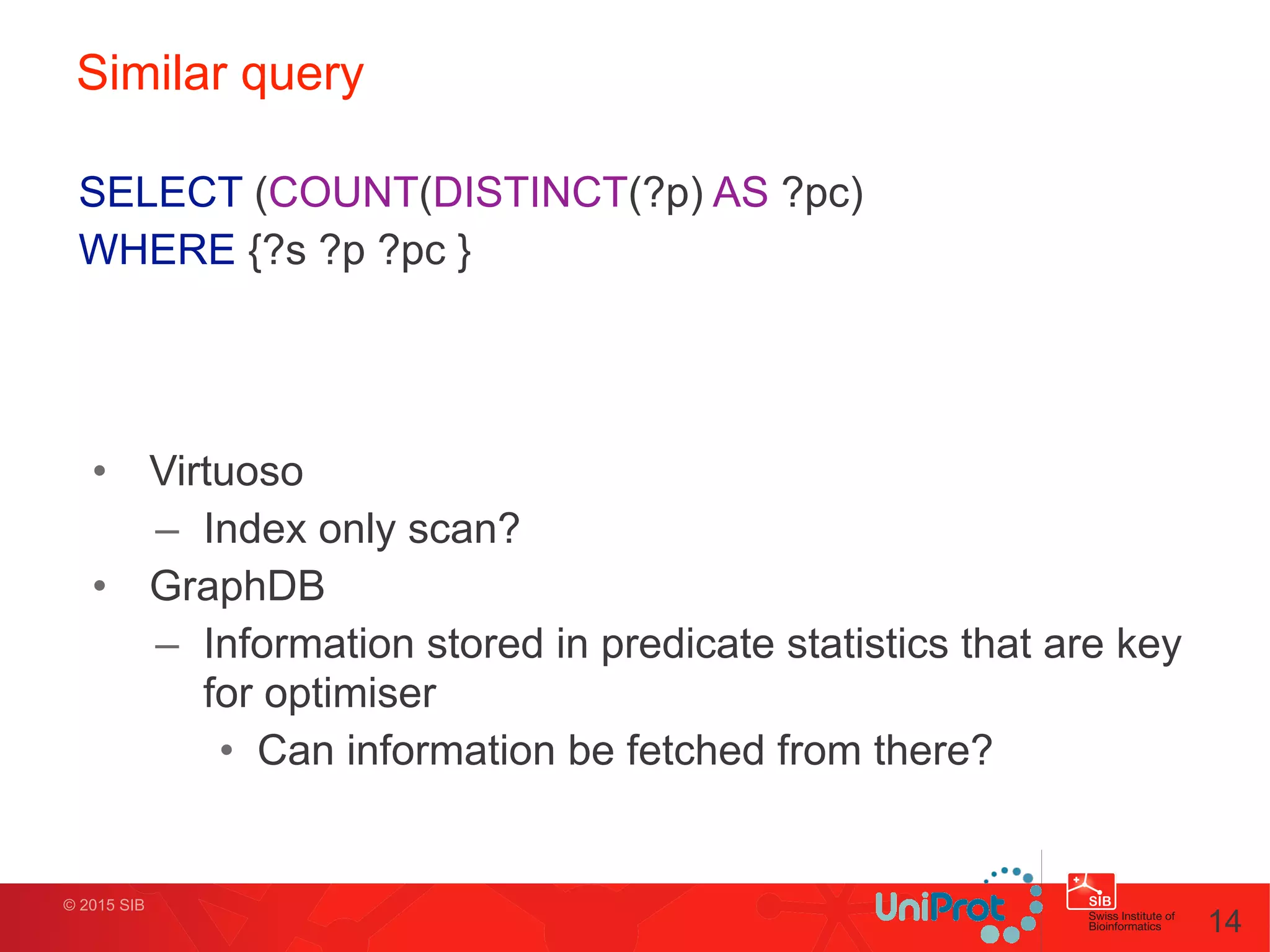
Similar query
• Virtuoso
– Index only scan?
• GraphDB
– Information stored in predicate statistics that are key
for optimiser
• Can information be fetched from there?
14
SELECT (COUNT(DISTINCT(?p) AS ?pc)
WHERE {?s ?p ?pc }
© 2015 SIB
Challenges
• Virtuoso
– transitive queries
– standards compliance
!
• GraphDB
– analytical queries
– complete store scans
!
• Oracle 12c1
– configuration
– global RDF tablespace
• difficult to manage as a normal Oracle DB
15
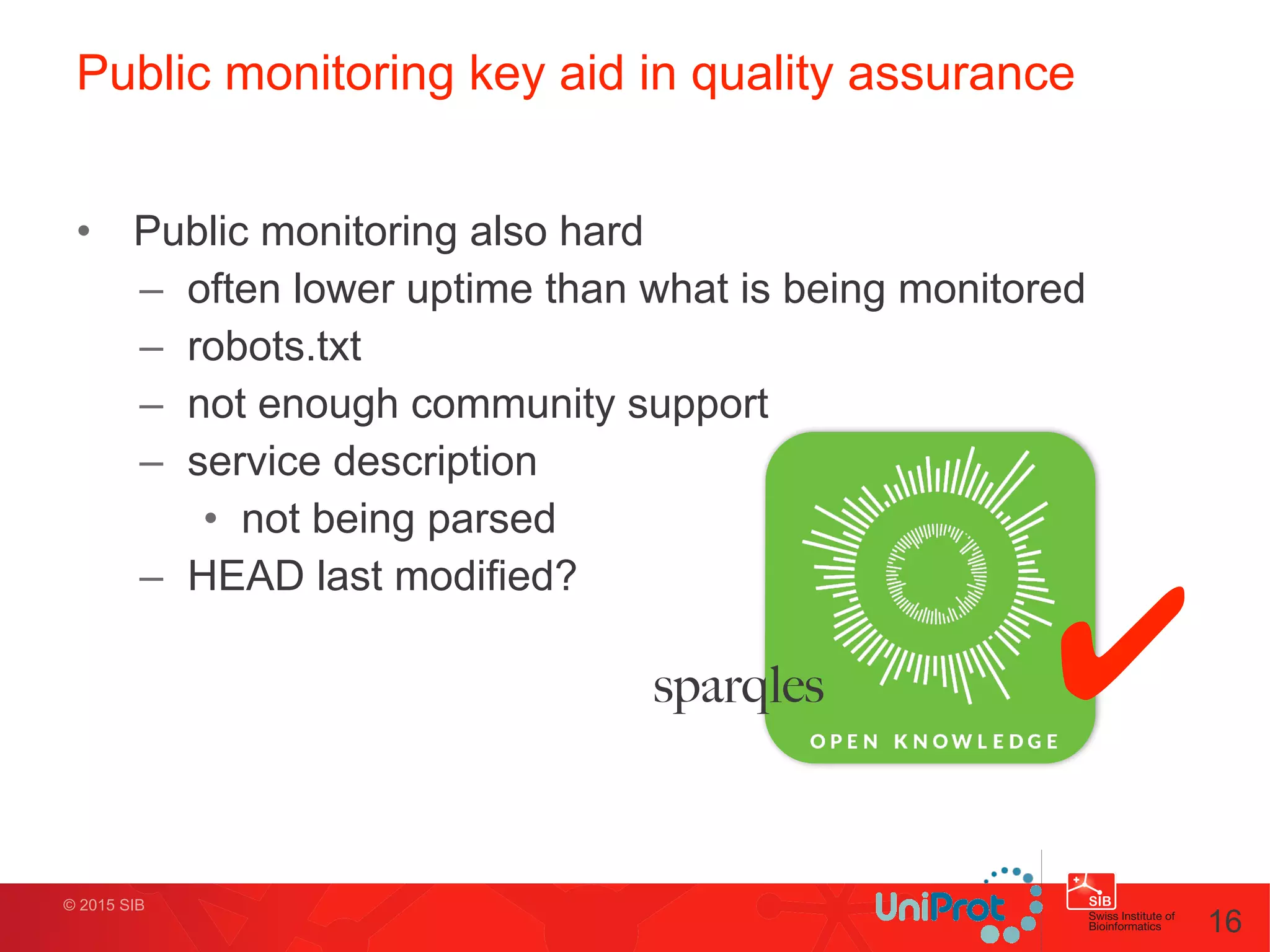
• Public monitoring also hard
– often lower uptime than what is being monitored
– robots.txt
– not enough community support
– service description
• not being parsed
– HEAD last modified?
© 2015 SIB
Public monitoring key aid in quality assurance
16
✔sparqles
© 2015 SIB
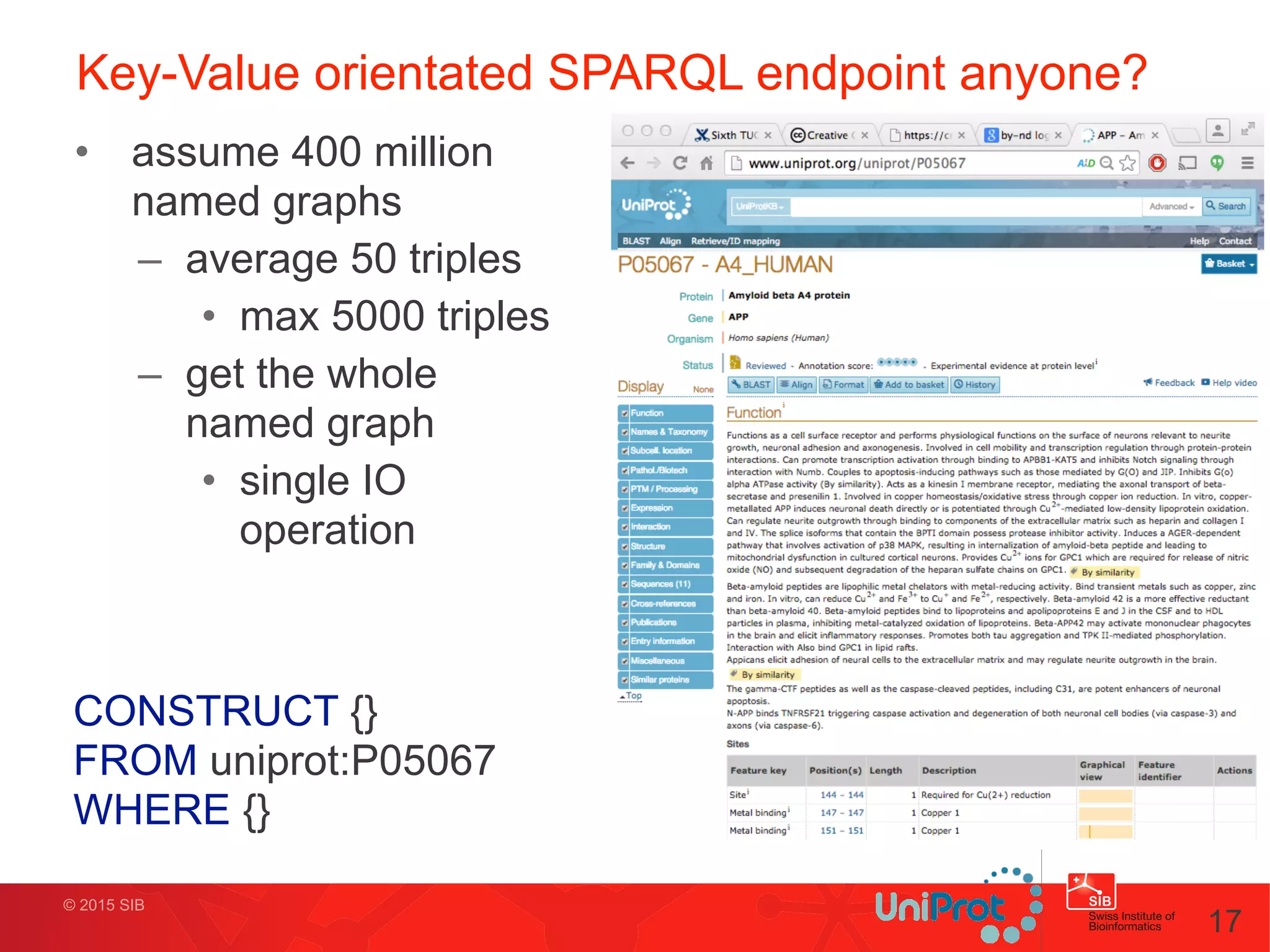
Key-Value orientated SPARQL endpoint anyone?
• assume 400 million
named graphs
– average 50 triples
• max 5000 triples
– get the whole
named graph
• single IO
operation
17
CONSTRUCT {}
FROM uniprot:P05067
WHERE {}
© 2015 SIB
18

The UniProt SPARQL endpoint: 20 billion quads in production

  • 1.
    The UniProt SPARQLendpoint: 20 billion quads in production
  • 2.
    © 2015 SIB Whyprovide a public SPARQL endpoint • A 10 man wet laboratory can not afford: – to host their own database houses holding all or even a bit of all life science data. – not to have access, and use, existing life science information. • Classical SQL can be provided on the web – Is not practical – No federation – No standards adherence • Document centric REST is not enough – Swiss-Prot available as REST (over e-mail !!) since 1986 2
  • 3.
  • 4.
    © 2015 SIB 19,361,572,066 4 Node1 ! 64 cpu cores 256 GB ram 2.5 TB consumer SSD Load Balancer = Apache mod_balancer Node 2 ! 64 cpu cores 256 GB ram 2.5 TB consumer SSD
  • 5.
    © 2015 SIB 19,361,572,066 5 Node1 Node 2 Tomcat + Sesame + UI Virtuoso 7.2 (+) Tomcat + Sesame + UI Virtuoso 7.2 (+) Load Balancer = Apache mod_balancer
  • 6.
    © 2015 SIB Dedicatedmachine for loading and testing • Loading RDF data “solved” problem – 500,000 triples per second easy • that’s what our machine plus virtuoso 7.2 – and some tricks does – 1,000,000 possible (gunzip limit on our machine) • nquads or rdf/xml – higher values needs parallel readers • or even lighter weight parsers – highest observed rate • 2.5 million per second on 1/4 exadata – could be pushed higher 6
  • 7.
    © 2015 SIB Chalengesas a public endpoint provider • Query load unpredictable ! • Simple data discovery queries are hard – 1 TB+ of DB files – e.g. from monitoring services ! • Query timeouts not sufficient – aim for 100% utilisation – what can http reasonably support – we want to be able to answer hard questions 7
  • 8.
  • 9.
    © 2015 SIB Realusers Mix between hard analytics and super specific Estimate somewhere between: 300 - 2000 real humans per month 9
  • 10.
    © 2015 SIB Reallyhard queries 10 SELECT (COUNT(DISTINCT(?iri) AS ?iriCount)) WHERE { {?iri ?p ?o} UNION {?s ?iri ?o} UNION {?s ?p ?iri} FILTER(isIRI(?iri)) }
  • 11.
    © 2014 SIB Countingall 3,897,109,089 IRI takes a while • Via iSQL – 9 to 10 hours – if no other users • SQL alternative ! ! ! ! ! ! • 18 minutes – Faster tricks? 11 > SELECT COUNT(RI_ID) FROM RDF_IRI; count INTEGER _____________________________________ 3897109089 1 Rows. -- 1126860 msec.
  • 12.
    © 2015 SIB Compilationwise unlikely to be found • Are templates a good idea? – e.g. JVM has intrinsics • Long.bitCount() – in java ! ! ! ! ! ! – or 1 X86 instruction (in use since 1.6) » POPCNT 12 i = i - ((i >>> 1) & 0x5555555555555555L); i = (i & 0x3333333333333333L) + ((i >>> 2) & 0x3333333333333333L); i = (i + (i >>> 4)) & 0x0f0f0f0f0f0f0f0fL; i = i + (i >>> 8); i = i + (i >>> 16); i = i + (i >>> 32); return (int)i & 0x7f;
  • 13.
    © 2015 SIB Template/Intrinsicsbased SPARQL compilation • Recognising query template matches can be difficult – query normalisation? 13
  • 14.
    © 2015 SIB Similarquery • Virtuoso – Index only scan? • GraphDB – Information stored in predicate statistics that are key for optimiser • Can information be fetched from there? 14 SELECT (COUNT(DISTINCT(?p) AS ?pc) WHERE {?s ?p ?pc }
  • 15.
    © 2015 SIB Challenges •Virtuoso – transitive queries – standards compliance ! • GraphDB – analytical queries – complete store scans ! • Oracle 12c1 – configuration – global RDF tablespace • difficult to manage as a normal Oracle DB 15
  • 16.
    • Public monitoringalso hard – often lower uptime than what is being monitored – robots.txt – not enough community support – service description • not being parsed – HEAD last modified? © 2015 SIB Public monitoring key aid in quality assurance 16 ✔sparqles
  • 17.
    © 2015 SIB Key-Valueorientated SPARQL endpoint anyone? • assume 400 million named graphs – average 50 triples • max 5000 triples – get the whole named graph • single IO operation 17 CONSTRUCT {} FROM uniprot:P05067 WHERE {}
  • 18.