An Introduction to
Financial Management
and Reporting
DC Department of Small & Local Business
Development

John Pace, CPA, CVA

Senior Manager, Client Services

Steven Lyons, CPA

Supervisor, Client Services

December 12, 2013
Financial Management and
Reporting

John Pace, CPA, CVA

Senior Manager, Gelman, Rosenberg & Freedman CPAs

 15 years of accounting and finance experience
 Provides assistance to GRF clients in the
capacity of temporary controller/chief financial
officer, with duties such as cash flow planning
and analysis, financial statement preparation,
financial performance analysis, budgeting and
bookkeeping.

2
Financial Management and
Reporting

Steven Lyons, CPA

Supervisor, Gelman, Rosenberg & Freedman CPAs

 12 years of accounting and finance
experience

 Provides assistance to GRF clients in the
capacity of temporary controller/chief
financial officer, with duties such as cash
financial statement preparation,
budgeting, bookkeeping, financial
performance analysis .
3
Financial Management and
Reporting

Firm Bio
 Gelman, Rosenberg & Freedman CPAs, located in the
Washington, DC metropolitan region since 1981, is a professional
services firm that provides clients with financial, tax and
consulting solutions. For more than 30 years, our business has
supported the financial and operational success of nonprofits
locally, nationally and around the world. Our professionals also
offer accounting and consulting services to government
contractors, businesses, individuals and attorneys in need of
advisory support.
 Our mission, vision, values and philosophy provide a foundation
upon which we strive to succeed. We want our clients to perceive
Gelman, Rosenberg & Freedman as more than just accountants
who deliver a once-a-year engagement. We seek to become
trusted financial advisors who work throughout the year to
provide clients with insights and expert advice.
4
Financial Management and
Reporting

Agenda
 Questions
 Types of Financial Statements

 Overview of Financial Statements
 Common Reports
 Cash vs. Accrual
 Budgets
5
Financial Management and
Reporting

Types of Financial Statements
 Audit
 Review
 Compilation

6
Financial Management and
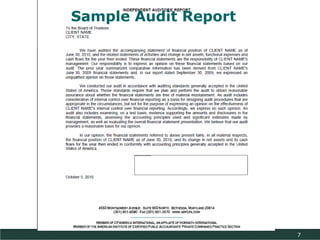
Sample Audit Report
Reporting

7
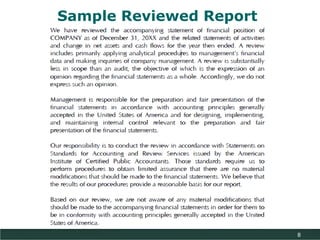
Financial Management and Report
Sample Reviewed
Reporting

8
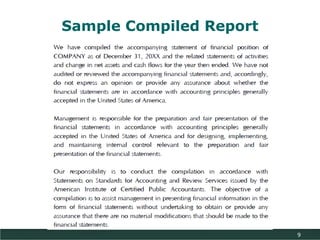
Financial Management and
Sample Compiled Report
Reporting

9
Financial Management and
Reporting

Overview of Financial Statements
 Financial statements offer a insight
into the company’s financial health.
 User of Financial Statements are
potential investors, bankers,
insurance agents, bond companies
etc.

10
Financial Management and
Reporting
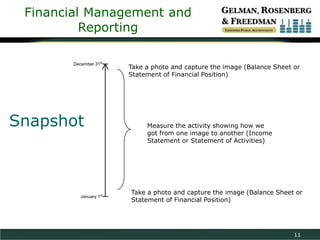
December 31st

Snapshot

January 1st

Take a photo and capture the image (Balance Sheet or
Statement of Financial Position)

Measure the activity showing how we
got from one image to another (Income
Statement or Statement of Activities)

Take a photo and capture the image (Balance Sheet or
Statement of Financial Position)

11
Financial Management and
Reporting

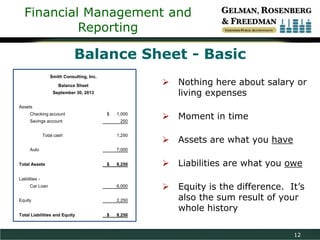
Balance Sheet - Basic
Smith Consulting, Inc.



Nothing here about salary or
living expenses



Moment in time



Assets are what you have

8,250



Liabilities are what you owe

6,000



Equity is the difference. It’s
also the sum result of your
whole history

Balance Sheet
September 30, 2013
Assets
Checking account

$

1,000

Savings account

250

Total cash

1,250

Auto
Total Assets

7,000
$

Liabilities Car Loan
Equity
Total Liabilities and Equity

2,250
$

8,250

12
Financial Management and
Reporting

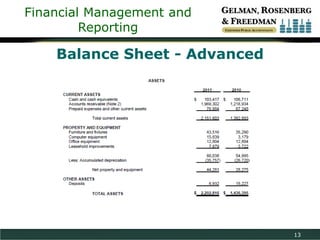
Balance Sheet - Advanced

13
Financial Management and
Reporting

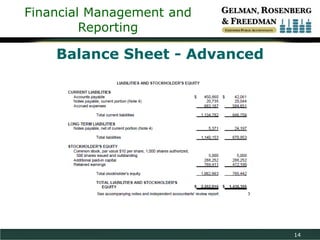
Balance Sheet - Advanced

14
Financial Management and
Reporting

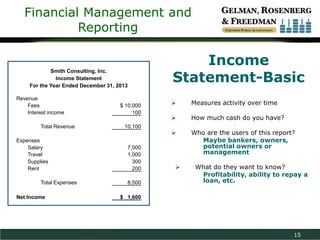
Smith Consulting, Inc.
Income Statement
For the Year Ended December 31, 2013
Revenue
Fees
Interest income
Total Revenue
Expenses
Salary
Travel
Supplies
Rent

Total Expenses
Net Income

$ 10,000
100
10,100

7,000
1,000
300
200

8,500

Income
Statement-Basic


Measures activity over time



How much cash do you have?



Who are the users of this report?
Maybe bankers, owners,
potential owners or
management



What do they want to know?
Profitability, ability to repay a
loan, etc.

$ 1,600

15
Financial Management and
Reporting

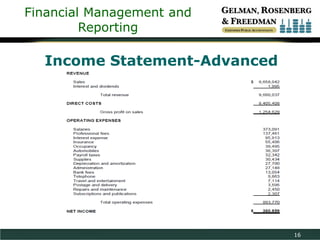
Income Statement-Advanced

16
Financial Management and
Reporting

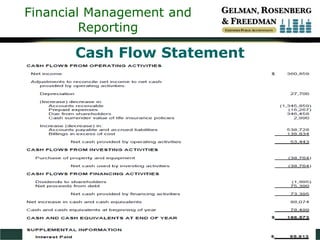
Cash Flow Statement

17
Financial Management and
Reporting

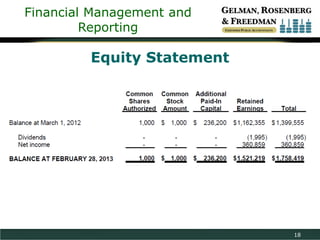
Equity Statement

18
Financial Management and
Reporting

Questions?

19
Financial Management and
Reporting

Common Internal Reports:
Budgets
Cash Projections

20
Financial Management and
Reporting

Budgets

21
Financial Management and
Reporting

Budget Process


Developing a budget involves consideration of
strategic priorities, gathering data, articulation of
assumptions and lots of communication. And a little
math.



Using a budget involves clear reporting aligning
budget categories with accounting data, more
discussions and then making decisions.

22
Financial Management and
Reporting

Budgets Are …
 Budgets are based on FACTS and ASSUMPTIONS
 More about priorities than numbers
 A roadmap for implementing the strategic plan
 Budgets should tell a story. Are there any new
activities or changes to existing activities?

23
Financial Management and
Reporting

Budgets Are Not …
 Budgets are not law –budgeting is a totally different
concept than a government’s budget.
 “Budgeted” doesn’t necessarily mean that the money
is there
 Budgets are not meant to be final – reality tends to
get in the way

24
Financial Management and
Reporting

Internal Reports: Comparisons to
Budget
 What do you do when you get a budget report?
 What should you do with budget reports?

– Format can really vary so make sure you understand what the
numbers represent (esp. terms, dates and signs)
– Help discover errors by making sure the numbers make sense -do they agree with your recollection of what actually happened?
– Use them to keep program on track or identify things that will go
over/under budget
– Ask questions!

25
Financial Management and
Reporting

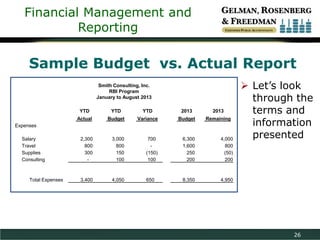
Sample Budget vs. Actual Report
Smith Consulting, Inc.
RBI Program
January to August 2013
YTD

YTD

YTD

2013

2013

Actual

Budget

Variance

Budget

Remaining

2,300
800
300
-

3,000
800
150
100

700
(150)
100

6,300
1,600
250
200

4,000
800
(50)
200

3,400

4,050

650

8,350

4,950

Expenses
Salary
Travel
Supplies
Consulting

Total Expenses

 Let’s look
through the
terms and
information
presented

26
Financial Management and
Reporting

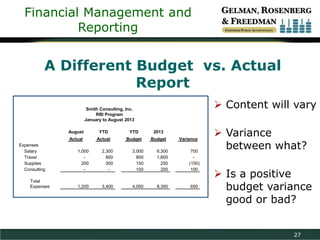
A Different Budget vs. Actual
Report
 Content will vary

Smith Consulting, Inc.
RBI Program
January to August 2013
August

Total
Expenses

YTD

2013

Actual

Expenses
Salary
Travel
Supplies
Consulting

YTD
Actual

Budget

Budget

Variance

1,000
200
-

2,300
800
300
-

3,000
800
150
100

6,300
1,600
250
200

700
(150)
100

1,200

3,400

4,050

8,350

650

 Variance
between what?
 Is a positive
budget variance
good or bad?
27
Financial Management and
Reporting

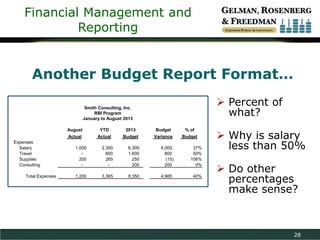
Another Budget Report Format…
 Percent of
what?

Smith Consulting, Inc.
RBI Program
January to August 2013
August

Total Expenses

2013

Budget

% of

Actual
Expenses
Salary
Travel
Supplies
Consulting

YTD
Actual

Budget

Variance

Budget

1,000
200
-

2,300
800
265
-

6,300
1,600
250
200

4,000
800
(15)
200

37%
50%
106%
0%

1,200

3,365

8,350

4,985

40%

 Why is salary
less than 50%
 Do other
percentages
make sense?

28
Financial Management and
Reporting

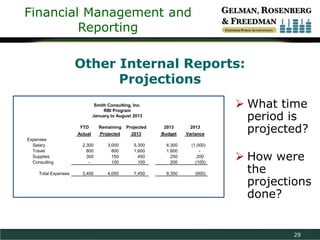
Other Internal Reports:
Projections
Smith Consulting, Inc.
RBI Program
January to August 2013
YTD

Total Expenses

Projected

2013

2013

Actual
Expenses
Salary
Travel
Supplies
Consulting

Remaining
Projected

2013

Budget

Variance

2,300
800
300
-

3,000
800
150
100

5,300
1,600
450
100

6,300
1,600
250
200

(1,000)
200
(100)

3,400

4,050

7,450

8,350

(900)

 What time
period is
projected?
 How were
the
projections
done?

29
Financial Management and
Reporting

Smith Consulting, Inc.
3 Month Projected Cash Flow as of 8/31/13

2013
September
Beginning Cash

$

68,300 $

2013
October
62,500

2013
November
$

(13,000)

Cash In
Contributions
Ticket Sales

86,500
5,000

6,300
4,500

127,000
6,900

Total Cash In

91,500

10,800

(80,000)
(4,000)
(2,300)

(80,000)
(20,000)
(2,300)

(97,300)

(86,300)

(102,300)

(5,800)

(75,500)

31,600

62,500 $

(13,000)

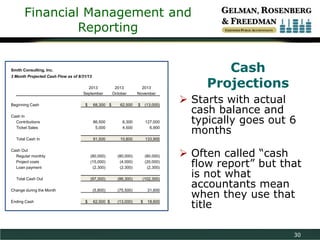
 Starts with actual
cash balance and
typically goes out 6
months

133,900

(80,000)
(15,000)
(2,300)

Cash
Projections

Cash Out
Regular monthly
Project costs
Loan payment
Total Cash Out
Change during the Month

Ending Cash

$

$

18,600

 Often called “cash
flow report” but that
is not what
accountants mean
when they use that
title
30
Financial Management and
Reporting

Cash Projections

Smith Consulting, Inc.
3 Month Projected Cash Flow as of 8/31/12

2013
September
Beginning Cash

$

68,300 $

2013
October
62,500

2013
November
$

(13,000)

Cash In
Contributions
Ticket Sales

86,500
5,000

6,300
4,500

127,000
6,900

Total Cash In

91,500

10,800

(80,000)
(4,000)
(2,300)

(80,000)
(20,000)
(2,300)

(97,300)

(86,300)

(102,300)

(5,800)

(75,500)

31,600

62,500 $

(13,000)

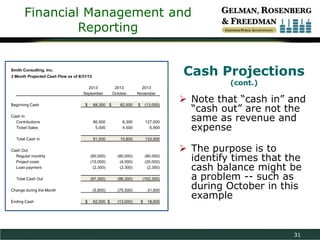
 Note that “cash in” and
“cash out” are not the
same as revenue and
expense

133,900

(80,000)
(15,000)
(2,300)

(cont.)

Cash Out
Regular monthly
Project costs
Loan payment
Total Cash Out
Change during the Month

Ending Cash

$

$

18,600

 The purpose is to
identify times that the
cash balance might be
a problem -- such as
during October in this
example

31
Financial Management and
Reporting

Cash vs. Accrual Accounting

32
Financial Management and
Reporting

Cash vs. Accrual Accounting
 Ex: In October 2010 a customer is invoiced for
$1,000. The check is sent to us in March 2011 What
is the 2011 Revenue

 Ex: In Dec 2010 you rented a meeting room to host a
seminar. In Jan you got a bill from the facility for
$800 and you paid it in Feb 2011. What is the 2011
expense?
 Pay particular attention to this issue when trying to
project revenue or when comparing budget to actual
expenses
33
Questions & Answers
John Pace, Senior Manager, Client Services
Email:
jpace@grfcpa.com

Steven Lyons, Supervisor, Client Services
Email:
slyons@grfcpa.com
Telephone:
(301) 951 – 9090
Website:
www.grfcpa.com

An Introduction to Financial Management and Reporting

  • 1.
    An Introduction to FinancialManagement and Reporting DC Department of Small & Local Business Development John Pace, CPA, CVA Senior Manager, Client Services Steven Lyons, CPA Supervisor, Client Services December 12, 2013
  • 2.
    Financial Management and Reporting JohnPace, CPA, CVA Senior Manager, Gelman, Rosenberg & Freedman CPAs  15 years of accounting and finance experience  Provides assistance to GRF clients in the capacity of temporary controller/chief financial officer, with duties such as cash flow planning and analysis, financial statement preparation, financial performance analysis, budgeting and bookkeeping. 2
  • 3.
    Financial Management and Reporting StevenLyons, CPA Supervisor, Gelman, Rosenberg & Freedman CPAs  12 years of accounting and finance experience  Provides assistance to GRF clients in the capacity of temporary controller/chief financial officer, with duties such as cash financial statement preparation, budgeting, bookkeeping, financial performance analysis . 3
  • 4.
    Financial Management and Reporting FirmBio  Gelman, Rosenberg & Freedman CPAs, located in the Washington, DC metropolitan region since 1981, is a professional services firm that provides clients with financial, tax and consulting solutions. For more than 30 years, our business has supported the financial and operational success of nonprofits locally, nationally and around the world. Our professionals also offer accounting and consulting services to government contractors, businesses, individuals and attorneys in need of advisory support.  Our mission, vision, values and philosophy provide a foundation upon which we strive to succeed. We want our clients to perceive Gelman, Rosenberg & Freedman as more than just accountants who deliver a once-a-year engagement. We seek to become trusted financial advisors who work throughout the year to provide clients with insights and expert advice. 4
  • 5.
    Financial Management and Reporting Agenda Questions  Types of Financial Statements  Overview of Financial Statements  Common Reports  Cash vs. Accrual  Budgets 5
  • 6.
    Financial Management and Reporting Typesof Financial Statements  Audit  Review  Compilation 6
  • 7.
    Financial Management and SampleAudit Report Reporting 7
  • 8.
    Financial Management andReport Sample Reviewed Reporting 8
  • 9.
    Financial Management and SampleCompiled Report Reporting 9
  • 10.
    Financial Management and Reporting Overviewof Financial Statements  Financial statements offer a insight into the company’s financial health.  User of Financial Statements are potential investors, bankers, insurance agents, bond companies etc. 10
  • 11.
    Financial Management and Reporting December31st Snapshot January 1st Take a photo and capture the image (Balance Sheet or Statement of Financial Position) Measure the activity showing how we got from one image to another (Income Statement or Statement of Activities) Take a photo and capture the image (Balance Sheet or Statement of Financial Position) 11
  • 12.
    Financial Management and Reporting BalanceSheet - Basic Smith Consulting, Inc.  Nothing here about salary or living expenses  Moment in time  Assets are what you have 8,250  Liabilities are what you owe 6,000  Equity is the difference. It’s also the sum result of your whole history Balance Sheet September 30, 2013 Assets Checking account $ 1,000 Savings account 250 Total cash 1,250 Auto Total Assets 7,000 $ Liabilities Car Loan Equity Total Liabilities and Equity 2,250 $ 8,250 12
  • 13.
  • 14.
  • 15.
    Financial Management and Reporting SmithConsulting, Inc. Income Statement For the Year Ended December 31, 2013 Revenue Fees Interest income Total Revenue Expenses Salary Travel Supplies Rent Total Expenses Net Income $ 10,000 100 10,100 7,000 1,000 300 200 8,500 Income Statement-Basic  Measures activity over time  How much cash do you have?  Who are the users of this report? Maybe bankers, owners, potential owners or management  What do they want to know? Profitability, ability to repay a loan, etc. $ 1,600 15
  • 16.
  • 17.
  • 18.
  • 19.
  • 20.
    Financial Management and Reporting CommonInternal Reports: Budgets Cash Projections 20
  • 21.
  • 22.
    Financial Management and Reporting BudgetProcess  Developing a budget involves consideration of strategic priorities, gathering data, articulation of assumptions and lots of communication. And a little math.  Using a budget involves clear reporting aligning budget categories with accounting data, more discussions and then making decisions. 22
  • 23.
    Financial Management and Reporting BudgetsAre …  Budgets are based on FACTS and ASSUMPTIONS  More about priorities than numbers  A roadmap for implementing the strategic plan  Budgets should tell a story. Are there any new activities or changes to existing activities? 23
  • 24.
    Financial Management and Reporting BudgetsAre Not …  Budgets are not law –budgeting is a totally different concept than a government’s budget.  “Budgeted” doesn’t necessarily mean that the money is there  Budgets are not meant to be final – reality tends to get in the way 24
  • 25.
    Financial Management and Reporting InternalReports: Comparisons to Budget  What do you do when you get a budget report?  What should you do with budget reports? – Format can really vary so make sure you understand what the numbers represent (esp. terms, dates and signs) – Help discover errors by making sure the numbers make sense -do they agree with your recollection of what actually happened? – Use them to keep program on track or identify things that will go over/under budget – Ask questions! 25
  • 26.
    Financial Management and Reporting SampleBudget vs. Actual Report Smith Consulting, Inc. RBI Program January to August 2013 YTD YTD YTD 2013 2013 Actual Budget Variance Budget Remaining 2,300 800 300 - 3,000 800 150 100 700 (150) 100 6,300 1,600 250 200 4,000 800 (50) 200 3,400 4,050 650 8,350 4,950 Expenses Salary Travel Supplies Consulting Total Expenses  Let’s look through the terms and information presented 26
  • 27.
    Financial Management and Reporting ADifferent Budget vs. Actual Report  Content will vary Smith Consulting, Inc. RBI Program January to August 2013 August Total Expenses YTD 2013 Actual Expenses Salary Travel Supplies Consulting YTD Actual Budget Budget Variance 1,000 200 - 2,300 800 300 - 3,000 800 150 100 6,300 1,600 250 200 700 (150) 100 1,200 3,400 4,050 8,350 650  Variance between what?  Is a positive budget variance good or bad? 27
  • 28.
    Financial Management and Reporting AnotherBudget Report Format…  Percent of what? Smith Consulting, Inc. RBI Program January to August 2013 August Total Expenses 2013 Budget % of Actual Expenses Salary Travel Supplies Consulting YTD Actual Budget Variance Budget 1,000 200 - 2,300 800 265 - 6,300 1,600 250 200 4,000 800 (15) 200 37% 50% 106% 0% 1,200 3,365 8,350 4,985 40%  Why is salary less than 50%  Do other percentages make sense? 28
  • 29.
    Financial Management and Reporting OtherInternal Reports: Projections Smith Consulting, Inc. RBI Program January to August 2013 YTD Total Expenses Projected 2013 2013 Actual Expenses Salary Travel Supplies Consulting Remaining Projected 2013 Budget Variance 2,300 800 300 - 3,000 800 150 100 5,300 1,600 450 100 6,300 1,600 250 200 (1,000) 200 (100) 3,400 4,050 7,450 8,350 (900)  What time period is projected?  How were the projections done? 29
  • 30.
    Financial Management and Reporting SmithConsulting, Inc. 3 Month Projected Cash Flow as of 8/31/13 2013 September Beginning Cash $ 68,300 $ 2013 October 62,500 2013 November $ (13,000) Cash In Contributions Ticket Sales 86,500 5,000 6,300 4,500 127,000 6,900 Total Cash In 91,500 10,800 (80,000) (4,000) (2,300) (80,000) (20,000) (2,300) (97,300) (86,300) (102,300) (5,800) (75,500) 31,600 62,500 $ (13,000)  Starts with actual cash balance and typically goes out 6 months 133,900 (80,000) (15,000) (2,300) Cash Projections Cash Out Regular monthly Project costs Loan payment Total Cash Out Change during the Month Ending Cash $ $ 18,600  Often called “cash flow report” but that is not what accountants mean when they use that title 30
  • 31.
    Financial Management and Reporting CashProjections Smith Consulting, Inc. 3 Month Projected Cash Flow as of 8/31/12 2013 September Beginning Cash $ 68,300 $ 2013 October 62,500 2013 November $ (13,000) Cash In Contributions Ticket Sales 86,500 5,000 6,300 4,500 127,000 6,900 Total Cash In 91,500 10,800 (80,000) (4,000) (2,300) (80,000) (20,000) (2,300) (97,300) (86,300) (102,300) (5,800) (75,500) 31,600 62,500 $ (13,000)  Note that “cash in” and “cash out” are not the same as revenue and expense 133,900 (80,000) (15,000) (2,300) (cont.) Cash Out Regular monthly Project costs Loan payment Total Cash Out Change during the Month Ending Cash $ $ 18,600  The purpose is to identify times that the cash balance might be a problem -- such as during October in this example 31
  • 32.
    Financial Management and Reporting Cashvs. Accrual Accounting 32
  • 33.
    Financial Management and Reporting Cashvs. Accrual Accounting  Ex: In October 2010 a customer is invoiced for $1,000. The check is sent to us in March 2011 What is the 2011 Revenue  Ex: In Dec 2010 you rented a meeting room to host a seminar. In Jan you got a bill from the facility for $800 and you paid it in Feb 2011. What is the 2011 expense?  Pay particular attention to this issue when trying to project revenue or when comparing budget to actual expenses 33
  • 34.
    Questions & Answers JohnPace, Senior Manager, Client Services Email: jpace@grfcpa.com Steven Lyons, Supervisor, Client Services Email: slyons@grfcpa.com Telephone: (301) 951 – 9090 Website: www.grfcpa.com