TRANSACTIONS
“A group of tasks that form a single logical unit”
TRANSACTIONS
 Example:
 To withdraw 100 from an account – Operations:
 check the account balance
 If sufficient balance is present request for withdrawal.
 Get the money
 Calculate balance = Balance – 100
 Update account with new balance
Transactions - Process
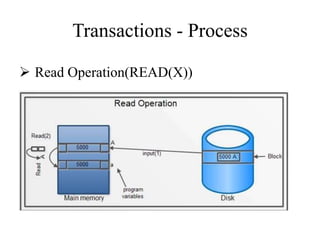
 Read Operation(READ(X))
 To read a database object, it is first brought
into main memory (Local Buffer) from
disk(database), and then its value is copied into
a program variable.
Transactions - Process
 Read Operation(READ(X))
Transactions - Process
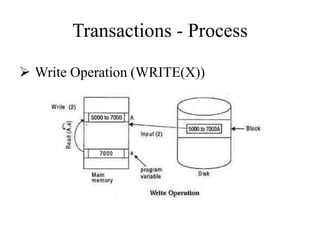
 Write Operation (WRITE(X))
 To write a database object, an in-memory
copy of the object is first modified and then
written to disk (i.e) Transfers the data item x
from the local buffer to the transaction that
executed the write back to the data base.
Transactions - Process
 Write Operation (WRITE(X))
ACID Properties
 Atomicity:
 each transaction must be considered as a single unit
and must be completed fully or not completed at all.
 Database should be in a state either before the
transaction execution or after the transaction
execution.
ACID Properties
 Consistency:
 The database must remain in consistent state after
performing any transaction.
ACID Properties
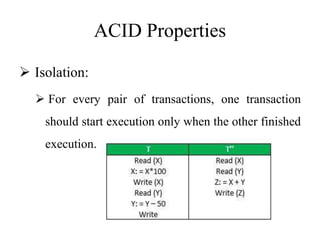
 Isolation:
 For every pair of transactions, one transaction
should start execution only when the other finished
execution.
ACID Properties
 Durability
 Once a transaction completes successfully, the
changes it has made into the database should be
permanent even if there is a system failure.
 If the system failure happens after customer getting
the money then the system should be strong enough to
update database with his new balance, after system
recovers
Transaction - States
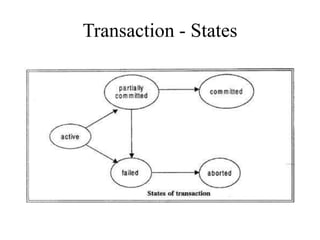
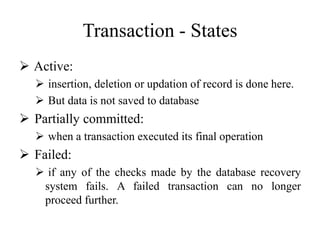
 Active:
 insertion, deletion or updation of record is done here.
 But data is not saved to database
 Partially committed:
 when a transaction executed its final operation
 Failed:
 if any of the checks made by the database recovery
system fails. A failed transaction can no longer
proceed further.
Transaction - States
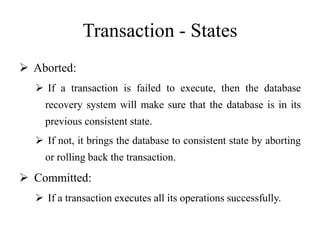
 Aborted:
 If a transaction is failed to execute, then the database
recovery system will make sure that the database is in its
previous consistent state.
 If not, it brings the database to consistent state by aborting
or rolling back the transaction.
 Committed:
 If a transaction executes all its operations successfully.
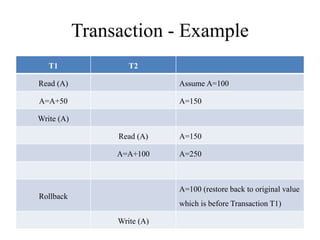
Transaction - Example
T1 T2
Read (A) Assume A=100
A=A+50 A=150
Write (A)
Read (A) A=150
A=A+100 A=250
Rollback
A=100 (restore back to original value
which is before Transaction T1)
Write (A)

DBMS - Transactions

  • 1.
    TRANSACTIONS “A group oftasks that form a single logical unit”
  • 2.
    TRANSACTIONS  Example:  Towithdraw 100 from an account – Operations:  check the account balance  If sufficient balance is present request for withdrawal.  Get the money  Calculate balance = Balance – 100  Update account with new balance
  • 3.
    Transactions - Process Read Operation(READ(X))  To read a database object, it is first brought into main memory (Local Buffer) from disk(database), and then its value is copied into a program variable.
  • 4.
    Transactions - Process Read Operation(READ(X))
  • 5.
    Transactions - Process Write Operation (WRITE(X))  To write a database object, an in-memory copy of the object is first modified and then written to disk (i.e) Transfers the data item x from the local buffer to the transaction that executed the write back to the data base.
  • 6.
    Transactions - Process Write Operation (WRITE(X))
  • 7.
    ACID Properties  Atomicity: each transaction must be considered as a single unit and must be completed fully or not completed at all.  Database should be in a state either before the transaction execution or after the transaction execution.
  • 8.
    ACID Properties  Consistency: The database must remain in consistent state after performing any transaction.
  • 9.
    ACID Properties  Isolation: For every pair of transactions, one transaction should start execution only when the other finished execution.
  • 10.
    ACID Properties  Durability Once a transaction completes successfully, the changes it has made into the database should be permanent even if there is a system failure.  If the system failure happens after customer getting the money then the system should be strong enough to update database with his new balance, after system recovers
  • 11.
  • 12.
    Transaction - States Active:  insertion, deletion or updation of record is done here.  But data is not saved to database  Partially committed:  when a transaction executed its final operation  Failed:  if any of the checks made by the database recovery system fails. A failed transaction can no longer proceed further.
  • 13.
    Transaction - States Aborted:  If a transaction is failed to execute, then the database recovery system will make sure that the database is in its previous consistent state.  If not, it brings the database to consistent state by aborting or rolling back the transaction.  Committed:  If a transaction executes all its operations successfully.
  • 14.
    Transaction - Example T1T2 Read (A) Assume A=100 A=A+50 A=150 Write (A) Read (A) A=150 A=A+100 A=250 Rollback A=100 (restore back to original value which is before Transaction T1) Write (A)