Binary Search Trees
Definition:
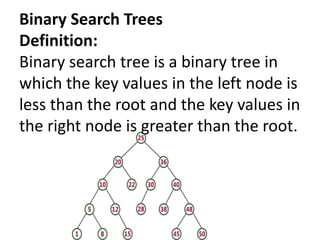
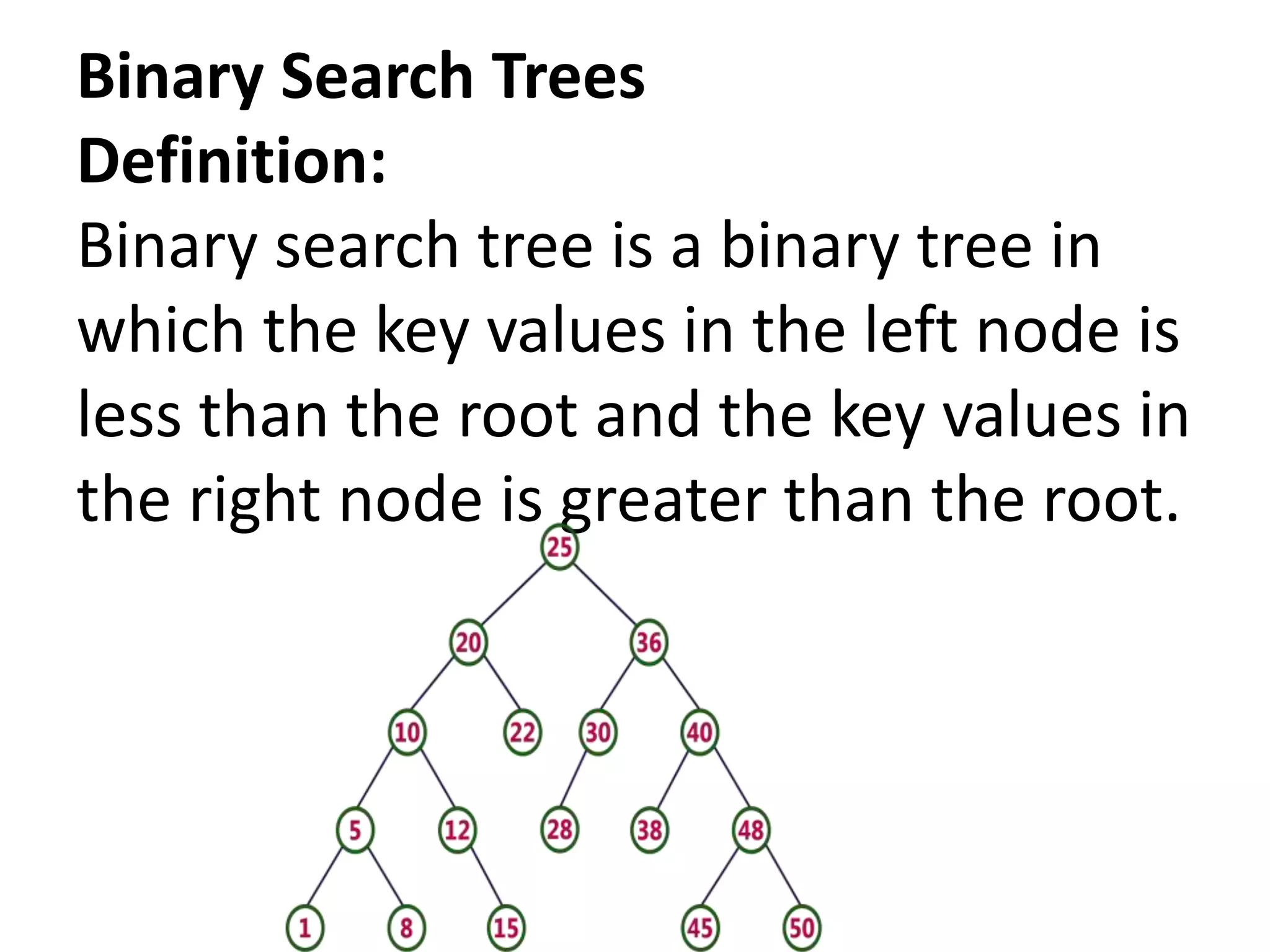
Binary search tree is a binary tree in
which the key values in the left node is
less than the root and the key values in
the right node is greater than the root.
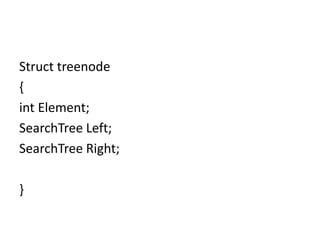
Struct treenode
{
int Element;
SearchTree Left;
SearchTree Right;
}
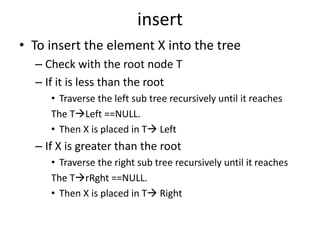
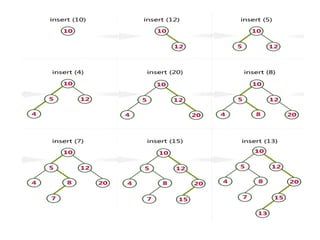
insert
• To insert the element X into the tree
– Check with the root node T
– If it is less than the root
• Traverse the left sub tree recursively until it reaches
The TLeft ==NULL.
• Then X is placed in T Left
– If X is greater than the root
• Traverse the right sub tree recursively until it reaches
The TrRght ==NULL.
• Then X is placed in T Right
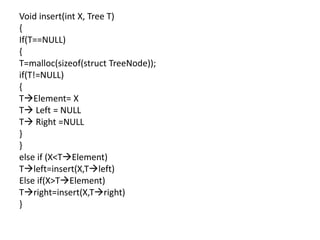
Void insert(int X, Tree T)
{
If(T==NULL)
{
T=malloc(sizeof(struct TreeNode));
if(T!=NULL)
{
TElement= X
T Left = NULL
T Right =NULL
}
}
else if (X<TElement)
Tleft=insert(X,Tleft)
Else if(X>TElement)
Tright=insert(X,Tright)
}
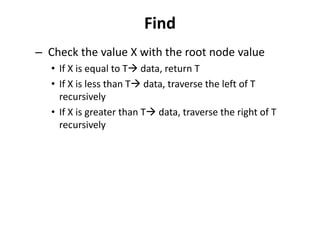
Find
– Check the value X with the root node value
• If X is equal to T data, return T
• If X is less than T data, traverse the left of T
recursively
• If X is greater than T data, traverse the right of T
recursively
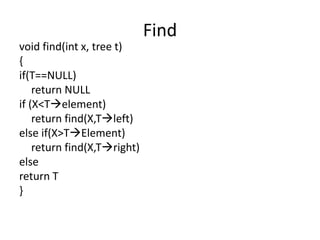
Find
void find(int x, tree t)
{
if(T==NULL)
return NULL
if (X<Telement)
return find(X,Tleft)
else if(X>TElement)
return find(X,Tright)
else
return T
}
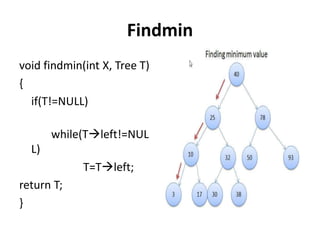
Findmin
– start from root go left as long as there is left child.
– Returns the position of the smallest element in
the tree
Findmin
void findmin(int X, Tree T)
{
if(T!=NULL)
while(Tleft!=NUL
L)
T=Tleft;
return T;
}
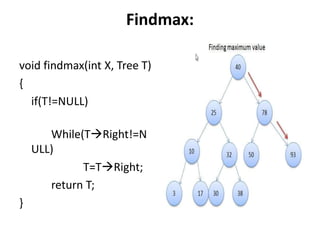
Findmax
• Return the position of largest in the tree
• start from root go left as long as there is left child.
Findmax:
void findmax(int X, Tree T)
{
if(T!=NULL)
While(TRight!=N
ULL)
T=TRight;
return T;
}
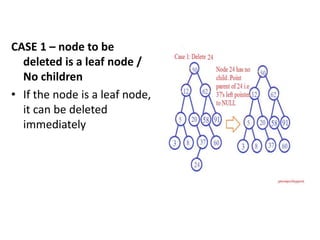
CASE 1 – node to be
deleted is a leaf node /
No children
• If the node is a leaf node,
it can be deleted
immediately
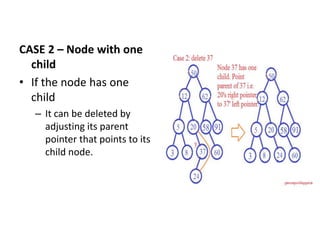
CASE 2 – Node with one
child
• If the node has one
child
– It can be deleted by
adjusting its parent
pointer that points to its
child node.
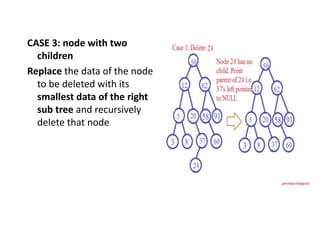
CASE 3: node with two
children
Replace the data of the node
to be deleted with its
smallest data of the right
sub tree and recursively
delete that node
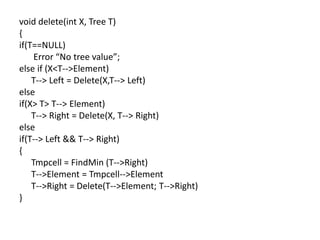
void delete(int X, Tree T)
{
if(T==NULL)
Error “No tree value”;
else if (X<T-->Element)
T--> Left = Delete(X,T--> Left)
else
if(X> T> T--> Element)
T--> Right = Delete(X, T--> Right)
else
if(T--> Left && T--> Right)
{
Tmpcell = FindMin (T-->Right)
T-->Element = Tmpcell-->Element
T-->Right = Delete(T-->Element; T-->Right)
}
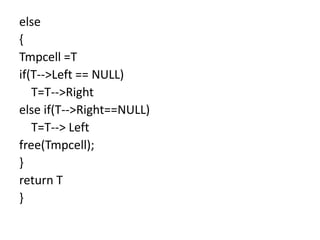
else
{
Tmpcell =T
if(T-->Left == NULL)
T=T-->Right
else if(T-->Right==NULL)
T=T--> Left
free(Tmpcell);
}
return T
}

DS - BST

  • 1.
    Binary Search Trees Definition: Binarysearch tree is a binary tree in which the key values in the left node is less than the root and the key values in the right node is greater than the root.
  • 2.
  • 3.
    insert • To insertthe element X into the tree – Check with the root node T – If it is less than the root • Traverse the left sub tree recursively until it reaches The TLeft ==NULL. • Then X is placed in T Left – If X is greater than the root • Traverse the right sub tree recursively until it reaches The TrRght ==NULL. • Then X is placed in T Right
  • 5.
    Void insert(int X,Tree T) { If(T==NULL) { T=malloc(sizeof(struct TreeNode)); if(T!=NULL) { TElement= X T Left = NULL T Right =NULL } } else if (X<TElement) Tleft=insert(X,Tleft) Else if(X>TElement) Tright=insert(X,Tright) }
  • 6.
    Find – Check thevalue X with the root node value • If X is equal to T data, return T • If X is less than T data, traverse the left of T recursively • If X is greater than T data, traverse the right of T recursively
  • 7.
    Find void find(int x,tree t) { if(T==NULL) return NULL if (X<Telement) return find(X,Tleft) else if(X>TElement) return find(X,Tright) else return T }
  • 8.
    Findmin – start fromroot go left as long as there is left child. – Returns the position of the smallest element in the tree
  • 9.
    Findmin void findmin(int X,Tree T) { if(T!=NULL) while(Tleft!=NUL L) T=Tleft; return T; }
  • 10.
    Findmax • Return theposition of largest in the tree • start from root go left as long as there is left child.
  • 11.
    Findmax: void findmax(int X,Tree T) { if(T!=NULL) While(TRight!=N ULL) T=TRight; return T; }
  • 12.
    CASE 1 –node to be deleted is a leaf node / No children • If the node is a leaf node, it can be deleted immediately
  • 13.
    CASE 2 –Node with one child • If the node has one child – It can be deleted by adjusting its parent pointer that points to its child node.
  • 14.
    CASE 3: nodewith two children Replace the data of the node to be deleted with its smallest data of the right sub tree and recursively delete that node
  • 15.
    void delete(int X,Tree T) { if(T==NULL) Error “No tree value”; else if (X<T-->Element) T--> Left = Delete(X,T--> Left) else if(X> T> T--> Element) T--> Right = Delete(X, T--> Right) else if(T--> Left && T--> Right) { Tmpcell = FindMin (T-->Right) T-->Element = Tmpcell-->Element T-->Right = Delete(T-->Element; T-->Right) }
  • 16.
    else { Tmpcell =T if(T-->Left ==NULL) T=T-->Right else if(T-->Right==NULL) T=T--> Left free(Tmpcell); } return T }