Hospital Management System.
By:
SIMRAN PARDESHI
ROLL NO: 36
ST AI&DS
Contents
1. Introduction
2. Software and Hardware Requirements
3. Entity, Attribute and Relationship
4. ER Diagram
5. Relational Schema
6. Implementation
7. Result of the project
8. Database Normalization
9. Future Scope
10. Conclusion
11. References
4/6/2022 Hospital management system 2
INTRODUCTION
• Hospital Management System is aimed at reducing paper work for a hospital and
hence improving its efficiency and speeding up of all processes.
• The database can be accessed by the employees from any computer terminal
connected through server. Hence, all the related information about a patient is
available to doctors, pharmacy, reception staff (for bill processing), etc.
• Thus this software saves the entire patient’s hassle. Moreover, all the information
regarding an employee is available to the administration and hence his salary can
be worked out easily. Thus it avoids employees’ trouble.
4/6/2022 Hospital management system 3
SOFTWARE AND HARDWARE REQUIREMENTS
4/6/2022 Hospital management system. 4
HARDWARE REQUIREMENTS
• Minimum 5 GB space in
HDD
• IBN Net vista Pentium 4 1.7
GHz
• 256 MB DDR SDRAM
• GB ULTRA HDD 7200 RPM
• 48 x CD ROM
• 15 `` color monitor
SOFTWARE REQUIREMENTS
• Microsoft Visual Basic 6.0
Windows XP (Professional)
• ODBC Driver
• Oracle DBMS with SQL
8.0 Plus
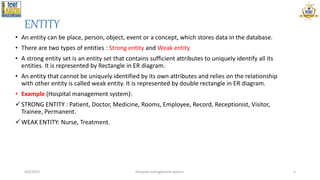
ENTITY
• An entity can be place, person, object, event or a concept, which stores data in the database.
• There are two types of entities : Strong entity and Weak entity
• A strong entity set is an entity set that contains sufficient attributes to uniquely identify all its
entities. It is represented by Rectangle in ER diagram.
• An entity that cannot be uniquely identified by its own attributes and relies on the relationship
with other entity is called weak entity. It is represented by double rectangle in ER diagram.
• Example (Hospital management system):
STRONG ENTITY : Patient, Doctor, Medicine, Rooms, Employee, Record, Receptionist, Visitor,
Trainee, Permanent.
WEAK ENTITY: Nurse, Treatment.
4/6/2022 Hospital management system. 5
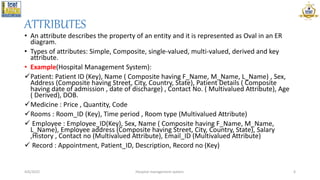
ATTRIBUTES
• An attribute describes the property of an entity and it is represented as Oval in an ER
diagram.
• Types of attributes: Simple, Composite, single-valued, multi-valued, derived and key
attribute.
• Example(Hospital Management System):
Patient: Patient ID (Key), Name ( Composite having F_Name, M_Name, L_Name) , Sex,
Address (Composite having Street, City, Country, State), Patient Details ( Composite
having date of admission , date of discharge) , Contact No. ( Multivalued Attribute), Age
( Derived), DOB.
Medicine : Price , Quantity, Code
Rooms : Room_ID (Key), Time period , Room type (Multivalued Attribute)
 Employee : Employee_ID(Key), Sex, Name ( Composite having F_Name, M_Name,
L_Name), Employee address (Composite having Street, City, Country, State), Salary
,History , Contact no (Multivalued Attribute), Email_ID (Multivalued Attribute)
 Record : Appointment, Patient_ID, Description, Record no (Key)
4/6/2022 Hospital management system. 6
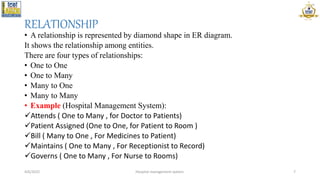
RELATIONSHIP
• A relationship is represented by diamond shape in ER diagram.
It shows the relationship among entities.
There are four types of relationships:
• One to One
• One to Many
• Many to One
• Many to Many
• Example (Hospital Management System):
Attends ( One to Many , for Doctor to Patients)
Patient Assigned (One to One, for Patient to Room )
Bill ( Many to One , For Medicines to Patient)
Maintains ( One to Many , For Receptionist to Record)
Governs ( One to Many , For Nurse to Rooms)
4/6/2022 Hospital management system. 7
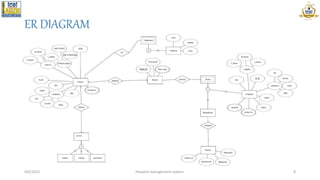
ER DIAGRAM
4/6/2022 Hospital management system. 8
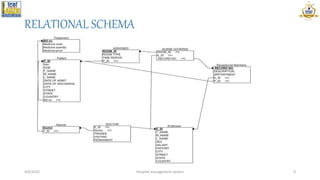
RELATIONAL SCHEMA
4/6/2022 Hospital management system 9
IMPLEMENTATION AND RESULT
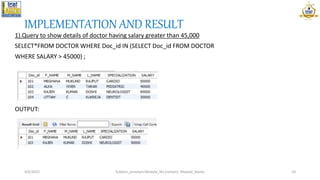
1).Query to show details of doctor having salary greater than 45,000
SELECT*FROM DOCTOR WHERE Doc_id IN (SELECT Doc_id FROM DOCTOR
WHERE SALARY > 45000) ;
OUTPUT:
4/6/2022 Subject_acronym:Module_No (roman): Module_Name 10
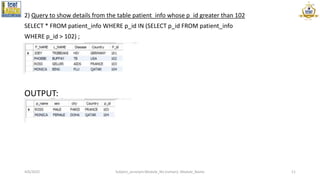
2) Query to show details from the table patient_info whose p_id greater than 102
SELECT * FROM patient_info WHERE p_id IN (SELECT p_id FROM patient_info
WHERE p_id > 102) ;
OUTPUT:
4/6/2022 Subject_acronym:Module_No (roman): Module_Name 11
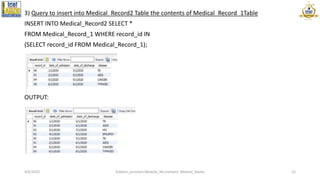
3) Query to insert into Medical_Record2 Table the contents of Medical_Record_1Table
INSERT INTO Medical_Record2 SELECT *
FROM Medical_Record_1 WHERE record_id IN
(SELECT record_id FROM Medical_Record_1);
OUTPUT:
4/6/2022 Subject_acronym:Module_No (roman): Module_Name 12
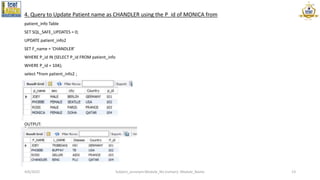
4. Query to Update Patient name as CHANDLER using the P_id of MONICA from
patient_info Table
SET SQL_SAFE_UPDATES = 0;
UPDATE patient_info2
SET F_name = 'CHANDLER'
WHERE P_id IN (SELECT P_id FROM patient_info
WHERE P_id = 104);
select *from patient_info2 ;
OUTPUT:
4/6/2022 Subject_acronym:Module_No (roman): Module_Name 13
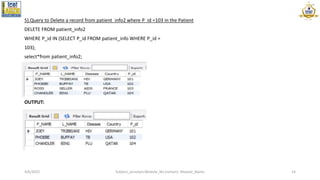
5).Query to Delete a record from patient_info2 where P_id =103 in the Patient
DELETE FROM patient_info2
WHERE P_id IN (SELECT P_id FROM patient_info WHERE P_id =
103);
select*from patient_info2;
OUTPUT:
4/6/2022 Subject_acronym:Module_No (roman): Module_Name 14
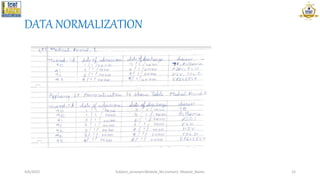
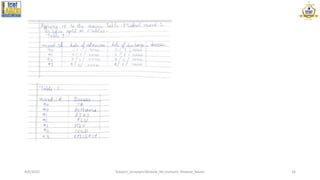
DATA NORMALIZATION
4/6/2022 Subject_acronym:Module_No (roman): Module_Name 15
4/6/2022 Subject_acronym:Module_No (roman): Module_Name 16
FUTURE SCOPE
• Hospital management system is a computer system that helps manage the
information related to health care and aids in the job completion of health care
providers effectively. They manage the data related to all departments of
healthcare such as, Clinical, Financial, Laboratory, Inpatient, Outpatient,
Operation theater, Materials, Nursing, Pharmaceutical, Radiology, Pathology etc.
• The future for databases is consolidation around big data with a rationalization
down to 10 core technologies that make data easy to access and leads to more
data-driven analytics and services. Data will be easier to access and use in future.
4/6/2022 Subject_acronym:Module_No (roman): Module_Name 17
CONCLUSION
• The developed system and its evaluation so far have been carried out to improve
the database system and management processes in hospitals.
• The Hospital database management needs to be improved or upgraded to meet
any situation. It is capable of storing variety and large volume of database. More
so, the software has been designed to include program modules to handle the
Medical Centre information such as patients’ data, supply (drug) management,
patients bill etc.
• This software contains the database files of hospital and will provide the
necessary information of the hospital and also will be compatible, accurate,
flexible, secured and efficient for the desired purpose it is to serve.
4/6/2022 Subject_acronym:Module_No (roman): Module_Name 18
REFERENCE
• https://projectsgeek.com/2013/08/hospital-management-system-
mini-project-2.html
• https://www.academia.edu/28734143/HOSPITAL_MANAGEMENT_SY
STEM_Software_Requirement_Specification
• https://dzone.com/articles/the-future-of-data-and-
databases#:~:text=The%20future%20for%20databases%20is,easier%
20to%20access%20and%20use.
4/6/2022 Subject_acronym:Module_No (roman): Module_Name 19
4/6/2022 Module_No: 20
THANK YOU!

Dbms mini project

  • 1.
    Hospital Management System. By: SIMRANPARDESHI ROLL NO: 36 ST AI&DS
  • 2.
    Contents 1. Introduction 2. Softwareand Hardware Requirements 3. Entity, Attribute and Relationship 4. ER Diagram 5. Relational Schema 6. Implementation 7. Result of the project 8. Database Normalization 9. Future Scope 10. Conclusion 11. References 4/6/2022 Hospital management system 2
  • 3.
    INTRODUCTION • Hospital ManagementSystem is aimed at reducing paper work for a hospital and hence improving its efficiency and speeding up of all processes. • The database can be accessed by the employees from any computer terminal connected through server. Hence, all the related information about a patient is available to doctors, pharmacy, reception staff (for bill processing), etc. • Thus this software saves the entire patient’s hassle. Moreover, all the information regarding an employee is available to the administration and hence his salary can be worked out easily. Thus it avoids employees’ trouble. 4/6/2022 Hospital management system 3
  • 4.
    SOFTWARE AND HARDWAREREQUIREMENTS 4/6/2022 Hospital management system. 4 HARDWARE REQUIREMENTS • Minimum 5 GB space in HDD • IBN Net vista Pentium 4 1.7 GHz • 256 MB DDR SDRAM • GB ULTRA HDD 7200 RPM • 48 x CD ROM • 15 `` color monitor SOFTWARE REQUIREMENTS • Microsoft Visual Basic 6.0 Windows XP (Professional) • ODBC Driver • Oracle DBMS with SQL 8.0 Plus
  • 5.
    ENTITY • An entitycan be place, person, object, event or a concept, which stores data in the database. • There are two types of entities : Strong entity and Weak entity • A strong entity set is an entity set that contains sufficient attributes to uniquely identify all its entities. It is represented by Rectangle in ER diagram. • An entity that cannot be uniquely identified by its own attributes and relies on the relationship with other entity is called weak entity. It is represented by double rectangle in ER diagram. • Example (Hospital management system): STRONG ENTITY : Patient, Doctor, Medicine, Rooms, Employee, Record, Receptionist, Visitor, Trainee, Permanent. WEAK ENTITY: Nurse, Treatment. 4/6/2022 Hospital management system. 5
  • 6.
    ATTRIBUTES • An attributedescribes the property of an entity and it is represented as Oval in an ER diagram. • Types of attributes: Simple, Composite, single-valued, multi-valued, derived and key attribute. • Example(Hospital Management System): Patient: Patient ID (Key), Name ( Composite having F_Name, M_Name, L_Name) , Sex, Address (Composite having Street, City, Country, State), Patient Details ( Composite having date of admission , date of discharge) , Contact No. ( Multivalued Attribute), Age ( Derived), DOB. Medicine : Price , Quantity, Code Rooms : Room_ID (Key), Time period , Room type (Multivalued Attribute)  Employee : Employee_ID(Key), Sex, Name ( Composite having F_Name, M_Name, L_Name), Employee address (Composite having Street, City, Country, State), Salary ,History , Contact no (Multivalued Attribute), Email_ID (Multivalued Attribute)  Record : Appointment, Patient_ID, Description, Record no (Key) 4/6/2022 Hospital management system. 6
  • 7.
    RELATIONSHIP • A relationshipis represented by diamond shape in ER diagram. It shows the relationship among entities. There are four types of relationships: • One to One • One to Many • Many to One • Many to Many • Example (Hospital Management System): Attends ( One to Many , for Doctor to Patients) Patient Assigned (One to One, for Patient to Room ) Bill ( Many to One , For Medicines to Patient) Maintains ( One to Many , For Receptionist to Record) Governs ( One to Many , For Nurse to Rooms) 4/6/2022 Hospital management system. 7
  • 8.
    ER DIAGRAM 4/6/2022 Hospitalmanagement system. 8
  • 9.
  • 10.
    IMPLEMENTATION AND RESULT 1).Queryto show details of doctor having salary greater than 45,000 SELECT*FROM DOCTOR WHERE Doc_id IN (SELECT Doc_id FROM DOCTOR WHERE SALARY > 45000) ; OUTPUT: 4/6/2022 Subject_acronym:Module_No (roman): Module_Name 10
  • 11.
    2) Query toshow details from the table patient_info whose p_id greater than 102 SELECT * FROM patient_info WHERE p_id IN (SELECT p_id FROM patient_info WHERE p_id > 102) ; OUTPUT: 4/6/2022 Subject_acronym:Module_No (roman): Module_Name 11
  • 12.
    3) Query toinsert into Medical_Record2 Table the contents of Medical_Record_1Table INSERT INTO Medical_Record2 SELECT * FROM Medical_Record_1 WHERE record_id IN (SELECT record_id FROM Medical_Record_1); OUTPUT: 4/6/2022 Subject_acronym:Module_No (roman): Module_Name 12
  • 13.
    4. Query toUpdate Patient name as CHANDLER using the P_id of MONICA from patient_info Table SET SQL_SAFE_UPDATES = 0; UPDATE patient_info2 SET F_name = 'CHANDLER' WHERE P_id IN (SELECT P_id FROM patient_info WHERE P_id = 104); select *from patient_info2 ; OUTPUT: 4/6/2022 Subject_acronym:Module_No (roman): Module_Name 13
  • 14.
    5).Query to Deletea record from patient_info2 where P_id =103 in the Patient DELETE FROM patient_info2 WHERE P_id IN (SELECT P_id FROM patient_info WHERE P_id = 103); select*from patient_info2; OUTPUT: 4/6/2022 Subject_acronym:Module_No (roman): Module_Name 14
  • 15.
  • 16.
  • 17.
    FUTURE SCOPE • Hospitalmanagement system is a computer system that helps manage the information related to health care and aids in the job completion of health care providers effectively. They manage the data related to all departments of healthcare such as, Clinical, Financial, Laboratory, Inpatient, Outpatient, Operation theater, Materials, Nursing, Pharmaceutical, Radiology, Pathology etc. • The future for databases is consolidation around big data with a rationalization down to 10 core technologies that make data easy to access and leads to more data-driven analytics and services. Data will be easier to access and use in future. 4/6/2022 Subject_acronym:Module_No (roman): Module_Name 17
  • 18.
    CONCLUSION • The developedsystem and its evaluation so far have been carried out to improve the database system and management processes in hospitals. • The Hospital database management needs to be improved or upgraded to meet any situation. It is capable of storing variety and large volume of database. More so, the software has been designed to include program modules to handle the Medical Centre information such as patients’ data, supply (drug) management, patients bill etc. • This software contains the database files of hospital and will provide the necessary information of the hospital and also will be compatible, accurate, flexible, secured and efficient for the desired purpose it is to serve. 4/6/2022 Subject_acronym:Module_No (roman): Module_Name 18
  • 19.
    REFERENCE • https://projectsgeek.com/2013/08/hospital-management-system- mini-project-2.html • https://www.academia.edu/28734143/HOSPITAL_MANAGEMENT_SY STEM_Software_Requirement_Specification •https://dzone.com/articles/the-future-of-data-and- databases#:~:text=The%20future%20for%20databases%20is,easier% 20to%20access%20and%20use. 4/6/2022 Subject_acronym:Module_No (roman): Module_Name 19
  • 20.