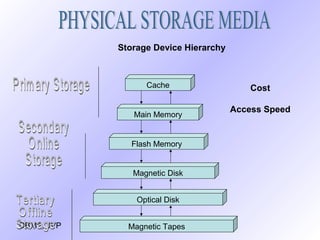
Storage Device Hierarchy

Cache

Main Memory

Flash Memory

Magnetic Disk
Optical Disk
DBMS, JVP

Magnetic Tapes

Cost
Access Speed
•
•
•
•
•

Fastest
Most Costly Media
Small & is managed by System H/W
Generally is inbuilt on-chip memory
For storage of important & critical
instructions
• If size of cache is increased –
cost increased
benefits of cache is lost
DBMS, JVP
• Machine instructions are stored in main
memory
• Its is quite small for storing Database
• Its Volatile i.e. data is lost on power failure or
system crash

DBMS, JVP
•
•
•
•
•

EEPROM
Read is Faster
Write is very slow & complicated
4-10 microsec to write, can’t be overwritten
To overwrite, has to erase entire data of
memory
• Used generally for hand-held & digital
electronics devices

DBMS, JVP
• Stores the Database, data moves between Main
Memory & Disk
• Size – Few GB upto 80GB
• Size of Magnetic Disk needs increases as we
have requirement for larger capacity disks
• Can survive power failure & system crash, is
non-volatile storage media
• Disk Failure results in loss of data stored on
disk.
DBMS, JVP
• CD – holds about 640MB
• DVD – holds 4.7 or 8.5GB per side to 17GB for
two-sided disk
• Data is stored optically on a disk, is read by laser
• WORM-write once read many CDs & DVDs
• CD-RW & DVD-RW : For multiple writes & read
• CDs are magnetic-optical storage devices that use
optical means to read magnetically encoded data.
• DBMS, JVP archival storages
Used for
•
•
•
•
•

Used for Backup Storage
Cheaper & Slower Access
Sequential-access Storage
Not direct access like CDs
Used for holding large backup data of large
organization

DBMS, JVP
Spindle
Track i
Platter

Disk Arm

Arm Assembly

Cylinder i

DBMS, JVP

R-W Head
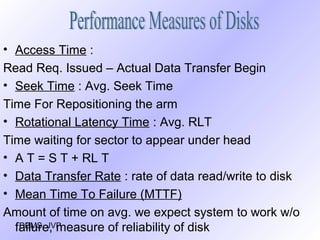
• Access Time :
Read Req. Issued – Actual Data Transfer Begin
• Seek Time : Avg. Seek Time
Time For Repositioning the arm
• Rotational Latency Time : Avg. RLT
Time waiting for sector to appear under head
• A T = S T + RL T
• Data Transfer Rate : rate of data read/write to disk
• Mean Time To Failure (MTTF)
Amount of time on avg. we expect system to work w/o
DBMS, JVP
failure, measure of reliability of disk
• Reliability of Disk : 1,00,000/100 = 1000 hours
• Disk Failure leads to loss of data
• So keep redundancy i.e. Mirroring of Disk
• MTTF of mirrored disk depends on MTTR, time to
replace failed disk & restore data
• First write to one copy them to other so on power
failure, blocks have complete data.
DBMS, JVP
• Parallel access to disks
• Improve the transfer rate by ‘Striping’
• Bit-level striping : splitting bits of each byte
across multiple disks, array of 4,8,16… disks,
increase R/W at 8 times
• Block-level striping : divide data into blocks,
each block in a disk.
• ith block is in (i mod n + 1)th disk, n=total no. of
disks in array.
• Balances load across multiple disks so access
is fast & o/p is high
DBMS, JVP
C

DBMS, JVP

C

C

C
P

DBMS, JVP

P

P
P

P

DBMS, JVP

P

P

P

P
P

DBMS, JVP

P

P

P

P

P
•
•
•
•

Monetary Cost of extra disk
Performance – no. of I/O Operations
Performance when Disk fails
Performance to rebuild the Data

RAID 0, 1, 5 are currently in use

DBMS, JVP
• File is organized logically as a sequence of
records. The records are stored in disk blocks.
Fixed Length Records
Variable Length Records

DBMS, JVP
• Deposit = record
acc_no:char(10);
br_nm:char(22);
bal:real;
end

Acc_n Br_nm
o

Bal

R-1

A-104 Bombay

500

R-2

A-121 Delhi

781

R-3

A-393 Pune

900

R-4

A-129 Bombay

400

R-5

A-214 Chennai 164

Total = 40 bytes

DBMS, JVP
Header

A-104 Bombay

500

A-121 Delhi

781

A-393 Pune

900

A-129 Bombay

400

A-214 Chennai 164
DBMS, JVP
• Records has varying length
• Account_list : record
Br_nm:char(22);
accounts :- array(1---infinite)
acc_no:char(10);
bal:real;
end
end
DBMS, JVP
• Dis. Adv. –
- Not easy to occupy space left by deleted record
Leads to small fragments on disk
- No space for records to grow

Header has info :
- No. of records
- Free space pointer
- Size of each record block
DBMS, JVP
• Reserved Space
• List Representation
– Anchor Block
– Over Flow Block

DBMS, JVP
• Heap file organization
• Sequential file organization
– Search Key
– Insert & Deleted using Overflow Block

• Hashing file organization
• Clustering file organization
DBMS, JVP
• A database that maintains data about
relations, stores information about the
tables of the database.
• E.g. Name of relations
Names of Attributes
Domains & Length
Constraints
DBMS, JVP
DBMS, JVP
• Ordered Indices
• Hash Indices
Aspects :- Access Type : by value or range
- Access Time
- Insertion Time
- Deletion Time
- Space Overhead
DBMS, JVP
• Primary Index
– Dense Index
– Sparse Index

Multilevel Indices
Secondary Indices

DBMS, JVP
• Hash File Organization
- Hash Function
Uniform Distribution
Random Distribution
- Bucket
Bucket Overflow & Skew
Overflow Chining
• Hash Indices
• Comparison of Indexing & Hashing
DBMS, JVP
DBMS, JVP

Dbms by jeet goyal

  • 2.
    Storage Device Hierarchy Cache MainMemory Flash Memory Magnetic Disk Optical Disk DBMS, JVP Magnetic Tapes Cost Access Speed
  • 3.
    • • • • • Fastest Most Costly Media Small& is managed by System H/W Generally is inbuilt on-chip memory For storage of important & critical instructions • If size of cache is increased – cost increased benefits of cache is lost DBMS, JVP
  • 4.
    • Machine instructionsare stored in main memory • Its is quite small for storing Database • Its Volatile i.e. data is lost on power failure or system crash DBMS, JVP
  • 5.
    • • • • • EEPROM Read is Faster Writeis very slow & complicated 4-10 microsec to write, can’t be overwritten To overwrite, has to erase entire data of memory • Used generally for hand-held & digital electronics devices DBMS, JVP
  • 6.
    • Stores theDatabase, data moves between Main Memory & Disk • Size – Few GB upto 80GB • Size of Magnetic Disk needs increases as we have requirement for larger capacity disks • Can survive power failure & system crash, is non-volatile storage media • Disk Failure results in loss of data stored on disk. DBMS, JVP
  • 7.
    • CD –holds about 640MB • DVD – holds 4.7 or 8.5GB per side to 17GB for two-sided disk • Data is stored optically on a disk, is read by laser • WORM-write once read many CDs & DVDs • CD-RW & DVD-RW : For multiple writes & read • CDs are magnetic-optical storage devices that use optical means to read magnetically encoded data. • DBMS, JVP archival storages Used for
  • 8.
    • • • • • Used for BackupStorage Cheaper & Slower Access Sequential-access Storage Not direct access like CDs Used for holding large backup data of large organization DBMS, JVP
  • 9.
    Spindle Track i Platter Disk Arm ArmAssembly Cylinder i DBMS, JVP R-W Head
  • 10.
    • Access Time: Read Req. Issued – Actual Data Transfer Begin • Seek Time : Avg. Seek Time Time For Repositioning the arm • Rotational Latency Time : Avg. RLT Time waiting for sector to appear under head • A T = S T + RL T • Data Transfer Rate : rate of data read/write to disk • Mean Time To Failure (MTTF) Amount of time on avg. we expect system to work w/o DBMS, JVP failure, measure of reliability of disk
  • 11.
    • Reliability ofDisk : 1,00,000/100 = 1000 hours • Disk Failure leads to loss of data • So keep redundancy i.e. Mirroring of Disk • MTTF of mirrored disk depends on MTTR, time to replace failed disk & restore data • First write to one copy them to other so on power failure, blocks have complete data. DBMS, JVP
  • 12.
    • Parallel accessto disks • Improve the transfer rate by ‘Striping’ • Bit-level striping : splitting bits of each byte across multiple disks, array of 4,8,16… disks, increase R/W at 8 times • Block-level striping : divide data into blocks, each block in a disk. • ith block is in (i mod n + 1)th disk, n=total no. of disks in array. • Balances load across multiple disks so access is fast & o/p is high DBMS, JVP
  • 14.
  • 15.
  • 16.
  • 17.
  • 18.
    • • • • Monetary Cost ofextra disk Performance – no. of I/O Operations Performance when Disk fails Performance to rebuild the Data RAID 0, 1, 5 are currently in use DBMS, JVP
  • 19.
    • File isorganized logically as a sequence of records. The records are stored in disk blocks. Fixed Length Records Variable Length Records DBMS, JVP
  • 20.
    • Deposit =record acc_no:char(10); br_nm:char(22); bal:real; end Acc_n Br_nm o Bal R-1 A-104 Bombay 500 R-2 A-121 Delhi 781 R-3 A-393 Pune 900 R-4 A-129 Bombay 400 R-5 A-214 Chennai 164 Total = 40 bytes DBMS, JVP
  • 21.
    Header A-104 Bombay 500 A-121 Delhi 781 A-393Pune 900 A-129 Bombay 400 A-214 Chennai 164 DBMS, JVP
  • 22.
    • Records hasvarying length • Account_list : record Br_nm:char(22); accounts :- array(1---infinite) acc_no:char(10); bal:real; end end DBMS, JVP
  • 23.
    • Dis. Adv.– - Not easy to occupy space left by deleted record Leads to small fragments on disk - No space for records to grow Header has info : - No. of records - Free space pointer - Size of each record block DBMS, JVP
  • 24.
    • Reserved Space •List Representation – Anchor Block – Over Flow Block DBMS, JVP
  • 25.
    • Heap fileorganization • Sequential file organization – Search Key – Insert & Deleted using Overflow Block • Hashing file organization • Clustering file organization DBMS, JVP
  • 26.
    • A databasethat maintains data about relations, stores information about the tables of the database. • E.g. Name of relations Names of Attributes Domains & Length Constraints DBMS, JVP
  • 27.
  • 28.
    • Ordered Indices •Hash Indices Aspects :- Access Type : by value or range - Access Time - Insertion Time - Deletion Time - Space Overhead DBMS, JVP
  • 29.
    • Primary Index –Dense Index – Sparse Index Multilevel Indices Secondary Indices DBMS, JVP
  • 30.
    • Hash FileOrganization - Hash Function Uniform Distribution Random Distribution - Bucket Bucket Overflow & Skew Overflow Chining • Hash Indices • Comparison of Indexing & Hashing DBMS, JVP
  • 31.