
DRYAMAL PATEL
• Honorary lecturer, Agakhan university hosp.
• Past Director, ICMAS
• Vice Chair, KESES
• Executive Board member, ISGE
• Associate MRCOG
• Member, AAGL
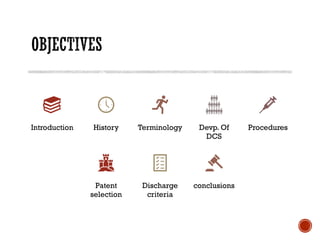
Introduction History Terminology Devp. Of
DCS
Procedures
Patent
selection
Discharge
criteria
conclusions
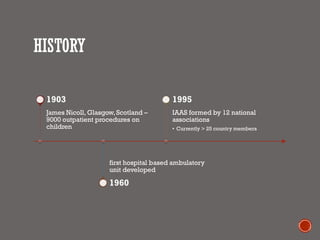
HISTORY
James Nicoll, Glasgow,Scotland –
9000 outpatient procedures on
children
1903
first hospital based ambulatory
unit developed
1960
IAAS formed by 12 national
associations
• Currently > 25 country members
1995
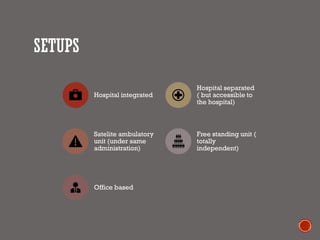
SETUPS
Hospital integrated
Hospital separated
( but accessible to
the hospital)
Satelite ambulatory
unit (under same
administration)
Free standing unit (
totally
independent)
Office based
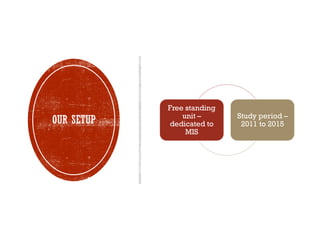
OUR SETUP
Free standing
unit –
dedicated to
MIS
Study period –
2011 to 2015
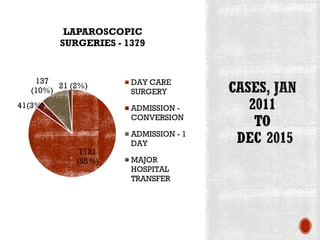
1121
(85%)
41(3%)
137
(10%)
21 (2%)
LAPAROSCOPIC
SURGERIES - 1379
DAY CARE
SURGERY
ADMISSION -
CONVERSION
ADMISSION - 1
DAY
MAJOR
HOSPITAL
TRANSFER
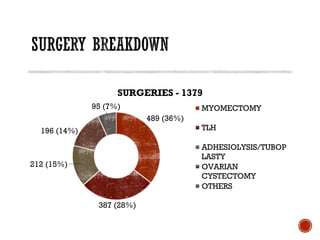
489 (36%)
387 (28%)
212 (15%)
196 (14%)
95 (7%)
SURGERIES - 1379
MYOMECTOMY
TLH
ADHESIOLYSIS/TUBOP
LASTY
OVARIAN
CYSTECTOMY
OTHERS
2011 – 16 cases to 2015 – 489
cases
Uterus size – bulky to 28 weeks
Dominant fibroid – 2 to 26.4 cm
Number – 2 to 17
Day care surgery – 456, admissions
33 [7.2%] with only 5[1.1%]
conversions.
▪ Day care surgery – 365,admissions – 22
[6%]
▪ Uterus size – 40g to 3.27kg
▪ Readmissions, transfers, conversions – None
▪ Blood transfusion – none
▪ Bladder injury – one [0.27%]
Some still believe in open TAH/myomectomy
Great variation hospital stay - 2-5 night stay
Nbm 2-3 days, drains etc
Surgeons want to play safe
Patients not aware of available options
Insurance companies ignorant and uncooperative.
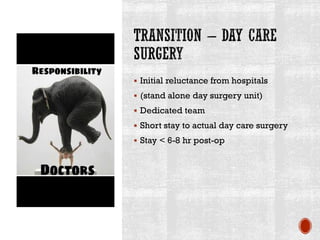
▪ Initial reluctance from hospitals
▪ (stand alone day surgery unit)
▪ Dedicated team
▪ Short stay to actual day care surgery
▪ Stay < 6-8 hr post-op
▪ Which procedures?
▪ Widening due to improvements in :
▪ Surgical techniques
▪ Anaesthetic techniques
▪ Pain control
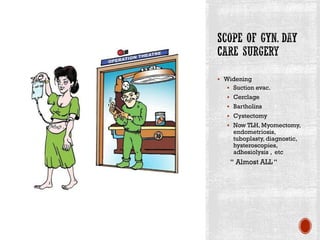
▪ Widening
▪ Suction evac.
▪ Cerclage
▪ Bartholins
▪ Cystectomy
▪ Now TLH, Myomectomy,
endometriosis,
tuboplasty, diagnostic,
hysteroscopies,
adhesiolysis , etc
“ Almost ALL“
CRITERIA OF DAY
CARE SURGERY?
▪ Which patients?
▪ Surgical criteria:
▪ No increased risk of
haemorrhage
▪ Able to allow oral intake in few
hr
▪ One that allows early
mobilization
▪ Abd/ thoracic cavity opened
only by MIS
▪ No requirement of prolonged
specialist post-op care
▪ Post-op pain amenable to oral
medication
▪ Anaesthesia side effects that
delay discharge must be
minimal
▪ Expected duration of surgery
▪ Medical:
▪ Fitness – physiological age,ASA,BMI etc
▪ Good control chronic disease – DM, HTN
▪ Social:
▪ Patient counselled well
▪ Consent for DCS
▪ Responsible adult to escort home
▪ Support for first 24hr at home
▪ Not far away from hospital
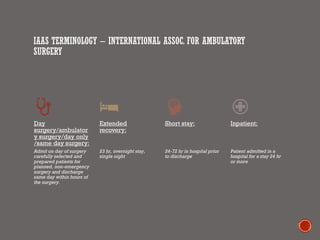
IAAS TERMINOLOGY – INTERNATIONAL ASSOC. FOR AMBULATORY
SURGERY
Day
surgery/ambulator
y surgery/day only
/same day surgery:
Admit on day of surgery
carefully selected and
prepared patients for
planned, non-emergency
surgery and discharge
same day within hours of
the surgery.
Extended
recovery:
23 hr, overnight stay,
single night
Short stay:
24-72 hr in hospital prior
to discharge
Inpatient:
Patient admitted in a
hospital for a stay 24 hr
or more
▪ A procedure carried out in a
medical practitioners
professional premises in an
appropriately designed and
equipped service room.
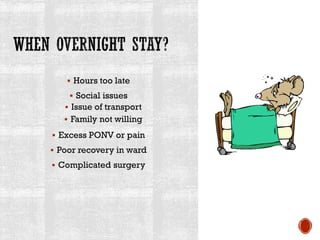
▪ Hours too late
▪ Social issues
▪ Issue of transport
▪ Family not willing
▪ Excess PONV or pain
▪ Poor recovery in ward
▪ Complicated surgery
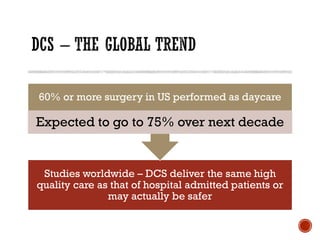
Studies worldwide – DCS deliver the same high
quality care as that of hospital admitted patients or
may actually be safer
60% or more surgery in US performed as daycare
Expected to go to 75% over next decade
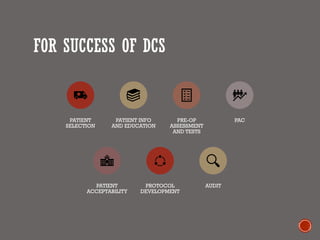
FOR SUCCESS OF DCS
PATIENT
SELECTION
PATIENT INFO
AND EDUCATION
PRE-OP
ASSESSMENT
AND TESTS
PAC
PATIENT
ACCEPTABILITY
PROTOCOL
DEVELOPMENT
AUDIT
Pain
PONV
Patient education and perception
Discharge planning
Follow-up care at home
Is readmission a taboo?
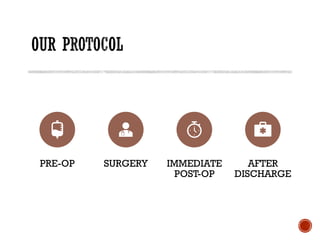
PRE-OP SURGERY IMMEDIATE
POST-OP
AFTER
DISCHARGE
▪ Explain what DCS means – involve patients in decision making
▪ Date, time and place to arrive
▪ Informed consent
▪ Prior anaesthetic check – ASA I/II, allay anxiety
▪ No smoking at least 12hr
▪ NBM from midnight
▪ Changes to current medication scheduling or dosing
▪ No J-ASA or blood thinner for a week prior
Bring all meds regularly taken to hospital
Stop COCPs at least 48hr prior
Shower evening before or on day of surgery
Report wounds, cuts or rashes on site of surgery
Remove nail polish
Leave jewellery at home
Inform about URTI and allergies
No alcohol day before
No shaving of abdomen
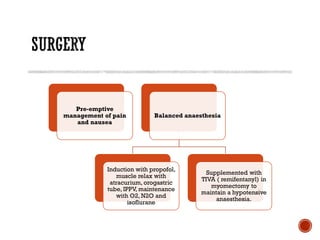
Pre-emptive
management of pain
and nausea
Balanced anaesthesia
Induction with propofol,
muscle relax with
atracurium, orogastric
tube, IPPV, maintenance
with O2, N2O and
isoflurane
Supplemented with
TIVA ( remifentanyl) in
myomectomy to
maintain a hypotensive
anaesthesia.
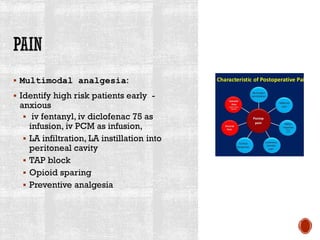
▪ Multimodal analgesia:
▪ Identify high risk patients early -
anxious
▪ iv fentanyl, iv diclofenac 75 as
infusion, iv PCM as infusion,
▪ LA infiltration, LA instillation into
peritoneal cavity
▪ TAP block
▪ Opioid sparing
▪ Preventive analgesia
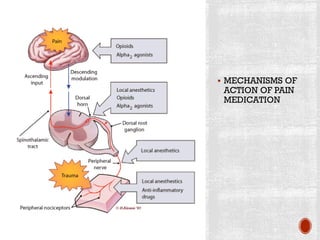
▪ MECHANISMS OF
ACTION OF PAIN
MEDICATION
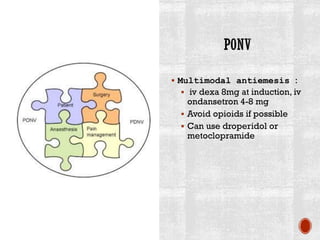
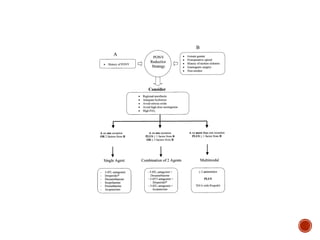
▪ Multimodal antiemesis :
▪ iv dexa 8mg at induction, iv
ondansetron 4-8 mg
▪ Avoid opioids if possible
▪ Can use droperidol or
metoclopramide
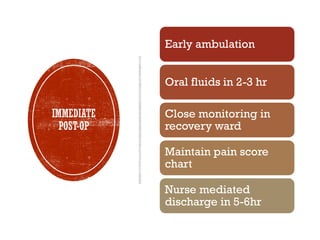
IMMEDIATE
POST-OP
Early ambulation
Oral fluids in 2-3 hr
Close monitoring in
recovery ward
Maintain pain score
chart
Nurse mediated
discharge in 5-6hr
DISCHARGE
PLANNING “protocol driven
nurse- led discharge”
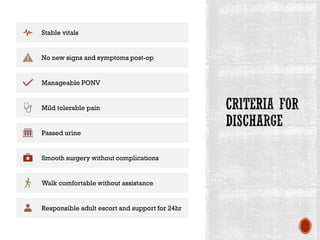
Stable vitals
No new signs and symptoms post-op
Manageable PONV
Mild tolerable pain
Passed urine
Smooth surgery without complications
Walk comfortable without assistance
Responsible adult escort and support for 24hr
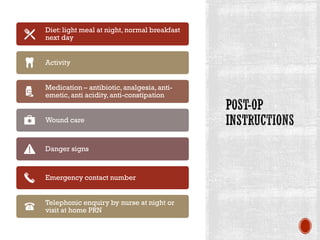
Diet: light meal at night, normal breakfast
next day
Activity
Medication – antibiotic,analgesia,anti-
emetic, anti acidity,anti-constipation
Wound care
Danger signs
Emergency contact number
Telephonic enquiry by nurse at night or
visit at home PRN
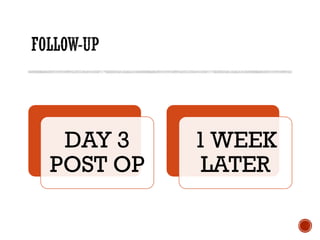
DAY 3
POST OP
1 WEEK
LATER
DCS
ADVANTAGES
▪Patient and family
▪ More personalized
▪ Recover in familiar home
environment
▪ Avoid complications of long
hospital stay – nosocomial
infections, DVT etc
▪ Resume personal life earlier
▪ Higher satisfaction
ADVANTAGES
▪ Hospital
▪ Cost 25%-75% lesser
▪ Less nursing and medical
supervision
▪ Ease scheduling patients
and surgeons
▪ More numbers can be
treated
▪ Decompression of busy
hospital beds
▪ Healthcare system
▪ Cost containment
▪ Can be made more accessible
▪ Will change design of health care
facilities and composition of health care
workforce
▪ Hospitals of ‘future’ – more OT and fewer
beds
▪ Lesser strain on ward staffing
▪ More home based nursing care.
▪ Prof. Rafique Parkar
▪ Dr Wanyoike Gichuhi
▪ ICMAS
Thank you all

Day care surgery

  • 1.
  • 2.
    • Honorary lecturer,Agakhan university hosp. • Past Director, ICMAS • Vice Chair, KESES • Executive Board member, ISGE • Associate MRCOG • Member, AAGL
  • 3.
    Introduction History TerminologyDevp. Of DCS Procedures Patent selection Discharge criteria conclusions
  • 4.
    HISTORY James Nicoll, Glasgow,Scotland– 9000 outpatient procedures on children 1903 first hospital based ambulatory unit developed 1960 IAAS formed by 12 national associations • Currently > 25 country members 1995
  • 5.
    SETUPS Hospital integrated Hospital separated (but accessible to the hospital) Satelite ambulatory unit (under same administration) Free standing unit ( totally independent) Office based
  • 6.
    OUR SETUP Free standing unit– dedicated to MIS Study period – 2011 to 2015
  • 7.
    1121 (85%) 41(3%) 137 (10%) 21 (2%) LAPAROSCOPIC SURGERIES -1379 DAY CARE SURGERY ADMISSION - CONVERSION ADMISSION - 1 DAY MAJOR HOSPITAL TRANSFER
  • 8.
    489 (36%) 387 (28%) 212(15%) 196 (14%) 95 (7%) SURGERIES - 1379 MYOMECTOMY TLH ADHESIOLYSIS/TUBOP LASTY OVARIAN CYSTECTOMY OTHERS
  • 9.
    2011 – 16cases to 2015 – 489 cases Uterus size – bulky to 28 weeks Dominant fibroid – 2 to 26.4 cm Number – 2 to 17 Day care surgery – 456, admissions 33 [7.2%] with only 5[1.1%] conversions.
  • 10.
    ▪ Day caresurgery – 365,admissions – 22 [6%] ▪ Uterus size – 40g to 3.27kg ▪ Readmissions, transfers, conversions – None ▪ Blood transfusion – none ▪ Bladder injury – one [0.27%]
  • 11.
    Some still believein open TAH/myomectomy Great variation hospital stay - 2-5 night stay Nbm 2-3 days, drains etc Surgeons want to play safe Patients not aware of available options Insurance companies ignorant and uncooperative.
  • 12.
    ▪ Initial reluctancefrom hospitals ▪ (stand alone day surgery unit) ▪ Dedicated team ▪ Short stay to actual day care surgery ▪ Stay < 6-8 hr post-op
  • 13.
    ▪ Which procedures? ▪Widening due to improvements in : ▪ Surgical techniques ▪ Anaesthetic techniques ▪ Pain control
  • 14.
    ▪ Widening ▪ Suctionevac. ▪ Cerclage ▪ Bartholins ▪ Cystectomy ▪ Now TLH, Myomectomy, endometriosis, tuboplasty, diagnostic, hysteroscopies, adhesiolysis , etc “ Almost ALL“
  • 15.
    CRITERIA OF DAY CARESURGERY? ▪ Which patients? ▪ Surgical criteria: ▪ No increased risk of haemorrhage ▪ Able to allow oral intake in few hr ▪ One that allows early mobilization ▪ Abd/ thoracic cavity opened only by MIS ▪ No requirement of prolonged specialist post-op care ▪ Post-op pain amenable to oral medication ▪ Anaesthesia side effects that delay discharge must be minimal ▪ Expected duration of surgery
  • 16.
    ▪ Medical: ▪ Fitness– physiological age,ASA,BMI etc ▪ Good control chronic disease – DM, HTN ▪ Social: ▪ Patient counselled well ▪ Consent for DCS ▪ Responsible adult to escort home ▪ Support for first 24hr at home ▪ Not far away from hospital
  • 17.
    IAAS TERMINOLOGY –INTERNATIONAL ASSOC. FOR AMBULATORY SURGERY Day surgery/ambulator y surgery/day only /same day surgery: Admit on day of surgery carefully selected and prepared patients for planned, non-emergency surgery and discharge same day within hours of the surgery. Extended recovery: 23 hr, overnight stay, single night Short stay: 24-72 hr in hospital prior to discharge Inpatient: Patient admitted in a hospital for a stay 24 hr or more
  • 18.
    ▪ A procedurecarried out in a medical practitioners professional premises in an appropriately designed and equipped service room.
  • 19.
    ▪ Hours toolate ▪ Social issues ▪ Issue of transport ▪ Family not willing ▪ Excess PONV or pain ▪ Poor recovery in ward ▪ Complicated surgery
  • 20.
    Studies worldwide –DCS deliver the same high quality care as that of hospital admitted patients or may actually be safer 60% or more surgery in US performed as daycare Expected to go to 75% over next decade
  • 21.
    FOR SUCCESS OFDCS PATIENT SELECTION PATIENT INFO AND EDUCATION PRE-OP ASSESSMENT AND TESTS PAC PATIENT ACCEPTABILITY PROTOCOL DEVELOPMENT AUDIT
  • 22.
    Pain PONV Patient education andperception Discharge planning Follow-up care at home Is readmission a taboo?
  • 23.
  • 24.
    ▪ Explain whatDCS means – involve patients in decision making ▪ Date, time and place to arrive ▪ Informed consent ▪ Prior anaesthetic check – ASA I/II, allay anxiety ▪ No smoking at least 12hr ▪ NBM from midnight ▪ Changes to current medication scheduling or dosing ▪ No J-ASA or blood thinner for a week prior
  • 25.
    Bring all medsregularly taken to hospital Stop COCPs at least 48hr prior Shower evening before or on day of surgery Report wounds, cuts or rashes on site of surgery Remove nail polish Leave jewellery at home Inform about URTI and allergies No alcohol day before No shaving of abdomen
  • 26.
    Pre-emptive management of pain andnausea Balanced anaesthesia Induction with propofol, muscle relax with atracurium, orogastric tube, IPPV, maintenance with O2, N2O and isoflurane Supplemented with TIVA ( remifentanyl) in myomectomy to maintain a hypotensive anaesthesia.
  • 27.
    ▪ Multimodal analgesia: ▪Identify high risk patients early - anxious ▪ iv fentanyl, iv diclofenac 75 as infusion, iv PCM as infusion, ▪ LA infiltration, LA instillation into peritoneal cavity ▪ TAP block ▪ Opioid sparing ▪ Preventive analgesia
  • 28.
    ▪ MECHANISMS OF ACTIONOF PAIN MEDICATION
  • 29.
    ▪ Multimodal antiemesis: ▪ iv dexa 8mg at induction, iv ondansetron 4-8 mg ▪ Avoid opioids if possible ▪ Can use droperidol or metoclopramide
  • 31.
    IMMEDIATE POST-OP Early ambulation Oral fluidsin 2-3 hr Close monitoring in recovery ward Maintain pain score chart Nurse mediated discharge in 5-6hr
  • 32.
  • 33.
    Stable vitals No newsigns and symptoms post-op Manageable PONV Mild tolerable pain Passed urine Smooth surgery without complications Walk comfortable without assistance Responsible adult escort and support for 24hr
  • 34.
    Diet: light mealat night, normal breakfast next day Activity Medication – antibiotic,analgesia,anti- emetic, anti acidity,anti-constipation Wound care Danger signs Emergency contact number Telephonic enquiry by nurse at night or visit at home PRN
  • 35.
    DAY 3 POST OP 1WEEK LATER
  • 36.
    DCS ADVANTAGES ▪Patient and family ▪More personalized ▪ Recover in familiar home environment ▪ Avoid complications of long hospital stay – nosocomial infections, DVT etc ▪ Resume personal life earlier ▪ Higher satisfaction
  • 37.
    ADVANTAGES ▪ Hospital ▪ Cost25%-75% lesser ▪ Less nursing and medical supervision ▪ Ease scheduling patients and surgeons ▪ More numbers can be treated ▪ Decompression of busy hospital beds
  • 38.
    ▪ Healthcare system ▪Cost containment ▪ Can be made more accessible
  • 39.
    ▪ Will changedesign of health care facilities and composition of health care workforce ▪ Hospitals of ‘future’ – more OT and fewer beds ▪ Lesser strain on ward staffing ▪ More home based nursing care.
  • 40.
    ▪ Prof. RafiqueParkar ▪ Dr Wanyoike Gichuhi ▪ ICMAS
  • 41.