Daming HeDaming HeDaming HeDaming He
AIRC, Yunnan University, ChinaAIRC, Yunnan University, ChinaAIRC, Yunnan University, ChinaAIRC, Yunnan University, China
Issues, Challenges, and Cooperation
in Transboundary Waters
Between China and Africa
Workshop on Transboundary Water Management: Orange-Senqu and
Zambezi Basins, Johannesburg, South Africa , 29-30 April, 2014
Diverse but common challenges we are facing on
Diverse but common TWR issues we have to
solute
Diverse but different advantages we could share
each other
Diverse but common interests we could
cooperate each other
China-Africa
Diverse but common challenges we are facing on
As developing countries: how to balance the
development and conservation?
As the monsoon-driving-ecosystem countries: how to
adapt the climate change?
As the riparian countries sharing diverse international
waters: how to strength the multiple geo-cooperation
and solute the transboundary issues?
As the long-friendship countries: how to facilitate and
update the transboundary water cooperation, from
basins, countries, regions, to global?
……
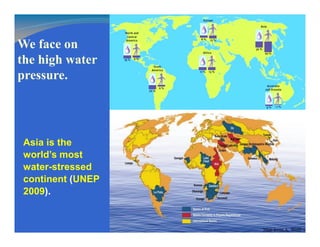
We face on
the high water
pressure.
Asia is the
world’s most
water-stressed
continent (UNEP
2009).
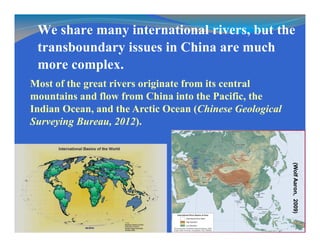
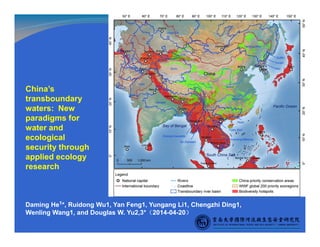
We share many international rivers, but the
transboundary issues in China are much
more complex.
Most of the great rivers originate from its central
mountains and flow from China into the Pacific, the
Indian Ocean, and the Arctic Ocean (Chinese Geological
Surveying Bureau, 2012).
(WolfAaron,2009)
Daming He1*, Ruidong Wu1, Yan Feng1, Yungang Li1, Chengzhi Ding1,
Wenling Wang1, and Douglas W. Yu2,3*((((2014-04-20))))
China’s
transboundary
waters: New
paradigms for
water and
ecological
security through
applied ecology
research
Response of key ecological elements (runoff, sediment, water
quality, bio-community) to climate changes.
Regional storming and transboundary flooding
Water quality change and transboundary water pollution
International Watercourse change and migration fish
ecosystem health
International water laws’ revision and improvement
Regional hydro-political issue of
Vulnerability Assessment and Management of Transboundary
Resources
Conflicts and solution of Transboundary water
We are facing on environmental issues under the
climate change and human activities driving as the
economic fast development.
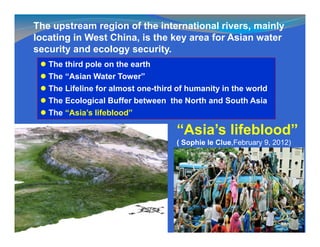
The upstream region of the international rivers, mainly
locating in West China, is the key area for Asian water
security and ecology security.
“Asia’s lifeblood”
( Sophie le Clue,February 9, 2012)
The third pole on the earth
The “Asian Water Tower”
The Lifeline for almost one-third of humanity in the world
The Ecological Buffer between the North and South Asia
The “Asia’s lifeblood”
The major transboundary issues of international
rivers in Southwest China
Degradation of river
ecosystem
Regional serious
soil erosion
Pattern changes in
wetland ecosystem
Environmental
degradation in mining
areas
River sedimentation
Region environmental
change
Damage to effect of
hydropower projects
Water shortage of mountain
environment
Biodiversity descend
Transboundary hydrological
regime changes
Damage to ecosystem
Transboundary flood
hazard
Watercourse fragmentation
Transboundary impact
of environmental change
River water quality worsen
Transboundary water
pollution
The conflicts of
transboundary
resources / ecology
Construction of the main
international passage
Geo-cooperation and
environmental diplomacy
The construction of cross-
border economic
corridors
Regional energy
cooperation
International treaties /
agreements
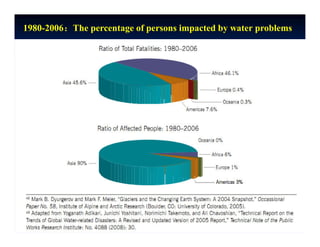
1980-2006::::The percentage of persons impacted by water problems
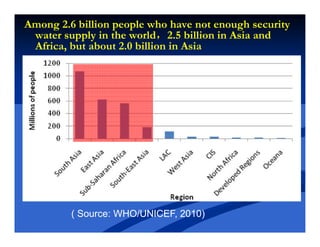
Among 2.6 billion people who have not enough security
water supply in the world,,,,2.5 billion in Asia and
Africa, but about 2.0 billion in Asia
( Source: WHO/UNICEF, 2010)
Diverse but common TWR issues we have to solute
How to allocate and utilize TWR equitably and
reasonably
How to assess transboundary impact of TWR
development
How to manage transboundary water resources
(TWR) coordinately among riparian countries
How to prevent and solve the conflict of TWR:
sharing the benefit and responsibility equitably
How to facilitate the participation for all
stakeholders of riparian countries
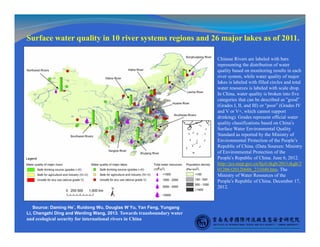
Surface water quality in 10 river systems regions and 26 major lakes as of 2011.
Chinese Rivers are labeled with bars
representing the distribution of water
quality based on monitoring results in each
river system, while water quality of major
lakes is labeled with filled circles and total
water resources is labeled with scale drop.
In China, water quality is broken into five
categories that can be described as ‘‘good’’
(Grades I, II, and III) or ‘‘poor’’ (Grades IV
and V or V+, which cannot support
drinking). Grades represent official water
quality classifications based on China’s
Surface Water Environmental Quality
Standard as reported by the Ministry of
Environmental Protection of the People’s
Republic of China. (Data Sources: Ministry
of Environmental Protection of the
People’s Republic of China. June 6, 2012.
http://jcs.mep.gov.cn/hjzl/zkgb/2011zkgb/2
01206/t20120606_231040.htm. The
Ministry of Water Resources of the
People’s Republic of China. December 17,
2012.
Source: Daming He*, Ruidong Wu, Douglas W Yu, Yan Feng, Yungang
Li, Chengzhi Ding and Wenling Wang, 2013. Towards transboundary water
and ecological security for international rivers in China
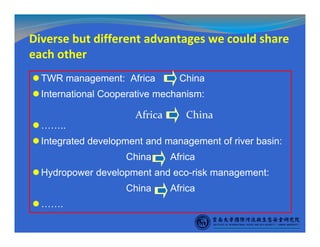
Diverse but different advantages we could share
each other
TWR management: Africa China
International Cooperative mechanism:
……..
Integrated development and management of river basin:
China Africa
Hydropower development and eco-risk management:
China Africa
…….
Africa China
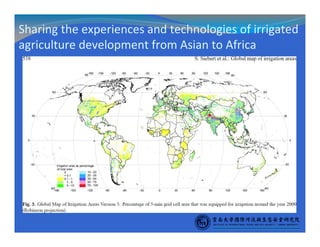
Sharing the experiences and technologies of irrigated
agriculture development from Asian to Africa
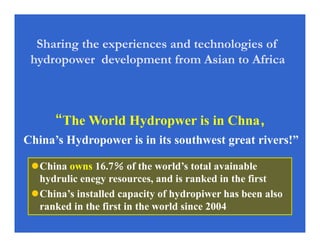
China owns 16.7%%%% of the world’s total avainable
hydrulic enegy resources, and is ranked in the first
China’s installed capacity of hydropiwer has been also
ranked in the first in the world since 2004
““““The World Hydropwer is in Chna,,,,
China’s Hydropower is in its southwest great rivers!”
Sharing the experiences and technologies of
hydropower development from Asian to Africa
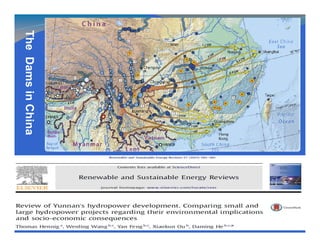
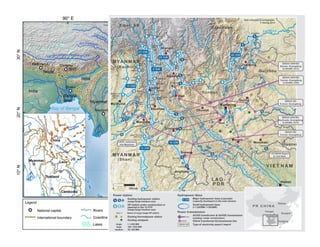
TheDamsinChina
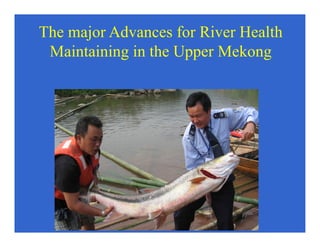
The major Advances for River Health
Maintaining in the Upper Mekong
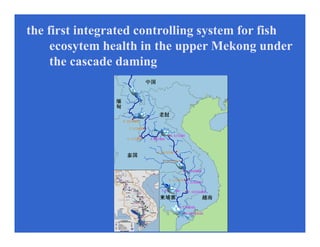
the first integrated controlling system for fish
ecosytem health in the upper Mekong under
the cascade daming
Canceling one cascade
dam
Building the fish
Facilities
Pumping at different
water levels
Cascade operating based
the eco-security demand
Establishing the fish
protected area
Lowering the dams
height
Developing the fish
hatchery
Babi fish releasing
Migrating
corridor
protection
Fishery
resources
proliferation
Water
temperature
regulating
Habitat
protection
(natural
nerves)
Diverse but common interests we could
cooperate each other
Information, knowledge and technologies sharing
Cooperative researches
Capacity building
Scholarship, education, and training
Exchange and workshops
….
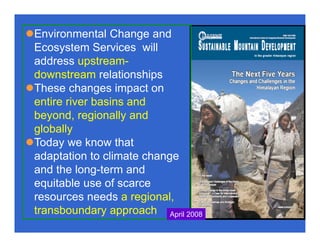
Environmental Change and
Ecosystem Services will
address upstream-
downstream relationships
These changes impact on
entire river basins and
beyond, regionally and
globally
Today we know that
adaptation to climate change
and the long-term and
equitable use of scarce
resources needs a regional,
transboundary approach April 2008
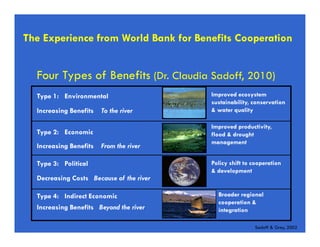
The Experience from World Bank for Benefits Cooperation
Four Types of Benefits (Dr. Claudia Sadoff, 2010)
Improved productivity,
flood & drought
management
Improved ecosystem
sustainability, conservation
& water quality
Policy shift to cooperation
& development
Broader regional
cooperation &
integration
Type 1: Environmental
Increasing Benefits To the river
Type 2: Economic
Increasing Benefits From the river
Type 3: Political
Decreasing Costs Because of the river
Type 4: Indirect Economic
Increasing Benefits Beyond the river
Sadoff & Grey, 2002
River ecosystem pattern and coupling
relationship
Chain structural characteristics and ecological
effect chain of river continuum
Change characteristics and regional differences
of river ecological process
Change trend of river ecological process
(1) Pattern and change trend of river ecological process
Some major topics suggesting for cooperative
research
Response of key ecological elements (runoff,
sediment, water quality, bio-community) to climate
changes.
Response of key ecological elements to regional
human activity driving
Relationship among solid water (glaciers), river
flow and climate changes.
Regional response of river ecological process to
the impacts of climate changes and human
activities.
(2) Regional response of river ecological
process to climate changes
(3) Multi-scale effect of river ecological changes
Changes of river ecological process and its integrity
conservation
Changes of major ecological service function and
ecological water requirement
Change of ecological process and hazard chain
Runoff change and the security of water resources
and hydropower energy
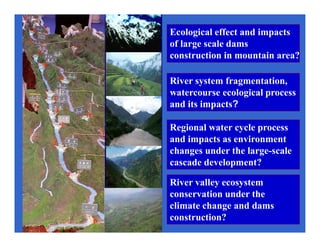
River system fragmentation,
watercourse ecological process
and its impacts?
Ecological effect and impacts
of large scale dams
construction in mountain area?
Regional water cycle process
and impacts as environment
changes under the large-scale
cascade development?
River valley ecosystem
conservation under the
climate change and dams
construction?
(4) Transboundary impacts of
river ecological changes
Transboundary impacts of sediment change
Transboundary impacts of runoff change
Regional storming and transboundary flooding
Water quality change and transboundary water
pollution
Impacts of river ecological changes to the
transboundary migration fish ecosystem
Watercourse change and border demarcation
uncertainties
(5) Maintenance of river health and regulating
mechanism of transboundary ecological security
Key ecological threshold and evaluation base of
river health
Standards of sharing water resources and benefits
allocation (Quantifiable indexes system)
Model system of transboundary water resources
allocation (Different watercourse type, regional
environment and cooperation region)
Regional variation and key influencing factors of
transboundary ecological security issues
Regulating mechanism and adaptive strategies
(Different regional environment and cooperation
region)
Need the new law’s articles for “common but different
duty ” to share the benefits and cost equitably between
upstream and downstream
Need the trans-boundary environmental compensation
mechanism to facilitate the regional development equity
(1) Regional development equity should
added in international rivers laws
The key suggestion we could cooperate to
facilitate more fair mechanism
development for transboundary waters
(2) Trans-boundary environmental
compensation mechanism should be
established
It has been recently apprehended from an
environmental and even ecological point of view IR
treaties has to be conceived in an interdisciplinary
and multisectorial context because its related features
involve, for instance, environment, health, agriculture,
economy, law or policies
Identify the key items/index of benefits and cost
from economic development, ecological security,
and geo-politics cooperation
Assess the getting and losing from the cooperation
among riparian countries
Establish the trans-boundary environmental
compensation mechanism to facilitate the regional
development equity
Negotiate the clear rules
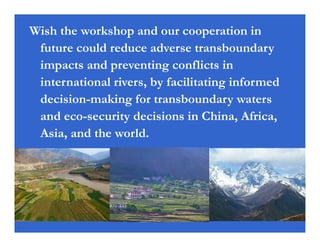
Wish the workshop and our cooperation in
future could reduce adverse transboundary
impacts and preventing conflicts in
international rivers, by facilitating informed
decision-making for transboundary waters
and eco-security decisions in China, Africa,
Asia, and the world.
Thank You!!!!

Issues, Challenges, and Cooperation in Transboundary Waters

  • 1.
    Daming HeDaming HeDamingHeDaming He AIRC, Yunnan University, ChinaAIRC, Yunnan University, ChinaAIRC, Yunnan University, ChinaAIRC, Yunnan University, China Issues, Challenges, and Cooperation in Transboundary Waters Between China and Africa Workshop on Transboundary Water Management: Orange-Senqu and Zambezi Basins, Johannesburg, South Africa , 29-30 April, 2014
  • 2.
    Diverse but commonchallenges we are facing on Diverse but common TWR issues we have to solute Diverse but different advantages we could share each other Diverse but common interests we could cooperate each other China-Africa
  • 3.
    Diverse but commonchallenges we are facing on As developing countries: how to balance the development and conservation? As the monsoon-driving-ecosystem countries: how to adapt the climate change? As the riparian countries sharing diverse international waters: how to strength the multiple geo-cooperation and solute the transboundary issues? As the long-friendship countries: how to facilitate and update the transboundary water cooperation, from basins, countries, regions, to global? ……
  • 4.
    We face on thehigh water pressure. Asia is the world’s most water-stressed continent (UNEP 2009).
  • 5.
    We share manyinternational rivers, but the transboundary issues in China are much more complex. Most of the great rivers originate from its central mountains and flow from China into the Pacific, the Indian Ocean, and the Arctic Ocean (Chinese Geological Surveying Bureau, 2012). (WolfAaron,2009)
  • 6.
    Daming He1*, RuidongWu1, Yan Feng1, Yungang Li1, Chengzhi Ding1, Wenling Wang1, and Douglas W. Yu2,3*((((2014-04-20)))) China’s transboundary waters: New paradigms for water and ecological security through applied ecology research
  • 7.
    Response of keyecological elements (runoff, sediment, water quality, bio-community) to climate changes. Regional storming and transboundary flooding Water quality change and transboundary water pollution International Watercourse change and migration fish ecosystem health International water laws’ revision and improvement Regional hydro-political issue of Vulnerability Assessment and Management of Transboundary Resources Conflicts and solution of Transboundary water We are facing on environmental issues under the climate change and human activities driving as the economic fast development.
  • 8.
    The upstream regionof the international rivers, mainly locating in West China, is the key area for Asian water security and ecology security. “Asia’s lifeblood” ( Sophie le Clue,February 9, 2012) The third pole on the earth The “Asian Water Tower” The Lifeline for almost one-third of humanity in the world The Ecological Buffer between the North and South Asia The “Asia’s lifeblood”
  • 9.
    The major transboundaryissues of international rivers in Southwest China Degradation of river ecosystem Regional serious soil erosion Pattern changes in wetland ecosystem Environmental degradation in mining areas River sedimentation Region environmental change Damage to effect of hydropower projects Water shortage of mountain environment Biodiversity descend Transboundary hydrological regime changes Damage to ecosystem Transboundary flood hazard Watercourse fragmentation Transboundary impact of environmental change River water quality worsen Transboundary water pollution The conflicts of transboundary resources / ecology Construction of the main international passage Geo-cooperation and environmental diplomacy The construction of cross- border economic corridors Regional energy cooperation International treaties / agreements
  • 10.
    1980-2006::::The percentage ofpersons impacted by water problems
  • 11.
    Among 2.6 billionpeople who have not enough security water supply in the world,,,,2.5 billion in Asia and Africa, but about 2.0 billion in Asia ( Source: WHO/UNICEF, 2010)
  • 12.
    Diverse but commonTWR issues we have to solute How to allocate and utilize TWR equitably and reasonably How to assess transboundary impact of TWR development How to manage transboundary water resources (TWR) coordinately among riparian countries How to prevent and solve the conflict of TWR: sharing the benefit and responsibility equitably How to facilitate the participation for all stakeholders of riparian countries
  • 13.
    Surface water qualityin 10 river systems regions and 26 major lakes as of 2011. Chinese Rivers are labeled with bars representing the distribution of water quality based on monitoring results in each river system, while water quality of major lakes is labeled with filled circles and total water resources is labeled with scale drop. In China, water quality is broken into five categories that can be described as ‘‘good’’ (Grades I, II, and III) or ‘‘poor’’ (Grades IV and V or V+, which cannot support drinking). Grades represent official water quality classifications based on China’s Surface Water Environmental Quality Standard as reported by the Ministry of Environmental Protection of the People’s Republic of China. (Data Sources: Ministry of Environmental Protection of the People’s Republic of China. June 6, 2012. http://jcs.mep.gov.cn/hjzl/zkgb/2011zkgb/2 01206/t20120606_231040.htm. The Ministry of Water Resources of the People’s Republic of China. December 17, 2012. Source: Daming He*, Ruidong Wu, Douglas W Yu, Yan Feng, Yungang Li, Chengzhi Ding and Wenling Wang, 2013. Towards transboundary water and ecological security for international rivers in China
  • 14.
    Diverse but differentadvantages we could share each other TWR management: Africa China International Cooperative mechanism: …….. Integrated development and management of river basin: China Africa Hydropower development and eco-risk management: China Africa ……. Africa China
  • 15.
    Sharing the experiencesand technologies of irrigated agriculture development from Asian to Africa
  • 16.
    China owns 16.7%%%%of the world’s total avainable hydrulic enegy resources, and is ranked in the first China’s installed capacity of hydropiwer has been also ranked in the first in the world since 2004 ““““The World Hydropwer is in Chna,,,, China’s Hydropower is in its southwest great rivers!” Sharing the experiences and technologies of hydropower development from Asian to Africa
  • 17.
  • 19.
    The major Advancesfor River Health Maintaining in the Upper Mekong
  • 20.
    the first integratedcontrolling system for fish ecosytem health in the upper Mekong under the cascade daming
  • 21.
    Canceling one cascade dam Buildingthe fish Facilities Pumping at different water levels Cascade operating based the eco-security demand Establishing the fish protected area Lowering the dams height Developing the fish hatchery Babi fish releasing Migrating corridor protection Fishery resources proliferation Water temperature regulating Habitat protection (natural nerves)
  • 22.
    Diverse but commoninterests we could cooperate each other Information, knowledge and technologies sharing Cooperative researches Capacity building Scholarship, education, and training Exchange and workshops ….
  • 23.
    Environmental Change and EcosystemServices will address upstream- downstream relationships These changes impact on entire river basins and beyond, regionally and globally Today we know that adaptation to climate change and the long-term and equitable use of scarce resources needs a regional, transboundary approach April 2008
  • 24.
    The Experience fromWorld Bank for Benefits Cooperation Four Types of Benefits (Dr. Claudia Sadoff, 2010) Improved productivity, flood & drought management Improved ecosystem sustainability, conservation & water quality Policy shift to cooperation & development Broader regional cooperation & integration Type 1: Environmental Increasing Benefits To the river Type 2: Economic Increasing Benefits From the river Type 3: Political Decreasing Costs Because of the river Type 4: Indirect Economic Increasing Benefits Beyond the river Sadoff & Grey, 2002
  • 25.
    River ecosystem patternand coupling relationship Chain structural characteristics and ecological effect chain of river continuum Change characteristics and regional differences of river ecological process Change trend of river ecological process (1) Pattern and change trend of river ecological process Some major topics suggesting for cooperative research
  • 26.
    Response of keyecological elements (runoff, sediment, water quality, bio-community) to climate changes. Response of key ecological elements to regional human activity driving Relationship among solid water (glaciers), river flow and climate changes. Regional response of river ecological process to the impacts of climate changes and human activities. (2) Regional response of river ecological process to climate changes
  • 27.
    (3) Multi-scale effectof river ecological changes Changes of river ecological process and its integrity conservation Changes of major ecological service function and ecological water requirement Change of ecological process and hazard chain Runoff change and the security of water resources and hydropower energy
  • 28.
    River system fragmentation, watercourseecological process and its impacts? Ecological effect and impacts of large scale dams construction in mountain area? Regional water cycle process and impacts as environment changes under the large-scale cascade development? River valley ecosystem conservation under the climate change and dams construction?
  • 29.
    (4) Transboundary impactsof river ecological changes Transboundary impacts of sediment change Transboundary impacts of runoff change Regional storming and transboundary flooding Water quality change and transboundary water pollution Impacts of river ecological changes to the transboundary migration fish ecosystem Watercourse change and border demarcation uncertainties
  • 30.
    (5) Maintenance ofriver health and regulating mechanism of transboundary ecological security Key ecological threshold and evaluation base of river health Standards of sharing water resources and benefits allocation (Quantifiable indexes system) Model system of transboundary water resources allocation (Different watercourse type, regional environment and cooperation region) Regional variation and key influencing factors of transboundary ecological security issues Regulating mechanism and adaptive strategies (Different regional environment and cooperation region)
  • 31.
    Need the newlaw’s articles for “common but different duty ” to share the benefits and cost equitably between upstream and downstream Need the trans-boundary environmental compensation mechanism to facilitate the regional development equity (1) Regional development equity should added in international rivers laws The key suggestion we could cooperate to facilitate more fair mechanism development for transboundary waters
  • 32.
    (2) Trans-boundary environmental compensationmechanism should be established It has been recently apprehended from an environmental and even ecological point of view IR treaties has to be conceived in an interdisciplinary and multisectorial context because its related features involve, for instance, environment, health, agriculture, economy, law or policies
  • 33.
    Identify the keyitems/index of benefits and cost from economic development, ecological security, and geo-politics cooperation Assess the getting and losing from the cooperation among riparian countries Establish the trans-boundary environmental compensation mechanism to facilitate the regional development equity Negotiate the clear rules
  • 34.
    Wish the workshopand our cooperation in future could reduce adverse transboundary impacts and preventing conflicts in international rivers, by facilitating informed decision-making for transboundary waters and eco-security decisions in China, Africa, Asia, and the world.
  • 35.