Workshop on Goal 2: Addressing Critical Development Challenges 15 August 2009, GWP CP 2009 Transboundary Water Resources Management: Experiences in Southeastern Europe Joint Presentation by GWP-MED and GWP-CEE
Southeastern Europe
 
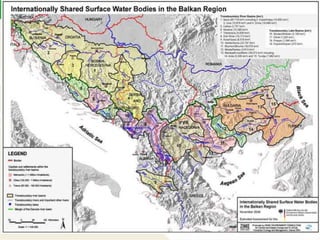
The region has a background of  political instability and conflict. Most of the countries are still in the process  towards establishing a well functioning market economy Some countries are EU members. In the Non-EU,   major reforms   guided primarily by the   EU accession prospect   have been initiated Economic growth has dictated choices  for water resources management in many cases These have also influenced cooperation for  transboundary water bodies 90% of water resources are shared by 2 or more  countries in the SEE - On-going  cooperation processes  for the management of shared basins  exists -  GEF and donor financed projects  support on-the-ground activities  - Initiatives are active in the area e.g.  UNECE Water Convention ,  Petersberg Phase II / Athens Declaration Process  etc. Some background for Southeastern Europe
Create the conditions for and enhance cooperation for the integrated  management of water resources at transboundary level Enhance IWRM at national level = the foundations for promoting integrated transboundary cooperation -  Harmonization of  rules and regulations for the management of shared basins -  Joint assessment and monitoring   -  Involvement of  local stakeholders  -  Establishment of sustainable institutions for the joint management of the shared basins  -  Benefit from the catalytic involvement of the international community for the enhancement of cooperation on the management of the shared basins, both at national and transboundary level   Key challenges for shared water resources management
-  Since 2005, GWP-Med  has systematically developed multi-level action on TWRM in SEE in the framework of the  Petersburg Phase II / Athens Declaration Process (Germany, Greece, WB, GEF, UNECE, UNDP, UNESCO) .  -  Priority areas of activities include : IWRM planning; shared groundwater management; multi-purpose management; water governance and civil society engagement; linkages to / promotion of the EU WFD.  - Since it launching, the Process has engaged more than 150 partners and has materialized  *  8 multi-stakeholder International Roundtables  on different aspects  *  more than 10 Capacity Building Workshops with targeted audiences ,  * has produced more than  15 general and targeted assessments and capacity building materials .  - Among current priority issues is the promotion of cooperation for the joint management of the  Drin River Basin – an important and complex system . GWP-Med activities on TWRM in SEE
 
Stakeholders Transboundary Cooperation for Integrated Management of Mesta/Nestos Basin: A joint GWP-Med and GWP-Bulgaria project Bulgaria and Greece are taking measures to reach coordinated management of the Mesta / Nestos river basin on the basis of the relevant prerequisites of the EU WFD, the existing bilateral agreement and the international legal framework and practices.  However, stakeholders involvement has been limited. A joint GWP-Med and GWP-Bulgaria project, supported by SDC, supported stakeholders engagement in an integrated approach and responding to the provisions of the EU WFD.
GWP CEE’s active role in the Danube River Basin - shared by 14 countries
Danube River Basin Management Plan 2009 (based on National Plans) GWP CEE contribution: Consultation processes with stakeholders Sustainable sanitation facilitation Toolbox role in the region
Consultation process with stakeholders GWP CEE involvement at Transboundary and Country levels   Key stakeholders: National governments International River Basin Commissions  Agriculture, industry, municipalities Practical measures to be identified in consultations with stakeholders  Constraints – financial crisis, low awareness and interest

Transboundary Water Management in Southeastern Europe

  • 1.
    Workshop on Goal2: Addressing Critical Development Challenges 15 August 2009, GWP CP 2009 Transboundary Water Resources Management: Experiences in Southeastern Europe Joint Presentation by GWP-MED and GWP-CEE
  • 2.
  • 3.
  • 4.
    The region hasa background of political instability and conflict. Most of the countries are still in the process towards establishing a well functioning market economy Some countries are EU members. In the Non-EU, major reforms guided primarily by the EU accession prospect have been initiated Economic growth has dictated choices for water resources management in many cases These have also influenced cooperation for transboundary water bodies 90% of water resources are shared by 2 or more countries in the SEE - On-going cooperation processes for the management of shared basins exists - GEF and donor financed projects support on-the-ground activities - Initiatives are active in the area e.g. UNECE Water Convention , Petersberg Phase II / Athens Declaration Process etc. Some background for Southeastern Europe
  • 5.
    Create the conditionsfor and enhance cooperation for the integrated management of water resources at transboundary level Enhance IWRM at national level = the foundations for promoting integrated transboundary cooperation - Harmonization of rules and regulations for the management of shared basins - Joint assessment and monitoring - Involvement of local stakeholders - Establishment of sustainable institutions for the joint management of the shared basins - Benefit from the catalytic involvement of the international community for the enhancement of cooperation on the management of the shared basins, both at national and transboundary level Key challenges for shared water resources management
  • 6.
    - Since2005, GWP-Med has systematically developed multi-level action on TWRM in SEE in the framework of the Petersburg Phase II / Athens Declaration Process (Germany, Greece, WB, GEF, UNECE, UNDP, UNESCO) . - Priority areas of activities include : IWRM planning; shared groundwater management; multi-purpose management; water governance and civil society engagement; linkages to / promotion of the EU WFD. - Since it launching, the Process has engaged more than 150 partners and has materialized * 8 multi-stakeholder International Roundtables on different aspects * more than 10 Capacity Building Workshops with targeted audiences , * has produced more than 15 general and targeted assessments and capacity building materials . - Among current priority issues is the promotion of cooperation for the joint management of the Drin River Basin – an important and complex system . GWP-Med activities on TWRM in SEE
  • 7.
  • 8.
    Stakeholders Transboundary Cooperationfor Integrated Management of Mesta/Nestos Basin: A joint GWP-Med and GWP-Bulgaria project Bulgaria and Greece are taking measures to reach coordinated management of the Mesta / Nestos river basin on the basis of the relevant prerequisites of the EU WFD, the existing bilateral agreement and the international legal framework and practices. However, stakeholders involvement has been limited. A joint GWP-Med and GWP-Bulgaria project, supported by SDC, supported stakeholders engagement in an integrated approach and responding to the provisions of the EU WFD.
  • 9.
    GWP CEE’s activerole in the Danube River Basin - shared by 14 countries
  • 10.
    Danube River BasinManagement Plan 2009 (based on National Plans) GWP CEE contribution: Consultation processes with stakeholders Sustainable sanitation facilitation Toolbox role in the region
  • 11.
    Consultation process withstakeholders GWP CEE involvement at Transboundary and Country levels Key stakeholders: National governments International River Basin Commissions Agriculture, industry, municipalities Practical measures to be identified in consultations with stakeholders Constraints – financial crisis, low awareness and interest