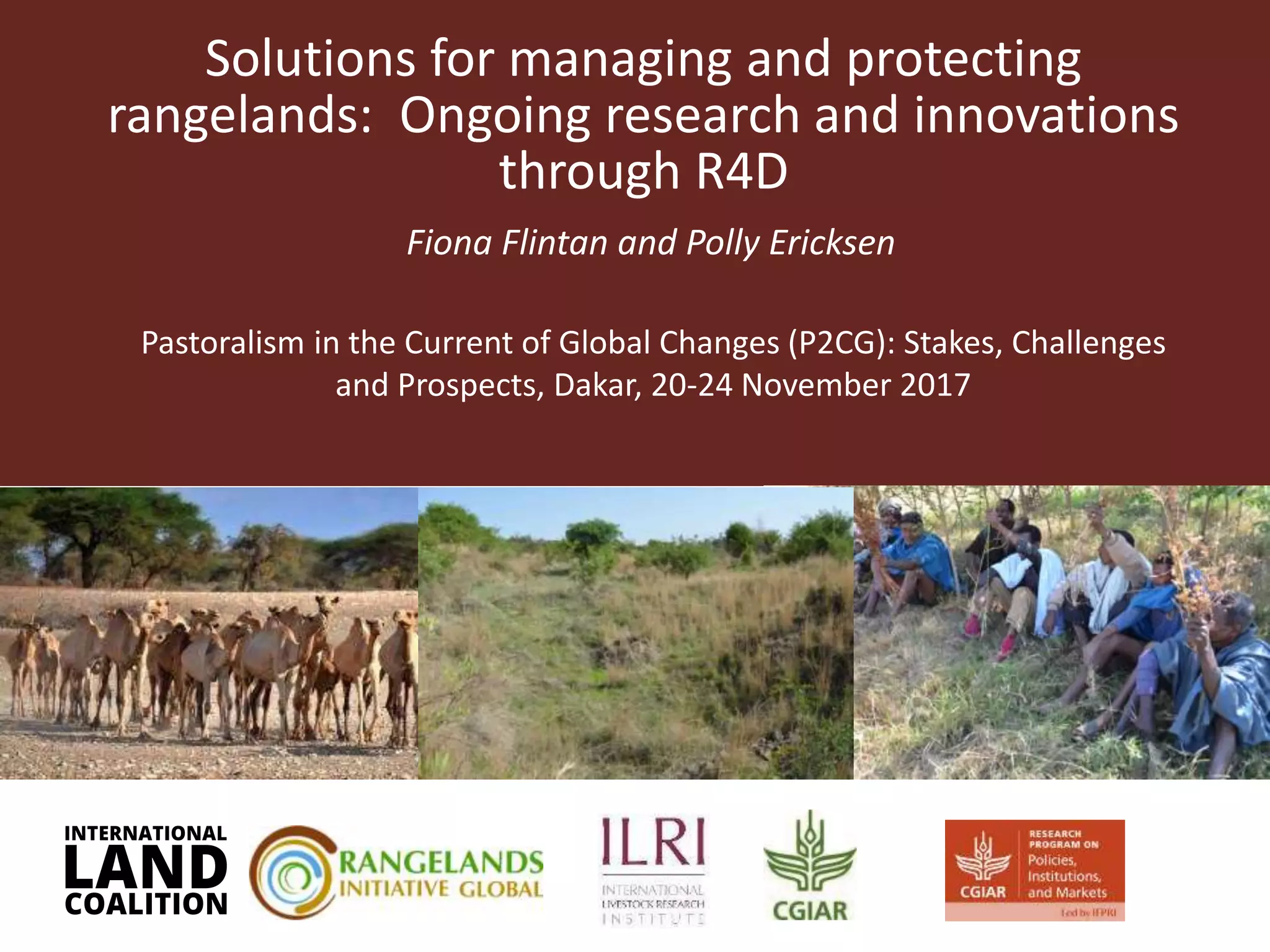
Solutions for managing and protecting
rangelands: Ongoing research and innovations
through R4D
Fiona Flintan and Polly Ericksen
Pastoralism in the Current of Global Changes (P2CG): Stakes, Challenges
and Prospects, Dakar, 20-24 November 2017
Coverage of rangelands worldwide
Pastoral land tenure systems: characteristics
• Lack of data and maps on land tenure systems in
rangelands globally (or even nationally).
• Majority held under communal land tenure systems.
• Under pressure from both external and internal forces
– but overall degree of changes unknown.
• Land and resource access highly politicized – a source
of power – wealth, prestige, control, etc.
• Challenge of formalization while maintaining flexiblity.
• Complex layers of tenure – a ‘nested’ approach of
governance.
“Nested” governance system
(Source: Flintan 2013)
Challenges to securing rangelands and
good management
• Complexity of pastoral land tenure
• Difficult to define boundaries (porous), size, appropriate
entry-point.
• Multiple users & uses – primary, secondary, tertiary
• Non-equilibrium ecosystem dynamics
• Need landscape level, adaptive & nested management
• Bad decisions eroding productivity
• Bush encroachment and invasive species
• Excising of key ‘high productivity’ resources, converting or
over-using them
• Lack of secure access rights or tenure
• Little incentive to invest
• “Land grabbing”
CRISIS in terms of access to pastoral
resources and land
• Lack of attention at global levels (unlike forests for example) –
livestock production being challenged e.g. in terms of emissions
and impact on climate change.
• Still a general lack of support of pastoralism as a land use
system at national levels. Decisions about land use made by
non-local land users (models, pre-conceived ideas, carrying
capacities) – lack of truly participatory approaches.
• Continental and regional bodies failing to pressure national
governments to abide by commitments to e.g. AU Framework
on Pastoralism, Voluntary Guidelines on the Responsible
Governance of Tenure (VGGT), ECOWAS, EAC, IGAD – closed
borders (Tanzania), blocked mobility, fractured communities.
• Blockages in approval and lack of application of Pastoral Codes
e.g. Cameroon.
Crisis in terms of access to pastoral
resources and land
• Increasing conflicts between different land users particularly
at local level (often politicized and manipulated by more
powerful actors) e.g. Ethiopia and Kenya.
Crisis in terms of access to pastoral
resources and land
• Solutions focus on limiting pastoral movements – open-
grazing ban in Benue State, Nigeria.
• Weakening in authority of customary institutions – external
and internal challenges. Individual rights vs. communal rights
e.g. issue of women’s rights.
• More supportive governments struggling to find solutions to
communal land tenure but reluctance to give power to the
land owners – pastoralists.
• Failed privatisation and communal schemes e.g. group
ranches and ”trust lands” in Kenya – Community Land Bill.
• Poorly planned ”development” schemes that e.g. invest in
infrastructure including water without considering impact on
wider pastoral landscape; and large-scale schemes e.g.
LAPSSET corridor, East Africa.
In response, ILRI is investing in
research for development
(R4D) on land governance, land
use planning and land
restoration in rangelands
R4D at global level – ILRI and ILC Rangelands
Initiative
• ILRI working with the International Land Coalition as a
member – coordination of ILC’s Rangelands Initiative global.
A core partnership of ILRI, IFAD, FAO-PKH, UNEP and US-
based Rangelands Partnership.
• Connecting ILC members and partners – To strengthen
community of practice on rangelands-land issues at global
level.
• Mobilising – To build the capacity of ILC members to mobilise
and engage with decision-makers at global levels.
• Influencing – To influencing changes in policy, legislation and
global strategic frameworks.
R4D at global level– ILC Rangelands Initiative
and CRPs (Livestock and PIM)
• Increasing attention to rangelands in global forum such as
Committee for Food Security; WB Conference on Land and Poverty;
VGGTs;
• Development of indictors and matrix for measuring land tenure
reform at national (global) levels (with ICARDA);
• Campaign for IYR&P;
• Developing global statement on land tenure in rangelands –
including feeding information to LANDMARK (platform for mapping
community lands), and Land Portal Foundation (Rangelands Tenure
page). Documentation and mapping of land tenure in rangelands.
• Working with UNEP on a gap analysis on rangelands (building on
success of Resolution on sustainable pastoralism and rangelands at
UNEA 2016).
• Influencing international partners to pay more attention to
rangelands & land; and supporting ILC RI Africa, Asia and LACs.
• Improving understanding and appreciation of livestock as a food
production and land use system.
R4D on land governance and land use planning
in Kenya
• Working with National Land Commission - development of annex
to County Spatial Planning on rangelands & technical toolkit.
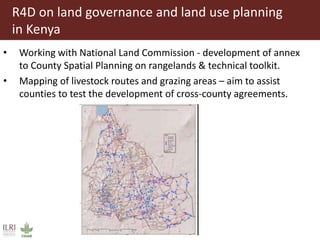
• Mapping of livestock routes and grazing areas – aim to assist
counties to test the development of cross-county agreements.
R4D on land governance and land use planning
in Kenya
• Working with large conservation-driven organisations or NGOs, and
projects to better understand pastoral and rangeland issues.
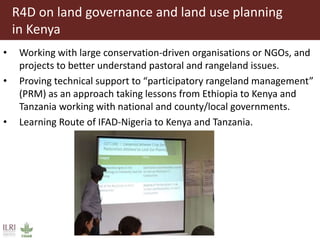
• Proving technical support to “participatory rangeland management”
(PRM) as an approach taking lessons from Ethiopia to Kenya and
Tanzania working with national and county/local governments.
• Learning Route of IFAD-Nigeria to Kenya and Tanzania.
R4D on land governance and land use
planning in Ethiopia
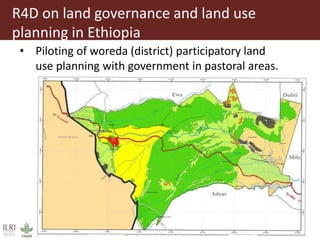
• Piloting of woreda (district) participatory land
use planning with government in pastoral areas.
R4D on land governance and land use
planning in Ethiopia
• Background paper for development of national land use
policy.
• Undertaking of baselines in pastoral areas (x 4 - 6500 HHs) –
with GoE – rich data source.
• Working with WRI on review of PRM (use of satellite imagery,
plus local-level research).
• Strengthening of PRM up-scaling e.g. WB-RPLRP.
• Studies on pastoral women and land (as part of a cross-
CGIAR land governance flagship).
• Definition of a pastoral household and relationship with
social and ecological landscape – implications for aid and
development delivery.
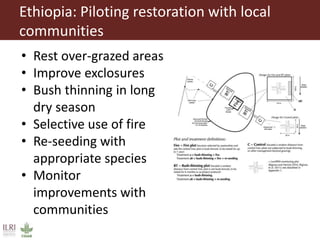
Ethiopia: Piloting restoration with local
communities
• Rest over-grazed areas
• Improve exclosures
• Bush thinning in long
dry season
• Selective use of fire
• Re-seeding with
appropriate species
• Monitor
improvements with
communities
A different approach to research is
required: R4D
• CGIAR as a whole under pressure to show more R4D and ”impact.”
• Reduced funding sources and changed focus.
• This approach fits with ILRI’s concerns for the crisis in land
governance in pastoral areas.
• By engaging with different actors, research can directly influence
and contribute to positive change.
• Provision of technical support working with these partners is a
good entry point.
• Not without its challenges.
• Always looking for additional partnerships.
This work is financed by
IFAD, EC, USAID, ILC, FAO, WRI,
It contributes to the CGIAR Research Program on
Livestock Agri-food Systems and Policies, Institutions & Markets
(PIM); as well as bilateral projects.
Acknowledgements
This presentation is licensed for use under the Creative Commons Attribution 4.0 International Licence.
better lives through livestock
ilri.org
ILRI thanks all donors and organizations who globally supported its work through their contributions
to the CGIAR system

Solutions for managing and protecting rangelands: Ongoing research and innovations through R4D

  • 1.
    Solutions for managingand protecting rangelands: Ongoing research and innovations through R4D Fiona Flintan and Polly Ericksen Pastoralism in the Current of Global Changes (P2CG): Stakes, Challenges and Prospects, Dakar, 20-24 November 2017
  • 2.
  • 3.
    Pastoral land tenuresystems: characteristics • Lack of data and maps on land tenure systems in rangelands globally (or even nationally). • Majority held under communal land tenure systems. • Under pressure from both external and internal forces – but overall degree of changes unknown. • Land and resource access highly politicized – a source of power – wealth, prestige, control, etc. • Challenge of formalization while maintaining flexiblity. • Complex layers of tenure – a ‘nested’ approach of governance.
  • 4.
  • 5.
    Challenges to securingrangelands and good management • Complexity of pastoral land tenure • Difficult to define boundaries (porous), size, appropriate entry-point. • Multiple users & uses – primary, secondary, tertiary • Non-equilibrium ecosystem dynamics • Need landscape level, adaptive & nested management • Bad decisions eroding productivity • Bush encroachment and invasive species • Excising of key ‘high productivity’ resources, converting or over-using them • Lack of secure access rights or tenure • Little incentive to invest • “Land grabbing”
  • 6.
    CRISIS in termsof access to pastoral resources and land • Lack of attention at global levels (unlike forests for example) – livestock production being challenged e.g. in terms of emissions and impact on climate change. • Still a general lack of support of pastoralism as a land use system at national levels. Decisions about land use made by non-local land users (models, pre-conceived ideas, carrying capacities) – lack of truly participatory approaches. • Continental and regional bodies failing to pressure national governments to abide by commitments to e.g. AU Framework on Pastoralism, Voluntary Guidelines on the Responsible Governance of Tenure (VGGT), ECOWAS, EAC, IGAD – closed borders (Tanzania), blocked mobility, fractured communities. • Blockages in approval and lack of application of Pastoral Codes e.g. Cameroon.
  • 7.
    Crisis in termsof access to pastoral resources and land • Increasing conflicts between different land users particularly at local level (often politicized and manipulated by more powerful actors) e.g. Ethiopia and Kenya.
  • 8.
    Crisis in termsof access to pastoral resources and land • Solutions focus on limiting pastoral movements – open- grazing ban in Benue State, Nigeria. • Weakening in authority of customary institutions – external and internal challenges. Individual rights vs. communal rights e.g. issue of women’s rights. • More supportive governments struggling to find solutions to communal land tenure but reluctance to give power to the land owners – pastoralists. • Failed privatisation and communal schemes e.g. group ranches and ”trust lands” in Kenya – Community Land Bill. • Poorly planned ”development” schemes that e.g. invest in infrastructure including water without considering impact on wider pastoral landscape; and large-scale schemes e.g. LAPSSET corridor, East Africa.
  • 9.
    In response, ILRIis investing in research for development (R4D) on land governance, land use planning and land restoration in rangelands
  • 10.
    R4D at globallevel – ILRI and ILC Rangelands Initiative • ILRI working with the International Land Coalition as a member – coordination of ILC’s Rangelands Initiative global. A core partnership of ILRI, IFAD, FAO-PKH, UNEP and US- based Rangelands Partnership. • Connecting ILC members and partners – To strengthen community of practice on rangelands-land issues at global level. • Mobilising – To build the capacity of ILC members to mobilise and engage with decision-makers at global levels. • Influencing – To influencing changes in policy, legislation and global strategic frameworks.
  • 11.
    R4D at globallevel– ILC Rangelands Initiative and CRPs (Livestock and PIM) • Increasing attention to rangelands in global forum such as Committee for Food Security; WB Conference on Land and Poverty; VGGTs; • Development of indictors and matrix for measuring land tenure reform at national (global) levels (with ICARDA); • Campaign for IYR&P; • Developing global statement on land tenure in rangelands – including feeding information to LANDMARK (platform for mapping community lands), and Land Portal Foundation (Rangelands Tenure page). Documentation and mapping of land tenure in rangelands. • Working with UNEP on a gap analysis on rangelands (building on success of Resolution on sustainable pastoralism and rangelands at UNEA 2016). • Influencing international partners to pay more attention to rangelands & land; and supporting ILC RI Africa, Asia and LACs. • Improving understanding and appreciation of livestock as a food production and land use system.
  • 12.
    R4D on landgovernance and land use planning in Kenya • Working with National Land Commission - development of annex to County Spatial Planning on rangelands & technical toolkit. • Mapping of livestock routes and grazing areas – aim to assist counties to test the development of cross-county agreements.
  • 13.
    R4D on landgovernance and land use planning in Kenya • Working with large conservation-driven organisations or NGOs, and projects to better understand pastoral and rangeland issues. • Proving technical support to “participatory rangeland management” (PRM) as an approach taking lessons from Ethiopia to Kenya and Tanzania working with national and county/local governments. • Learning Route of IFAD-Nigeria to Kenya and Tanzania.
  • 14.
    R4D on landgovernance and land use planning in Ethiopia • Piloting of woreda (district) participatory land use planning with government in pastoral areas.
  • 15.
    R4D on landgovernance and land use planning in Ethiopia • Background paper for development of national land use policy. • Undertaking of baselines in pastoral areas (x 4 - 6500 HHs) – with GoE – rich data source. • Working with WRI on review of PRM (use of satellite imagery, plus local-level research). • Strengthening of PRM up-scaling e.g. WB-RPLRP. • Studies on pastoral women and land (as part of a cross- CGIAR land governance flagship). • Definition of a pastoral household and relationship with social and ecological landscape – implications for aid and development delivery.
  • 16.
    Ethiopia: Piloting restorationwith local communities • Rest over-grazed areas • Improve exclosures • Bush thinning in long dry season • Selective use of fire • Re-seeding with appropriate species • Monitor improvements with communities
  • 17.
    A different approachto research is required: R4D • CGIAR as a whole under pressure to show more R4D and ”impact.” • Reduced funding sources and changed focus. • This approach fits with ILRI’s concerns for the crisis in land governance in pastoral areas. • By engaging with different actors, research can directly influence and contribute to positive change. • Provision of technical support working with these partners is a good entry point. • Not without its challenges. • Always looking for additional partnerships.
  • 18.
    This work isfinanced by IFAD, EC, USAID, ILC, FAO, WRI, It contributes to the CGIAR Research Program on Livestock Agri-food Systems and Policies, Institutions & Markets (PIM); as well as bilateral projects. Acknowledgements
  • 19.
    This presentation islicensed for use under the Creative Commons Attribution 4.0 International Licence. better lives through livestock ilri.org ILRI thanks all donors and organizations who globally supported its work through their contributions to the CGIAR system

Editor's Notes

  • #2 There MUST be a CGIAR logo or a CRP logo. You can copy and paste the logo you need from the final slide of this presentation. Then you can delete that final slide   To replace a photo above, copy and paste this link in your browser: http://www.flickr.com/photos/ilri/sets/72157632057087650/detail/   Find a photo you like and the right size, copy and paste it in the block above.