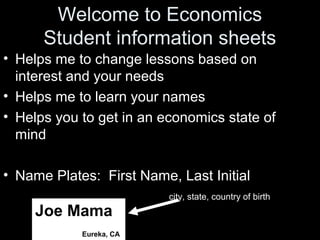
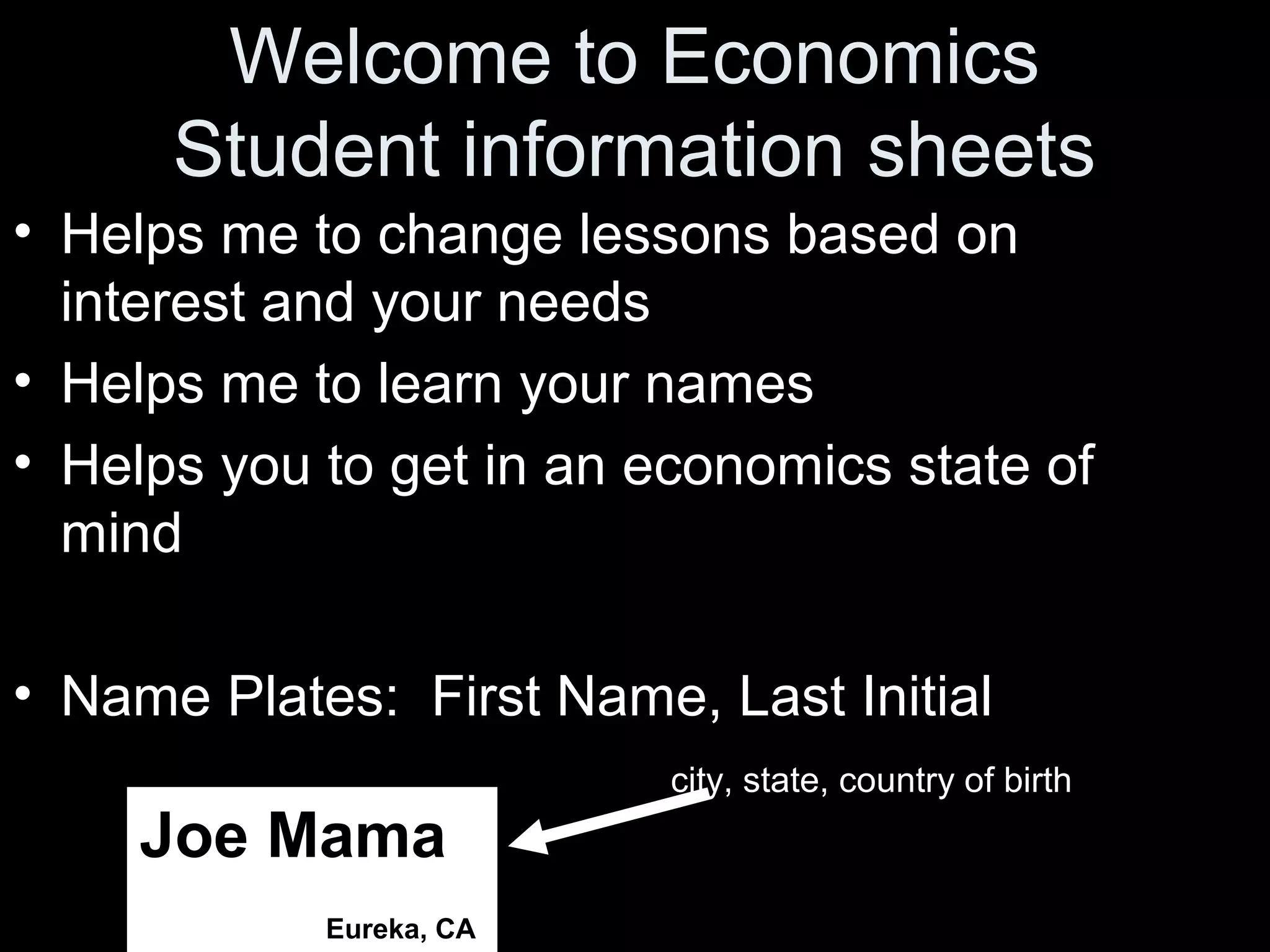
Welcome to Economics
Student information sheets
• Helps me to change lessons based on
interest and your needs
• Helps me to learn your names
• Helps you to get in an economics state of
mind
• Name Plates: First Name, Last Initial
city, state, country of birth
Joe Mama
Eureka, CA
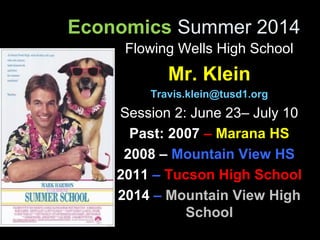
Economics Summer 2014
Flowing Wells High School
Mr. Klein
Travis.klein@tusd1.org
Session 2: June 23– July 10
Past: 2007 – Marana HS
2008 – Mountain View HS
2011 – Tucson High School
2014 – Mountain View High
School
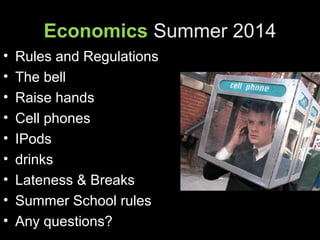
Economics Summer 2014
• Rules and Regulations
• The bell
• Raise hands
• Cell phones
• IPods
• drinks
• Lateness & Breaks
• Summer School rules
• Any questions?
Today’s topics
• Rules
• Opening grades
• What is “economics”?
• Economic Vocabulary
• Opportunity costs
• Factors of Production
• Economic System
• Entrepreneurship
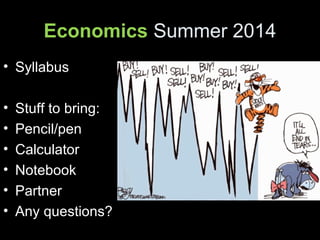
Economics Summer 2014
• Syllabus
• Stuff to bring:
• Pencil/pen
• Calculator
• Notebook
• Partner
• Any questions?
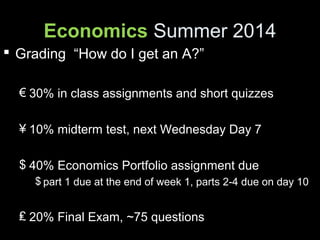
Economics Summer 2014
 Grading “How do I get an A?”
€ 30% in class assignments and short quizzes
¥ 10% midterm test, next Wednesday Day 7
$ 40% Economics Portfolio assignment due
$ part 1 due at the end of week 1, parts 2-4 due on day 10
₤ 20% Final Exam, ~75 questions
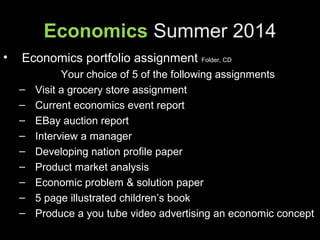
Economics Summer 2014
• Economics portfolio assignment Folder, CD
Your choice of 5 of the following assignments
– Visit a grocery store assignment
– Current economics event report
– EBay auction report
– Interview a manager
– Developing nation profile paper
– Product market analysis
– Economic problem & solution paper
– 5 page illustrated children’s book
– Produce a you tube video advertising an economic concept
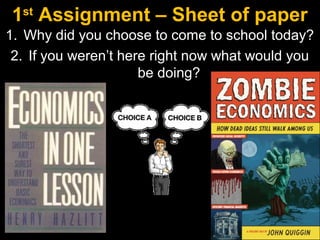
1st
Assignment – Sheet of paper
1. Why did you choose to come to school today?
2. If you weren’t here right now what would you
be doing?
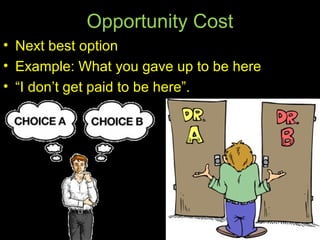
Opportunity Cost
• Next best option
• Example: What you gave up to be here
• “I don’t get paid to be here”.
What is economics?
• Study of how
people make
choices
• You made a choice
by coming to class
today
• But that choice also
has a cost
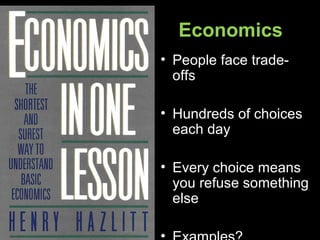
Economics
• People face trade-
offs
• Hundreds of choices
each day
• Every choice means
you refuse something
else
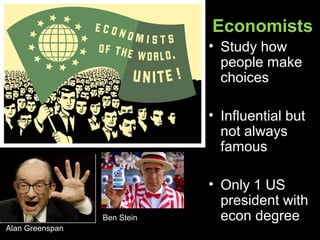
Economists
• Study how
people make
choices
• Influential but
not always
famous
• Only 1 US
president with
econ degree
Alan Greenspan
Ben Stein
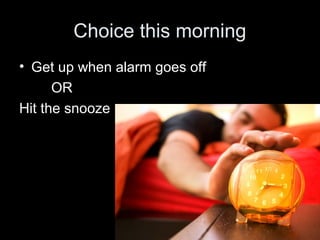
Choice this morning
• Get up when alarm goes off
OR
Hit the snooze
Choice #1
Get up when
alarm goes off
Choice #2
Snooze for 10 more
minutes
At least 2
benefits
Check the
one you did
today
Benefits
refused
#3
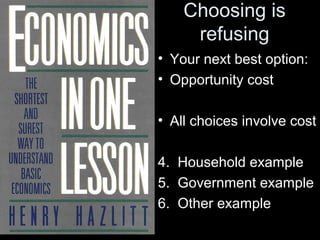
Choosing is
refusing
• Your next best option:
• Opportunity cost
• All choices involve cost
4. Household example
5. Government example
6. Other example
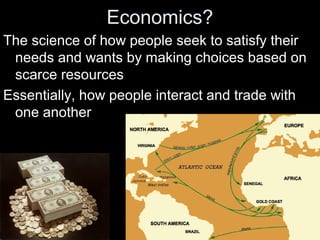
Economics?
The science of how people seek to satisfy their
needs and wants by making choices based on
scarce resources
Essentially, how people interact and trade with
one another
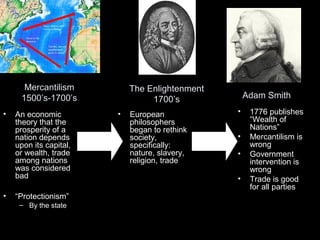
Mercantilism
1500’s-1700’s
• An economic
theory that the
prosperity of a
nation depends
upon its capital,
or wealth, trade
among nations
was considered
bad
• “Protectionism”
– By the state
The Enlightenment
1700’s
• European
philosophers
began to rethink
society,
specifically:
nature, slavery,
religion, trade
Adam Smith
• 1776 publishes
“Wealth of
Nations”
• Mercantilism is
wrong
• Government
intervention is
wrong
• Trade is good
for all parties
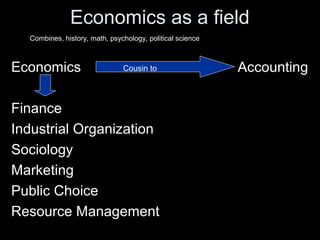
Economics as a field
Economics
Finance
Industrial Organization
Sociology
Marketing
Public Choice
Resource Management
Cousin to Accounting
Combines, history, math, psychology, political science
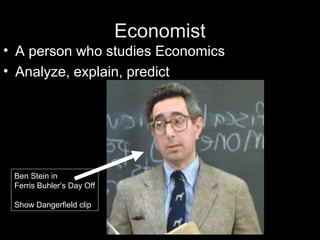
Economist
• A person who studies Economics
• Analyze, explain, predict
Ben Stein in
Ferris Buhler’s Day Off
Show Dangerfield clip
Problem for humans
• People have unlimited wants
• People have limited resources to get those
wants
• We call this problem: Scarcity
Opportunity Cost
• What you give up to do something
• “The next best option”
• For example: If you have $20 in your pocket
and you want to take your BF/GF to the
movies, then you won’t have any money left
for a new $20 shirt
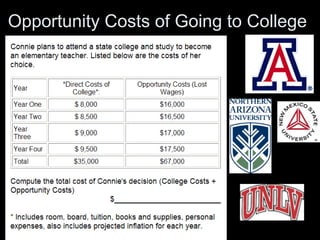
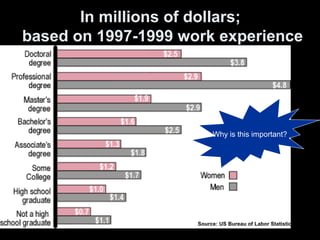
Opportunity Costs of Going to College
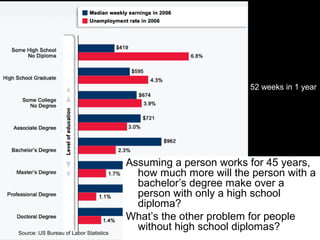
Source: US Bureau of Labor Statistics
Assuming a person works for 45 years,
how much more will the person with a
bachelor’s degree make over a
person with only a high school
diploma?
What’s the other problem for people
without high school diplomas?
52 weeks in 1 year
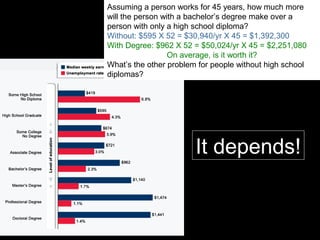
Assuming a person works for 45 years, how much more
will the person with a bachelor’s degree make over a
person with only a high school diploma?
Without: $595 X 52 = $30,940/yr X 45 = $1,392,300
With Degree: $962 X 52 = $50,024/yr X 45 = $2,251,080
On average, is it worth it?
What’s the other problem for people without high school
diplomas?
It depends!
In millions of dollars;
based on 1997-1999 work experience
Source: US Bureau of Labor Statistics
Why is this important?
Next Assignment
1. Describe a time you received something for
“free”
(What was it, where was it, when was it, etc)
2. Describe the role of the government in our
economy?
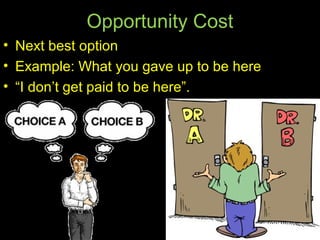
Opportunity Cost
• Next best option
• Example: What you gave up to be here
• “I don’t get paid to be here”.
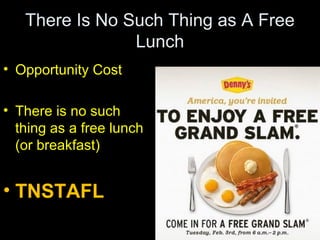
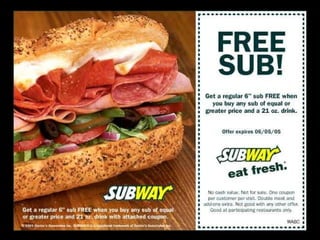
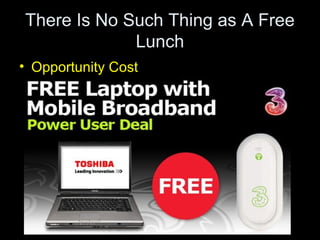
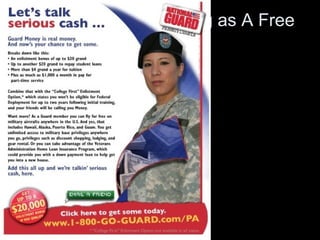
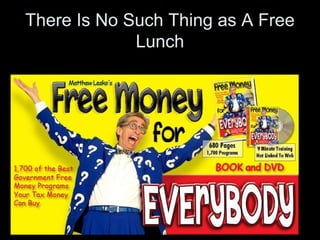
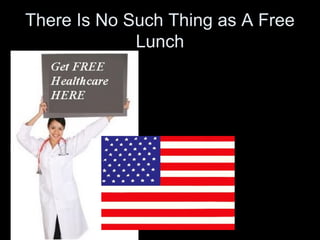
There Is No Such Thing as A Free
Lunch
• Opportunity Cost
• There is no such
thing as a free lunch
(or breakfast)
• TNSTAFL
There Is No Such Thing as A Free
Lunch
There Is No Such Thing as A Free
Lunch
• Opportunity Cost
There Is No Such Thing as A Free
Lunch
There Is No Such Thing as A Free
Lunch
There Is No Such Thing as A Free
Lunch
Example?
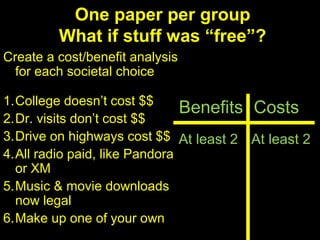
One paper per group
What if stuff was “free”?
Create a cost/benefit analysis
for each societal choice
1.College doesn’t cost $$
2.Dr. visits don’t cost $$
3.Drive on highways cost $$
4.All radio paid, like Pandora
or XM
5.Music & movie downloads
now legal
6.Make up one of your own
Benefits Costs
At least 2 At least 2
One paper per group
What if stuff was “free”?
Create a cost/benefit analysis
for each societal choice
(Jorge)
1.“Free” college
2.“Free” doctor visits
3.No free roads “toll roads”
4.No free radio, like Pandora
or XM
5.All movie & music downloads
“free” and legal
6.Make up one of your own
Benefits Costs
At least 2 At least 2
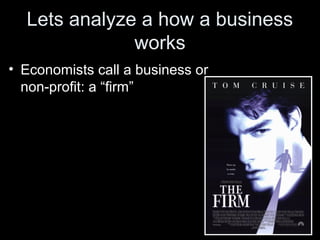
Lets analyze a how a business
works
• Economists call a business or
non-profit: a “firm”
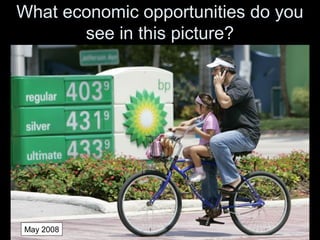
What economic opportunities do you
see in this picture?
May 2008
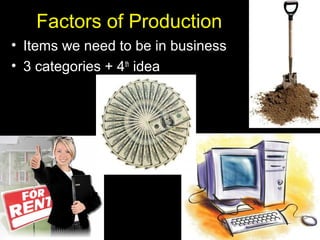
Factors of Production
• Items we need to be in business
• 3 categories + 4th
idea
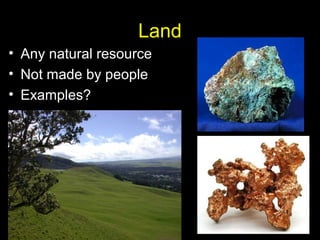
Land
• Any natural resource
• Not made by people
• Examples?
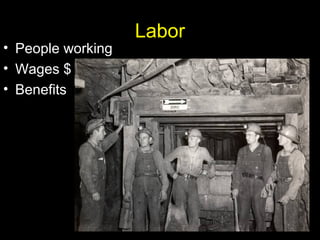
Labor
• People working
• Wages $
• Benefits
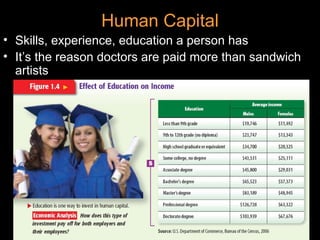
Human Capital
• Skills, experience, education a person has
• It’s the reason doctors are paid more than sandwich
artists
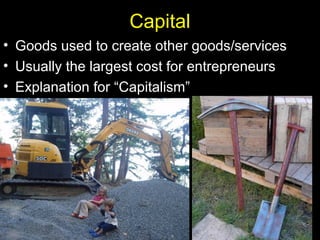
Capital
• Goods used to create other goods/services
• Usually the largest cost for entrepreneurs
• Explanation for “Capitalism”
Let’s build a new Circle K!
• Land
• Labor
• Capital
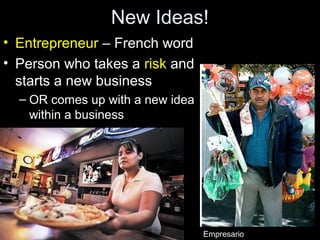
New Ideas!
• Entrepreneur – French word
• Person who takes a risk and
starts a new business
– OR comes up with a new idea
within a business
Empresario
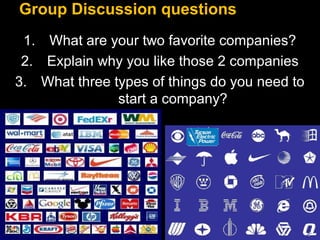
1. What are your two favorite companies?
2. Explain why you like those 2 companies
3. What three types of things do you need to
start a company?
Group Discussion questions
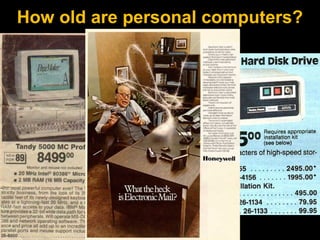
How old are personal computers?
1989
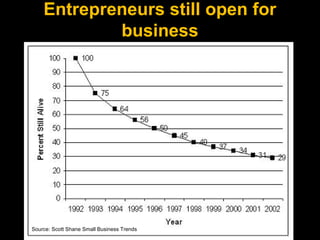
Entrepreneurs still open for
business
Source: Scott Shane Small Business Trends
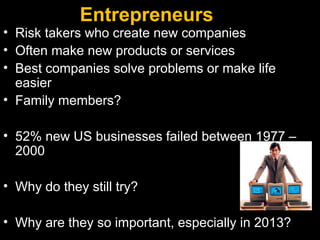
• Risk takers who create new companies
• Often make new products or services
• Best companies solve problems or make life
easier
• Family members?
• 52% new US businesses failed between 1977 –
2000
• Why do they still try?
• Why are they so important, especially in 2013?
Entrepreneurs
• 25 minutes
• NO LOOKING THEM UP ON INTERNET
• Group that guesses all correct:
1st
place: 5 quantitative easing points
2nd
place: 3 quantitative easing points
3rd
place: 1 quantitative easing points
Reading on famous
Entrepreneurs
Group Activity “Entrepreneurship”
• Groups of 3, Design a brand new business
One a single sheet of paper with everyone’s name
answer these ?

Day 1 FW Summer 2014

  • 1.
    Welcome to Economics Studentinformation sheets • Helps me to change lessons based on interest and your needs • Helps me to learn your names • Helps you to get in an economics state of mind • Name Plates: First Name, Last Initial city, state, country of birth Joe Mama Eureka, CA
  • 2.
    Economics Summer 2014 FlowingWells High School Mr. Klein Travis.klein@tusd1.org Session 2: June 23– July 10 Past: 2007 – Marana HS 2008 – Mountain View HS 2011 – Tucson High School 2014 – Mountain View High School
  • 3.
    Economics Summer 2014 •Rules and Regulations • The bell • Raise hands • Cell phones • IPods • drinks • Lateness & Breaks • Summer School rules • Any questions?
  • 4.
    Today’s topics • Rules •Opening grades • What is “economics”? • Economic Vocabulary • Opportunity costs • Factors of Production • Economic System • Entrepreneurship
  • 5.
    Economics Summer 2014 •Syllabus • Stuff to bring: • Pencil/pen • Calculator • Notebook • Partner • Any questions?
  • 6.
    Economics Summer 2014 Grading “How do I get an A?” € 30% in class assignments and short quizzes ¥ 10% midterm test, next Wednesday Day 7 $ 40% Economics Portfolio assignment due $ part 1 due at the end of week 1, parts 2-4 due on day 10 ₤ 20% Final Exam, ~75 questions
  • 7.
    Economics Summer 2014 •Economics portfolio assignment Folder, CD Your choice of 5 of the following assignments – Visit a grocery store assignment – Current economics event report – EBay auction report – Interview a manager – Developing nation profile paper – Product market analysis – Economic problem & solution paper – 5 page illustrated children’s book – Produce a you tube video advertising an economic concept
  • 8.
    1st Assignment – Sheetof paper 1. Why did you choose to come to school today? 2. If you weren’t here right now what would you be doing?
  • 9.
    Opportunity Cost • Nextbest option • Example: What you gave up to be here • “I don’t get paid to be here”.
  • 10.
    What is economics? •Study of how people make choices • You made a choice by coming to class today • But that choice also has a cost
  • 11.
    Economics • People facetrade- offs • Hundreds of choices each day • Every choice means you refuse something else
  • 12.
    Economists • Study how peoplemake choices • Influential but not always famous • Only 1 US president with econ degree Alan Greenspan Ben Stein
  • 13.
    Choice this morning •Get up when alarm goes off OR Hit the snooze
  • 14.
    Choice #1 Get upwhen alarm goes off Choice #2 Snooze for 10 more minutes At least 2 benefits Check the one you did today Benefits refused #3
  • 15.
    Choosing is refusing • Yournext best option: • Opportunity cost • All choices involve cost 4. Household example 5. Government example 6. Other example
  • 16.
    Economics? The science ofhow people seek to satisfy their needs and wants by making choices based on scarce resources Essentially, how people interact and trade with one another
  • 17.
    Mercantilism 1500’s-1700’s • An economic theorythat the prosperity of a nation depends upon its capital, or wealth, trade among nations was considered bad • “Protectionism” – By the state The Enlightenment 1700’s • European philosophers began to rethink society, specifically: nature, slavery, religion, trade Adam Smith • 1776 publishes “Wealth of Nations” • Mercantilism is wrong • Government intervention is wrong • Trade is good for all parties
  • 18.
    Economics as afield Economics Finance Industrial Organization Sociology Marketing Public Choice Resource Management Cousin to Accounting Combines, history, math, psychology, political science
  • 19.
    Economist • A personwho studies Economics • Analyze, explain, predict Ben Stein in Ferris Buhler’s Day Off Show Dangerfield clip
  • 20.
    Problem for humans •People have unlimited wants • People have limited resources to get those wants • We call this problem: Scarcity
  • 22.
    Opportunity Cost • Whatyou give up to do something • “The next best option” • For example: If you have $20 in your pocket and you want to take your BF/GF to the movies, then you won’t have any money left for a new $20 shirt
  • 23.
    Opportunity Costs ofGoing to College
  • 24.
    Source: US Bureauof Labor Statistics Assuming a person works for 45 years, how much more will the person with a bachelor’s degree make over a person with only a high school diploma? What’s the other problem for people without high school diplomas? 52 weeks in 1 year
  • 25.
    Assuming a personworks for 45 years, how much more will the person with a bachelor’s degree make over a person with only a high school diploma? Without: $595 X 52 = $30,940/yr X 45 = $1,392,300 With Degree: $962 X 52 = $50,024/yr X 45 = $2,251,080 On average, is it worth it? What’s the other problem for people without high school diplomas? It depends!
  • 26.
    In millions ofdollars; based on 1997-1999 work experience Source: US Bureau of Labor Statistics Why is this important?
  • 27.
    Next Assignment 1. Describea time you received something for “free” (What was it, where was it, when was it, etc) 2. Describe the role of the government in our economy?
  • 28.
    Opportunity Cost • Nextbest option • Example: What you gave up to be here • “I don’t get paid to be here”.
  • 29.
    There Is NoSuch Thing as A Free Lunch • Opportunity Cost • There is no such thing as a free lunch (or breakfast) • TNSTAFL
  • 30.
    There Is NoSuch Thing as A Free Lunch
  • 31.
    There Is NoSuch Thing as A Free Lunch • Opportunity Cost
  • 32.
    There Is NoSuch Thing as A Free Lunch
  • 33.
    There Is NoSuch Thing as A Free Lunch
  • 34.
    There Is NoSuch Thing as A Free Lunch
  • 35.
  • 36.
    One paper pergroup What if stuff was “free”? Create a cost/benefit analysis for each societal choice 1.College doesn’t cost $$ 2.Dr. visits don’t cost $$ 3.Drive on highways cost $$ 4.All radio paid, like Pandora or XM 5.Music & movie downloads now legal 6.Make up one of your own Benefits Costs At least 2 At least 2
  • 37.
    One paper pergroup What if stuff was “free”? Create a cost/benefit analysis for each societal choice (Jorge) 1.“Free” college 2.“Free” doctor visits 3.No free roads “toll roads” 4.No free radio, like Pandora or XM 5.All movie & music downloads “free” and legal 6.Make up one of your own Benefits Costs At least 2 At least 2
  • 38.
    Lets analyze ahow a business works • Economists call a business or non-profit: a “firm”
  • 39.
    What economic opportunitiesdo you see in this picture? May 2008
  • 40.
    Factors of Production •Items we need to be in business • 3 categories + 4th idea
  • 41.
    Land • Any naturalresource • Not made by people • Examples?
  • 42.
    Labor • People working •Wages $ • Benefits
  • 43.
    Human Capital • Skills,experience, education a person has • It’s the reason doctors are paid more than sandwich artists
  • 44.
    Capital • Goods usedto create other goods/services • Usually the largest cost for entrepreneurs • Explanation for “Capitalism”
  • 45.
    Let’s build anew Circle K! • Land • Labor • Capital
  • 46.
    New Ideas! • Entrepreneur– French word • Person who takes a risk and starts a new business – OR comes up with a new idea within a business Empresario
  • 47.
    1. What areyour two favorite companies? 2. Explain why you like those 2 companies 3. What three types of things do you need to start a company? Group Discussion questions
  • 48.
    How old arepersonal computers? 1989
  • 49.
    Entrepreneurs still openfor business Source: Scott Shane Small Business Trends
  • 50.
    • Risk takerswho create new companies • Often make new products or services • Best companies solve problems or make life easier • Family members? • 52% new US businesses failed between 1977 – 2000 • Why do they still try? • Why are they so important, especially in 2013? Entrepreneurs
  • 52.
    • 25 minutes •NO LOOKING THEM UP ON INTERNET • Group that guesses all correct: 1st place: 5 quantitative easing points 2nd place: 3 quantitative easing points 3rd place: 1 quantitative easing points Reading on famous Entrepreneurs
  • 53.
    Group Activity “Entrepreneurship” •Groups of 3, Design a brand new business One a single sheet of paper with everyone’s name answer these ?