Energize & Envision
Our Future
Who are the Young Workers?
Is someone classified as young
because they look it?
New in the trade?
Living at home with Mom & Dad?
Newlywed/New parent?
Highschool Graduate?
This is their first job?
MAYBE YES, MAYBE NOT!
Let’s look at Generations…
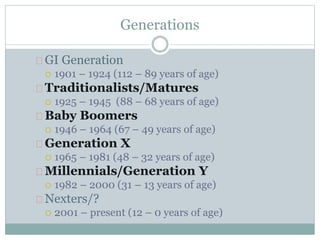
Generations
GI Generation
 1901 – 1924 (112 – 89 years of age)
Traditionalists/Matures
 1925 – 1945 (88 – 68 years of age)
Baby Boomers
 1946 – 1964 (67 – 49 years of age)
Generation X
 1965 – 1981 (48 – 32 years of age)
Millennials/Generation Y
 1982 – 2000 (31 – 13 years of age)
Nexters/?
 2001 – present (12 – 0 years of age)
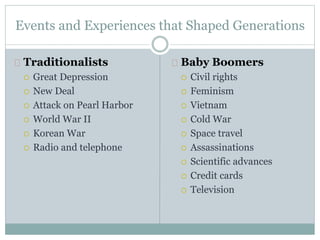
Events and Experiences that Shaped Generations
Traditionalists
 Great Depression
 New Deal
 Attack on Pearl Harbor
 World War II
 Korean War
 Radio and telephone
Baby Boomers
 Civil rights
 Feminism
 Vietnam
 Cold War
 Space travel
 Assassinations
 Scientific advances
 Credit cards
 Television
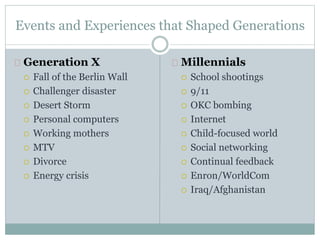
Events and Experiences that Shaped Generations
Generation X
 Fall of the Berlin Wall
 Challenger disaster
 Desert Storm
 Personal computers
 Working mothers
 MTV
 Divorce
 Energy crisis
Millennials
 School shootings
 9/11
 OKC bombing
 Internet
 Child-focused world
 Social networking
 Continual feedback
 Enron/WorldCom
 Iraq/Afghanistan
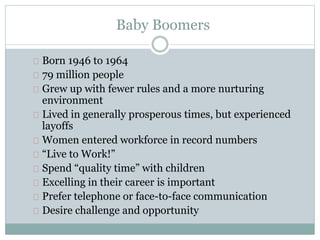
Baby Boomers
Born 1946 to 1964
79 million people
Grew up with fewer rules and a more nurturing
environment
Lived in generally prosperous times, but experienced
layoffs
Women entered workforce in record numbers
“Live to Work!”
Spend “quality time” with children
Excelling in their career is important
Prefer telephone or face-to-face communication
Desire challenge and opportunity
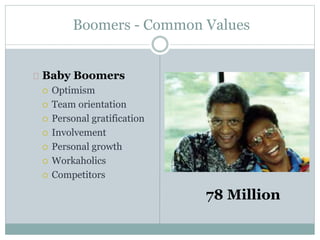
Boomers - Common Values
Baby Boomers
 Optimism
 Team orientation
 Personal gratification
 Involvement
 Personal growth
 Workaholics
 Competitors
78 Million
Generation X
Born 1965 to 1981
49 million people
Grew up as latchkey or day-care children
Turbulent economic times – downturn in 80s,
upswing in 90s
“Work to Live!”
Friends with their child, want to spend quantity time
Expect their careers to keep moving forward or they
will leave
Prefer electronic communication
Change from job security to career security
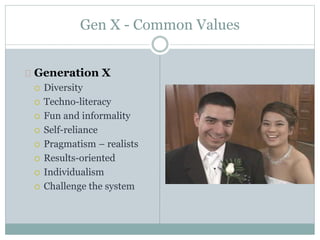
Gen X - Common Values
Generation X
 Diversity
 Techno-literacy
 Fun and informality
 Self-reliance
 Pragmatism – realists
 Results-oriented
 Individualism
 Challenge the system
Millennials
Born 1982 to 2000
Attended day care, very involved “helicopter”
parents
Prosperity has increased over their lifetime
“Live, then Work!”
Achievement-oriented
Prefer instant or text messaging
Want to build parallel careers – experts in
multitasking
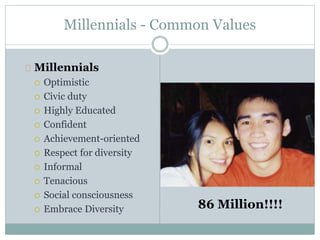
Millennials - Common Values
Millennials
 Optimistic
 Civic duty
 Highly Educated
 Confident
 Achievement-oriented
 Respect for diversity
 Informal
 Tenacious
 Social consciousness
 Embrace Diversity 86 Million!!!!
12
Determining Generational Bias
How do you prefer to communicate –
email or phone?
What operating system are you
running?
How many mobile devices do you
carry?
Who are your role models/heroes?
On-the-Job Challenges
Traditionalists and Boomers
 generally do not question or challenge
authority
 accepts the status quo
X’ers and Millennials
 have been taught to speak up
 may not understand, and may even resent,
what they see as a lack of a backbone or
initiative.
On-the-Job Challenges
Traditionalists and Boomers
 prefer face-to-face communication
 Boomer bosses like to have at least one
meeting each week with employees.
Gen Xers and Millennials
 Prefer electronic communication
 Tend to not like meetings
 many have not developed mature listening
skills
Bridging the Generation Gaps
Getting along with Boomers
 Show respect. Acknowledge that you have less experience
and can learn from their experience.
 Choose face-to-face conversations.
 Give people your full attention. Stop multitasking while
someone is talking.
 Play the game. Workplace politics are a fact of life, so learn
to be polite and respectful in these situations.
 Learn the corporate history. Find out what has gone
wrong and right in the past before making suggestions for
changes.
Bridging the Generation Gaps
Getting along with Gen X’ers
 Get to the point. Avoid jargon and buzzwords that obscure
your point.
 Use e-mail. Take advantage of technology and only have
face-to-face meetings when required.
 Give them space. Don’t micromanage but have an open
door. Xers crave autonomy.
 Get over the notion of dues paying.
 Lighten up. Remember, it’s OK for work to be fun.
Bridging the Generation Gaps
Getting along with Millennials
 Challenge them. They want to do work that really matters.
 Ask them their opinion. They love to collaborate and be a
team player.
 Help them find a mentor. They have an affinity and
respect for Silents.
 Provide timely feedback. They are used to getting feedback
instantaneously.
 Lighten up. Remember, it’s OK for work to be fun.
18
Coaching and Managing Xers
DO:
Put all the options on the table
Be prepared to answer “why”
Present yourself as an information
provider
Use their peers as testimonials when
possible
Appear to enjoy your work – remember
carpe diem
Follow up and meet your commitments.
They’re eager to improve and expect you to
follow through.
19
Coaching and Managing Millennials
DO:
Offer customization—a plan specific
to them
Offer peer-level examples
Spend time providing information
and guidance
Be impressed with their decisions
Why does Labor need them?
Let’s be frank: The House of Labor is
aging.
Boomers are preparing to retire, and the
numbers of Gen X’ers simply aren’t
enough to fill the vacuum.
Millennials like unions
 PEW Research
 Rate of Unionized Young
What can YOU do for our Young Workers?
Organize WITHIN – when young people are
challenged to step up to responsibilities,
they feel more a part of the team.
“Pull back the curtain” – Show how
business is run, instead of relying on
“because I said so”
Reach out – Mentor personally, or establish
Intensive Orientation Training
Communicate! Pass on valuable knowledge
from the past, carry on today to push
through the future.
What can YOU do for our Young Workers?
If your local doesn’t have a RENEW
Committee, consider helping to form one
If your local DOES have a RENEW
Committee, invite them to help with
projects where you may need more hands
Consider a shadowing program for young
workers to witness what an Organizer does
Seek out Community Colleges & community
groups outside of Labor, where many
enthusiastic young people can be found
Civic & Community Engagement
Tarn Puvapiromquan – Your person @IO
 Tarn_Puvapiromquan@ibew.org
 202.728.6203
RENEW
 “Reach out & Engage Next-gen Electrical Workers”
 Twitter - @IBEWRENEW
 Facebook - https://www.facebook.com/RENEW.IBEW
 Resources: Mission Statement, Group Charter, “Labor
Lingo”, RENEW Advisory Council, IBEW Store (RENEW
Products), Mentoring Guidebook, RENEW Committee
Toolkit
 1st International RENEW Conference: Sept 27th – 29th 2013
THANK YOU

Generations 30 min Summary

  • 1.
  • 2.
    Who are theYoung Workers? Is someone classified as young because they look it? New in the trade? Living at home with Mom & Dad? Newlywed/New parent? Highschool Graduate? This is their first job? MAYBE YES, MAYBE NOT! Let’s look at Generations…
  • 3.
    Generations GI Generation  1901– 1924 (112 – 89 years of age) Traditionalists/Matures  1925 – 1945 (88 – 68 years of age) Baby Boomers  1946 – 1964 (67 – 49 years of age) Generation X  1965 – 1981 (48 – 32 years of age) Millennials/Generation Y  1982 – 2000 (31 – 13 years of age) Nexters/?  2001 – present (12 – 0 years of age)
  • 4.
    Events and Experiencesthat Shaped Generations Traditionalists  Great Depression  New Deal  Attack on Pearl Harbor  World War II  Korean War  Radio and telephone Baby Boomers  Civil rights  Feminism  Vietnam  Cold War  Space travel  Assassinations  Scientific advances  Credit cards  Television
  • 5.
    Events and Experiencesthat Shaped Generations Generation X  Fall of the Berlin Wall  Challenger disaster  Desert Storm  Personal computers  Working mothers  MTV  Divorce  Energy crisis Millennials  School shootings  9/11  OKC bombing  Internet  Child-focused world  Social networking  Continual feedback  Enron/WorldCom  Iraq/Afghanistan
  • 6.
    Baby Boomers Born 1946to 1964 79 million people Grew up with fewer rules and a more nurturing environment Lived in generally prosperous times, but experienced layoffs Women entered workforce in record numbers “Live to Work!” Spend “quality time” with children Excelling in their career is important Prefer telephone or face-to-face communication Desire challenge and opportunity
  • 7.
    Boomers - CommonValues Baby Boomers  Optimism  Team orientation  Personal gratification  Involvement  Personal growth  Workaholics  Competitors 78 Million
  • 8.
    Generation X Born 1965to 1981 49 million people Grew up as latchkey or day-care children Turbulent economic times – downturn in 80s, upswing in 90s “Work to Live!” Friends with their child, want to spend quantity time Expect their careers to keep moving forward or they will leave Prefer electronic communication Change from job security to career security
  • 9.
    Gen X -Common Values Generation X  Diversity  Techno-literacy  Fun and informality  Self-reliance  Pragmatism – realists  Results-oriented  Individualism  Challenge the system
  • 10.
    Millennials Born 1982 to2000 Attended day care, very involved “helicopter” parents Prosperity has increased over their lifetime “Live, then Work!” Achievement-oriented Prefer instant or text messaging Want to build parallel careers – experts in multitasking
  • 11.
    Millennials - CommonValues Millennials  Optimistic  Civic duty  Highly Educated  Confident  Achievement-oriented  Respect for diversity  Informal  Tenacious  Social consciousness  Embrace Diversity 86 Million!!!!
  • 12.
    12 Determining Generational Bias Howdo you prefer to communicate – email or phone? What operating system are you running? How many mobile devices do you carry? Who are your role models/heroes?
  • 13.
    On-the-Job Challenges Traditionalists andBoomers  generally do not question or challenge authority  accepts the status quo X’ers and Millennials  have been taught to speak up  may not understand, and may even resent, what they see as a lack of a backbone or initiative.
  • 14.
    On-the-Job Challenges Traditionalists andBoomers  prefer face-to-face communication  Boomer bosses like to have at least one meeting each week with employees. Gen Xers and Millennials  Prefer electronic communication  Tend to not like meetings  many have not developed mature listening skills
  • 15.
    Bridging the GenerationGaps Getting along with Boomers  Show respect. Acknowledge that you have less experience and can learn from their experience.  Choose face-to-face conversations.  Give people your full attention. Stop multitasking while someone is talking.  Play the game. Workplace politics are a fact of life, so learn to be polite and respectful in these situations.  Learn the corporate history. Find out what has gone wrong and right in the past before making suggestions for changes.
  • 16.
    Bridging the GenerationGaps Getting along with Gen X’ers  Get to the point. Avoid jargon and buzzwords that obscure your point.  Use e-mail. Take advantage of technology and only have face-to-face meetings when required.  Give them space. Don’t micromanage but have an open door. Xers crave autonomy.  Get over the notion of dues paying.  Lighten up. Remember, it’s OK for work to be fun.
  • 17.
    Bridging the GenerationGaps Getting along with Millennials  Challenge them. They want to do work that really matters.  Ask them their opinion. They love to collaborate and be a team player.  Help them find a mentor. They have an affinity and respect for Silents.  Provide timely feedback. They are used to getting feedback instantaneously.  Lighten up. Remember, it’s OK for work to be fun.
  • 18.
    18 Coaching and ManagingXers DO: Put all the options on the table Be prepared to answer “why” Present yourself as an information provider Use their peers as testimonials when possible Appear to enjoy your work – remember carpe diem Follow up and meet your commitments. They’re eager to improve and expect you to follow through.
  • 19.
    19 Coaching and ManagingMillennials DO: Offer customization—a plan specific to them Offer peer-level examples Spend time providing information and guidance Be impressed with their decisions
  • 20.
    Why does Laborneed them? Let’s be frank: The House of Labor is aging. Boomers are preparing to retire, and the numbers of Gen X’ers simply aren’t enough to fill the vacuum. Millennials like unions  PEW Research  Rate of Unionized Young
  • 21.
    What can YOUdo for our Young Workers? Organize WITHIN – when young people are challenged to step up to responsibilities, they feel more a part of the team. “Pull back the curtain” – Show how business is run, instead of relying on “because I said so” Reach out – Mentor personally, or establish Intensive Orientation Training Communicate! Pass on valuable knowledge from the past, carry on today to push through the future.
  • 22.
    What can YOUdo for our Young Workers? If your local doesn’t have a RENEW Committee, consider helping to form one If your local DOES have a RENEW Committee, invite them to help with projects where you may need more hands Consider a shadowing program for young workers to witness what an Organizer does Seek out Community Colleges & community groups outside of Labor, where many enthusiastic young people can be found
  • 23.
    Civic & CommunityEngagement Tarn Puvapiromquan – Your person @IO  Tarn_Puvapiromquan@ibew.org  202.728.6203 RENEW  “Reach out & Engage Next-gen Electrical Workers”  Twitter - @IBEWRENEW  Facebook - https://www.facebook.com/RENEW.IBEW  Resources: Mission Statement, Group Charter, “Labor Lingo”, RENEW Advisory Council, IBEW Store (RENEW Products), Mentoring Guidebook, RENEW Committee Toolkit  1st International RENEW Conference: Sept 27th – 29th 2013
  • 24.