

Leadership Across
Generations
August 13, 2013
Emily Davis, MNM
EDA Consulting LLC
emilydavisconsulting.com
Turn on Your Tech
Join the conversation…
@edaconsulting
@HUB_Boulder
#leadership

emilydavisconsulting.com
Outcomes
• Understand leadership
dynamics & challenges
• Identify strategic &
attainable solutions.
• Find a more inclusive
approach.
• Learn how to motivate
leadership across
generations.
emilydavisconsulting.com
•Question you have
•Challenge you’ve experienced
•Goal for today

emilydavisconsulting.com
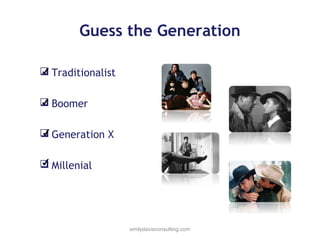
Guess the Generation
✔
 Traditionalist
✔
 Boomer
✔
 Generation X
✔
 Millenial

emilydavisconsulting.com
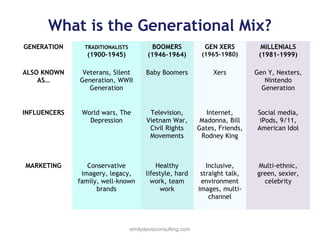
What is the Generational Mix?
GENERATION

BOOMERS
(1946-1964)

TRADITIONALISTS

(1900-1945)

GEN XERS
(1965-1980)

MILLENIALS
(1981-1999)

ALSO KNOWN
AS…

Veterans, Silent
Generation, WWII
Generation

Baby Boomers

Xers

Gen Y, Nexters,
Nintendo
Generation

INFLUENCERS

World wars, The
Depression

Television,
Vietnam War,
Civil Rights
Movements

Internet,
Madonna, Bill
Gates, Friends,
Rodney King

Social media,
iPods, 9/11,
American Idol

MARKETING

Conservative
imagery, legacy,
family, well-known
brands

Healthy
lifestyle, hard
work, team
work

Inclusive,
straight talk,
environment
images, multichannel

Multi-ethnic,
green, sexier,
celebrity

emilydavisconsulting.com
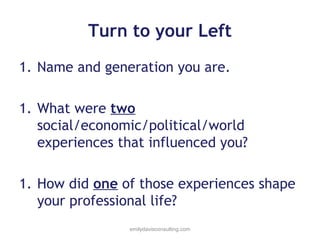
Turn to your Left
1. Name and generation you are.
1. What were two
social/economic/political/world
experiences that influenced you?
1. How did one of those experiences shape
your professional life?
emilydavisconsulting.com
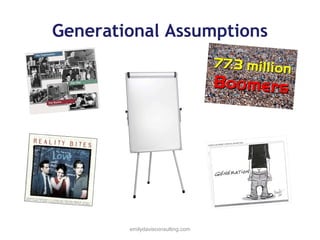
Generational Assumptions

emilydavisconsulting.com
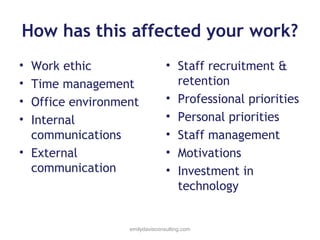
How has this affected your work?
•
•
•
•

Work ethic
Time management
Office environment
Internal
communications
• External
communication

• Staff recruitment &
retention
• Professional priorities
• Personal priorities
• Staff management
• Motivations
• Investment in
technology

emilydavisconsulting.com
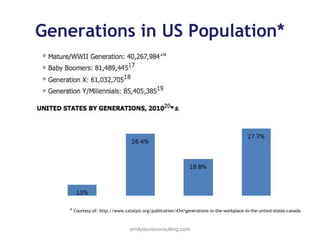
Generations in US Population*

* Courtesy of: http://www.catalyst.org/publication/434/generations-in-the-workplace-in-the-united-states-canada
emilydavisconsulting.com
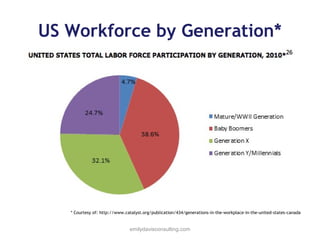
US Workforce by Generation*

* Courtesy of: http://www.catalyst.org/publication/434/generations-in-the-workplace-in-the-united-states-canada

emilydavisconsulting.com
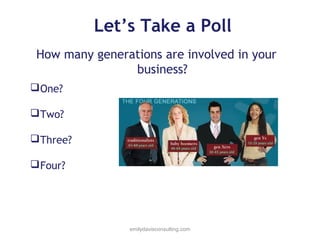
Let’s Take a Poll
How many generations are involved in your
business?
 One?
 Two?
 Three?
 Four?

emilydavisconsulting.com
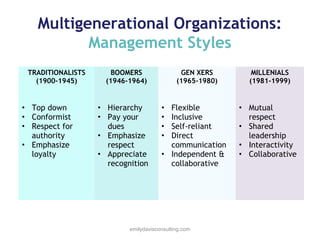
Multigenerational Organizations:
Management Styles
TRADITIONALISTS
(1900-1945)

• Top down
• Conformist
• Respect for
authority
• Emphasize
loyalty

BOOMERS
(1946-1964)

• Hierarchy
• Pay your
dues
• Emphasize
respect
• Appreciate
recognition

GEN XERS
(1965-1980)

Flexible
Inclusive
Self-reliant
Direct
communication
• Independent &
collaborative
•
•
•
•

emilydavisconsulting.com

MILLENIALS
(1981-1999)

• Mutual
respect
• Shared
leadership
• Interactivity
• Collaborative
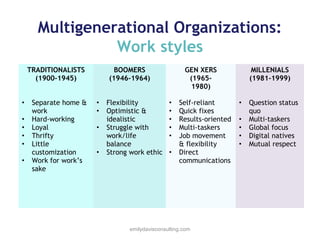
Multigenerational Organizations:
Work styles
TRADITIONALISTS
(1900-1945)
•
•
•
•
•
•

Separate home &
work
Hard-working
Loyal
Thrifty
Little
customization
Work for work’s
sake

BOOMERS
(1946-1964)
•
•
•
•

Flexibility
Optimistic &
idealistic
Struggle with
work/life
balance
Strong work ethic

GEN XERS
(19651980)
•
•
•
•
•
•

Self-reliant
Quick fixes
Results-oriented
Multi-taskers
Job movement
& flexibility
Direct
communications

emilydavisconsulting.com

MILLENIALS
(1981-1999)
•
•
•
•
•

Question status
quo
Multi-taskers
Global focus
Digital natives
Mutual respect
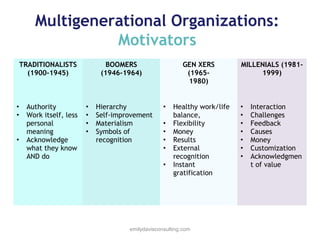
Multigenerational Organizations:
Motivators
TRADITIONALISTS
(1900-1945)

•
•
•

Authority
Work itself, less
personal
meaning
Acknowledge
what they know
AND do

BOOMERS
(1946-1964)

•
•
•
•

Hierarchy
Self-improvement
Materialism
Symbols of
recognition

GEN XERS
(19651980)
•
•
•
•
•
•

Healthy work/life
balance,
Flexibility
Money
Results
External
recognition
Instant
gratification

emilydavisconsulting.com

MILLENIALS (19811999)

•
•
•
•
•
•
•

Interaction
Challenges
Feedback
Causes
Money
Customization
Acknowledgmen
t of value
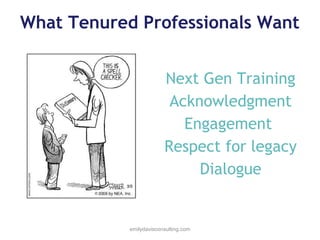
What Tenured Professionals Want
Next Gen Training
Acknowledgment
Engagement
Respect for legacy
Dialogue

emilydavisconsulting.com
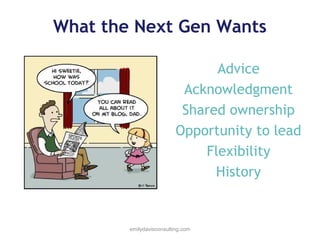
What the Next Gen Wants
Advice
Acknowledgment
Shared ownership
Opportunity to lead
Flexibility
History

emilydavisconsulting.com
What do we have in common?
• Commitment
• High hopes for the future
• Value recognition &
relationships with our peers
• Want to share stories
• Desire mutual respect & trust

emilydavisconsulting.com
Turn to Your Right
• Your name
• How have you seen
others approach this
challenge?
• What is one thing you
can do to approach
the challenge?
emilydavisconsulting.com
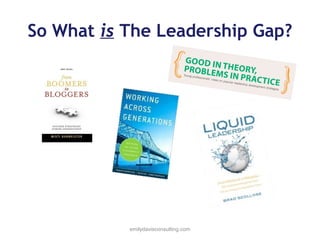
So What is The Leadership Gap?

emilydavisconsulting.com
Defining the Leadership Gap
• The period of time when executive Boomers are
preparing to leave their leadership roles to when new
leadership is installed.
• Describes not only temporal gaps, but perceptual
gaps in what well-qualified leaders look like.
• The lack of communication, preparation, and support
available among multiple generations of leaders.

emilydavisconsulting.com
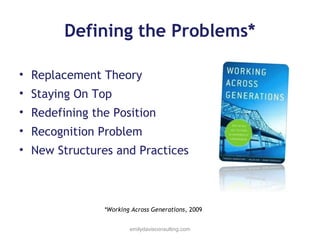
Defining the Problems*
• Replacement Theory
• Staying On Top
• Redefining the Position
• Recognition Problem
• New Structures and Practices

*Working Across Generations, 2009
emilydavisconsulting.com
Replacement Theory
Not enough people to fill
leadership gaps so we need
to develop a pipeline.
SOLUTION:
If we recruit and train enough people we
won’t have a problem. Develop a pipeline.
emilydavisconsulting.com
Staying On Top
Little to no room for the next
gen to lead.
Boomer-led orgs will continue as
usual & next gen will start new
orgs.

SOLUTION:
Find ways to integrate new ideas.
Work side-by-side, not top down.
emilydavisconsulting.com
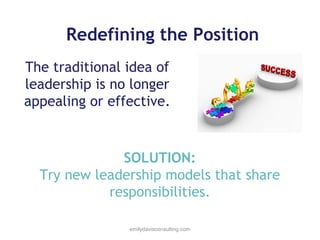
Redefining the Position
The traditional idea of
leadership is no longer
appealing or effective.

SOLUTION:
Try new leadership models that share
responsibilities.
emilydavisconsulting.com
Recognition Problem
There is a generation
ready to step up to the
plate that feels invisible to
the current leadership.
SOLUTIONS:
•Search internally when recruiting
•Acknowledge value & contributions of next gen leaders
•Shift mental models – inclusiveness, coaching
emilydavisconsulting.com
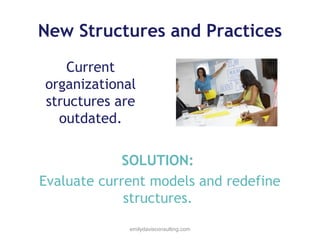
New Structures and Practices
Current
organizational
structures are
outdated.
SOLUTION:
Evaluate current models and redefine
structures.
emilydavisconsulting.com
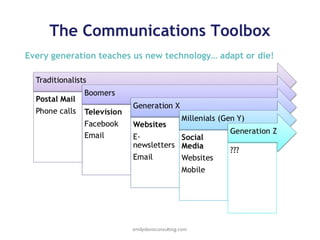
The Communications Toolbox
Every generation teaches us new technology… adapt or die!

emilydavisconsulting.com
10 Ways to Work with Every Gen
1.
2.
3.
4.
5.
6.
7.
8.
9.
10.

Know each gen’s value
Recruit & retain emerging leaders
Learn individual & generational motivations
Be flexible for work/life balance
Encourage peer learning
Invest in talent development
Develop trust to advance the work
Encourage emotional connection and intelligence
Communicate what accountability looks like
Understand & communicate work’s relevance

emilydavisconsulting.com
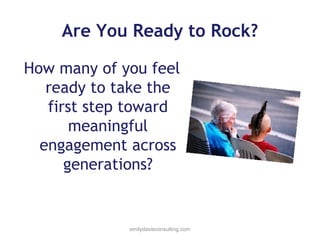
Are You Ready to Rock?
How many of you feel
ready to take the
first step toward
meaningful
engagement across
generations?

emilydavisconsulting.com
5 Things To Do Today
1. Make a plan
2. Watch others
3. Attend trainings &
ask for support
4. Invite participation
5. Support new ideas

emilydavisconsulting.com
Resources
•

Working Across Generations

•

Liquid Leadership

•

From Boomers to Bloggers

•

Ready to Lead?

•

5 Leadership Toys for the
Multigenerational Workplace Sandbox

•

Stepping Up or Stepping Out

•

Daring to Lead

•

Building Movement Project

•

21/64

•

Annie E. Casey Foundation
emilydavisconsulting.com
Emily Davis, MNM
EDA Consulting LLC
(720) 515-0581
emily@emilydavisconsulting.com

emilydavisconsulting.com
emilydavisconsulting.com/blog
Facebook.com/emilydavisconsulting
twitter.com/edaconsulting

Who
Nonprofits & Philanthropy
What
Communications
Governance
Philanthropy
How
Speaking
Training
Consulting

linkedin.com/in/emilylariedavis
emilydavisconsulting.com

Leadership Across Generations

  • 1.
    Leadership Across Generations August 13,2013 Emily Davis, MNM EDA Consulting LLC emilydavisconsulting.com
  • 2.
    Turn on YourTech Join the conversation… @edaconsulting @HUB_Boulder #leadership emilydavisconsulting.com
  • 3.
  • 4.
    Outcomes • Understand leadership dynamics& challenges • Identify strategic & attainable solutions. • Find a more inclusive approach. • Learn how to motivate leadership across generations. emilydavisconsulting.com
  • 5.
    •Question you have •Challengeyou’ve experienced •Goal for today emilydavisconsulting.com
  • 6.
    Guess the Generation ✔ Traditionalist ✔  Boomer ✔  Generation X ✔  Millenial emilydavisconsulting.com
  • 7.
    What is theGenerational Mix? GENERATION BOOMERS (1946-1964) TRADITIONALISTS (1900-1945) GEN XERS (1965-1980) MILLENIALS (1981-1999) ALSO KNOWN AS… Veterans, Silent Generation, WWII Generation Baby Boomers Xers Gen Y, Nexters, Nintendo Generation INFLUENCERS World wars, The Depression Television, Vietnam War, Civil Rights Movements Internet, Madonna, Bill Gates, Friends, Rodney King Social media, iPods, 9/11, American Idol MARKETING Conservative imagery, legacy, family, well-known brands Healthy lifestyle, hard work, team work Inclusive, straight talk, environment images, multichannel Multi-ethnic, green, sexier, celebrity emilydavisconsulting.com
  • 8.
    Turn to yourLeft 1. Name and generation you are. 1. What were two social/economic/political/world experiences that influenced you? 1. How did one of those experiences shape your professional life? emilydavisconsulting.com
  • 9.
  • 10.
    How has thisaffected your work? • • • • Work ethic Time management Office environment Internal communications • External communication • Staff recruitment & retention • Professional priorities • Personal priorities • Staff management • Motivations • Investment in technology emilydavisconsulting.com
  • 11.
    Generations in USPopulation* * Courtesy of: http://www.catalyst.org/publication/434/generations-in-the-workplace-in-the-united-states-canada emilydavisconsulting.com
  • 12.
    US Workforce byGeneration* * Courtesy of: http://www.catalyst.org/publication/434/generations-in-the-workplace-in-the-united-states-canada emilydavisconsulting.com
  • 13.
    Let’s Take aPoll How many generations are involved in your business?  One?  Two?  Three?  Four? emilydavisconsulting.com
  • 14.
    Multigenerational Organizations: Management Styles TRADITIONALISTS (1900-1945) •Top down • Conformist • Respect for authority • Emphasize loyalty BOOMERS (1946-1964) • Hierarchy • Pay your dues • Emphasize respect • Appreciate recognition GEN XERS (1965-1980) Flexible Inclusive Self-reliant Direct communication • Independent & collaborative • • • • emilydavisconsulting.com MILLENIALS (1981-1999) • Mutual respect • Shared leadership • Interactivity • Collaborative
  • 15.
    Multigenerational Organizations: Work styles TRADITIONALISTS (1900-1945) • • • • • • Separatehome & work Hard-working Loyal Thrifty Little customization Work for work’s sake BOOMERS (1946-1964) • • • • Flexibility Optimistic & idealistic Struggle with work/life balance Strong work ethic GEN XERS (19651980) • • • • • • Self-reliant Quick fixes Results-oriented Multi-taskers Job movement & flexibility Direct communications emilydavisconsulting.com MILLENIALS (1981-1999) • • • • • Question status quo Multi-taskers Global focus Digital natives Mutual respect
  • 16.
    Multigenerational Organizations: Motivators TRADITIONALISTS (1900-1945) • • • Authority Work itself,less personal meaning Acknowledge what they know AND do BOOMERS (1946-1964) • • • • Hierarchy Self-improvement Materialism Symbols of recognition GEN XERS (19651980) • • • • • • Healthy work/life balance, Flexibility Money Results External recognition Instant gratification emilydavisconsulting.com MILLENIALS (19811999) • • • • • • • Interaction Challenges Feedback Causes Money Customization Acknowledgmen t of value
  • 17.
    What Tenured ProfessionalsWant Next Gen Training Acknowledgment Engagement Respect for legacy Dialogue emilydavisconsulting.com
  • 18.
    What the NextGen Wants Advice Acknowledgment Shared ownership Opportunity to lead Flexibility History emilydavisconsulting.com
  • 19.
    What do wehave in common? • Commitment • High hopes for the future • Value recognition & relationships with our peers • Want to share stories • Desire mutual respect & trust emilydavisconsulting.com
  • 20.
    Turn to YourRight • Your name • How have you seen others approach this challenge? • What is one thing you can do to approach the challenge? emilydavisconsulting.com
  • 21.
    So What isThe Leadership Gap? emilydavisconsulting.com
  • 22.
    Defining the LeadershipGap • The period of time when executive Boomers are preparing to leave their leadership roles to when new leadership is installed. • Describes not only temporal gaps, but perceptual gaps in what well-qualified leaders look like. • The lack of communication, preparation, and support available among multiple generations of leaders. emilydavisconsulting.com
  • 23.
    Defining the Problems* •Replacement Theory • Staying On Top • Redefining the Position • Recognition Problem • New Structures and Practices *Working Across Generations, 2009 emilydavisconsulting.com
  • 24.
    Replacement Theory Not enoughpeople to fill leadership gaps so we need to develop a pipeline. SOLUTION: If we recruit and train enough people we won’t have a problem. Develop a pipeline. emilydavisconsulting.com
  • 25.
    Staying On Top Littleto no room for the next gen to lead. Boomer-led orgs will continue as usual & next gen will start new orgs. SOLUTION: Find ways to integrate new ideas. Work side-by-side, not top down. emilydavisconsulting.com
  • 26.
    Redefining the Position Thetraditional idea of leadership is no longer appealing or effective. SOLUTION: Try new leadership models that share responsibilities. emilydavisconsulting.com
  • 27.
    Recognition Problem There isa generation ready to step up to the plate that feels invisible to the current leadership. SOLUTIONS: •Search internally when recruiting •Acknowledge value & contributions of next gen leaders •Shift mental models – inclusiveness, coaching emilydavisconsulting.com
  • 28.
    New Structures andPractices Current organizational structures are outdated. SOLUTION: Evaluate current models and redefine structures. emilydavisconsulting.com
  • 29.
    The Communications Toolbox Everygeneration teaches us new technology… adapt or die! emilydavisconsulting.com
  • 30.
    10 Ways toWork with Every Gen 1. 2. 3. 4. 5. 6. 7. 8. 9. 10. Know each gen’s value Recruit & retain emerging leaders Learn individual & generational motivations Be flexible for work/life balance Encourage peer learning Invest in talent development Develop trust to advance the work Encourage emotional connection and intelligence Communicate what accountability looks like Understand & communicate work’s relevance emilydavisconsulting.com
  • 31.
    Are You Readyto Rock? How many of you feel ready to take the first step toward meaningful engagement across generations? emilydavisconsulting.com
  • 32.
    5 Things ToDo Today 1. Make a plan 2. Watch others 3. Attend trainings & ask for support 4. Invite participation 5. Support new ideas emilydavisconsulting.com
  • 33.
    Resources • Working Across Generations • LiquidLeadership • From Boomers to Bloggers • Ready to Lead? • 5 Leadership Toys for the Multigenerational Workplace Sandbox • Stepping Up or Stepping Out • Daring to Lead • Building Movement Project • 21/64 • Annie E. Casey Foundation emilydavisconsulting.com
  • 34.
  • 35.
    Emily Davis, MNM EDAConsulting LLC (720) 515-0581 emily@emilydavisconsulting.com emilydavisconsulting.com emilydavisconsulting.com/blog Facebook.com/emilydavisconsulting twitter.com/edaconsulting Who Nonprofits & Philanthropy What Communications Governance Philanthropy How Speaking Training Consulting linkedin.com/in/emilylariedavis emilydavisconsulting.com

Editor's Notes

  • #5 What do you really want to know today? What are you looking to get out of this?
  • #10 Write down the assumptions about each generation on a piece of flip chart paper. Good and Bad.
  • #11 What are positive ways you have seen companies address this?
  • #15 GENERATION X: Self-reliant: bend rules if they need to, Striving for work life balance, Lives for today, Distrust of corporate america, The boomers are a hard act to follow, More self reliant – like to solve own problems Quick fix – sound-byte processing and instant gratification Collaborative and independent – they work well independently, but also on teams You will find more movement between jobs with this group Direct communicators – don’t want to read between the lines. Just tell me what you want to say. Financially-motivated – huge amounts of debt from school loans, housing, etc. Motivations: Money; Balancing work and home/family; Results; Efficiency; Money; Challenge; Flexibility; Healthy lifestyle; Hybrids – making things their own Messaging: Straight talk; Get to the benefit or result; No B.S or unsubstantiated claims; Informal; Reduce sexism; Increase Environmentally friendly verbiage; Humor; Thought provoking comments Imagery– Inclusive Bill Gates, internet, Rodney King, Berlin Wall, Apartheid, Madonna, children of divorced parents, Seinfeld, Friends MILLENIALS Digital natives, Independent but interactive, Questions the status quo, Desire mutual respect, Celebrate diversity, Express to express -- not impress, Acknowledgement for being her, Civically-minded 9/11, Facebook, ipods, American idol Millenials are going to be second in size to Boomers – could rival the size depending where we call the end of the generation Digital natives/Civic minded- think globally because they have more global community access than any other generation. Use their practical know-how to make an impact, Independent but interactive – collaborative as well as independent, Multi-taskers, want customization Motivations: Relationships; Varied experiences; Celebrity; Feedback; Mutual respect; Happiness; Materialism; Cause; Creativity; Community; Environment; Money; Having experiences Messaging: Green and NOT green washing; Sexy Imagery: Multiracial imagery
  • #16 GENERATION X: Self-reliant: bend rules if they need to, Striving for work life balance, Lives for today, Distrust of corporate america, The boomers are a hard act to follow, More self reliant – like to solve own problems Quick fix – sound-byte processing and instant gratification Collaborative and independent – they work well independently, but also on teams You will find more movement between jobs with this group Direct communicators – don’t want to read between the lines. Just tell me what you want to say. Financially-motivated – huge amounts of debt from school loans, housing, etc. Motivations: Money; Balancing work and home/family; Results; Efficiency; Money; Challenge; Flexibility; Healthy lifestyle; Hybrids – making things their own Messaging: Straight talk; Get to the benefit or result; No B.S or unsubstantiated claims; Informal; Reduce sexism; Increase Environmentally friendly verbiage; Humor; Thought provoking comments Imagery– Inclusive Bill Gates, internet, Rodney King, Berlin Wall, Apartheid, Madonna, children of divorced parents, Seinfeld, Friends MILLENIALS Digital natives, Independent but interactive, Questions the status quo, Desire mutual respect, Celebrate diversity, Express to express -- not impress, Acknowledgement for being her, Civically-minded 9/11, Facebook, ipods, American idol Millenials are going to be second in size to Boomers – could rival the size depending where we call the end of the generation Digital natives/Civic minded- think globally because they have more global community access than any other generation. Use their practical know-how to make an impact, Independent but interactive – collaborative as well as independent, Multi-taskers, want customization Motivations: Relationships; Varied experiences; Celebrity; Feedback; Mutual respect; Happiness; Materialism; Cause; Creativity; Community; Environment; Money; Having experiences Messaging: Green and NOT green washing; Sexy Imagery: Multiracial imagery
  • #17 GENERATION X: Self-reliant: bend rules if they need to, Striving for work life balance, Lives for today, Distrust of corporate america, The boomers are a hard act to follow, More self reliant – like to solve own problems Quick fix – sound-byte processing and instant gratification Collaborative and independent – they work well independently, but also on teams You will find more movement between jobs with this group Direct communicators – don’t want to read between the lines. Just tell me what you want to say. Financially-motivated – huge amounts of debt from school loans, housing, etc. Motivations: Money; Balancing work and home/family; Results; Efficiency; Money; Challenge; Flexibility; Healthy lifestyle; Hybrids – making things their own Messaging: Straight talk; Get to the benefit or result; No B.S or unsubstantiated claims; Informal; Reduce sexism; Increase Environmentally friendly verbiage; Humor; Thought provoking comments Imagery– Inclusive Bill Gates, internet, Rodney King, Berlin Wall, Apartheid, Madonna, children of divorced parents, Seinfeld, Friends MILLENIALS Digital natives, Independent but interactive, Questions the status quo, Desire mutual respect, Celebrate diversity, Express to express -- not impress, Acknowledgement for being her, Civically-minded 9/11, Facebook, ipods, American idol Millenials are going to be second in size to Boomers – could rival the size depending where we call the end of the generation Digital natives/Civic minded- think globally because they have more global community access than any other generation. Use their practical know-how to make an impact, Independent but interactive – collaborative as well as independent, Multi-taskers, want customization Motivations: Relationships; Varied experiences; Celebrity; Feedback; Mutual respect; Happiness; Materialism; Cause; Creativity; Community; Environment; Money; Having experiences Messaging: Green and NOT green washing; Sexy Imagery: Multiracial imagery
  • #19 Advice from the older generations that will inform their leadership Acknowledgement: commitment to the sector, new leadership ideas, structures and vision for the sector. Shared ownership of the sector Flexibility from older generations about new leadership qualities and management styles The real stories behind organizations and the sector – the good, the bad, and the ugly. Challenges: long hours make it difficult to have a life outside of work, going back to school, change jobs, look at different interests, have families; more plugged in than previous generations Reasons for working for an NPO: Enjoy giving back to the community - 82% Personal sense of satisfaction - 81.5%) Positive work environment - 58.3% Professional challenges - 57.2% Co-workers - 56% Working with clients: 42.7% Encouraging and supportive leadership: 40% Professional development opportunities: 37% Other: 3.4% Financial compensation: 2.8% Sherri to look for emerging leader corporate stats
  • #22 According to a 2004 Annie E. Casey Foundation survey, “more than 2,200 nonprofit organizations found that 65 percent of respondents expected to go through a leadership transition by 2009, while just 57 percent had experienced a transition during the past 10 years (2005, p.2).” In 2006 in San Diego, 68% of the nonprofit leaders expected to leave within 5 years. (Executive Transition in San Diego’s Nonprofit Sector) In 2006, report indicated that there would be 640,000 vacant senior management positions in the nonprofit sector in next 10 years (the Leadership Deficit) 45% of respondents in a YNPN report stated that they will leave the nonprofit sector. Why? (Stepping Up or Stepping Out)
  • #24 Originally thought there was one specific problem to be solved, but that is not the case. There are multiple leadership problems to be addressed for the future of nonprofits Multilayered issues related to leadership.
  • #25 This is the most common identification of the problem, but there are issues with it Not very motivating or innovative Target MBAs Recruit into the sector
  • #27 More attractive to new leaders Examples: Co-directors Flattened hierarchy Team approaches Coaching
  • #28 Be flexible about what the image of leadership is Despite the outward promotion of hiring people of color only 17% of exec dir are people of color and yet we know the US population is becoming more diverse. We need to reflect that diversity in our leadership. Boomer leaders are really busy and often don’t know how to develop the next generation of leaders
  • #29 Hierarchal organizations that were created in the 60s and 70s – popular business model that eventually became bureaucratic Little support from funders or boards to make change that would make decision-making and process more appealing. Outcomes: Innovative, flexible, and fun orgs Advance the sector Support current staff Attract and build the next generation of leadership
  • #34 Young Nonprofit Professionals Network (YNPN) Building Movement Project Emerging Practitioners in Philanthropy (EPIP) 21/64 CompassPoint