Chapter 1 – Introduction to Economics
ECONOMICS
THEORY AND PRACTICE
Seventh Edition
Copyright © 2004 John Wiley & Sons, Inc. All rights reserved.
Patrick J.
Welch
St. Louis University
Gerry F. Welch
St. Louis Community College
at Meramec
&
PowerPoint Presentation by:
Dr. Ray Everett
Pima Community College
. . . The word economy comes from a
Greek word for “one who manages a
household.”
Economy. . .
What Economics Is
• Economics is the study of how human
beings coordinate their wants and desires,
given the decision-making mechanisms,
social customs, and political realities of the
society.
Or in simple terms
How scarce resources are used to satisfy
people’s unlimited wants.
What Economics Is
• Scarcity exists because individuals want
more than can be produced.
– Scarcity – the goods available are too few
to satisfy individuals’ desires.
A household and an economy face many
decisions:
 Who will work?
 What goods and how many of them should be
produced?
 What resources should be used in production?
 At what price should the goods be sold?
What Economics Is
• The degree of scarcity is constantly
changing.
• The quantity of goods, services, and usable
resources depends on technology and
human action.
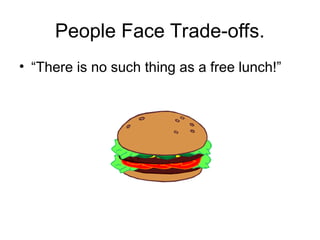
• “There is no such thing as a free lunch!”
People Face Trade-offs.
• To get one thing, we usually have to give
up another thing.
– Guns v. butter
– Food v. clothing
– Leisure time v. work
– Efficiency v. equity
Decisions usually involve a value judgment
The Cost of Holding a Job
Page 6 in Your Book
• For decades the conventional wisdom has
been that it is great for teenagers to hold
after-school jobs because it teaches them
responsibility, provides pocket money, and
keeps the out of trouble
What are the tradeoffs?
People Face Trade-offs
• Efficiency v. Equity
– Efficiency means society gets the most that it
can from its scarce resources.
– Equity means the benefits of those resources
are distributed fairly among the members of
society.
The Cost of Something Is What
You Give Up to Get It.
• Decisions require comparing costs and
benefits of alternatives.
– Whether to go to college or to work?
– Whether to study or go out on a date?
– Whether to go to class or sleep in?
• The opportunity cost of an item is what
you give up to obtain that item.
The Cost of Something Is What
You Give Up to Get It.
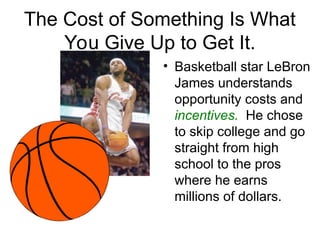
• Basketball star LeBron
James understands
opportunity costs and
incentives. He chose
to skip college and go
straight from high
school to the pros
where he earns
millions of dollars.
• Marginal changes are small, incremental
adjustments to an existing plan of action.
People make decisions by comparing
costs and benefits at the margin.
Unfortunately, we are not rational all
of the time.
Rational People Think at the
Margin.
Thinking Like an Economist
Every field of study has its own terminology
 Mathematics
• integrals  axioms  vector spaces
 Psychology
• ego  id  cognitive dissonance
 Law
• promissory  estoppels  torts  venues
 Economics
• supply  opportunity cost  elasticity  consumer
surplus  demand  comparative advantage 
deadweight loss
Thinking Like an Economist
Economics trains you to. . . .
 Think in terms of alternatives.
 Evaluate the cost of individual and social
choices.
 Examine and understand how certain events
and issues are related.
THE ECONOMIST AS A
SCIENTIST
The economic way of thinking . . .
 Involves thinking analytically and objectively.
 Makes use of the scientific method.
 Uses abstract models to help explain how a
complex, real world operates.
 Develops theories, collects and analyzes data
to evaluate the theories.
The Scientific Method:
Observation, Theory, and More
Observation
• Uses abstract models to help explain how
a complex, real world operates.
• Develops theories, collects and analyzes
data to evaluate the theories.
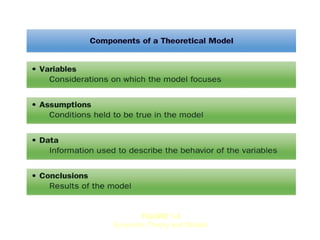
FIGURE 1-3
Economic Theory and Models
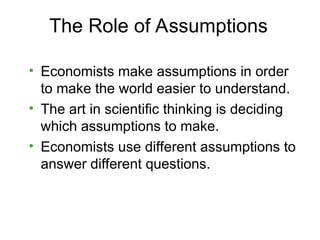
• Economists make assumptions in order
to make the world easier to understand.
• The art in scientific thinking is deciding
which assumptions to make.
• Economists use different assumptions to
answer different questions.
The Role of Assumptions
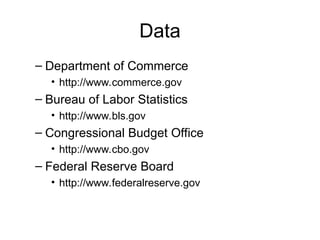
Data
– Department of Commerce
• http://www.commerce.gov
– Bureau of Labor Statistics
• http://www.bls.gov
– Congressional Budget Office
• http://www.cbo.gov
– Federal Reserve Board
• http://www.federalreserve.gov
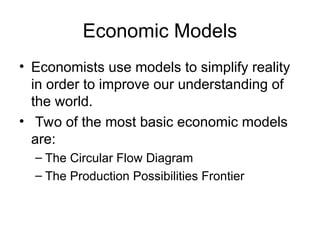
Economic Models
• Economists use models to simplify reality
in order to improve our understanding of
the world.
• Two of the most basic economic models
are:
– The Circular Flow Diagram
– The Production Possibilities Frontier
Our First Model: The Circular-
Flow Diagram
• Firms
– Produce and sell goods and services
– Hire and use factors of production
• Households
– Buy and consume goods and services
– Own and sell factors of production
Our First Model: The Circular-
Flow Diagram
• Markets for Goods and Services
– Firms sell
– Households buy
• Markets for Factors of Production
– Households sell
– Firms buy
Our First Model: The Circular-
Flow Diagram
• Factors of Production
– Inputs used to produce goods and services
– Land, labor, capital, and entrepreneurship
• Labor includes all human effort, both physical an
mental.
• Capital are the tools used to produce goods
• Land is the land itself and all of the raw materials
that originate in nature
• Entrepreneurship is the function of organizing the
factors together
Microeconomics and
Macroeconomics
• Microeconomics focuses on the individual
parts of the economy.
– How households and firms make decisions
and how they interact in specific markets
• Macroeconomics looks at the economy as
a whole.
– Economy-wide phenomena, including
inflation, unemployment, and economic
growth
Our Second Model: The
Production Possibilities Frontier
• The production possibilities frontier is a
graph that shows the combinations of
output that the economy can possibly
produce given the available factors of
production and the available production
technology.
Our Second Model: The
Production Possibilities Frontier
• Concepts illustrated by the production
possibilities frontier
– Efficiency
– Trade-offs
– Opportunity cost
– Economic growth
THE ECONOMIST AS POLICY
ADVISOR
• When economists are trying to explain the
world, they are scientists.
• When economists are trying to change the
world, they are policy advisors.
Positive versus Normative
Analysis
• Positive statements are statements that
attempt to describe the world as it is.
– Called descriptive analysis
• Normative statements are statements
about how the world should be.
– Called prescriptive analysis
Positive Versus Normative
Analysis
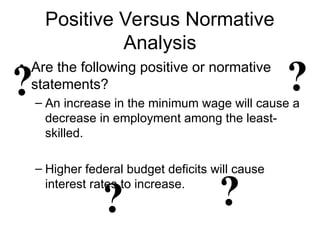
• Are the following positive or normative
statements?
– An increase in the minimum wage will cause a
decrease in employment among the least-
skilled.
– Higher federal budget deficits will cause
interest rates to increase.
? ?
?
?
Positive Versus Normative
Analysis
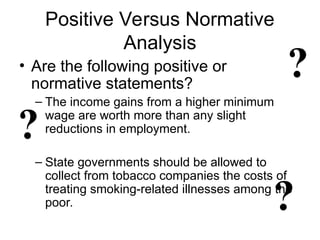
• Are the following positive or
normative statements?
– The income gains from a higher minimum
wage are worth more than any slight
reductions in employment.
– State governments should be allowed to
collect from tobacco companies the costs of
treating smoking-related illnesses among the
poor.
?
?
?

Introduction to Economics lecture one/ chapter one

  • 1.
    Chapter 1 –Introduction to Economics ECONOMICS THEORY AND PRACTICE Seventh Edition Copyright © 2004 John Wiley & Sons, Inc. All rights reserved. Patrick J. Welch St. Louis University Gerry F. Welch St. Louis Community College at Meramec & PowerPoint Presentation by: Dr. Ray Everett Pima Community College
  • 2.
    . . .The word economy comes from a Greek word for “one who manages a household.” Economy. . .
  • 3.
    What Economics Is •Economics is the study of how human beings coordinate their wants and desires, given the decision-making mechanisms, social customs, and political realities of the society. Or in simple terms How scarce resources are used to satisfy people’s unlimited wants.
  • 4.
    What Economics Is •Scarcity exists because individuals want more than can be produced. – Scarcity – the goods available are too few to satisfy individuals’ desires.
  • 5.
    A household andan economy face many decisions:  Who will work?  What goods and how many of them should be produced?  What resources should be used in production?  At what price should the goods be sold?
  • 6.
    What Economics Is •The degree of scarcity is constantly changing. • The quantity of goods, services, and usable resources depends on technology and human action.
  • 7.
    • “There isno such thing as a free lunch!” People Face Trade-offs.
  • 8.
    People Face Trade-offs. •To get one thing, we usually have to give up another thing. – Guns v. butter – Food v. clothing – Leisure time v. work – Efficiency v. equity Decisions usually involve a value judgment
  • 9.
    The Cost ofHolding a Job Page 6 in Your Book • For decades the conventional wisdom has been that it is great for teenagers to hold after-school jobs because it teaches them responsibility, provides pocket money, and keeps the out of trouble What are the tradeoffs?
  • 10.
    People Face Trade-offs •Efficiency v. Equity – Efficiency means society gets the most that it can from its scarce resources. – Equity means the benefits of those resources are distributed fairly among the members of society.
  • 11.
    The Cost ofSomething Is What You Give Up to Get It. • Decisions require comparing costs and benefits of alternatives. – Whether to go to college or to work? – Whether to study or go out on a date? – Whether to go to class or sleep in? • The opportunity cost of an item is what you give up to obtain that item.
  • 12.
    The Cost ofSomething Is What You Give Up to Get It. • Basketball star LeBron James understands opportunity costs and incentives. He chose to skip college and go straight from high school to the pros where he earns millions of dollars.
  • 13.
    • Marginal changesare small, incremental adjustments to an existing plan of action. People make decisions by comparing costs and benefits at the margin. Unfortunately, we are not rational all of the time. Rational People Think at the Margin.
  • 14.
    Thinking Like anEconomist Every field of study has its own terminology  Mathematics • integrals  axioms  vector spaces  Psychology • ego  id  cognitive dissonance  Law • promissory  estoppels  torts  venues  Economics • supply  opportunity cost  elasticity  consumer surplus  demand  comparative advantage  deadweight loss
  • 15.
    Thinking Like anEconomist Economics trains you to. . . .  Think in terms of alternatives.  Evaluate the cost of individual and social choices.  Examine and understand how certain events and issues are related.
  • 16.
    THE ECONOMIST ASA SCIENTIST The economic way of thinking . . .  Involves thinking analytically and objectively.  Makes use of the scientific method.  Uses abstract models to help explain how a complex, real world operates.  Develops theories, collects and analyzes data to evaluate the theories.
  • 17.
    The Scientific Method: Observation,Theory, and More Observation • Uses abstract models to help explain how a complex, real world operates. • Develops theories, collects and analyzes data to evaluate the theories.
  • 18.
  • 19.
    • Economists makeassumptions in order to make the world easier to understand. • The art in scientific thinking is deciding which assumptions to make. • Economists use different assumptions to answer different questions. The Role of Assumptions
  • 20.
    Data – Department ofCommerce • http://www.commerce.gov – Bureau of Labor Statistics • http://www.bls.gov – Congressional Budget Office • http://www.cbo.gov – Federal Reserve Board • http://www.federalreserve.gov
  • 21.
    Economic Models • Economistsuse models to simplify reality in order to improve our understanding of the world. • Two of the most basic economic models are: – The Circular Flow Diagram – The Production Possibilities Frontier
  • 22.
    Our First Model:The Circular- Flow Diagram • Firms – Produce and sell goods and services – Hire and use factors of production • Households – Buy and consume goods and services – Own and sell factors of production
  • 23.
    Our First Model:The Circular- Flow Diagram • Markets for Goods and Services – Firms sell – Households buy • Markets for Factors of Production – Households sell – Firms buy
  • 24.
    Our First Model:The Circular- Flow Diagram • Factors of Production – Inputs used to produce goods and services – Land, labor, capital, and entrepreneurship • Labor includes all human effort, both physical an mental. • Capital are the tools used to produce goods • Land is the land itself and all of the raw materials that originate in nature • Entrepreneurship is the function of organizing the factors together
  • 25.
    Microeconomics and Macroeconomics • Microeconomicsfocuses on the individual parts of the economy. – How households and firms make decisions and how they interact in specific markets • Macroeconomics looks at the economy as a whole. – Economy-wide phenomena, including inflation, unemployment, and economic growth
  • 26.
    Our Second Model:The Production Possibilities Frontier • The production possibilities frontier is a graph that shows the combinations of output that the economy can possibly produce given the available factors of production and the available production technology.
  • 27.
    Our Second Model:The Production Possibilities Frontier • Concepts illustrated by the production possibilities frontier – Efficiency – Trade-offs – Opportunity cost – Economic growth
  • 28.
    THE ECONOMIST ASPOLICY ADVISOR • When economists are trying to explain the world, they are scientists. • When economists are trying to change the world, they are policy advisors.
  • 29.
    Positive versus Normative Analysis •Positive statements are statements that attempt to describe the world as it is. – Called descriptive analysis • Normative statements are statements about how the world should be. – Called prescriptive analysis
  • 30.
    Positive Versus Normative Analysis •Are the following positive or normative statements? – An increase in the minimum wage will cause a decrease in employment among the least- skilled. – Higher federal budget deficits will cause interest rates to increase. ? ? ? ?
  • 31.
    Positive Versus Normative Analysis •Are the following positive or normative statements? – The income gains from a higher minimum wage are worth more than any slight reductions in employment. – State governments should be allowed to collect from tobacco companies the costs of treating smoking-related illnesses among the poor. ? ? ?