
Some slides introducing myself! Davinia Hernández-Leo Visiting Fulbright Scholar  @  Virginia Tech – CS department - POET Lab January 2012
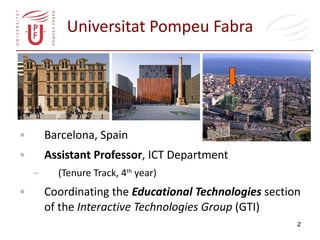
Universitat Pompeu Fabra Barcelona, Spain Assistant Professor , ICT Department (Tenure Track, 4 th  year) Coordinating the  Educational Technologies   section of the  Interactive Technologies Group  (GTI)
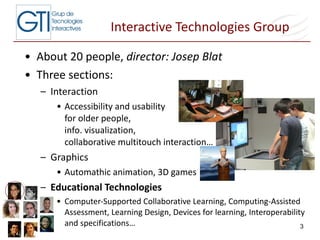
Interactive Technologies Group About 20 people,  director: Josep Blat Three sections: Interaction Accessibility and usability  for older people,  info. visualization,  collaborative multitouch interaction…  Graphics Automathic animation, 3D games Educational Technologies Computer-Supported Collaborative Learning, Computing-Assisted Assessment, Learning Design, Devices for learning, Interoperability and specifications…
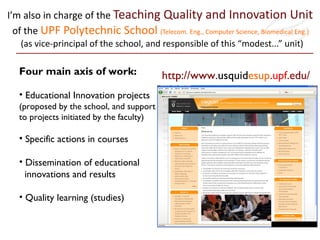
I’m also in charge of the  Teaching Quality and Innovation Unit  of the  UPF Polytechnic School  (Telecom. Eng., Computer Science, Biomedical Eng.)   (as vice-principal of the school, and responsible of this “modest...” unit) http://www. usquid esup . upf .edu/ Four main axis of work: Educational Innovation projects  (proposed by the school, and support  to projects initiated by the faculty) Specific actions in courses Dissemination of educational    innovations and results Quality learning (studies)
Previously University of Valladolid, Spain  (GSIC/EMIC research group) M.S. Telecommunications Engineering 2003 PhD Thesis, 2007,  on Computer-Supported Collaborative Learning, Learning Design, authoring tools, and Pattern-based design  Open University of the Netherlands  (Educational Technology Centre)   Pre-doctoral research fellow (2006) Working  on the specification of IMS Learning Design,  and its support for CSCL
My main research interest  / challenges being tackled Providing teachers with design processes and tools that facilitate the planning of learning and assessment activities, making the designs explicit for computational interpretation and sharing Supporting the orchestration of integrated flows of collaborative learning activities across virtual and physical spaces Within the interdisciplinary domain of  Learning Technologies / Technology Enhanced Learning
Some outcomes
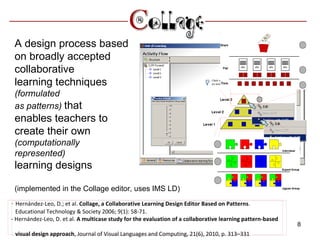
-  Hernández-Leo, D.; et al.  Collage, a Collaborative Learning Design Editor Based on Patterns .    Educational Technology & Society 2006; 9(1): 58-71. - Hernández-Leo, D. et al.  A multicase study for the evaluation of a collaborative learning pattern-based    visual design approach , Journal of Visual Languages and Computing, 21(6), 2010, p. 313–331  A design process based  on broadly accepted  collaborative learning techniques  (formulated  as patterns)  that  enables teachers to create their own (computationally represented)  learning designs (implemented in the Collage editor, uses IMS LD)
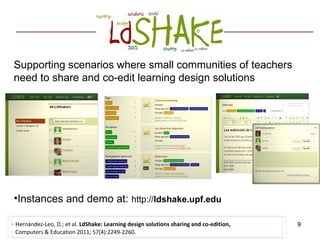
Supporting scenarios where small communities of teachers  need to share and co-edit learning design solutions Instances and demo at:  http:// ldshake.upf.edu -  Hernández-Leo, D.; et al.  LdShake: Learning design solutions sharing and co-edition,    Computers & Education 2011; 57(4):2249-2260.
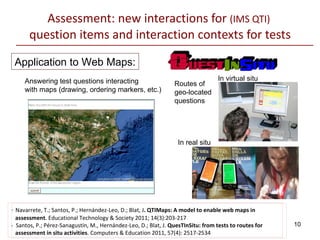
Assessment: new interactions for  (IMS QTI)  question items and interaction contexts for tests Application to Web Maps: Answering test questions interacting  with maps (drawing, ordering markers, etc.) Routes of  geo-located  questions In virtual situ In real situ -  Navarrete, T.; Santos, P.; Hernández-Leo, D.; Blat, J . QTIMaps: A model to enable web maps in    assessment . Educational Technology & Society 2011; 14(3):203-217 -  Santos, P.; Pérez-Sanagustín, M., Hernández-Leo, D.; Blat, J.  QuesTInSitu: from tests to routes for    assessment in situ activities . Computers & Education 2011, 57(4):  2517-2534
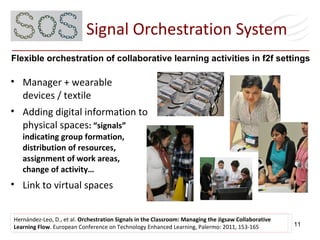
Signal Orchestration System Hernández-Leo, D., et al.  Orchestration Signals in the Classroom: Managing the Jigsaw Collaborative Learning Flow . European Conference on Technology Enhanced Learning, Palermo: 2011, 153-165  Flexible orchestration of collaborative learning activities in f2f settings  Manager + wearable devices / textile Adding digital information to physical spaces : “signals” indicating group formation, distribution of resources, assignment of work areas,  change of activity… Link to virtual spaces
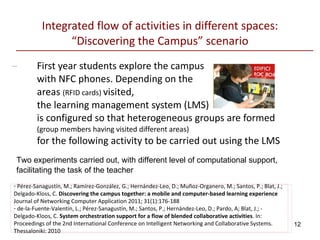
Integrated flow of activities in different spaces: “Discovering the Campus” scenario First year students explore the campus  with NFC phones. Depending on the  areas  (RFID cards)  visited,  the learning management system (LMS)  is configured so that heterogeneous groups are formed  (group members having visited different areas)  for the following activity to be carried out using the LMS  Pérez-Sanagustín, M.; Ramírez-González, G.; Hernández-Leo, D.; Muñoz-Organero, M.; Santos, P.; Blat, J.; Delgado-Kloss, C.  Discovering the campus together: a mobile and computer-based learning experience  Journal of Networking Computer Application 2011; 31(1):176-188 de-la-Fuente-Valentín, L.; Pérez-Sanagustín, M.; Santos, P.; Hernández-Leo, D.; Pardo, A; Blat, J.; - Delgado-Kloos, C.  System orchestration support for a flow of blended collaborative activities . In: Proceedings of the 2nd International Conference on Intelligent Networking and Collaborative Systems. Thessaloniki: 2010 Two experiments carried out, with different level of computational support, facilitating the task of the teacher
More about me can be found at: http://www.dtic.upf.edu/~daviniah/ But I’m in room  KW1114 , please visit me if you are interested in any of these topics or if you want to share with me your research!
Thank you! Gracias!

Daviniahl@vtintroduction

  • 1.
    Some slides introducingmyself! Davinia Hernández-Leo Visiting Fulbright Scholar @ Virginia Tech – CS department - POET Lab January 2012
  • 2.
    Universitat Pompeu FabraBarcelona, Spain Assistant Professor , ICT Department (Tenure Track, 4 th year) Coordinating the Educational Technologies section of the Interactive Technologies Group (GTI)
  • 3.
    Interactive Technologies GroupAbout 20 people, director: Josep Blat Three sections: Interaction Accessibility and usability for older people, info. visualization, collaborative multitouch interaction… Graphics Automathic animation, 3D games Educational Technologies Computer-Supported Collaborative Learning, Computing-Assisted Assessment, Learning Design, Devices for learning, Interoperability and specifications…
  • 4.
    I’m also incharge of the Teaching Quality and Innovation Unit of the UPF Polytechnic School (Telecom. Eng., Computer Science, Biomedical Eng.) (as vice-principal of the school, and responsible of this “modest...” unit) http://www. usquid esup . upf .edu/ Four main axis of work: Educational Innovation projects (proposed by the school, and support to projects initiated by the faculty) Specific actions in courses Dissemination of educational innovations and results Quality learning (studies)
  • 5.
    Previously University ofValladolid, Spain (GSIC/EMIC research group) M.S. Telecommunications Engineering 2003 PhD Thesis, 2007, on Computer-Supported Collaborative Learning, Learning Design, authoring tools, and Pattern-based design Open University of the Netherlands (Educational Technology Centre) Pre-doctoral research fellow (2006) Working on the specification of IMS Learning Design, and its support for CSCL
  • 6.
    My main researchinterest / challenges being tackled Providing teachers with design processes and tools that facilitate the planning of learning and assessment activities, making the designs explicit for computational interpretation and sharing Supporting the orchestration of integrated flows of collaborative learning activities across virtual and physical spaces Within the interdisciplinary domain of Learning Technologies / Technology Enhanced Learning
  • 7.
  • 8.
    - Hernández-Leo,D.; et al. Collage, a Collaborative Learning Design Editor Based on Patterns . Educational Technology & Society 2006; 9(1): 58-71. - Hernández-Leo, D. et al. A multicase study for the evaluation of a collaborative learning pattern-based visual design approach , Journal of Visual Languages and Computing, 21(6), 2010, p. 313–331 A design process based on broadly accepted collaborative learning techniques (formulated as patterns) that enables teachers to create their own (computationally represented) learning designs (implemented in the Collage editor, uses IMS LD)
  • 9.
    Supporting scenarios wheresmall communities of teachers need to share and co-edit learning design solutions Instances and demo at: http:// ldshake.upf.edu - Hernández-Leo, D.; et al. LdShake: Learning design solutions sharing and co-edition, Computers & Education 2011; 57(4):2249-2260.
  • 10.
    Assessment: new interactionsfor (IMS QTI) question items and interaction contexts for tests Application to Web Maps: Answering test questions interacting with maps (drawing, ordering markers, etc.) Routes of geo-located questions In virtual situ In real situ - Navarrete, T.; Santos, P.; Hernández-Leo, D.; Blat, J . QTIMaps: A model to enable web maps in assessment . Educational Technology & Society 2011; 14(3):203-217 - Santos, P.; Pérez-Sanagustín, M., Hernández-Leo, D.; Blat, J. QuesTInSitu: from tests to routes for assessment in situ activities . Computers & Education 2011, 57(4): 2517-2534
  • 11.
    Signal Orchestration SystemHernández-Leo, D., et al. Orchestration Signals in the Classroom: Managing the Jigsaw Collaborative Learning Flow . European Conference on Technology Enhanced Learning, Palermo: 2011, 153-165 Flexible orchestration of collaborative learning activities in f2f settings Manager + wearable devices / textile Adding digital information to physical spaces : “signals” indicating group formation, distribution of resources, assignment of work areas, change of activity… Link to virtual spaces
  • 12.
    Integrated flow ofactivities in different spaces: “Discovering the Campus” scenario First year students explore the campus with NFC phones. Depending on the areas (RFID cards) visited, the learning management system (LMS) is configured so that heterogeneous groups are formed (group members having visited different areas) for the following activity to be carried out using the LMS Pérez-Sanagustín, M.; Ramírez-González, G.; Hernández-Leo, D.; Muñoz-Organero, M.; Santos, P.; Blat, J.; Delgado-Kloss, C. Discovering the campus together: a mobile and computer-based learning experience Journal of Networking Computer Application 2011; 31(1):176-188 de-la-Fuente-Valentín, L.; Pérez-Sanagustín, M.; Santos, P.; Hernández-Leo, D.; Pardo, A; Blat, J.; - Delgado-Kloos, C. System orchestration support for a flow of blended collaborative activities . In: Proceedings of the 2nd International Conference on Intelligent Networking and Collaborative Systems. Thessaloniki: 2010 Two experiments carried out, with different level of computational support, facilitating the task of the teacher
  • 13.
    More about mecan be found at: http://www.dtic.upf.edu/~daviniah/ But I’m in room KW1114 , please visit me if you are interested in any of these topics or if you want to share with me your research!
  • 14.

Editor's Notes

  • #3 Assistant Professor, is the coordinator of the Educational Technologies research section of the Interactive Technologies Group (GTI), Information and Communication Department at Universtitat Pompeu Fabra (UPF), Barcelona, Spain.
  • #5 She is also in charge of the Teaching Quality and Innovation Unit of the UPF Polytechnic School since 2008.
  • #6 Davinia was previously a member of the GSIC/EMIC multidisplinary group and Assistant Teacher at the Department of Signal Theory, Communications and Telematics Engineering of the University of Valladolid, where she received the M.S. and the Ph.D. degrees (European mention) in Telecommunications Engineering in 2003 and 2007, respectively. She was also a visiting Research Fellow at the Educational Technology Centre of the Open University of the Netherlands in 2006
  • #7 Tacking two main challenges providing teachers with modeling languages, design processes and tools that facilitate the planning of learning and assessment activities supported by technologies, making the designs explicit for computational interpretation, communication and sharing; second, supporting the orchestration of integrated flows of collaborative learning activities across virtual and physical spaces using multiple software services, ubiquitous computing and personal devices. This research is being conducted as part of a number of European and national projects, and published in more than 70 journal articles, book chapters and conference papers. Some of these publications are being highly cited, and their contributions have been implemented in renowned tools: Collage, LdShake, QuesTInSitu and SOS. Davinia has also directed three PhD theses and several Master theses on these research lines.