


Efficient and effective mobile collaborative learning
21st World conference on mobile, blended and seamless learning (mLearn2022)
https://www.iamlearn.org/mlearn 10-12 Oct. 2022
Davinia Hernández-Leo
TIDE, Universitat Pompeu Fabra, Barcelona
twitter: @davinia.hl @TIDE_UPF
website : http://www.upf.edu/web/tide
What do we mean by efficient and effective
mobile collaborative learning?
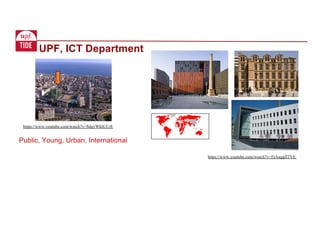
Public, Young, Urban, International
https://www.youtube.com/watch?v=8dgvWkICCr8
https://www.youtube.com/watch?v=FjAuggflTVE
UPF, ICT Department
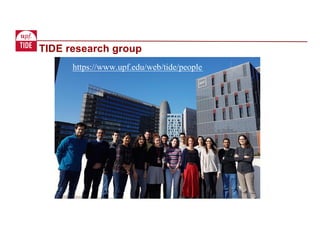
TIDE research group
https://www.upf.edu/web/tide/people
Collaborative Learning
Computer-Supported Collaborative Learning
Collaborative Learning
social interactions triggering learning mechanics
Computer-Supported Collaborative Learning
Mobile Collaborative Learning
networked computers (software, multiple devices) can facilitate these interactions
http://tiny.cc/mLearn22
What do we mean by efficient and effective
mobile collaborative learning?
Productive collaborative Learning
• Genuine collaboration requires systematic efforts to learn together:
- free collaboration does not necessarily lead to fruitful learning (Dillenbourg,
2002)
- learners should be engaged in processes involving social
knowledge-intensive interactions (Roschelle & Teasley, 1995; Johnson &
Johnson, 1999; Barron, 2003)
- design science: designing for collaborative learning
Learning Design
Support teachers in designing the “best possible”
conditions for their students to learn, documenting them,
making their design ideas explicit and sharable.
(Agostinho, 2011; Conole, 2012; Koper et al., 2004; Laurillard, 2013;
Mor, Craft & Hernández-Leo, 2013; Wasson & Kirschner 2020)
Learning Design
Learning Design
What can be designed?
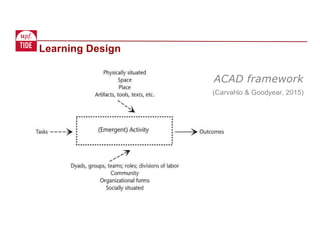
Learning Design
(Carvahlo & Goodyear, 2015)
ACAD framework
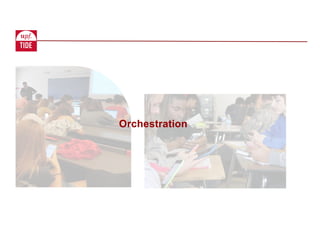
Orchestration
Orchestration
- (Classroom) orchestration: real-time coordination of
collaborative learning processes at different social levels
(individual, small groups, whole class), using a variety of
resources and tools (both ICT and non-ICT) in a synergic
way to maintain progress towards the learning outcomes
(Moor, 2001; Dillenbourg, Järvela & Fischer, 2009; Prieto et al., 2018)
- Usually by teachers
Efficient & effective (mobile) collaborative learning
Design & Orchestration (& Redesign)
How can technologies support … ?
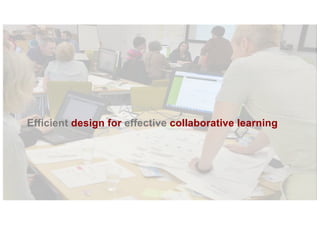
Efficient design for effective collaborative learning
Collaborative Learning scripts
Computer-Supported Collaborative Learning
An approach to enhance effective collaboration:
Guide / structure collaboration in a way that the probability of reaching
successful learning situations increases
(Dillenbourg, 1999)
Macro-scripting
Macro-scripts structure the collaborative learning flow
(aspects of their learning design: activity sequence, roles,
group formation, resource allocation) to trigger potentially
effective social interactions.
(Dillenbourg & Tchounikine, 2007; Kobbe et al., 2007)
Collaborative Learning scripts
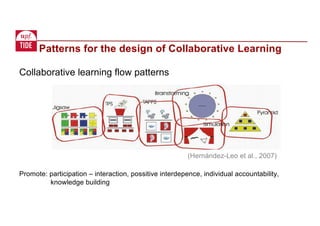
Collaborative learning flow patterns
Promote: participation – interaction, possitive interdepence, individual accountability,
knowledge building
Patterns for the design of Collaborative Learning
(Hernández-Leo et al., 2007)
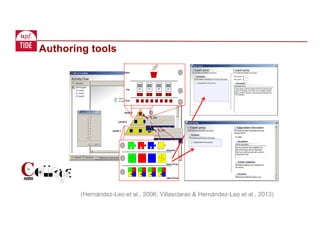
Authoring tools
(Hernández-Leo et al., 2006; Villasclaras & Hernández-Leo et al., 2013)
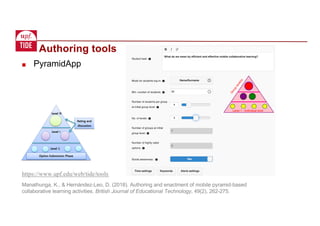
■ PyramidApp
Authoring tools
https://www.upf.edu/web/tide/tools
Manathunga, K., & Hernández-Leo, D. (2018). Authoring and enactment of mobile pyramid-based
collaborative learning activities. British Journal of Educational Technology, 49(2), 262-275.
Learning design and data analytics: from teacher communities to CSCL scripts
Learning design tools
■ Co-design with teachers
■ Emphasis in design for blended learning (PBL, flipped classroom, …)
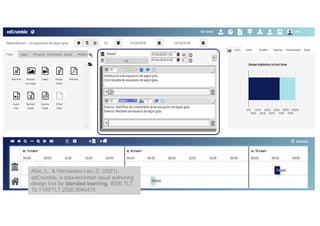
ILDE2/edCrumble
Albo, L., & Hernandez-Leo, D. (2021).
edCrumble, a data-enriched visual authoring
design tool for blended learning. IEEE TLT.
10.1109/TLT.2020.3040475
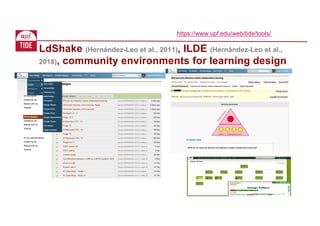
LdShake (Hernández-Leo et al., 2011), ILDE (Hernández-Leo et al.,
2018), community environments for learning design
https://www.upf.edu/web/tide/tools/
https://ildeplus.upf.edu/DTIPS/
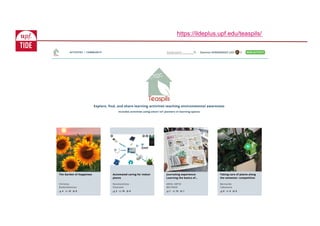
https://ildeplus.upf.edu/teaspils/
26
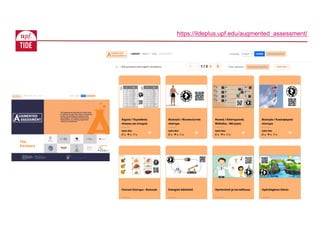
https://ildeplus.upf.edu/augmented_assessment/
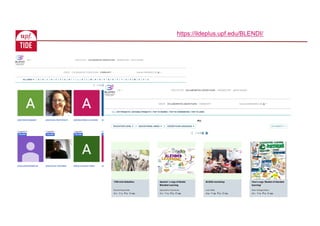
https://ildeplus.upf.edu/BLENDI/
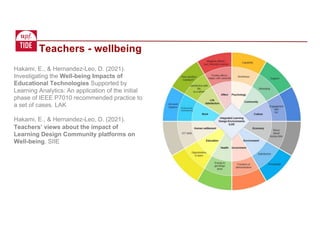
Hakami, E., & Hernandez-Leo, D. (2021).
Investigating the Well-being Impacts of
Educational Technologies Supported by
Learning Analytics: An application of the initial
phase of IEEE P7010 recommended practice to
a set of cases. LAK
Hakami, E., & Hernandez-Leo, D. (2021).
Teachers’ views about the impact of
Learning Design Community platforms on
Well-being. SIIE
Teachers - wellbeing
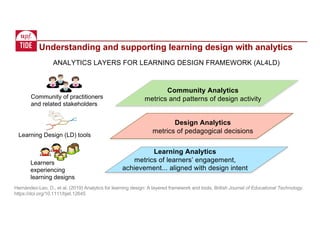
ANALYTICS LAYERS FOR LEARNING DESIGN FRAMEWORK (AL4LD)
Understanding and supporting learning design with analytics
Community of practitioners
and related stakeholders
Learning Design (LD) tools
Learners
experiencing
learning designs
Community Analytics
metrics and patterns of design activity
Design Analytics
metrics of pedagogical decisions
Learning Analytics
metrics of learners’ engagement,
achievement... aligned with design intent
Hernández-Leo, D., et al. (2019) Analytics for learning design: A layered framework and tools, British Journal of Educational Technology.
https://doi.org/10.1111/bjet.12645
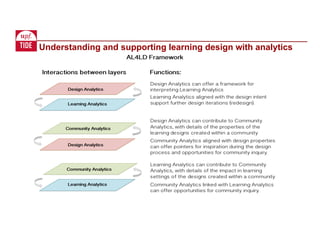
Understanding and supporting learning design with analytics
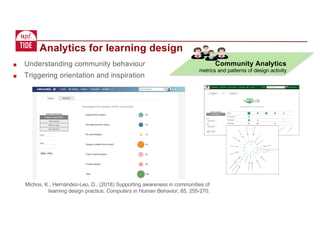
Analytics for learning design
Community Analytics
metrics and patterns of design activity
■ Understanding community behaviour
■ Triggering orientation and inspiration
Michos, K., Hernández-Leo, D., (2018) Supporting awareness in communities of
learning design practice, Computers in Human Behavior, 85, 255-270.
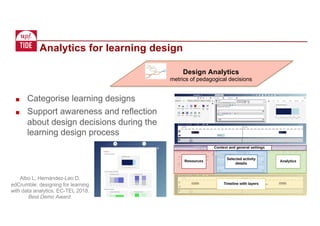
Design Analytics
metrics of pedagogical decisions
■ Categorise learning designs
■ Support awareness and reflection
about design decisions during the
learning design process
Analytics for learning design
Albo L, Hernández-Leo D.
edCrumble: designing for learning
with data analytics. EC-TEL 2018.
Best Demo Award.
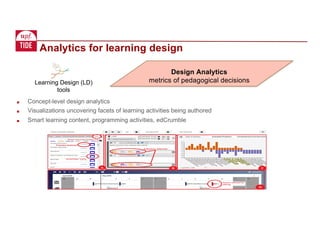
Learning Design (LD)
tools
Design Analytics
metrics of pedagogical decisions
■ Concept-level design analytics
■ Visualizations uncovering facets of learning activities being authored
■ Smart learning content, programming activities, edCrumble
Analytics for learning design
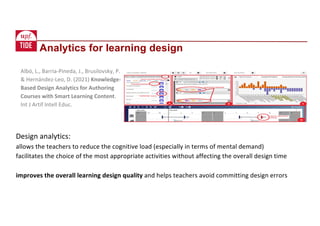
Albó, L., Barria-Pineda, J., Brusilovsky, P.
& Hernández-Leo, D. (2021) Knowledge-
Based Design Analytics for Authoring
Courses with Smart Learning Content.
Int J Artif Intell Educ.
Design analytics:
allows the teachers to reduce the cognitive load (especially in terms of mental demand)
facilitates the choice of the most appropriate activities without affecting the overall design time
improves the overall learning design quality and helps teachers avoid committing design errors
Analytics for learning design
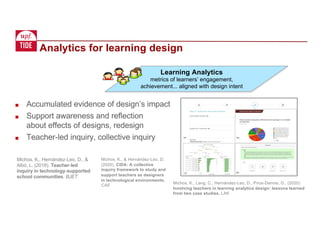
Learning Analytics
metrics of learners’ engagement,
achievement... aligned with design intent
■ Accumulated evidence of design’s impact
■ Support awareness and reflection
about effects of designs, redesign
■ Teacher-led inquiry, collective inquiry
Analytics for learning design
Michos, K., Hernández-Leo, D., &
Albó, L. (2018). Teacher-led
inquiry in technology-supported
school communities. BJET
Michos, K., & Hernández-Leo, D.
(2020). CIDA: A collective
inquiry framework to study and
support teachers as designers
in technological environments.
CAE
Michos, K., Lang, C., Hernández-Leo, D., Price-Dennis, D., (2020)
Involving teachers in learning analytics design: lessons learned
from two case studies. LAK
Efficient & Effective Orchestration
Can technology support?
Orchestration technology: the case of PyramidApp
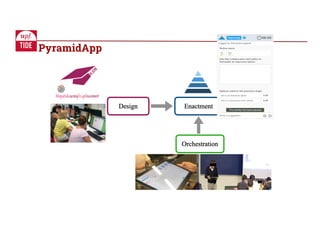
PyramidApp
PyramidApp
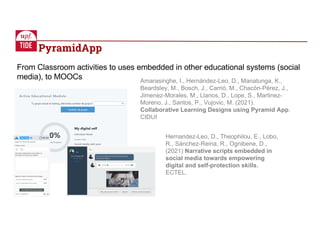
From Classroom activities to uses embedded in other educational systems (social
media), to MOOCs Amarasinghe, I., Hernández-Leo, D., Manatunga, K.,
Beardsley, M., Bosch, J., Carrió, M., Chacón-Pérez, J.,
Jimenez-Morales, M., Llanos, D., Lope, S., Martinez-
Moreno, J., Santos, P., Vujovic, M. (2021).
Collaborative Learning Designs using Pyramid App.
CIDUI
Hernandez-Leo, D., Theophilou, E., Lobo,
R., Sánchez-Reina, R., Ognibene, D.,
(2021) Narrative scripts embedded in
social media towards empowering
digital and self-protection skills,
ECTEL.
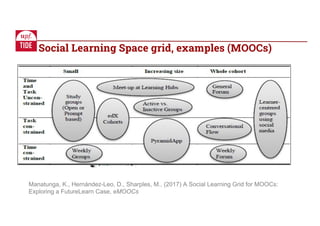
Social Learning Space grid, examples (MOOCs)
Manatunga, K., Hernández-Leo, D., Sharples, M., (2017) A Social Learning Grid for MOOCs:
Exploring a FutureLearn Case, eMOOCs
Mirroring
Dashboards
Guiding
Dashboards
Orchestration
Agents
Adaptive Groups
using Predictions
Adaptive Groups
using Predictions
Human-in-Control Machine-in-Control
Small-scale CSCL
activities in the
classroom learning
context
Large-scale CSCL
activities in the
distance learning
context
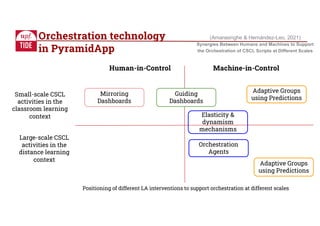
Orchestration technology
in PyramidApp
Positioning of different LA interventions to support orchestration at different scales
(Amarasinghe & Hernández-Leo, 2021)
Synergies Between Humans and Machines to Support
the Orchestration of CSCL Scripts at Different Scales
Elasticity &
dynamism
mechanisms
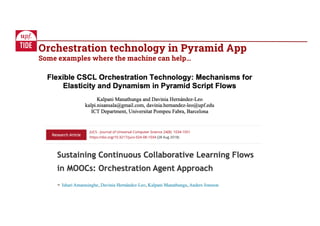
Orchestration technology in Pyramid App
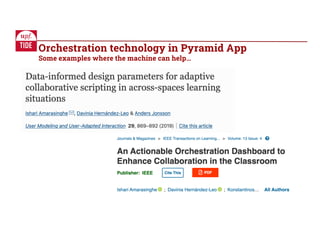
Some examples where the machine can help…
Orchestration technology in Pyramid App
Some examples where the machine can help…
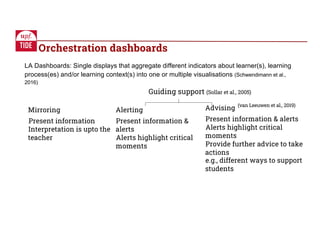
Mirroring
●Present information
●Interpretation is upto the
teacher
Alerting
●Present information &
alerts
●Alerts highlight critical
moments
Advising
●Present information & alerts
●Alerts highlight critical
moments
●Provide further advice to take
actions
●e.g., different ways to support
students
Guiding support (Sollar et al., 2005)
Orchestration dashboards
➢ LA Dashboards: Single displays that aggregate different indicators about learner(s), learning
process(es) and/or learning context(s) into one or multiple visualisations (Schwendimann et al.,
2016)
(van Leeuwen et al., 2019)
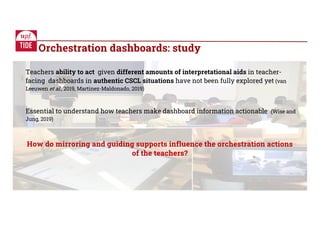
➢ Teachers ability to act given different amounts of interpretational aids in teacher-
facing dashboards in authentic CSCL situations have not been fully explored yet (van
Leeuwen et al., 2019, Martinez-Maldonado, 2019)
➢ Essential to understand how teachers make dashboard information actionable (Wise and
Jung, 2019)
How do mirroring and guiding supports influence the orchestration actions
of the teachers?
Orchestration dashboards: study
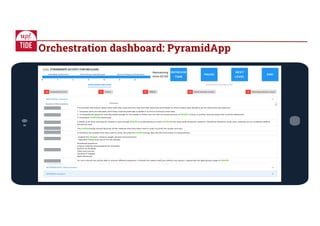
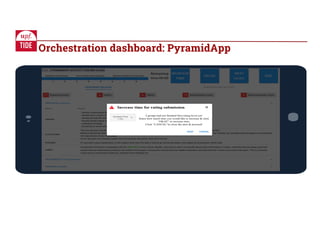
Orchestration dashboard: PyramidApp
Guiding Condition
○ More targeted interventions at the individual & group level
○ More interventions (to address needs and optimize time)
○ Alerts helped to upfront critical moments reducing the orchestration load
(assist sense-making – diagnosis of the situation)
○ Receiving alerts about known information did not add value
Orchestration dashboard: PyramidApp
Amarasinghe, I., Hernández-Leo, D. & Ulrich Hoppe, H. (2021) Deconstructing orchestration load:
comparing teacher support through mirroring and guiding. Intern. J. Comput.-Support. Collab. Learn
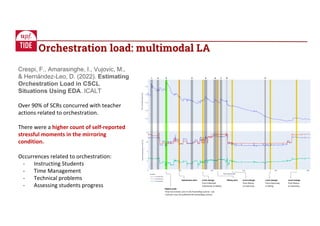
Orchestration load: multimodal LA
Crespi, F., Amarasinghe, I., Vujovic, M.,
& Hernández-Leo, D. (2022). Estimating
Orchestration Load in CSCL
Situations Using EDA. ICALT
Over 90% of SCRs concurred with teacher
actions related to orchestration.
There were a higher count of self-reported
stressful moments in the mirroring
condition.
Occurrences related to orchestration:
- Instructing Students
- Time Management
- Technical problems
- Assessing students progress
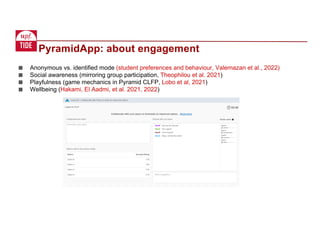
■ Anonymous vs. identified mode (student preferences and behaviour, Valemazan et al., 2022)
■ Social awareness (mirroring group participation, Theophilou et al. 2021)
■ Playfulness (game mechanics in Pyramid CLFP, Lobo et al, 2021)
■ Wellbeing (Hakami, El Aadmi, et al. 2021, 2022)
PyramidApp: about engagement
PyramidApp: about learning
■ The pedagogical envelope (prior activities), type of task, pyramid design elements, engagement,
(epistemic) orchestration
Amarasinghe, I., Hernández-Leo, D., Theophilou, E., Sanchez-Reina, R., Lobo, R., (2021) Learning gains in
Pyramid computer-supported collaboration scripts: factors and implications for design, CollabTech.
Albó, L., Beardsley, M., Amarasinghe, I., Hernández-Leo, D., (2020) Individual versus computer-supported
collaborative self-explanations: how do their writing analytics differ? ICALT
■ Teacher-led debriefing
Amarasinghe, I., Hernández-Leo, D., Manathunga, K., Chacón Pérez, J., & Dimitriadis, Y. (2022). Teacher-
Led Debriefing in Computer-Supported Collaborative Learning Pyramid Scripts. CSCL
Dieckmann, M., Hernández-Leo, D., & Amarasinghe I., (2022) Flagging in teacher-facing orchestration
dashboards: factors affecting its use in Pyramid CSCL debriefing, ICALT.
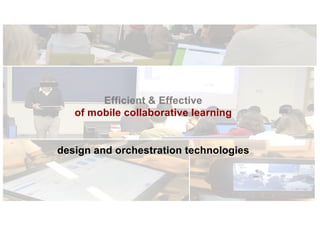
Efficient & Effective
of mobile collaborative learning
design and orchestration technologies
Design for collaborative learning
■ Learning design: CSCL scripts and patterns, authoring tools
■ Community platforms
■ Analytics layers for learning design:
community, design and learning analytics
■ Design & redesign
Orchestration of collaborative learning
■ Need for adaptations in real-time,
automatic vs. human-in-control and combinations
■ Mirroring vs. guiding dashboards
■ Orchestration load
■ Factors affecting engagement and learning gains
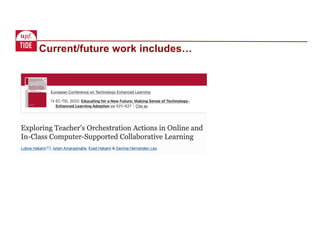
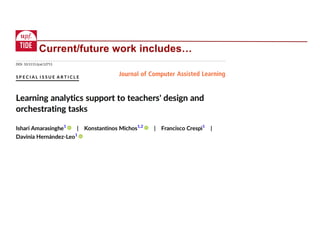
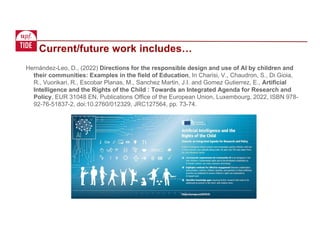
Current/future work includes…
Hernández-Leo, D., (2022) Directions for the responsible design and use of AI by children and
their communities: Examples in the field of Education, In Charisi, V., Chaudron, S., Di Gioia,
R., Vuorikari, R., Escobar Planas, M., Sanchez Martin, J.I. and Gomez Gutierrez, E., Artificial
Intelligence and the Rights of the Child : Towards an Integrated Agenda for Research and
Policy, EUR 31048 EN, Publications Office of the European Union, Luxembourg, 2022, ISBN 978-
92-76-51837-2, doi:10.2760/012329, JRC127564, pp. 73-74.
Thank you!
davinia.hernandez-leo@upf.edu
twitter: @daviniahl @TIDE_UPF
website : http://www.upf.edu/web/tide

Efficient and effective mobile collaborative learning

  • 1.
    Efficient and effectivemobile collaborative learning 21st World conference on mobile, blended and seamless learning (mLearn2022) https://www.iamlearn.org/mlearn 10-12 Oct. 2022 Davinia Hernández-Leo TIDE, Universitat Pompeu Fabra, Barcelona twitter: @davinia.hl @TIDE_UPF website : http://www.upf.edu/web/tide
  • 2.
    What do wemean by efficient and effective mobile collaborative learning?
  • 3.
    Public, Young, Urban,International https://www.youtube.com/watch?v=8dgvWkICCr8 https://www.youtube.com/watch?v=FjAuggflTVE UPF, ICT Department
  • 4.
  • 5.
  • 6.
    Collaborative Learning social interactionstriggering learning mechanics Computer-Supported Collaborative Learning Mobile Collaborative Learning networked computers (software, multiple devices) can facilitate these interactions
  • 7.
    http://tiny.cc/mLearn22 What do wemean by efficient and effective mobile collaborative learning?
  • 8.
    Productive collaborative Learning •Genuine collaboration requires systematic efforts to learn together: - free collaboration does not necessarily lead to fruitful learning (Dillenbourg, 2002) - learners should be engaged in processes involving social knowledge-intensive interactions (Roschelle & Teasley, 1995; Johnson & Johnson, 1999; Barron, 2003) - design science: designing for collaborative learning
  • 9.
  • 10.
    Support teachers indesigning the “best possible” conditions for their students to learn, documenting them, making their design ideas explicit and sharable. (Agostinho, 2011; Conole, 2012; Koper et al., 2004; Laurillard, 2013; Mor, Craft & Hernández-Leo, 2013; Wasson & Kirschner 2020) Learning Design
  • 11.
  • 12.
    Learning Design (Carvahlo &Goodyear, 2015) ACAD framework
  • 13.
  • 14.
    Orchestration - (Classroom) orchestration:real-time coordination of collaborative learning processes at different social levels (individual, small groups, whole class), using a variety of resources and tools (both ICT and non-ICT) in a synergic way to maintain progress towards the learning outcomes (Moor, 2001; Dillenbourg, Järvela & Fischer, 2009; Prieto et al., 2018) - Usually by teachers
  • 15.
    Efficient & effective(mobile) collaborative learning Design & Orchestration (& Redesign) How can technologies support … ?
  • 16.
    Efficient design foreffective collaborative learning
  • 17.
    Collaborative Learning scripts Computer-SupportedCollaborative Learning An approach to enhance effective collaboration: Guide / structure collaboration in a way that the probability of reaching successful learning situations increases (Dillenbourg, 1999)
  • 18.
    Macro-scripting Macro-scripts structure thecollaborative learning flow (aspects of their learning design: activity sequence, roles, group formation, resource allocation) to trigger potentially effective social interactions. (Dillenbourg & Tchounikine, 2007; Kobbe et al., 2007) Collaborative Learning scripts
  • 19.
    Collaborative learning flowpatterns Promote: participation – interaction, possitive interdepence, individual accountability, knowledge building Patterns for the design of Collaborative Learning (Hernández-Leo et al., 2007)
  • 20.
    Authoring tools (Hernández-Leo etal., 2006; Villasclaras & Hernández-Leo et al., 2013)
  • 21.
    ■ PyramidApp Authoring tools https://www.upf.edu/web/tide/tools Manathunga,K., & Hernández-Leo, D. (2018). Authoring and enactment of mobile pyramid-based collaborative learning activities. British Journal of Educational Technology, 49(2), 262-275.
  • 22.
    Learning design anddata analytics: from teacher communities to CSCL scripts Learning design tools ■ Co-design with teachers ■ Emphasis in design for blended learning (PBL, flipped classroom, …) ILDE2/edCrumble Albo, L., & Hernandez-Leo, D. (2021). edCrumble, a data-enriched visual authoring design tool for blended learning. IEEE TLT. 10.1109/TLT.2020.3040475
  • 23.
    LdShake (Hernández-Leo etal., 2011), ILDE (Hernández-Leo et al., 2018), community environments for learning design https://www.upf.edu/web/tide/tools/
  • 24.
  • 25.
  • 26.
  • 27.
  • 28.
  • 29.
    Hakami, E., &Hernandez-Leo, D. (2021). Investigating the Well-being Impacts of Educational Technologies Supported by Learning Analytics: An application of the initial phase of IEEE P7010 recommended practice to a set of cases. LAK Hakami, E., & Hernandez-Leo, D. (2021). Teachers’ views about the impact of Learning Design Community platforms on Well-being. SIIE Teachers - wellbeing
  • 30.
    ANALYTICS LAYERS FORLEARNING DESIGN FRAMEWORK (AL4LD) Understanding and supporting learning design with analytics Community of practitioners and related stakeholders Learning Design (LD) tools Learners experiencing learning designs Community Analytics metrics and patterns of design activity Design Analytics metrics of pedagogical decisions Learning Analytics metrics of learners’ engagement, achievement... aligned with design intent Hernández-Leo, D., et al. (2019) Analytics for learning design: A layered framework and tools, British Journal of Educational Technology. https://doi.org/10.1111/bjet.12645
  • 31.
    Understanding and supportinglearning design with analytics
  • 32.
    Analytics for learningdesign Community Analytics metrics and patterns of design activity ■ Understanding community behaviour ■ Triggering orientation and inspiration Michos, K., Hernández-Leo, D., (2018) Supporting awareness in communities of learning design practice, Computers in Human Behavior, 85, 255-270.
  • 33.
    Design Analytics metrics ofpedagogical decisions ■ Categorise learning designs ■ Support awareness and reflection about design decisions during the learning design process Analytics for learning design Albo L, Hernández-Leo D. edCrumble: designing for learning with data analytics. EC-TEL 2018. Best Demo Award.
  • 34.
    Learning Design (LD) tools DesignAnalytics metrics of pedagogical decisions ■ Concept-level design analytics ■ Visualizations uncovering facets of learning activities being authored ■ Smart learning content, programming activities, edCrumble Analytics for learning design
  • 35.
    Albó, L., Barria-Pineda,J., Brusilovsky, P. & Hernández-Leo, D. (2021) Knowledge- Based Design Analytics for Authoring Courses with Smart Learning Content. Int J Artif Intell Educ. Design analytics: allows the teachers to reduce the cognitive load (especially in terms of mental demand) facilitates the choice of the most appropriate activities without affecting the overall design time improves the overall learning design quality and helps teachers avoid committing design errors Analytics for learning design
  • 36.
    Learning Analytics metrics oflearners’ engagement, achievement... aligned with design intent ■ Accumulated evidence of design’s impact ■ Support awareness and reflection about effects of designs, redesign ■ Teacher-led inquiry, collective inquiry Analytics for learning design Michos, K., Hernández-Leo, D., & Albó, L. (2018). Teacher-led inquiry in technology-supported school communities. BJET Michos, K., & Hernández-Leo, D. (2020). CIDA: A collective inquiry framework to study and support teachers as designers in technological environments. CAE Michos, K., Lang, C., Hernández-Leo, D., Price-Dennis, D., (2020) Involving teachers in learning analytics design: lessons learned from two case studies. LAK
  • 37.
    Efficient & EffectiveOrchestration
  • 38.
    Efficient & EffectiveOrchestration Can technology support? Orchestration technology: the case of PyramidApp
  • 39.
  • 40.
    PyramidApp From Classroom activitiesto uses embedded in other educational systems (social media), to MOOCs Amarasinghe, I., Hernández-Leo, D., Manatunga, K., Beardsley, M., Bosch, J., Carrió, M., Chacón-Pérez, J., Jimenez-Morales, M., Llanos, D., Lope, S., Martinez- Moreno, J., Santos, P., Vujovic, M. (2021). Collaborative Learning Designs using Pyramid App. CIDUI Hernandez-Leo, D., Theophilou, E., Lobo, R., Sánchez-Reina, R., Ognibene, D., (2021) Narrative scripts embedded in social media towards empowering digital and self-protection skills, ECTEL.
  • 41.
    Social Learning Spacegrid, examples (MOOCs) Manatunga, K., Hernández-Leo, D., Sharples, M., (2017) A Social Learning Grid for MOOCs: Exploring a FutureLearn Case, eMOOCs
  • 42.
    Mirroring Dashboards Guiding Dashboards Orchestration Agents Adaptive Groups using Predictions AdaptiveGroups using Predictions Human-in-Control Machine-in-Control Small-scale CSCL activities in the classroom learning context Large-scale CSCL activities in the distance learning context Orchestration technology in PyramidApp Positioning of different LA interventions to support orchestration at different scales (Amarasinghe & Hernández-Leo, 2021) Synergies Between Humans and Machines to Support the Orchestration of CSCL Scripts at Different Scales Elasticity & dynamism mechanisms
  • 43.
    Orchestration technology inPyramid App Some examples where the machine can help…
  • 44.
    Orchestration technology inPyramid App Some examples where the machine can help…
  • 45.
    Mirroring ●Present information ●Interpretation isupto the teacher Alerting ●Present information & alerts ●Alerts highlight critical moments Advising ●Present information & alerts ●Alerts highlight critical moments ●Provide further advice to take actions ●e.g., different ways to support students Guiding support (Sollar et al., 2005) Orchestration dashboards ➢ LA Dashboards: Single displays that aggregate different indicators about learner(s), learning process(es) and/or learning context(s) into one or multiple visualisations (Schwendimann et al., 2016) (van Leeuwen et al., 2019)
  • 46.
    ➢ Teachers abilityto act given different amounts of interpretational aids in teacher- facing dashboards in authentic CSCL situations have not been fully explored yet (van Leeuwen et al., 2019, Martinez-Maldonado, 2019) ➢ Essential to understand how teachers make dashboard information actionable (Wise and Jung, 2019) How do mirroring and guiding supports influence the orchestration actions of the teachers? Orchestration dashboards: study
  • 47.
  • 48.
  • 49.
    Guiding Condition ○ Moretargeted interventions at the individual & group level ○ More interventions (to address needs and optimize time) ○ Alerts helped to upfront critical moments reducing the orchestration load (assist sense-making – diagnosis of the situation) ○ Receiving alerts about known information did not add value Orchestration dashboard: PyramidApp Amarasinghe, I., Hernández-Leo, D. & Ulrich Hoppe, H. (2021) Deconstructing orchestration load: comparing teacher support through mirroring and guiding. Intern. J. Comput.-Support. Collab. Learn
  • 50.
    Orchestration load: multimodalLA Crespi, F., Amarasinghe, I., Vujovic, M., & Hernández-Leo, D. (2022). Estimating Orchestration Load in CSCL Situations Using EDA. ICALT Over 90% of SCRs concurred with teacher actions related to orchestration. There were a higher count of self-reported stressful moments in the mirroring condition. Occurrences related to orchestration: - Instructing Students - Time Management - Technical problems - Assessing students progress
  • 51.
    ■ Anonymous vs.identified mode (student preferences and behaviour, Valemazan et al., 2022) ■ Social awareness (mirroring group participation, Theophilou et al. 2021) ■ Playfulness (game mechanics in Pyramid CLFP, Lobo et al, 2021) ■ Wellbeing (Hakami, El Aadmi, et al. 2021, 2022) PyramidApp: about engagement
  • 52.
    PyramidApp: about learning ■The pedagogical envelope (prior activities), type of task, pyramid design elements, engagement, (epistemic) orchestration Amarasinghe, I., Hernández-Leo, D., Theophilou, E., Sanchez-Reina, R., Lobo, R., (2021) Learning gains in Pyramid computer-supported collaboration scripts: factors and implications for design, CollabTech. Albó, L., Beardsley, M., Amarasinghe, I., Hernández-Leo, D., (2020) Individual versus computer-supported collaborative self-explanations: how do their writing analytics differ? ICALT ■ Teacher-led debriefing Amarasinghe, I., Hernández-Leo, D., Manathunga, K., Chacón Pérez, J., & Dimitriadis, Y. (2022). Teacher- Led Debriefing in Computer-Supported Collaborative Learning Pyramid Scripts. CSCL Dieckmann, M., Hernández-Leo, D., & Amarasinghe I., (2022) Flagging in teacher-facing orchestration dashboards: factors affecting its use in Pyramid CSCL debriefing, ICALT.
  • 53.
    Efficient & Effective ofmobile collaborative learning design and orchestration technologies
  • 54.
    Design for collaborativelearning ■ Learning design: CSCL scripts and patterns, authoring tools ■ Community platforms ■ Analytics layers for learning design: community, design and learning analytics ■ Design & redesign
  • 55.
    Orchestration of collaborativelearning ■ Need for adaptations in real-time, automatic vs. human-in-control and combinations ■ Mirroring vs. guiding dashboards ■ Orchestration load ■ Factors affecting engagement and learning gains
  • 56.
  • 57.
  • 58.
    Current/future work includes… Hernández-Leo,D., (2022) Directions for the responsible design and use of AI by children and their communities: Examples in the field of Education, In Charisi, V., Chaudron, S., Di Gioia, R., Vuorikari, R., Escobar Planas, M., Sanchez Martin, J.I. and Gomez Gutierrez, E., Artificial Intelligence and the Rights of the Child : Towards an Integrated Agenda for Research and Policy, EUR 31048 EN, Publications Office of the European Union, Luxembourg, 2022, ISBN 978- 92-76-51837-2, doi:10.2760/012329, JRC127564, pp. 73-74.
  • 59.
    Thank you! davinia.hernandez-leo@upf.edu twitter: @daviniahl@TIDE_UPF website : http://www.upf.edu/web/tide