CPD Presentation
David Buckley, Estates Manager, IT Carlow
Professional Bodies
 Engineers Ireland
 Institution of Civil Engineers
Definition of CPD
“The systematic maintenance, enhancement and development of knowledge and skill, and the
development of personal qualities necessary for the execution of professional and technical
duties throughout the practising engineering professional’s career.” – Engineers Ireland
“The systematic maintenance, improvement and broadening of knowledge and skills, and the
development of personal qualities necessary for the execution of professional and technical
duties throughout your working life.” – Institution of Civil Engineers
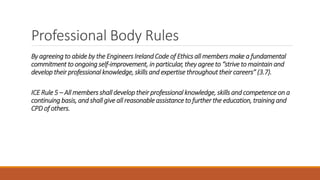
Professional Body Rules
By agreeing to abide by the Engineers IrelandCode of Ethics all members make a fundamental
commitment to ongoing self-improvement, in particular, they agree to “strive to maintain and
develop their professional knowledge, skills and expertisethroughout their careers” (3.7).
ICE Rule 5 – All members shall develop theirprofessional knowledge, skills and competence on a
continuing basis, and shall give all reasonable assistanceto further the education, training and
CPD of others.
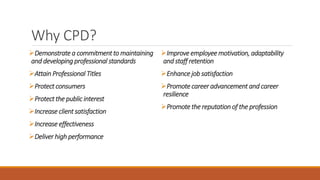
Why CPD?
Demonstrate a commitment to maintaining
and developing professional standards
Attain Professional Titles
Protect consumers
Protect the public interest
Increase client satisfaction
Increase effectiveness
Deliver high performance
Improve employee motivation, adaptability
and staff retention
Enhance job satisfaction
Promote career advancement and career
resilience
Promote the reputation of the profession
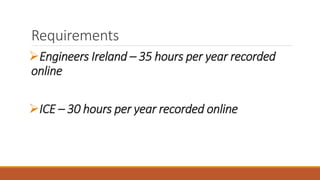
Requirements
Engineers Ireland – 35 hours per year recorded
online
ICE – 30 hours per year recorded online
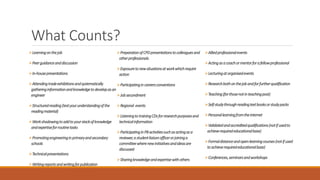
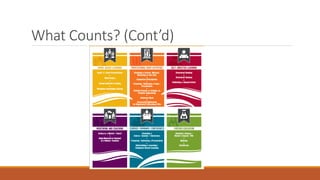
What Counts?
Learningonthejob
Peerguidanceanddiscussion
In-housepresentations
Attendingtradeexhibitionsandsystematically
gatheringinformationandknowledgetodevelopasan
engineer
Structuredreading(testyourunderstandingofthe
readingmaterial)
Workshadowingtoaddtoyourstackofknowledge
andexpertiseforroutinetasks
Promotingengineeringinprimaryandsecondary
schools
Technicalpresentations
Writingreportsandwritingforpublication
PreparationofCPDpresentationstocolleaguesand
otherprofessionals
Exposuretonewsituationsatworkwhichrequire
action
Participatingincareersconventions
Jobsecondment
Regional events
ListeningtotrainingCDsforresearchpurposesand
technicalinformation
ParticipatinginPBactivitiessuchasactingasa
reviewer,astudentliaisonofficerorjoininga
committeewherenewinitiativesandideasare
discussed
Sharingknowledgeandexpertisewithothers
Alliedprofessionalevents
Actingasacoachormentorforafellowprofessional
Lecturingatorganisedevents
Researchbothonthejobandforfurtherqualification
Teaching(forthosenotinteachingpost)
Self-studythroughreadingtextbooksorstudypacks
Personallearningfromtheinternet
Validatedandaccreditedqualifications(notifusedto
achieverequirededucationalbase)
Formaldistanceandopen-learningcourses(notifused
toachieverequirededucationalbase)
Conferences,seminarsandworkshops
What Counts? (Cont’d)
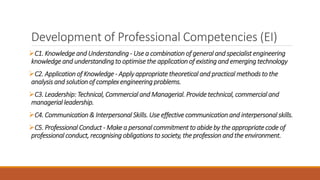
Development of Professional Competencies (EI)
C1. Knowledge and Understanding - Use a combination of general and specialist engineering
knowledge and understandingto optimisethe application of existing and emerging technology
C2. Application of Knowledge - Applyappropriate theoretical and practical methods to the
analysis and solution of complex engineering problems.
C3. Leadership: Technical, Commercial and Managerial. Provide technical, commercial and
managerial leadership.
C4. Communication & Interpersonal Skills. Use effective communication and interpersonal skills.
C5. Professional Conduct - Make a personal commitment to abide by the appropriatecode of
professional conduct, recognising obligations to society, the profession and the environment.
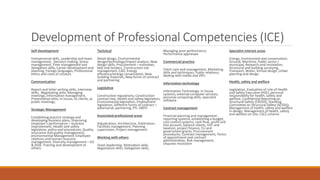
Self-Development
Interpersonal skills, Leadership and team
management, Decision making, Stress
management, Time management and
delegation skills, Career development and
planning, Foreign languages, Professional
ethics and rules of conduct
Communication
Report and letter writing skills, Interview
skills, Negotiating skills, Managing
meetings, Information management,
Presentation skills, In house, to clients, at
public meetings,
Strategic Management
Establishing practice strategy and
developing business plans, Improving
employer’s performance – business
improvement, Health and safety
legislation, policy and procedures, Quality
assurance and quality management,
environmental Management, Employee
relations and human resource
management, Diversity management – EO
& DDA, Training and development of
others
Technical
Detail design, Environmental
design/technology/impact analysis, New
design skills, Procurement – estimates,
bids and tenders, Construction site
management, CAD, Energy
efficiency/energy conservation, New
building materials, New forms of contract
and partnering
Legislative
Construction regulations, Construction
contract law, Health and safety legislation,
Environmental legislation, Employment
legislation, Different forms of contract –
adversarial, partnering, PFI, DBFO
Associated professional areas
Adjudication, Architecture, Arbitration,
Facilities management, Planning
supervision, Project management
Working with others
Team leadership, Motivation skills,
Negotiation skills, Delegation skills,
Managing poor performance,
Performance appraisals
Commercial practice
Client care and management, Marketing
skills and techniques, Public relations;
dealing with media and VIPs
Information technology
Information Technology: In house
systems; external computer services;
personal computing skills; specialist
software
Contract management
Financial planning and management -
reporting systems, establishing a budget,
cost control systems, cash flow, profit and
loss account, balance sheets, VAT and
taxation, project finance, EU and
government grants, Procurement
procedures, Contract management, Terms
of appointment and contract
administration, Risk management,
Disputes resolution
Specialist interest areas
Energy, Environment and conservation,
Ground, Maritime, Public sector /
municipal, Research and innovation,
Structural and building surveying,
Transport, Water, Virtual design, Urban
planning and design
Health, safety and welfare
Legislation, Evaluation of role of Health
and Safety Executive (HSE), personal
responsibility for health, safety and
welfare, Confidential Reporting on
Structural Safety (CROSS), Standing
Committee on Structural Safety (SCOSS),
Management of health, safety and welfare
in design, Management of health, safety
and welfare on site, CSCS scheme
Development of Professional Competencies (ICE)
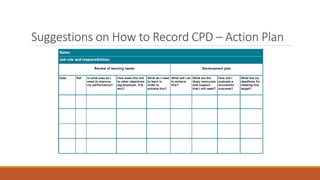
Suggestions on How to Record CPD – Action Plan
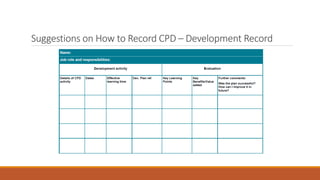
Suggestions on How to Record CPD – Development Record
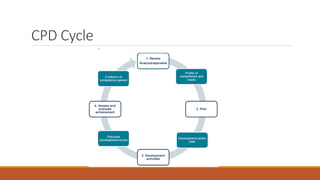
CPD Cycle
Thank You

CPD by David Buckley