WELCOME
to the Work Smarter Together October Event
www.slido.com http://worksmartertogether.ucd.ie/
#WST23OCT
23rd October 2019
The Fitzgerald Chamber, UCD Student Centre
http://www.ucd.ie/agile/
http://worksmartertogether.ucd.ie/
23rd October 2019 1
Event Opening
Professor Mark Rogers
Registrar & Deputy President
23rd October 2019 2
http://www.ucd.ie/agile/
http://worksmartertogether.ucd.ie/
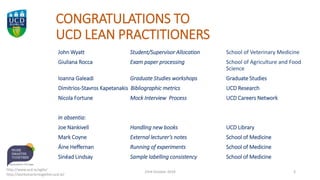
CONGRATULATIONS TO
UCD LEAN PRACTITIONERS
John Wyatt Student/Supervisor Allocation School of Veterinary Medicine
Giuliana Rocca Exam paper processing School of Agriculture and Food
Science
Ioanna Galeadi Graduate Studies workshops Graduate Studies
Dimitrios-Stavros Kapetanakis Bibliographic metrics UCD Research
Nicola Fortune Mock Interview Process UCD Careers Network
In absentia:
Joe Nankivell Handling new books UCD Library
Mark Coyne External lecturer’s notes School of Medicine
Áine Heffernan Running of experiments School of Medicine
Sinéad Lindsay Sample labelling consistency School of Medicine
23rd October 2019 3
http://www.ucd.ie/agile/
http://worksmartertogether.ucd.ie/
Launch of the Project
Management Community
of Practice
23rd October 2019 4
http://www.ucd.ie/agile/
http://worksmartertogether.ucd.ie/
www.slido.com
#WST23OCT
UCD – Launch of PM Community of Practice
PMO & CoP - A Personal Perspective
John O’Sullivan
Director – Programme Management Organisation (PMO)
Date 23/10/19
 Early Career- Jacobs Engineering
• Electrical Design Engineer
• Power Calcs, Cable Calcs, Switchgear Calcs
Lighting Calcs, Draughting, Bills of Quantities …
Sent to Construction Project Site
• First taste of Project Management
• Progress, Quality, Quantity, Cost, Document
Management, Reporting…
 Moved to CRH – New Cement Plant - Limerick
• Large Plant, High Voltage, Ambitious Timeline, Large
Workforce, £ Big Budgets, Safety 1st,
• Planning, Scheduling, Coordinating, Monitoring,
Controlling, Reporting, Commissioning,
• First exposure to High Voltage (Drives/Switchgear)
Instrumentation, Automation, Process Control, early
computerisation
 Moved to Texas Instruments
• Responsible for Automation & Process Control Projects
• Introduction to Software Development Project
Management
• Exposure to complex manufacturing and automation
projects in the Pharma / Chemical / Healthcare / Food
and Beverage / Discrete Manufacturing and FMCG Sector
• Introduction to Validation / FDA / Regulated Industry
 Moved to Siemens Ltd (Ireland)
• Control Systems become more powerful, networked,
integrated to Management Information Systems
• Managed more complex System and Software Projects
• Moved into Pure IT (PCs /Networks/ Business Systems)
• Managed ERP Introduction (SAP R/3) Project
• First introduction to Managing Business Led Projects
• First introduction in Behavioural Change Management
 Moved to Siemens (Switzerland)
• Managing Business Change through Projects
• Worked on Acquisition / Divestment / Merger Projects
• Led BPR and Business Turnaround Projects
• Led Technology Enabled Transformation Projects
• Led Global Customer Complaint and NPS Project
• Led Knowledge Management Projects - CoP
• Part of Introduction of PM@Siemens - Portfolio /
Programme / Project Management
 Moved to Siemens (USA) LA/SF
• Operations Management – Large Capital Projects
• Leadership for Business Excellence in Large Projects incl.
Government Projects / Utilities Projects / Hospital
Projects / Data Centre Projects / Real- Estate
Projects Bio-Tech Projects / University Projects
• Introduction to US (CA) Construction Contract Law
 Currently with Trinity College Dublin
• Director of PMO (Programme Management Office)
• Role:- Develop PMO & Project Maturity in TCD
• Governance Role – Not Project Execution
• Enterprise Approach - from Free-Style to Franchise
• Contract Law & Contract Administration in Irish Public
Sector (Unique GCCC Contracts)
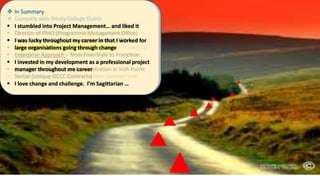
 In Summary
 I stumbled into Project Management… and liked it
 I was lucky throughout my career in that I worked for
large organisations going through change
 I invested in my development as a professional project
manager throughout me career
 I love change and challenge. I’m Sagittarian …
Thank You
http://www.ucd.ie/agile/
http://worksmartertogether.ucd.ie/
23rd October 2019 8
Digital Media
Pr ojec t Management
C ommunity of Pr ac tic e
( C OP)
“…groups of people who share
a concern or passion for
something they do and learn
how to do it better as they
interact regularly” (Etienne
Wenger-Trayner and Beverly
Wenger-Trayner)
What is a Community of Practice (COP)?
http://www.ucd.ie/agile/
http://worksmartertogether.ucd.ie/
23rd October 2019 9
• Enable knowledge sharing
• Accelerate professional development
• Support better communication
• Build networks and break down
organisational silos
COP Principle Benefits
23rd October 2019 10
http://www.ucd.ie/agile/
http://worksmartertogether.ucd.ie/
PM COP Vision
In simple terms, this is to create a group of
people who play a role in managing projects in
UCD, for the purpose of helping the group
members to gain knowledge by coming
together and sharing information and
experiences with other people in the group.
The idea is that the members of the CoP learn
from each other and have an opportunity to
develop and better their level of
understanding or improve their way of
working.
23rd October 2019 11
http://www.ucd.ie/agile/
http://worksmartertogether.ucd.ie/
Building
Better
Practice
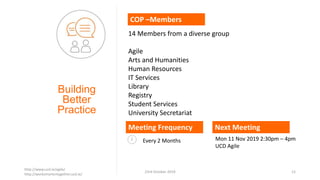
COP –Members
Meeting Frequency
Every 2 Months
14 Members from a diverse group
Agile
Arts and Humanities
Human Resources
IT Services
Library
Registry
Student Services
University Secretariat
Next Meeting
Mon 11 Nov 2019 2:30pm – 4pm
UCD Agile
http://www.ucd.ie/agile/
http://worksmartertogether.ucd.ie/
23rd October 2019 12
23rd October 2019 13
http://www.ucd.ie/agile/
http://worksmartertogether.ucd.ie/
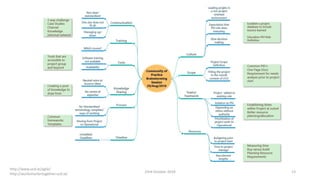
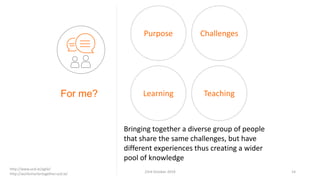
For me?
Bringing together a diverse group of people
that share the same challenges, but have
different experiences thus creating a wider
pool of knowledge
23rd October 2019 14
Teaching
ChallengesPurpose
Learning
http://www.ucd.ie/agile/
http://worksmartertogether.ucd.ie/
Contact Us
bridin.walsh@ucd.ie
iseult.osiochain@ucd.ie
marian.oconnor@ucd.ie
Frank.desmond@ucd.ie
23rd October 2019 15
http://www.ucd.ie/agile/
http://worksmartertogether.ucd.ie/
23rd October 2019 16
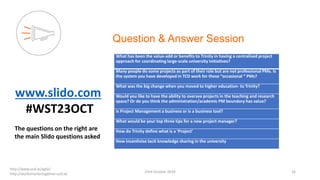
Question & Answer Session
www.slido.com
#WST23OCT
The questions on the right are
the main Slido questions asked
http://www.ucd.ie/agile/
http://worksmartertogether.ucd.ie/
What has been the value-add or benefits to Trinity in having a centralised project
approach for coordinating large-scale university initiatives?
Many people do some projects as part of their role but are not professional PMs. Is
the system you have developed in TCD work for these “occasional “ PMs?
What was the big change when you moved to higher education- to Trinity?
Would you like to have the ability to oversee projects in the teaching and research
space? Or do you think the administration/academic PM boundary has value?
Is Project Management a business or is a business tool?
What would be your top three tips for a new project manager?
How do Trinity define what is a 'Project'
How incentivise tacit knowledge sharing in the university
Lean Green and UCD
brought to you by UCD Agile
23rd October 2019 17
http://www.ucd.ie/agile/
http://worksmartertogether.ucd.ie/
www.slido.com
#WST23OCT
Dublin City University –
Sustainability
WST Event, UCD
23 October 2019
Samantha Fahy,
Director of Sustainability
Outline
• Overview & Challenges
• Interventions & Outcomes
• Role of HEIs & Sustainability
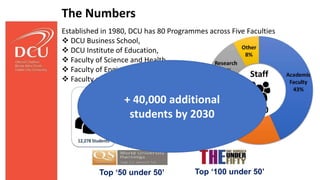
The Numbers
• Top ‘50 under 50’ •Top ‘100 under 50’
2,500
Established in 1980, DCU has 80 Programmes across Five Faculties
 DCU Business School,
 DCU Institute of Education,
 Faculty of Science and Health,
 Faculty of Engineering and Computing
 Faculty of Humanities and Social Sciences
Staff
+ 40,000 additional
students by 2030
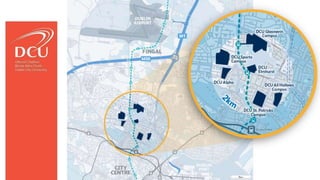
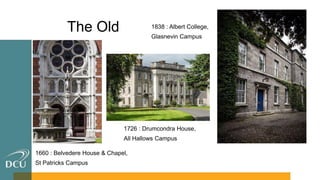
The Old 1838 : Albert College,
Glasnevin Campus
1726 : Drumcondra House,
All Hallows Campus
1660 : Belvedere House & Chapel,
St Patricks Campus
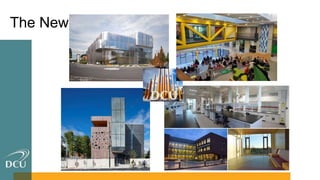
The New
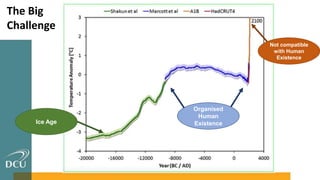
Ice Age
Organised
Human
Existence
Not compatible
with Human
Existence
The Big
Challenge
Sustainability at DCU
-Initial Sustainable Development Policy in 2010/2011
-Created Sustainability Position in 2013
-RCE Dublin 2014
-FEE/An Taisce Green Campus Programme
-First Green Campus Flag in 2014
-Renewed and extended in 2017
-2017 : Sustainability at the Core
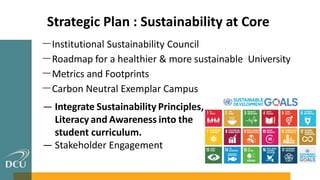
Strategic Plan : Sustainability at Core
-Institutional Sustainability Council
-Roadmap for a healthier & more sustainable University
-Metrics and Footprints
-Carbon Neutral Exemplar Campus
— Integrate Sustainability Principles,
Literacy and Awareness into the
student curriculum.
— Stakeholder Engagement
Sustainability @ DCU
An Taisce Green Campus
First Flag : July 2014
Re-awarded : Nov 2017
Core to the our 2017-2022 Strategic Plan
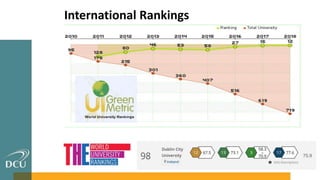
International Rankings
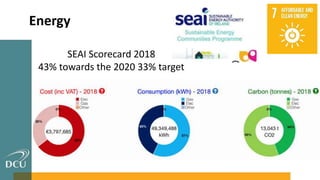
Energy
SEAI Scorecard 2018
43% towards the 2020 33% target
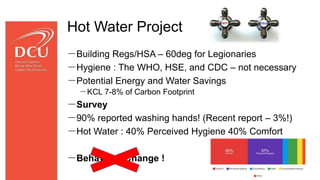
Hot Water Project
-Building Regs/HSA – 60deg for Legionaries
-Hygiene : The WHO, HSE, and CDC – not necessary
-Potential Energy and Water Savings
-KCL 7-8% of Carbon Footprint
-Survey
-90% reported washing hands! (Recent report – 3%!)
-Hot Water : 40% Perceived Hygiene 40% Comfort
-Behaviour Change !
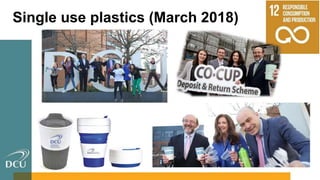
Single use plastics (March 2018)
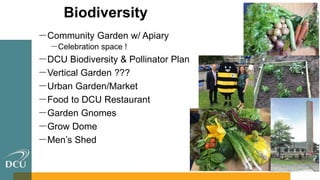
Biodiversity
-Community Garden w/ Apiary
-Celebration space !
-DCU Biodiversity & Pollinator Plan
-Vertical Garden ???
-Urban Garden/Market
-Food to DCU Restaurant
-Garden Gnomes
-Grow Dome
-Men’s Shed
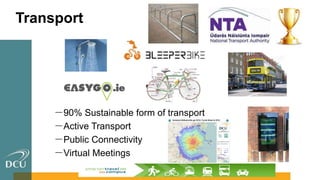
Transport
-90% Sustainable form of transport
-Active Transport
-Public Connectivity
-Virtual Meetings
Role of HEIs
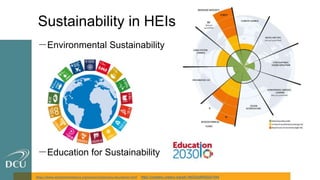
Sustainability in HEIs
-Environmental Sustainability
-Education for Sustainability
https://www.stockholmresilience.org/research/planetary-boundaries.html https://unesdoc.unesco.org/ark:/48223/pf0000247444
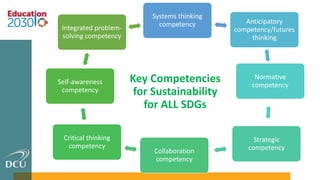
Systems thinking
competency Anticipatory
competency/futures
thinking
Normative
competency
Strategic
competencyCollaboration
competency
Critical thinking
competency
Self-awareness
competency
Integrated problem-
solving competency
Key Competencies
for Sustainability
for ALL SDGs
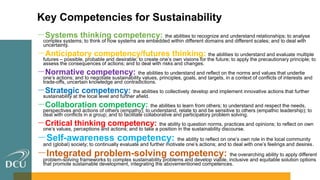
Key Competencies for Sustainability
-Systems thinking competency: the abilities to recognize and understand relationships; to analyse
complex systems; to think of how systems are embedded within different domains and different scales; and to deal with
uncertainty.
-Anticipatory competency/futures thinking: the abilities to understand and evaluate multiple
futures – possible, probable and desirable; to create one’s own visions for the future; to apply the precautionary principle; to
assess the consequences of actions; and to deal with risks and changes.
-Normative competency: the abilities to understand and reflect on the norms and values that underlie
one’s actions; and to negotiate sustainability values, principles, goals, and targets, in a context of conflicts of interests and
trade-offs, uncertain knowledge and contradictions.
-Strategic competency: the abilities to collectively develop and implement innovative actions that further
sustainability at the local level and further afield.
-Collaboration competency: the abilities to learn from others; to understand and respect the needs,
perspectives and actions of others (empathy); to understand, relate to and be sensitive to others (empathic leadership); to
deal with conflicts in a group; and to facilitate collaborative and participatory problem solving.
-Critical thinking competency: the ability to question norms, practices and opinions; to reflect on own
one’s values, perceptions and actions; and to take a position in the sustainability discourse.
-Self-awareness competency: the ability to reflect on one’s own role in the local community
and (global) society; to continually evaluate and further motivate one’s actions; and to deal with one’s feelings and desires.
-Integrated problem-solving competency: the overarching ability to apply different
problem-solving frameworks to complex sustainability problems and develop viable, inclusive and equitable solution options
that promote sustainable development, integrating the abovementioned competences.
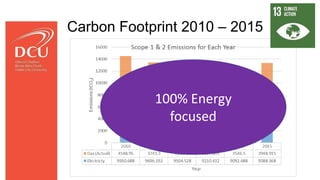
Carbon Footprint 2010 – 2015
100% Energy
focused
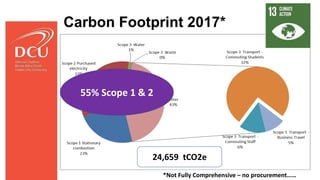
Carbon Footprint 2017*
24,659 tCO2e
*Not Fully Comprehensive – no procurement……
55% Scope 1 & 2
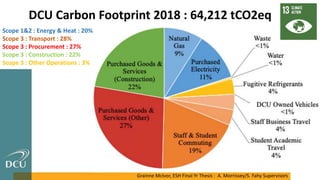
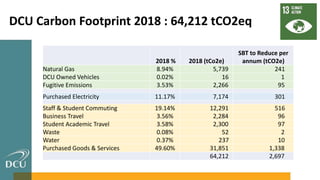
DCU Carbon Footprint 2018 : 64,212 tCO2eq
Grainne McIvor, ESH Final Yr Thesis : A. Morrissey/S. Fahy Supervisors
Scope 1&2 : Energy & Heat : 20%
Scope 3 : Transport : 28%
Scope 3 : Procurement : 27%
Scope 3 : Construction : 22%
Scope 3 : Other Operations : 3%
2018 % 2018 (tCo2e)
SBT to Reduce per
annum (tCO2e)
Natural Gas 8.94% 5,739 241
DCU Owned Vehicles 0.02% 16 1
Fugitive Emissions 3.53% 2,266 95
Purchased Electricity 11.17% 7,174 301
Staff & Student Commuting 19.14% 12,291 516
Business Travel 3.56% 2,284 96
Student Academic Travel 3.58% 2,300 97
Waste 0.08% 52 2
Water 0.37% 237 10
Purchased Goods & Services 49.60% 31,851 1,338
64,212 2,697
DCU Carbon Footprint 2018 : 64,212 tCO2eq
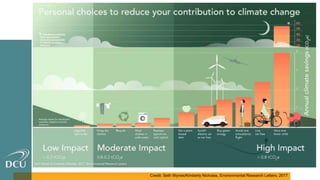
Credit: Seth Wynes/Kimberly Nicholas, Environmental Research Letters, 2017
Thank You
Sustainability Partnerships
-Partnership & Collaboration
Climate Action Regional Office
Lean Green and UCD
Presented by Ciaran Bennett, UCD Estate Services
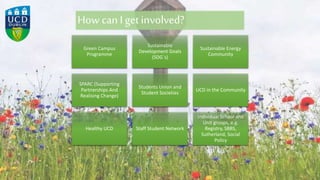
Green Campus
Programme
Sustainable
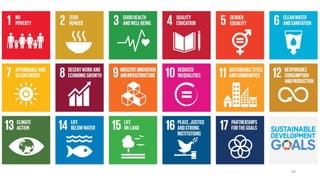
Development Goals
(SDG`s)
Sustainable Energy
Community
SPARC (Supporting
Partnerships And
Realising Change)
Students Union and
Student Societies
UCD in the Community
Healthy UCD Staff Student Network
Individual School and
Unit groups, e.g.
Registry, SBBS,
Sutherland, Social
Policy
How canI getinvolved?
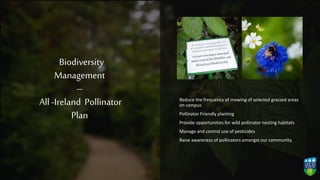
Biodiversity
Management
–
All -Ireland Pollinator
Plan
Reduce the frequency of mowing of selected grassed areas
on campus
Pollinator Friendly planting
Provide opportunities for wild pollinator nesting habitats
Manage and control use of pesticides
Raise awareness of pollinators amongst our community.
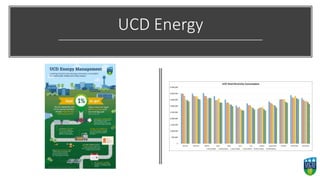
UCD Energy
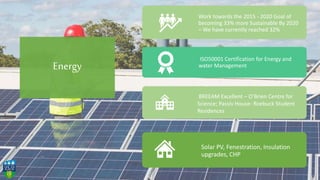
Energy
Work towards the 2015 - 2020 Goal of
becoming 33% more Sustainable By 2020
– We have currently reached 32%
ISO50001 Certification for Energy and
water Management
Solar PV, Fenestration, Insulation
upgrades, CHP
BREEAM Excellent – O’Brien Centre for
Science; Passiv House- Roebuck Student
Residences
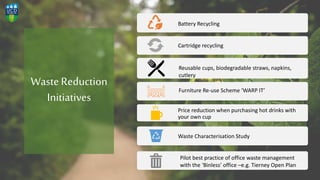
WasteReduction
Initiatives
Battery Recycling
Cartridge recycling
Price reduction when purchasing hot drinks with
your own cup
Waste Characterisation Study
Reusable cups, biodegradable straws, napkins,
cutlery
Furniture Re-use Scheme ‘WARP IT’
Pilot best practice of office waste management
with the ‘Binless’ office –e.g. Tierney Open Plan
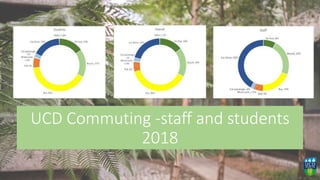
UCD Commuting -staff and students
2018
Promoting
Sustainable Travel
options
• Annual travel Survey- Approx. 7,000
respondents
• 11,000 journeys on Dart shuttle bus
• Installation of Bicycle Repair Stations
• Bike Awareness Day.
• Reduced prices at the Belfield Bikes pop up
shop at the village market
Water Management
33% Reduction in potable water consumption since 2012
Monthly Consumption Reports
Water Meter Upgrade and Replacement Works - Improved monitoring and controls of the water
network throughout campus to assist in consumption analysis
Infrastructure upgrades and leak detection programme
SUDS- Upper Lake
Lean and Green
Projects
Pia Polotto
UCD Estate Services
UCD SmartFurniture
Reuse programme
When a leanerprocess is a greenerprocess
Challenges:
• Increased pressure in storage space
• What we keep? What we dispose? Who will reuse it?
• The reuse process was time consuming for Estate
Services staff and for the customer
What we want to do:
• Reduce the waste going to landfill
• Increase capacity of furniture reuse by making the
furniture more visible to staff and greater community.
• Life-Cycle assessment: Identify reuse trends: size,
quality, type of furniture. etc
When a leaner processis a greenerprocess -
assessment
What we knew:
• Sustainability was the lean answer.
• The connection between lean and green was beyond waste
reduction.
What happened :
• The fact that both ideas lean and green were implemented
simultaneously unfolded greater benefits: in this case
increased the customer satisfaction and the impact in the
UCD greater community.
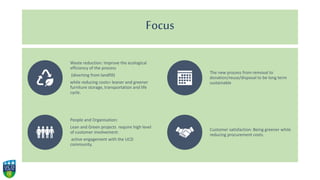
Focus
Waste reduction: Improve the ecological
efficiency of the process
(diverting from landfill)
while reducing costs= leaner and greener
furniture storage, transportation and life
cycle.
The new process from removal to
donation/reuse/disposal to be long term
sustainable
People and Organisation:
Lean and Green projects require high level
of customer involvement:
active engagement with the UCD
community.
Customer satisfaction: Being greener while
reducing procurement costs.
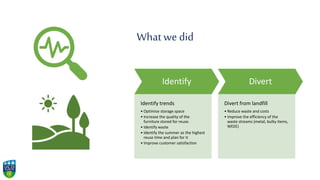
What wedid
Identify
Identify trends
• Optimise storage space
• Increase the quality of the
furniture stored for reuse.
• Identify waste
• Identify the summer as the highest
reuse time and plan for it
• Improve customer satisfaction
Divert
Divert from landfill
• Reduce waste and costs
• Improve the efficiency of the
waste streams (metal, bulky items,
WEEE)
Engage
• We put in place a proactive
approach for engaging with charitable
organisations and the UCD Community
that has been win-win for all involved
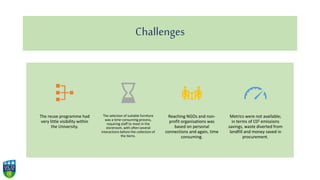
Challenges
The reuse programme had
very little visibility within
the University.
The selection of suitable furniture
was a time-consuming process,
requiring staff to meet in the
storeroom, with often several
interactions before the collection of
the items.
Reaching NGOs and non-
profit organisations was
based on personal
connections and again, time
consuming.
Metrics were not available;
in terms of C02 emissions
savings, waste diverted from
landfill and money saved in
procurement.
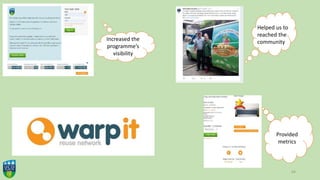
64
Increased the
programme’s
visibility
Helped us to
reached the
community
Provided
metrics
Conclusion
The integration of
Lean and Green
practices into the
process design of the
UCD Furniture Reuse
Programme in order
to prolong the life
cycle of the furniture
Enabling easy
recycling of items as
well as making
processes more
efficient, i.e. less
wasteful
http://www.ucd.ie/agile/
http://worksmartertogether.ucd.ie/
23rd October 2019 66
Lean Green and UCD
… the UCD Agile contribution
Michael Sinnott, UCD Agile
67https://leanngreen.net/
68
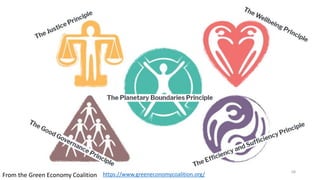
From the Green Economy Coalition https://www.greeneconomycoalition.org/
69
70
http://www.ucd.ie/agile/
http://worksmartertogether.ucd.ie/
23rd October 2019 71
72
http://www.ucd.ie/agile/
http://worksmartertogether.ucd.ie/
23rd October 2019 73
http://www.ucd.ie/agile/
http://worksmartertogether.ucd.ie/
23rd October 2019 74
http://www.ucd.ie/agile/
http://worksmartertogether.ucd.ie/
23rd October 2019 75
http://www.ucd.ie/agile/
http://worksmartertogether.ucd.ie/
23rd October 2019 76
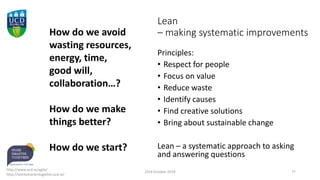
Lean
– making systematic improvements
Principles:
• Respect for people
• Focus on value
• Reduce waste
• Identify causes
• Find creative solutions
• Bring about sustainable change
Lean – a systematic approach to asking
and answering questions
How do we avoid
wasting resources,
energy, time,
good will,
collaboration…?
How do we make
things better?
How do we start?
http://www.ucd.ie/agile/
http://worksmartertogether.ucd.ie/
23rd October 2019 77
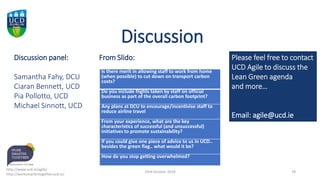
Discussion
23rd October 2019 78
http://www.ucd.ie/agile/
http://worksmartertogether.ucd.ie/
Discussion panel:
Samantha Fahy, DCU
Ciaran Bennett, UCD
Pia Pollotto, UCD
Michael Sinnott, UCD
Please feel free to contact
UCD Agile to discuss the
Lean Green agenda
and more…
Email: agile@ucd.ie
Is there merit in allowing staff to work from home
(when possible) to cut down on transport carbon
costs?
Do you include flights taken by staff on official
business as part of the overall carbon footprint?
Any plans at DCU to encourage/incentivise staff to
reduce airline travel
From your experience, what are the key
characteristics of successful (and unsuccessful)
initiatives to promote sustainability?
If you could give one piece of advice to us in UCD..
besides the green flag.. what would it be?
How do you stop getting overwhelmed?
From Slido:
THANK YOU
for joining us at the Work Smarter Together
October Event
- UCD Agile team
23rd October 2019 79
http://www.ucd.ie/agile/
http://worksmartertogether.ucd.ie/

UCD WST 23 October 2019

  • 1.
    WELCOME to the WorkSmarter Together October Event www.slido.com http://worksmartertogether.ucd.ie/ #WST23OCT 23rd October 2019 The Fitzgerald Chamber, UCD Student Centre http://www.ucd.ie/agile/ http://worksmartertogether.ucd.ie/ 23rd October 2019 1
  • 2.
    Event Opening Professor MarkRogers Registrar & Deputy President 23rd October 2019 2 http://www.ucd.ie/agile/ http://worksmartertogether.ucd.ie/
  • 3.
    CONGRATULATIONS TO UCD LEANPRACTITIONERS John Wyatt Student/Supervisor Allocation School of Veterinary Medicine Giuliana Rocca Exam paper processing School of Agriculture and Food Science Ioanna Galeadi Graduate Studies workshops Graduate Studies Dimitrios-Stavros Kapetanakis Bibliographic metrics UCD Research Nicola Fortune Mock Interview Process UCD Careers Network In absentia: Joe Nankivell Handling new books UCD Library Mark Coyne External lecturer’s notes School of Medicine Áine Heffernan Running of experiments School of Medicine Sinéad Lindsay Sample labelling consistency School of Medicine 23rd October 2019 3 http://www.ucd.ie/agile/ http://worksmartertogether.ucd.ie/
  • 4.
    Launch of theProject Management Community of Practice 23rd October 2019 4 http://www.ucd.ie/agile/ http://worksmartertogether.ucd.ie/ www.slido.com #WST23OCT
  • 5.
    UCD – Launchof PM Community of Practice PMO & CoP - A Personal Perspective John O’Sullivan Director – Programme Management Organisation (PMO) Date 23/10/19
  • 6.
     Early Career-Jacobs Engineering • Electrical Design Engineer • Power Calcs, Cable Calcs, Switchgear Calcs Lighting Calcs, Draughting, Bills of Quantities … Sent to Construction Project Site • First taste of Project Management • Progress, Quality, Quantity, Cost, Document Management, Reporting…  Moved to CRH – New Cement Plant - Limerick • Large Plant, High Voltage, Ambitious Timeline, Large Workforce, £ Big Budgets, Safety 1st, • Planning, Scheduling, Coordinating, Monitoring, Controlling, Reporting, Commissioning, • First exposure to High Voltage (Drives/Switchgear) Instrumentation, Automation, Process Control, early computerisation  Moved to Texas Instruments • Responsible for Automation & Process Control Projects • Introduction to Software Development Project Management • Exposure to complex manufacturing and automation projects in the Pharma / Chemical / Healthcare / Food and Beverage / Discrete Manufacturing and FMCG Sector • Introduction to Validation / FDA / Regulated Industry  Moved to Siemens Ltd (Ireland) • Control Systems become more powerful, networked, integrated to Management Information Systems • Managed more complex System and Software Projects • Moved into Pure IT (PCs /Networks/ Business Systems) • Managed ERP Introduction (SAP R/3) Project • First introduction to Managing Business Led Projects • First introduction in Behavioural Change Management  Moved to Siemens (Switzerland) • Managing Business Change through Projects • Worked on Acquisition / Divestment / Merger Projects • Led BPR and Business Turnaround Projects • Led Technology Enabled Transformation Projects • Led Global Customer Complaint and NPS Project • Led Knowledge Management Projects - CoP • Part of Introduction of PM@Siemens - Portfolio / Programme / Project Management  Moved to Siemens (USA) LA/SF • Operations Management – Large Capital Projects • Leadership for Business Excellence in Large Projects incl. Government Projects / Utilities Projects / Hospital Projects / Data Centre Projects / Real- Estate Projects Bio-Tech Projects / University Projects • Introduction to US (CA) Construction Contract Law  Currently with Trinity College Dublin • Director of PMO (Programme Management Office) • Role:- Develop PMO & Project Maturity in TCD • Governance Role – Not Project Execution • Enterprise Approach - from Free-Style to Franchise • Contract Law & Contract Administration in Irish Public Sector (Unique GCCC Contracts)  In Summary  I stumbled into Project Management… and liked it  I was lucky throughout my career in that I worked for large organisations going through change  I invested in my development as a professional project manager throughout me career  I love change and challenge. I’m Sagittarian …
  • 7.
  • 8.
    http://www.ucd.ie/agile/ http://worksmartertogether.ucd.ie/ 23rd October 20198 Digital Media Pr ojec t Management C ommunity of Pr ac tic e ( C OP)
  • 9.
    “…groups of peoplewho share a concern or passion for something they do and learn how to do it better as they interact regularly” (Etienne Wenger-Trayner and Beverly Wenger-Trayner) What is a Community of Practice (COP)? http://www.ucd.ie/agile/ http://worksmartertogether.ucd.ie/ 23rd October 2019 9
  • 10.
    • Enable knowledgesharing • Accelerate professional development • Support better communication • Build networks and break down organisational silos COP Principle Benefits 23rd October 2019 10 http://www.ucd.ie/agile/ http://worksmartertogether.ucd.ie/
  • 11.
    PM COP Vision Insimple terms, this is to create a group of people who play a role in managing projects in UCD, for the purpose of helping the group members to gain knowledge by coming together and sharing information and experiences with other people in the group. The idea is that the members of the CoP learn from each other and have an opportunity to develop and better their level of understanding or improve their way of working. 23rd October 2019 11 http://www.ucd.ie/agile/ http://worksmartertogether.ucd.ie/
  • 12.
    Building Better Practice COP –Members Meeting Frequency Every2 Months 14 Members from a diverse group Agile Arts and Humanities Human Resources IT Services Library Registry Student Services University Secretariat Next Meeting Mon 11 Nov 2019 2:30pm – 4pm UCD Agile http://www.ucd.ie/agile/ http://worksmartertogether.ucd.ie/ 23rd October 2019 12
  • 13.
    23rd October 201913 http://www.ucd.ie/agile/ http://worksmartertogether.ucd.ie/
  • 14.
    For me? Bringing togethera diverse group of people that share the same challenges, but have different experiences thus creating a wider pool of knowledge 23rd October 2019 14 Teaching ChallengesPurpose Learning http://www.ucd.ie/agile/ http://worksmartertogether.ucd.ie/
  • 15.
  • 16.
    23rd October 201916 Question & Answer Session www.slido.com #WST23OCT The questions on the right are the main Slido questions asked http://www.ucd.ie/agile/ http://worksmartertogether.ucd.ie/ What has been the value-add or benefits to Trinity in having a centralised project approach for coordinating large-scale university initiatives? Many people do some projects as part of their role but are not professional PMs. Is the system you have developed in TCD work for these “occasional “ PMs? What was the big change when you moved to higher education- to Trinity? Would you like to have the ability to oversee projects in the teaching and research space? Or do you think the administration/academic PM boundary has value? Is Project Management a business or is a business tool? What would be your top three tips for a new project manager? How do Trinity define what is a 'Project' How incentivise tacit knowledge sharing in the university
  • 17.
    Lean Green andUCD brought to you by UCD Agile 23rd October 2019 17 http://www.ucd.ie/agile/ http://worksmartertogether.ucd.ie/ www.slido.com #WST23OCT
  • 18.
    Dublin City University– Sustainability WST Event, UCD 23 October 2019 Samantha Fahy, Director of Sustainability
  • 19.
    Outline • Overview &Challenges • Interventions & Outcomes • Role of HEIs & Sustainability
  • 21.
    The Numbers • Top‘50 under 50’ •Top ‘100 under 50’ 2,500 Established in 1980, DCU has 80 Programmes across Five Faculties  DCU Business School,  DCU Institute of Education,  Faculty of Science and Health,  Faculty of Engineering and Computing  Faculty of Humanities and Social Sciences Staff + 40,000 additional students by 2030
  • 22.
    The Old 1838: Albert College, Glasnevin Campus 1726 : Drumcondra House, All Hallows Campus 1660 : Belvedere House & Chapel, St Patricks Campus
  • 23.
  • 24.
  • 25.
    Sustainability at DCU -InitialSustainable Development Policy in 2010/2011 -Created Sustainability Position in 2013 -RCE Dublin 2014 -FEE/An Taisce Green Campus Programme -First Green Campus Flag in 2014 -Renewed and extended in 2017 -2017 : Sustainability at the Core
  • 26.
    Strategic Plan :Sustainability at Core -Institutional Sustainability Council -Roadmap for a healthier & more sustainable University -Metrics and Footprints -Carbon Neutral Exemplar Campus — Integrate Sustainability Principles, Literacy and Awareness into the student curriculum. — Stakeholder Engagement
  • 27.
    Sustainability @ DCU AnTaisce Green Campus First Flag : July 2014 Re-awarded : Nov 2017 Core to the our 2017-2022 Strategic Plan
  • 28.
  • 29.
    Energy SEAI Scorecard 2018 43%towards the 2020 33% target
  • 30.
    Hot Water Project -BuildingRegs/HSA – 60deg for Legionaries -Hygiene : The WHO, HSE, and CDC – not necessary -Potential Energy and Water Savings -KCL 7-8% of Carbon Footprint -Survey -90% reported washing hands! (Recent report – 3%!) -Hot Water : 40% Perceived Hygiene 40% Comfort -Behaviour Change !
  • 31.
    Single use plastics(March 2018)
  • 32.
    Biodiversity -Community Garden w/Apiary -Celebration space ! -DCU Biodiversity & Pollinator Plan -Vertical Garden ??? -Urban Garden/Market -Food to DCU Restaurant -Garden Gnomes -Grow Dome -Men’s Shed
  • 33.
    Transport -90% Sustainable formof transport -Active Transport -Public Connectivity -Virtual Meetings
  • 34.
  • 35.
    Sustainability in HEIs -EnvironmentalSustainability -Education for Sustainability https://www.stockholmresilience.org/research/planetary-boundaries.html https://unesdoc.unesco.org/ark:/48223/pf0000247444
  • 36.
    Systems thinking competency Anticipatory competency/futures thinking Normative competency Strategic competencyCollaboration competency Criticalthinking competency Self-awareness competency Integrated problem- solving competency Key Competencies for Sustainability for ALL SDGs
  • 37.
    Key Competencies forSustainability -Systems thinking competency: the abilities to recognize and understand relationships; to analyse complex systems; to think of how systems are embedded within different domains and different scales; and to deal with uncertainty. -Anticipatory competency/futures thinking: the abilities to understand and evaluate multiple futures – possible, probable and desirable; to create one’s own visions for the future; to apply the precautionary principle; to assess the consequences of actions; and to deal with risks and changes. -Normative competency: the abilities to understand and reflect on the norms and values that underlie one’s actions; and to negotiate sustainability values, principles, goals, and targets, in a context of conflicts of interests and trade-offs, uncertain knowledge and contradictions. -Strategic competency: the abilities to collectively develop and implement innovative actions that further sustainability at the local level and further afield. -Collaboration competency: the abilities to learn from others; to understand and respect the needs, perspectives and actions of others (empathy); to understand, relate to and be sensitive to others (empathic leadership); to deal with conflicts in a group; and to facilitate collaborative and participatory problem solving. -Critical thinking competency: the ability to question norms, practices and opinions; to reflect on own one’s values, perceptions and actions; and to take a position in the sustainability discourse. -Self-awareness competency: the ability to reflect on one’s own role in the local community and (global) society; to continually evaluate and further motivate one’s actions; and to deal with one’s feelings and desires. -Integrated problem-solving competency: the overarching ability to apply different problem-solving frameworks to complex sustainability problems and develop viable, inclusive and equitable solution options that promote sustainable development, integrating the abovementioned competences.
  • 39.
    Carbon Footprint 2010– 2015 100% Energy focused
  • 40.
    Carbon Footprint 2017* 24,659tCO2e *Not Fully Comprehensive – no procurement…… 55% Scope 1 & 2
  • 41.
    DCU Carbon Footprint2018 : 64,212 tCO2eq Grainne McIvor, ESH Final Yr Thesis : A. Morrissey/S. Fahy Supervisors Scope 1&2 : Energy & Heat : 20% Scope 3 : Transport : 28% Scope 3 : Procurement : 27% Scope 3 : Construction : 22% Scope 3 : Other Operations : 3%
  • 42.
    2018 % 2018(tCo2e) SBT to Reduce per annum (tCO2e) Natural Gas 8.94% 5,739 241 DCU Owned Vehicles 0.02% 16 1 Fugitive Emissions 3.53% 2,266 95 Purchased Electricity 11.17% 7,174 301 Staff & Student Commuting 19.14% 12,291 516 Business Travel 3.56% 2,284 96 Student Academic Travel 3.58% 2,300 97 Waste 0.08% 52 2 Water 0.37% 237 10 Purchased Goods & Services 49.60% 31,851 1,338 64,212 2,697 DCU Carbon Footprint 2018 : 64,212 tCO2eq
  • 43.
    Credit: Seth Wynes/KimberlyNicholas, Environmental Research Letters, 2017
  • 44.
  • 45.
  • 46.
  • 47.
    Lean Green andUCD Presented by Ciaran Bennett, UCD Estate Services
  • 48.
    Green Campus Programme Sustainable Development Goals (SDG`s) SustainableEnergy Community SPARC (Supporting Partnerships And Realising Change) Students Union and Student Societies UCD in the Community Healthy UCD Staff Student Network Individual School and Unit groups, e.g. Registry, SBBS, Sutherland, Social Policy How canI getinvolved?
  • 49.
    Biodiversity Management – All -Ireland Pollinator Plan Reducethe frequency of mowing of selected grassed areas on campus Pollinator Friendly planting Provide opportunities for wild pollinator nesting habitats Manage and control use of pesticides Raise awareness of pollinators amongst our community.
  • 50.
  • 51.
    Energy Work towards the2015 - 2020 Goal of becoming 33% more Sustainable By 2020 – We have currently reached 32% ISO50001 Certification for Energy and water Management Solar PV, Fenestration, Insulation upgrades, CHP BREEAM Excellent – O’Brien Centre for Science; Passiv House- Roebuck Student Residences
  • 52.
    WasteReduction Initiatives Battery Recycling Cartridge recycling Pricereduction when purchasing hot drinks with your own cup Waste Characterisation Study Reusable cups, biodegradable straws, napkins, cutlery Furniture Re-use Scheme ‘WARP IT’ Pilot best practice of office waste management with the ‘Binless’ office –e.g. Tierney Open Plan
  • 53.
    UCD Commuting -staffand students 2018
  • 54.
    Promoting Sustainable Travel options • Annualtravel Survey- Approx. 7,000 respondents • 11,000 journeys on Dart shuttle bus • Installation of Bicycle Repair Stations • Bike Awareness Day. • Reduced prices at the Belfield Bikes pop up shop at the village market
  • 55.
    Water Management 33% Reductionin potable water consumption since 2012 Monthly Consumption Reports Water Meter Upgrade and Replacement Works - Improved monitoring and controls of the water network throughout campus to assist in consumption analysis Infrastructure upgrades and leak detection programme SUDS- Upper Lake
  • 57.
    Lean and Green Projects PiaPolotto UCD Estate Services
  • 58.
    UCD SmartFurniture Reuse programme Whena leanerprocess is a greenerprocess Challenges: • Increased pressure in storage space • What we keep? What we dispose? Who will reuse it? • The reuse process was time consuming for Estate Services staff and for the customer What we want to do: • Reduce the waste going to landfill • Increase capacity of furniture reuse by making the furniture more visible to staff and greater community. • Life-Cycle assessment: Identify reuse trends: size, quality, type of furniture. etc
  • 59.
    When a leanerprocessis a greenerprocess - assessment What we knew: • Sustainability was the lean answer. • The connection between lean and green was beyond waste reduction. What happened : • The fact that both ideas lean and green were implemented simultaneously unfolded greater benefits: in this case increased the customer satisfaction and the impact in the UCD greater community.
  • 60.
    Focus Waste reduction: Improvethe ecological efficiency of the process (diverting from landfill) while reducing costs= leaner and greener furniture storage, transportation and life cycle. The new process from removal to donation/reuse/disposal to be long term sustainable People and Organisation: Lean and Green projects require high level of customer involvement: active engagement with the UCD community. Customer satisfaction: Being greener while reducing procurement costs.
  • 61.
    What wedid Identify Identify trends •Optimise storage space • Increase the quality of the furniture stored for reuse. • Identify waste • Identify the summer as the highest reuse time and plan for it • Improve customer satisfaction Divert Divert from landfill • Reduce waste and costs • Improve the efficiency of the waste streams (metal, bulky items, WEEE)
  • 62.
    Engage • We putin place a proactive approach for engaging with charitable organisations and the UCD Community that has been win-win for all involved
  • 63.
    Challenges The reuse programmehad very little visibility within the University. The selection of suitable furniture was a time-consuming process, requiring staff to meet in the storeroom, with often several interactions before the collection of the items. Reaching NGOs and non- profit organisations was based on personal connections and again, time consuming. Metrics were not available; in terms of C02 emissions savings, waste diverted from landfill and money saved in procurement.
  • 64.
    64 Increased the programme’s visibility Helped usto reached the community Provided metrics
  • 65.
    Conclusion The integration of Leanand Green practices into the process design of the UCD Furniture Reuse Programme in order to prolong the life cycle of the furniture Enabling easy recycling of items as well as making processes more efficient, i.e. less wasteful
  • 66.
    http://www.ucd.ie/agile/ http://worksmartertogether.ucd.ie/ 23rd October 201966 Lean Green and UCD … the UCD Agile contribution Michael Sinnott, UCD Agile
  • 67.
  • 68.
    68 From the GreenEconomy Coalition https://www.greeneconomycoalition.org/
  • 69.
  • 70.
  • 71.
  • 72.
  • 73.
  • 74.
  • 75.
  • 76.
  • 77.
    Lean – making systematicimprovements Principles: • Respect for people • Focus on value • Reduce waste • Identify causes • Find creative solutions • Bring about sustainable change Lean – a systematic approach to asking and answering questions How do we avoid wasting resources, energy, time, good will, collaboration…? How do we make things better? How do we start? http://www.ucd.ie/agile/ http://worksmartertogether.ucd.ie/ 23rd October 2019 77
  • 78.
    Discussion 23rd October 201978 http://www.ucd.ie/agile/ http://worksmartertogether.ucd.ie/ Discussion panel: Samantha Fahy, DCU Ciaran Bennett, UCD Pia Pollotto, UCD Michael Sinnott, UCD Please feel free to contact UCD Agile to discuss the Lean Green agenda and more… Email: agile@ucd.ie Is there merit in allowing staff to work from home (when possible) to cut down on transport carbon costs? Do you include flights taken by staff on official business as part of the overall carbon footprint? Any plans at DCU to encourage/incentivise staff to reduce airline travel From your experience, what are the key characteristics of successful (and unsuccessful) initiatives to promote sustainability? If you could give one piece of advice to us in UCD.. besides the green flag.. what would it be? How do you stop getting overwhelmed? From Slido:
  • 79.
    THANK YOU for joiningus at the Work Smarter Together October Event - UCD Agile team 23rd October 2019 79 http://www.ucd.ie/agile/ http://worksmartertogether.ucd.ie/

Editor's Notes

  • #7 Slide One – No Pop-UP Who sees a Sunset ? Who sees a Sunrise ? I see a Sunrise, so I’ll plot my journey from the most distant point to today
  • #15 Do you shar a role, similar environment and overall work goals Share the same day to day challenges Would you learn things from other people Would people learn things from you?
  • #22 Academic Faculty 1050 Non Academic 825 Research 350 Technical/Other Staff 190
  • #26 United Nations University designated Regional Centre for Expertise in Education for Sustainable Development
  • #28 Short presentation on some of the many sustainability activities going on the DCU campuses Sustainability for DCU is not just about the environment but how we balance the demands of our economy and society and maintain a healthy environment for current and future generations A small part of our efforts is our participation in the An Tasice Green Campus Programme – I’m sure lots of you had green flags in your primary and secondary school – well DCU got its first flag in 2014 and we were reassessed last November where St. Patricks Campus also got its green flag – this year we need to work on the All Hallows campus
  • #67 The green agenda and the desire for sustainability are huge challenges. How can we do practical things here in a university environment? Lean and Green have much in common – reducing waste, making the best use of our resources, creating sustainable change. UCD Agile promotes Lean Six Sigma in the UCD community. How can the thinking and techniques of Lean Six Sigma help us make practical changes that improve sustainability and respond to the green agenda?
  • #68 If you Google Lean Green you get many things, including this add for slimming coffee, that are not going to help us directly progress a lean green agenda her in UCD! Googling for examples of Lean promoting Green is a challenge. A lot of the work done in promoting sustainability is part of broader improvement/effective use of resources projects, sometimes as a directly intended outcome, sometimes as part of a number of outcomes.
  • #69 Again, this slide makes the point that trying to start out on a green journey can be overwhelming.
  • #70 Similarly, this slide makes the point that trying to start out on a sustainability journey can be overwhelming.
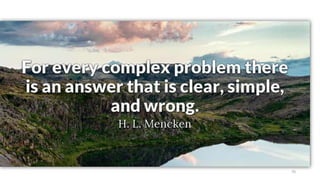
  • #71 Never trust simple answers to complex questions – it is rare they are right. So how do we manage to clearly articulate a complex question and credibly pursue real answers?
  • #72 UCD Green Week earlier in 2019 is an example of a broad initiative in the University which promoted many aspects of green and greening UCD
  • #73 A key driver in reducing the consequences of our consumption
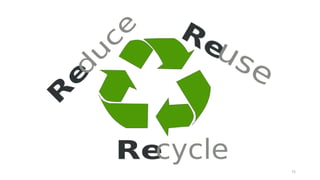
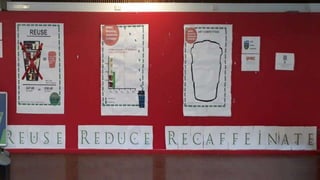
  • #74 This initiative applied the reduce – reuse – recycle approach to the consumption of single use coffee cups on campus. This gave us reduce – reuse – recaffinate, promoting the use of non-disposable coffee and tea cups across the campus.
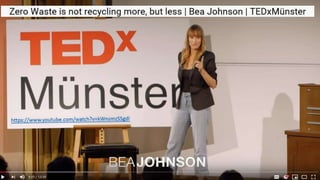
  • #75 But what if it is more complex than reduce – reuse – recycle. This TEDx makes the point that the issue is primarily to reduce the amount of waste we create in the first place. Behind her back she holds a jar which contains ALL (!!?) the waste her family produced in a year. https://www.youtube.com/watch?v=kWnsmzSSgdI
  • #76 So the driver is not better waste recycling but getting to zero waste.
  • #77 Again, looking into the question makes it seem more complex and the challenge of finding a right answer more problematic. And by the way, Google rarely gets you to a clear owner of a poplar quote. Is it HL Menken or Albert Einstein?
  • #78 UCD Agile can help you. Talk to us.