Modular, Polymeric Development
Platform for Microfluidic Applications
-
Design, Fabrication,Testing and Examples
Proyag Datta
PhD Thesis Presentation
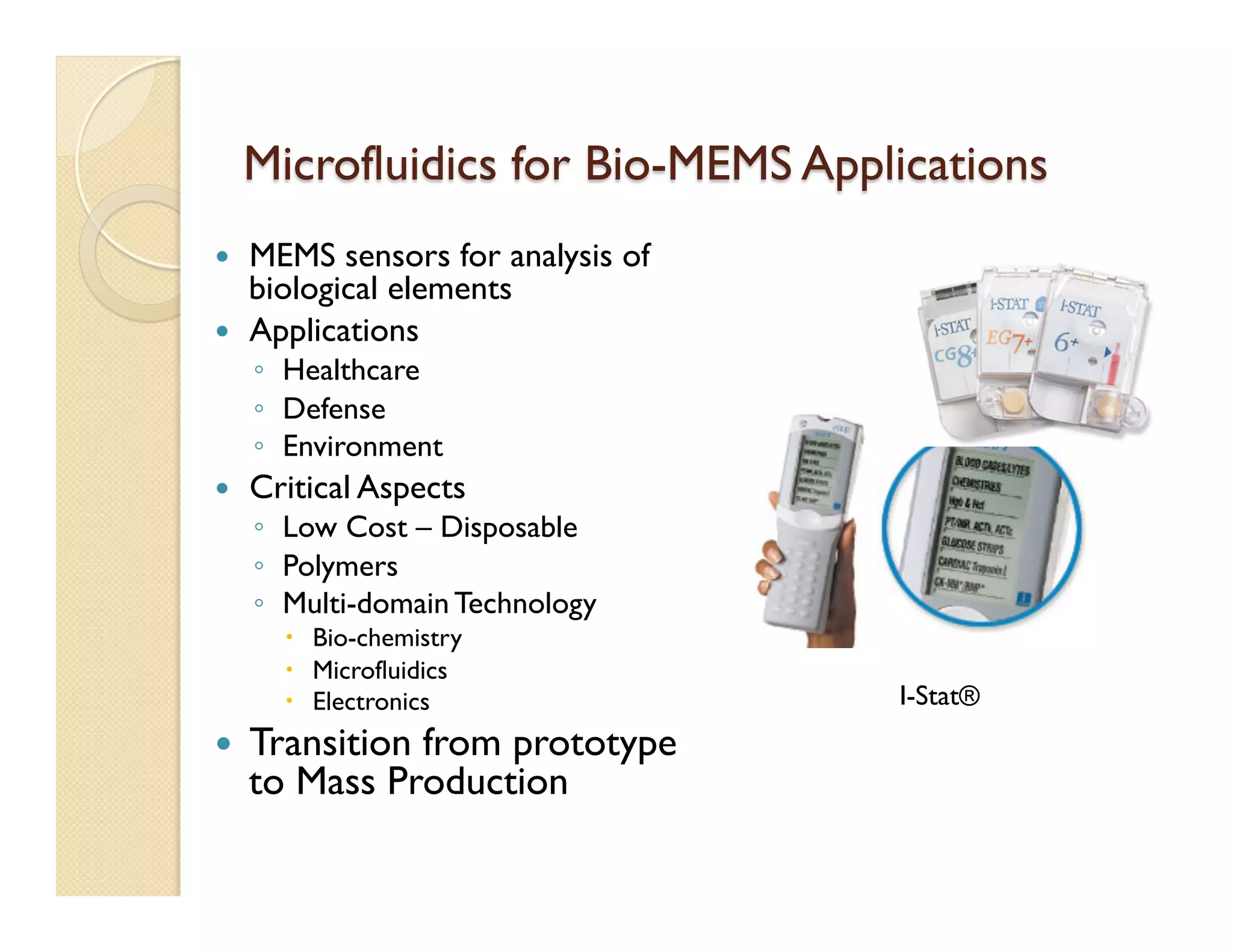
Microfluidics for Bio-MEMS Applications
—  MEMS sensors for analysis of
biological elements
—  Applications
◦  Healthcare
◦  Defense
◦  Environment
—  Critical Aspects
◦  Low Cost – Disposable
◦  Polymers
◦  Multi-domain Technology
–  Bio-chemistry
–  Microfluidics
–  Electronics
—  Transition from prototype
to Mass Production
I-Stat®
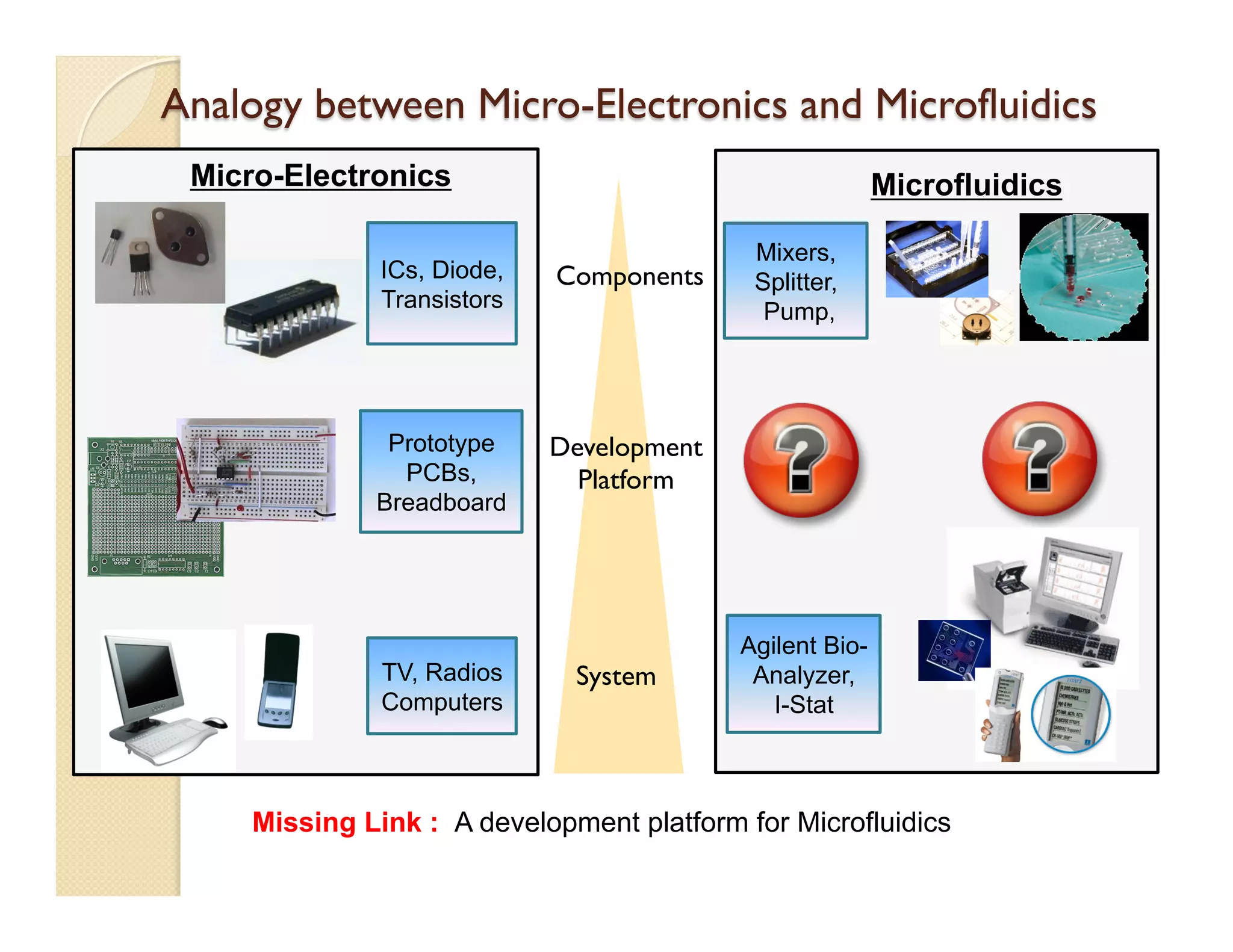
ICs, Diode,
Transistors
TV, Radios
Computers
Prototype
PCBs,
Breadboard
Mixers,
Splitter,
Pump,
Agilent Bio-
Analyzer,
I-Stat
Components
System
Development
Platform
Micro-Electronics Microfluidics
Analogy between Micro-Electronics and Microfluidics
Missing Link : A development platform for Microfluidics
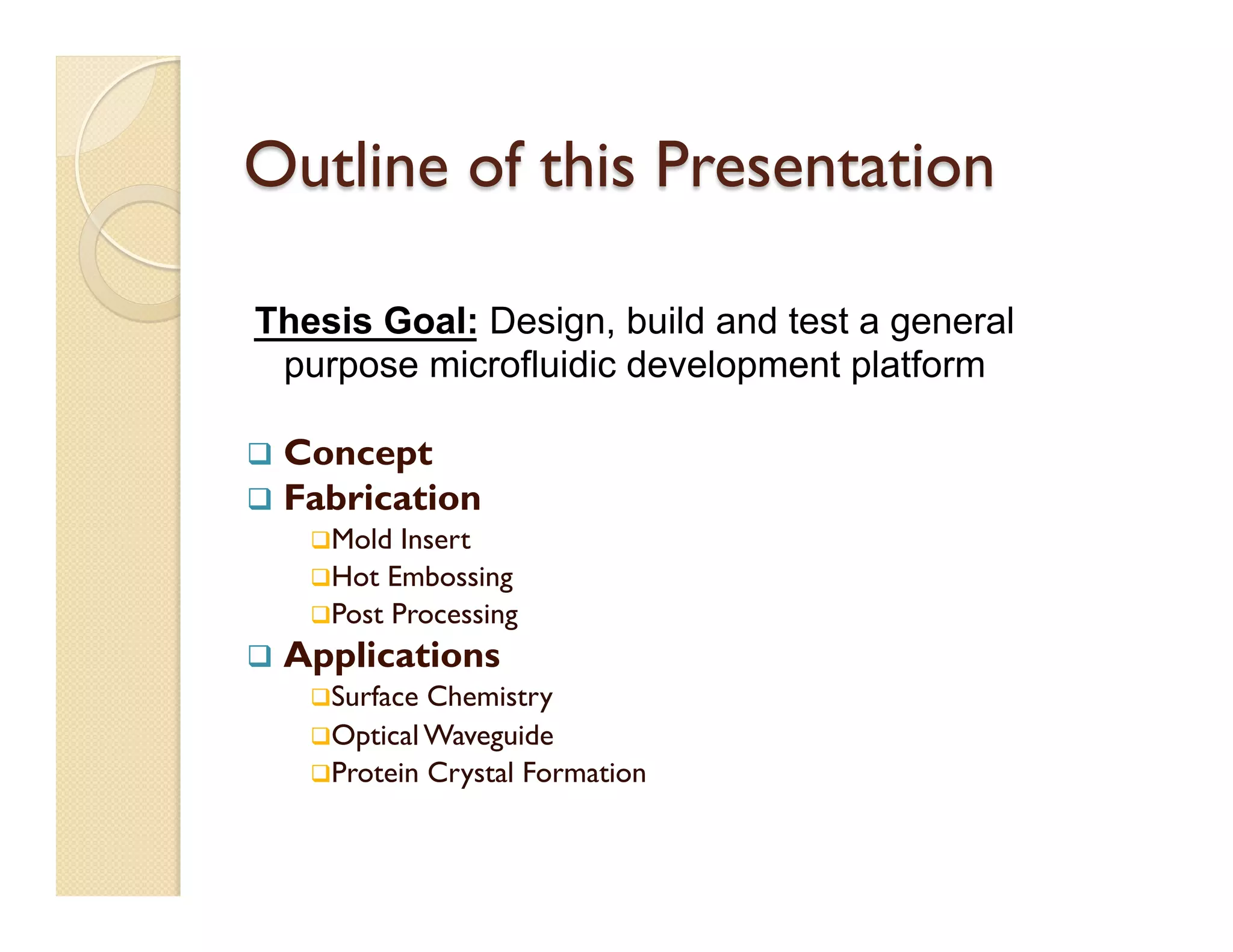
Outline of this Presentation
q  Concept
q  Fabrication
q Mold Insert
q Hot Embossing
q Post Processing
q  Applications
q Surface Chemistry
q Optical Waveguide
q Protein Crystal Formation
Thesis Goal: Design, build and test a general
purpose microfluidic development platform
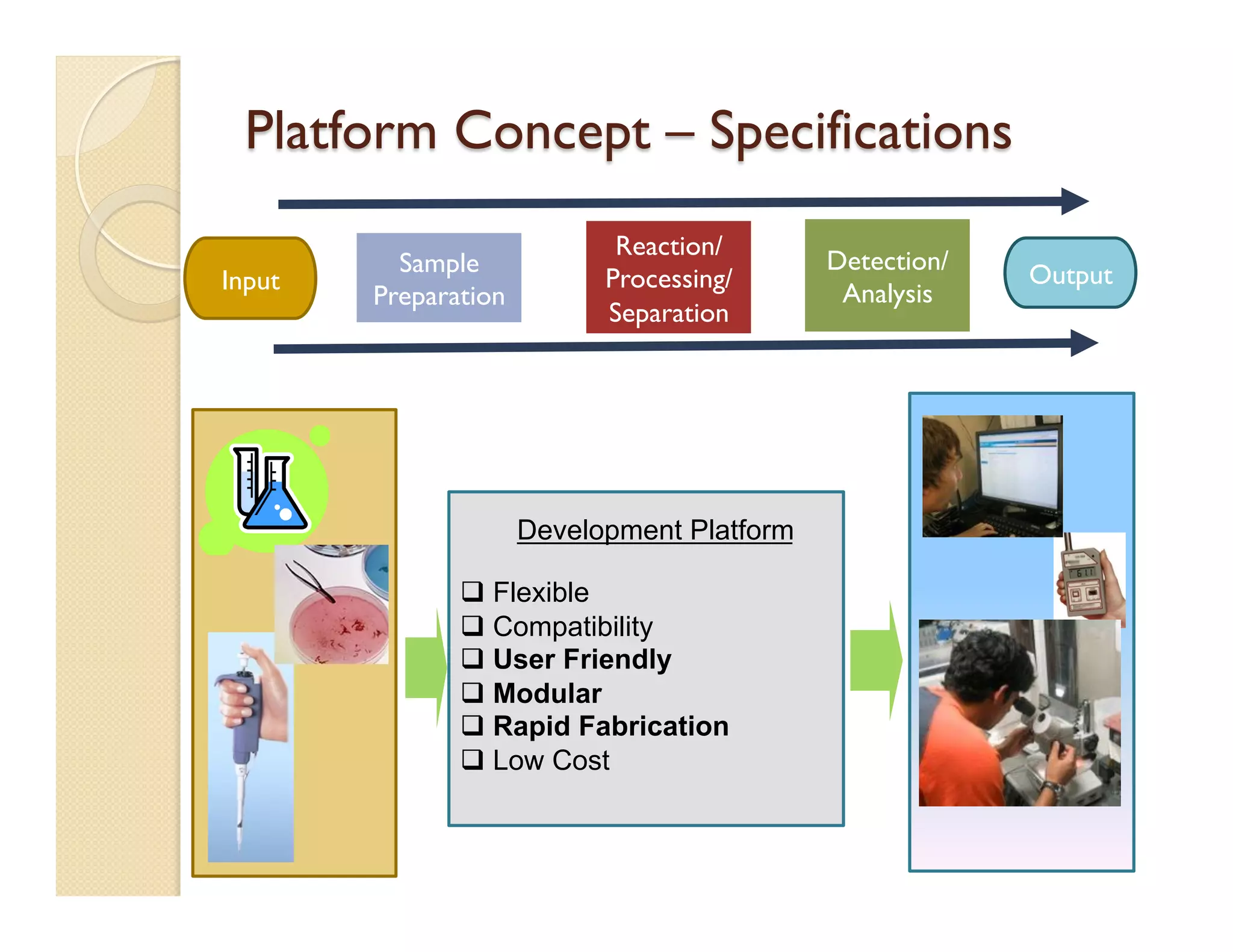
q Flexible
q Compatibility
q User Friendly
q Modular
q Rapid Fabrication
q Low Cost
Development Platform
Platform Concept – Specifications
Input
Sample
Preparation
Reaction/
Processing/
Separation
Detection/
Analysis
Output
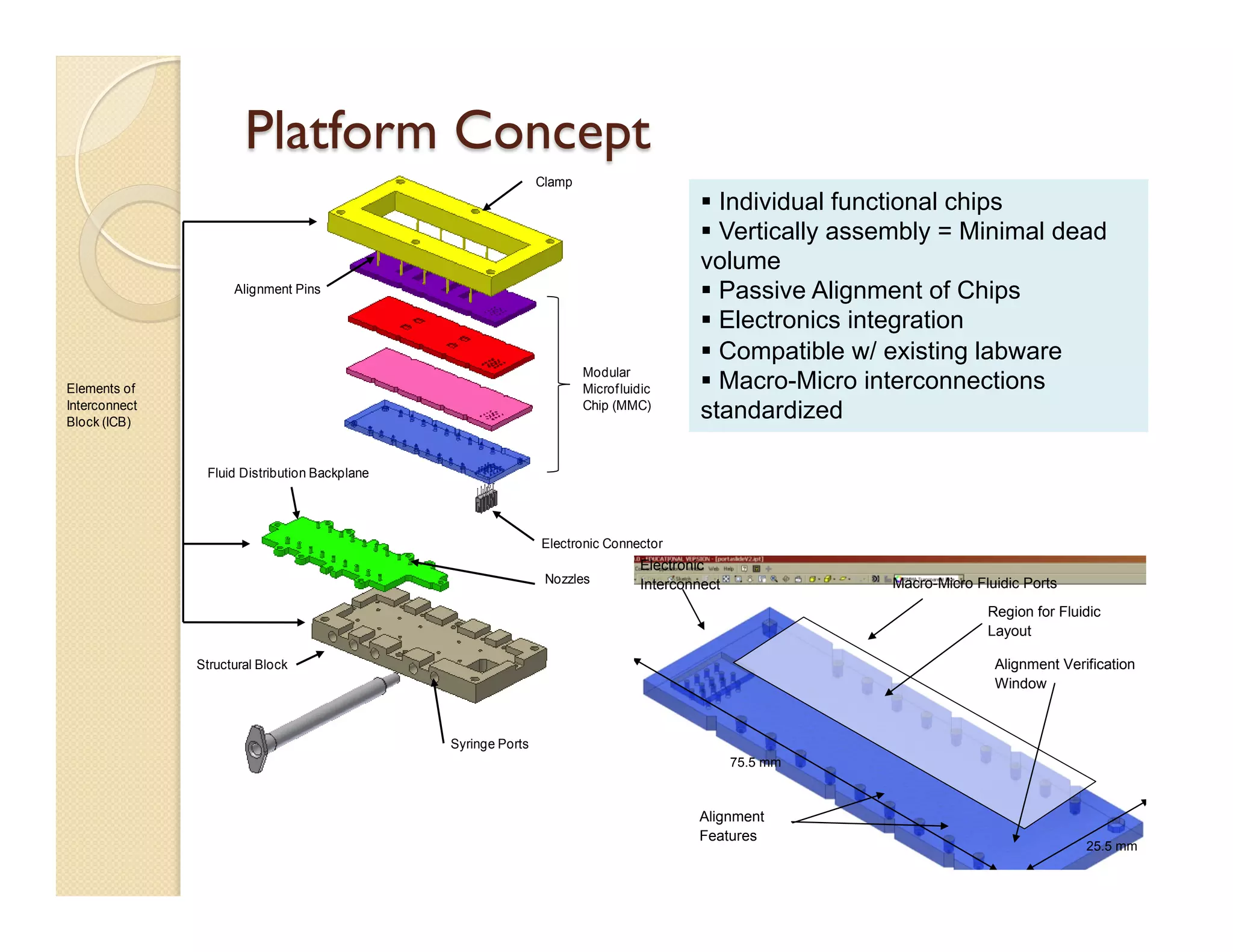
Platform Concept
§ Individual functional chips
§ Vertically assembly = Minimal dead
volume
§ Passive Alignment of Chips
§ Electronics integration
§ Compatible w/ existing labware
§ Macro-Micro interconnections
standardized
Clamp
Alignment Pins
Electronic Connector
Fluid Distribution Backplane
Nozzles
Syringe Ports
Structural Block
Modular
Microfluidic
Chip (MMC)
Elements of
Interconnect
Block (ICB)
Electronic
Interconnect Macro-Micro Fluidic Ports
Alignment
Features
Alignment Verification
Window
75.5 mm
25.5 mm
Region for Fluidic
Layout
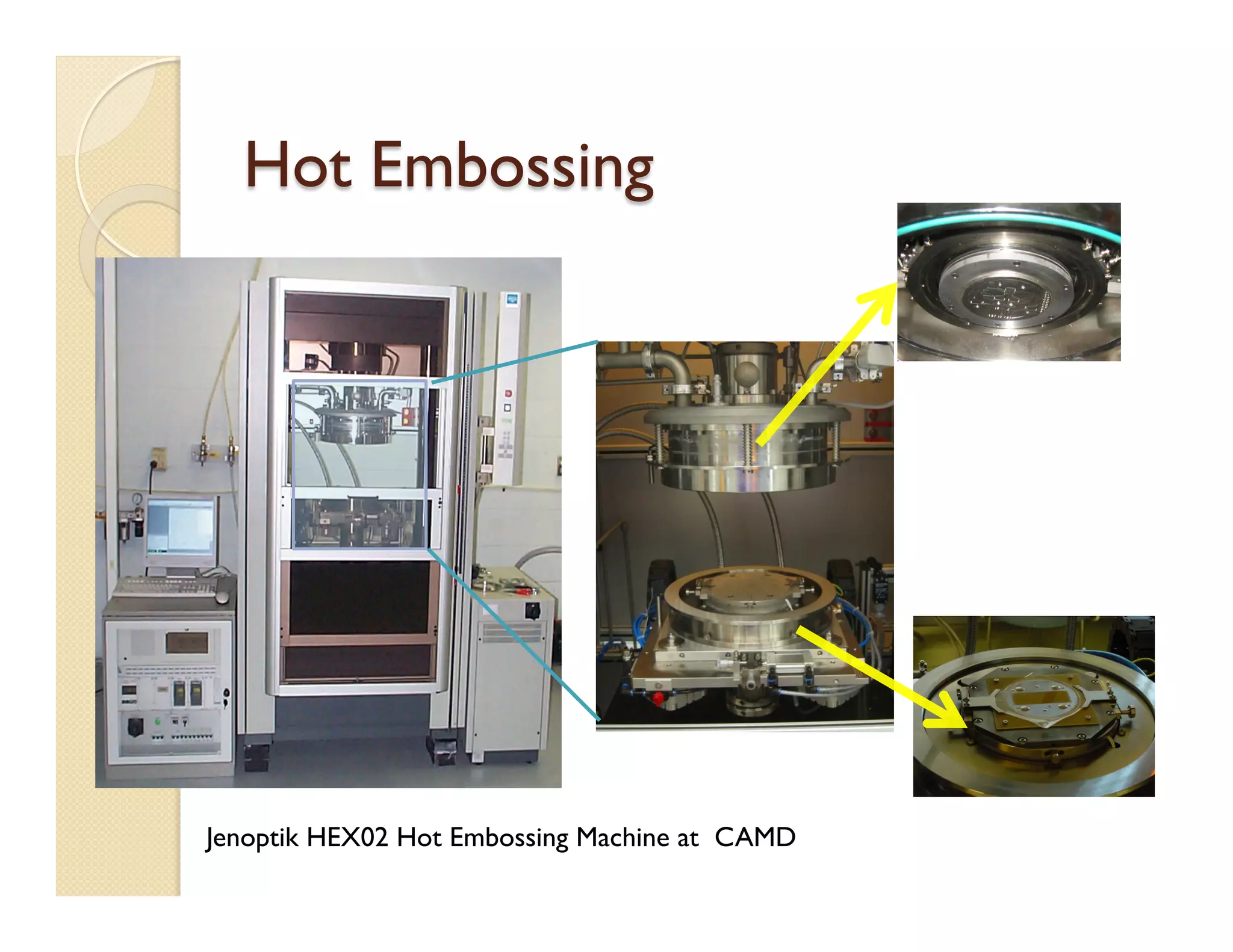
Hot Embossing
Jenoptik HEX02 Hot Embossing Machine at CAMD
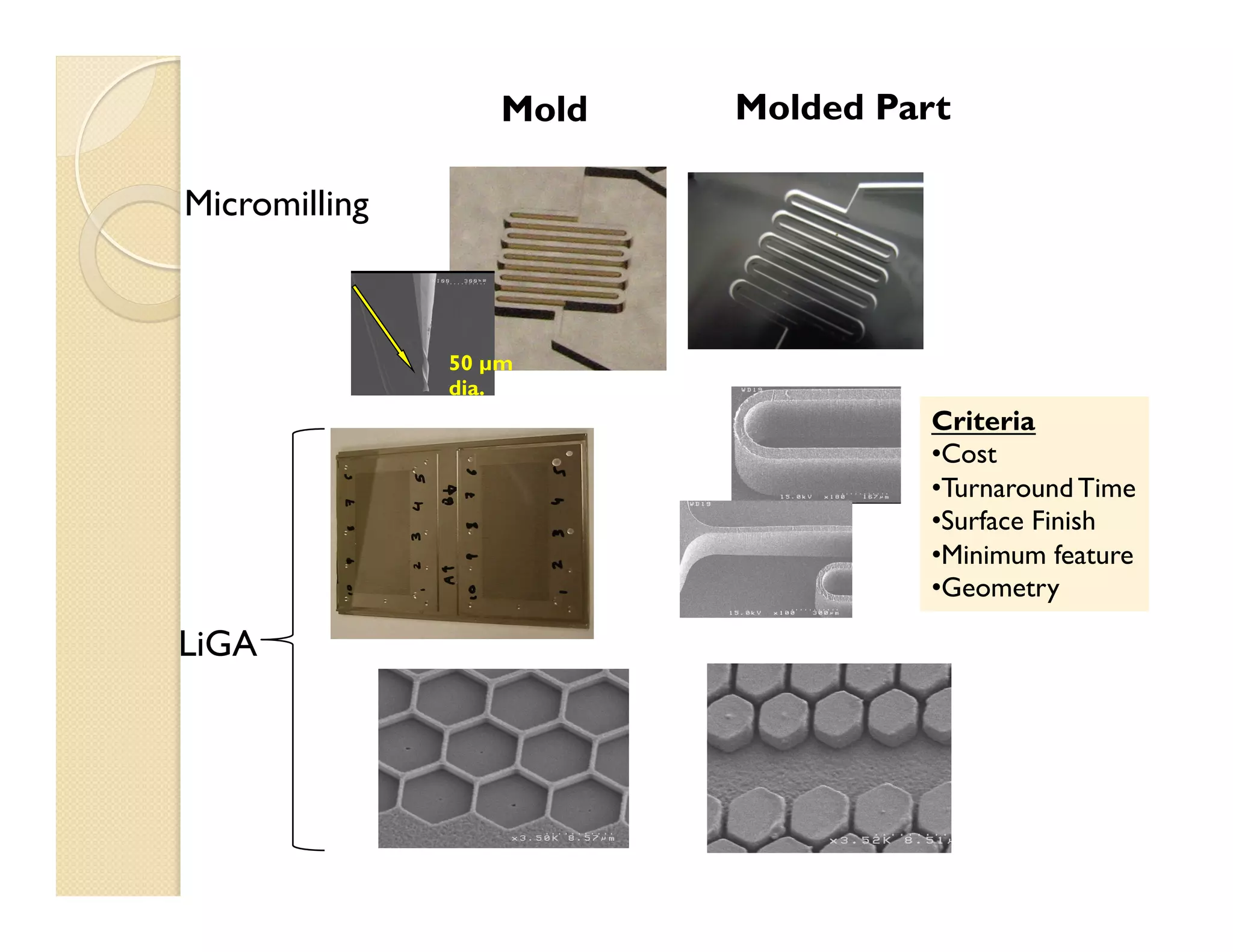
Mold Molded Part
LiGA
Micromilling
50 µm
dia.
Criteria
• Cost
• Turnaround Time
• Surface Finish
• Minimum feature
• Geometry
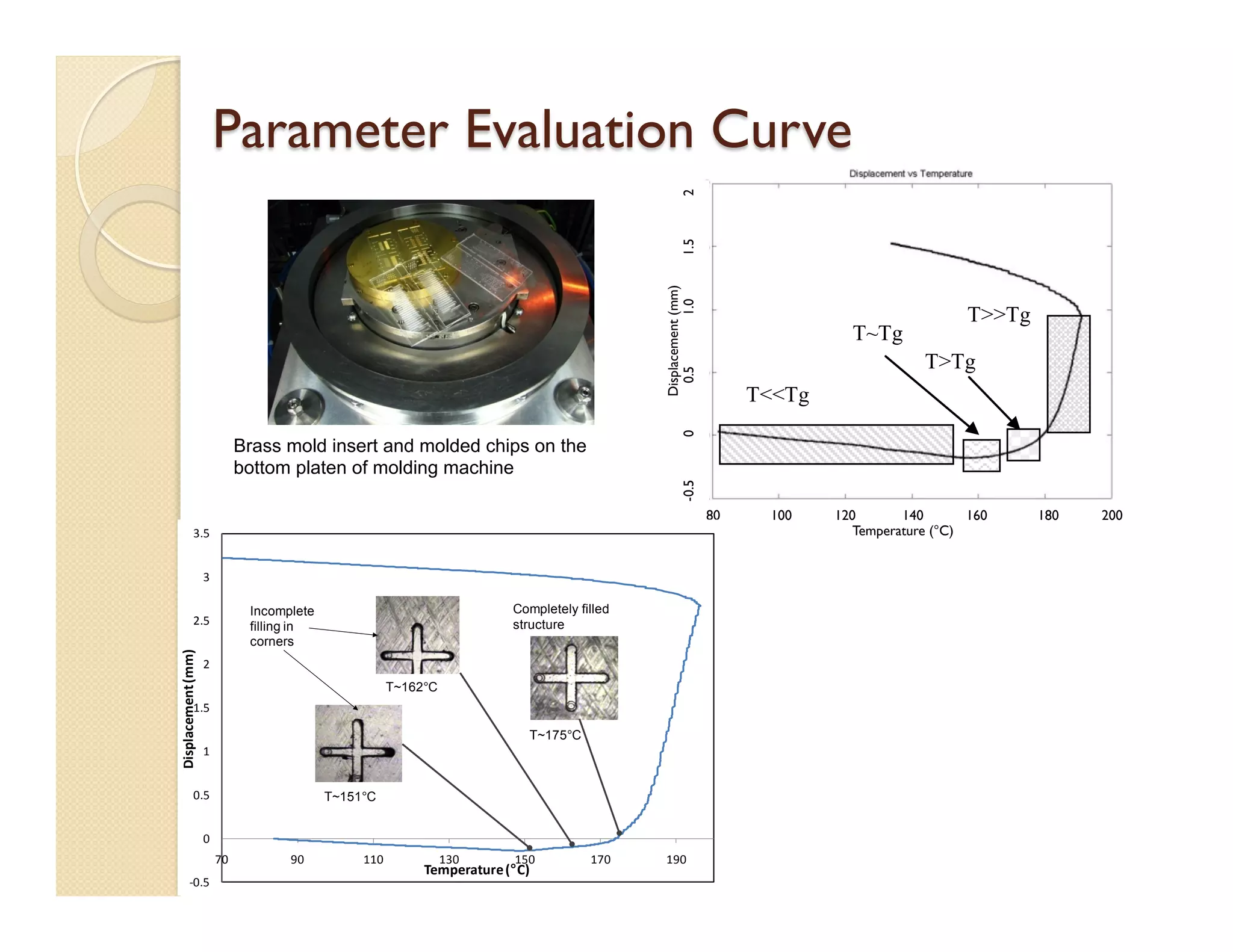
Parameter Evaluation Curve
Brass mold insert and molded chips on the
bottom platen of molding machine
T>>Tg
T<<Tg
T~Tg
T>Tg
80 100 120 140 160 180 200
Temperature (°C)
Displacement(mm)
-0.500.51.01.52
-­‐0.5
0
0.5
1
1.5
2
2.5
3
3.5
70 90 110 130 150 170 190
Displacement	
  (mm)
Temperature	
  (°C)
T~151°C
T~162°C
T~175°C
Incomplete
filling in
corners
Completely filled
structure
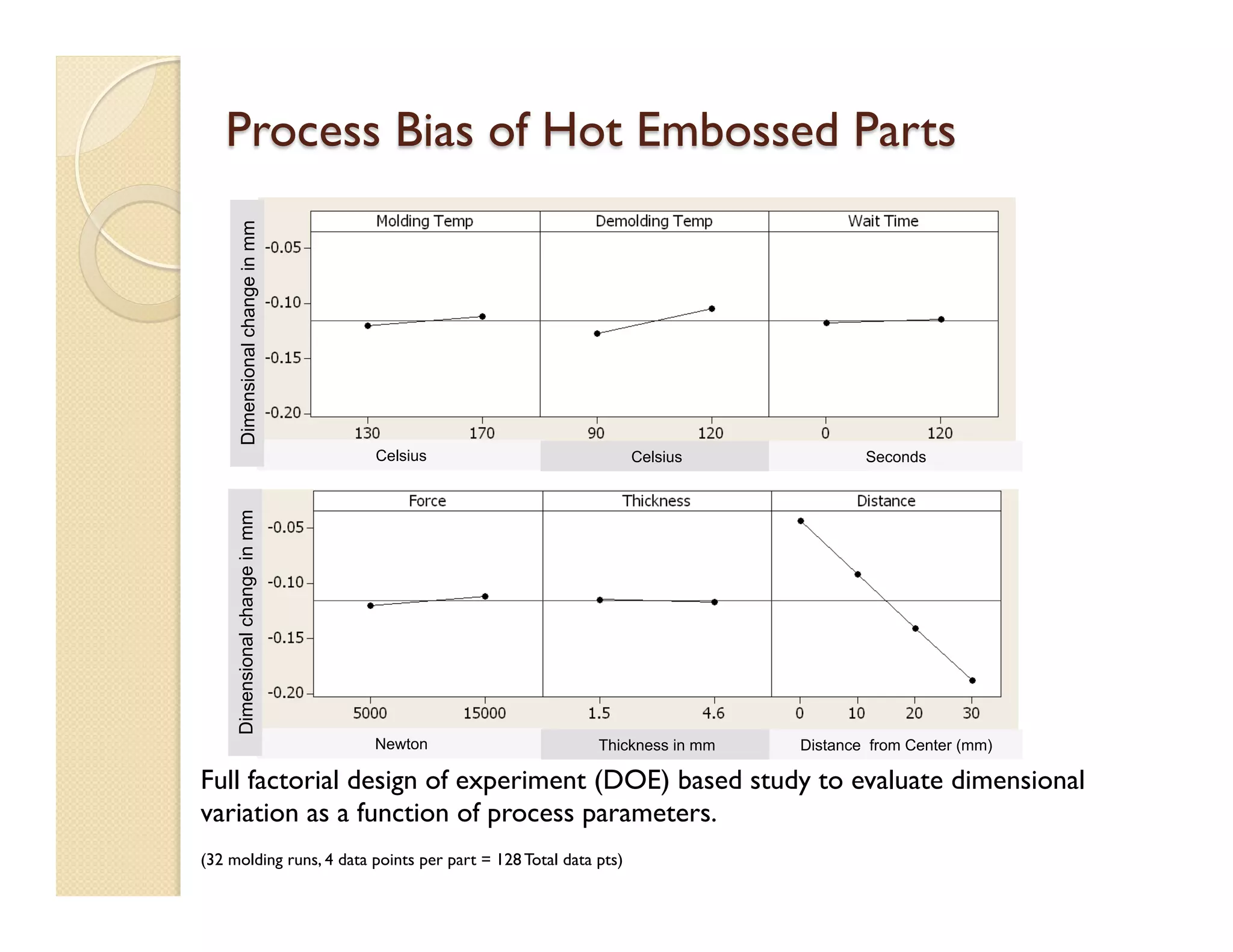
Process Bias of Hot Embossed Parts
Full factorial design of experiment (DOE) based study to evaluate dimensional
variation as a function of process parameters.
(32 molding runs, 4 data points per part = 128 Total data pts)
Newton Thickness in mm Distance from Center (mm)
Dimensionalchangeinmm
Celsius Celsius Seconds
Dimensionalchangeinmm
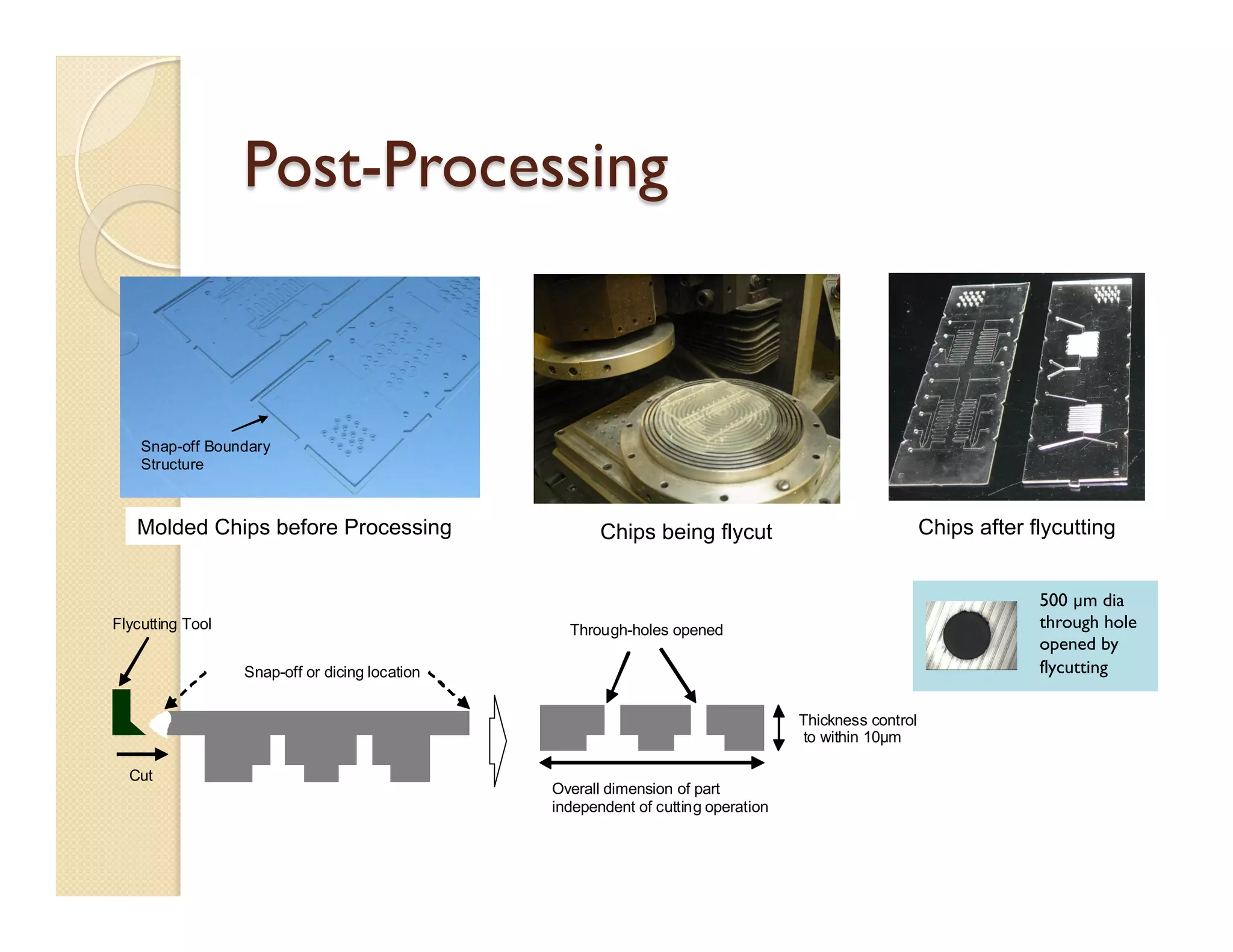
Post-Processing
Cut
Snap-off or dicing location
Flycutting Tool
Overall dimension of part
independent of cutting operation
Through-holes opened
Thickness control
to within 10µm
Snap-off Boundary
Structure
Molded Chips before Processing Chips being flycut Chips after flycutting
500 µm dia
through hole
opened by
flycutting
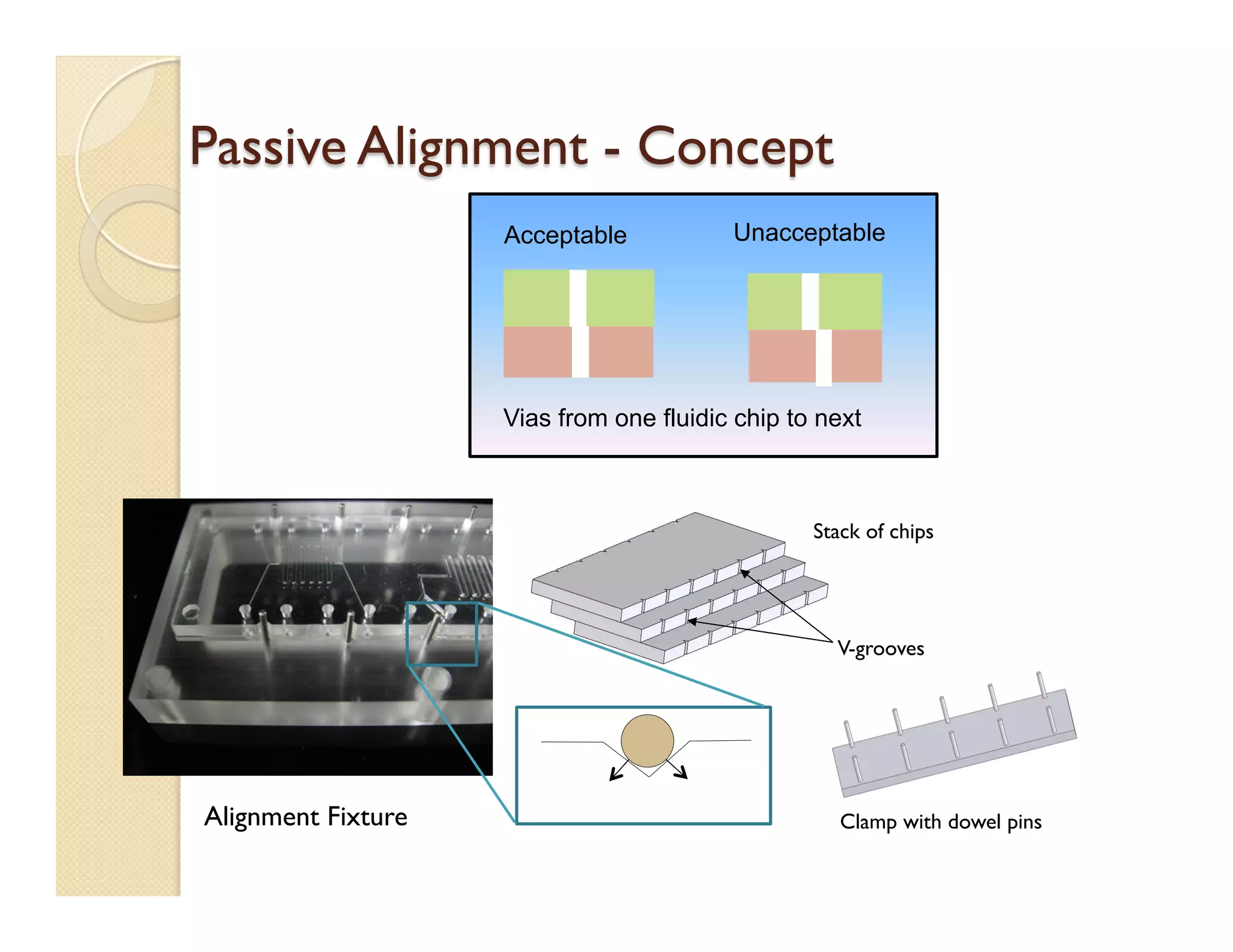
Passive Alignment - Concept
Clamp with dowel pins
Stack of chips
V-grooves
Acceptable Unacceptable
Vias from one fluidic chip to next
Alignment Fixture
Alignment Verification
Window
75.5 mm
25.5 mm
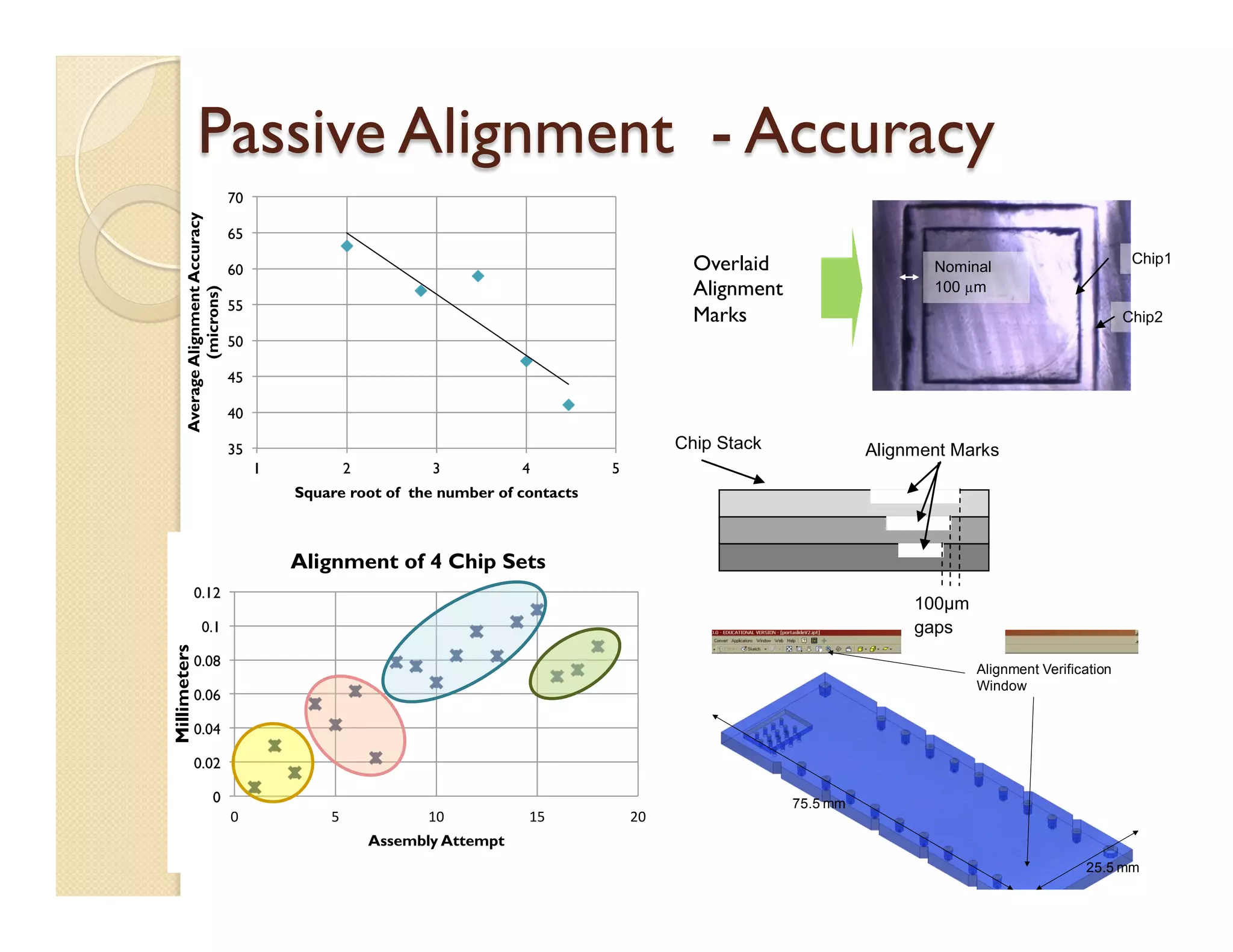
Passive Alignment - Accuracy
0
0.02
0.04
0.06
0.08
0.1
0.12
0	
   5	
   10	
   15	
   20	
  
Millimeters
Assembly Attempt
Alignment of 4 Chip Sets
Overlaid
Alignment
Marks
Nominal
100 µm
Chip2
Chip1
35
40
45
50
55
60
65
70
1 2 3 4 5
AverageAlignmentAccuracy
(microns)
Square root of the number of contacts
Chip Stack Alignment Marks
100µm
gaps
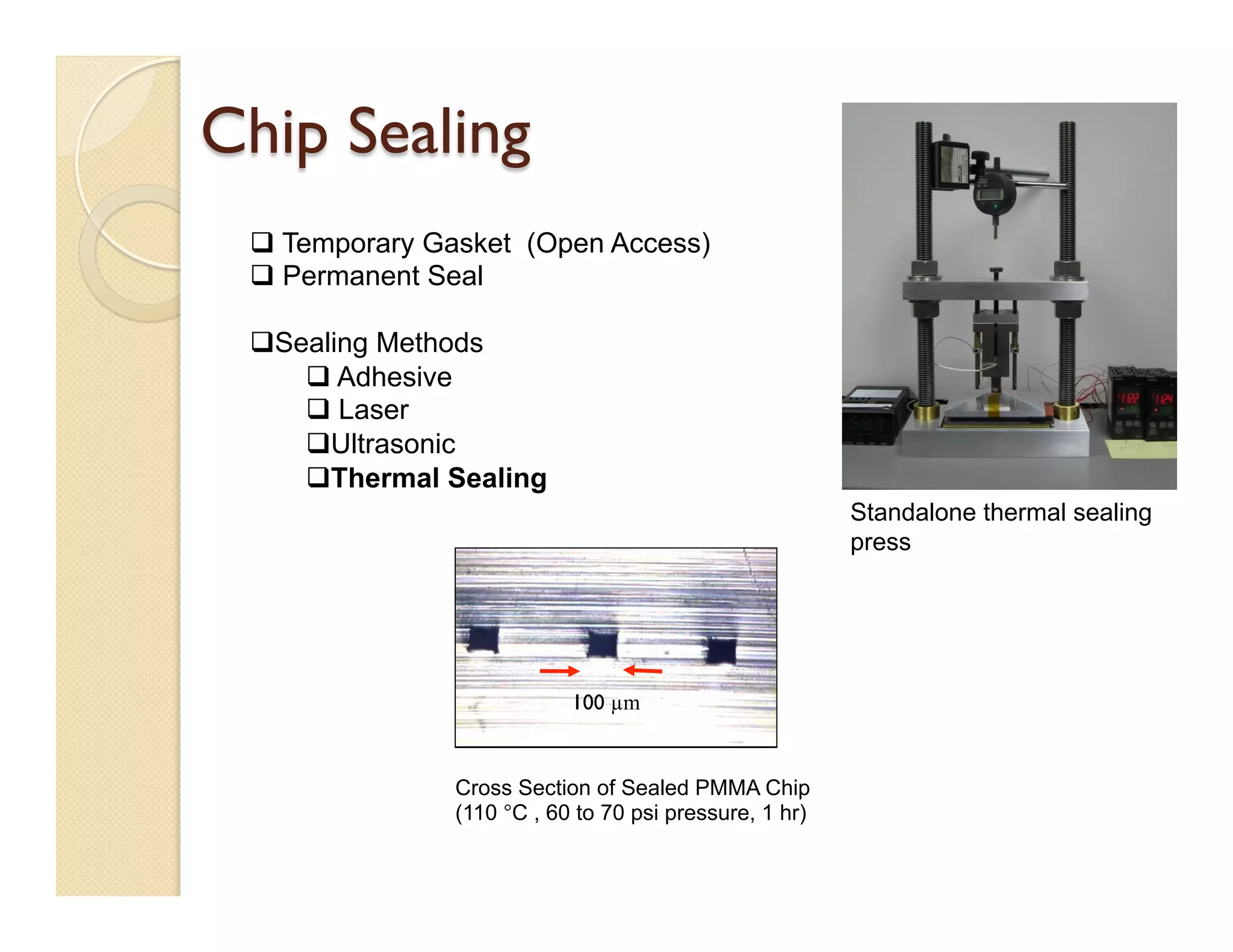
Chip Sealing
Cross Section of Sealed PMMA Chip
(110 °C , 60 to 70 psi pressure, 1 hr)
q Temporary Gasket (Open Access)
q Permanent Seal
q Sealing Methods
q Adhesive
q Laser
q Ultrasonic
q Thermal Sealing
Standalone thermal sealing
press
100 µm
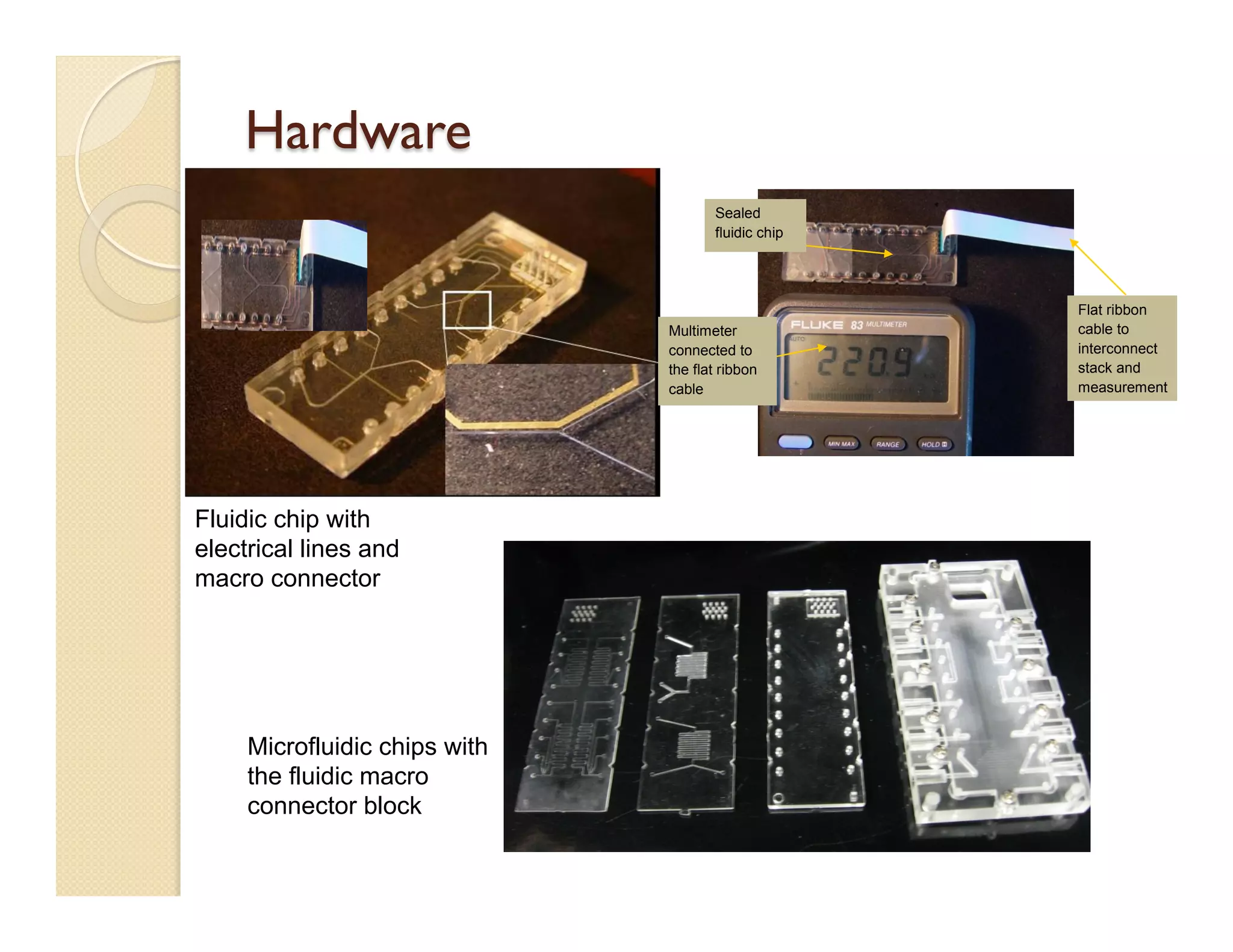
Hardware
Fluidic chip with
electrical lines and
macro connector
Microfluidic chips with
the fluidic macro
connector block
Sealed
fluidic chip
Multimeter
connected to
the flat ribbon
cable
Flat ribbon
cable to
interconnect
stack and
measurement
devices
 
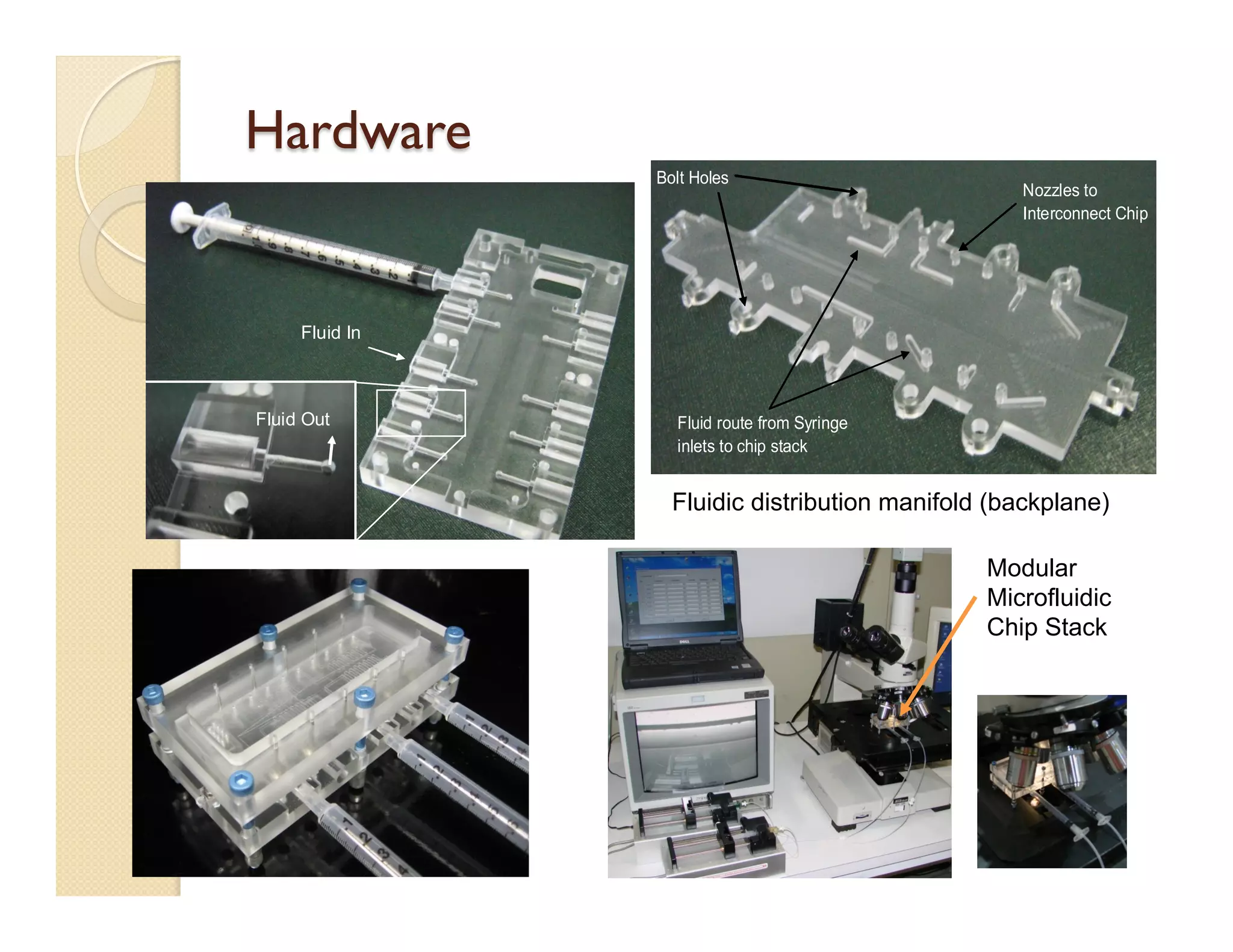
Fluid In
Fluid Out
	
  
Nozzles to
Interconnect Chip
Fluid route from Syringe
inlets to chip stack
Bolt Holes
Hardware
Fluidic distribution manifold (backplane)
Modular
Microfluidic
Chip Stack
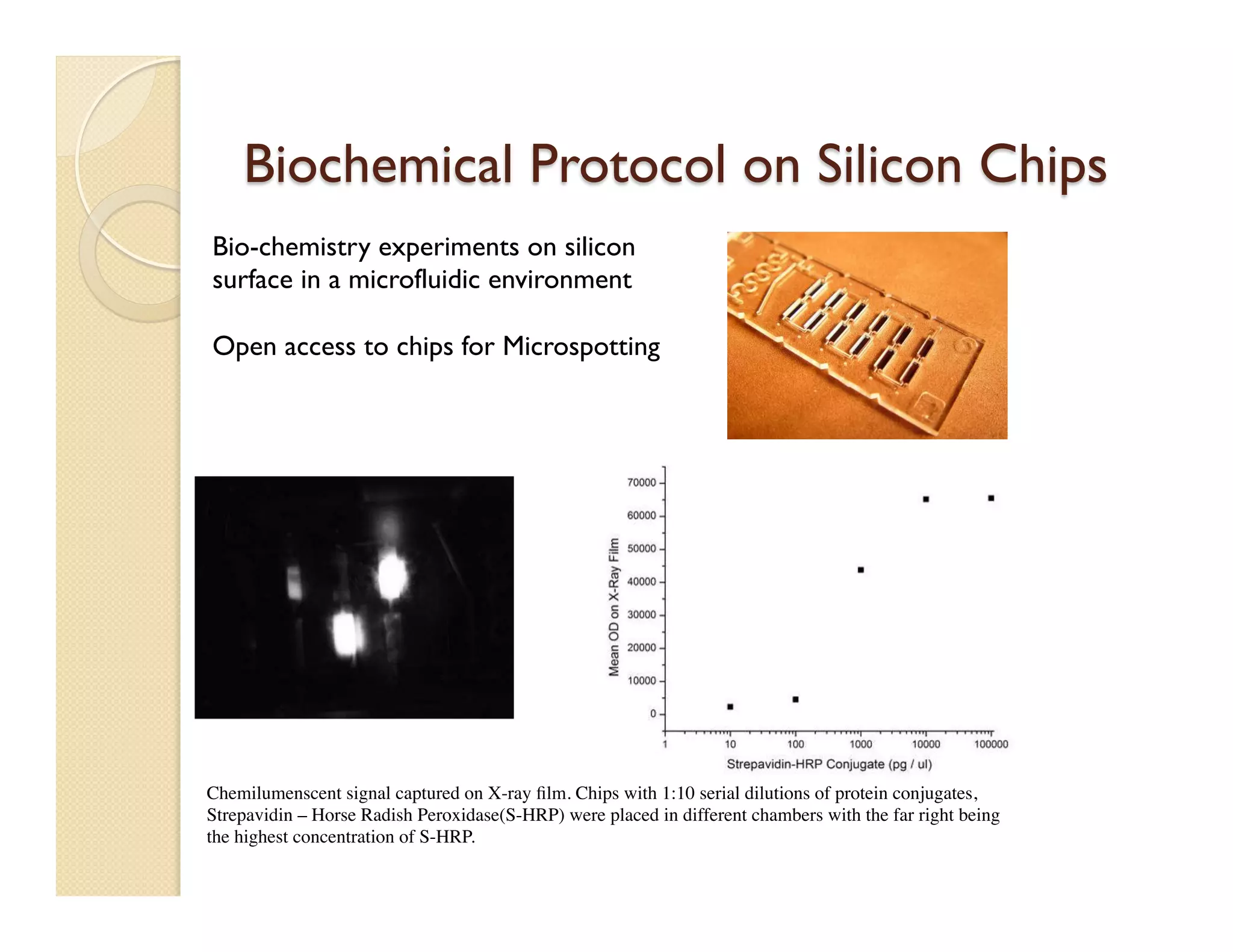
Biochemical Protocol on Silicon Chips
Chemilumenscent signal captured on X-ray film. Chips with 1:10 serial dilutions of protein conjugates,
Strepavidin – Horse Radish Peroxidase(S-HRP) were placed in different chambers with the far right being
the highest concentration of S-HRP.
Bio-chemistry experiments on silicon
surface in a microfluidic environment
Open access to chips for Microspotting
Application - Optical Waveguide
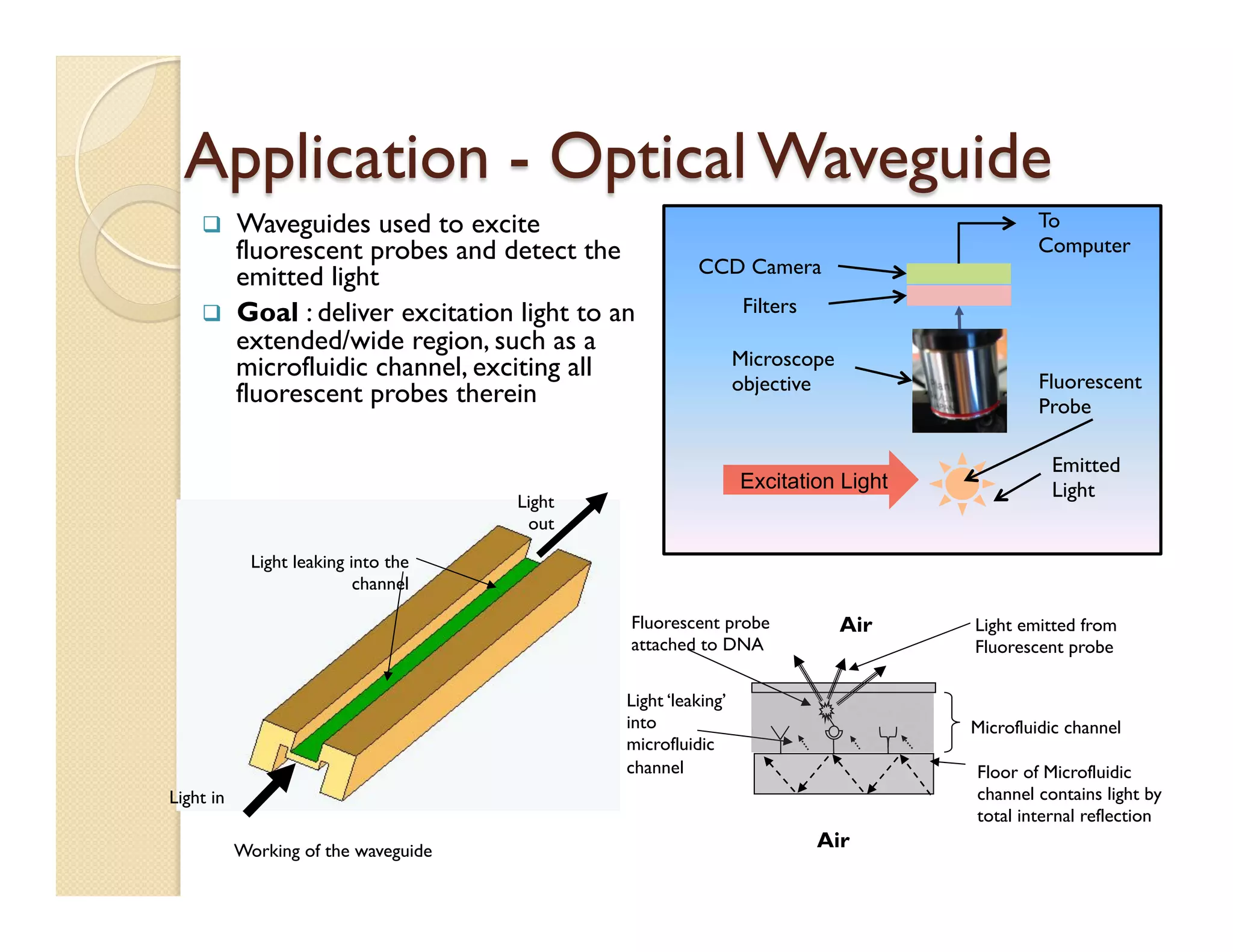
q  Waveguides used to excite
fluorescent probes and detect the
emitted light
q  Goal : deliver excitation light to an
extended/wide region, such as a
microfluidic channel, exciting all
fluorescent probes therein
Microscope
objective
Excitation Light
Fluorescent
Probe
Filters
CCD Camera
Emitted
Light
To
Computer
Light in
Light
out
Light leaking into the
channel
Working of the waveguide
Light emitted from
Fluorescent probe
Floor of Microfluidic
channel contains light by
total internal reflection
Microfluidic channel
Light ‘leaking’
into
microfluidic
channel
Fluorescent probe
attached to DNA
Air
Air
Application - Optical Waveguide
Waveguide
Fluidic ChannelTop mold
insert
Bottom mold
insert
Micro fluidic channel
Polymer
Air
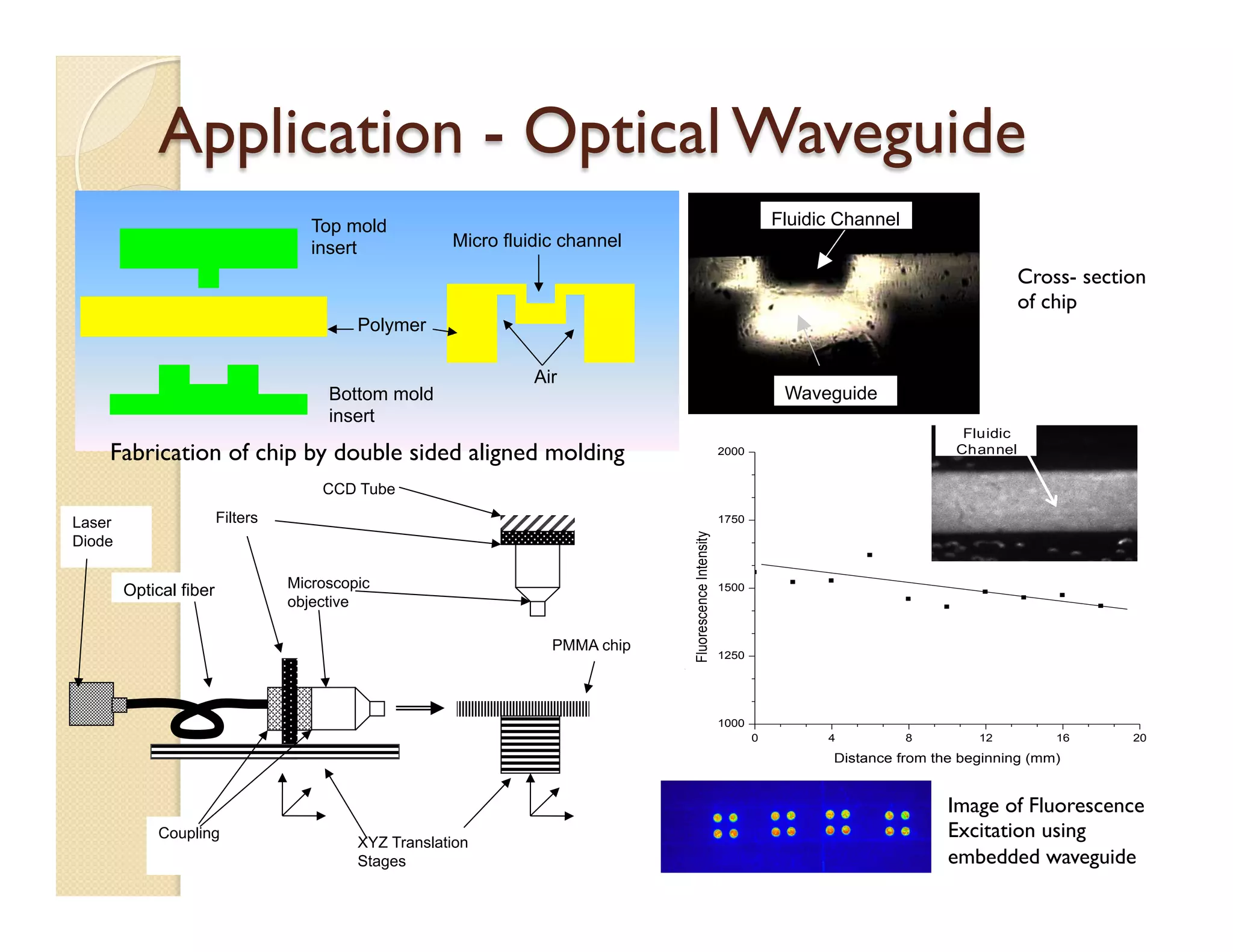
Fabrication of chip by double sided aligned molding
Image of Fluorescence
Excitation using
embedded waveguide
Cross- section
of chip
0 4 8 12 16 20
1000
1250
1500
1750
2000
FluorescenceIntensity
Distance from the beginning (mm)
Fluidic
Channel
Laser
Diode
Microscopic
objective
Filters
PMMA chip
XYZ Translation
Stages
Optical fiber
CCD Tube
Coupling
Application – Protein Crystallography
Oil
Precipitant
Protein
Electronic
Wiring for
feedback
Interconnect
Slide
Removable
Storage
Slide
Differentproportionsof
macromoleculeandprecipitantmix
Protein
MoleculesPrecipitant
Separating
fluid (oil)
Real time X-ray Spectroscopy of
Nanoparticles Creation Chemistry
Controlled Cell Growth
Other Applications
X-rays from
Synchrotron
Beamline
Detector
Reagents
Product
Microscope
Alignment
Optics
Summary
—  Microfluidic Development Platform
◦  Vertically stacked ,Modular chips
◦  User friendly
◦  Compatible w/ Standard Labware
—  Fabrication Technologies
◦  Mold insert
◦  Hot embossing
◦  Post Processing
—  Applications
◦  Bio Protocol
◦  Waveguide
◦  Protein Crystallography
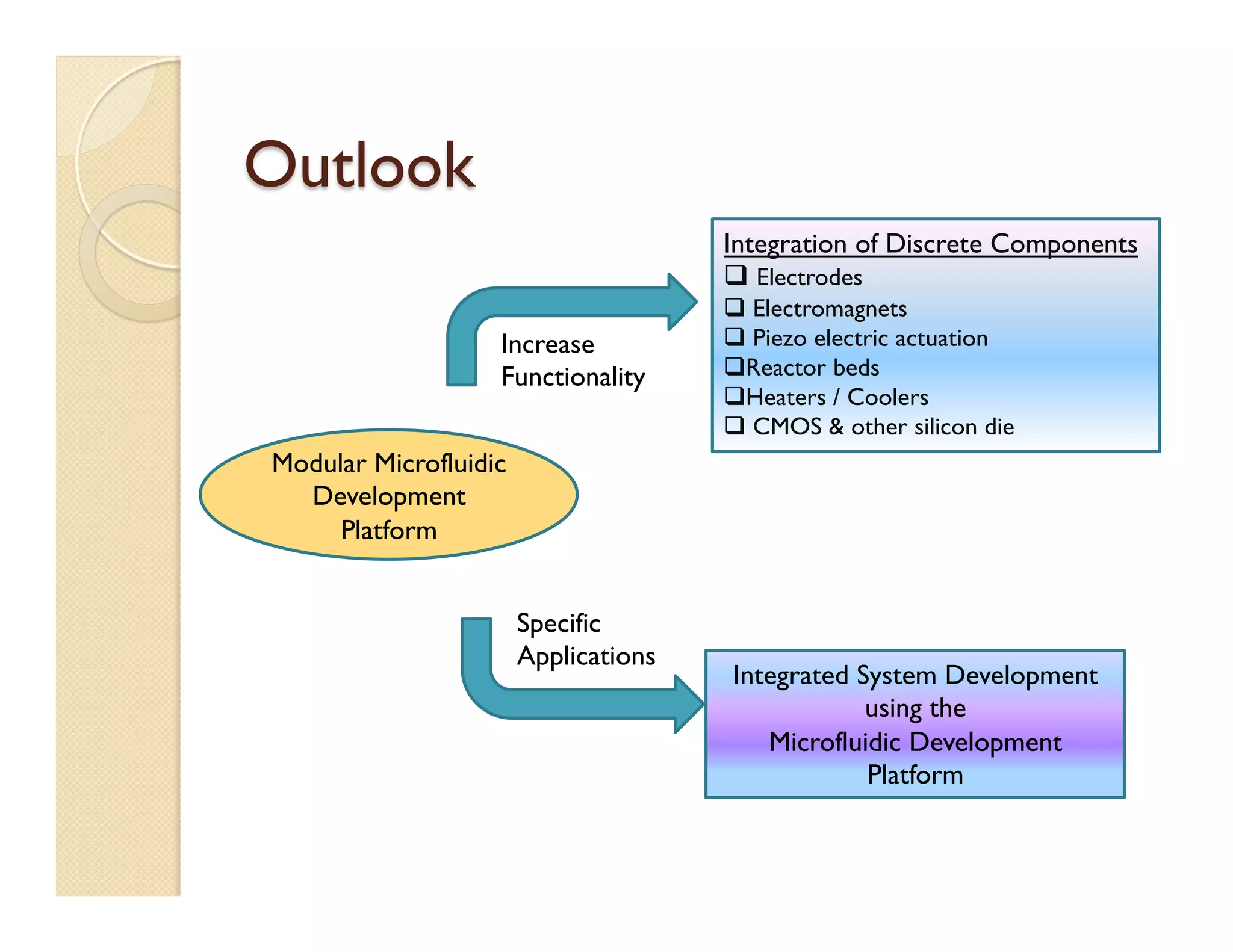
Outlook
Integration of Discrete Components
q Electrodes
q Electromagnets
q Piezo electric actuation
q Reactor beds
q Heaters / Coolers
q CMOS & other silicon die
Integrated System Development
using the
Microfluidic Development
Platform
Modular Microfluidic
Development
Platform
Increase
Functionality
Specific
Applications
ThankYou !

Datta PhD Defense 20 min presentation

  • 1.
    Modular, Polymeric Development Platformfor Microfluidic Applications - Design, Fabrication,Testing and Examples Proyag Datta PhD Thesis Presentation
  • 2.
    Microfluidics for Bio-MEMSApplications —  MEMS sensors for analysis of biological elements —  Applications ◦  Healthcare ◦  Defense ◦  Environment —  Critical Aspects ◦  Low Cost – Disposable ◦  Polymers ◦  Multi-domain Technology –  Bio-chemistry –  Microfluidics –  Electronics —  Transition from prototype to Mass Production I-Stat®
  • 3.
    ICs, Diode, Transistors TV, Radios Computers Prototype PCBs, Breadboard Mixers, Splitter, Pump, AgilentBio- Analyzer, I-Stat Components System Development Platform Micro-Electronics Microfluidics Analogy between Micro-Electronics and Microfluidics Missing Link : A development platform for Microfluidics
  • 4.
    Outline of thisPresentation q  Concept q  Fabrication q Mold Insert q Hot Embossing q Post Processing q  Applications q Surface Chemistry q Optical Waveguide q Protein Crystal Formation Thesis Goal: Design, build and test a general purpose microfluidic development platform
  • 5.
    q Flexible q Compatibility q User Friendly q Modular q Rapid Fabrication q LowCost Development Platform Platform Concept – Specifications Input Sample Preparation Reaction/ Processing/ Separation Detection/ Analysis Output
  • 6.
    Platform Concept § Individual functionalchips § Vertically assembly = Minimal dead volume § Passive Alignment of Chips § Electronics integration § Compatible w/ existing labware § Macro-Micro interconnections standardized Clamp Alignment Pins Electronic Connector Fluid Distribution Backplane Nozzles Syringe Ports Structural Block Modular Microfluidic Chip (MMC) Elements of Interconnect Block (ICB) Electronic Interconnect Macro-Micro Fluidic Ports Alignment Features Alignment Verification Window 75.5 mm 25.5 mm Region for Fluidic Layout
  • 7.
    Hot Embossing Jenoptik HEX02Hot Embossing Machine at CAMD
  • 8.
    Mold Molded Part LiGA Micromilling 50µm dia. Criteria • Cost • Turnaround Time • Surface Finish • Minimum feature • Geometry
  • 9.
    Parameter Evaluation Curve Brassmold insert and molded chips on the bottom platen of molding machine T>>Tg T<<Tg T~Tg T>Tg 80 100 120 140 160 180 200 Temperature (°C) Displacement(mm) -0.500.51.01.52 -­‐0.5 0 0.5 1 1.5 2 2.5 3 3.5 70 90 110 130 150 170 190 Displacement  (mm) Temperature  (°C) T~151°C T~162°C T~175°C Incomplete filling in corners Completely filled structure
  • 10.
    Process Bias ofHot Embossed Parts Full factorial design of experiment (DOE) based study to evaluate dimensional variation as a function of process parameters. (32 molding runs, 4 data points per part = 128 Total data pts) Newton Thickness in mm Distance from Center (mm) Dimensionalchangeinmm Celsius Celsius Seconds Dimensionalchangeinmm
  • 11.
    Post-Processing Cut Snap-off or dicinglocation Flycutting Tool Overall dimension of part independent of cutting operation Through-holes opened Thickness control to within 10µm Snap-off Boundary Structure Molded Chips before Processing Chips being flycut Chips after flycutting 500 µm dia through hole opened by flycutting
  • 12.
    Passive Alignment -Concept Clamp with dowel pins Stack of chips V-grooves Acceptable Unacceptable Vias from one fluidic chip to next Alignment Fixture
  • 13.
    Alignment Verification Window 75.5 mm 25.5mm Passive Alignment - Accuracy 0 0.02 0.04 0.06 0.08 0.1 0.12 0   5   10   15   20   Millimeters Assembly Attempt Alignment of 4 Chip Sets Overlaid Alignment Marks Nominal 100 µm Chip2 Chip1 35 40 45 50 55 60 65 70 1 2 3 4 5 AverageAlignmentAccuracy (microns) Square root of the number of contacts Chip Stack Alignment Marks 100µm gaps
  • 14.
    Chip Sealing Cross Sectionof Sealed PMMA Chip (110 °C , 60 to 70 psi pressure, 1 hr) q Temporary Gasket (Open Access) q Permanent Seal q Sealing Methods q Adhesive q Laser q Ultrasonic q Thermal Sealing Standalone thermal sealing press 100 µm
  • 15.
    Hardware Fluidic chip with electricallines and macro connector Microfluidic chips with the fluidic macro connector block Sealed fluidic chip Multimeter connected to the flat ribbon cable Flat ribbon cable to interconnect stack and measurement devices
  • 16.
      Fluid In Fluid Out   Nozzles to Interconnect Chip Fluid route from Syringe inlets to chip stack Bolt Holes Hardware Fluidic distribution manifold (backplane) Modular Microfluidic Chip Stack
  • 17.
    Biochemical Protocol onSilicon Chips Chemilumenscent signal captured on X-ray film. Chips with 1:10 serial dilutions of protein conjugates, Strepavidin – Horse Radish Peroxidase(S-HRP) were placed in different chambers with the far right being the highest concentration of S-HRP. Bio-chemistry experiments on silicon surface in a microfluidic environment Open access to chips for Microspotting
  • 18.
    Application - OpticalWaveguide q  Waveguides used to excite fluorescent probes and detect the emitted light q  Goal : deliver excitation light to an extended/wide region, such as a microfluidic channel, exciting all fluorescent probes therein Microscope objective Excitation Light Fluorescent Probe Filters CCD Camera Emitted Light To Computer Light in Light out Light leaking into the channel Working of the waveguide Light emitted from Fluorescent probe Floor of Microfluidic channel contains light by total internal reflection Microfluidic channel Light ‘leaking’ into microfluidic channel Fluorescent probe attached to DNA Air Air
  • 19.
    Application - OpticalWaveguide Waveguide Fluidic ChannelTop mold insert Bottom mold insert Micro fluidic channel Polymer Air Fabrication of chip by double sided aligned molding Image of Fluorescence Excitation using embedded waveguide Cross- section of chip 0 4 8 12 16 20 1000 1250 1500 1750 2000 FluorescenceIntensity Distance from the beginning (mm) Fluidic Channel Laser Diode Microscopic objective Filters PMMA chip XYZ Translation Stages Optical fiber CCD Tube Coupling
  • 20.
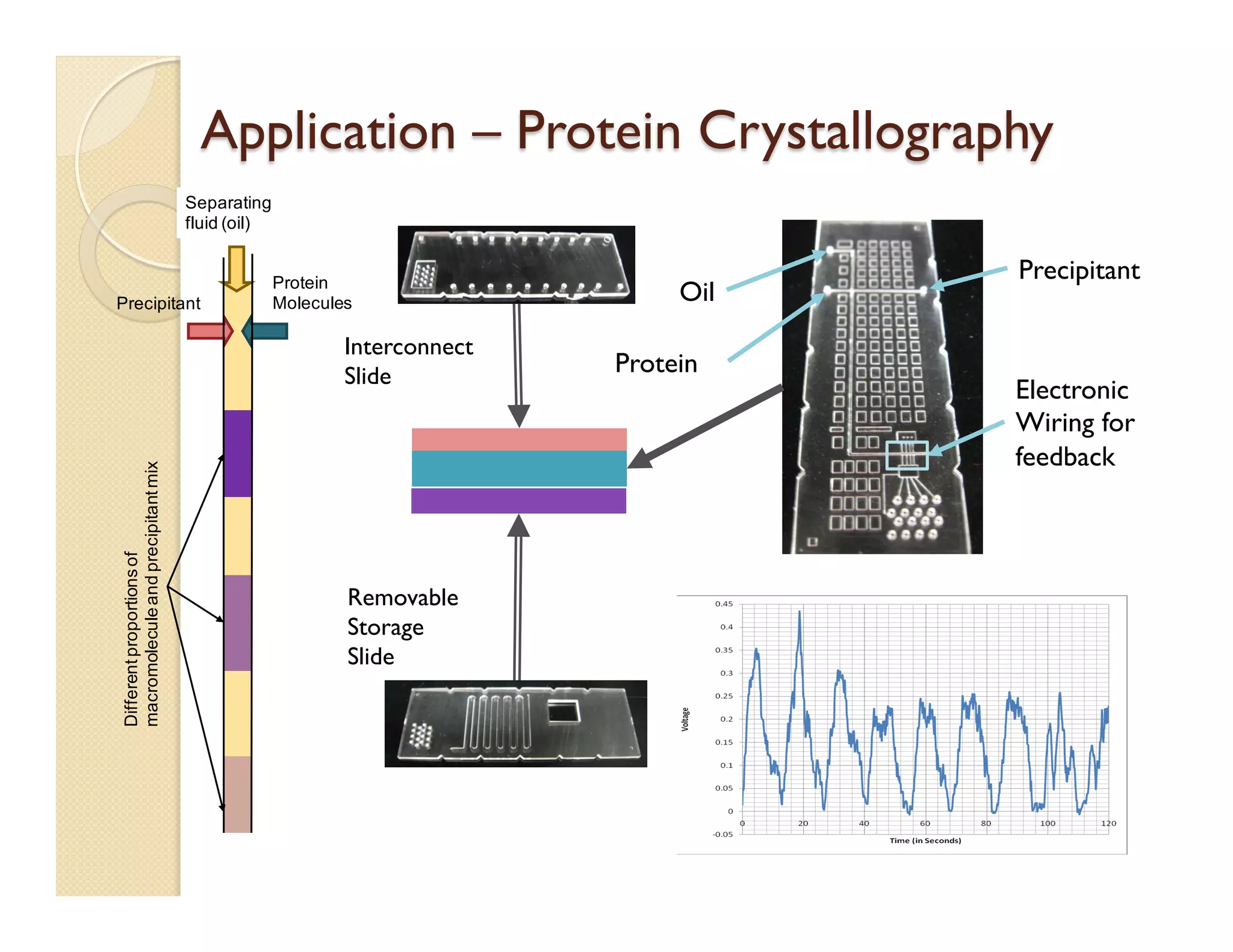
    Application – ProteinCrystallography Oil Precipitant Protein Electronic Wiring for feedback Interconnect Slide Removable Storage Slide Differentproportionsof macromoleculeandprecipitantmix Protein MoleculesPrecipitant Separating fluid (oil)
  • 21.
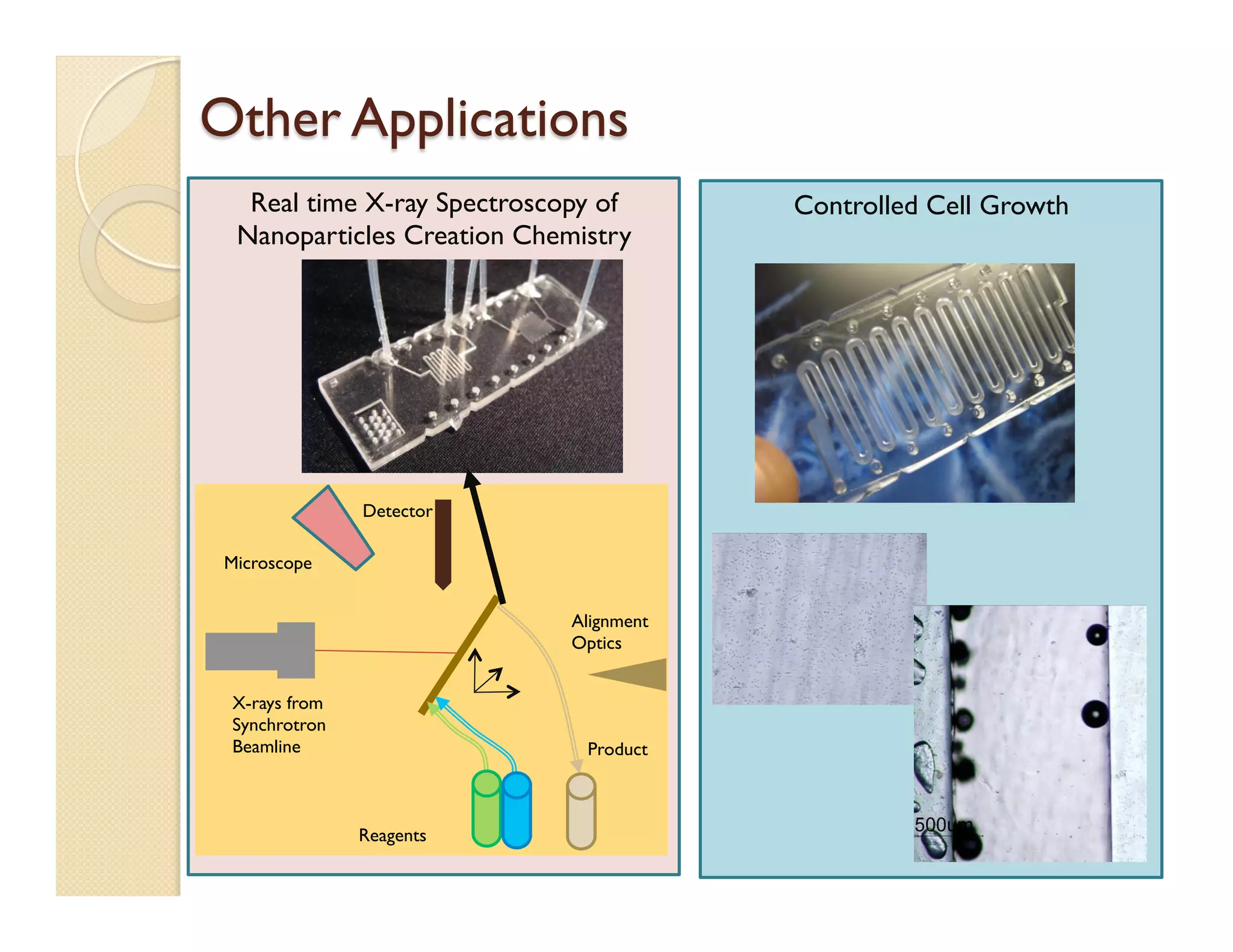
    Real time X-raySpectroscopy of Nanoparticles Creation Chemistry Controlled Cell Growth Other Applications X-rays from Synchrotron Beamline Detector Reagents Product Microscope Alignment Optics
  • 22.
    Summary —  Microfluidic DevelopmentPlatform ◦  Vertically stacked ,Modular chips ◦  User friendly ◦  Compatible w/ Standard Labware —  Fabrication Technologies ◦  Mold insert ◦  Hot embossing ◦  Post Processing —  Applications ◦  Bio Protocol ◦  Waveguide ◦  Protein Crystallography
  • 23.
    Outlook Integration of DiscreteComponents q Electrodes q Electromagnets q Piezo electric actuation q Reactor beds q Heaters / Coolers q CMOS & other silicon die Integrated System Development using the Microfluidic Development Platform Modular Microfluidic Development Platform Increase Functionality Specific Applications
  • 24.