Data + Design
Humanizing Data To Create Living Services
”Nine out of 10 companies
are investing in data yet the
return on that investment
remains elusive.”
Consumers, and increasingly business users,
are demanding more contextualized,
personalized services, but brands are
challenged to deliver them.
Context is key
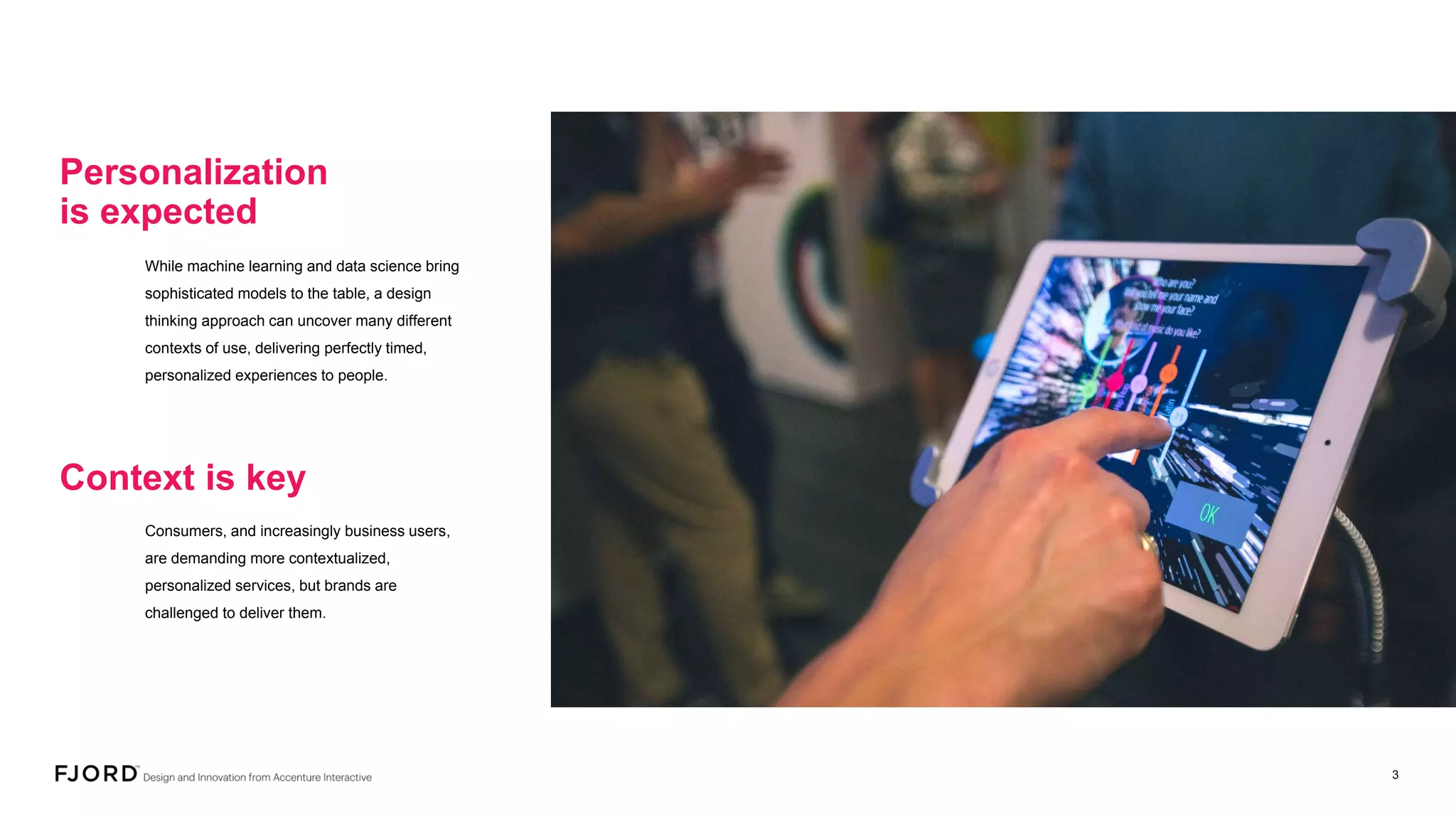
While machine learning and data science bring
sophisticated models to the table, a design
thinking approach can uncover many different
contexts of use, delivering perfectly timed,
personalized experiences to people.
Personalization
is expected
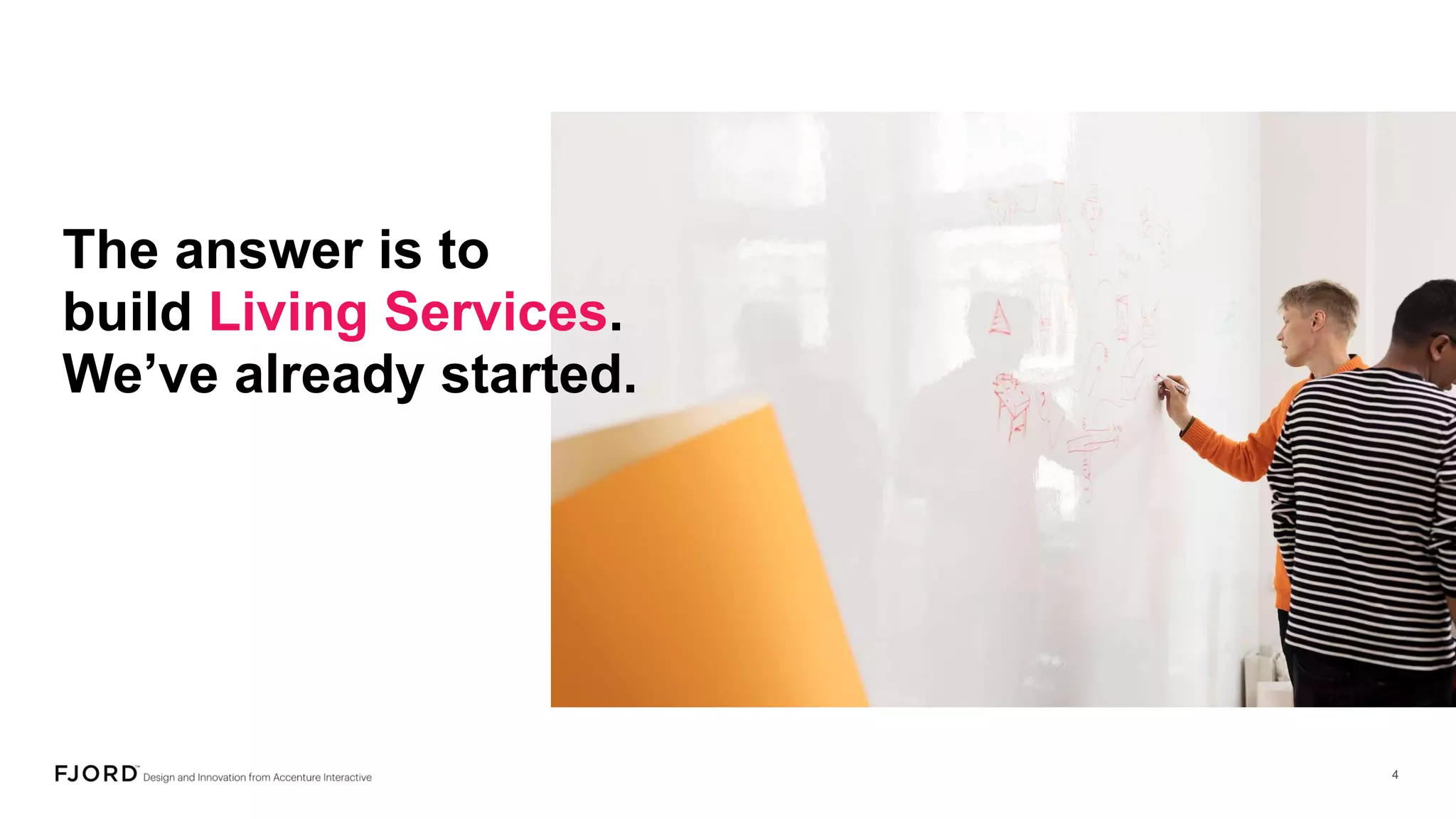
The answer is to
build Living Services.
We’ve already started.
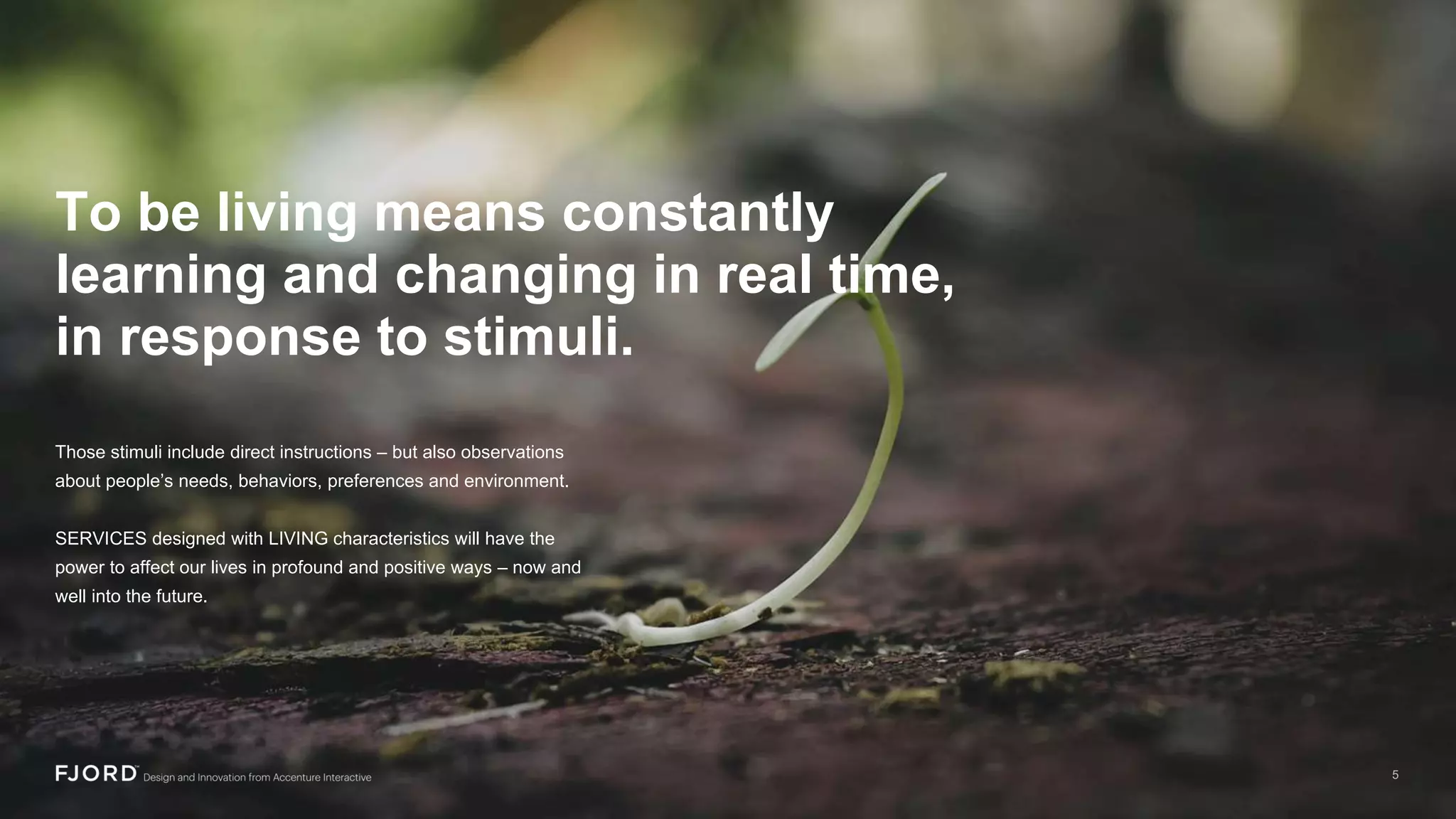
To be living means constantly
learning and changing in real time,
in response to stimuli.
Those stimuli include direct instructions – but also observations
about people’s needs, behaviors, preferences and environment.
SERVICES designed with LIVING characteristics will have the
power to affect our lives in profound and positive ways – now and
well into the future.
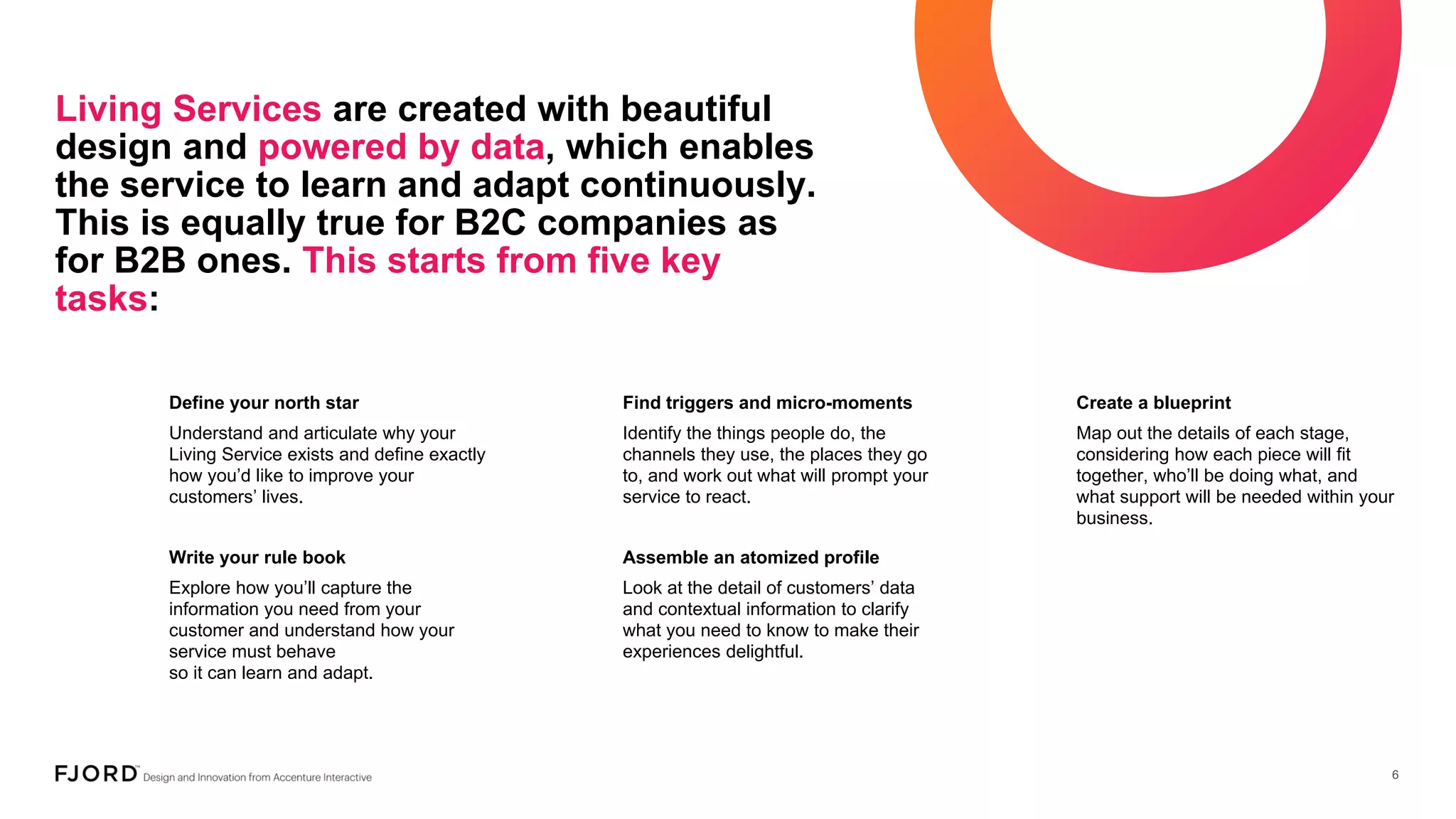
Living Services are created with beautiful
design and powered by data, which enables
the service to learn and adapt continuously.
This is equally true for B2C companies as
for B2B ones. This starts from five key
tasks:
Define your north star
Understand and articulate why your
Living Service exists and define exactly
how you’d like to improve your
customers’ lives.
Write your rule book
Explore how you’ll capture the
information you need from your
customer and understand how your
service must behave
so it can learn and adapt.
Find triggers and micro-moments
Identify the things people do, the
channels they use, the places they go
to, and work out what will prompt your
service to react.
Assemble an atomized profile
Look at the detail of customers’ data
and contextual information to clarify
what you need to know to make their
experiences delightful.
Create a blueprint
Map out the details of each stage,
considering how each piece will fit
together, who’ll be doing what, and
what support will be needed within your
business.
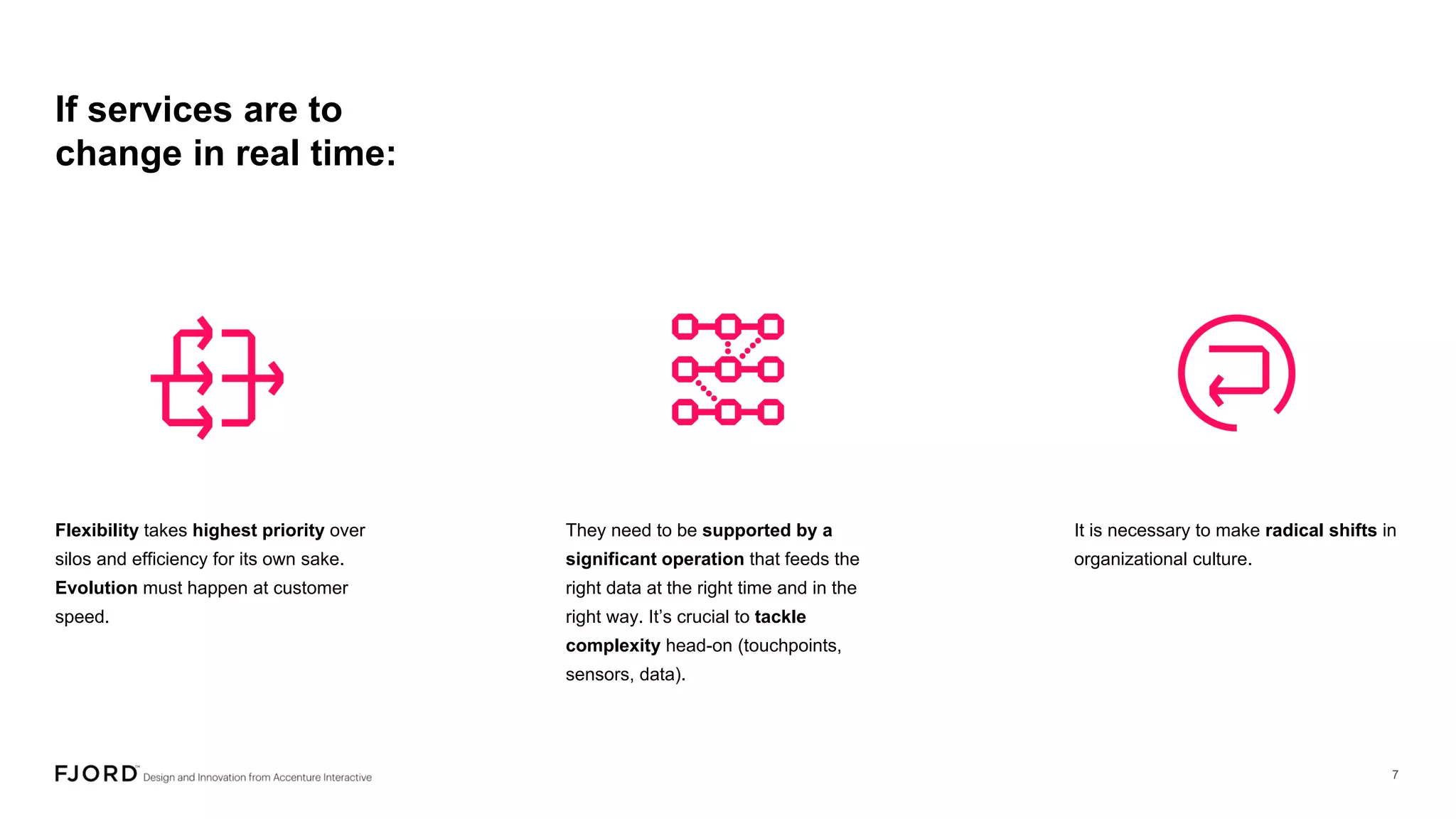
If services are to
change in real time:
Flexibility takes highest priority over
silos and efficiency for its own sake.
Evolution must happen at customer
speed.
They need to be supported by a
significant operation that feeds the
right data at the right time and in the
right way. It’s crucial to tackle
complexity head-on (touchpoints,
sensors, data).
It is necessary to make radical shifts in
organizational culture.
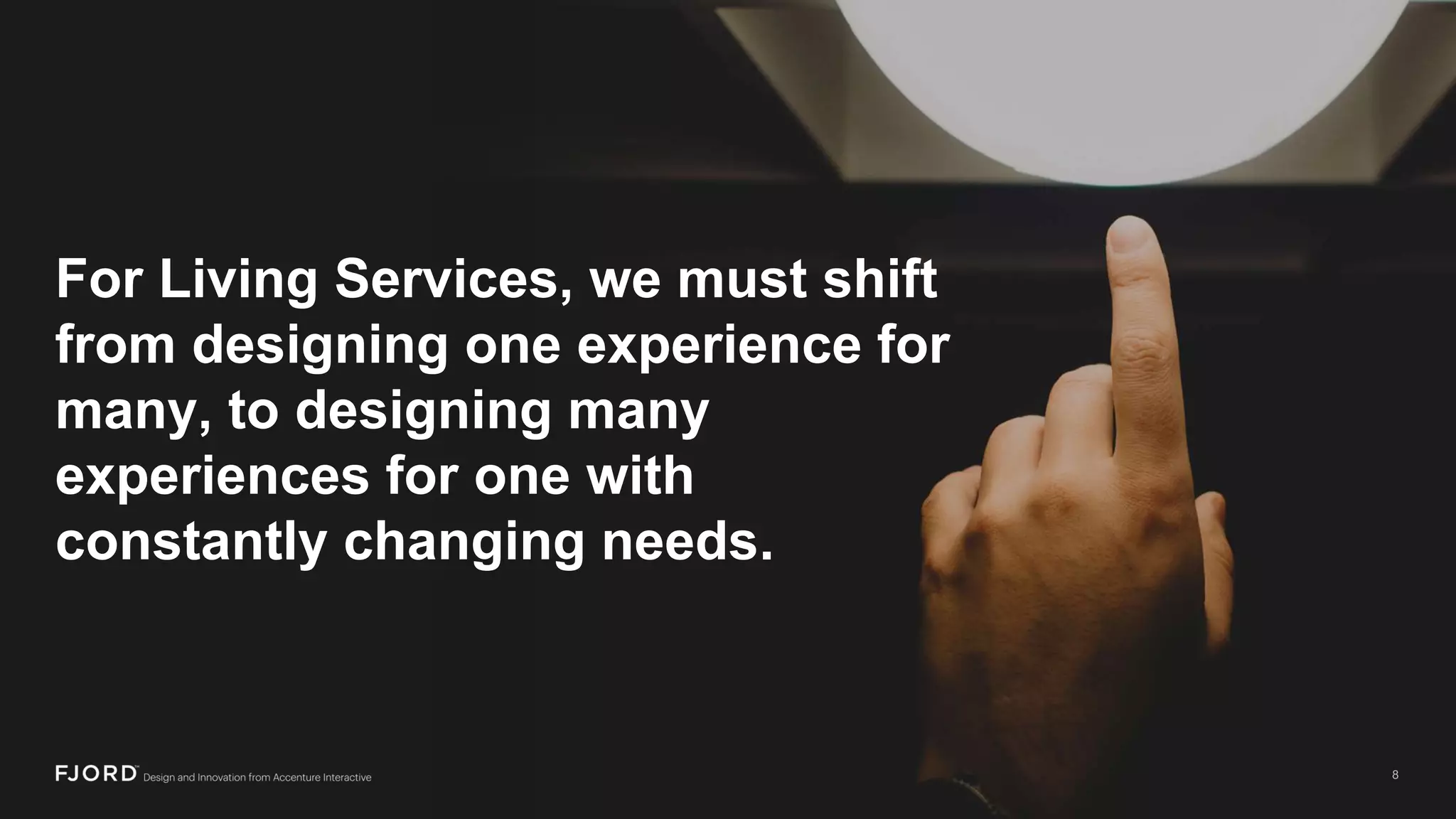
For Living Services, we must shift
from designing one experience for
many, to designing many
experiences for one with
constantly changing needs.
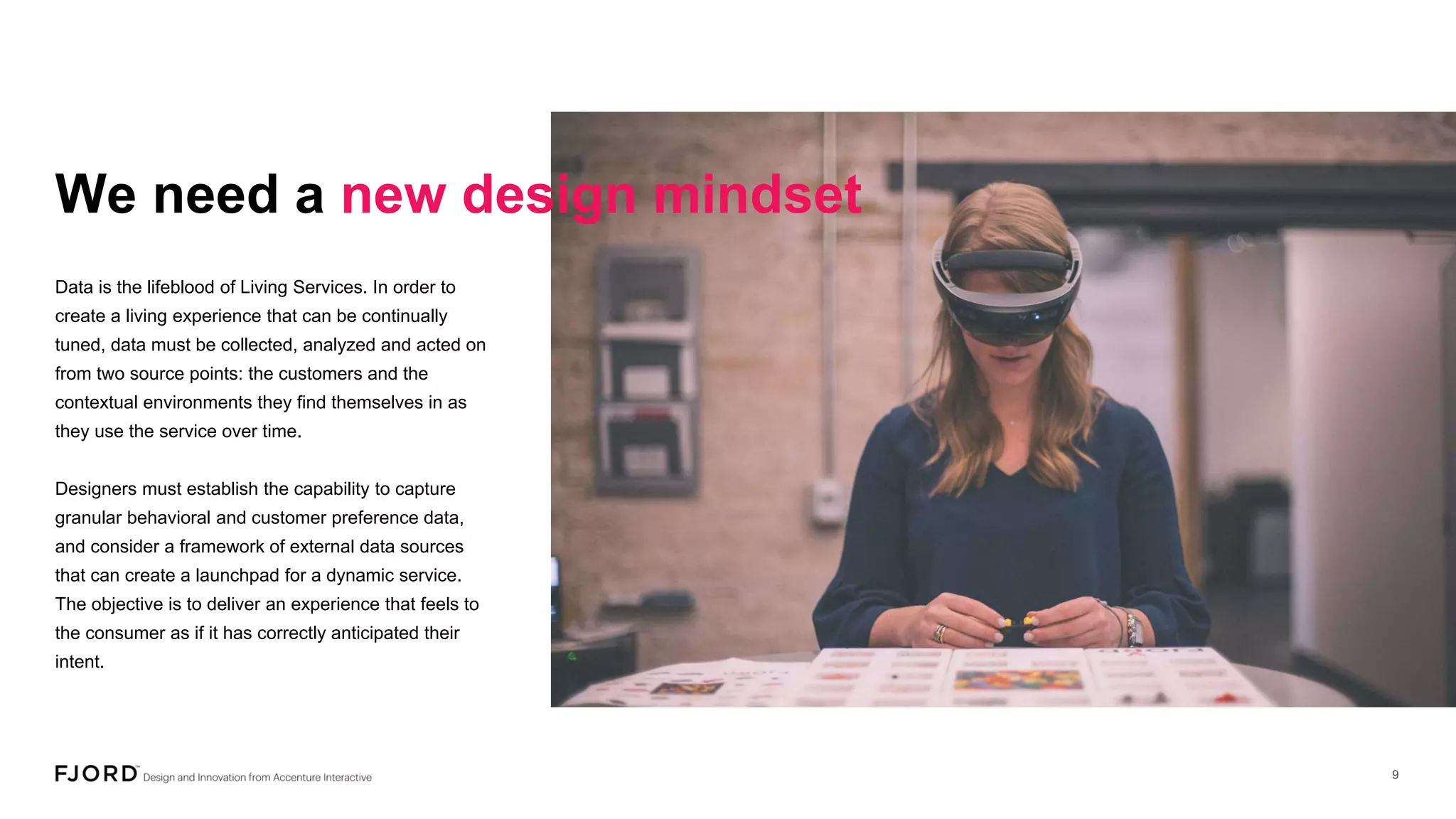
We need a new design mindset
Data is the lifeblood of Living Services. In order to
create a living experience that can be continually
tuned, data must be collected, analyzed and acted on
from two source points: the customers and the
contextual environments they find themselves in as
they use the service over time.
Designers must establish the capability to capture
granular behavioral and customer preference data,
and consider a framework of external data sources
that can create a launchpad for a dynamic service.
The objective is to deliver an experience that feels to
the consumer as if it has correctly anticipated their
intent.
A Data + Design
approach that
humanizes data
…to converting
insights into actions
and experiences
Shifts the focus from data
and analysis…
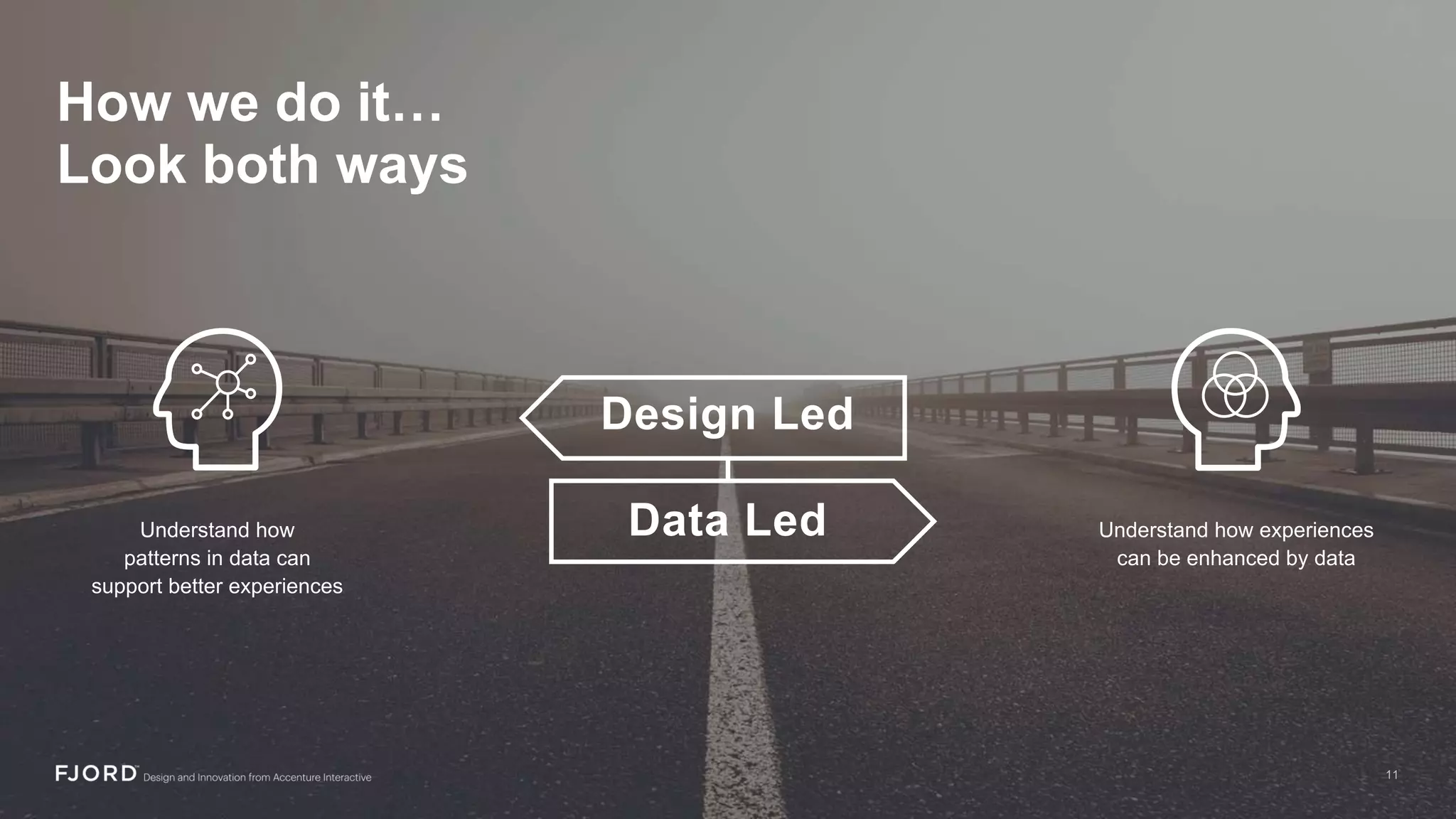
Understand how experiences
can be enhanced by data
How we do it…
Look both ways
Understand how
patterns in data can
support better experiences
Design Led
Data Led
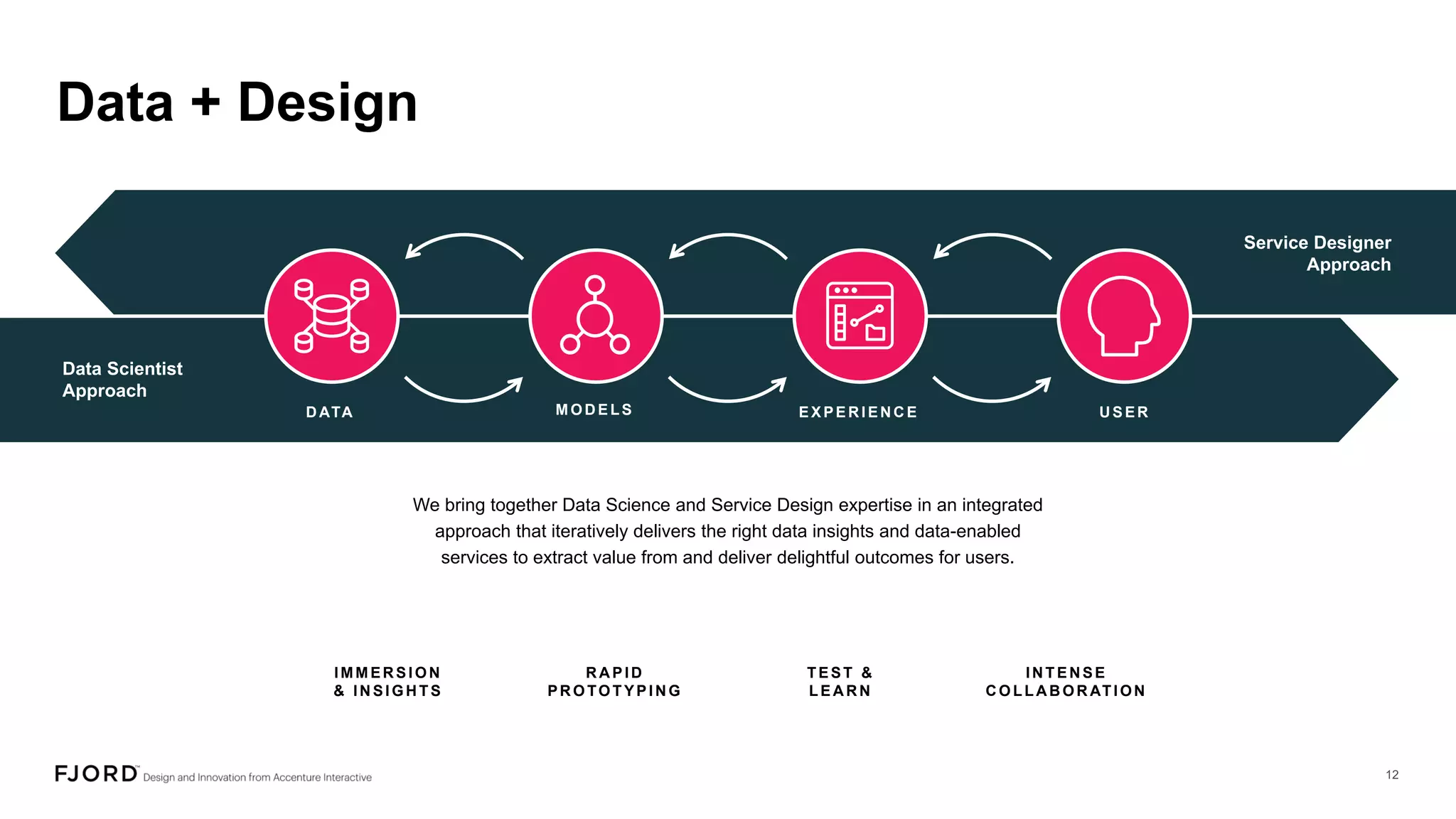
Data + Design
We bring together Data Science and Service Design expertise in an integrated
approach that iteratively delivers the right data insights and data-enabled
services to extract value from and deliver delightful outcomes for users.
U SERMODELSD ATA EXPER IEN C E
R A PID
PR OTOTYPIN G
TEST &
LEA R N
IMMER SION
& IN SIGH TS
IN TEN SE
C OLLA B OR ATION
Data Scientist
Approach
Service Designer
Approach
Design-led
questions:
• What do we wish we knew about each
customer?
• If we knew everything, what new services
would we create? What would we
anticipate? How would we flex the
experience for each consumer?
• How do we design to learn each user’s
intent, context and attitudes?
Data-led
questions:
• What do we know about our customers that
no one else does?
• What needs and changes do we anticipate?
What additional data do we need to
anticipate better?
• How do we build millions of segments of
one? Can we incorporate new data
sources?
We ask…
A Data + Design
approach to
Living Services
Design
For Data
Apply data layers to every design
artifact. Define how sensing,
reaction, feedback and evolution is
designed into your service.
Design
With Data
Augment qualitative research with
quantitative analysis to gain a
more holistic understanding of our
users. Aim to create dynamic
digital footprints.
Design
By Data
Using data as a raw material in our
creative process. Sketch with code
and use generative technologies in
our experiments.
Understand
We blend digital footprints with
quantitative and qualitative
research to get a more holistic
understanding of our users.​
Get
We leverage transactional level
data stored in our clients'
databases, publicly-available data,
or data that we capture in
research. ​
Apply
Designing with data is about
overlaying concepts and designs
with data that is available, either
internally or externally.
Design
With Data
Design
For Data
Plan
As we build roadmaps for products
and services, we build in
instrumentation so data collections
are an integral part of product and
service strategies.
Collect
We can design how we collect
data, such as, with sensors either
physically or digitally, and plan
data sharing partnerships.
Profile
Designing for data also sets up the
analytics to refine the value of the
underlying data.
We use tools like the customer
genome and contextual awareness
to bring multiple data sets together
to create an understanding of our
customers and their context.
Design
By Data
Personalize
The atomized Profile is the ever-
changing dynamic profile of your
customers’ preferences, context,
history, needs and wants.
It contains data that is relevant to
your customers as well as the
environment around them. It’s
based on historical interaction data
and the instrumentation of
services.
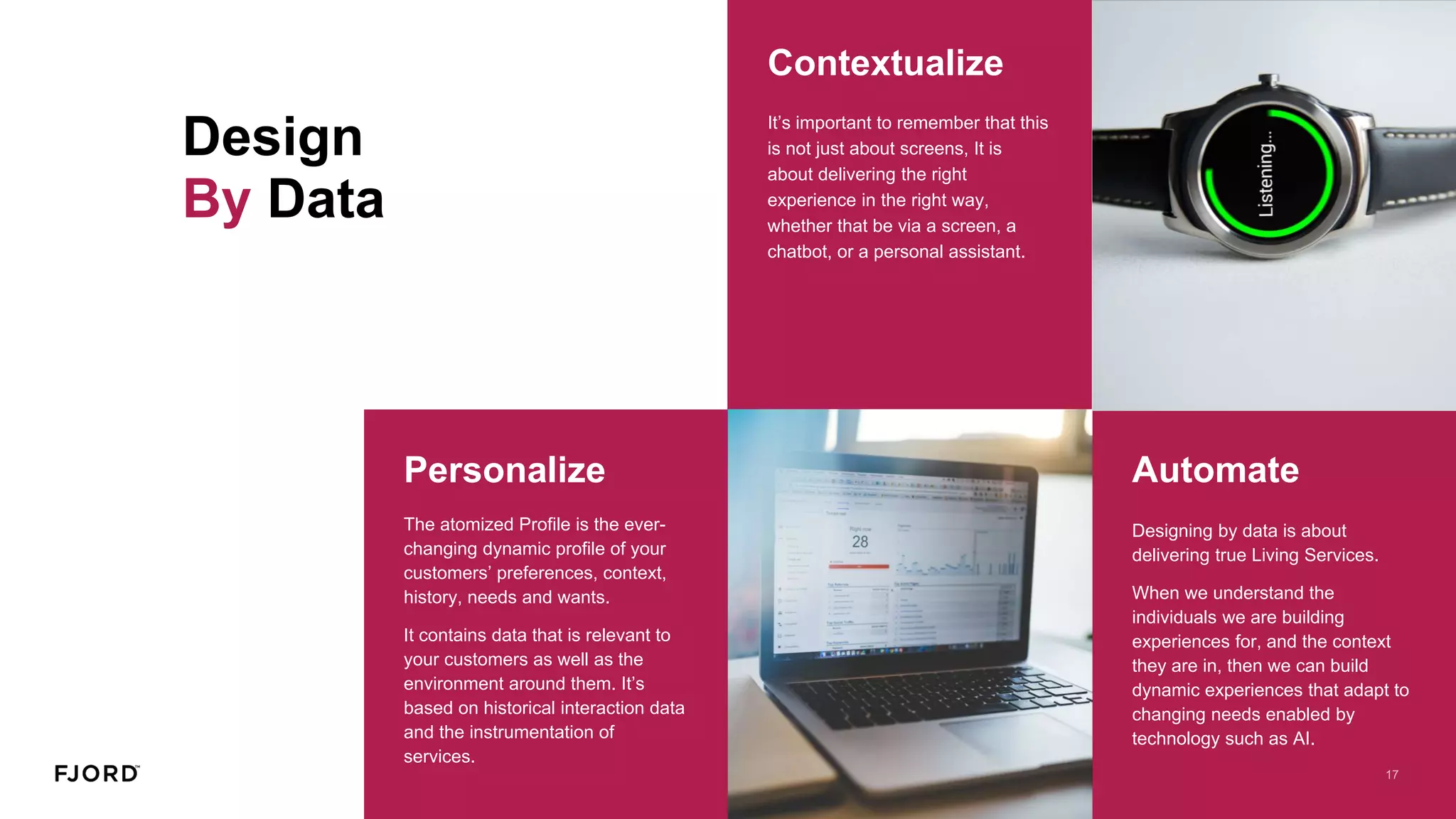
Contextualize
It’s important to remember that this
is not just about screens, It is
about delivering the right
experience in the right way,
whether that be via a screen, a
chatbot, or a personal assistant.
Automate
Designing by data is about
delivering true Living Services.
When we understand the
individuals we are building
experiences for, and the context
they are in, then we can build
dynamic experiences that adapt to
changing needs enabled by
technology such as AI.
Data + Design
answers the
following:
I have created the data platform.
How can I get my organization to adopt and use the
data insights I provide to make better decisions?
Personalization is important.
How can I enhance my existing products and
services using data to create better experiences
for my customers?
Artificial Intelligence.
How can I use it to create new services that anticipate
customer needs?
Worldwide Telco
(WWT)
C A SE STU D Y
B R IEF
How can WWT increase
data consumption?
Fjord and Accenture Analytics
co-developed an interactive story
based around 3D visualizations and
decision-assistance tools showcasing:
The project crystalized the role of the
Chief Analytics Officer and Data
Science team to the Executive
Committee.
• Which customer through
• Which apps on
• Which device
• When to contact them
• Where to push the notifications
A PPR OA C H IMPA C T
Global Beverage
Producer
How can GBP identify and
address brand specific
loyalty deterioration?
Fjord and Accenture Tech Labs leveraged a cross-
disciplinary team to design and develop a mobile
analytics experience which:
The prototype distilled a clear
decision-making process that enabled
direct and efficient diagnosis of
performance issues. This project
therefore illustrated the power and
benefit of a well-design data analysis
experience.
• Revealed acute issues
with brand performance
• Enabled analysis by focusing
on relevant data
• Unlocked insights by researching analysts’
needs
C A SE STU D Y
B R IEF A PPR OA C H IMPA C T
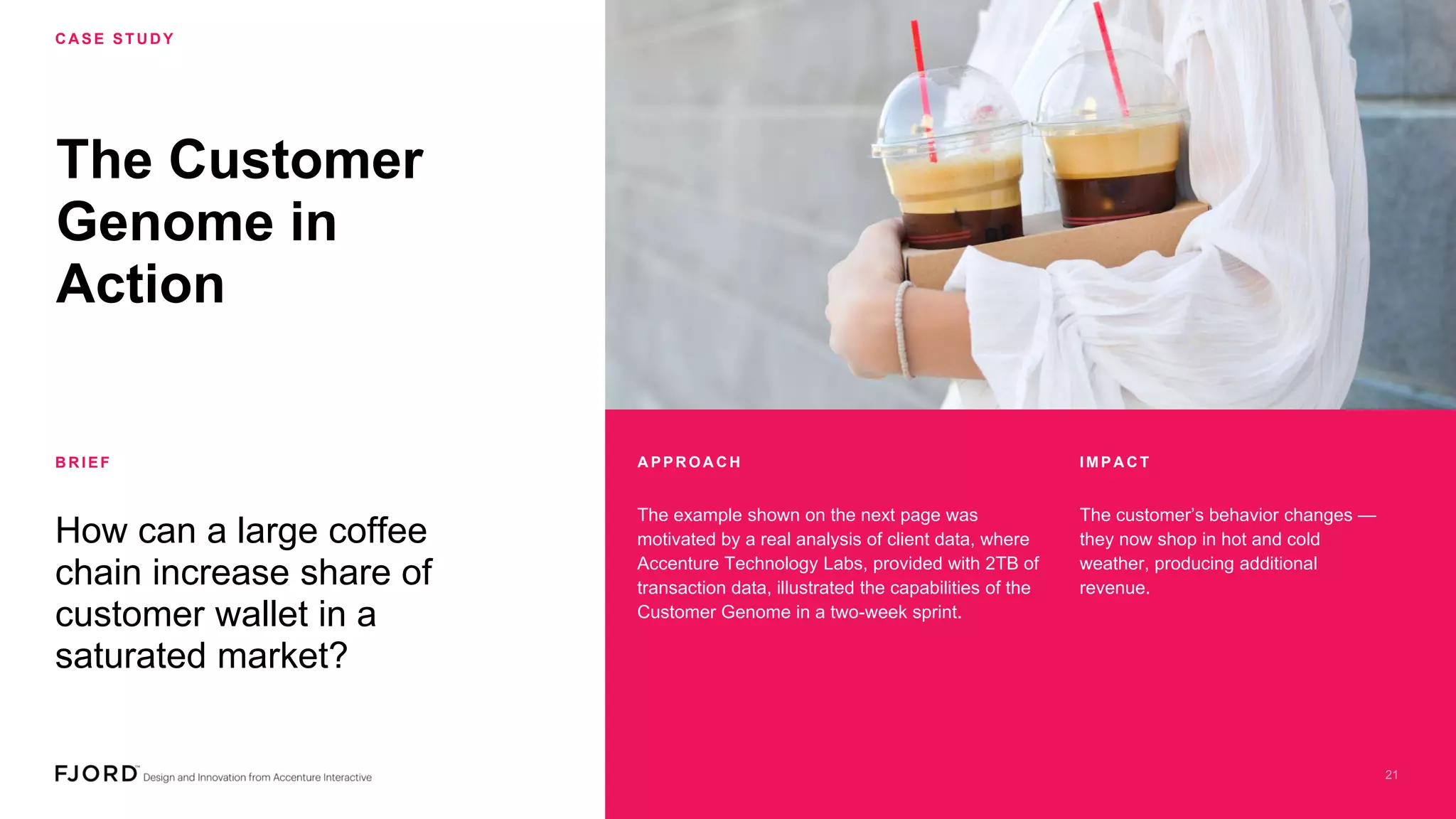
The Customer
Genome in
Action
How can a large coffee
chain increase share of
customer wallet in a
saturated market?
C A SE STU D Y
B R IEF
The example shown on the next page was
motivated by a real analysis of client data, where
Accenture Technology Labs, provided with 2TB of
transaction data, illustrated the capabilities of the
Customer Genome in a two-week sprint.
The customer’s behavior changes —
they now shop in hot and cold
weather, producing additional
revenue.
A PPR OA C H IMPA C T
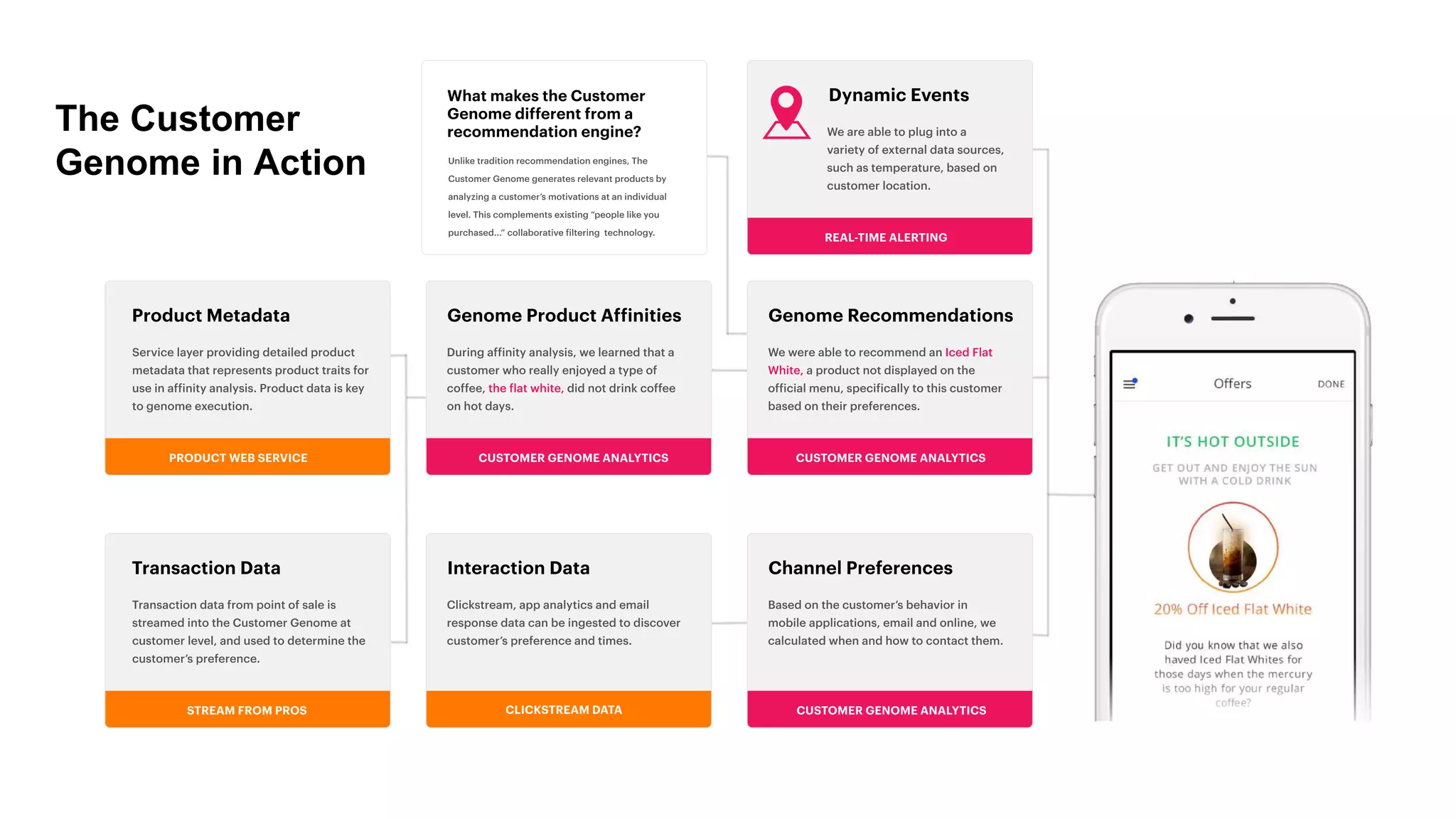
The Customer
Genome in Action
Thank you

Data+design

  • 1.
    Data + Design HumanizingData To Create Living Services
  • 2.
    ”Nine out of10 companies are investing in data yet the return on that investment remains elusive.”
  • 3.
    Consumers, and increasinglybusiness users, are demanding more contextualized, personalized services, but brands are challenged to deliver them. Context is key While machine learning and data science bring sophisticated models to the table, a design thinking approach can uncover many different contexts of use, delivering perfectly timed, personalized experiences to people. Personalization is expected
  • 4.
    The answer isto build Living Services. We’ve already started.
  • 5.
    To be livingmeans constantly learning and changing in real time, in response to stimuli. Those stimuli include direct instructions – but also observations about people’s needs, behaviors, preferences and environment. SERVICES designed with LIVING characteristics will have the power to affect our lives in profound and positive ways – now and well into the future.
  • 6.
    Living Services arecreated with beautiful design and powered by data, which enables the service to learn and adapt continuously. This is equally true for B2C companies as for B2B ones. This starts from five key tasks: Define your north star Understand and articulate why your Living Service exists and define exactly how you’d like to improve your customers’ lives. Write your rule book Explore how you’ll capture the information you need from your customer and understand how your service must behave so it can learn and adapt. Find triggers and micro-moments Identify the things people do, the channels they use, the places they go to, and work out what will prompt your service to react. Assemble an atomized profile Look at the detail of customers’ data and contextual information to clarify what you need to know to make their experiences delightful. Create a blueprint Map out the details of each stage, considering how each piece will fit together, who’ll be doing what, and what support will be needed within your business.
  • 7.
    If services areto change in real time: Flexibility takes highest priority over silos and efficiency for its own sake. Evolution must happen at customer speed. They need to be supported by a significant operation that feeds the right data at the right time and in the right way. It’s crucial to tackle complexity head-on (touchpoints, sensors, data). It is necessary to make radical shifts in organizational culture.
  • 8.
    For Living Services,we must shift from designing one experience for many, to designing many experiences for one with constantly changing needs.
  • 9.
    We need anew design mindset Data is the lifeblood of Living Services. In order to create a living experience that can be continually tuned, data must be collected, analyzed and acted on from two source points: the customers and the contextual environments they find themselves in as they use the service over time. Designers must establish the capability to capture granular behavioral and customer preference data, and consider a framework of external data sources that can create a launchpad for a dynamic service. The objective is to deliver an experience that feels to the consumer as if it has correctly anticipated their intent.
  • 10.
    A Data +Design approach that humanizes data …to converting insights into actions and experiences Shifts the focus from data and analysis…
  • 11.
    Understand how experiences canbe enhanced by data How we do it… Look both ways Understand how patterns in data can support better experiences Design Led Data Led
  • 12.
    Data + Design Webring together Data Science and Service Design expertise in an integrated approach that iteratively delivers the right data insights and data-enabled services to extract value from and deliver delightful outcomes for users. U SERMODELSD ATA EXPER IEN C E R A PID PR OTOTYPIN G TEST & LEA R N IMMER SION & IN SIGH TS IN TEN SE C OLLA B OR ATION Data Scientist Approach Service Designer Approach
  • 13.
    Design-led questions: • What dowe wish we knew about each customer? • If we knew everything, what new services would we create? What would we anticipate? How would we flex the experience for each consumer? • How do we design to learn each user’s intent, context and attitudes? Data-led questions: • What do we know about our customers that no one else does? • What needs and changes do we anticipate? What additional data do we need to anticipate better? • How do we build millions of segments of one? Can we incorporate new data sources? We ask…
  • 14.
    A Data +Design approach to Living Services Design For Data Apply data layers to every design artifact. Define how sensing, reaction, feedback and evolution is designed into your service. Design With Data Augment qualitative research with quantitative analysis to gain a more holistic understanding of our users. Aim to create dynamic digital footprints. Design By Data Using data as a raw material in our creative process. Sketch with code and use generative technologies in our experiments.
  • 15.
    Understand We blend digitalfootprints with quantitative and qualitative research to get a more holistic understanding of our users.​ Get We leverage transactional level data stored in our clients' databases, publicly-available data, or data that we capture in research. ​ Apply Designing with data is about overlaying concepts and designs with data that is available, either internally or externally. Design With Data
  • 16.
    Design For Data Plan As webuild roadmaps for products and services, we build in instrumentation so data collections are an integral part of product and service strategies. Collect We can design how we collect data, such as, with sensors either physically or digitally, and plan data sharing partnerships. Profile Designing for data also sets up the analytics to refine the value of the underlying data. We use tools like the customer genome and contextual awareness to bring multiple data sets together to create an understanding of our customers and their context.
  • 17.
    Design By Data Personalize The atomizedProfile is the ever- changing dynamic profile of your customers’ preferences, context, history, needs and wants. It contains data that is relevant to your customers as well as the environment around them. It’s based on historical interaction data and the instrumentation of services. Contextualize It’s important to remember that this is not just about screens, It is about delivering the right experience in the right way, whether that be via a screen, a chatbot, or a personal assistant. Automate Designing by data is about delivering true Living Services. When we understand the individuals we are building experiences for, and the context they are in, then we can build dynamic experiences that adapt to changing needs enabled by technology such as AI.
  • 18.
    Data + Design answersthe following: I have created the data platform. How can I get my organization to adopt and use the data insights I provide to make better decisions? Personalization is important. How can I enhance my existing products and services using data to create better experiences for my customers? Artificial Intelligence. How can I use it to create new services that anticipate customer needs?
  • 19.
    Worldwide Telco (WWT) C ASE STU D Y B R IEF How can WWT increase data consumption? Fjord and Accenture Analytics co-developed an interactive story based around 3D visualizations and decision-assistance tools showcasing: The project crystalized the role of the Chief Analytics Officer and Data Science team to the Executive Committee. • Which customer through • Which apps on • Which device • When to contact them • Where to push the notifications A PPR OA C H IMPA C T
  • 20.
    Global Beverage Producer How canGBP identify and address brand specific loyalty deterioration? Fjord and Accenture Tech Labs leveraged a cross- disciplinary team to design and develop a mobile analytics experience which: The prototype distilled a clear decision-making process that enabled direct and efficient diagnosis of performance issues. This project therefore illustrated the power and benefit of a well-design data analysis experience. • Revealed acute issues with brand performance • Enabled analysis by focusing on relevant data • Unlocked insights by researching analysts’ needs C A SE STU D Y B R IEF A PPR OA C H IMPA C T
  • 21.
    The Customer Genome in Action Howcan a large coffee chain increase share of customer wallet in a saturated market? C A SE STU D Y B R IEF The example shown on the next page was motivated by a real analysis of client data, where Accenture Technology Labs, provided with 2TB of transaction data, illustrated the capabilities of the Customer Genome in a two-week sprint. The customer’s behavior changes — they now shop in hot and cold weather, producing additional revenue. A PPR OA C H IMPA C T
  • 22.
  • 23.

Editor's Notes

  • #11  Watch this slide in presentation mode