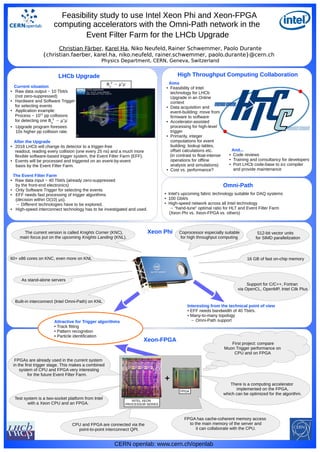
LHCb Upgrade
CERN openlab: www.cern.ch/openlab
High Throughput Computing Collaboration
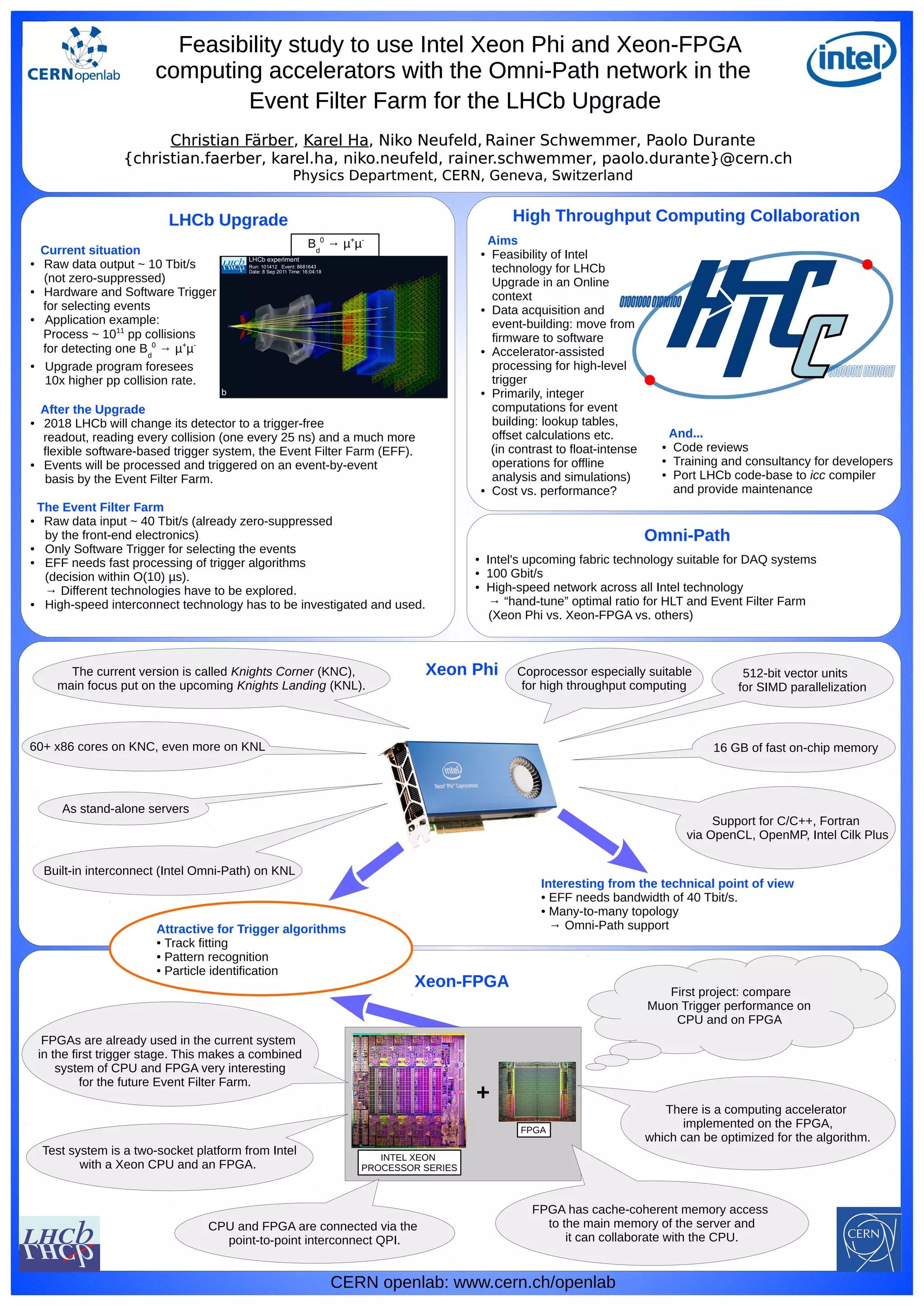
Feasibility study to use Intel Xeon Phi and Xeon-FPGA
computing accelerators with the Omni-Path network in the
Event Filter Farm for the LHCb Upgrade
Christian Färber, Karel Ha, Niko Neufeld, Rainer Schwemmer, Paolo Durante
{christian.faerber, karel.ha, niko.neufeld, rainer.schwemmer, paolo.durante}@cern.ch
Physics Department, CERN, Geneva, Switzerland
Feasibility study to use Intel Xeon Phi and Xeon-FPGA
computing accelerators with the Omni-Path network in the
Event Filter Farm for the LHCb Upgrade
Christian Färber, Karel Ha, Niko Neufeld, Rainer Schwemmer, Paolo Durante
{christian.faerber, karel.ha, niko.neufeld, rainer.schwemmer, paolo.durante}@cern.ch
Physics Department, CERN, Geneva, Switzerland
Xeon Phi
After the Upgrade
● 2018 LHCb will change its detector to a trigger-free
readout, reading every collision (one every 25 ns) and a much more
flexible software-based trigger system, the Event Filter Farm (EFF).
● Events will be processed and triggered on an event-by-event
basis by the Event Filter Farm.
The Event Filter Farm
● Raw data input ~ 40 Tbit/s (already zero-suppressed
by the front-end electronics)
● Only Software Trigger for selecting the events
● EFF needs fast processing of trigger algorithms
(decision within O(10) µs).
→ Different technologies have to be explored.
● High-speed interconnect technology has to be investigated and used.
512-bit vector units
for SIMD parallelization
Support for C/C++, Fortran
via OpenCL, OpenMP, Intel Cilk Plus
60+ x86 cores on KNC, even more on KNL
The current version is called Knights Corner (KNC),
main focus put on the upcoming Knights Landing (KNL).
Xeon-FPGA
Interesting from the technical point of view
● EFF needs bandwidth of 40 Tbit/s.
● Many-to-many topology
→ Omni-Path support
Omni-Path
Built-in interconnect (Intel Omni-Path) on KNL
Coprocessor especially suitable
for high throughput computing
Aims
● Feasibility of Intel
technology for LHCb
Upgrade in an Online
context
● Data acquisition and
event-building: move from
firmware to software
● Accelerator-assisted
processing for high-level
trigger
● Primarily, integer
computations for event
building: lookup tables,
offset calculations etc.
(in contrast to float-intense
operations for offline
analysis and simulations)
● Cost vs. performance?
As stand-alone servers
Current situation
● Raw data output ~ 10 Tbit/s
(not zero-suppressed)
● Hardware and Software Trigger
for selecting events
● Application example:
Process ~ 1011
pp collisions
for detecting one Bd
0
→ µ+
µ-
● Upgrade program foresees
10x higher pp collision rate.
Bd
0
→ µ+
µ-
● Intel's upcoming fabric technology suitable for DAQ systems
● 100 Gbit/s
● High-speed network across all Intel technology
→ “hand-tune” optimal ratio for HLT and Event Filter Farm
(Xeon Phi vs. Xeon-FPGA vs. others)
16 GB of fast on-chip memory
CPU and FPGA are connected via the
point-to-point interconnect QPI.
Attractive for Trigger algorithms
● Track fitting
● Pattern recognition
● Particle identification
FPGA has cache-coherent memory access
to the main memory of the server and
it can collaborate with the CPU.
First project: compare
Muon Trigger performance on
CPU and on FPGA
There is a computing accelerator
implemented on the FPGA,
which can be optimized for the algorithm.
FPGAs are already used in the current system
in the first trigger stage. This makes a combined
system of CPU and FPGA very interesting
for the future Event Filter Farm.
Test system is a two-socket platform from Intel
with a Xeon CPU and an FPGA.
And...
● Code reviews
● Training and consultancy for developers
● Port LHCb code-base to icc compiler
and provide maintenance
INTEL XEON
PROCESSOR SERIES
FPGA
+

HTCC poster for CERN Openlab opendays 2015

  • 1.
    LHCb Upgrade CERN openlab:www.cern.ch/openlab High Throughput Computing Collaboration Feasibility study to use Intel Xeon Phi and Xeon-FPGA computing accelerators with the Omni-Path network in the Event Filter Farm for the LHCb Upgrade Christian Färber, Karel Ha, Niko Neufeld, Rainer Schwemmer, Paolo Durante {christian.faerber, karel.ha, niko.neufeld, rainer.schwemmer, paolo.durante}@cern.ch Physics Department, CERN, Geneva, Switzerland Feasibility study to use Intel Xeon Phi and Xeon-FPGA computing accelerators with the Omni-Path network in the Event Filter Farm for the LHCb Upgrade Christian Färber, Karel Ha, Niko Neufeld, Rainer Schwemmer, Paolo Durante {christian.faerber, karel.ha, niko.neufeld, rainer.schwemmer, paolo.durante}@cern.ch Physics Department, CERN, Geneva, Switzerland Xeon Phi After the Upgrade ● 2018 LHCb will change its detector to a trigger-free readout, reading every collision (one every 25 ns) and a much more flexible software-based trigger system, the Event Filter Farm (EFF). ● Events will be processed and triggered on an event-by-event basis by the Event Filter Farm. The Event Filter Farm ● Raw data input ~ 40 Tbit/s (already zero-suppressed by the front-end electronics) ● Only Software Trigger for selecting the events ● EFF needs fast processing of trigger algorithms (decision within O(10) µs). → Different technologies have to be explored. ● High-speed interconnect technology has to be investigated and used. 512-bit vector units for SIMD parallelization Support for C/C++, Fortran via OpenCL, OpenMP, Intel Cilk Plus 60+ x86 cores on KNC, even more on KNL The current version is called Knights Corner (KNC), main focus put on the upcoming Knights Landing (KNL). Xeon-FPGA Interesting from the technical point of view ● EFF needs bandwidth of 40 Tbit/s. ● Many-to-many topology → Omni-Path support Omni-Path Built-in interconnect (Intel Omni-Path) on KNL Coprocessor especially suitable for high throughput computing Aims ● Feasibility of Intel technology for LHCb Upgrade in an Online context ● Data acquisition and event-building: move from firmware to software ● Accelerator-assisted processing for high-level trigger ● Primarily, integer computations for event building: lookup tables, offset calculations etc. (in contrast to float-intense operations for offline analysis and simulations) ● Cost vs. performance? As stand-alone servers Current situation ● Raw data output ~ 10 Tbit/s (not zero-suppressed) ● Hardware and Software Trigger for selecting events ● Application example: Process ~ 1011 pp collisions for detecting one Bd 0 → µ+ µ- ● Upgrade program foresees 10x higher pp collision rate. Bd 0 → µ+ µ- ● Intel's upcoming fabric technology suitable for DAQ systems ● 100 Gbit/s ● High-speed network across all Intel technology → “hand-tune” optimal ratio for HLT and Event Filter Farm (Xeon Phi vs. Xeon-FPGA vs. others) 16 GB of fast on-chip memory CPU and FPGA are connected via the point-to-point interconnect QPI. Attractive for Trigger algorithms ● Track fitting ● Pattern recognition ● Particle identification FPGA has cache-coherent memory access to the main memory of the server and it can collaborate with the CPU. First project: compare Muon Trigger performance on CPU and on FPGA There is a computing accelerator implemented on the FPGA, which can be optimized for the algorithm. FPGAs are already used in the current system in the first trigger stage. This makes a combined system of CPU and FPGA very interesting for the future Event Filter Farm. Test system is a two-socket platform from Intel with a Xeon CPU and an FPGA. And... ● Code reviews ● Training and consultancy for developers ● Port LHCb code-base to icc compiler and provide maintenance INTEL XEON PROCESSOR SERIES FPGA +