Data Transformation –
Standardization & Normalization
Data Transformation
• Data transformation is one of the fundamental
steps in the part of data processing
• The technique of feature scaling includes the
terms scale, standardize, and normalize
• The key issues are –
– the difference between Standardization and
Normalization
– when to use Standardization and when to use
Normalization
– how to apply feature scaling in Python/R
Feature Scaling
• Different types of variables in the same dataset is quite
common
• A significant issue - the range of the variables may
differ a lot
• Using the original scale - may put more weights on the
variables with a large range
• To deal with this problem, - apply the technique of
features rescaling to independent variables or features
of data in the step of data pre-processing
• The terms normalization and standardization are
sometimes used interchangeably, but they usually refer
to different things
Feature Scaling
• The goal of applying Feature Scaling is to make
sure features are on almost the same scale so
that each feature is equally important and
make it easier to process by most ML
algorithms
Example
Example
• This is a dataset that contains an independent variable
(Purchased) and 3 dependent variables (Country, Age,
and Salary)
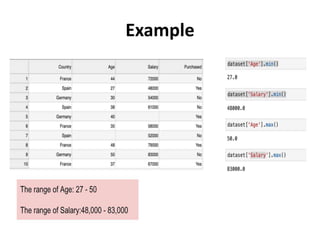
• Variables are not on the same scale because the range
of Age is from 27 to 50, while the range of Salary going
from 48 K to 83 K
• The range of Salary is much wider than the range
of Age
• This will cause some issues –
– a lot of machine learning models such as k-means
clustering and nearest neighbour classification are based
on the Euclidean Distance
Example
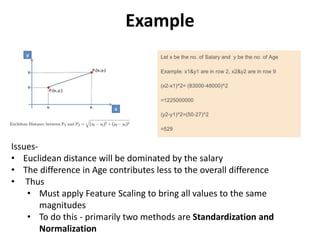
Issues-
• Euclidean distance will be dominated by the salary
• The difference in Age contributes less to the overall difference
• Thus
• Must apply Feature Scaling to bring all values to the same
magnitudes
• To do this - primarily two methods are Standardization and
Normalization
Standardization
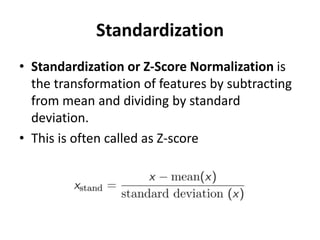
• Standardization or Z-Score Normalization is
the transformation of features by subtracting
from mean and dividing by standard
deviation.
• This is often called as Z-score
Standardization
• Standardization can be helpful in cases where the
data follows a Gaussian distribution, however,
this does not have to be necessarily true
• Geometrically - it translates the data to the mean
vector of original data to the origin and squishes
or expands the points if std dev is 1 respectively
• The shape of the distribution is not affected – as
this transforms a normal distribution to a
standard normal distribution
• Standardization - not affected by outliers as there
is no predefined range of transformed features
Normalization
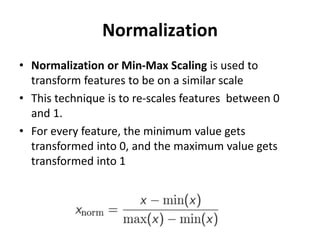
• Normalization or Min-Max Scaling is used to
transform features to be on a similar scale
• This technique is to re-scales features between 0
and 1.
• For every feature, the minimum value gets
transformed into 0, and the maximum value gets
transformed into 1
Standardization vs. Normalization
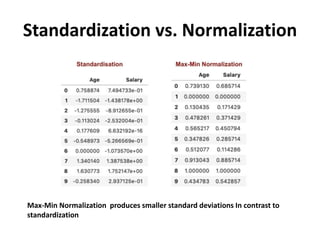
Max-Min Normalization produces smaller standard deviations In contrast to
standardization
Standardization vs. Normalization
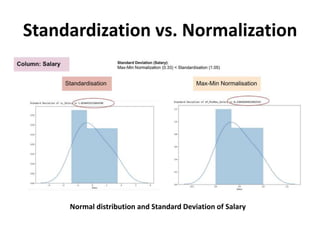
Normal distribution and Standard Deviation of Salary
Standardization vs. Normalization
Normal distribution and Standard Deviation of Age
Standardization vs. Normalization
• From the above graphs, it is quite clear that applying
Max-Min Nomaralization in this dataset has generated
smaller standard deviations (Salary and Age) than using
Standardization method. It implies the data are more
concentrated around the mean if data is scaled using
Max-Min Nomaralization.
• As a result, if you have outliers in your feature
(column), normalizing your data will scale most of the
data to a small interval, which means all features will
have the same scale but does not handle outliers well.
Standardization is more robust to outliers, and in many
cases, it is preferable over Max-Min Normalization.
Standardization vs. Normalization
Normalization Standardization
Minimum and maximum value of features
are used for scaling
Mean and standard deviation is used for
scaling.
It is used when features are of different
scales.
It is used when we want to ensure zero
mean and unit standard deviation.
Scales values usually between [0, 1] It is not bounded to a certain range.
It is really affected by outliers. It is much less affected by outliers.
This transformation squishes the n-
dimensional data into an n-dimensional
unit hypercube.
It translates the data to the mean vector of
original data to the origin and squishes or
expands.
It is useful when we don’t know about the
distribution
It is useful when the feature distribution is
Normal or Gaussian.
It is a often called as Scaling Normalization It is a often called as Z-Score Normalization.
When Feature Scaling Matters
• Some machine learning models are
fundamentally based on distance matrix, also
known as the distance-based classifier - K-
Nearest-Neighbours, SVM, and Neural Network
• Feature scaling is extremely essential to those
models, especially when the range of the features
is very different
• Otherwise, features with a large range will have a
large influence in computing the distance.
When Feature Scaling Matters
• Max-Min Normalization typically allows us to transform
the data with varying scales so that no specific
dimension will dominate the statistics, and it does not
require making a very strong assumption about the
distribution of the data, such as k-nearest neighbours
and artificial neural networks
• However, Normalization does not treat outliners very
well. On the contrary, standardization allows users to
better handle the outliers and facilitate convergence
for some computational algorithms like gradient
descent. Therefore, we usually prefer standardization
over Min-Max Normalisation.

Data Transformation – Standardization & Normalization PPM.pptx

  • 1.
  • 2.
    Data Transformation • Datatransformation is one of the fundamental steps in the part of data processing • The technique of feature scaling includes the terms scale, standardize, and normalize • The key issues are – – the difference between Standardization and Normalization – when to use Standardization and when to use Normalization – how to apply feature scaling in Python/R
  • 3.
    Feature Scaling • Differenttypes of variables in the same dataset is quite common • A significant issue - the range of the variables may differ a lot • Using the original scale - may put more weights on the variables with a large range • To deal with this problem, - apply the technique of features rescaling to independent variables or features of data in the step of data pre-processing • The terms normalization and standardization are sometimes used interchangeably, but they usually refer to different things
  • 4.
    Feature Scaling • Thegoal of applying Feature Scaling is to make sure features are on almost the same scale so that each feature is equally important and make it easier to process by most ML algorithms
  • 5.
  • 6.
    Example • This isa dataset that contains an independent variable (Purchased) and 3 dependent variables (Country, Age, and Salary) • Variables are not on the same scale because the range of Age is from 27 to 50, while the range of Salary going from 48 K to 83 K • The range of Salary is much wider than the range of Age • This will cause some issues – – a lot of machine learning models such as k-means clustering and nearest neighbour classification are based on the Euclidean Distance
  • 7.
    Example Issues- • Euclidean distancewill be dominated by the salary • The difference in Age contributes less to the overall difference • Thus • Must apply Feature Scaling to bring all values to the same magnitudes • To do this - primarily two methods are Standardization and Normalization
  • 8.
    Standardization • Standardization orZ-Score Normalization is the transformation of features by subtracting from mean and dividing by standard deviation. • This is often called as Z-score
  • 9.
    Standardization • Standardization canbe helpful in cases where the data follows a Gaussian distribution, however, this does not have to be necessarily true • Geometrically - it translates the data to the mean vector of original data to the origin and squishes or expands the points if std dev is 1 respectively • The shape of the distribution is not affected – as this transforms a normal distribution to a standard normal distribution • Standardization - not affected by outliers as there is no predefined range of transformed features
  • 10.
    Normalization • Normalization orMin-Max Scaling is used to transform features to be on a similar scale • This technique is to re-scales features between 0 and 1. • For every feature, the minimum value gets transformed into 0, and the maximum value gets transformed into 1
  • 11.
    Standardization vs. Normalization Max-MinNormalization produces smaller standard deviations In contrast to standardization
  • 12.
    Standardization vs. Normalization Normaldistribution and Standard Deviation of Salary
  • 13.
    Standardization vs. Normalization Normaldistribution and Standard Deviation of Age
  • 14.
    Standardization vs. Normalization •From the above graphs, it is quite clear that applying Max-Min Nomaralization in this dataset has generated smaller standard deviations (Salary and Age) than using Standardization method. It implies the data are more concentrated around the mean if data is scaled using Max-Min Nomaralization. • As a result, if you have outliers in your feature (column), normalizing your data will scale most of the data to a small interval, which means all features will have the same scale but does not handle outliers well. Standardization is more robust to outliers, and in many cases, it is preferable over Max-Min Normalization.
  • 15.
    Standardization vs. Normalization NormalizationStandardization Minimum and maximum value of features are used for scaling Mean and standard deviation is used for scaling. It is used when features are of different scales. It is used when we want to ensure zero mean and unit standard deviation. Scales values usually between [0, 1] It is not bounded to a certain range. It is really affected by outliers. It is much less affected by outliers. This transformation squishes the n- dimensional data into an n-dimensional unit hypercube. It translates the data to the mean vector of original data to the origin and squishes or expands. It is useful when we don’t know about the distribution It is useful when the feature distribution is Normal or Gaussian. It is a often called as Scaling Normalization It is a often called as Z-Score Normalization.
  • 16.
    When Feature ScalingMatters • Some machine learning models are fundamentally based on distance matrix, also known as the distance-based classifier - K- Nearest-Neighbours, SVM, and Neural Network • Feature scaling is extremely essential to those models, especially when the range of the features is very different • Otherwise, features with a large range will have a large influence in computing the distance.
  • 17.
    When Feature ScalingMatters • Max-Min Normalization typically allows us to transform the data with varying scales so that no specific dimension will dominate the statistics, and it does not require making a very strong assumption about the distribution of the data, such as k-nearest neighbours and artificial neural networks • However, Normalization does not treat outliners very well. On the contrary, standardization allows users to better handle the outliers and facilitate convergence for some computational algorithms like gradient descent. Therefore, we usually prefer standardization over Min-Max Normalisation.