Service
Design
Berlin
H E R E / M AY 1 0 , 2 0 1 7
Data & Services
Katrin
Business
Analyst,

CSC
Who is inviting?
Olga
Business
Consultant,
Fuxblau
Mauro
Freelance
Designer
(Hire me)
Martin
Service
Designer,
UK Gov
Manuel
Service
Designer,
Fuxblau
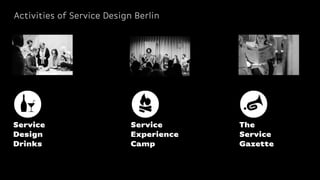
Activities of Service Design Berlin
Service
Design
Drinks
Service
Experience
Camp
The
Service
Gazette
Who’s hosting?
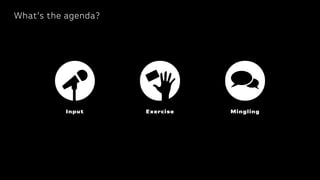
What’s the agenda?
Input Exercise Mingling
Who’s talking?
Maria Izquierdo
Service Designer
GDS
Martin Jordan
Service Designer
GDS
Data
Maria Izquierdo, @izdo_maria
Martin Jordan, @martin_jordan
SERVICE DESIGN DRINKS BERLIN, 10 MAY 2017
Services
&
@sd_berlin
Disclaimer:
We are not speaking on behalf of the UK
Government today, but as professionals with
a genuine interest in data
@sd_berlin
Stand up, please!
@sd_berlin
Sit down if you have never dealt with data in
a digital product or service in some way
@sd_berlin
Sit down if you have never had a discussion
about the collection of data in a digital
product or service
@sd_berlin
Service
@sd_berlin
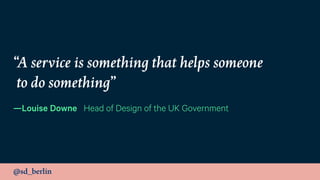
“A service is something that helps someone

to do something”
—Louise Downe Head of Design of the UK Government
@sd_berlin
“Service is the application of specialised
competences through deeds, processes and
performances for the benefit of another entity”
—Stephen L. Vargo Professor of Marketing, University of Hawai'i at Manoa
@sd_berlin
Data
@sd_berlin
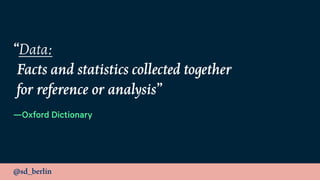
“Data:

Facts and statistics collected together

for reference or analysis”
—Oxford Dictionary
@sd_berlin
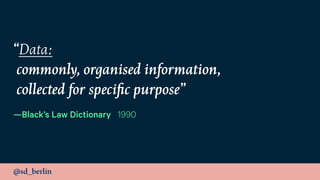
“Data:

commonly, organised information,

collected for specific purpose”
—Black’s Law Dictionary 1990
@sd_berlin
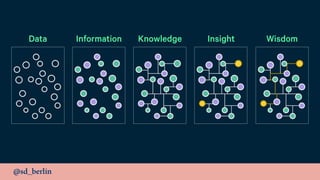
Data Information Knowledge Insight Wisdom
@sd_berlin
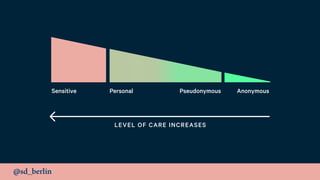
LEVEL OF CARE INCREASES
Sensitive Personal Pseudonymous Anonymous
@sd_berlin
Personal data
• name
• date of birth
• address
• telephone number
@sd_berlin
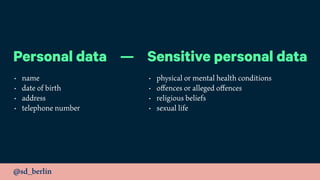
Personal data — Sensitive personal data
• name
• date of birth
• address
• telephone number
• physical or mental health conditions
• offences or alleged offences
• religious beliefs
• sexual life
@sd_berlin
@sd_berlin
Data in services
@sd_berlin
There can be no service without data
@sd_berlin
You cannot not design data in a service
@sd_berlin
@sd_berlin
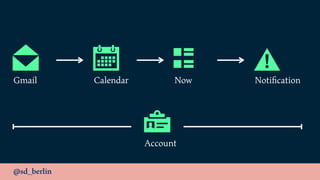
Gmail Calendar NotificationNow
Account
@sd_berlin
Data in services has implications

for its users
@sd_berlin
Data in services has implications

for its users, but also for non-users
@sd_berlin
Service needs
Business needs
User needs
@sd_berlin
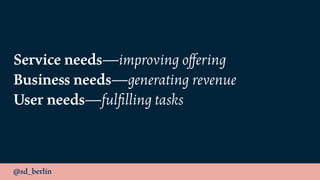
Service needs—improving offering
Business needs—generating revenue
User needs—fulfilling tasks
@sd_berlin
“There is no such thing as a free service.

So who gets paid by whom before what?”
—Horace Dediu Industry analyst
@sd_berlin
From “You are the product”

to “You are the training data”
—Chris Albon Data Scientist
@sd_berlin
Source:
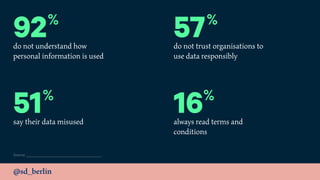
92%
do not understand how
personal information is used
57%
do not trust organisations to
use data responsibly
51%
say their data misused
16%
always read terms and
conditions
@sd_berlin
When things go wrong
@sd_berlin
Target—is able to calculate a pregnancy
prediction score based on 25 products and send
coupons timed to very specific stages of someone’s
pregnancy, thereby, in one instance, knowing
about a teenage girl’s pregnancy before their
parents did
Ethical aspect
Source:
@sd_berlin
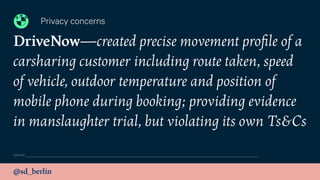
DriveNow—created precise movement profile of a
carsharing customer including route taken, speed
of vehicle, outdoor temperature and position of
mobile phone during booking; providing evidence
in manslaughter trial, but violating its own Ts&Cs
Privacy concerns
Source:
@sd_berlin
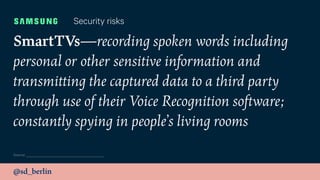
SmartTVs—recording spoken words including
personal or other sensitive information and
transmitting the captured data to a third party
through use of their Voice Recognition software;
constantly spying in people’s living rooms
Security risks
Source:
@sd_berlin
Privacy paradox
@sd_berlin
“We say we want privacy online, but our actions
say otherwise […] people who indicate serious
privacy concern nevertheless reveal intimate
details of their lives for trivial rewards”
—Leslie K. John Associate professor, Harvard Business School
Source:
@sd_berlin
1975
Source: Paramount Pictures
@sd_berlin
2017
Source: Amazon
@sd_berlin
“All information that can be collected will be
collected. […] Today, we have to assume that
many people know lots about us.”
—Andreas Weigend former Chief Scientist, Amazon
Source:
@sd_berlin
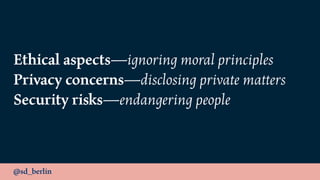
Ethical aspects—ignoring moral principles
Privacy concerns—disclosing private matters
Security risks—endangering people
@sd_berlin
What the heck?
@sd_berlin
Designers, ethics over aesthetics!
@sd_berlin
You are the advocate for your users
@sd_berlin
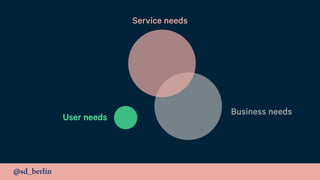
User needs
Business needs
Service needs
@sd_berlin
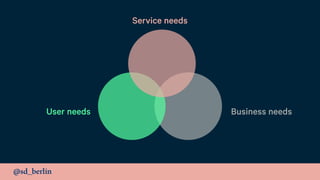
User needs Business needs
Service needs
@sd_berlin
Ask:
What data is the service collecting? And why?
How and when is this data being used?
Who has access to this data and who owns it?
And how do we keep it secure?
@sd_berlin
When things go well
@sd_berlin
@sd_berlin
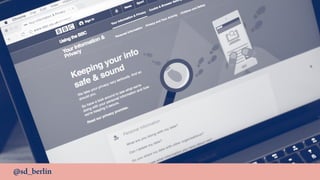
BBC—“Our privacy promise covers how we treat
your data and put you in control of what happens
to it. It’s based around three main areas […]
transparency, choice, trust”
Embracing transparency and simple language
Source:
@sd_berlin
@sd_berlin
@sd_berlin
Co-op Paperfree—“We’re committing to a data
relationship that’s unambiguously clear and
transparent. We will always be clear and precise
with you, our members about what we are going to
do with your data. You will be in control of the
data we hold on you.”
Taking sensitive data seriously
Source:
@sd_berlin
@sd_berlin
Source:
Providing options and guaranteeing privacy
Clue—“You can use Clue without creating an
account and if you do you will not share your
data. If you wish to use Clue Connect, however,
you do need an account and once you create an
account your data will be hosted on Clue’s servers.
@sd_berlin
Principles for design for data
by Sarah Gold / Project IF
@sd_berlin
Source: Sarah Gold, Projects by IF /
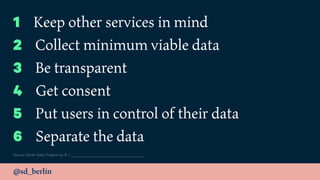
1 Keep other services in mind
2 Collect minimum viable data
3 Be transparent
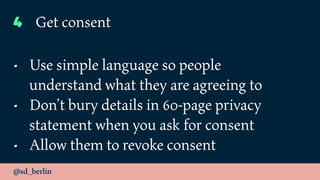
4 Get consent
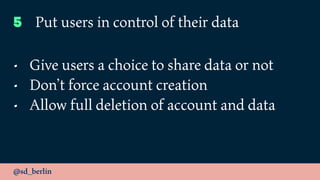
5 Put users in control of their data
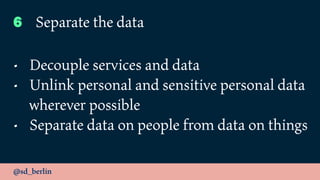
6 Separate the data
@sd_berlin
Source: Sarah Gold, Projects by IF /
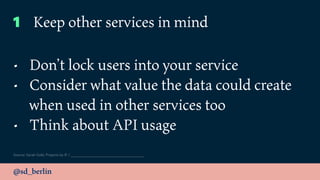
1 Keep other services in mind
• Don’t lock users into your service
• Consider what value the data could create
when used in other services too
• Think about API usage
@sd_berlin
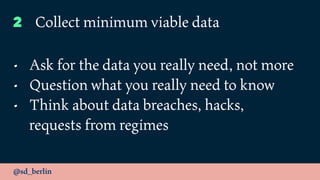
2 Collect minimum viable data
• Ask for the data you really need, not more
• Question what you really need to know
• Think about data breaches, hacks,
requests from regimes
@sd_berlin
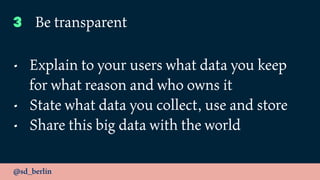
3 Be transparent
• Explain to your users what data you keep
for what reason and who owns it
• State what data you collect, use and store
• Share this big data with the world
@sd_berlin
4 Get consent
• Use simple language so people
understand what they are agreeing to
• Don’t bury details in 60-page privacy
statement when you ask for consent
• Allow them to revoke consent
@sd_berlin
5 Put users in control of their data
• Give users a choice to share data or not
• Don’t force account creation
• Allow full deletion of account and data
@sd_berlin
6 Separate the data
• Decouple services and data
• Unlink personal and sensitive personal data
wherever possible
• Separate data on people from data on things
@sd_berlin
Exercise
@sd_berlin
Exercise!
@sd_berlin
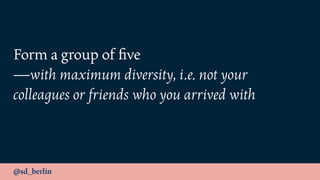
Form a group of five

—with maximum diversity, i.e. not your
colleagues or friends who you arrived with
@sd_berlin
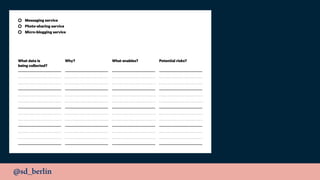
Grab a sheet, pick a service category,
answer the questions
@sd_berlin
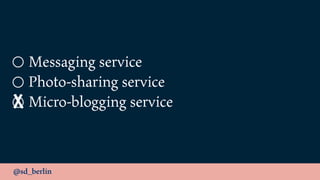
Messaging service
Photo-sharing service
Micro-blogging serviceX

@sd_berlin
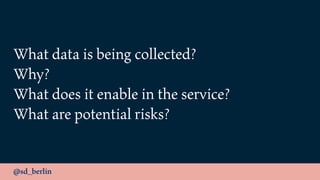
What data is being collected?
Why?
What does it enable in the service?
What are potential risks?
@sd_berlin
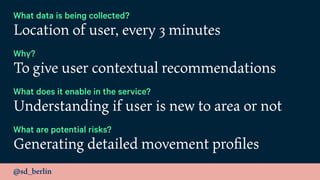
What data is being collected?
Location of user, every 3 minutes
Why?
To give user contextual recommendations
What does it enable in the service?
Understanding if user is new to area or not
What are potential risks?
Generating detailed movement profiles
@sd_berlin
Messaging service
Photo-sharing service
Micro-blogging service
What data is
being collected?
Why? What enables? Potential risks?
@sd_berlin
Tell us!
@sd_berlin
Take-aways
@sd_berlin
If you aren’t acting as the users’ advocate,
no one else will
@sd_berlin
Step up your game, designers, don’t only
design services that are easy to use but also
trustworthy, understandable, accountable*
*Inspiration: Richard Pope /
@sd_berlin
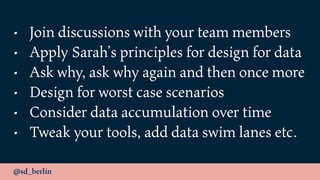
• Join discussions with your team members
• Apply Sarah’s principles for design for data
• Ask why, ask why again and then once more
• Design for worst case scenarios
• Consider data accumulation over time
• Tweak your tools, add data swim lanes etc.
@sd_berlin
It ain’t proper service design,
if you aren’t designing for data in the service
@sd_berlin
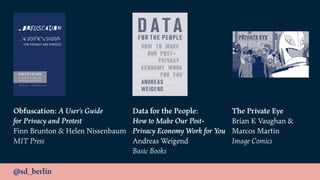
Things to read
@sd_berlin
@sd_berlin
Obfuscation: A User's Guide

for Privacy and Protest

Finn Brunton & Helen Nissenbaum
MIT Press
Data for the People:

How to Make Our Post-

Privacy Economy Work for You
Andreas Weigend

Basic Books
The Private Eye
Brian K Vaughan &

Marcos Martin
Image Comics
@sd_berlin
Thanks very much
Questions? Comments? Concerns?
Next Drinks: 14 June on Design Thinking in Public Administration
See you in June!
servicedesignberlin.de
@SD_Berlin
fb.com/servicedesignberlin

Data & Services / Service Design Drinks