DESCRIPTIVE &
INFERENTIAL STATISTICS
Dr. Ratnaprabha Jadhav (Prof & Head)
Department of Geography, PGSR,
SNDT Women’s University, Pune Campus
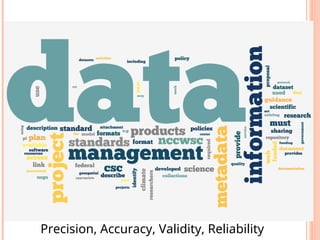
Precision, Accuracy, Validity, Reliability
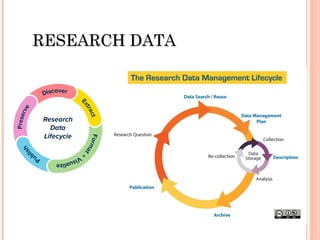
RESEARCH DATA
RESEARCH DATA
HOW DO RESEARCHERS USE
DATA?
 Qualitative and Quantitative Data, Approaches and
Analysis
 Qualitative Data – Text, documents, interviews,
observations, focus groups etc.
 Quantitative Data – Test, surveys, experiments
1. Describe and summarize data
2. Make generalizations concerning complex spatial patterns
3. Estimate likelihoods of outcomes for events at particular
location(s)
4. Use sample data to make inferences about a larger set of
data (a population)
5. Learn whether actual pattern matches an expected or
theoretical
6. Compare or associate (correlate) patterns of distributions
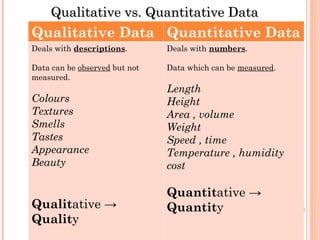
Qualitative vs. Quantitative Data
Qualitative Data Quantitative Data
Deals with descriptions.
Data can be observed but not
measured.
Colours
Textures
Smells
Tastes
Appearance
Beauty
Qualitative →
Quality
Deals with numbers.
Data which can be measured.
Length
Height
Area , volume
Weight
Speed , time
Temperature , humidity
cost
Quantitative →
Quantity
S
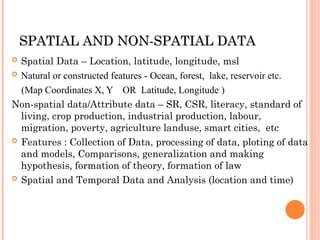
SPATIAL AND NON-SPATIAL DATA
PATIAL AND NON-SPATIAL DATA
 Spatial Data – Location, latitude, longitude, msl
 Natural or constructed features - Ocean, forest, lake, reservoir etc.
(Map Coordinates X, Y OR Latitude, Longitude )
Non-spatial data/Attribute data – SR, CSR, literacy, standard of
living, crop production, industrial production, labour,
migration, poverty, agriculture landuse, smart cities, etc
 Features : Collection of Data, processing of data, ploting of data
and models, Comparisons, generalization and making
hypothesis, formation of theory, formation of law
 Spatial and Temporal Data and Analysis (location and time)
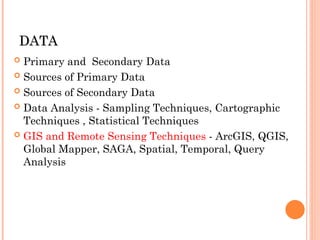
DATA
DATA
 Primary and Secondary Data
 Sources of Primary Data
 Sources of Secondary Data
 Data Analysis - Sampling Techniques, Cartographic
Techniques , Statistical Techniques
 GIS and Remote Sensing Techniques - ArcGIS, QGIS,
Global Mapper, SAGA, Spatial, Temporal, Query
Analysis
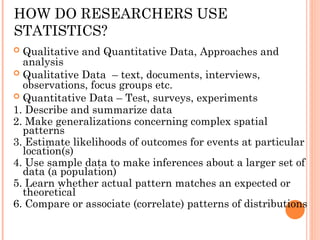
HOW DO RESEARCHERS USE
STATISTICS?
 Qualitative and Quantitative Data, Approaches and
analysis
 Qualitative Data – text, documents, interviews,
observations, focus groups etc.
 Quantitative Data – Test, surveys, experiments
1. Describe and summarize data
2. Make generalizations concerning complex spatial
patterns
3. Estimate likelihoods of outcomes for events at particular
location(s)
4. Use sample data to make inferences about a larger set of
data (a population)
5. Learn whether actual pattern matches an expected or
theoretical
6. Compare or associate (correlate) patterns of distributions
MEASUREMENT CONCEPTS
1.Precision- level of exactness associated with
measurement (rain gauge to inches or fractions of
inches)
2. Accuracy- extent of system wide bias in
measurement process
3. Validity- if geographical concept is complex
expressing “true” or “appropriate” meaning of the
concept through measurement may be difficult
(levels of poverty, economic well being,
environmental quality)
4. Reliability- changes in spatial patterns are
analyzed over time must ask about consistency
and stability of data
TYPES OF STATISTICAL
ANALYSIS
 Descriptive Statistics- concise numerical or
quantitative summaries of the characteristics of a
variable or data set (e.g. mean, standard deviation, etc).
 To present raw data ineffective/meaningful way using
numerical calculations or graphs or tables.
 This type of statistics is applied on already known data.
 To organize, analyze and present data in a meaningful
manner.
 It is used to describe a situation.
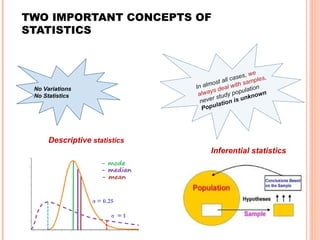
TWO IMPORTANT CONCEPTS OF
STATISTICS
No Variations
No Statistics
Descriptive statistics
Inferential statistics
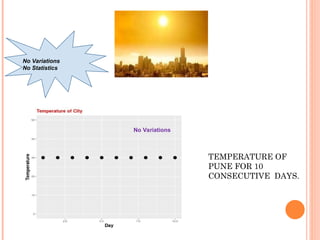
No Variations
No Variations
No Statistics
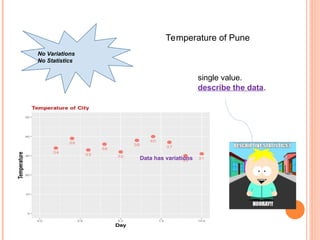
TEMPERATURE OF
PUNE FOR 10
CONSECUTIVE DAYS.
Temperature of Pune
single value.
describe the data.
Data has variations
No Variations
No Statistics
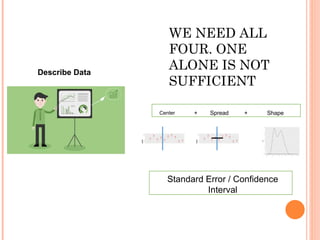
Describe Data
Center + Spread + Shape
WE NEED ALL
FOUR. ONE
ALONE IS NOT
SUFFICIENT
Standard Error / Confidence
Interval
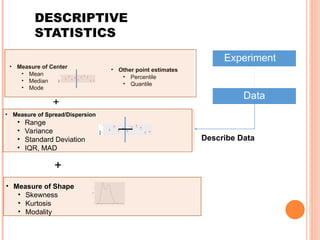
DESCRIPTIVE
STATISTICS
Experiment
Data
Describe Data
• Other point estimates
• Percentile
• Quantile
• Measure of Spread/Dispersion
• Range
• Variance
• Standard Deviation
• IQR, MAD
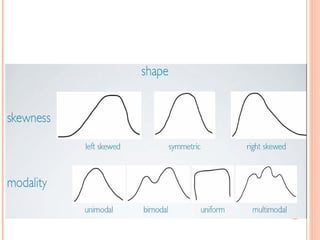
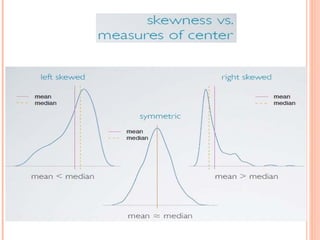
• Measure of Shape
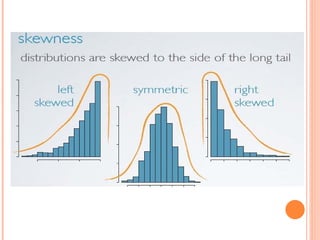
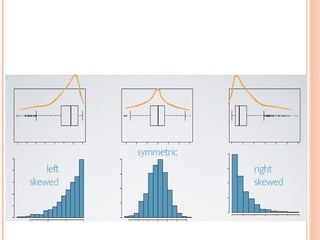
• Skewness
• Kurtosis
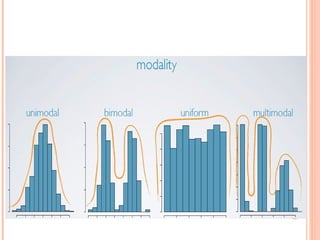
• Modality
• Measure of Center
• Mean
• Median
• Mode
+
+
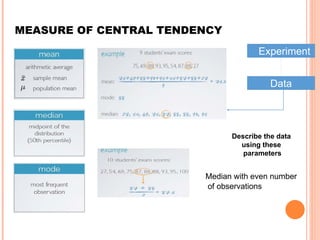
MEASURE OF CENTRAL TENDENCY
Experiment
Data
Describe the data
using these
parameters
Median with even number
of observations
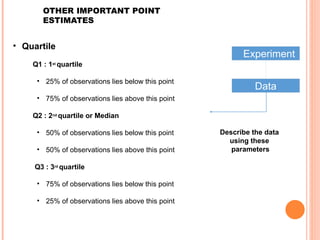
OTHER IMPORTANT POINT
ESTIMATES
Experiment
Data
Describe the data
using these
parameters
• Quartile
Q1 : 1st quartile
• 25% of observations lies below this point
• 75% of observations lies above this point
Q2 : 2nd quartile or Median
• 50% of observations lies below this point
• 50% of observations lies above this point
Q3 : 3rd quartile
• 75% of observations lies below this point
• 25% of observations lies above this point
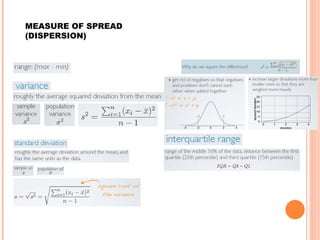
MEASURE OF SPREAD
(DISPERSION)
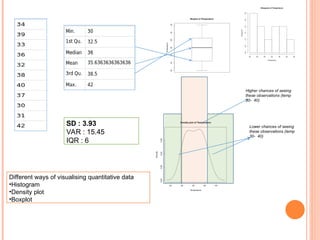
Different ways of visualising quantitative data
•Histogram
•Density plot
•Boxplot
Higher chances of seeing
these observations (temp
30- 40)
Lower chances of seeing
these observations (temp
30- 40)
SD : 3.93
VAR : 15.45
IQR : 6
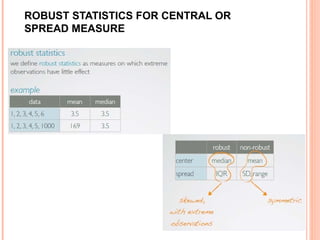
ROBUST STATISTICS FOR CENTRAL OR
SPREAD MEASURE
INFERENTIAL STATISTICS
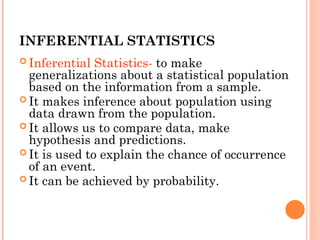
 Inferential Statistics- to make
generalizations about a statistical population
based on the information from a sample.
 It makes inference about population using
data drawn from the population.
 It allows us to compare data, make
hypothesis and predictions.
 It is used to explain the chance of occurrence
of an event.
 It can be achieved by probability.
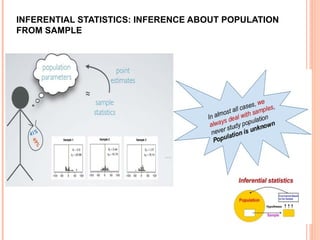
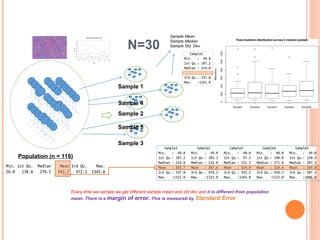
INFERENTIAL STATISTICS: INFERENCE ABOUT POPULATION
FROM SAMPLE
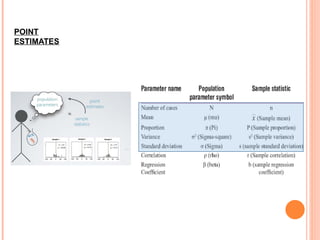
POINT
ESTIMATES
Population (n = 116)
Every time we sample we get different sample mean and std dev and it is different from population
mean. There is a margin of error. This is measured by Standard Error
Sample 1
Sample 4
Sample 2
Sample 5
Sample 3
N=30
Sample Mean
Sample Median
Sample Std. Dev
KARL PEARSON’S COEFFICIENT OF
CORRELATION
Karl Pearson’s coefficient of
correlation was discovered by Bravais
in 1846, but Karl Pearson was the
first to describe, in 1896.
1920- theory of correlation.
KARL PEARSON’S METHOD OF
PRODUCT MOMENTUM
 Denoted by r or rho.
 It is a measure of the degree of linear correlation between two
continuous variables.
Covariance of XY
r = ----------------------
(SDx *SDy)
Coefficient of Correlation or method of “Product momentum”.
PROPERTIES OF COEFFICIENT OF
CORRELATION
The Pearson correlation coefficients
can range in value from −1 to +1.
The Pearson correlation coefficient to
be +1, when one variable increases
then the other variable increases by a
consistent amount. This relationship
forms a perfect line.
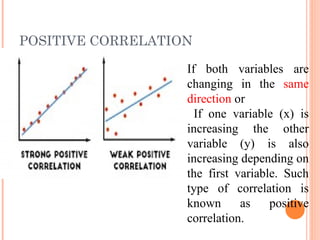
POSITIVE CORRELATION
If both variables are
changing in the same
direction or
If one variable (x) is
increasing the other
variable (y) is also
increasing depending on
the first variable. Such
type of correlation is
known as positive
correlation.
NEGATIVE/ INVERSE CORRELATION
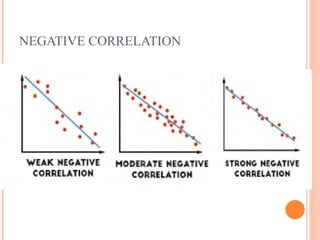
 If both variables are changing in the opposite direction
 r = -1 : perfect negative correlation,
 Eg. Height and temperature, shortage of product and
prices of product, low price and more demand
NEGATIVE CORRELATION
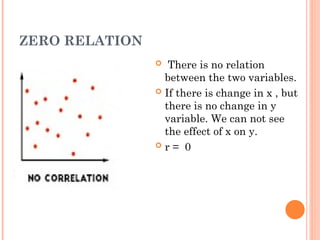
ZERO RELATION
 There is no relation
between the two variables.
 If there is change in x , but
there is no change in y
variable. We can not see
the effect of x on y.
 r = 0
Descriptive and Inferential Statistics Basics

  • 1.
    DESCRIPTIVE & INFERENTIAL STATISTICS Dr.Ratnaprabha Jadhav (Prof & Head) Department of Geography, PGSR, SNDT Women’s University, Pune Campus
  • 2.
  • 4.
  • 5.
    HOW DO RESEARCHERSUSE DATA?  Qualitative and Quantitative Data, Approaches and Analysis  Qualitative Data – Text, documents, interviews, observations, focus groups etc.  Quantitative Data – Test, surveys, experiments 1. Describe and summarize data 2. Make generalizations concerning complex spatial patterns 3. Estimate likelihoods of outcomes for events at particular location(s) 4. Use sample data to make inferences about a larger set of data (a population) 5. Learn whether actual pattern matches an expected or theoretical 6. Compare or associate (correlate) patterns of distributions
  • 6.
    Qualitative vs. QuantitativeData Qualitative vs. Quantitative Data Qualitative Data Quantitative Data Deals with descriptions. Data can be observed but not measured. Colours Textures Smells Tastes Appearance Beauty Qualitative → Quality Deals with numbers. Data which can be measured. Length Height Area , volume Weight Speed , time Temperature , humidity cost Quantitative → Quantity
  • 7.
    S SPATIAL AND NON-SPATIALDATA PATIAL AND NON-SPATIAL DATA  Spatial Data – Location, latitude, longitude, msl  Natural or constructed features - Ocean, forest, lake, reservoir etc. (Map Coordinates X, Y OR Latitude, Longitude ) Non-spatial data/Attribute data – SR, CSR, literacy, standard of living, crop production, industrial production, labour, migration, poverty, agriculture landuse, smart cities, etc  Features : Collection of Data, processing of data, ploting of data and models, Comparisons, generalization and making hypothesis, formation of theory, formation of law  Spatial and Temporal Data and Analysis (location and time)
  • 8.
    DATA DATA  Primary andSecondary Data  Sources of Primary Data  Sources of Secondary Data  Data Analysis - Sampling Techniques, Cartographic Techniques , Statistical Techniques  GIS and Remote Sensing Techniques - ArcGIS, QGIS, Global Mapper, SAGA, Spatial, Temporal, Query Analysis
  • 9.
    HOW DO RESEARCHERSUSE STATISTICS?  Qualitative and Quantitative Data, Approaches and analysis  Qualitative Data – text, documents, interviews, observations, focus groups etc.  Quantitative Data – Test, surveys, experiments 1. Describe and summarize data 2. Make generalizations concerning complex spatial patterns 3. Estimate likelihoods of outcomes for events at particular location(s) 4. Use sample data to make inferences about a larger set of data (a population) 5. Learn whether actual pattern matches an expected or theoretical 6. Compare or associate (correlate) patterns of distributions
  • 10.
    MEASUREMENT CONCEPTS 1.Precision- levelof exactness associated with measurement (rain gauge to inches or fractions of inches) 2. Accuracy- extent of system wide bias in measurement process 3. Validity- if geographical concept is complex expressing “true” or “appropriate” meaning of the concept through measurement may be difficult (levels of poverty, economic well being, environmental quality) 4. Reliability- changes in spatial patterns are analyzed over time must ask about consistency and stability of data
  • 11.
    TYPES OF STATISTICAL ANALYSIS Descriptive Statistics- concise numerical or quantitative summaries of the characteristics of a variable or data set (e.g. mean, standard deviation, etc).  To present raw data ineffective/meaningful way using numerical calculations or graphs or tables.  This type of statistics is applied on already known data.  To organize, analyze and present data in a meaningful manner.  It is used to describe a situation.
  • 12.
    TWO IMPORTANT CONCEPTSOF STATISTICS No Variations No Statistics Descriptive statistics Inferential statistics
  • 13.
    No Variations No Variations NoStatistics TEMPERATURE OF PUNE FOR 10 CONSECUTIVE DAYS.
  • 14.
    Temperature of Pune singlevalue. describe the data. Data has variations No Variations No Statistics
  • 15.
    Describe Data Center +Spread + Shape WE NEED ALL FOUR. ONE ALONE IS NOT SUFFICIENT Standard Error / Confidence Interval
  • 16.
    DESCRIPTIVE STATISTICS Experiment Data Describe Data • Otherpoint estimates • Percentile • Quantile • Measure of Spread/Dispersion • Range • Variance • Standard Deviation • IQR, MAD • Measure of Shape • Skewness • Kurtosis • Modality • Measure of Center • Mean • Median • Mode + +
  • 17.
    MEASURE OF CENTRALTENDENCY Experiment Data Describe the data using these parameters Median with even number of observations
  • 18.
    OTHER IMPORTANT POINT ESTIMATES Experiment Data Describethe data using these parameters • Quartile Q1 : 1st quartile • 25% of observations lies below this point • 75% of observations lies above this point Q2 : 2nd quartile or Median • 50% of observations lies below this point • 50% of observations lies above this point Q3 : 3rd quartile • 75% of observations lies below this point • 25% of observations lies above this point
  • 19.
  • 20.
    Different ways ofvisualising quantitative data •Histogram •Density plot •Boxplot Higher chances of seeing these observations (temp 30- 40) Lower chances of seeing these observations (temp 30- 40) SD : 3.93 VAR : 15.45 IQR : 6
  • 21.
    ROBUST STATISTICS FORCENTRAL OR SPREAD MEASURE
  • 27.
    INFERENTIAL STATISTICS  InferentialStatistics- to make generalizations about a statistical population based on the information from a sample.  It makes inference about population using data drawn from the population.  It allows us to compare data, make hypothesis and predictions.  It is used to explain the chance of occurrence of an event.  It can be achieved by probability.
  • 28.
    INFERENTIAL STATISTICS: INFERENCEABOUT POPULATION FROM SAMPLE
  • 29.
  • 30.
    Population (n =116) Every time we sample we get different sample mean and std dev and it is different from population mean. There is a margin of error. This is measured by Standard Error Sample 1 Sample 4 Sample 2 Sample 5 Sample 3 N=30 Sample Mean Sample Median Sample Std. Dev
  • 31.
    KARL PEARSON’S COEFFICIENTOF CORRELATION Karl Pearson’s coefficient of correlation was discovered by Bravais in 1846, but Karl Pearson was the first to describe, in 1896. 1920- theory of correlation.
  • 32.
    KARL PEARSON’S METHODOF PRODUCT MOMENTUM  Denoted by r or rho.  It is a measure of the degree of linear correlation between two continuous variables. Covariance of XY r = ---------------------- (SDx *SDy) Coefficient of Correlation or method of “Product momentum”.
  • 33.
    PROPERTIES OF COEFFICIENTOF CORRELATION The Pearson correlation coefficients can range in value from −1 to +1. The Pearson correlation coefficient to be +1, when one variable increases then the other variable increases by a consistent amount. This relationship forms a perfect line.
  • 34.
    POSITIVE CORRELATION If bothvariables are changing in the same direction or If one variable (x) is increasing the other variable (y) is also increasing depending on the first variable. Such type of correlation is known as positive correlation.
  • 35.
    NEGATIVE/ INVERSE CORRELATION If both variables are changing in the opposite direction  r = -1 : perfect negative correlation,  Eg. Height and temperature, shortage of product and prices of product, low price and more demand
  • 36.
  • 37.
    ZERO RELATION  Thereis no relation between the two variables.  If there is change in x , but there is no change in y variable. We can not see the effect of x on y.  r = 0