Statistical Methods for
Decision Making
Page 1
Agenda
• Sampling
• Basic Descriptive Statistics
• Probability basics, Bayes Theorem
• Probability distributions
• Sampling Distribution
• Interval Estimation and Hypothesis Testing
• Introduction to Linear Regression
Page 2
Descriptive Statistics
SMDM
Page 3
Agenda
• Population and Sample
• Data Collection
• Types of data
• Measures of central tendence
• Measures of dispersion
• Covariance and Coefficient of correlation
Page 4
Population and Sample
• The collection of all data points is the “population” or the “universe” data
for a process
• A subset of points drawn from a population is called “sample”
• Measurement of a characteristic of population is called “parameter”
• Measurement of a characteristic of sample is called “statistic”
Page 5
Data Collection – Data sources
• Primary vs Secondary data sources
• Internal vs External data sources
Page 6
Data Collection
• Observation
• Questionnaires and Surveys
• Interviews
etc
Page 7
Data Collection - Sampling
• Non-probability sampling: Selection is not statistically random. E.g. based
on judgement or convenience.
• Probability sampling
• Random sampling - Every item has equal chance of being selected
• Sampling without replacement
• Samling with replacement
• Stratified random sampling: Select randomly from predefined subgroups (strata)
• Cluster sampling – Sampling from naturally occurring clusters, e.g. cities.
• Systematic sampling – Divide into n groups containing k items. Randomly select
from first k items. Then select every kth item.
Page 8
Types of Data
Page 9
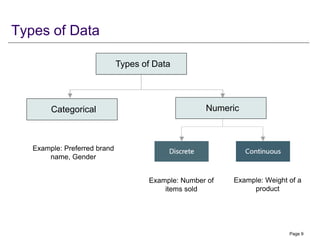
Example: Number of
items sold
Example: Weight of a
product
Example: Preferred brand
name, Gender
Types of Data
Categorical Numeric
Measurement Scale
Nominal data does not have order. For
example: gender
Ordinal data has a meaningful order.
For example: appraisal rating
Page 10
Interval example: Temperature in
Celsius.
Ratio example: Cost of an item
Measurement Scale
Categorical (Qualitative) Numeric (Quantitative)
Descriptive Statistics
• Central Tendency
• Mean: Arithmetic mean of numbers. Add the observations and divide by
count of the observations. Mean is affected by extreme values
• Median: When observations are sorted in ascending order, the middle
observation is median. If we have n observations, the (n+1)/2 th
observation is median. The median can be an observation or between
two observations
• Mode: Mode is the most frequently occurring data point in a data set
Page 11
Descriptive Statistics
• Range: It is the difference between the maximum and minimum values in a
data set. Affected by extreme values
• Inter Quartile Range (IQR) – IQR is the distance between the first and the
third quartile.
• First quartile (Q1) has 25% observation lower than it. (i.e. 25th
percentile)
• Third quartile (Q3) has 75% observation lower than it
• Median is also called second quartile (Q2)
• Variance is measured as the average of sum of squared difference
between each data point (represented by xi) and the mean represented by
Page 12
n
Σ (xi - ҧ
𝑥)2
i=1
------------
n - 1
N
Σ (xi - )2
i=1
------------
N
Unbiased
formula
Descriptive Statistics
• Standard deviation is one of the most popular measure of spread. It is the
square root of the variance.
Page 13
n
Σ (xi - ҧ
𝑥)2
i=1
------------
n - 1
N
Σ (xi - )2
i=1
------------
N Unbiased
formula
Descriptive Statistics
• Listing of Minimum, 1st quartile, Median, 3rd Quartile and Maximum is also called
“five number summary”
• Boxplot: A boxplot is a standardized way of displaying the distribution of data based
on a five-number summary (“minimum”, first quartile (Q1), median, third quartile
(Q3), and “maximum”).
• The box is drawn from Q1 to Q3
• Each whisker can extend maximum of (1.5 * IQR) beyond Q1 and Q3
• Any points beyond whisker, called outliers, are also plotted
Page 14
Discussion
• How to interpret the following
Page 15
OR
B
A
A B
Descriptive Statistics
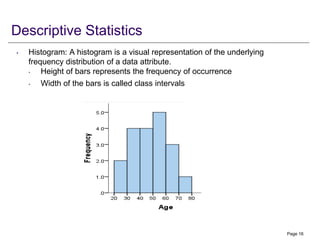
• Histogram: A histogram is a visual representation of the underlying
frequency distribution of a data attribute.
• Height of bars represents the frequency of occurrence
• Width of the bars is called class intervals
Page 16
Skewness
• A measure of the asymmetry of distribution of data
• Types of Skewness:
• Positive Skew (Right Skew): Tail on the right side is longer.
• Negative Skew (Left Skew): Tail on the left side is longer.
• Symmetrical Distribution: Skewness ≈ 0.
Page 17
Image credit: https://www.analyticsvidhya.com/blog/2020/07/what-is-skewness-statistics/
Kurtosis
• A measure of “tailedness” or “peakedness” of a data
• Note: Additional information:
• Mesokurtic: Normal distribution. Excess Kurtosis ≈ 0.
• Leptokurtic: Peaked distribution with fat tails. Excess Kurtosis > 0.
• Platykurtic: Flat distribution with thin tails. Excess Kurtosis < 0.
Page 18
Coefficient of Variation
Comparing dispersion – food for thought
• Following is the performance of two factories in terms number of parts
produced per day
Factory 1: Standard deviation 10
Factory 2: Standard deviation 12
What is the observation?
Possible answer: it appears that the factory-2 has more variation in
output (note: this may not a correct answer)
Page 19
Coefficient of Variation
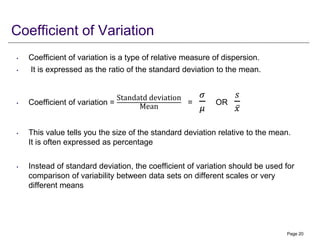
• Coefficient of variation is a type of relative measure of dispersion.
• It is expressed as the ratio of the standard deviation to the mean.
• Coefficient of variation =
Standatd deviation
Mean
=
𝜎
𝜇
OR
𝑠
ҧ
𝑥
• This value tells you the size of the standard deviation relative to the mean.
It is often expressed as percentage
• Instead of standard deviation, the coefficient of variation should be used for
comparison of variability between data sets on different scales or very
different means
Page 20
Coefficient of Variation
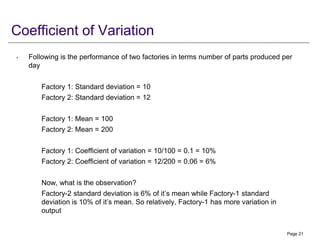
• Following is the performance of two factories in terms number of parts produced per
day
Factory 1: Standard deviation = 10
Factory 2: Standard deviation = 12
Factory 1: Mean = 100
Factory 2: Mean = 200
Factory 1: Coefficient of variation = 10/100 = 0.1 = 10%
Factory 2: Coefficient of variation = 12/200 = 0.06 = 6%
Now, what is the observation?
Factory-2 standard deviation is 6% of it’s mean while Factory-1 standard
deviation is 10% of it’s mean. So relatively, Factory-1 has more variation in
output
Page 21
Covariance
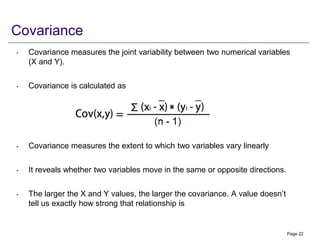
• Covariance measures the joint variability between two numerical variables
(X and Y).
• Covariance is calculated as
• Covariance measures the extent to which two variables vary linearly
• It reveals whether two variables move in the same or opposite directions.
• The larger the X and Y values, the larger the covariance. A value doesn’t
tell us exactly how strong that relationship is
Page 22
Covariance
• The sign of covariance reveals whether two variables move in the same or
opposite directions.
• The larger the X and Y values, the larger the covariance. The values of
Covariance is not range bound. Covariance value doesn’t indicate how
strong that relationship is
Image: https://www.allmath.com/covariance.php
Page 23
Positive
covariance
Negative
covariance
Near Zero
covariance
Positive
covariance
Negative
covariance
Coefficient of Correlation
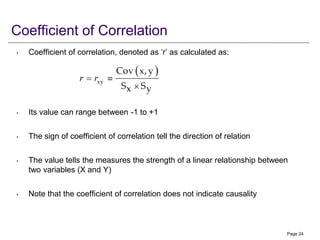
• Coefficient of correlation, denoted as ‘r’ as calculated as:
• Its value can range between -1 to +1
• The sign of coefficient of correlation tell the direction of relation
• The value tells the measures the strength of a linear relationship between
two variables (X and Y)
• Note that the coefficient of correlation does not indicate causality
Page 24
Coefficient of Correlation
• A value closer to +1 indicates a strong positive (direct) relationship while a
value closer to -1 indicates a strong negative (inverse) relationship
• A value close to zero indicates no linear relationship
Page 25
Coefficient of Correlation
• Note that the coefficient of correlation does not indicate causality
Credit: https://xkcd.com/552/
Page 26
Thank you!
Page 27

1-Descriptive Statistics - pdf file descriptive

  • 1.
  • 2.
    Agenda • Sampling • BasicDescriptive Statistics • Probability basics, Bayes Theorem • Probability distributions • Sampling Distribution • Interval Estimation and Hypothesis Testing • Introduction to Linear Regression Page 2
  • 3.
  • 4.
    Agenda • Population andSample • Data Collection • Types of data • Measures of central tendence • Measures of dispersion • Covariance and Coefficient of correlation Page 4
  • 5.
    Population and Sample •The collection of all data points is the “population” or the “universe” data for a process • A subset of points drawn from a population is called “sample” • Measurement of a characteristic of population is called “parameter” • Measurement of a characteristic of sample is called “statistic” Page 5
  • 6.
    Data Collection –Data sources • Primary vs Secondary data sources • Internal vs External data sources Page 6
  • 7.
    Data Collection • Observation •Questionnaires and Surveys • Interviews etc Page 7
  • 8.
    Data Collection -Sampling • Non-probability sampling: Selection is not statistically random. E.g. based on judgement or convenience. • Probability sampling • Random sampling - Every item has equal chance of being selected • Sampling without replacement • Samling with replacement • Stratified random sampling: Select randomly from predefined subgroups (strata) • Cluster sampling – Sampling from naturally occurring clusters, e.g. cities. • Systematic sampling – Divide into n groups containing k items. Randomly select from first k items. Then select every kth item. Page 8
  • 9.
    Types of Data Page9 Example: Number of items sold Example: Weight of a product Example: Preferred brand name, Gender Types of Data Categorical Numeric
  • 10.
    Measurement Scale Nominal datadoes not have order. For example: gender Ordinal data has a meaningful order. For example: appraisal rating Page 10 Interval example: Temperature in Celsius. Ratio example: Cost of an item Measurement Scale Categorical (Qualitative) Numeric (Quantitative)
  • 11.
    Descriptive Statistics • CentralTendency • Mean: Arithmetic mean of numbers. Add the observations and divide by count of the observations. Mean is affected by extreme values • Median: When observations are sorted in ascending order, the middle observation is median. If we have n observations, the (n+1)/2 th observation is median. The median can be an observation or between two observations • Mode: Mode is the most frequently occurring data point in a data set Page 11
  • 12.
    Descriptive Statistics • Range:It is the difference between the maximum and minimum values in a data set. Affected by extreme values • Inter Quartile Range (IQR) – IQR is the distance between the first and the third quartile. • First quartile (Q1) has 25% observation lower than it. (i.e. 25th percentile) • Third quartile (Q3) has 75% observation lower than it • Median is also called second quartile (Q2) • Variance is measured as the average of sum of squared difference between each data point (represented by xi) and the mean represented by Page 12 n Σ (xi - ҧ 𝑥)2 i=1 ------------ n - 1 N Σ (xi - )2 i=1 ------------ N Unbiased formula
  • 13.
    Descriptive Statistics • Standarddeviation is one of the most popular measure of spread. It is the square root of the variance. Page 13 n Σ (xi - ҧ 𝑥)2 i=1 ------------ n - 1 N Σ (xi - )2 i=1 ------------ N Unbiased formula
  • 14.
    Descriptive Statistics • Listingof Minimum, 1st quartile, Median, 3rd Quartile and Maximum is also called “five number summary” • Boxplot: A boxplot is a standardized way of displaying the distribution of data based on a five-number summary (“minimum”, first quartile (Q1), median, third quartile (Q3), and “maximum”). • The box is drawn from Q1 to Q3 • Each whisker can extend maximum of (1.5 * IQR) beyond Q1 and Q3 • Any points beyond whisker, called outliers, are also plotted Page 14
  • 15.
    Discussion • How tointerpret the following Page 15 OR B A A B
  • 16.
    Descriptive Statistics • Histogram:A histogram is a visual representation of the underlying frequency distribution of a data attribute. • Height of bars represents the frequency of occurrence • Width of the bars is called class intervals Page 16
  • 17.
    Skewness • A measureof the asymmetry of distribution of data • Types of Skewness: • Positive Skew (Right Skew): Tail on the right side is longer. • Negative Skew (Left Skew): Tail on the left side is longer. • Symmetrical Distribution: Skewness ≈ 0. Page 17 Image credit: https://www.analyticsvidhya.com/blog/2020/07/what-is-skewness-statistics/
  • 18.
    Kurtosis • A measureof “tailedness” or “peakedness” of a data • Note: Additional information: • Mesokurtic: Normal distribution. Excess Kurtosis ≈ 0. • Leptokurtic: Peaked distribution with fat tails. Excess Kurtosis > 0. • Platykurtic: Flat distribution with thin tails. Excess Kurtosis < 0. Page 18
  • 19.
    Coefficient of Variation Comparingdispersion – food for thought • Following is the performance of two factories in terms number of parts produced per day Factory 1: Standard deviation 10 Factory 2: Standard deviation 12 What is the observation? Possible answer: it appears that the factory-2 has more variation in output (note: this may not a correct answer) Page 19
  • 20.
    Coefficient of Variation •Coefficient of variation is a type of relative measure of dispersion. • It is expressed as the ratio of the standard deviation to the mean. • Coefficient of variation = Standatd deviation Mean = 𝜎 𝜇 OR 𝑠 ҧ 𝑥 • This value tells you the size of the standard deviation relative to the mean. It is often expressed as percentage • Instead of standard deviation, the coefficient of variation should be used for comparison of variability between data sets on different scales or very different means Page 20
  • 21.
    Coefficient of Variation •Following is the performance of two factories in terms number of parts produced per day Factory 1: Standard deviation = 10 Factory 2: Standard deviation = 12 Factory 1: Mean = 100 Factory 2: Mean = 200 Factory 1: Coefficient of variation = 10/100 = 0.1 = 10% Factory 2: Coefficient of variation = 12/200 = 0.06 = 6% Now, what is the observation? Factory-2 standard deviation is 6% of it’s mean while Factory-1 standard deviation is 10% of it’s mean. So relatively, Factory-1 has more variation in output Page 21
  • 22.
    Covariance • Covariance measuresthe joint variability between two numerical variables (X and Y). • Covariance is calculated as • Covariance measures the extent to which two variables vary linearly • It reveals whether two variables move in the same or opposite directions. • The larger the X and Y values, the larger the covariance. A value doesn’t tell us exactly how strong that relationship is Page 22
  • 23.
    Covariance • The signof covariance reveals whether two variables move in the same or opposite directions. • The larger the X and Y values, the larger the covariance. The values of Covariance is not range bound. Covariance value doesn’t indicate how strong that relationship is Image: https://www.allmath.com/covariance.php Page 23 Positive covariance Negative covariance Near Zero covariance Positive covariance Negative covariance
  • 24.
    Coefficient of Correlation •Coefficient of correlation, denoted as ‘r’ as calculated as: • Its value can range between -1 to +1 • The sign of coefficient of correlation tell the direction of relation • The value tells the measures the strength of a linear relationship between two variables (X and Y) • Note that the coefficient of correlation does not indicate causality Page 24
  • 25.
    Coefficient of Correlation •A value closer to +1 indicates a strong positive (direct) relationship while a value closer to -1 indicates a strong negative (inverse) relationship • A value close to zero indicates no linear relationship Page 25
  • 26.
    Coefficient of Correlation •Note that the coefficient of correlation does not indicate causality Credit: https://xkcd.com/552/ Page 26
  • 27.