
Data over Coax
The Best Last Mile Access Technology before FttH
ANGA COM 2013
4-6.6.2013
Hanno Narjus
Senior Vice President, Video and Broadband Solutions
ON EVERY STREET CORNER IN EUROPE
Or in Other Words:
Should your Next Generation CMTS be Installed Here?
ON EVERY STREET CORNER IN EUROPE
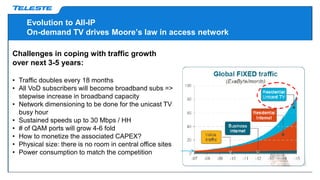
Evolution to All-IP
On-demand TV drives Moore’s law in access network
Challenges in coping with traffic growth
over next 3-5 years:
• Traffic doubles every 18 months
• All VoD subscribers will become broadband subs =>
stepwise increase in broadband capacity
• Network dimensioning to be done for the unicast TV
busy hour
• Sustained speeds up to 30 Mbps / HH
• # of QAM ports will grow 4-6 fold
• How to monetize the associated CAPEX?
• Physical size: there is no room in central office sites
• Power consumption to match the competition
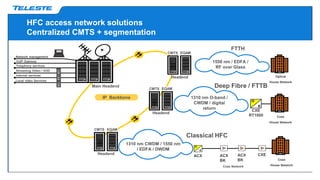
HFC access network solutions
Centralized CMTS + segmentation
Main Headend
ACX ACX
BK
ACX
BK
Coax Network
Coax
House Network
IP Backbone
Streaming Video / VOD
Network management
Deep Fibre / FTTB
FTTH
Classical HFC
VoIP Gateway
Internet services
Local video Services
Telephony services
CXE
O
E
CXE
RT1000
O
E
CMTS EQAM
Headend
1550 nm / EDFA /
RF over Glass
Coax
House Network
Optical
House Network
1310 nm O-band /
CWDM / digital
return
CMTS EQAM
Headend
CMTS EQAM
Headend
1310 nm CWDM / 1550 nm
/ EDFA / DWDM
Main Headend
IP Backbone
Streaming video / VOD
Network management
Deep Fibre / FTTB
FTTH
VoIP Gateway
Internet services
Local video Services
Telephony services
IP Edge EQAM
PoP
Coax
House Network
Optical
House Network
P2p GigE / xPON
RF overlay
IP Edge EQAM
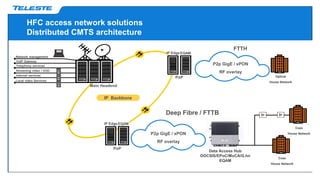
HFC access network solutions
Distributed CMTS architecture
P2p GigE / xPON
RF overlay
Data Access Hub
DOCSIS/EPoC/MoCA/G.hn
EQAM
Coax
House Network
PoP
CMTS
Docsis 3.0
DVB VoD
1000 HP /
segment
CCAP
Docsis 3.0
DVB VoD
250-500 HP /
segment
CCAP
Docsis 3.1
All-IP VoD
100-250 HP / segment
Spectrum upgrade (CPE,
Amps, passives)
Distributed architecture
More capacity (3.0 32 DS / 8 US
or EPOC / GPOC)
All-IP
50-100 HP / segment
Distributed architecture
Docsis 3.0
DVB VoD
100-200 HP / segment
FTTH
Distributed
architecture
Docsis 3.1 / EPOC
/ GPOC
All-IP
100 HP / segment
CMTS
Docsis 3.0
DVB VoD
1000 HP /
segment
CCAP
Docsis 3.0
DVB VoD
250-500 HP /
segment
Distributed architecture
More capacity (3.0 32 DS / 8 US
or EPOC / GPOC)
All-IP
50-100 HP / segment
Distributed architecture
Docsis 3.0
DVB VoD
100-200 HP / segment
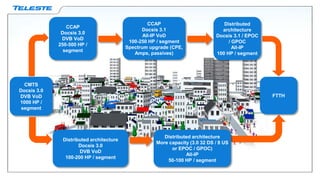
An example scenario
1. CCAP to be launched for lower CAPEX + red-cell
fighting node segmentation
2. Distributed architecture for ”hot spots” in the network
• Uniform Docsis 3.0 platform (postpone 3.1 launch)
• Avoidance of spectrum upgrade major CAPEX
• Further segmentation
• Future proof optical transmission in acces
3. Launch more capacity
• Either stay at Docsis 3.0 + segmentation or
• Future technology e.g. EPOC
FTTH
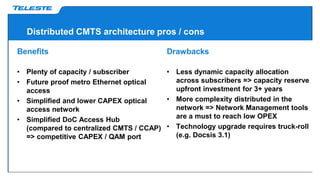
Distributed CMTS architecture pros / cons
Benefits
• Plenty of capacity / subscriber
• Future proof metro Ethernet optical
access
• Simplified and lower CAPEX optical
access network
• Simplified DoC Access Hub
(compared to centralized CMTS / CCAP)
=> competitive CAPEX / QAM port
Drawbacks
• Less dynamic capacity allocation
across subscribers => capacity reserve
upfront investment for 3+ years
• More complexity distributed in the
network => Network Management tools
are a must to reach low OPEX
• Technology upgrade requires truck-roll
(e.g. Docsis 3.1)
Star and
Cascade
MoCA 2.0
DOCSIS
CATV
FM
2013
MoCA
400 /800 Mbps
Shared
Star and
Cascade
G.hn
(DOCSIS )
CATV
(FM )
2012
ITU -T
600Mbps
Shared
Network
topologies
Technology
Service co -
existance
Availability
Standardisation
organisation
Coax
Throughput
Amplifiers on
signal path
Star and
Cascade
IEEE P 1901
CATV
FM
Yes
IEEE
500Mbps
Shared
GoodGoodIngress
Robustness Good
Star and
Cascade
DOCSIS EoC
DOCSIS
CATV
FM
2012
Cablelabs
160Mbps US /
960Mbps DS
Shared
Active return
path amps , no
bypass needed
Fair
Star only
Baseband
Ethernet
CATV
2011
-
100Mbps
dedicated
Cannot exist
Excellent
Star and
Cascade
EPON over
Coax
DOCSIS
CATV
FM
Unknown
IEEE 802 .3
Ethernet
Working Group
Same as
DOCSIS
Active return
path amps , no
bypass needed
Poor
Star and
Cascade
HPNA 3.1
CATV
FM
Yes
ITU-T
discontinued
200 Mbps
Shared
Average
Bypass needed Bypass needed Bypass needed Bypass needed
(DOCSIS)
CATV
(FM)
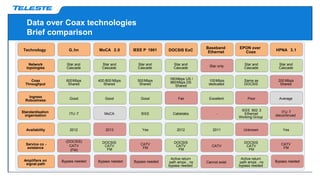
Data over Coax technologies
Brief comparison
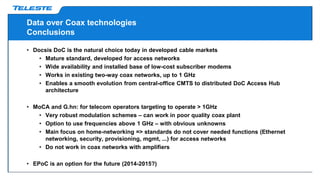
Data over Coax technologies
Conclusions
• Docsis DoC is the natural choice today in developed cable markets
• Mature standard, developed for access networks
• Wide availability and installed base of low-cost subscriber modems
• Works in existing two-way coax networks, up to 1 GHz
• Enables a smooth evolution from central-office CMTS to distributed DoC Access Hub
architecture
• MoCA and G.hn: for telecom operators targeting to operate > 1GHz
• Very robust modulation schemes – can work in poor quality coax plant
• Option to use frequencies above 1 GHz – with obvious unknowns
• Main focus on home-networking => standards do not cover needed functions (Ethernet
networking, security, provisioning, mgmt, ...) for access networks
• Do not work in coax networks with amplifiers
• EPoC is an option for the future (2014-2015?)
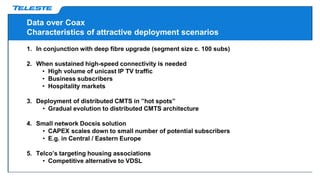
Data over Coax
Characteristics of attractive deployment scenarios
1. In conjunction with deep fibre upgrade (segment size c. 100 subs)
2. When sustained high-speed connectivity is needed
• High volume of unicast IP TV traffic
• Business subscribers
• Hospitality markets
3. Deployment of distributed CMTS in ”hot spots”
• Gradual evolution to distributed CMTS architecture
4. Small network Docsis solution
• CAPEX scales down to small number of potential subscribers
• E.g. in Central / Eastern Europe
5. Telco’s targeting housing associations
• Competitive alternative to VDSL
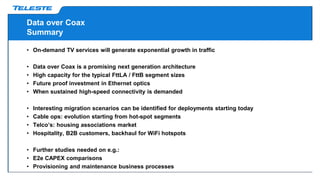
Data over Coax
Summary
• On-demand TV services will generate exponential growth in traffic
• Data over Coax is a promising next generation architecture
• High capacity for the typical FttLA / FttB segment sizes
• Future proof investment in Ethernet optics
• When sustained high-speed connectivity is demanded
• Interesting migration scenarios can be identified for deployments starting today
• Cable ops: evolution starting from hot-spot segments
• Telco’s: housing associations market
• Hospitality, B2B customers, backhaul for WiFi hotspots
• Further studies needed on e.g.:
• E2e CAPEX comparisons
• Provisioning and maintenance business processes
Thank You!
Q & A
ON EVERY STREET CORNER IN EUROPE

Data over Coax - The Best Last Mile Access Technology before FTTH

  • 1.
    Data over Coax TheBest Last Mile Access Technology before FttH ANGA COM 2013 4-6.6.2013 Hanno Narjus Senior Vice President, Video and Broadband Solutions ON EVERY STREET CORNER IN EUROPE
  • 2.
    Or in OtherWords: Should your Next Generation CMTS be Installed Here? ON EVERY STREET CORNER IN EUROPE
  • 3.
    Evolution to All-IP On-demandTV drives Moore’s law in access network Challenges in coping with traffic growth over next 3-5 years: • Traffic doubles every 18 months • All VoD subscribers will become broadband subs => stepwise increase in broadband capacity • Network dimensioning to be done for the unicast TV busy hour • Sustained speeds up to 30 Mbps / HH • # of QAM ports will grow 4-6 fold • How to monetize the associated CAPEX? • Physical size: there is no room in central office sites • Power consumption to match the competition
  • 4.
    HFC access networksolutions Centralized CMTS + segmentation Main Headend ACX ACX BK ACX BK Coax Network Coax House Network IP Backbone Streaming Video / VOD Network management Deep Fibre / FTTB FTTH Classical HFC VoIP Gateway Internet services Local video Services Telephony services CXE O E CXE RT1000 O E CMTS EQAM Headend 1550 nm / EDFA / RF over Glass Coax House Network Optical House Network 1310 nm O-band / CWDM / digital return CMTS EQAM Headend CMTS EQAM Headend 1310 nm CWDM / 1550 nm / EDFA / DWDM
  • 5.
    Main Headend IP Backbone Streamingvideo / VOD Network management Deep Fibre / FTTB FTTH VoIP Gateway Internet services Local video Services Telephony services IP Edge EQAM PoP Coax House Network Optical House Network P2p GigE / xPON RF overlay IP Edge EQAM HFC access network solutions Distributed CMTS architecture P2p GigE / xPON RF overlay Data Access Hub DOCSIS/EPoC/MoCA/G.hn EQAM Coax House Network PoP
  • 6.
    CMTS Docsis 3.0 DVB VoD 1000HP / segment CCAP Docsis 3.0 DVB VoD 250-500 HP / segment CCAP Docsis 3.1 All-IP VoD 100-250 HP / segment Spectrum upgrade (CPE, Amps, passives) Distributed architecture More capacity (3.0 32 DS / 8 US or EPOC / GPOC) All-IP 50-100 HP / segment Distributed architecture Docsis 3.0 DVB VoD 100-200 HP / segment FTTH Distributed architecture Docsis 3.1 / EPOC / GPOC All-IP 100 HP / segment
  • 7.
    CMTS Docsis 3.0 DVB VoD 1000HP / segment CCAP Docsis 3.0 DVB VoD 250-500 HP / segment Distributed architecture More capacity (3.0 32 DS / 8 US or EPOC / GPOC) All-IP 50-100 HP / segment Distributed architecture Docsis 3.0 DVB VoD 100-200 HP / segment An example scenario 1. CCAP to be launched for lower CAPEX + red-cell fighting node segmentation 2. Distributed architecture for ”hot spots” in the network • Uniform Docsis 3.0 platform (postpone 3.1 launch) • Avoidance of spectrum upgrade major CAPEX • Further segmentation • Future proof optical transmission in acces 3. Launch more capacity • Either stay at Docsis 3.0 + segmentation or • Future technology e.g. EPOC FTTH
  • 8.
    Distributed CMTS architecturepros / cons Benefits • Plenty of capacity / subscriber • Future proof metro Ethernet optical access • Simplified and lower CAPEX optical access network • Simplified DoC Access Hub (compared to centralized CMTS / CCAP) => competitive CAPEX / QAM port Drawbacks • Less dynamic capacity allocation across subscribers => capacity reserve upfront investment for 3+ years • More complexity distributed in the network => Network Management tools are a must to reach low OPEX • Technology upgrade requires truck-roll (e.g. Docsis 3.1)
  • 9.
    Star and Cascade MoCA 2.0 DOCSIS CATV FM 2013 MoCA 400/800 Mbps Shared Star and Cascade G.hn (DOCSIS ) CATV (FM ) 2012 ITU -T 600Mbps Shared Network topologies Technology Service co - existance Availability Standardisation organisation Coax Throughput Amplifiers on signal path Star and Cascade IEEE P 1901 CATV FM Yes IEEE 500Mbps Shared GoodGoodIngress Robustness Good Star and Cascade DOCSIS EoC DOCSIS CATV FM 2012 Cablelabs 160Mbps US / 960Mbps DS Shared Active return path amps , no bypass needed Fair Star only Baseband Ethernet CATV 2011 - 100Mbps dedicated Cannot exist Excellent Star and Cascade EPON over Coax DOCSIS CATV FM Unknown IEEE 802 .3 Ethernet Working Group Same as DOCSIS Active return path amps , no bypass needed Poor Star and Cascade HPNA 3.1 CATV FM Yes ITU-T discontinued 200 Mbps Shared Average Bypass needed Bypass needed Bypass needed Bypass needed (DOCSIS) CATV (FM) Data over Coax technologies Brief comparison
  • 10.
    Data over Coaxtechnologies Conclusions • Docsis DoC is the natural choice today in developed cable markets • Mature standard, developed for access networks • Wide availability and installed base of low-cost subscriber modems • Works in existing two-way coax networks, up to 1 GHz • Enables a smooth evolution from central-office CMTS to distributed DoC Access Hub architecture • MoCA and G.hn: for telecom operators targeting to operate > 1GHz • Very robust modulation schemes – can work in poor quality coax plant • Option to use frequencies above 1 GHz – with obvious unknowns • Main focus on home-networking => standards do not cover needed functions (Ethernet networking, security, provisioning, mgmt, ...) for access networks • Do not work in coax networks with amplifiers • EPoC is an option for the future (2014-2015?)
  • 11.
    Data over Coax Characteristicsof attractive deployment scenarios 1. In conjunction with deep fibre upgrade (segment size c. 100 subs) 2. When sustained high-speed connectivity is needed • High volume of unicast IP TV traffic • Business subscribers • Hospitality markets 3. Deployment of distributed CMTS in ”hot spots” • Gradual evolution to distributed CMTS architecture 4. Small network Docsis solution • CAPEX scales down to small number of potential subscribers • E.g. in Central / Eastern Europe 5. Telco’s targeting housing associations • Competitive alternative to VDSL
  • 12.
    Data over Coax Summary •On-demand TV services will generate exponential growth in traffic • Data over Coax is a promising next generation architecture • High capacity for the typical FttLA / FttB segment sizes • Future proof investment in Ethernet optics • When sustained high-speed connectivity is demanded • Interesting migration scenarios can be identified for deployments starting today • Cable ops: evolution starting from hot-spot segments • Telco’s: housing associations market • Hospitality, B2B customers, backhaul for WiFi hotspots • Further studies needed on e.g.: • E2e CAPEX comparisons • Provisioning and maintenance business processes
  • 13.
    Thank You! Q &A ON EVERY STREET CORNER IN EUROPE