
Digitization Issues In
Television
Broadcasting
IFRATH RAEESA K P
Digitization
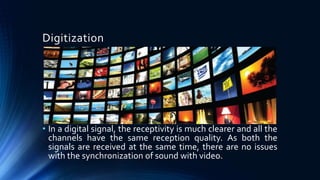
• In a digital signal, the receptivity is much clearer and all the
channels have the same reception quality. As both the
signals are received at the same time, there are no issues
with the synchronization of sound with video.
Channel distribution before digitization
• Broadcasters
• Multi system operators (MSO)
• Local cable operators (LCO)
• Consumers
2010
• Report recommending for complete digitisation
December , 2011
• The parliament passed the bill to amend the CableTelevision
Networks (Regulation) Act in December, 2011.
The Cable Television Networks (Regulation)
Amendment Bill, 2011
• All cableTV operators will have to transmitTV signals in an encrypted
format through a Digital Addressable System (D A S).
• Consumers will now be able to enjoy better picture and sound quality,
enhanced services such as high definition and video on demand
content.
• Viewers will be able to choose and pay for
only those channels that they want rather
than having to pick from packages
with fixed prices.
•Subscription revenue will increase for the
broadcaster and make them less dependent
on advertising and drive higher value creation.
Digitization by 2014
Phases of Digitization
4 phases
1st phase
• 4 major cities
• Delhi, Kolkata, Mumbai & Chennai
• End of 2012
2nd Phase
• 38 cities.
• Bangalore, Hyderabad, Ahmadabad, Pune, Lucknow, Patna, Bhopal,
Agra,Varanasi, Chandigarh, Coimbatore, Mysore……
• End of 2013
3rd Phase
• All urban cities
• 30th September 2014
• Extended to December 31, 2015
4th phase
• Rest of India
• December 31st, 2014
• By December 31st 2016
Digitization issues

Digitization issues

  • 1.
  • 2.
    Digitization • In adigital signal, the receptivity is much clearer and all the channels have the same reception quality. As both the signals are received at the same time, there are no issues with the synchronization of sound with video.
  • 3.
    Channel distribution beforedigitization • Broadcasters • Multi system operators (MSO) • Local cable operators (LCO) • Consumers
  • 4.
    2010 • Report recommendingfor complete digitisation
  • 5.
    December , 2011 •The parliament passed the bill to amend the CableTelevision Networks (Regulation) Act in December, 2011.
  • 6.
    The Cable TelevisionNetworks (Regulation) Amendment Bill, 2011 • All cableTV operators will have to transmitTV signals in an encrypted format through a Digital Addressable System (D A S).
  • 7.
    • Consumers willnow be able to enjoy better picture and sound quality, enhanced services such as high definition and video on demand content. • Viewers will be able to choose and pay for only those channels that they want rather than having to pick from packages with fixed prices. •Subscription revenue will increase for the broadcaster and make them less dependent on advertising and drive higher value creation.
  • 8.
  • 9.
    Phases of Digitization 4phases 1st phase • 4 major cities • Delhi, Kolkata, Mumbai & Chennai • End of 2012
  • 10.
    2nd Phase • 38cities. • Bangalore, Hyderabad, Ahmadabad, Pune, Lucknow, Patna, Bhopal, Agra,Varanasi, Chandigarh, Coimbatore, Mysore…… • End of 2013
  • 12.
    3rd Phase • Allurban cities • 30th September 2014 • Extended to December 31, 2015
  • 13.
    4th phase • Restof India • December 31st, 2014 • By December 31st 2016