Cable Broadband 
Access Developments 
Benjamin Fu 
June 5th, 2014
Agenda 
• DOCSIS Recap 
• DOCSIS 3.1 
• CCAP & Other Fancy Stuff 
• Vendor-X’s Strategy
DOCSIS Recap 
DOCSIS: Most successful broadband access tech in NA 
• DOCSIS 1.0 
o Started the broadband access era 
• DOCSIS 1.1 
o Sophisticated QoS mechanism enabled IP Voice 
o Still the stepping stone for today’s QoS 
o BPI+, certificate 
• DOCSIS 3.0 
o Channel bonding 
o IPv6 
o More security enhancements
DOCSIS Recap (cont.) 
DOCSIS 3.0 deployment facts 
• Actively deployed for 5+ years, fast-growing 
• Majority offering: 8x4 (DS/US) 
• Some started 24x8 
o 1Gbps downstream / 200Mbps upstream peak rate 
DOCSIS 3.0 CPE 
• Vendors ceased D2.0 in 2012 
• D3.0 CPE revenue increased by 85% in 2013 
• 16/24 channel D3.0 CPE started shipping late 2013
Agenda 
• DOCSIS Recap 
• DOCSIS 3.1 
• CCAP & Other Fancy Stuff 
• Vendor-X’s Strategy
DOCSIS 3.1 - Why 
• EPON/GPON, Google fiber, etc. 
• IP Video: YouTube, Netflix, Hulu, emerging 4K video 
• Why not just bond more channels? 
• Backwards compatibility
DOCSIS 3.1 - Basics 
• Goal 
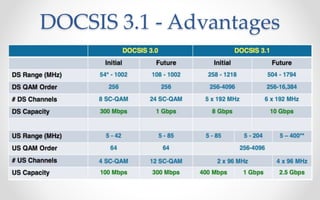
o Achieve 10G+ bps in downstream & 2G+ bps in upstream 
o Backwards compatible all the way back to DOCSIS 1.1 
o Spectral efficiency 
• Technology 
o OFDM, OFDMA, LDPC 
o Expanded spectrum 
o Greener 
• Competitive with FTTH at much lower cost
DOCSIS 3.1 - Advantages
DOCSIS 3.1 - Technologies
DOCSIS 3.1 - Technologies 
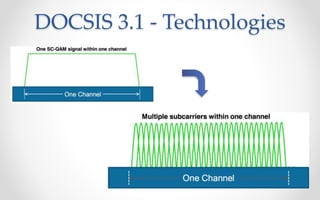
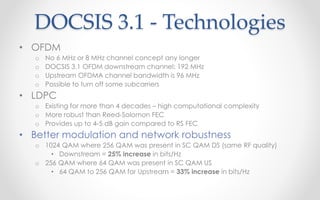
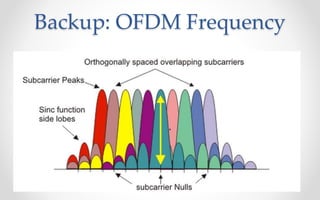
• OFDM 
o No 6 MHz or 8 MHz channel concept any longer 
o DOCSIS 3.1 OFDM downstream channel: 192 MHz 
o Upstream OFDMA channel bandwidth is 96 MHz 
o Possible to turn off some subcarriers 
• LDPC 
o Existing for more than 4 decades – high computational complexity 
o More robust than Reed-Solomon FEC 
o Provides up to 4-5 dB gain compared to RS FEC 
• Better modulation and network robustness 
o 1024 QAM where 256 QAM was present in SC QAM DS (same RF quality) 
• Downstream = 25% increase in bits/Hz 
o 256 QAM where 64 QAM was present in SC QAM US 
• 64 QAM to 256 QAM for Upstream = 33% increase in bits/Hz
DOCSIS 3.1 – Backwards Compatibility 
• Back office 
o Only MULPI and PHY spec published, no OSSI yet 
o Shouldn’t be big change requiring back office upgrade 
• DOCSIS 3.1 CPE 
o Simultaneously support legacy SC-QAM channels and OFDM channels 
o Possibility of bonding SC-QAM and OFDM 
• Upstream spectral multiplexing 
o Legacy SC-QAM and OFDMA able to be time multiplexed 
All for Gradual introduction
DOCSIS 3.1 – Practical Concerns 
• Upstream 
o Sub-split, mid-split, high-split 
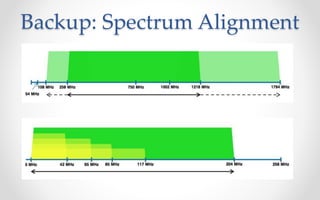
o In relatively long period, many MSO will be stuck at 5-42Mhz 
o Higher-split then 42Mhz 
• Diplex filter replacement 
• Most likely amplifier replacement 
o Legacy DTV OOB 
• Movable above 120Mhz? 
o Return laser upgrade – higher order modulation… 
• Downstream 
o RF plan upgrade: 860Mhz to 1Ghz or even 1.2Ghz plant 
o Very high cost
Agenda 
• DOCSIS Recap 
• DOCSIS 3.1 
• CCAP & Other Fancy Stuff 
• Vendor-X’s Strategy
CCAP 
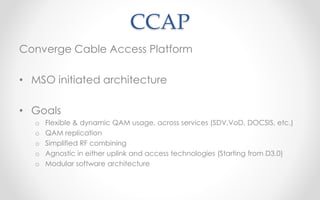
Converge Cable Access Platform 
• MSO initiated architecture 
• Goals 
o Flexible & dynamic QAM usage, across services (SDV,VoD, DOCSIS, etc.) 
o QAM replication 
o Simplified RF combining 
o Agnostic in either uplink and access technologies (Starting from D3.0) 
o Modular software architecture
CCAP (cont.) 
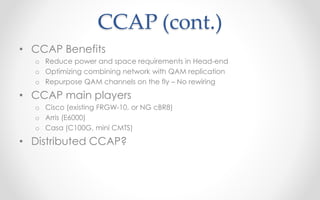
• CCAP Benefits 
o Reduce power and space requirements in Head-end 
o Optimizing combining network with QAM replication 
o Repurpose QAM channels on the fly – No rewiring 
• CCAP main players 
o Cisco (existing FRGW-10, or NG cBR8) 
o Arris (E6000) 
o Casa (C100G, mini CMTS) 
• Distributed CCAP?
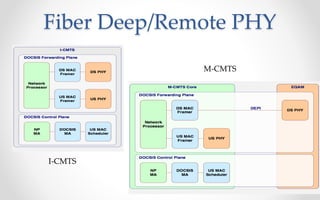
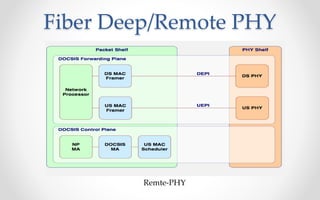
Fiber Deep/Remote PHY 
I-CMTS 
M-CMTS
Fiber Deep/Remote PHY 
Remte-PHY
C-DOCSIS 
• C-DOCSIS 
o Full feature layer 2 Mini CMTS 
o OLT mandate as uplink 
• Cisco’s version of C-DOCSIS 
o 3G60 based 
o PHY on CMC only (long-term goal: remote-PHY) 
• Virtualization 
o Server based MAC and management 
o CMTS in the Cloud
Agenda 
• DOCSIS Recap 
• DOCSIS 3.1 
• CCAP & Other Fancy Stuff 
• Vendor-X’s Strategy
Vendor-X Strategy 
• CMTS/CCAP 
o Dominant technology in North America but not Asia/Europe 
o Is Vendor-X strong in CMTS ? 
• Distributed/Remote 
o C-DOCSIS – Main drafting member, MA5633 
o Very strong in EPON/GPON 
o Porting to broader market? 
• DOCSIS 3.1 
o Sampled back in Oct, 2013 
o Very strong in CPE, both technology and marketing 
o CPE, esp. DOCSIS 3.1 CPE (gateway)
Thank You! 
Sources from: 
CableLabs, 
Cisco Live! 2014 presentation, 
Lightreading.com 
Vendor’s website.
Backup: OFDM Frequency
Backup: DS Profiles 
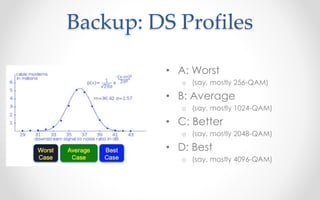
• A: Worst 
o (say, mostly 256-QAM) 
• B: Average 
o (say, mostly 1024-QAM) 
• C: Better 
o (say, mostly 2048-QAM) 
• D: Best 
o (say, mostly 4096-QAM)
Backup: Spectrum Alignment
Backup: Energy Mangement

Cable Access Developments

  • 1.
    Cable Broadband AccessDevelopments Benjamin Fu June 5th, 2014
  • 2.
    Agenda • DOCSISRecap • DOCSIS 3.1 • CCAP & Other Fancy Stuff • Vendor-X’s Strategy
  • 3.
    DOCSIS Recap DOCSIS:Most successful broadband access tech in NA • DOCSIS 1.0 o Started the broadband access era • DOCSIS 1.1 o Sophisticated QoS mechanism enabled IP Voice o Still the stepping stone for today’s QoS o BPI+, certificate • DOCSIS 3.0 o Channel bonding o IPv6 o More security enhancements
  • 4.
    DOCSIS Recap (cont.) DOCSIS 3.0 deployment facts • Actively deployed for 5+ years, fast-growing • Majority offering: 8x4 (DS/US) • Some started 24x8 o 1Gbps downstream / 200Mbps upstream peak rate DOCSIS 3.0 CPE • Vendors ceased D2.0 in 2012 • D3.0 CPE revenue increased by 85% in 2013 • 16/24 channel D3.0 CPE started shipping late 2013
  • 5.
    Agenda • DOCSISRecap • DOCSIS 3.1 • CCAP & Other Fancy Stuff • Vendor-X’s Strategy
  • 6.
    DOCSIS 3.1 -Why • EPON/GPON, Google fiber, etc. • IP Video: YouTube, Netflix, Hulu, emerging 4K video • Why not just bond more channels? • Backwards compatibility
  • 7.
    DOCSIS 3.1 -Basics • Goal o Achieve 10G+ bps in downstream & 2G+ bps in upstream o Backwards compatible all the way back to DOCSIS 1.1 o Spectral efficiency • Technology o OFDM, OFDMA, LDPC o Expanded spectrum o Greener • Competitive with FTTH at much lower cost
  • 8.
    DOCSIS 3.1 -Advantages
  • 9.
    DOCSIS 3.1 -Technologies
  • 10.
    DOCSIS 3.1 -Technologies • OFDM o No 6 MHz or 8 MHz channel concept any longer o DOCSIS 3.1 OFDM downstream channel: 192 MHz o Upstream OFDMA channel bandwidth is 96 MHz o Possible to turn off some subcarriers • LDPC o Existing for more than 4 decades – high computational complexity o More robust than Reed-Solomon FEC o Provides up to 4-5 dB gain compared to RS FEC • Better modulation and network robustness o 1024 QAM where 256 QAM was present in SC QAM DS (same RF quality) • Downstream = 25% increase in bits/Hz o 256 QAM where 64 QAM was present in SC QAM US • 64 QAM to 256 QAM for Upstream = 33% increase in bits/Hz
  • 11.
    DOCSIS 3.1 –Backwards Compatibility • Back office o Only MULPI and PHY spec published, no OSSI yet o Shouldn’t be big change requiring back office upgrade • DOCSIS 3.1 CPE o Simultaneously support legacy SC-QAM channels and OFDM channels o Possibility of bonding SC-QAM and OFDM • Upstream spectral multiplexing o Legacy SC-QAM and OFDMA able to be time multiplexed All for Gradual introduction
  • 12.
    DOCSIS 3.1 –Practical Concerns • Upstream o Sub-split, mid-split, high-split o In relatively long period, many MSO will be stuck at 5-42Mhz o Higher-split then 42Mhz • Diplex filter replacement • Most likely amplifier replacement o Legacy DTV OOB • Movable above 120Mhz? o Return laser upgrade – higher order modulation… • Downstream o RF plan upgrade: 860Mhz to 1Ghz or even 1.2Ghz plant o Very high cost
  • 13.
    Agenda • DOCSISRecap • DOCSIS 3.1 • CCAP & Other Fancy Stuff • Vendor-X’s Strategy
  • 14.
    CCAP Converge CableAccess Platform • MSO initiated architecture • Goals o Flexible & dynamic QAM usage, across services (SDV,VoD, DOCSIS, etc.) o QAM replication o Simplified RF combining o Agnostic in either uplink and access technologies (Starting from D3.0) o Modular software architecture
  • 15.
    CCAP (cont.) •CCAP Benefits o Reduce power and space requirements in Head-end o Optimizing combining network with QAM replication o Repurpose QAM channels on the fly – No rewiring • CCAP main players o Cisco (existing FRGW-10, or NG cBR8) o Arris (E6000) o Casa (C100G, mini CMTS) • Distributed CCAP?
  • 16.
    Fiber Deep/Remote PHY I-CMTS M-CMTS
  • 17.
  • 18.
    C-DOCSIS • C-DOCSIS o Full feature layer 2 Mini CMTS o OLT mandate as uplink • Cisco’s version of C-DOCSIS o 3G60 based o PHY on CMC only (long-term goal: remote-PHY) • Virtualization o Server based MAC and management o CMTS in the Cloud
  • 19.
    Agenda • DOCSISRecap • DOCSIS 3.1 • CCAP & Other Fancy Stuff • Vendor-X’s Strategy
  • 20.
    Vendor-X Strategy •CMTS/CCAP o Dominant technology in North America but not Asia/Europe o Is Vendor-X strong in CMTS ? • Distributed/Remote o C-DOCSIS – Main drafting member, MA5633 o Very strong in EPON/GPON o Porting to broader market? • DOCSIS 3.1 o Sampled back in Oct, 2013 o Very strong in CPE, both technology and marketing o CPE, esp. DOCSIS 3.1 CPE (gateway)
  • 21.
    Thank You! Sourcesfrom: CableLabs, Cisco Live! 2014 presentation, Lightreading.com Vendor’s website.
  • 22.
  • 23.
    Backup: DS Profiles • A: Worst o (say, mostly 256-QAM) • B: Average o (say, mostly 1024-QAM) • C: Better o (say, mostly 2048-QAM) • D: Best o (say, mostly 4096-QAM)
  • 24.
  • 25.

Editor's Notes

  • #4 MSO hold 59% US broadband market, 85+ million home passes (Leichtman Research Group,2014) DOCSIS 2.0 SC-CDMA on upstream
  • #5 Infonetics : 2013 D3.0 CPE revenue increased by 85% over 2012 When peak rate/ billboard speed goes 1Gps, average 50Mbps 16 DS, 608M, maximum service offering: 300+ 24 DS, 912Mbps, maximum service rate: 450M bps
  • #7 Single Channel QAM not efficient enough Backwards compatibility – key feature keeps DOCSIS so successful FTTH -- $1500 per home pass – 3 to 4 times comparing with D3.1
  • #8 Minor change in version number, but fundamental change in technology 192Mhz/96Mhz
  • #9 Minor change in version number, but fundamental change in technology 192Mhz/96Mhz $1500 per hp - FTTH
  • #10 Robert Gallager in his 1960 Ph.D. thesis Targeted modulation increase Different profiles enables more network adaptiveness – A: Worst (say, mostly 256-QAM) – B: Average (say, mostly 1024-QAM) – C: Better (say, mostly 2048-QAM) – D: Best (say, mostly 4096-QAM)
  • #11 Robert Gallager in his 1960 Ph.D. thesis Targeted modulation increase Different profiles enables more network adaptiveness (typical 8 db variance) SC-QAM must be down to accommodate the lowest… – A: Worst (say, mostly 256-QAM) – B: Average (say, mostly 1024-QAM) – C: Better (say, mostly 2048-QAM) – D: Best (say, mostly 4096-QAM)
  • #12 Devices could support bonding between OFDM and SC-QAM in order to aggregate that capacity and provide an incremental and orderly migration
  • #13 Legacy VOD C&C E.G Cogeco uses 70Mhz for VoD return. Most Moto box can’t move OOB up above 129Mhz.
  • #15 Comcast: CMAP; TWC: CESAR; Other smaller MSO EPON, GPON, etc.
  • #16 Facilitate today’s high QAM density Replace multiple racks of single-purpose QAMs in most cases – Eliminate the physical forward combining network saving additional space – Remotely change the number nodes per service group by QAM application – Efficiently use QAM – Reallocate QAMs between MPEG Video and DOCSIS remotely as requirements change
  • #21 D3.1 CPE – must be gateway, with advanced WiFi, even MoCA 2.0 for MSO’s managed Video OR, OTT video Mangement – TR69, TR-181 data model, Net-conf , etc. MA5633 – large installation base?