Webinar: Data Management Plans
16 February 2017
Natasha Simons
Kathryn Unsworth
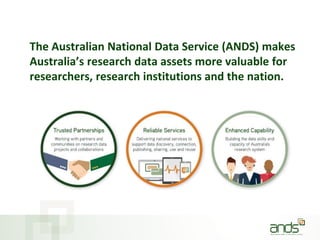
The Australian National Data Service (ANDS) makes
Australia’s research data assets more valuable for
researchers, research institutions and the nation.
Getting involved
#andsdata
Please use the Chat
box for questions
and comments
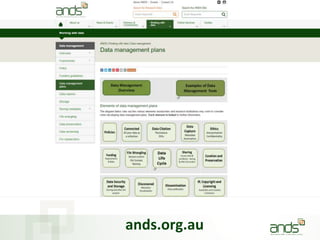
Data Management Plans
ands.org.au
Todays webinar in 3 parts
1. Talks:
• DMPs – overview + intro to v2.0 (Natasha)
• DMP Birds of a Feather session at eResearch Australasia
(Kathryn)
• DMPs at The University of Melbourne (Nick Smale)
2. Open Mike time
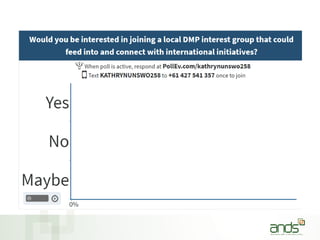
3. DMP Community of Practice in Australia.
There will be a pop up survey for your ideas after you leave the
webinar - please don’t ignore it!
We’ll relay questions and tweets during the
webinar, so please Chat pod & Tweet as
things occur to you
Natasha Simons
DMP webinar
Senior Data Management Specialist
16 February 2017
What are Research DMPs?
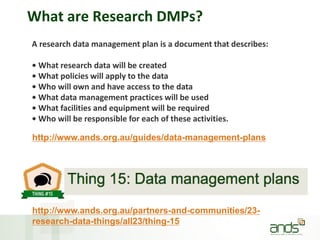
A research data management plan is a document that describes:
• What research data will be created
• What policies will apply to the data
• Who will own and have access to the data
• What data management practices will be used
• What facilities and equipment will be required
• Who will be responsible for each of these activities.
http://www.ands.org.au/guides/data-management-plans
http://www.ands.org.au/partners-and-communities/23-
research-data-things/all23/thing-15
Why DMPs?
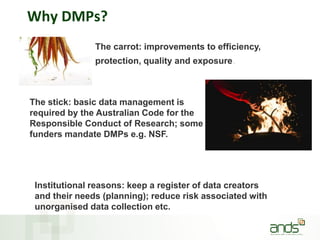
The carrot: improvements to efficiency,
protection, quality and exposure.
The stick: basic data management is
required by the Australian Code for the
Responsible Conduct of Research; some
funders mandate DMPs e.g. NSF.
Institutional reasons: keep a register of data creators
and their needs (planning); reduce risk associated with
unorganised data collection etc.
Added incentives for researchers
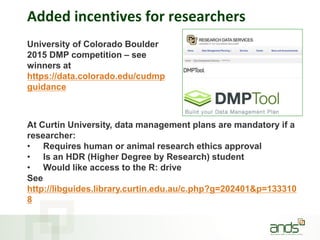
University of Colorado Boulder
2015 DMP competition – see
winners at
https://data.colorado.edu/cudmp
guidance
At Curtin University, data management plans are mandatory if a
researcher:​​
• Requires human or animal research ethics approval
• Is an HDR (Higher Degree by Research) student
• Would like access to the R: drive
See
http://libguides.library.curtin.edu.au/c.php?g=202401&p=133310
8
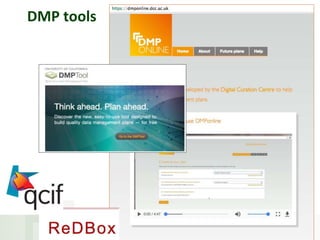
DMP tools
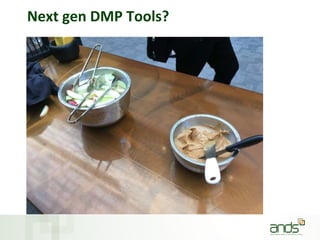
Next gen DMP Tools?
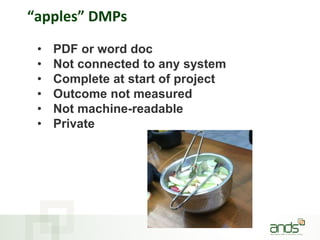
“apples” DMPs
• PDF or word doc
• Not connected to any system
• Complete at start of project
• Outcome not measured
• Not machine-readable
• Private
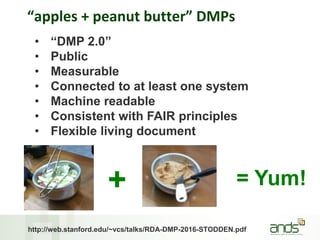
“apples + peanut butter” DMPs
• “DMP 2.0”
• Public
• Measurable
• Connected to at least one system
• Machine readable
• Consistent with FAIR principles
• Flexible living document
+ = Yum!
http://web.stanford.edu/~vcs/talks/RDA-DMP-2016-STODDEN.pdf
DMP BoF – eResearch Australasia 2016 –
report back
DMPs: Aligning use to
motivations and intended
outcomes
Abstract (extract)
DMPs are increasingly seen as a key component of data infrastructure. Fundamentally,
DMPs are a mechanism for researchers to state their intentions on how they plan to manage
their data across the data lifecycle. However, the agents and motivations driving DMP use
differ, providing us with a number of use cases to examine and interrogate. DMP use is now
driven by multiple agents: funding bodies to encourage data sharing, researchers themselves
as a project management tool, and institutions to increase researcher efficiency, for business
intelligence or as a connection point for systems integration.
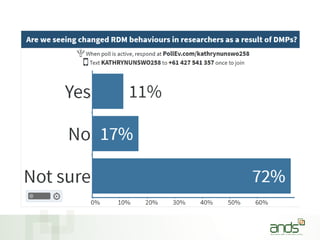
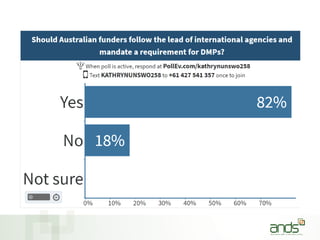
Questions posed to presenters and the audience included:
• Why implement a DMP tool?
• Does DMP use align with an agent’s motivations and more importantly with
intended outcomes?
• What are the expected outcomes?
• Enterprise-level DMP tools (one-size-fits-all) – what is their place in the
landscape?
• Is ‘best practice’ for researchers the aim or a hoped for by-product?
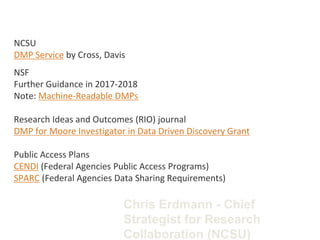
NCSU
DMP Service by Cross, Davis
NSF
Further Guidance in 2017-2018
Note: Machine-Readable DMPs
Research Ideas and Outcomes (RIO) journal
DMP for Moore Investigator in Data Driven Discovery Grant
Public Access Plans
CENDI (Federal Agencies Public Access Programs)
SPARC (Federal Agencies Data Sharing Requirements)
Chris Erdmann - Chief
Strategist for Research
Collaboration (NCSU)
Goal
Helping a research group to reach, document and communicate
data management decisions
Live document
Metadata reuse from existing systems
Metadata reuse to other systems
Guided questions
Minimum mandatory questions
Conditional questions
Supporting and supported by data management governance and policy
procedures
1
7
Sue Cook - Data Librarian,
Research Data Support Team
(CSIRO)
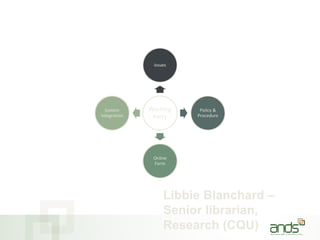
Working
Party
Issues
Policy &
Procedure
Online
Form
System
Integration
Libbie Blanchard –
Senior librarian,
Research (CQU)
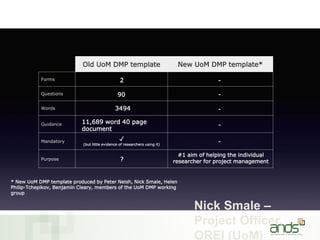
Old UoM DMP template New UoM DMP template*
Forms
Questions
Words
Guidance
Mandatory
Purpose
* New UoM DMP template produced by Peter Neish, Nick Smale, Helen
Philip-Tchepikov, Benjamin Cleary, members of the UoM DMP working
group
2
90
11,689 word 40 page
document
✓
(but little evidence of researchers using it)
?
3494
-
-
-
-
-
#1 aim of helping the individual
researcher for project management
Nick Smale –
Project Officer,
OREI (UoM)
DMP use cases
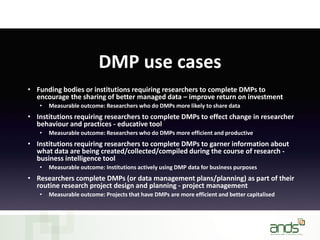
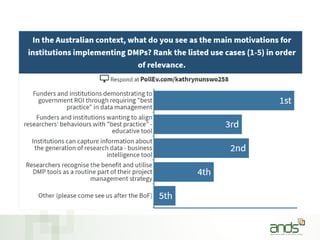
• Funding bodies or institutions requiring researchers to complete DMPs to
encourage the sharing of better managed data – improve return on investment
• Measurable outcome: Researchers who do DMPs more likely to share data
• Institutions requiring researchers to complete DMPs to effect change in researcher
behaviour and practices - educative tool
• Measurable outcome: Researchers who do DMPs more efficient and productive
• Institutions requiring researchers to complete DMPs to garner information about
what data are being created/collected/compiled during the course of research -
business intelligence tool
• Measurable outcome: Institutions actively using DMP data for business purposes
• Researchers complete DMPs (or data management plans/planning) as part of their
routine research project design and planning - project management
• Measurable outcome: Projects that have DMPs are more efficient and better capitalised
Senior Data Management Specialist
Natasha.simons@ands.org.au
NATASHA SIMONS
With the exception of third party images or where otherwise indicated, this work
is licensed under the Creative Commons 4.0 International Attribution Licence.
ANDS is supported by the Australian
Government through the National Collaborative
Research Infrastructure Strategy Program.
Monash University leads the partnership with
the Australian National University and CSIRO.
KATHRYN UNSWORTH
Data Librarian – Institutional
Engagement
Kathryn.unsworth@ands.org.au

Data management plans (DMPs)- 16 Feb 2017

  • 1.
    Webinar: Data ManagementPlans 16 February 2017 Natasha Simons Kathryn Unsworth
  • 2.
    The Australian NationalData Service (ANDS) makes Australia’s research data assets more valuable for researchers, research institutions and the nation.
  • 3.
    Getting involved #andsdata Please usethe Chat box for questions and comments
  • 4.
  • 5.
    Todays webinar in3 parts 1. Talks: • DMPs – overview + intro to v2.0 (Natasha) • DMP Birds of a Feather session at eResearch Australasia (Kathryn) • DMPs at The University of Melbourne (Nick Smale) 2. Open Mike time 3. DMP Community of Practice in Australia. There will be a pop up survey for your ideas after you leave the webinar - please don’t ignore it! We’ll relay questions and tweets during the webinar, so please Chat pod & Tweet as things occur to you
  • 6.
    Natasha Simons DMP webinar SeniorData Management Specialist 16 February 2017
  • 7.
    What are ResearchDMPs? A research data management plan is a document that describes: • What research data will be created • What policies will apply to the data • Who will own and have access to the data • What data management practices will be used • What facilities and equipment will be required • Who will be responsible for each of these activities. http://www.ands.org.au/guides/data-management-plans http://www.ands.org.au/partners-and-communities/23- research-data-things/all23/thing-15
  • 8.
    Why DMPs? The carrot:improvements to efficiency, protection, quality and exposure. The stick: basic data management is required by the Australian Code for the Responsible Conduct of Research; some funders mandate DMPs e.g. NSF. Institutional reasons: keep a register of data creators and their needs (planning); reduce risk associated with unorganised data collection etc.
  • 9.
    Added incentives forresearchers University of Colorado Boulder 2015 DMP competition – see winners at https://data.colorado.edu/cudmp guidance At Curtin University, data management plans are mandatory if a researcher:​​ • Requires human or animal research ethics approval • Is an HDR (Higher Degree by Research) student • Would like access to the R: drive See http://libguides.library.curtin.edu.au/c.php?g=202401&p=133310 8
  • 10.
  • 11.
  • 12.
    “apples” DMPs • PDFor word doc • Not connected to any system • Complete at start of project • Outcome not measured • Not machine-readable • Private
  • 13.
    “apples + peanutbutter” DMPs • “DMP 2.0” • Public • Measurable • Connected to at least one system • Machine readable • Consistent with FAIR principles • Flexible living document + = Yum! http://web.stanford.edu/~vcs/talks/RDA-DMP-2016-STODDEN.pdf
  • 14.
    DMP BoF –eResearch Australasia 2016 – report back DMPs: Aligning use to motivations and intended outcomes
  • 15.
    Abstract (extract) DMPs areincreasingly seen as a key component of data infrastructure. Fundamentally, DMPs are a mechanism for researchers to state their intentions on how they plan to manage their data across the data lifecycle. However, the agents and motivations driving DMP use differ, providing us with a number of use cases to examine and interrogate. DMP use is now driven by multiple agents: funding bodies to encourage data sharing, researchers themselves as a project management tool, and institutions to increase researcher efficiency, for business intelligence or as a connection point for systems integration. Questions posed to presenters and the audience included: • Why implement a DMP tool? • Does DMP use align with an agent’s motivations and more importantly with intended outcomes? • What are the expected outcomes? • Enterprise-level DMP tools (one-size-fits-all) – what is their place in the landscape? • Is ‘best practice’ for researchers the aim or a hoped for by-product?
  • 16.
    NCSU DMP Service byCross, Davis NSF Further Guidance in 2017-2018 Note: Machine-Readable DMPs Research Ideas and Outcomes (RIO) journal DMP for Moore Investigator in Data Driven Discovery Grant Public Access Plans CENDI (Federal Agencies Public Access Programs) SPARC (Federal Agencies Data Sharing Requirements) Chris Erdmann - Chief Strategist for Research Collaboration (NCSU)
  • 17.
    Goal Helping a researchgroup to reach, document and communicate data management decisions Live document Metadata reuse from existing systems Metadata reuse to other systems Guided questions Minimum mandatory questions Conditional questions Supporting and supported by data management governance and policy procedures 1 7 Sue Cook - Data Librarian, Research Data Support Team (CSIRO)
  • 18.
  • 19.
    Old UoM DMPtemplate New UoM DMP template* Forms Questions Words Guidance Mandatory Purpose * New UoM DMP template produced by Peter Neish, Nick Smale, Helen Philip-Tchepikov, Benjamin Cleary, members of the UoM DMP working group 2 90 11,689 word 40 page document ✓ (but little evidence of researchers using it) ? 3494 - - - - - #1 aim of helping the individual researcher for project management Nick Smale – Project Officer, OREI (UoM)
  • 20.
    DMP use cases •Funding bodies or institutions requiring researchers to complete DMPs to encourage the sharing of better managed data – improve return on investment • Measurable outcome: Researchers who do DMPs more likely to share data • Institutions requiring researchers to complete DMPs to effect change in researcher behaviour and practices - educative tool • Measurable outcome: Researchers who do DMPs more efficient and productive • Institutions requiring researchers to complete DMPs to garner information about what data are being created/collected/compiled during the course of research - business intelligence tool • Measurable outcome: Institutions actively using DMP data for business purposes • Researchers complete DMPs (or data management plans/planning) as part of their routine research project design and planning - project management • Measurable outcome: Projects that have DMPs are more efficient and better capitalised
  • 25.
    Senior Data ManagementSpecialist Natasha.simons@ands.org.au NATASHA SIMONS With the exception of third party images or where otherwise indicated, this work is licensed under the Creative Commons 4.0 International Attribution Licence. ANDS is supported by the Australian Government through the National Collaborative Research Infrastructure Strategy Program. Monash University leads the partnership with the Australian National University and CSIRO. KATHRYN UNSWORTH Data Librarian – Institutional Engagement Kathryn.unsworth@ands.org.au

Editor's Notes

  • #8 A research data management plan is a formal document that describes how data will be collected, organized, described, shared, and preserved throughout the course of a research project and beyond. Data management plans are structured to provide needed information about the kinds of data collected, formats, descriptions, how long data will be retained, in what manner data will be disseminated, and how data will be preserved over the long term.
  • #9 Note: ARC Discovery Grant applicants are asked for a statement about data management, not a DMP as such…
  • #13 And only prove researchers can fill out a form
  • #14 Next gen tools are a flexible living document, Public, measurable, connected, machine readable, consistent with FAIR principles People are also finding ways to make DMPs more popular e.g. DMP competition at CU Boulder
  • #17 Building Capacity in Your Library for Research Data Management Support (Or What We Learned From Offering to Review DMPs) William M. Cross NCSU Libraries, wmcross@ncsu.edu Hilary M. Davis NCSU Libraries, hmdavis4@ncsu.edu [http://docs.lib.purdue.edu/cgi/viewcontent.cgi?article=1607&context=charleston] An example of a published data management plan - http://riojournal.com/articles.php?journal_name=rio&id=10708 Chris also talked about the EAGER project which addresses the urgent need to better understand the research community's Data Management Plan (DMP) requirements and, based on this understanding, provides an open software tool that helps investigators generate structured and machine-readable Data Management Plans that fulfill both the researcher's need to easily deliver a standardized set of information to the funder, and the funder's need to analyze the information contained in DMPs. This allows funders to identify trends in data and software submission, repository use patterns, and carry out other analyses that can assist in understanding community use patterns and needs. https://www.nsf.gov/awardsearch/showAward?AWD_ID=1649703&HistoricalAwards=false
  • #18 learnt from other organisations and RDA DMP working party