Building and Providing Data
Management Services: A Framework
for Everyone!
A presentation for the Florida Library Association annual conference
March 2, 2016
Renaine Julian
Stacey Mantooth
Micah Vandegrift
About us
Renaine Julian - Data Research Librarian
Stacey Mantooth - Science Librarian
Micah Vandegrift - Digital Scholarship Coordinator
Overview
Defining Research Data and Data Management
Funding Requirements
Getting Started at FSU
Data Management by the Numbers
Lessons Learned
Plans for the Future
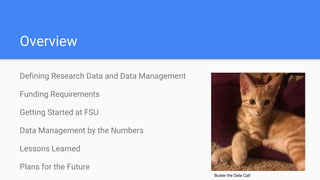
Buster the Data Cat!
What is Research Data
“Data are outputs of research and inputs to scholarly publications and
inputs to subsequent sharing and learning” (Borgman 2007)
“...The recorded factual material commonly accepted in the scientific
community as necessary to validate research findings.” (2 CFR
200.315(3))
What is Research Data Management
“Research Data Management is part of the research
process, and aims to make the research process as
efficient as possible, and meet expectations and
requirements of the university, research funders, and
legislation”
Source: University of Leicester, http://www2.le.ac.uk/services/research-data/rdm/what-is-rdm
Why Manage Research Data?
“And yet, research data is the currency of science, even if publications are still
the currency of tenure. To be able to exchange data, communicate it, mine, it ,
reuse it, and review it is essential to scientific productivity, collaboration, and
to discovery itself” (Gold 2007)
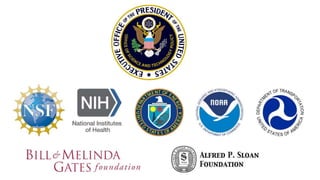
“The Administration is committed to ensuring that…the direct results of
federally funded scientific research are made available to and useful for the
public, industry, and the scientific community. Such results include peer-
reviewed publications and digital data” (Holdren 2013).
National Oceanographic and
Atmospheric Administration
1. Type of data and information created
2. Expected Schedule for data sharing
3. Standards for format and content
4. Policies for stewardship and preservation
5. Procedures for providing access
National Science Foundation
Directorate for Biological Sciences
1. Describe the types of data, physical samples or collections, software, curriculum materials, and other materials to be
produced in the course of the project.
2. Describe the standards to be used for all the data types anticipated, including data or file format and metadata (where
existing standards are absent or deemed inadequate, this should be documented along with any proposed solutions or
remedies)
3. Describe the roles and responsibilities of all parties with respect to the management of the data
4. Describe the dissemination methods that will be used to make data and metadata available to others during the period
of the award, and any modifications or additional technical information regarding data access after the grant ends.
5. Describe the PI’s policies for data sharing, public access and reuse, including re-distribution by others and the
production of derivatives. Where appropriate, include provisions for protection of privacy, confidentiality, security,
intellectual property rights and other rights.
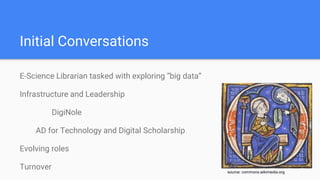
Initial Conversations
E-Science Librarian tasked with exploring “big data”
Infrastructure and Leadership
DigiNole
AD for Technology and Digital Scholarship
Evolving roles
Turnover source: commons.wikimedia.org
Getting Started
Data Librarian hired in April 2014
Biweekly meetings between Scholarly
Communication Librarian and Data
Librarian
Self Training
Identify Low Hanging Fruit
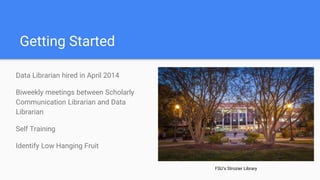
FSU’s Strozier Library
Identifying Stakeholders
Office of Proposal Development
Research Computing Center
Graduate School
Office of Research
Subject Librarians!
Source: Igor Pancaldi, Pinterest
Low Hanging Fruit
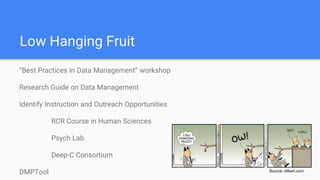
“Best Practices in Data Management” workshop
Research Guide on Data Management
Identify Instruction and Outreach Opportunities
RCR Course in Human Sciences
Psych Lab
Deep-C Consortium
DMPTool Source: dilbert.com
DMPTool
Developed by California Digital Library
Data Management Templates by Funding Agency
FSU as a Partner Institution
Community Involvement and Participation
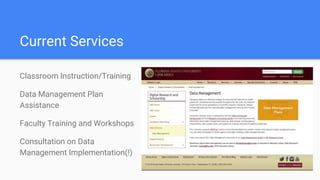
Current Services
Classroom Instruction/Training
Data Management Plan
Assistance
Faculty Training and Workshops
Consultation on Data
Management Implementation(!)
Data Management Plan Consultations
Work directly with PI(s) to develop a data management
plan for their grant proposal
Scaffolding a Project Team
Determine Roles and Tasks for Project Team
Support from Office of Proposal Development
Data Management Plan Consultations
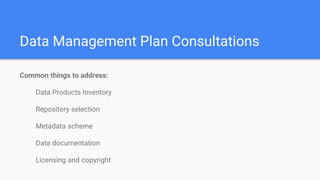
Common things to address:
Data Products Inventory
Repository selection
Metadata scheme
Data documentation
Licensing and copyright
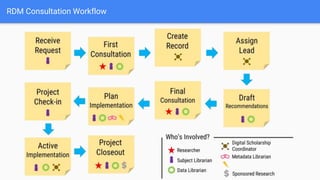
RDM Consultation Workflow
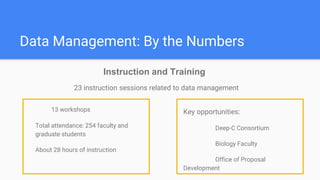
Data Management: By the Numbers
13 workshops
Total attendance: 254 faculty and
graduate students
About 28 hours of instruction
Instruction and Training
23 instruction sessions related to data management
Key opportunities:
Deep-C Consortium
Biology Faculty
Office of Proposal
Development
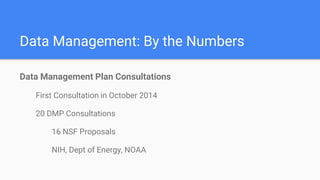
Data Management: By the Numbers
Data Management Plan Consultations
First Consultation in October 2014
20 DMP Consultations
16 NSF Proposals
NIH, Dept of Energy, NOAA
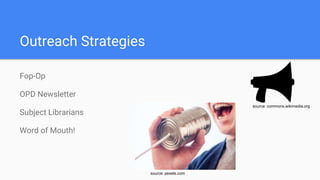
Outreach Strategies
Fop-Op
OPD Newsletter
Subject Librarians
Word of Mouth!
source: commons.wikimedia.org
source: pexels.com
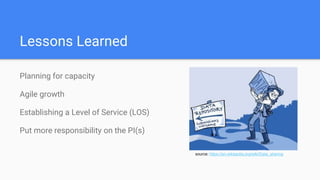
Lessons Learned
Planning for capacity
Agile growth
Establishing a Level of Service (LOS)
Put more responsibility on the PI(s)
source: https://en.wikipedia.org/wiki/Data_sharing
Future Plans
Data Curation: Diginole
DMP Implementation
Metadata Services
Data Management Policy
source: https://de.wikipedia.org/wiki/Future_(Rapper)
Daps and Hugs
source: https://en.wikipedia.org/wiki/Fist_bump
Works Cited
Borgman, C.L. (2007) Scholarship in the Digital Age : Information, infrastructure, and the Internet. Cambridge, MA. : MIT
Press
Office of Management and Budget Requirements, Uniform Administrative Requirements, Cost Principles, and Audit
Requirements for Federal Awards, 2 CFR 200.315 (2016)
Gold, A. (2007)Cyberinfrastructure, Data, and Libraries, Part 1: A Cyberinfrastructure Primer for Librarians. D-Lib Magazine,
September/October, 2007, Volume 13 Number 9/10 http://www.dlib.org/dlib/september07/gold/09gold-pt1.html
Holdren (2013) Expanding Public Access to the Results of Federally Funded Research.
http://www.whitehouse.gov/blog/2013/02/22/expanding-public-access-results-federally-funded-research
National Science Foundation. Dissemination and Sharing of Research Results.
http://www.nsf.gov/bfa/dias/policy/dmp.jsp
National Institutes of Health. NIH Data Sharing Policy and Implementation Guidance.
http://grants.nih.gov/grants/policy/data_sharing/data_sharing_guidance.htm

Building and providing data management services a framework for everyone!

  • 1.
    Building and ProvidingData Management Services: A Framework for Everyone! A presentation for the Florida Library Association annual conference March 2, 2016 Renaine Julian Stacey Mantooth Micah Vandegrift
  • 2.
    About us Renaine Julian- Data Research Librarian Stacey Mantooth - Science Librarian Micah Vandegrift - Digital Scholarship Coordinator
  • 3.
    Overview Defining Research Dataand Data Management Funding Requirements Getting Started at FSU Data Management by the Numbers Lessons Learned Plans for the Future Buster the Data Cat!
  • 4.
    What is ResearchData “Data are outputs of research and inputs to scholarly publications and inputs to subsequent sharing and learning” (Borgman 2007) “...The recorded factual material commonly accepted in the scientific community as necessary to validate research findings.” (2 CFR 200.315(3))
  • 5.
    What is ResearchData Management “Research Data Management is part of the research process, and aims to make the research process as efficient as possible, and meet expectations and requirements of the university, research funders, and legislation” Source: University of Leicester, http://www2.le.ac.uk/services/research-data/rdm/what-is-rdm
  • 6.
    Why Manage ResearchData? “And yet, research data is the currency of science, even if publications are still the currency of tenure. To be able to exchange data, communicate it, mine, it , reuse it, and review it is essential to scientific productivity, collaboration, and to discovery itself” (Gold 2007) “The Administration is committed to ensuring that…the direct results of federally funded scientific research are made available to and useful for the public, industry, and the scientific community. Such results include peer- reviewed publications and digital data” (Holdren 2013).
  • 8.
    National Oceanographic and AtmosphericAdministration 1. Type of data and information created 2. Expected Schedule for data sharing 3. Standards for format and content 4. Policies for stewardship and preservation 5. Procedures for providing access
  • 9.
    National Science Foundation Directoratefor Biological Sciences 1. Describe the types of data, physical samples or collections, software, curriculum materials, and other materials to be produced in the course of the project. 2. Describe the standards to be used for all the data types anticipated, including data or file format and metadata (where existing standards are absent or deemed inadequate, this should be documented along with any proposed solutions or remedies) 3. Describe the roles and responsibilities of all parties with respect to the management of the data 4. Describe the dissemination methods that will be used to make data and metadata available to others during the period of the award, and any modifications or additional technical information regarding data access after the grant ends. 5. Describe the PI’s policies for data sharing, public access and reuse, including re-distribution by others and the production of derivatives. Where appropriate, include provisions for protection of privacy, confidentiality, security, intellectual property rights and other rights.
  • 10.
    Initial Conversations E-Science Librariantasked with exploring “big data” Infrastructure and Leadership DigiNole AD for Technology and Digital Scholarship Evolving roles Turnover source: commons.wikimedia.org
  • 11.
    Getting Started Data Librarianhired in April 2014 Biweekly meetings between Scholarly Communication Librarian and Data Librarian Self Training Identify Low Hanging Fruit FSU’s Strozier Library
  • 12.
    Identifying Stakeholders Office ofProposal Development Research Computing Center Graduate School Office of Research Subject Librarians! Source: Igor Pancaldi, Pinterest
  • 13.
    Low Hanging Fruit “BestPractices in Data Management” workshop Research Guide on Data Management Identify Instruction and Outreach Opportunities RCR Course in Human Sciences Psych Lab Deep-C Consortium DMPTool Source: dilbert.com
  • 14.
    DMPTool Developed by CaliforniaDigital Library Data Management Templates by Funding Agency FSU as a Partner Institution Community Involvement and Participation
  • 15.
    Current Services Classroom Instruction/Training DataManagement Plan Assistance Faculty Training and Workshops Consultation on Data Management Implementation(!)
  • 16.
    Data Management PlanConsultations Work directly with PI(s) to develop a data management plan for their grant proposal Scaffolding a Project Team Determine Roles and Tasks for Project Team Support from Office of Proposal Development
  • 17.
    Data Management PlanConsultations Common things to address: Data Products Inventory Repository selection Metadata scheme Data documentation Licensing and copyright
  • 18.
  • 19.
    Data Management: Bythe Numbers 13 workshops Total attendance: 254 faculty and graduate students About 28 hours of instruction Instruction and Training 23 instruction sessions related to data management Key opportunities: Deep-C Consortium Biology Faculty Office of Proposal Development
  • 20.
    Data Management: Bythe Numbers Data Management Plan Consultations First Consultation in October 2014 20 DMP Consultations 16 NSF Proposals NIH, Dept of Energy, NOAA
  • 21.
    Outreach Strategies Fop-Op OPD Newsletter SubjectLibrarians Word of Mouth! source: commons.wikimedia.org source: pexels.com
  • 22.
    Lessons Learned Planning forcapacity Agile growth Establishing a Level of Service (LOS) Put more responsibility on the PI(s) source: https://en.wikipedia.org/wiki/Data_sharing
  • 23.
    Future Plans Data Curation:Diginole DMP Implementation Metadata Services Data Management Policy source: https://de.wikipedia.org/wiki/Future_(Rapper)
  • 24.
    Daps and Hugs source:https://en.wikipedia.org/wiki/Fist_bump
  • 25.
    Works Cited Borgman, C.L.(2007) Scholarship in the Digital Age : Information, infrastructure, and the Internet. Cambridge, MA. : MIT Press Office of Management and Budget Requirements, Uniform Administrative Requirements, Cost Principles, and Audit Requirements for Federal Awards, 2 CFR 200.315 (2016) Gold, A. (2007)Cyberinfrastructure, Data, and Libraries, Part 1: A Cyberinfrastructure Primer for Librarians. D-Lib Magazine, September/October, 2007, Volume 13 Number 9/10 http://www.dlib.org/dlib/september07/gold/09gold-pt1.html Holdren (2013) Expanding Public Access to the Results of Federally Funded Research. http://www.whitehouse.gov/blog/2013/02/22/expanding-public-access-results-federally-funded-research National Science Foundation. Dissemination and Sharing of Research Results. http://www.nsf.gov/bfa/dias/policy/dmp.jsp National Institutes of Health. NIH Data Sharing Policy and Implementation Guidance. http://grants.nih.gov/grants/policy/data_sharing/data_sharing_guidance.htm

Editor's Notes

  • #8  NIH actually pre-empted some of this with a public access policy for publications in 2005. OSTP directive issued Feb 22, 2013 -- applies to any agency with $100 million or more in R&D Supposed to have plans in place by Aug. 2013 Trickle down - OSTP directive led to a number of agencies responding to and issuing their policies. over 2013 many agencies issued “plans” - most were focused on publications AND data Federal policies led even private funders to adopt strong open policies for research they fund. We’ll highlight a few policies, but to underline, this is one thing that has created the opportunity for libraries to grow into the area of data management services.
  • #9  Here’s the guidelines that NOAA issued - any full fleshed out DMP should address each of these areas. NOAAtes: Develop their own repo tech reports, data reports and technical memos into repo as well as pubs broader scope than most other policies - calling for the policy to ultimately apply to “all future results, and to all past results from current programs” and legacy data on NOAA data centers data visible and accessible in one year, or at time of publication
  • #10  Early in requiring a DMP. Updated plan for access to data and publications new requirements apply to grants issued after Jan. 16 highlight #3 roles/responsibilities of DMP
  • #12  support for academic publishing began to overlap significantly with support for data early work - walked ourselves through a series of DMP trainings -- New England Collaborative Data Management Curriculum (NECDMC) and Mantra (sponsored by U of Edinburgh) Connected with newly formed Office of Proposal Development, helps researchers ID and write proposals. Also, Sponsored Research Administration Find a way to pilot our ideas (which would become our program) in Psychology classrooms, in responsible conduct of research courses, trainings within the library and with grants staff
  • #22  imagined easy and low barrier entry ways to begin to intro our work to campus FOP-Op - Federal Open Policies Operation, completed an entire outreach strategy in one month: website build, research guide, talking points, slide decks Research Newsletter - distributed to #____ of researchers and support staff Coordinated program planning with subject experts, especially in the STEM areas and SocSci. WOM - best month of DMPs came after we helped one researcher, and she emailed all other colleagues applying for the same award.