Data Management Plans: 
Policy and Practice 
Workshop 
CASRAI Reconnect 2014 Conference 
Ernie Boyko & Wendy Watkins, Carleton University 
Chuck Humphrey, University of Alberta
Outline 
➢Workshop objectives 
➢Context for Data Management Plans (DMPs) 
○ Why research data management 
○ Tri-Council+ initiative 
○ Value propositions and uptake 
➢An exercise 
➢DMP purpose, process, and practice 
○ How to produce a DMP
Overall objectives 
➢ To provide you with practical advice in 
preparing Data Management Plans using 
online DMP tools. 
➢ The background and the context for DMPs 
➢ A tool that you can use (here or at home)
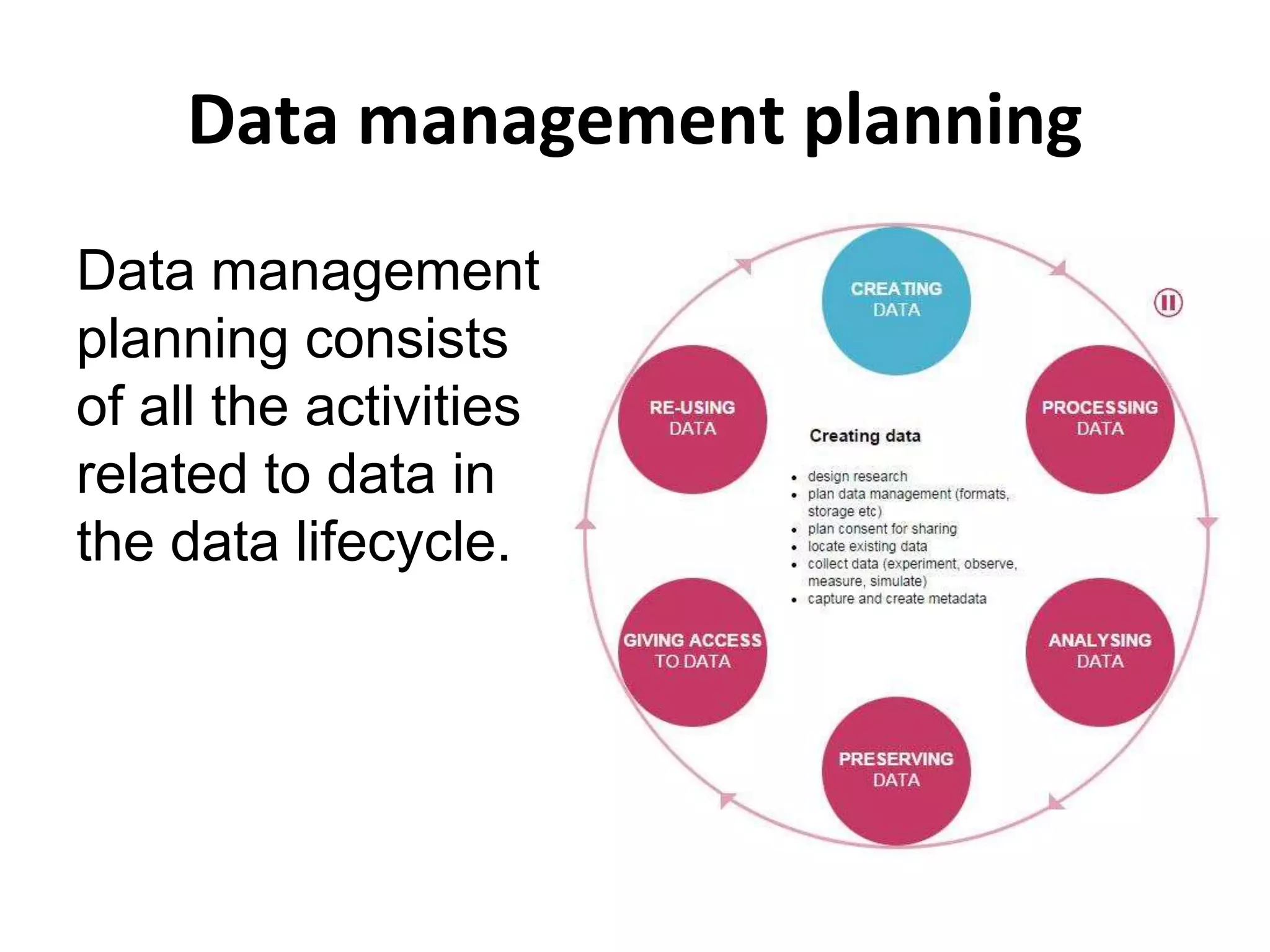
Data management planning 
Data management 
planning consists 
of all the activities 
related to data in 
the data lifecycle.
Managing research data 
➢ The process of controlling the research administrative 
information and data generated during a research 
project. 
➢ An integral part of the research process 
○ DM is particularly challenging when studies involve 
several researchers and/or when studies are 
conducted from multiple locations. 
➢ Depends on 
○ how they are produced and used throughout the 
research lifecycle, 
○ the types of data involved, 
○ how data are collected, stored, shared, & preserved. 
(Adapted from Penn State University Libraries Publishing and Curation Services: 
http://www.libraries.psu.edu/psul/pubcur/what_is_dm.html)
Benefits of research data 
management planning 
➢ Helps to identify issues and strategies early in your 
research project. 
➢ Confirms that you have documented your compliance with 
institutional and funder policies and ethics approval 
requirements. 
➢ Provides focus on data sharing and re-use opportunities of 
your research data. 
➢ Charts a pathway for your research data to remain useful 
and to be preserved for future use. 
➢ Ensures that any questions regarding your findings can be 
validated using your data. 
(Adapted from the University of Sheffield, University Library 
http://www.sheffield.ac.uk/library/rdm/dmp)
DMPs: form and function 
➢A data management plan is a formal 
statement that describes how a researcher 
will address specific topics on the production 
and stewardship of data both during and after 
a research project is completed. 
➢It facilitates research data management to 
support the research project as well as 
broader institutional and funder objectives. 
➢Sustain data sharing and re-use.
How data management planning 
relates to DMPs 
➢Provides context for DMPs 
➢Specific policy aspects related to data 
management get expressed in DMPs 
➢Describes data management in research 
administrative concepts 
➢Connects data management with larger 
goals and objectives of funders and 
research administrators
Some context for research data 
management in Canada 
➢ This is not a new activity in many leading 
research countries. 
➢ Researchers in Canada are doing this in an 
informal or ad hoc manner now but without 
the benefit of a systematic process. 
➢ Canada’s Tri-Councils+ are about to launch 
an initiative that will bring this to the fore. 
➢ And as we do so,Canada will be catching up 
to other regions of the world.
Tri-Agency / CFI Consultation – Fall 2013 
•“Capitalizing on Big Data: Toward a Policy Framework 
for Advancing Digital Scholarship in Canada” 
•Discussed ways the agencies can promote excellence in data 
management practices and help to establish a “Culture of 
Stewardship” in Canada 
•Proposed that data management plans be required as part of 
grant applications 
•Highlighted the need for ongoing coordination with other players 
in the « research ecosystem » 
Source: Christine Trauttmansdorff, Executive Director, Corporate Strategy and Performance, SSHRC) Presented to 
Canadian Association of Research Libraries, Québec – November 2014
GoC Open Government / Open Science 
•Government of Canada initiative to maximize access to 
federally-funded scientific research, to encourage greater 
collaboration and engagement with the scientific 
community, the private sector, and the public. 
•G8 Science Ministers Agreement: "to promote policies that 
increase access to the results of publicly funded research 
results to spur scientific discovery, enable better 
international collaboration and coordination of research, 
enhance the engagement of society and help support 
economic prosperity". 
Source: Christine Trauttmansdorff, Executive Director, Corporate Strategy and Performance, SSHRC) Presented to 
Canadian Association of Research Libraries, Québec – November 2014
Tri-Agency Approach: Key Considerations 
•Data management requirements will impact researchers, 
students and institutions, among others 
•Long-term success depends on availability of standards, 
repositories, expertise and other resources. 
•Education and awareness activities, sharing best practices, etc. 
are essential 
•Coordination, consultations and communications will be 
required on an ongoing basis 
•Parallel initiatives being led by the GoC (Treasury Board 
Secretariat) on Open Government and Open Science 
Source: Christine Trauttmansdorff, Executive Director, Corporate Strategy and Performance, SSHRC) Presented to 
Canadian Association of Research Libraries, Québec – November 2014
Tri-Agency: Next Steps 
Fall/winter 2014-15: 
•Tri-agency working group with RDC and CAURA observers 
•Participation in discussions such as CSPC, CASRAI, CAURA, 
CARL, etc. 
•Environmental scan: Kathleen Shearer 
•External advisory group 
•Promotion and awareness 
2015: 
•Public consultation on proposed policy direction 
•Guiding principles, pilots, guidance documents, etc. 
•Determine next steps 
Source: Christine Trauttmansdorff, Executive Director, Corporate Strategy and Performance, SSHRC) Presented to 
Canadian Association of Research Libraries, Québec – November 2014
Value propositions for DMPs 
➢Data sharing 
➢Reproducible research 
➢Managing digital assets 
➢Building a corpus of Canadian research 
data
Data sharing 
➢Data archives have been enabling the sharing of 
data for over 5 decades (e.g.,ICPSR, UKDA, Carleton) 
➢2004 OECD 
▪ Declaration on Access to Research Data from Public Funding 
➢UK Research Councils 
▪ “Publicly funded research data are a public good, produced in 
the public interest, which should be made openly available with 
as few restrictions as possible in a timely and responsible 
manner that does not harm intellectual property.” 
➢US National Science Foundation 
▪ “[A Data Management Plan (DMP)] should describe how the 
proposal will conform to NSF policy on the dissemination and 
sharing of research results.”
Reproducible Research 
➢Supports academic integrity 
➢Journals increasingly asking for data to be 
deposited as condition of publishing 
➢Compliance with funders’ expectations 
that research is reproducible
Management of digital assets 
➢Digital content (data, etc) must be managed to 
facilitate access and use over the long run 
➢Data stewardship 
“acquire, manage, organize, preserve, and provide access to 
massive amounts of data for use and re-use by a variety of 
interdisciplinary and heterogeneous communities over time” 
http://besser.tsoa.nyu.edu/howard/Talks/imagem-som.pdf
A Canadian corpus of research data 
➢Creates opportunities to create new data from 
existing data. 
➢Allows the application of new methodologies 
to existing data. 
➢Facilitates connections between research 
outputs and the data associated with them to 
deepen the knowledge behind the findings.
Excercise 
➢ What is the value proposition with respect to 
Data Management Plans for your institution 
or situation? 
➢ Take some time to reflect on this and then at 
your table, discuss the value propositions 
with your colleagues.
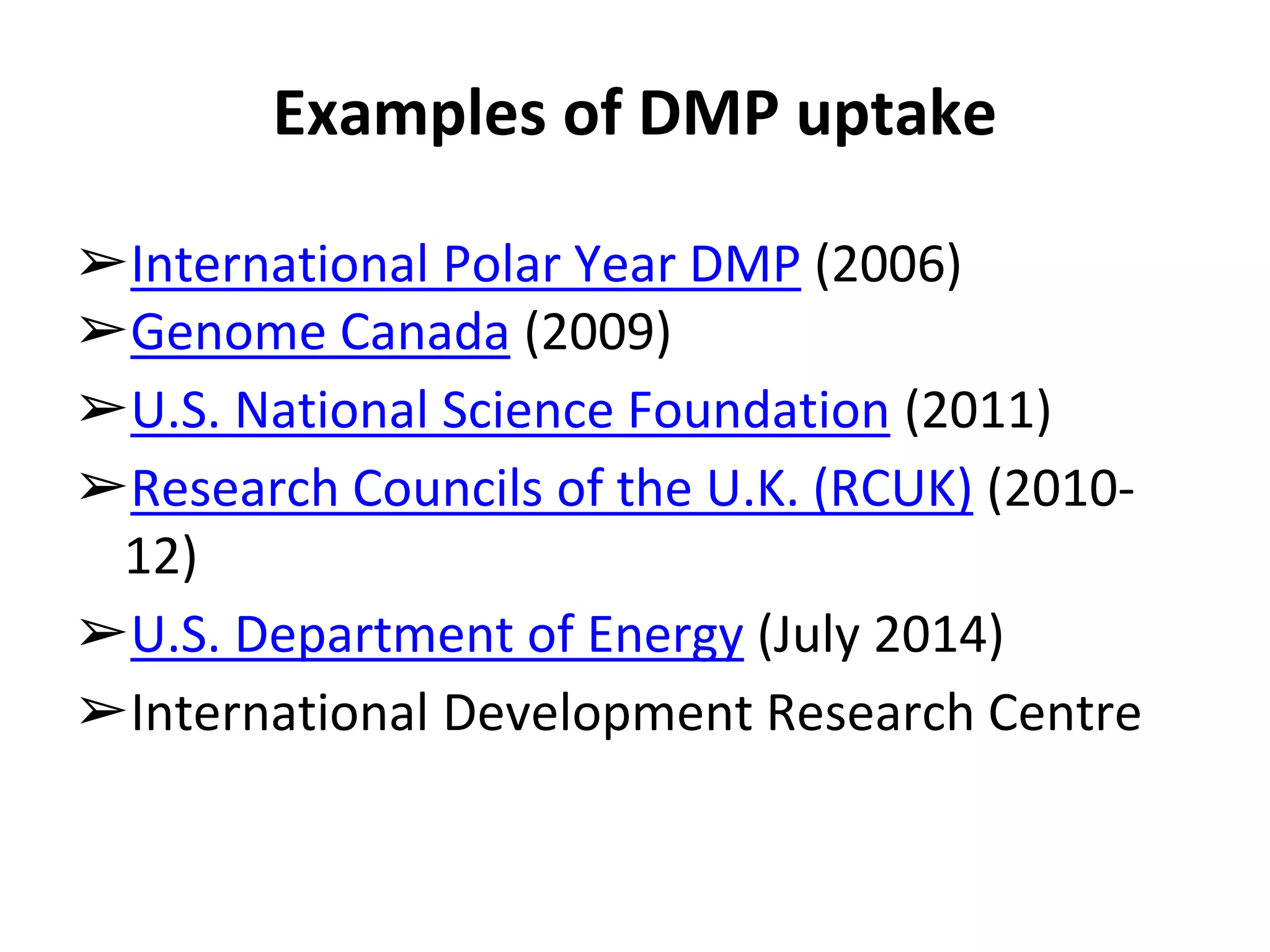
Examples of DMP uptake 
➢International Polar Year DMP (2006) 
➢Genome Canada (2009) 
➢U.S. National Science Foundation (2011) 
➢Research Councils of the U.K. (RCUK) (2010- 
12) 
➢U.S. Department of Energy (July 2014) 
➢International Development Research Centre
DMPs in practice 
➢ Development of templates and tools 
○ The central themes in an organization’s data policy 
act as the topics of a DMP template. Within these 
topics, relevant questions are asked about each 
area. A researcher then provides her or his answers 
to each question. 
○ Tools to help with a DMP 
■ DMPOnline (UK Digital Curation Centre) 
● DMP Builder (Canada U of Alberta) 
■ DMP Tool (US California Digital Library) 
➢ Establish a consultation process to support the 
use of DMPs
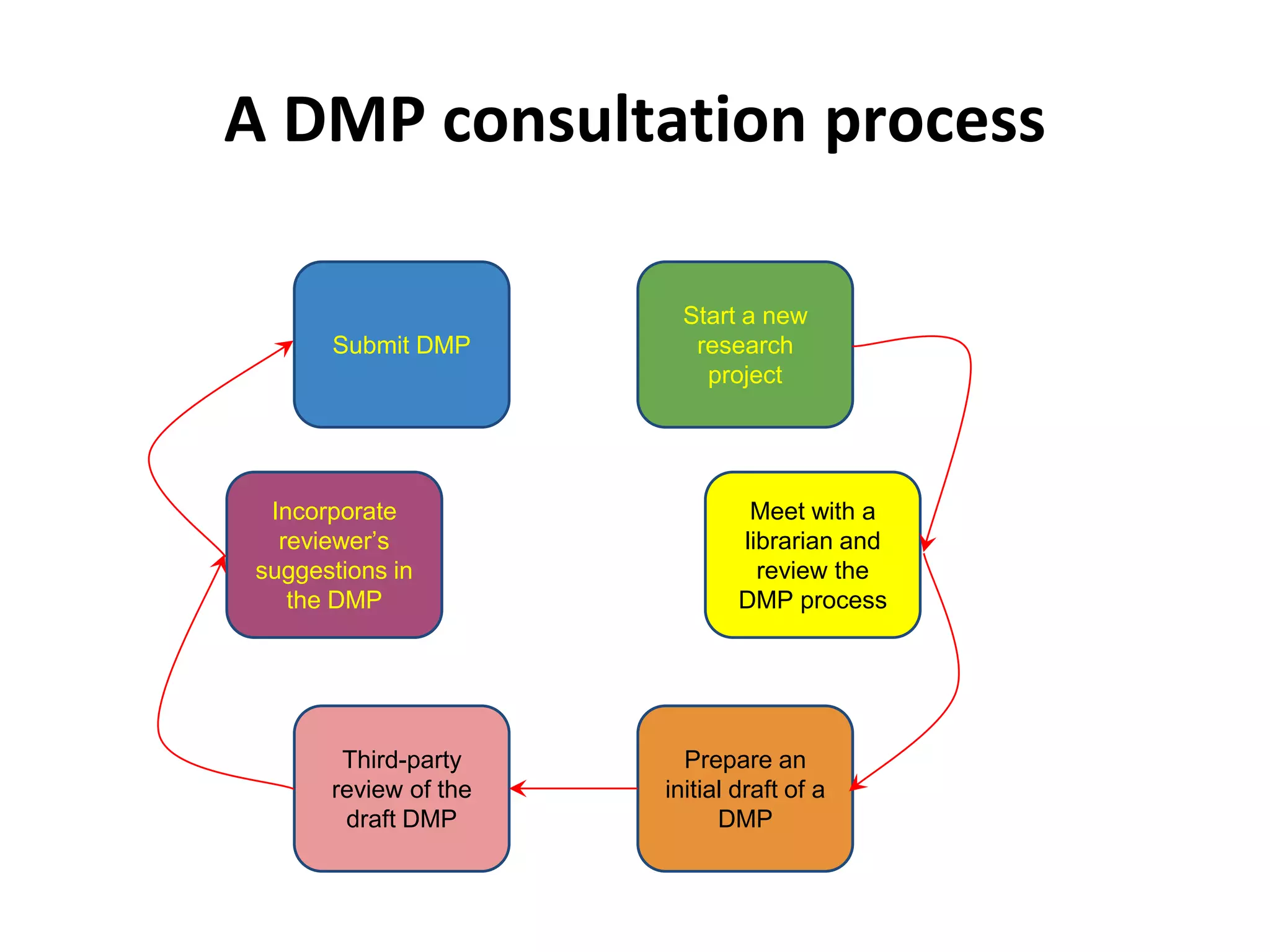
A DMP consultation process 
Start a new 
research 
project 
Meet with a 
librarian and 
review the 
DMP process 
Prepare an 
initial draft of a 
DMP 
Submit DMP 
Incorporate 
reviewer’s 
suggestions in 
the DMP 
Third-party 
review of the 
draft DMP
DMP purposes 
➢A DMP embodies the main elements of an 
organization’s data policy. 
➢ The following example is based on the 
University of Alberta Research Policy and its 
focus on the stewardship of research records .
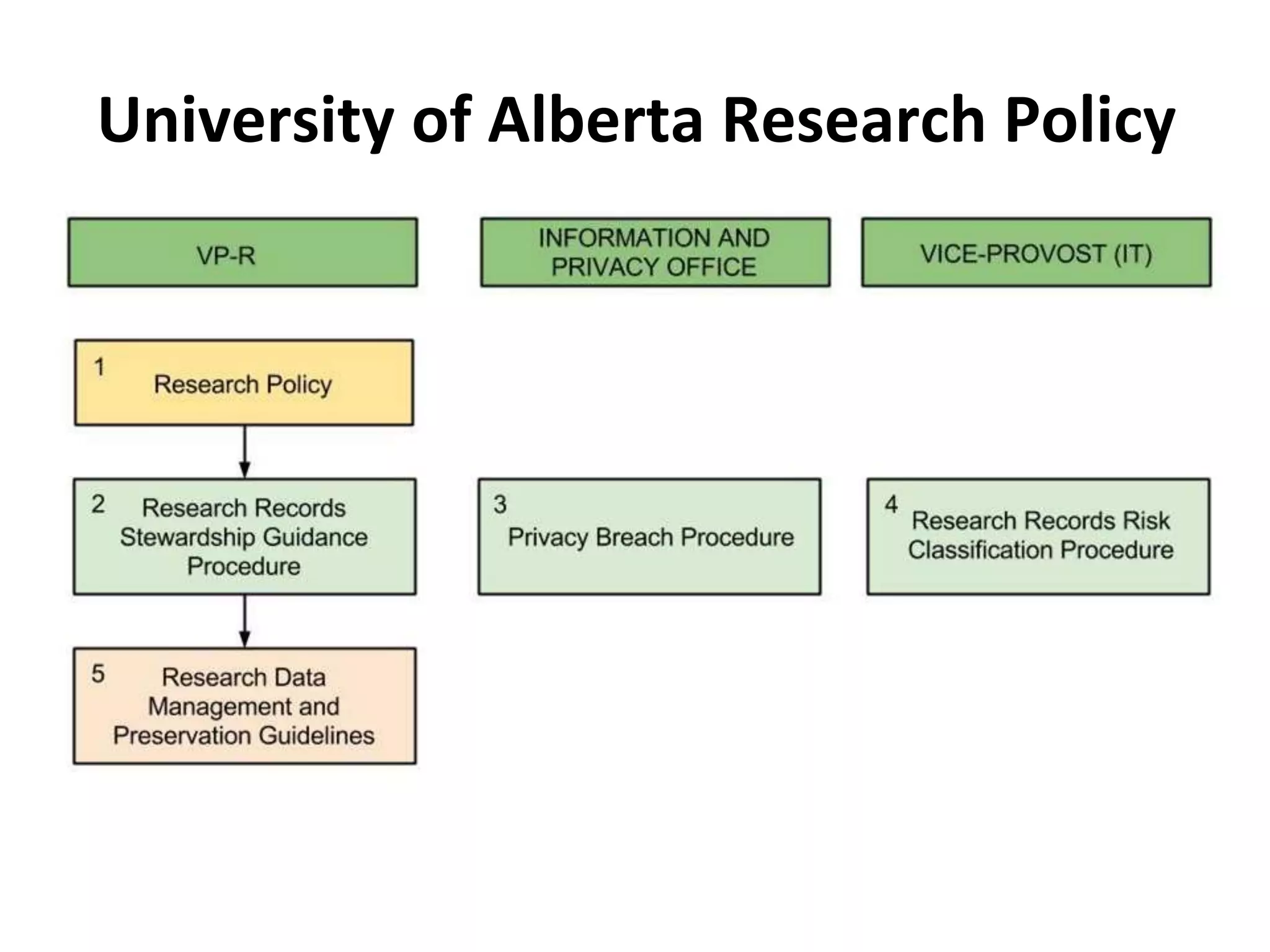
University of Alberta Research Policy
University of Alberta Research Policy 
“Ensure that principles of stewardship are 
applied to research records, protecting the 
integrity of the assets.” 
“[DM] plans recognize the stages through which research 
records will be produced, managed, documented, stored, 
disseminated and deposited (with either a staging or a 
preservation repository). Furthermore, these plans will identify 
the data stewards across a project’s lifecycle.”
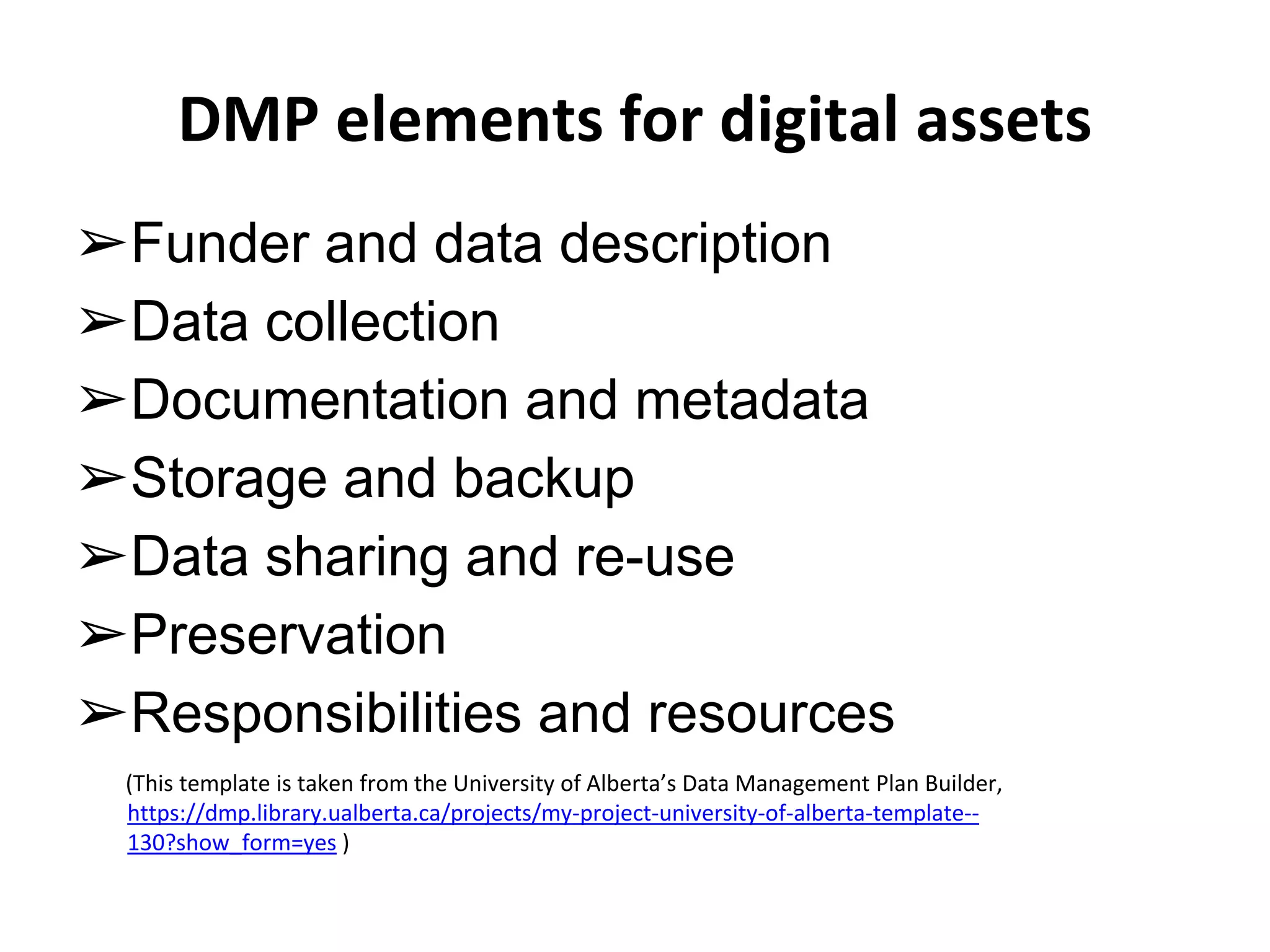
DMP elements for digital assets 
➢Funder and data description 
➢Data collection 
➢Documentation and metadata 
➢Storage and backup 
➢Data sharing and re-use 
➢Preservation 
➢Responsibilities and resources 
(This template is taken from the University of Alberta’s Data Management Plan Builder, 
https://dmp.library.ualberta.ca/projects/my-project-university-of-alberta-template-- 
130?show_form=yes )
Open Discussion
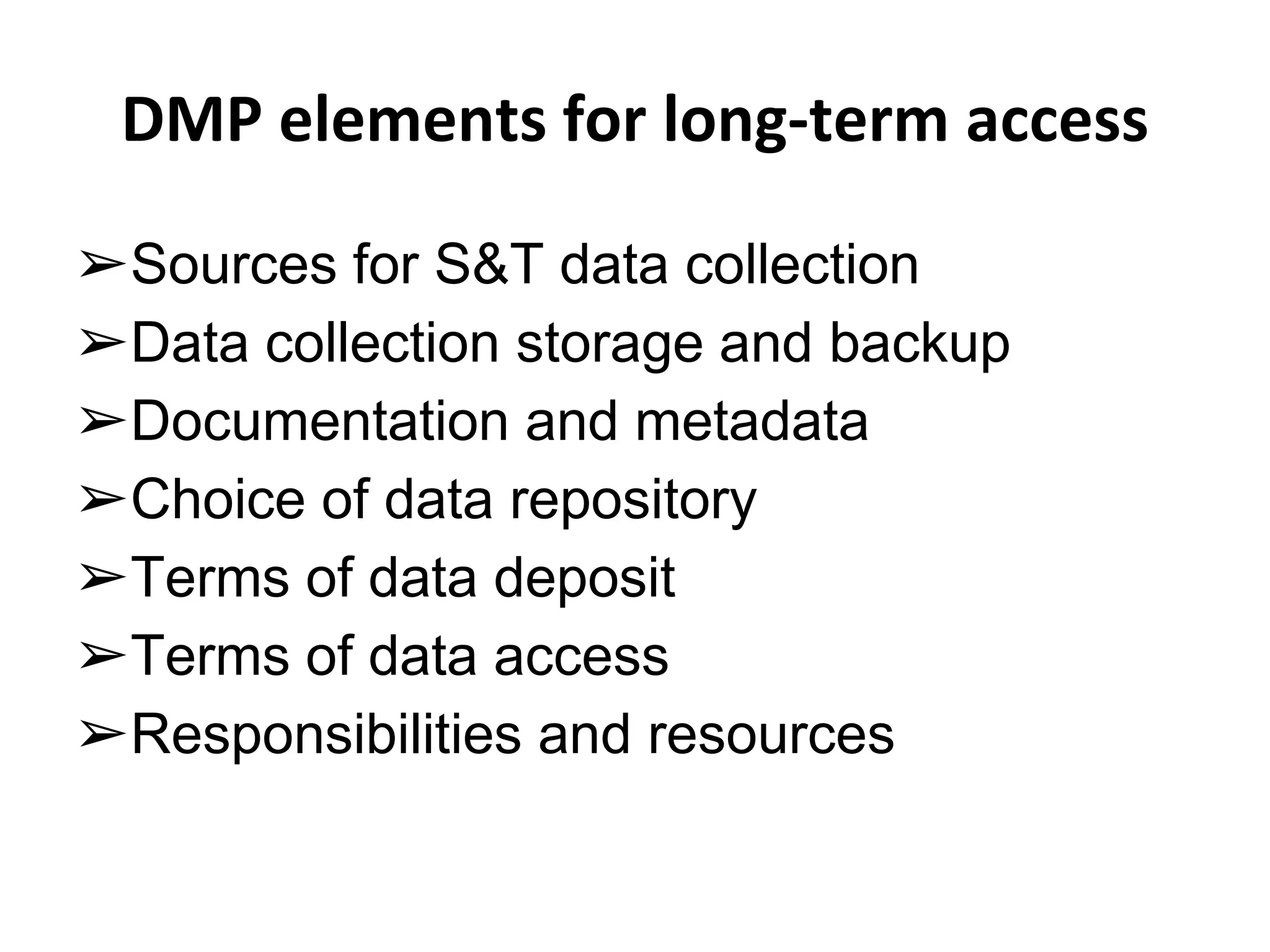
DMP elements for long-term access 
➢Sources for S&T data collection 
➢Data collection storage and backup 
➢Documentation and metadata 
➢Choice of data repository 
➢Terms of data deposit 
➢Terms of data access 
➢Responsibilities and resources
Knowledge Mobilization Plans 
➢ Scholarly publication lifecycle 
➢ Not unlike DMPs and data lifecycle
Exercise 
➢Prepare a DMP using DMP Builder (shortened 
template) around depositing data in a 
publication with a repository.
Hypothetical Example 
➢Hypothetical open access and data policies for 
the Canadian Science Policy Centre 
➢Open Access: all research publications of the 
CSPC will be freely available to the public 
through the CSPC website.
Hypothetical Example 
➢Data Policy: all data used as evidence in 
research publications of the CSPC will be 
made available to allow the findings to be 
reproduced. 
○A citation for each dataset in an article or report 
will be included. 
○All data will be discoverable through the use of 
persistent identifiers (handles or digital object 
identifiers) and preferably registered with 
DataCite Canada.
Hypothetical Example 
➢Data Policy: all data used as evidence in 
research publications of the CSPC will be 
made available to allow the findings to be 
reproduced. 
○Intelligent access to data will be provided to 
ensure that confidentiality is protected.
Intelligent Access 
Intelligent access employs data management methods and 
services that best align user needs with the access control 
deemed necessary for a particular dataset. 
Examples of intelligent access: 
• using visualization techniques to explore data without having 
to transport it, 
• co-locating “big data” with high performance computing, 
• aggregating data to guard against disclosure while 
safeguarding sensitive content, 
• providing secure environments for analyzing sensitive data, 
and 
• performing data linkages in a controlled setting.
Hypothetical Example 
1. Will this CSPC publication involve the use of data? 
a. No. 
i. No DMP required 
b. Yes. 
i. Sources of the data 
1. Data collected by the researcher 
2. Data from other data providers 
ii. Requirement for special software or code 
1. No: go to next item 
2. Yes: steps to provide access to code
Hypothetical Example 
2. Are there any restrictions on the data being used? 
a. No. 
i. Go to the next item. 
b. Yes. 
i. Confidentiality of research participants 
1. Need for informed consent about reuse of the 
data 
ii. Data from another producer 
1. Does the producer allow the data to be 
redisseminated?
Hypothetical Example 
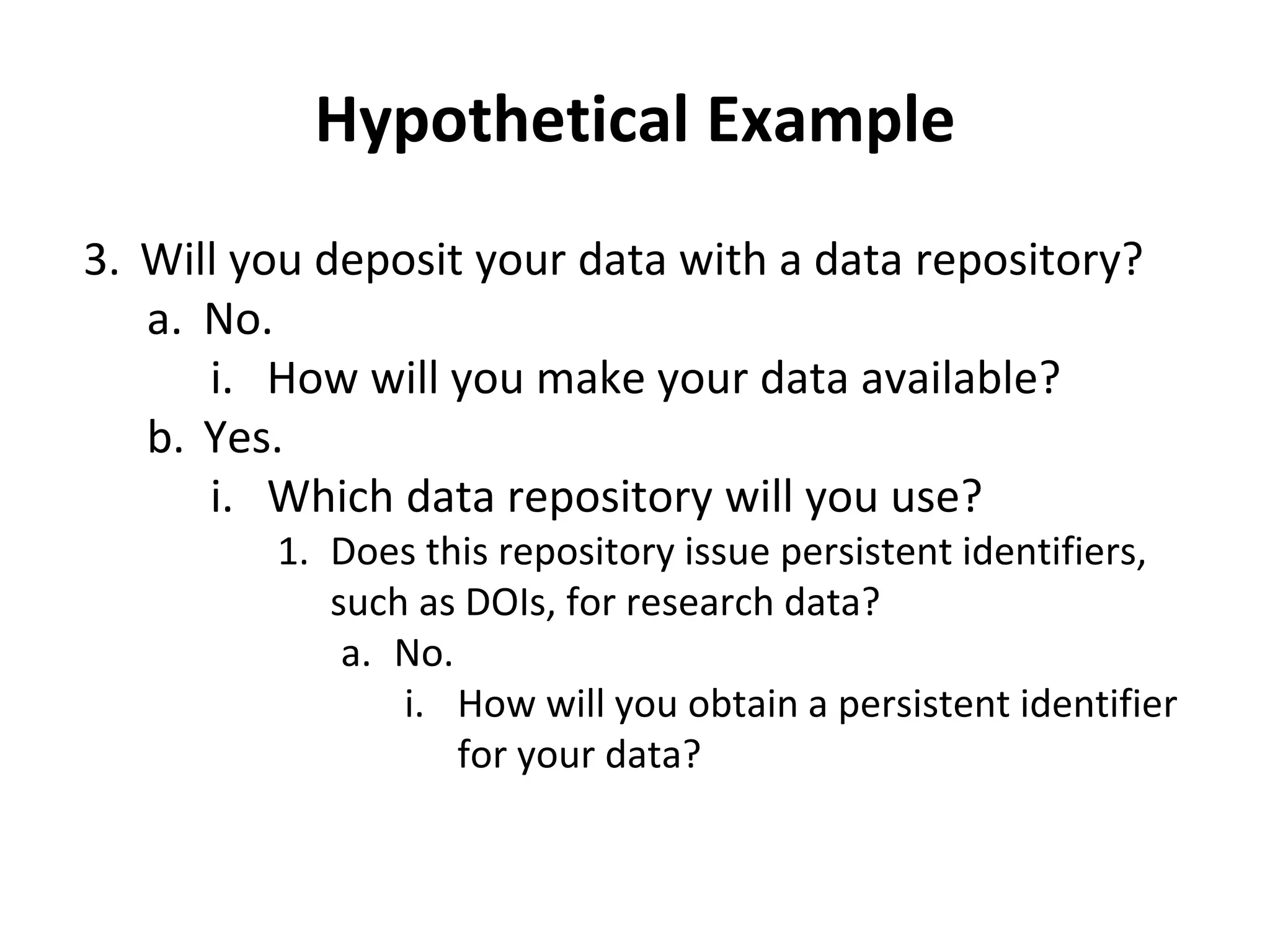
3. Will you deposit your data with a data repository? 
a. No. 
i. How will you make your data available? 
b. Yes. 
i. Which data repository will you use? 
1. Does this repository issue persistent identifiers, 
such as DOIs, for research data? 
a. No. 
i. How will you obtain a persistent identifier 
for your data?
Hypothetical Example 
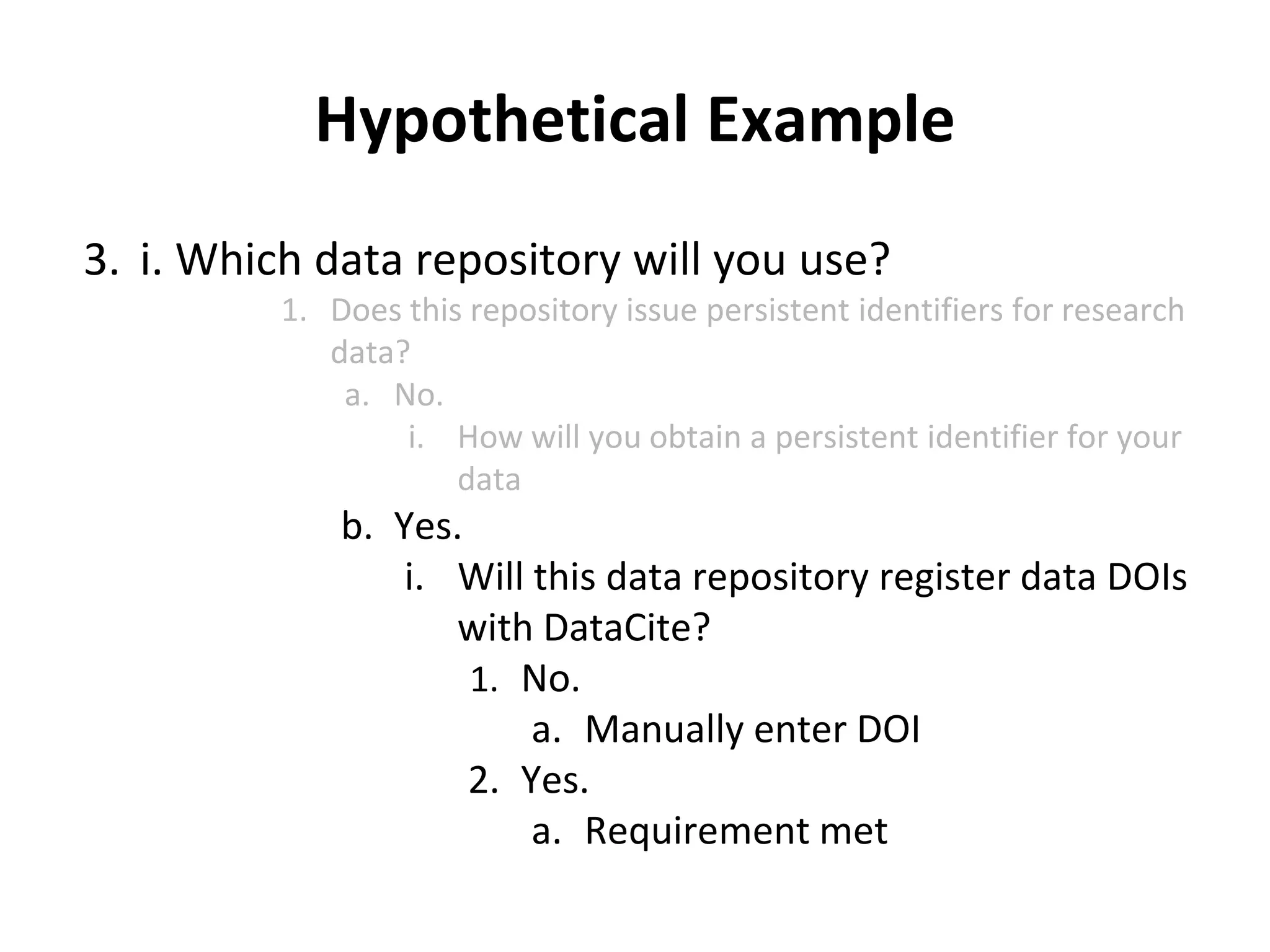
3. i. Which data repository will you use? 
1. Does this repository issue persistent identifiers for research 
data? 
a. No. 
i. How will you obtain a persistent identifier for your 
data 
b. Yes. 
i. Will this data repository register data DOIs 
with DataCite? 
1. No. 
a. Manually enter DOI 
2. Yes. 
a. Requirement met
Hypothetical Example 
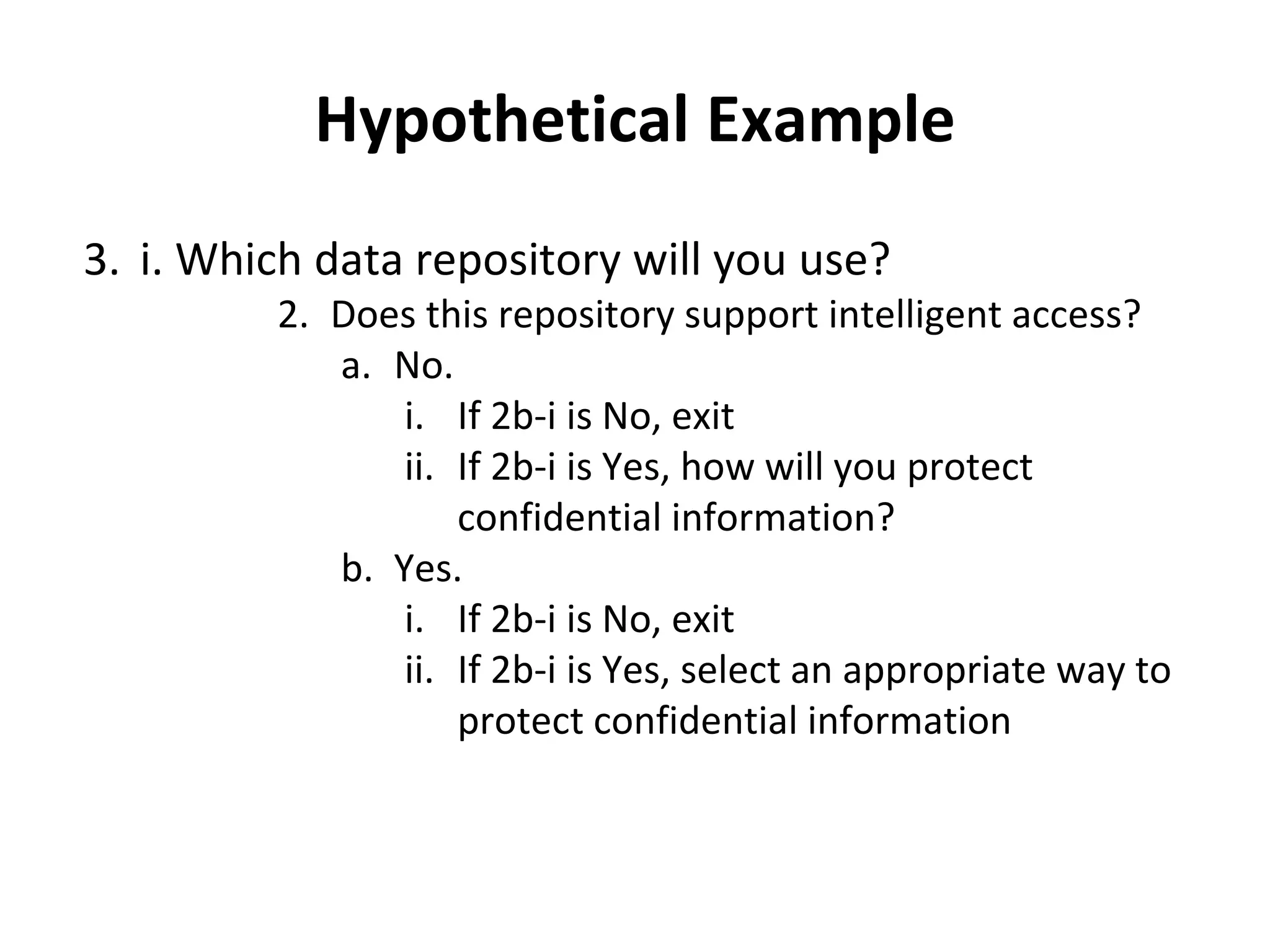
3. i. Which data repository will you use? 
2. Does this repository support intelligent access? 
a. No. 
i. If 2b-i is No, exit 
ii. If 2b-i is Yes, how will you protect 
confidential information? 
b. Yes. 
i. If 2b-i is No, exit 
ii. If 2b-i is Yes, select an appropriate way to 
protect confidential information
Hypothetical Example 
4. Data citation 
a. Has a citation format for datasets been identified?

Workshop humphrey watkins-boyko-dmp workshop

  • 1.
    Data Management Plans: Policy and Practice Workshop CASRAI Reconnect 2014 Conference Ernie Boyko & Wendy Watkins, Carleton University Chuck Humphrey, University of Alberta
  • 2.
    Outline ➢Workshop objectives ➢Context for Data Management Plans (DMPs) ○ Why research data management ○ Tri-Council+ initiative ○ Value propositions and uptake ➢An exercise ➢DMP purpose, process, and practice ○ How to produce a DMP
  • 3.
    Overall objectives ➢To provide you with practical advice in preparing Data Management Plans using online DMP tools. ➢ The background and the context for DMPs ➢ A tool that you can use (here or at home)
  • 4.
    Data management planning Data management planning consists of all the activities related to data in the data lifecycle.
  • 5.
    Managing research data ➢ The process of controlling the research administrative information and data generated during a research project. ➢ An integral part of the research process ○ DM is particularly challenging when studies involve several researchers and/or when studies are conducted from multiple locations. ➢ Depends on ○ how they are produced and used throughout the research lifecycle, ○ the types of data involved, ○ how data are collected, stored, shared, & preserved. (Adapted from Penn State University Libraries Publishing and Curation Services: http://www.libraries.psu.edu/psul/pubcur/what_is_dm.html)
  • 6.
    Benefits of researchdata management planning ➢ Helps to identify issues and strategies early in your research project. ➢ Confirms that you have documented your compliance with institutional and funder policies and ethics approval requirements. ➢ Provides focus on data sharing and re-use opportunities of your research data. ➢ Charts a pathway for your research data to remain useful and to be preserved for future use. ➢ Ensures that any questions regarding your findings can be validated using your data. (Adapted from the University of Sheffield, University Library http://www.sheffield.ac.uk/library/rdm/dmp)
  • 7.
    DMPs: form andfunction ➢A data management plan is a formal statement that describes how a researcher will address specific topics on the production and stewardship of data both during and after a research project is completed. ➢It facilitates research data management to support the research project as well as broader institutional and funder objectives. ➢Sustain data sharing and re-use.
  • 8.
    How data managementplanning relates to DMPs ➢Provides context for DMPs ➢Specific policy aspects related to data management get expressed in DMPs ➢Describes data management in research administrative concepts ➢Connects data management with larger goals and objectives of funders and research administrators
  • 9.
    Some context forresearch data management in Canada ➢ This is not a new activity in many leading research countries. ➢ Researchers in Canada are doing this in an informal or ad hoc manner now but without the benefit of a systematic process. ➢ Canada’s Tri-Councils+ are about to launch an initiative that will bring this to the fore. ➢ And as we do so,Canada will be catching up to other regions of the world.
  • 10.
    Tri-Agency / CFIConsultation – Fall 2013 •“Capitalizing on Big Data: Toward a Policy Framework for Advancing Digital Scholarship in Canada” •Discussed ways the agencies can promote excellence in data management practices and help to establish a “Culture of Stewardship” in Canada •Proposed that data management plans be required as part of grant applications •Highlighted the need for ongoing coordination with other players in the « research ecosystem » Source: Christine Trauttmansdorff, Executive Director, Corporate Strategy and Performance, SSHRC) Presented to Canadian Association of Research Libraries, Québec – November 2014
  • 11.
    GoC Open Government/ Open Science •Government of Canada initiative to maximize access to federally-funded scientific research, to encourage greater collaboration and engagement with the scientific community, the private sector, and the public. •G8 Science Ministers Agreement: "to promote policies that increase access to the results of publicly funded research results to spur scientific discovery, enable better international collaboration and coordination of research, enhance the engagement of society and help support economic prosperity". Source: Christine Trauttmansdorff, Executive Director, Corporate Strategy and Performance, SSHRC) Presented to Canadian Association of Research Libraries, Québec – November 2014
  • 12.
    Tri-Agency Approach: KeyConsiderations •Data management requirements will impact researchers, students and institutions, among others •Long-term success depends on availability of standards, repositories, expertise and other resources. •Education and awareness activities, sharing best practices, etc. are essential •Coordination, consultations and communications will be required on an ongoing basis •Parallel initiatives being led by the GoC (Treasury Board Secretariat) on Open Government and Open Science Source: Christine Trauttmansdorff, Executive Director, Corporate Strategy and Performance, SSHRC) Presented to Canadian Association of Research Libraries, Québec – November 2014
  • 13.
    Tri-Agency: Next Steps Fall/winter 2014-15: •Tri-agency working group with RDC and CAURA observers •Participation in discussions such as CSPC, CASRAI, CAURA, CARL, etc. •Environmental scan: Kathleen Shearer •External advisory group •Promotion and awareness 2015: •Public consultation on proposed policy direction •Guiding principles, pilots, guidance documents, etc. •Determine next steps Source: Christine Trauttmansdorff, Executive Director, Corporate Strategy and Performance, SSHRC) Presented to Canadian Association of Research Libraries, Québec – November 2014
  • 14.
    Value propositions forDMPs ➢Data sharing ➢Reproducible research ➢Managing digital assets ➢Building a corpus of Canadian research data
  • 15.
    Data sharing ➢Dataarchives have been enabling the sharing of data for over 5 decades (e.g.,ICPSR, UKDA, Carleton) ➢2004 OECD ▪ Declaration on Access to Research Data from Public Funding ➢UK Research Councils ▪ “Publicly funded research data are a public good, produced in the public interest, which should be made openly available with as few restrictions as possible in a timely and responsible manner that does not harm intellectual property.” ➢US National Science Foundation ▪ “[A Data Management Plan (DMP)] should describe how the proposal will conform to NSF policy on the dissemination and sharing of research results.”
  • 16.
    Reproducible Research ➢Supportsacademic integrity ➢Journals increasingly asking for data to be deposited as condition of publishing ➢Compliance with funders’ expectations that research is reproducible
  • 17.
    Management of digitalassets ➢Digital content (data, etc) must be managed to facilitate access and use over the long run ➢Data stewardship “acquire, manage, organize, preserve, and provide access to massive amounts of data for use and re-use by a variety of interdisciplinary and heterogeneous communities over time” http://besser.tsoa.nyu.edu/howard/Talks/imagem-som.pdf
  • 18.
    A Canadian corpusof research data ➢Creates opportunities to create new data from existing data. ➢Allows the application of new methodologies to existing data. ➢Facilitates connections between research outputs and the data associated with them to deepen the knowledge behind the findings.
  • 19.
    Excercise ➢ Whatis the value proposition with respect to Data Management Plans for your institution or situation? ➢ Take some time to reflect on this and then at your table, discuss the value propositions with your colleagues.
  • 20.
    Examples of DMPuptake ➢International Polar Year DMP (2006) ➢Genome Canada (2009) ➢U.S. National Science Foundation (2011) ➢Research Councils of the U.K. (RCUK) (2010- 12) ➢U.S. Department of Energy (July 2014) ➢International Development Research Centre
  • 22.
    DMPs in practice ➢ Development of templates and tools ○ The central themes in an organization’s data policy act as the topics of a DMP template. Within these topics, relevant questions are asked about each area. A researcher then provides her or his answers to each question. ○ Tools to help with a DMP ■ DMPOnline (UK Digital Curation Centre) ● DMP Builder (Canada U of Alberta) ■ DMP Tool (US California Digital Library) ➢ Establish a consultation process to support the use of DMPs
  • 23.
    A DMP consultationprocess Start a new research project Meet with a librarian and review the DMP process Prepare an initial draft of a DMP Submit DMP Incorporate reviewer’s suggestions in the DMP Third-party review of the draft DMP
  • 24.
    DMP purposes ➢ADMP embodies the main elements of an organization’s data policy. ➢ The following example is based on the University of Alberta Research Policy and its focus on the stewardship of research records .
  • 25.
    University of AlbertaResearch Policy
  • 26.
    University of AlbertaResearch Policy “Ensure that principles of stewardship are applied to research records, protecting the integrity of the assets.” “[DM] plans recognize the stages through which research records will be produced, managed, documented, stored, disseminated and deposited (with either a staging or a preservation repository). Furthermore, these plans will identify the data stewards across a project’s lifecycle.”
  • 27.
    DMP elements fordigital assets ➢Funder and data description ➢Data collection ➢Documentation and metadata ➢Storage and backup ➢Data sharing and re-use ➢Preservation ➢Responsibilities and resources (This template is taken from the University of Alberta’s Data Management Plan Builder, https://dmp.library.ualberta.ca/projects/my-project-university-of-alberta-template-- 130?show_form=yes )
  • 28.
  • 31.
    DMP elements forlong-term access ➢Sources for S&T data collection ➢Data collection storage and backup ➢Documentation and metadata ➢Choice of data repository ➢Terms of data deposit ➢Terms of data access ➢Responsibilities and resources
  • 32.
    Knowledge Mobilization Plans ➢ Scholarly publication lifecycle ➢ Not unlike DMPs and data lifecycle
  • 33.
    Exercise ➢Prepare aDMP using DMP Builder (shortened template) around depositing data in a publication with a repository.
  • 34.
    Hypothetical Example ➢Hypotheticalopen access and data policies for the Canadian Science Policy Centre ➢Open Access: all research publications of the CSPC will be freely available to the public through the CSPC website.
  • 35.
    Hypothetical Example ➢DataPolicy: all data used as evidence in research publications of the CSPC will be made available to allow the findings to be reproduced. ○A citation for each dataset in an article or report will be included. ○All data will be discoverable through the use of persistent identifiers (handles or digital object identifiers) and preferably registered with DataCite Canada.
  • 36.
    Hypothetical Example ➢DataPolicy: all data used as evidence in research publications of the CSPC will be made available to allow the findings to be reproduced. ○Intelligent access to data will be provided to ensure that confidentiality is protected.
  • 37.
    Intelligent Access Intelligentaccess employs data management methods and services that best align user needs with the access control deemed necessary for a particular dataset. Examples of intelligent access: • using visualization techniques to explore data without having to transport it, • co-locating “big data” with high performance computing, • aggregating data to guard against disclosure while safeguarding sensitive content, • providing secure environments for analyzing sensitive data, and • performing data linkages in a controlled setting.
  • 38.
    Hypothetical Example 1.Will this CSPC publication involve the use of data? a. No. i. No DMP required b. Yes. i. Sources of the data 1. Data collected by the researcher 2. Data from other data providers ii. Requirement for special software or code 1. No: go to next item 2. Yes: steps to provide access to code
  • 39.
    Hypothetical Example 2.Are there any restrictions on the data being used? a. No. i. Go to the next item. b. Yes. i. Confidentiality of research participants 1. Need for informed consent about reuse of the data ii. Data from another producer 1. Does the producer allow the data to be redisseminated?
  • 40.
    Hypothetical Example 3.Will you deposit your data with a data repository? a. No. i. How will you make your data available? b. Yes. i. Which data repository will you use? 1. Does this repository issue persistent identifiers, such as DOIs, for research data? a. No. i. How will you obtain a persistent identifier for your data?
  • 41.
    Hypothetical Example 3.i. Which data repository will you use? 1. Does this repository issue persistent identifiers for research data? a. No. i. How will you obtain a persistent identifier for your data b. Yes. i. Will this data repository register data DOIs with DataCite? 1. No. a. Manually enter DOI 2. Yes. a. Requirement met
  • 42.
    Hypothetical Example 3.i. Which data repository will you use? 2. Does this repository support intelligent access? a. No. i. If 2b-i is No, exit ii. If 2b-i is Yes, how will you protect confidential information? b. Yes. i. If 2b-i is No, exit ii. If 2b-i is Yes, select an appropriate way to protect confidential information
  • 43.
    Hypothetical Example 4.Data citation a. Has a citation format for datasets been identified?