DATA FLOW
DIAGRAMS
Ɣ Also called Data Flow Graphs.
Ɣ Commonly used during Problem Analysis.
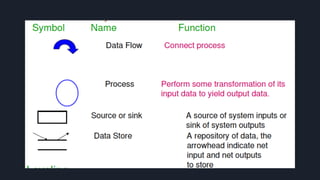
Ɣ A DFD shows the flow of data through a system.
Ɣ It views a system as a function that transforms the inputs into desired
outputs.
Ɣ Any complex system will not perform this transformation in a "single
VWHSë
Ɣ Data will typically undergo a series of transformations before it becomes
the output.
Ɣ The DFD aims to capture the transformations that take place within a
system to the input data so that eventually the output data is produced.
Ɣ A DFD is not a flowchart.
Ɣ DFD represents flow of data and not flow of control.
Ɣ A DFD does not represent procedural information.
Ɣ While drawing a DFD, procedural thinking must be consciously avoided.
Ɣ Considerations of loops and decisions must be ignored.
Ɣ In drawing the DFD, the designer has to specify the major transforms in the
path of the data flowing from the input to output.
Ɣ How those transforms are performed is not an issue while drawing the data
Leveled DFD Set
Ɣ Many systems are too large for a single DFD to describe the data
processing clearly.
Ɣ It is necessary that some decomposition and abstraction
mechanism be used for such systems.
Ɣ DFDs can be hierarchically organized.
Ɣ This helps in progressively partitioning and analyzing large systems.
Ɣ Such DFDs together are called a leveled DFD set.
Ɣ Each level has more information flow and data functional details
than the previous level.
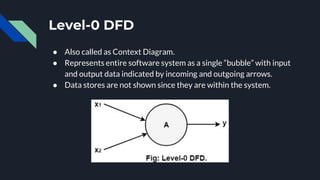
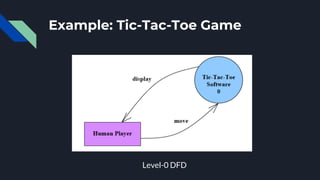
Level-0 DFD
Ɣ Also called as Context Diagram.
Ɣ 5HSUHVHQWVHQWLUHVRIWZDUHVVWHPDVDVLQJOHêEXEEOHëZLWKLQSXW
and output data indicated by incoming and outgoing arrows.
Ɣ Data stores are not shown since they are within the system.
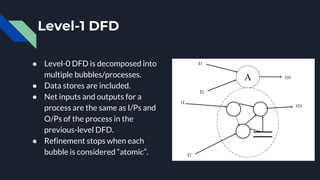
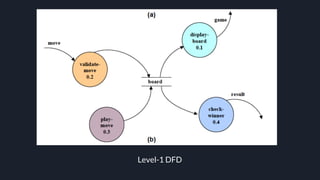
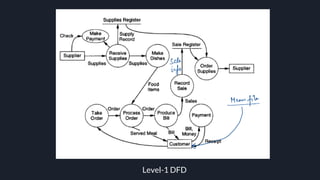
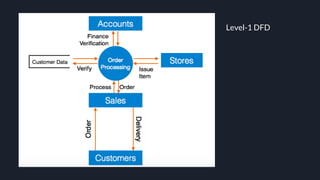
Level-1 DFD
Ɣ Level-0 DFD is decomposed into
multiple bubbles/processes.
Ɣ Data stores are included.
Ɣ Net inputs and outputs for a
process are the same as I/Ps and
O/Ps of the process in the
previous-level DFD.
Ɣ Refinement stops when each
EXEEOHLVFRQVLGHUHGêDWRPLFë
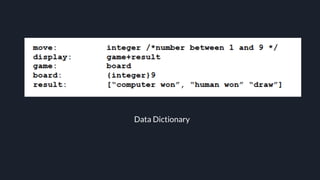
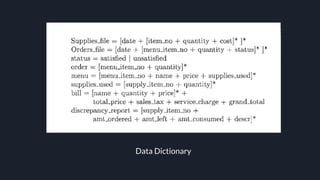
Data Dictionary
Ɣ In a DFD, data flows are identified by unique names. (All
components should be named uniquely)
Ɣ The data dictionary is a repository of various data flows defined
in a DFD.
Ɣ X = A+B : X consists of data elements A and B.
Ɣ X = A|B : X consists of either A or B.
Ɣ X = [A] : X consists of optional data element A.
Ɣ X = A*: X consists of one or more occurrences of A.
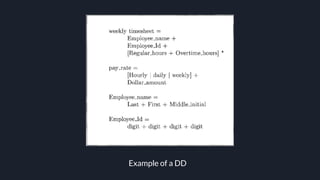
Example of a DD
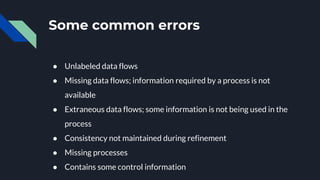
Some common errors
Ɣ Unlabeled data flows
Ɣ Missing data flows; information required by a process is not
available
Ɣ Extraneous data flows; some information is not being used in the
process
Ɣ Consistency not maintained during refinement
Ɣ Missing processes
Ɣ Contains some control information
Example: Tic-Tac-Toe Game
Level-0 DFD
Level-1 DFD
Data Dictionary
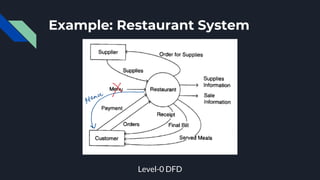
Example: Restaurant System
Level-0 DFD
purify
-
Level-1 DFD
sale
info
)→_
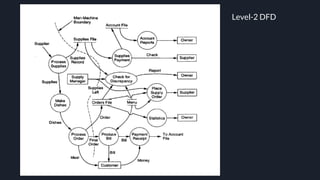
Level-2 DFD
Data Dictionary
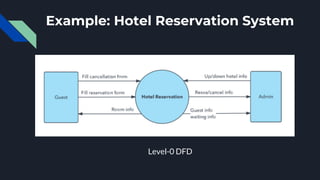
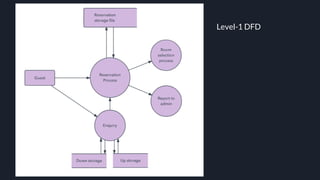
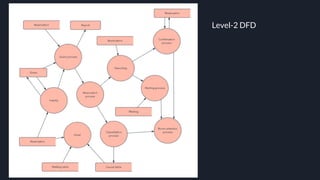
Example: Hotel Reservation System
Level-0 DFD
Level-1 DFD
Level-2 DFD
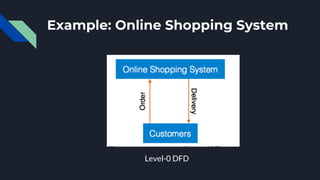
Example: Online Shopping System
Level-0 DFD
Level-1 DFD

DATA FLOW DIAGRAMS pdf for college student.pdf

  • 1.
  • 2.
    Ɣ Also calledData Flow Graphs. Ɣ Commonly used during Problem Analysis. Ɣ A DFD shows the flow of data through a system. Ɣ It views a system as a function that transforms the inputs into desired outputs. Ɣ Any complex system will not perform this transformation in a "single VWHSë Ɣ Data will typically undergo a series of transformations before it becomes the output. Ɣ The DFD aims to capture the transformations that take place within a system to the input data so that eventually the output data is produced.
  • 4.
    Ɣ A DFDis not a flowchart. Ɣ DFD represents flow of data and not flow of control. Ɣ A DFD does not represent procedural information. Ɣ While drawing a DFD, procedural thinking must be consciously avoided. Ɣ Considerations of loops and decisions must be ignored. Ɣ In drawing the DFD, the designer has to specify the major transforms in the path of the data flowing from the input to output. Ɣ How those transforms are performed is not an issue while drawing the data
  • 5.
    Leveled DFD Set ƔMany systems are too large for a single DFD to describe the data processing clearly. Ɣ It is necessary that some decomposition and abstraction mechanism be used for such systems. Ɣ DFDs can be hierarchically organized. Ɣ This helps in progressively partitioning and analyzing large systems. Ɣ Such DFDs together are called a leveled DFD set. Ɣ Each level has more information flow and data functional details than the previous level.
  • 6.
    Level-0 DFD Ɣ Alsocalled as Context Diagram. Ɣ 5HSUHVHQWVHQWLUHVRIWZDUHVVWHPDVDVLQJOHêEXEEOHëZLWKLQSXW and output data indicated by incoming and outgoing arrows. Ɣ Data stores are not shown since they are within the system.
  • 7.
    Level-1 DFD Ɣ Level-0DFD is decomposed into multiple bubbles/processes. Ɣ Data stores are included. Ɣ Net inputs and outputs for a process are the same as I/Ps and O/Ps of the process in the previous-level DFD. Ɣ Refinement stops when each EXEEOHLVFRQVLGHUHGêDWRPLFë
  • 8.
    Data Dictionary Ɣ Ina DFD, data flows are identified by unique names. (All components should be named uniquely) Ɣ The data dictionary is a repository of various data flows defined in a DFD. Ɣ X = A+B : X consists of data elements A and B. Ɣ X = A|B : X consists of either A or B. Ɣ X = [A] : X consists of optional data element A. Ɣ X = A*: X consists of one or more occurrences of A.
  • 9.
  • 10.
    Some common errors ƔUnlabeled data flows Ɣ Missing data flows; information required by a process is not available Ɣ Extraneous data flows; some information is not being used in the process Ɣ Consistency not maintained during refinement Ɣ Missing processes Ɣ Contains some control information
  • 11.
  • 12.
  • 13.
  • 14.
  • 15.
  • 16.
  • 17.
  • 18.
    Example: Hotel ReservationSystem Level-0 DFD
  • 19.
  • 20.
  • 21.
    Example: Online ShoppingSystem Level-0 DFD
  • 22.