Data encoding and 
metadata for streams
> Introduction 
Me at a glance 
• My name is Jonathan Winandy (@ahoy_jon). 
• I am a Data pipeline engineer : 
• I worked on a “DataLake” ! 
• I use tools in the larger Java ecosystem like 
Java, Scala, Clojure, Hadoop … 
• And I am an “entrepreneur”.
> Introduction 
I cofounded two companies and they use streams 
as their data backbone. 
Health care oriented software engineering. 
Provide : 
Coordination for health care professionals.
I cofounded two companies and they use streams 
as their data backbone. 
@PrimaticeData 
“Good dataviz, surreal backends.” 
> Introduction 
Provide : 
Tools and methods for Data capitalisation.
> Introduction 
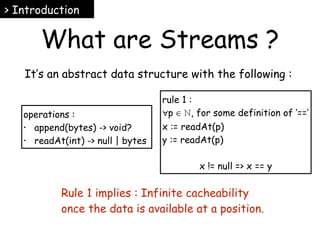
What are Streams ? 
It’s an abstract data structure with the following : 
operations : 
• append(bytes) -> void? 
• readAt(int) -> null | bytes 
rule 1 : 
∀p ∈ ℕ, for some definition of ‘==‘ 
x := readAt(p) 
y := readAt(p) 
! 
x != null => x == y 
Rule 1 implies : Infinite cacheability 
once the data is available at a position.
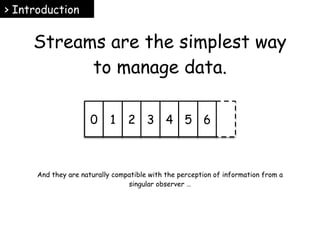
Streams are the simplest way 
to manage data. 
0 1 2 3 4 5 6 
And they are naturally compatible with the perception of information from a 
singular observer … 
> Introduction
But be careful, streams are definitely 
not like queues, ESB, EAI, or what ever 
messaging solution comes to mind …
> Introduction 
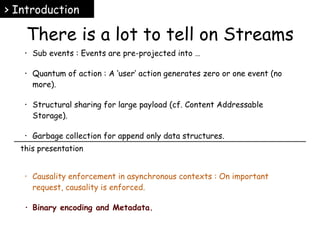
There is a lot to tell on Streams 
• Sub events : Events are pre-projected into … 
• Quantum of action : A ‘user’ action generates zero or one event (no 
more). 
• Structural sharing for large payload (cf. Content Addressable 
Storage). 
• Garbage collection for append only data structures. 
this presentation 
! 
• Causality enforcement in asynchronous contexts : On important 
request, causality is enforced. 
• Binary encoding and Metadata.
> Introduction 
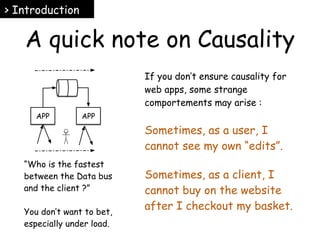
A quick note on Causality 
If you don’t ensure causality for 
web apps, some strange 
comportements may arise : 
Sometimes, as a user, I 
cannot see my own “edits”. 
Sometimes, as a client, I 
cannot buy on the website 
after I checkout my basket. 
APP APP 
“Who is the fastest 
between the Data bus 
and the client ?” 
You don’t want to bet, 
especially under load.
Data encoding and 
metadata for streams
> Content 
Content : 
• Data encoding 
• Identity 
• Metadata 
• Datagram 
• Conclusion
> Data encoding 
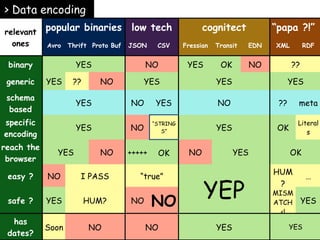
State of data encodings in the 
industry 
• As always worse is considered better. 
• Most of streams have data encoded in : 
• CSV/TSV 
• JSON 
• Platform specific serialisations (eg: Java 
serialisation, Kryo)
> Data encoding 
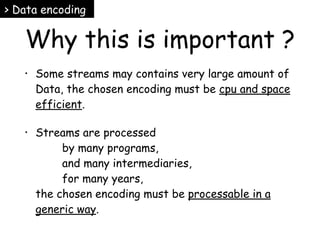
Why this is important ? 
• Some streams may contains very large amount of 
Data, the chosen encoding must be cpu and space 
efficient. 
• Streams are processed 
by many programs, 
and many intermediaries, 
for many years, 
the chosen encoding must be processable in a 
generic way.
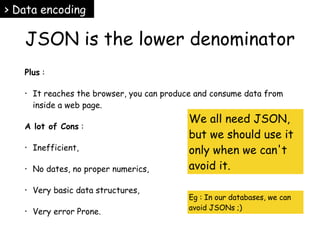
JSON is the lower denominator 
Plus : 
• It reaches the browser, you can produce and consume data from 
inside a web page. 
A lot of Cons : 
• Inefficient, 
• No dates, no proper numerics, 
• Very basic data structures, 
• Very error Prone. 
We all need JSON, 
but we should use it 
only when we can't 
avoid it. 
> Data encoding 
Eg : In our databases, we can 
avoid JSONs ;)
> Data encoding 
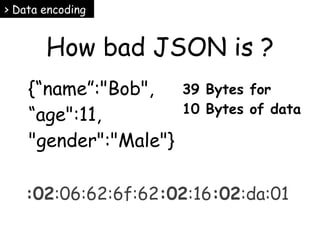
How bad JSON is ? 
{“name”:"Bob", 
“age":11, 
"gender":"Male"} 
39 Bytes for 
10 Bytes of data 
:02:06:62:6f:62:02:16:02:da:01
> Data encoding 
relevant 
ones 
popular binaries low tech cognitect “papa ?!” 
Avro Thrift Proto Buf JSON CSV Fressian Transit EDN XML RDF 
binary YES NO YES OK NO ?? 
generic YES ?? NO YES YES YES 
schema 
based 
YES NO YES NO ?? meta 
specific 
encoding 
S” YES OK Literal 
YES NO “STRING 
s 
reach the 
browser 
YES NO +++++ OK NO YES OK 
easy ? NO I PASS “true” YEP 
HUM 
? 
… 
safe ? YES HUM? NO NO MISM 
ATCH 
<! 
YES 
has 
dates? Soon NO NO YES YES
Identity 
> Identity 
• Most mechanism around stream assure an “at 
most once delivery”. 
• An identity definition is necessary to ensure 
idempotency.
> Identity 
There are 2 ways to refer to a message : 
• with a fingerprint calculated from the message 
(digest). 
• with an external identifier (like UUIDs).
> Identity 
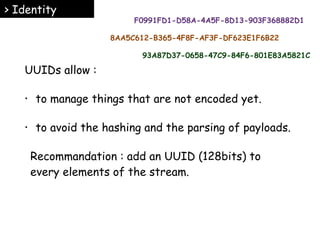
UUIDs allow : 
F0991FD1-D58A-4A5F-8D13-903F368882D1 
8AA5C612-B365-4F8F-AF3F-DF623E1F6B22 
93A87D37-0658-47C9-84F6-801E83A5821C 
• to manage things that are not encoded yet. 
• to avoid the hashing and the parsing of payloads. 
Recommandation : add an UUID (128bits) to 
every elements of the stream.
Metadata 
> Metadata 
• Metadata uses range from the very useful (like 
http headers) to the very meta meta[1]. 
• Metadata on Stream elements is most of the 
time implicit, like for example the Content-Type : 
• “It’s a stream of JSONs” then every element 
of the stream has “content-type=application/json”. 
[1] I am looking at you RDF !
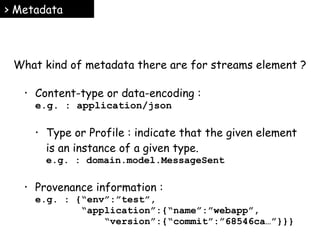
What kind of metadata there are for streams element ? 
• Content-type or data-encoding : 
e.g. : application/json 
• Type or Profile : indicate that the given element 
is an instance of a given type. 
e.g. : domain.model.MessageSent 
• Provenance information : 
e.g. : {“env”:”test”, 
“application”:{“name”:”webapp”, 
“version”:{“commit”:”68546ca…”}}} 
> Metadata
> Metadata 
A quick note on provenance 
The provenance is practical in distributed systems we 
want to know : 
• from which node do a element comes. 
• on the behalf of which agent this element is created. 
• from which environment[1] a element comes. 
[1] with new architecture and Data Labs, environments are sometimes 
shared on the same infrastructure (eg : no Pre-Production platform). 
It’s then very useful to safeguard against the pollution of data.
> Metadata 
{ 
"content-type":"application/json", 
"profile":"domain.model.MessageSent", 
"provenance":{ 
"application":{ 
"name":"webapp", 
"version":"68546ca6e963981a8279aa327cc1e1362d15554e" 
}, 
"node":{ 
"environement":"test", 
"network":{ 
"interface":{ 
"en0":{ 
"addresses":{ 
"192.168.0.13":{ 
"family":"inet", 
"netmask":"255.255.255.0", 
"broadcast":"192.168.0.255" 
} 
} 
} 
} 
}, 
"hostname":["Blaze"], 
"platform_family":"mac_os_x" 
} 
} 
} 
• The metadata of an element can 
represent a significant piece of data. 
Sometimes more than the data itself. 
• !! The same piece of metadata can be 
shared across many elements. !!
> Datagram 
Anatomy of an element 
:ID :HEADERS 
:BODY 
DB7D919B-248F-4676- 
8494-2698B48C69C3 
57158663-5933-4CE6- 
A54E-8179ECFBFCCA [“ich”,“bin”,“ein”,“JSON”] 
e.g.
> Datagram 
1. Create and register your headers 
(in a distributed Key/Store for example) . 
4813EDF2-B04E-4B70- 
{ 
AB04-0F9EA456E032 
"content-type":"application/json", 
"profile":"domain.model.MessageSent", 
"provenance":{ 
"application":{ 
"name":"webapp", 
"version":"68546ca6e963981a8279aa327cc1e1362d15554e" 
}, 
"node":{ 
"environement":"test", 
"network":{ 
"interface":{ 
"en0":{ 
"addresses":{ 
"192.168.0.13":{ 
"family":"inet", 
"netmask":"255.255.255.0", 
"broadcast":"192.168.0.255" 
} 
} 
} 
} 
}, 
"hostname":["Blaze"], 
"platform_family":"mac_os_x" 
} 
} 
}
> Datagram 
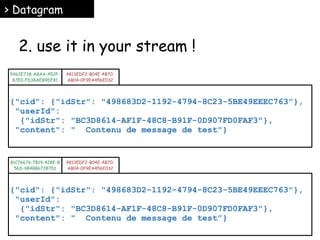
2. use it in your stream ! 
5462E738-ABAA-452F- 
87E0-FD38AEB9DF81 
4813EDF2-B04E-4B70- 
AB04-0F9EA456E032 
{"cid": {"idStr": "498683D2-1192-4794-8C23-5BE49EEEC763"}, 
"userId": 
{"idStr": "BC3D8614-AF1F-48C8-B91F-0D907FD0FAF3"}, 
"content": " Contenu de message de test"} 
81C76676-7B19-428E-8 
56D-984BB67287D1 
4813EDF2-B04E-4B70- 
AB04-0F9EA456E032 
{"cid": {"idStr": "498683D2-1192-4794-8C23-5BE49EEEC763"}, 
"userId": 
{"idStr": "BC3D8614-AF1F-48C8-B91F-0D907FD0FAF3"}, 
"content": " Contenu de message de test”}
> Datagram 
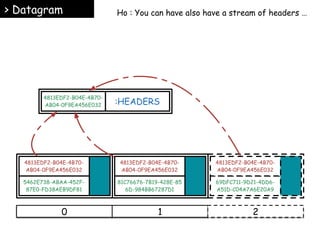
Ho : You can have also have a stream of headers … 
4813EDF2-B04E-4B70- 
AB04-0F9EA456E032 :HEADERS 
4813EDF2-B04E-4B70- 
AB04-0F9EA456E032 
5462E738-ABAA-452F- 
87E0-FD38AEB9DF81 
4813EDF2-B04E-4B70- 
AB04-0F9EA456E032 
81C76676-7B19-428E-85 
6D-984BB67287D1 
4813EDF2-B04E-4B70- 
AB04-0F9EA456E032 
69DFC711-9D21-4DD6- 
A51D-C04A7A6E20A9 
0 1 2
> Conclusion 
If you don’t yet use streams instead of 
databases, start to use one next Monday 
(even with JSON and no headers…). 
If you do already use streams … Well, 
you know what to do ! ;)
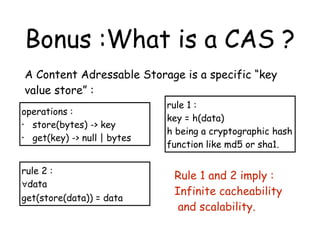
Bonus :What is a CAS ? 
A Content Adressable Storage is a specific “key 
value store” : 
operations : 
• store(bytes) -> key 
• get(key) -> null | bytes 
rule 1 : 
key = h(data) 
h being a cryptographic hash 
function like md5 or sha1. 
rule 2 : 
∀data 
get(store(data)) = data 
Rule 1 and 2 imply : 
Infinite cacheability 
and scalability.
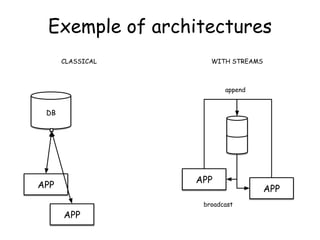
Exemple of architectures 
CLASSICAL 
APP 
APP 
DB 
WITH STREAMS 
APP 
APP 
append 
broadcast
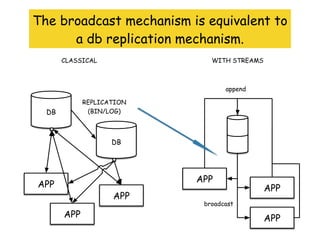
The broadcast mechanism is equivalent to 
Exemple of architectures 
a db replication mechanism. 
CLASSICAL 
APP 
REPLICATION 
(BIN/LOG) 
APP 
APP 
DB 
DB 
WITH STREAMS 
APP 
APP 
APP 
append 
broadcast

Data encoding and Metadata for Streams

  • 1.
    Data encoding and metadata for streams
  • 3.
    > Introduction Meat a glance • My name is Jonathan Winandy (@ahoy_jon). • I am a Data pipeline engineer : • I worked on a “DataLake” ! • I use tools in the larger Java ecosystem like Java, Scala, Clojure, Hadoop … • And I am an “entrepreneur”.
  • 4.
    > Introduction Icofounded two companies and they use streams as their data backbone. Health care oriented software engineering. Provide : Coordination for health care professionals.
  • 5.
    I cofounded twocompanies and they use streams as their data backbone. @PrimaticeData “Good dataviz, surreal backends.” > Introduction Provide : Tools and methods for Data capitalisation.
  • 6.
    > Introduction Whatare Streams ? It’s an abstract data structure with the following : operations : • append(bytes) -> void? • readAt(int) -> null | bytes rule 1 : ∀p ∈ ℕ, for some definition of ‘==‘ x := readAt(p) y := readAt(p) ! x != null => x == y Rule 1 implies : Infinite cacheability once the data is available at a position.
  • 7.
    Streams are thesimplest way to manage data. 0 1 2 3 4 5 6 And they are naturally compatible with the perception of information from a singular observer … > Introduction
  • 8.
    But be careful,streams are definitely not like queues, ESB, EAI, or what ever messaging solution comes to mind …
  • 9.
    > Introduction Thereis a lot to tell on Streams • Sub events : Events are pre-projected into … • Quantum of action : A ‘user’ action generates zero or one event (no more). • Structural sharing for large payload (cf. Content Addressable Storage). • Garbage collection for append only data structures. this presentation ! • Causality enforcement in asynchronous contexts : On important request, causality is enforced. • Binary encoding and Metadata.
  • 10.
    > Introduction Aquick note on Causality If you don’t ensure causality for web apps, some strange comportements may arise : Sometimes, as a user, I cannot see my own “edits”. Sometimes, as a client, I cannot buy on the website after I checkout my basket. APP APP “Who is the fastest between the Data bus and the client ?” You don’t want to bet, especially under load.
  • 11.
    Data encoding and metadata for streams
  • 12.
    > Content Content: • Data encoding • Identity • Metadata • Datagram • Conclusion
  • 13.
    > Data encoding State of data encodings in the industry • As always worse is considered better. • Most of streams have data encoded in : • CSV/TSV • JSON • Platform specific serialisations (eg: Java serialisation, Kryo)
  • 14.
    > Data encoding Why this is important ? • Some streams may contains very large amount of Data, the chosen encoding must be cpu and space efficient. • Streams are processed by many programs, and many intermediaries, for many years, the chosen encoding must be processable in a generic way.
  • 15.
    JSON is thelower denominator Plus : • It reaches the browser, you can produce and consume data from inside a web page. A lot of Cons : • Inefficient, • No dates, no proper numerics, • Very basic data structures, • Very error Prone. We all need JSON, but we should use it only when we can't avoid it. > Data encoding Eg : In our databases, we can avoid JSONs ;)
  • 16.
    > Data encoding How bad JSON is ? {“name”:"Bob", “age":11, "gender":"Male"} 39 Bytes for 10 Bytes of data :02:06:62:6f:62:02:16:02:da:01
  • 17.
    > Data encoding relevant ones popular binaries low tech cognitect “papa ?!” Avro Thrift Proto Buf JSON CSV Fressian Transit EDN XML RDF binary YES NO YES OK NO ?? generic YES ?? NO YES YES YES schema based YES NO YES NO ?? meta specific encoding S” YES OK Literal YES NO “STRING s reach the browser YES NO +++++ OK NO YES OK easy ? NO I PASS “true” YEP HUM ? … safe ? YES HUM? NO NO MISM ATCH <! YES has dates? Soon NO NO YES YES
  • 18.
    Identity > Identity • Most mechanism around stream assure an “at most once delivery”. • An identity definition is necessary to ensure idempotency.
  • 19.
    > Identity Thereare 2 ways to refer to a message : • with a fingerprint calculated from the message (digest). • with an external identifier (like UUIDs).
  • 20.
    > Identity UUIDsallow : F0991FD1-D58A-4A5F-8D13-903F368882D1 8AA5C612-B365-4F8F-AF3F-DF623E1F6B22 93A87D37-0658-47C9-84F6-801E83A5821C • to manage things that are not encoded yet. • to avoid the hashing and the parsing of payloads. Recommandation : add an UUID (128bits) to every elements of the stream.
  • 21.
    Metadata > Metadata • Metadata uses range from the very useful (like http headers) to the very meta meta[1]. • Metadata on Stream elements is most of the time implicit, like for example the Content-Type : • “It’s a stream of JSONs” then every element of the stream has “content-type=application/json”. [1] I am looking at you RDF !
  • 22.
    What kind ofmetadata there are for streams element ? • Content-type or data-encoding : e.g. : application/json • Type or Profile : indicate that the given element is an instance of a given type. e.g. : domain.model.MessageSent • Provenance information : e.g. : {“env”:”test”, “application”:{“name”:”webapp”, “version”:{“commit”:”68546ca…”}}} > Metadata
  • 23.
    > Metadata Aquick note on provenance The provenance is practical in distributed systems we want to know : • from which node do a element comes. • on the behalf of which agent this element is created. • from which environment[1] a element comes. [1] with new architecture and Data Labs, environments are sometimes shared on the same infrastructure (eg : no Pre-Production platform). It’s then very useful to safeguard against the pollution of data.
  • 24.
    > Metadata { "content-type":"application/json", "profile":"domain.model.MessageSent", "provenance":{ "application":{ "name":"webapp", "version":"68546ca6e963981a8279aa327cc1e1362d15554e" }, "node":{ "environement":"test", "network":{ "interface":{ "en0":{ "addresses":{ "192.168.0.13":{ "family":"inet", "netmask":"255.255.255.0", "broadcast":"192.168.0.255" } } } } }, "hostname":["Blaze"], "platform_family":"mac_os_x" } } } • The metadata of an element can represent a significant piece of data. Sometimes more than the data itself. • !! The same piece of metadata can be shared across many elements. !!
  • 25.
    > Datagram Anatomyof an element :ID :HEADERS :BODY DB7D919B-248F-4676- 8494-2698B48C69C3 57158663-5933-4CE6- A54E-8179ECFBFCCA [“ich”,“bin”,“ein”,“JSON”] e.g.
  • 26.
    > Datagram 1.Create and register your headers (in a distributed Key/Store for example) . 4813EDF2-B04E-4B70- { AB04-0F9EA456E032 "content-type":"application/json", "profile":"domain.model.MessageSent", "provenance":{ "application":{ "name":"webapp", "version":"68546ca6e963981a8279aa327cc1e1362d15554e" }, "node":{ "environement":"test", "network":{ "interface":{ "en0":{ "addresses":{ "192.168.0.13":{ "family":"inet", "netmask":"255.255.255.0", "broadcast":"192.168.0.255" } } } } }, "hostname":["Blaze"], "platform_family":"mac_os_x" } } }
  • 27.
    > Datagram 2.use it in your stream ! 5462E738-ABAA-452F- 87E0-FD38AEB9DF81 4813EDF2-B04E-4B70- AB04-0F9EA456E032 {"cid": {"idStr": "498683D2-1192-4794-8C23-5BE49EEEC763"}, "userId": {"idStr": "BC3D8614-AF1F-48C8-B91F-0D907FD0FAF3"}, "content": " Contenu de message de test"} 81C76676-7B19-428E-8 56D-984BB67287D1 4813EDF2-B04E-4B70- AB04-0F9EA456E032 {"cid": {"idStr": "498683D2-1192-4794-8C23-5BE49EEEC763"}, "userId": {"idStr": "BC3D8614-AF1F-48C8-B91F-0D907FD0FAF3"}, "content": " Contenu de message de test”}
  • 28.
    > Datagram Ho: You can have also have a stream of headers … 4813EDF2-B04E-4B70- AB04-0F9EA456E032 :HEADERS 4813EDF2-B04E-4B70- AB04-0F9EA456E032 5462E738-ABAA-452F- 87E0-FD38AEB9DF81 4813EDF2-B04E-4B70- AB04-0F9EA456E032 81C76676-7B19-428E-85 6D-984BB67287D1 4813EDF2-B04E-4B70- AB04-0F9EA456E032 69DFC711-9D21-4DD6- A51D-C04A7A6E20A9 0 1 2
  • 29.
    > Conclusion Ifyou don’t yet use streams instead of databases, start to use one next Monday (even with JSON and no headers…). If you do already use streams … Well, you know what to do ! ;)
  • 33.
    Bonus :What isa CAS ? A Content Adressable Storage is a specific “key value store” : operations : • store(bytes) -> key • get(key) -> null | bytes rule 1 : key = h(data) h being a cryptographic hash function like md5 or sha1. rule 2 : ∀data get(store(data)) = data Rule 1 and 2 imply : Infinite cacheability and scalability.
  • 34.
    Exemple of architectures CLASSICAL APP APP DB WITH STREAMS APP APP append broadcast
  • 35.
    The broadcast mechanismis equivalent to Exemple of architectures a db replication mechanism. CLASSICAL APP REPLICATION (BIN/LOG) APP APP DB DB WITH STREAMS APP APP APP append broadcast