Ember	
  +	
  D3	
  
(and	
  maybe	
  a	
  framework	
  rant?)	
  
Ben	
  Lesh	
  
•  Twi<er:	
  @benlesh	
  
•  Email:	
  ben@benlesh.com	
  
•  GitHub:	
  h<p://github.com/blesh	


Ben	
  Lesh	
  
Edge	
  Insights	
  @	


Other	
  UI	
  developers:	
  
@jeff3dx	
  
@_jayphelps	
  
@kevinlew15	
  
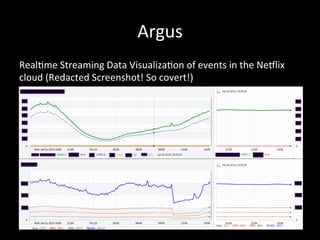
Argus	
  
RealTme	
  Streaming	
  Data	
  VisualizaTon	
  of	
  events	
  in	
  the	
  NeYlix	
  
cloud	
  (Redacted	
  Screenshot!	
  So	
  covert!)	
  
Ember.JS	
  
•  Home:	
  h<p://emberjs.com	
  
•  Docs:	
  h<p://emberjs.com/api	
  
•  Source:	
  h<p://github.com/emberjs/ember.js	
  
Ember.JS	
  
•  Opinionated	
  structure	
  
•  Uniform	
  declaraTons	
  
•  Components	
  and	
  Helpers	
  vs	
  DirecTves	
  
•  Observes	
  changes	
  rather	
  than	
  dirty	
  checking	
  
•  Computed	
  ProperTes	
  
Ember-­‐CLI	
  
•  Home:	
  h<p://ember-­‐cli.com	
  
•  Install:	
  npm	
  install	
  -­‐g	
  ember-­‐cli	


Ember-­‐CLI	
  
•  ApplicaTon	
  scaffolding	
  
•  ES6	
  transpilaTon	
  
•  JS	
  concatenaTon	
  
•  MinificaTon	
  
•  JSHint	
  
•  Unit	
  Tests	
  
•  Development	
  mode	
  (watching)	
  
•  Much,	
  much	
  more	


Ember	
  +	
  D3:	
  Mostly	
  Ember	
  Method	
  
•  Create	
  a	
  component	
  
•  Create	
  a	
  template	
  
•  Add	
  properTes	
  
•  Use	
  D3	
  scales,	
  line	
  funcTons,	
  etc	
  as	
  “helpers”,	
  
but	
  let	
  Ember	
  manage	
  creaTng	
  DOM	
  
•  For	
  animaTons,	
  observe	
  property	
  changes,	
  
then	
  trigger	
  animaTons	
  with	
  D3	


Ember	
  +	
  D3:	
  Mostly	
  Ember	
  Method	
  
PROS	
  
•  Highly	
  testable	
  
•  Easier	
  to	
  maintain	
  a	
  template	
  
•  Only	
  one	
  library	
  responsible	
  for	
  inserTng	
  DOM	
  
CONS	
  
•  AnimaTon	
  capability	
  is	
  limited	


Ember	
  +	
  D3:	
  Mostly	
  Ember	
  Method	


Code	
  example	
  
h<p://github.com/blesh/ember-­‐d3-­‐example	


Ember	
  +	
  D3:	
  Mostly	
  D3	
  Method	
  
•  Use	
  very	
  li<le	
  of	
  Ember’s	
  templaTng	
  
•  Observe	
  changes	
  to	
  incoming	
  data	
  
•  use	
  D3’s	
  .data().enter().exit()	
  pa<ern	
  for	
  DOM	
  
creaTon	
  instead	
  
•  D3	
  does	
  all	
  of	
  the	
  work	
  of	
  adding	
  to	
  the	
  DOM	
  
•  Most	
  of	
  the	
  a<r()	
  handlers	
  can	
  be	
  members	
  of	
  
the	
  component	
  for	
  easier	
  tesTng	


Ember	
  +	
  D3:	
  Mostly	
  D3	
  Method	
  
PROS	
  
•  More	
  animaTon	
  possibiliTes	
  
•  Be<er	
  control	
  for	
  D3	
  specialists,	
  perhaps?	
  
CONS	
  
•  Harder	
  to	
  test	
  
•  Easier	
  to	
  mess	
  up	
  
•  No	
  templaTng	
  used	


What	
  we’re	
  doing	


A	
  combinaTon	
  of	
  both	
  approaches,	
  heavily	
  
favoring	
  the	
  mostly	
  Ember	
  approach	
  for	
  
testability	
  and	
  templaTng	
  
What	
  we’re	
  doing	


Code	
  example	
  	
  
(animaTon	
  branch)	
  
…	
  and	
  that’s	
  it.	
  
•  QuesTons?	
  	
  
•  Comments?	
  
•  Want	
  to	
  hear	
  me	
  rant	
  about	
  Frameworks	
  in	
  
general?	
  

SF Front End Developers - Ember + D3

  • 1.
    Ember  +  D3   (and  maybe  a  framework  rant?)  
  • 2.
    Ben  Lesh   • Twi<er:  @benlesh   •  Email:  ben@benlesh.com   •  GitHub:  h<p://github.com/blesh    
  • 3.
    Ben  Lesh   Edge  Insights  @     Other  UI  developers:   @jeff3dx   @_jayphelps   @kevinlew15  
  • 4.
    Argus   RealTme  Streaming  Data  VisualizaTon  of  events  in  the  NeYlix   cloud  (Redacted  Screenshot!  So  covert!)  
  • 5.
    Ember.JS   •  Home:  h<p://emberjs.com   •  Docs:  h<p://emberjs.com/api   •  Source:  h<p://github.com/emberjs/ember.js  
  • 6.
    Ember.JS   •  Opinionated  structure   •  Uniform  declaraTons   •  Components  and  Helpers  vs  DirecTves   •  Observes  changes  rather  than  dirty  checking   •  Computed  ProperTes  
  • 7.
    Ember-­‐CLI   •  Home:  h<p://ember-­‐cli.com   •  Install:  npm  install  -­‐g  ember-­‐cli    
  • 8.
    Ember-­‐CLI   •  ApplicaTon  scaffolding   •  ES6  transpilaTon   •  JS  concatenaTon   •  MinificaTon   •  JSHint   •  Unit  Tests   •  Development  mode  (watching)   •  Much,  much  more    
  • 9.
    Ember  +  D3:  Mostly  Ember  Method   •  Create  a  component   •  Create  a  template   •  Add  properTes   •  Use  D3  scales,  line  funcTons,  etc  as  “helpers”,   but  let  Ember  manage  creaTng  DOM   •  For  animaTons,  observe  property  changes,   then  trigger  animaTons  with  D3      
  • 10.
    Ember  +  D3:  Mostly  Ember  Method   PROS   •  Highly  testable   •  Easier  to  maintain  a  template   •  Only  one  library  responsible  for  inserTng  DOM   CONS   •  AnimaTon  capability  is  limited      
  • 11.
    Ember  +  D3:  Mostly  Ember  Method       Code  example   h<p://github.com/blesh/ember-­‐d3-­‐example    
  • 12.
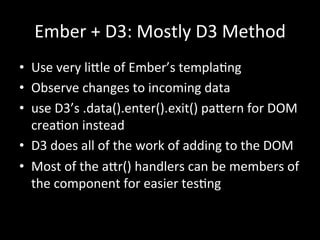
    Ember  +  D3:  Mostly  D3  Method   •  Use  very  li<le  of  Ember’s  templaTng   •  Observe  changes  to  incoming  data   •  use  D3’s  .data().enter().exit()  pa<ern  for  DOM   creaTon  instead   •  D3  does  all  of  the  work  of  adding  to  the  DOM   •  Most  of  the  a<r()  handlers  can  be  members  of   the  component  for  easier  tesTng      
  • 13.
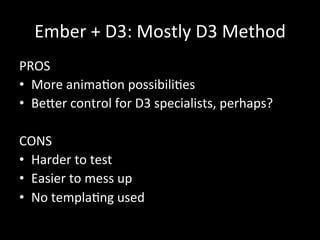
    Ember  +  D3:  Mostly  D3  Method   PROS   •  More  animaTon  possibiliTes   •  Be<er  control  for  D3  specialists,  perhaps?   CONS   •  Harder  to  test   •  Easier  to  mess  up   •  No  templaTng  used    
  • 14.
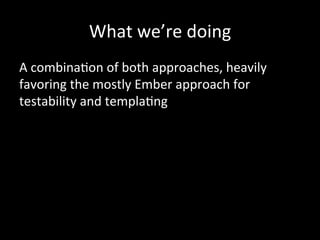
    What  we’re  doing       A  combinaTon  of  both  approaches,  heavily   favoring  the  mostly  Ember  approach  for   testability  and  templaTng  
  • 15.
    What  we’re  doing           Code  example     (animaTon  branch)  
  • 16.
  • 17.
    •  QuesTons?     •  Comments?   •  Want  to  hear  me  rant  about  Frameworks  in   general?