Intuitive APIs and
Developer Education
Bear Douglas
@beardigsit
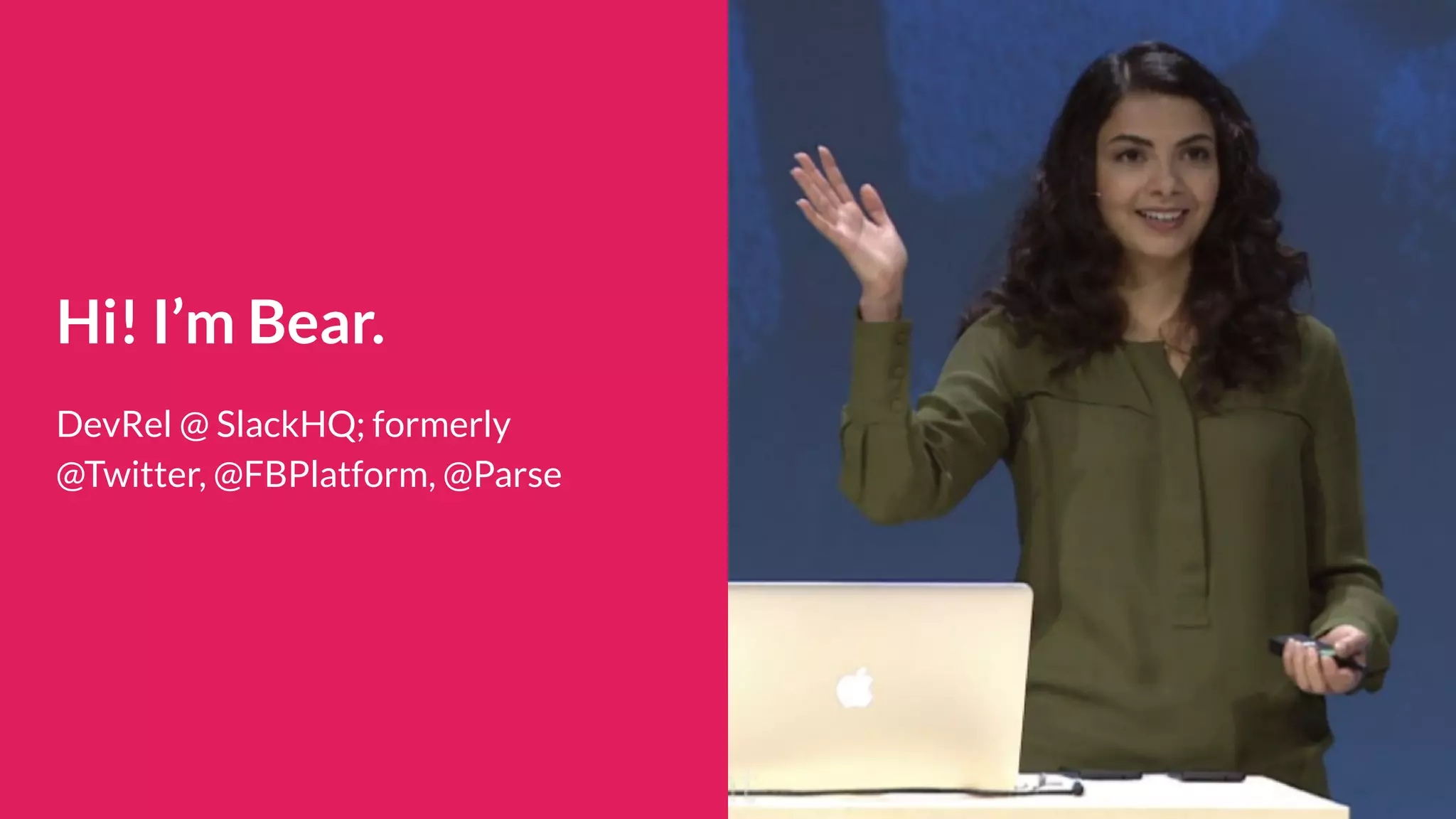
Hi! I’m Bear.
DevRel @ SlackHQ; formerly
@Twitter, @FBPlatform, @Parse
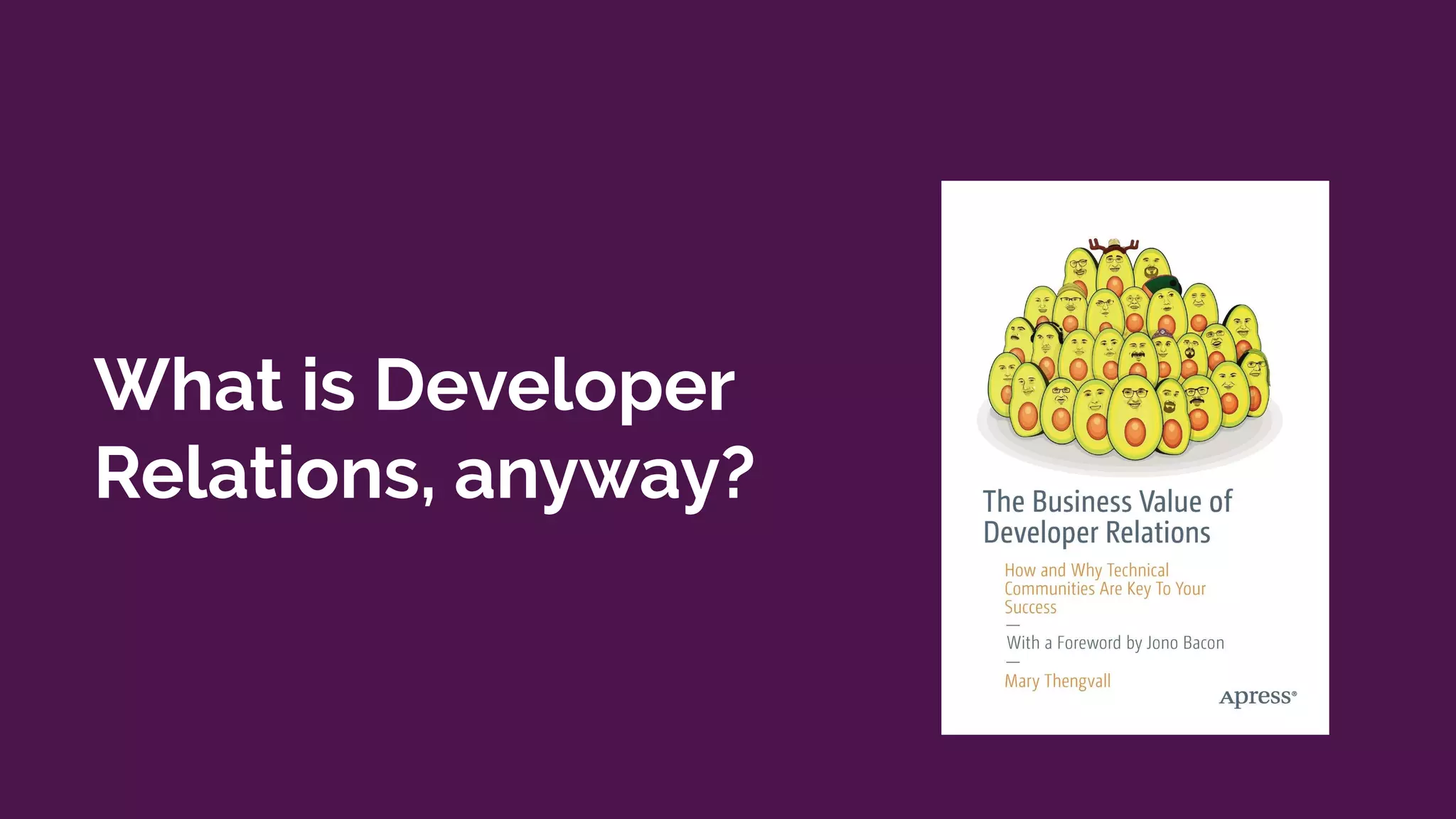
What is Developer
Relations, anyway?
❏ Teach people how to use APIs
❏ Use a lot of APIs ourselves
❏ Develop strong opinions about API design
❏ Share those back with our product &
engineering partners
❏ Learn a lot about how to explain abstract
concepts to other engineers
Designing APIs that
make sense
Designing APIs that
make sense
… because you want people
to use them
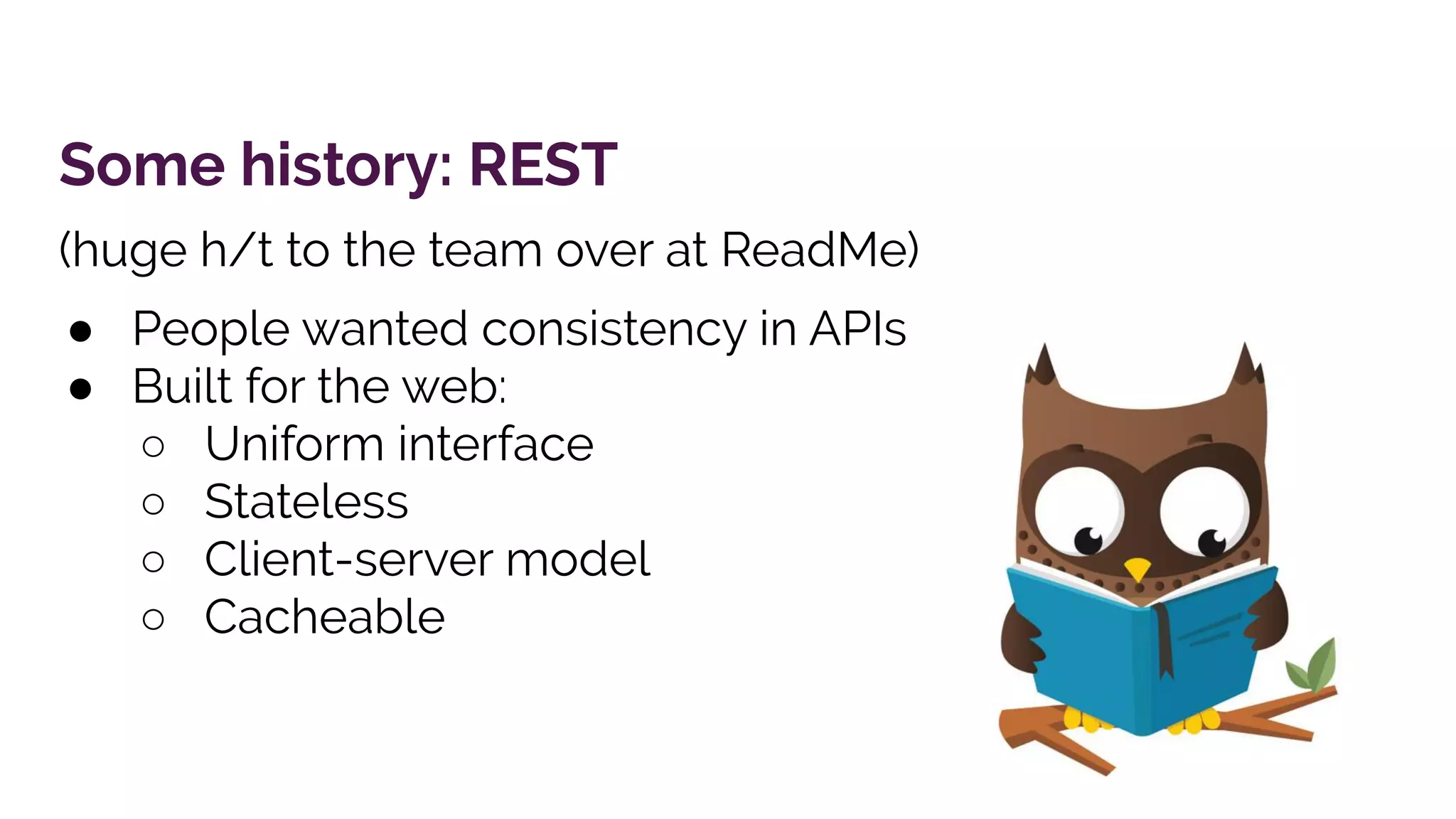
Some history: REST
(huge h/t to the team over at ReadMe)
● People wanted consistency in APIs
● Built for the web:
○ Uniform interface
○ Stateless
○ Client-server model
○ Cacheable
The name "Representational State Transfer" is
intended to evoke an image of how a well-designed
Web application behaves: a network of web pages
(a virtual state-machine), where the user progresses
through the application by selecting links (state
transitions), resulting in the next page (representing
the next state of the application) being transferred
to the user and rendered for their use.
From Fielding’s dissertation publication: https://www.ics.uci.edu/~fielding/pubs/dissertation/evaluation.htm
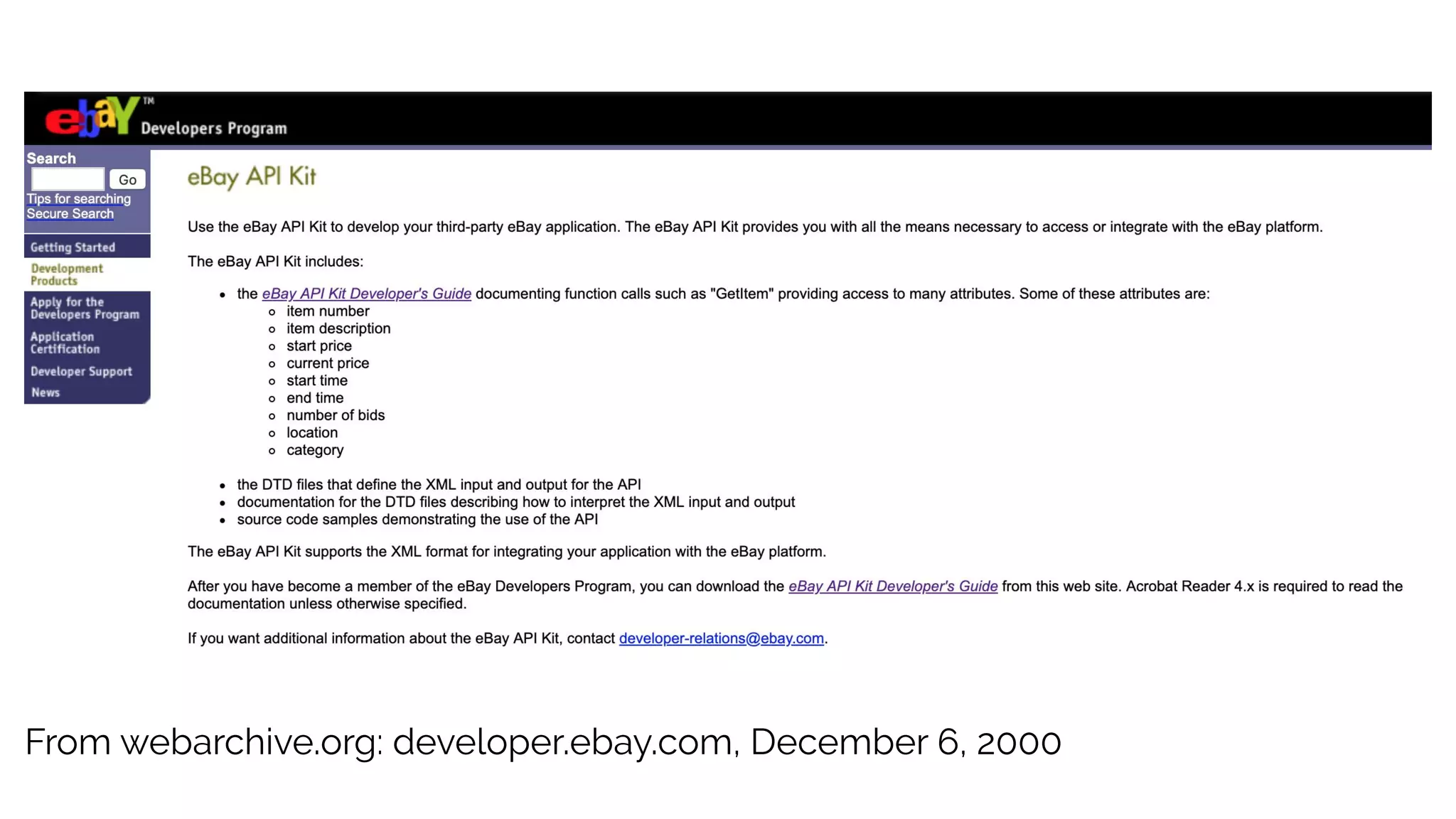
From webarchive.org: developer.ebay.com, December 6, 2000
eBay’s API…
❏ Made REST more concrete (getItem
example)
❏ Provided sample code
❏ Gave people an incentive to learn
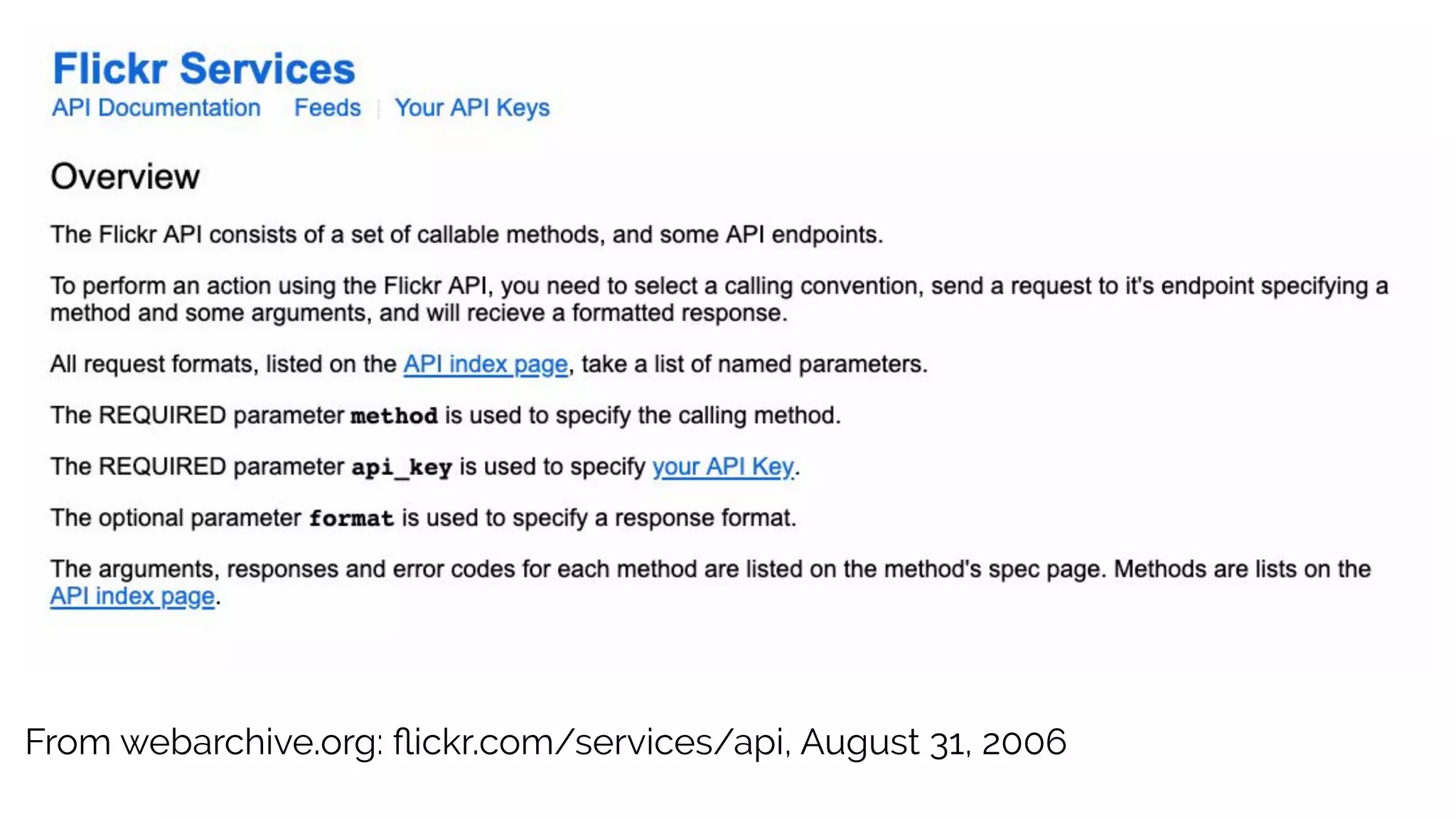
From webarchive.org: flickr.com/services/api, August 31, 2006
Flickr developer
tooling
● Reduce complexity
● Lower barriers to adoption
● Highlighted on the API site
Fast forward to 2010...
Open Graph
Let developers represent their web
apps and objects on the social graph
The Open Graph protocol enables any web page to
become a rich object in a social graph. For
instance, this is used on Facebook to allow any web
page to have the same functionality as any other
object on Facebook.
Opening to the Open Graph Protocol: ogp.me
Open Graph
Let developers represent their web
apps and objects on the social graph
… though what ended up being most
meaningful were videos, music,
articles, books, and profiles.
… and it paved the way
for GraphQL
Facebook and objects within it
provided a concrete representation of
graph data
… but let’s go back to Flickr
OAuth
Get permission to access data as a
third party, without sharing credentials
In order for the client to access resources, it first has
to obtain permission from the resource owner. This
permission is expressed in the form of a token and
matching shared-secret. The purpose of the token
is to make it unnecessary for the resource owner to
share its credentials with the client. Unlike the
resource owner credentials, tokens can be issued
with a restricted scope and limited lifetime, and
revoked independently.
From the OAuth 1.0 spec: https://tools.ietf.org/html/rfc5849
Image: dummies.com/business/marketing/social-media-marketing/how-to-use-twitter-to-share-blog-content
OAuth in the Enterprise: the case for “Workspace Apps”
❏ (Mostly) familiar concepts around auth
❏ Lots of platform-specific abstract concepts:
workspaces, orgs, resources, channel
membership
❏ Did support with tooling
❏ Did rewrite documentation
❏ Few incentives to rewrite
Context matters when you
decide whether to teach
developers something new
or use what they know
Who are my developers?
What might they already
know and expect?
When might they give up?
How could we convince
them to keep trying?
Thanks!

Intuitive APIs and Developer Education

  • 2.
    Intuitive APIs and DeveloperEducation Bear Douglas @beardigsit
  • 3.
    Hi! I’m Bear. DevRel@ SlackHQ; formerly @Twitter, @FBPlatform, @Parse
  • 4.
  • 5.
    ❏ Teach peoplehow to use APIs ❏ Use a lot of APIs ourselves ❏ Develop strong opinions about API design ❏ Share those back with our product & engineering partners ❏ Learn a lot about how to explain abstract concepts to other engineers
  • 6.
  • 7.
    Designing APIs that makesense … because you want people to use them
  • 8.
    Some history: REST (hugeh/t to the team over at ReadMe) ● People wanted consistency in APIs ● Built for the web: ○ Uniform interface ○ Stateless ○ Client-server model ○ Cacheable
  • 9.
    The name "RepresentationalState Transfer" is intended to evoke an image of how a well-designed Web application behaves: a network of web pages (a virtual state-machine), where the user progresses through the application by selecting links (state transitions), resulting in the next page (representing the next state of the application) being transferred to the user and rendered for their use. From Fielding’s dissertation publication: https://www.ics.uci.edu/~fielding/pubs/dissertation/evaluation.htm
  • 10.
  • 11.
    eBay’s API… ❏ MadeREST more concrete (getItem example) ❏ Provided sample code ❏ Gave people an incentive to learn
  • 12.
  • 13.
  • 15.
    Flickr developer tooling ● Reducecomplexity ● Lower barriers to adoption ● Highlighted on the API site
  • 16.
  • 18.
    Open Graph Let developersrepresent their web apps and objects on the social graph
  • 19.
    The Open Graphprotocol enables any web page to become a rich object in a social graph. For instance, this is used on Facebook to allow any web page to have the same functionality as any other object on Facebook. Opening to the Open Graph Protocol: ogp.me
  • 24.
    Open Graph Let developersrepresent their web apps and objects on the social graph … though what ended up being most meaningful were videos, music, articles, books, and profiles.
  • 25.
    … and itpaved the way for GraphQL Facebook and objects within it provided a concrete representation of graph data
  • 27.
    … but let’sgo back to Flickr
  • 29.
    OAuth Get permission toaccess data as a third party, without sharing credentials
  • 30.
    In order forthe client to access resources, it first has to obtain permission from the resource owner. This permission is expressed in the form of a token and matching shared-secret. The purpose of the token is to make it unnecessary for the resource owner to share its credentials with the client. Unlike the resource owner credentials, tokens can be issued with a restricted scope and limited lifetime, and revoked independently. From the OAuth 1.0 spec: https://tools.ietf.org/html/rfc5849
  • 31.
  • 32.
    OAuth in theEnterprise: the case for “Workspace Apps”
  • 33.
    ❏ (Mostly) familiarconcepts around auth ❏ Lots of platform-specific abstract concepts: workspaces, orgs, resources, channel membership ❏ Did support with tooling ❏ Did rewrite documentation ❏ Few incentives to rewrite
  • 34.
    Context matters whenyou decide whether to teach developers something new or use what they know
  • 35.
    Who are mydevelopers? What might they already know and expect?
  • 36.
    When might theygive up? How could we convince them to keep trying?
  • 37.