Latest Trends in ERP -
A Manufacturing Perspective
Trends, Challenges, Investments and Roadmap
Debashis Majumder
SAP India
National Seminar on Leadership through Manufacturing Excellence,
02 September 2010, Kolkata
© SAP AG 2009. All rights reserved. / Page 2
1. Trends and Challenges
2. Investments in Manufacturing
3. Road Map and Summary
Agenda
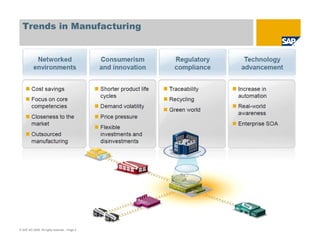
Trends in Manufacturing
© SAP AG 2009. All rights reserved. / Page 3
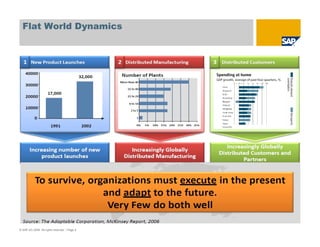
Flat World Dynamics
© SAP AG 2009. All rights reserved. / Page 4
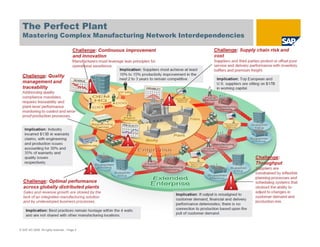
The Perfect Plant
Mastering Complex Manufacturing Network Interdependencies
© SAP AG 2009. All rights reserved. / Page 5
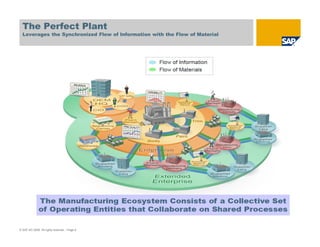
The Perfect Plant
Leverages the Synchronized Flow of Information with the Flow of Material
© SAP AG 2009. All rights reserved. / Page 6
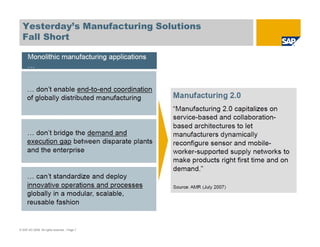
Yesterday’s Manufacturing Solutions
Fall Short
© SAP AG 2009. All rights reserved. / Page 7
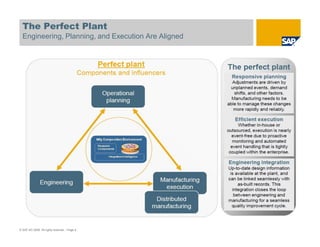
The Perfect Plant
Engineering, Planning, and Execution Are Aligned
© SAP AG 2009. All rights reserved. / Page 8
© SAP AG 2009. All rights reserved. / Page 9
1. Trends and Challenges
2. Investments in Manufacturing
1. Evolution of Manufacturing Software
2. Supporting Technological Developments
1. Data Mining in Manufacturing
2. RFID
3. In Memory
3. Road Map and Summary
Agenda
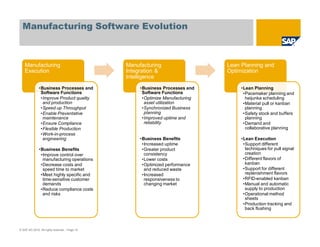
Manufacturing Software Evolution
© SAP AG 2010. All rights reserved. / Page 10
Manufacturing
Execution
•Business Processes and
Software Functions
•Improve Product quality
and production
•Speed up Throughput
•Enable Preventative
maintenance
•Ensure Compliance
•Flexible Production
•Work-in-process
engineering
•Business Benefits
•Improve control over
manufacturing operations
•Decrease costs and
speed time to market
•Meet highly specific and
time-sensitive customer
demands
•Reduce compliance costs
and risks
Manufacturing
Integration &
Intelligence
•Business Processes and
Software Functions
•Optimize Manufacturing
asset utilization
•Synchronized Business
planning
•Improved uptime and
reliability
•Business Benefits
•Increased uptime
•Greater product
consistency
•Lower costs
•Optimized performance
and reduced waste
•Increased
responsiveness to
changing market
Lean Planning and
Optimization
•Lean Planning
•Pacemaker planning and
heijunka scheduling
•Material pull or kanban
planning
•Safety stock and buffers
planning
•Demand and
collaborative planning
•Lean Execution
•Support different
techniques for pull signal
creation
•Different flavors of
kanban
•Support for different
replenishment flavors
•RFID-enabled kanban
•Manual and automatic
supply to production
•Operational method
sheets
•Production tracking and
back flushing
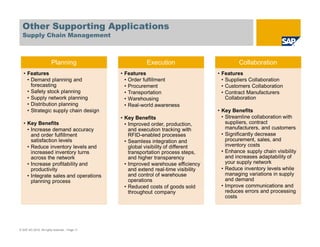
Other Supporting Applications
Supply Chain Management
© SAP AG 2010. All rights reserved. / Page 11
Planning
• Features
• Demand planning and
forecasting
• Safety stock planning
• Supply network planning
• Distribution planning
• Strategic supply chain design
• Key Benefits
• Increase demand accuracy
and order fulfillment
satisfaction levels
• Reduce inventory levels and
increased inventory turns
across the network
• Increase profitability and
productivity
• Integrate sales and operations
planning process
Execution
• Features
• Order fulfillment
• Procurement
• Transportation
• Warehousing
• Real-world awareness
• Key Benefits
• Improved order, production,
and execution tracking with
RFID-enabled processes
• Seamless integration and
global visibility of different
transportation process steps,
and higher transparency
• Improved warehouse efficiency
and extend real-time visibility
and control of warehouse
operations
• Reduced costs of goods sold
throughout company
Collaboration
• Features
• Suppliers Collaboration
• Customers Collaboration
• Contract Manufacturers
Collaboration
• Key Benefits
• Streamline collaboration with
suppliers, contract
manufacturers, and customers
• Significantly decrease
procurement, sales, and
inventory costs
• Enhance supply chain visibility
and increases adaptability of
your supply network
• Reduce inventory levels while
managing variations in supply
and demand
• Improve communications and
reduces errors and processing
costs
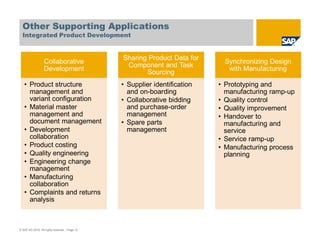
Other Supporting Applications
Integrated Product Development
© SAP AG 2010. All rights reserved. / Page 12
Collaborative
Development
• Product structure
management and
variant configuration
• Material master
management and
document management
• Development
collaboration
• Product costing
• Quality engineering
• Engineering change
management
• Manufacturing
collaboration
• Complaints and returns
analysis
Sharing Product Data for
Component and Task
Sourcing
• Supplier identification
and on-boarding
• Collaborative bidding
and purchase-order
management
• Spare parts
management
Synchronizing Design
with Manufacturing
• Prototyping and
manufacturing ramp-up
• Quality control
• Quality improvement
• Handover to
manufacturing and
service
• Service ramp-up
• Manufacturing process
planning
© SAP AG 2009. All rights reserved. / Page 13
1. Trends and Challenges
2. Investments in Manufacturing
1. Evolution of Manufacturing Software
2. Supporting Technological Developments
1. Data Mining in Manufacturing
2. RFID
3. In Memory
3. Road Map and Summary
Agenda
Creating Value From Increasing Access to
Granular Level Data
© SAP AG 2010. All rights reserved. / Page 14
n Engineering Design
n Engineering design is a multidisciplinary, multidimensional, and non-linear decision-making process where parameters,
actions, and components are selected. This selection is often based on historical data, information, and knowledge. It is
therefore a prime area for data mining applications
n Manufacturing Systems
n Data collection in manufacturing is common but its use tends to be limited to rather few applications. Machine learning
and computational intelligence tools provide excellent potential for better control of manufacturing systems, especially in
complex manufacturing environments where detection of the causes of problems is difficult
n Decision Support Systems
n Decisions are made based on a combination of judgment and knowledge from various domains. Decision support,
knowledge management, and processing are interdependent activities in many organizations. The knowledge extracted
from databases can be integrated with existing expert systems
n Shop Floor Control and Layout
n The shop floor control and layout problems are concerned with the efficient and effective utilization of resources, at the
lowest level of control in manufacturing. A vast amount of data is recorded during the operation of a shop floor, often to
ensure that parts and production steps can be traced
n Fault Detection and Quality Improvement
n Data mining can help in identifying the patterns that lead toward potential failure of manufacturing equipment. This
methodology helps in identifying not only the defective products but can also simultaneously determine the significant
factors that influence the success or failure of the process
n Data Mining in Maintenance
n Preventive maintenance is of key importance in process and manufacturing engineering. Databases containing the
events of failure of the machines and the behavior of the relevant equipment at the time of the failure can be used in the
design of the maintenance management systems
© SAP AG 2009. All rights reserved. / Page 15
1. Trends and Challenges
2. Investments in Manufacturing
1. Evolution of Manufacturing Software
1. Manufacturing Execution
2. Manufacturing Integration and Intelligence
3. Lean Planning and Optimization
4. Supply Chain Management
5. Product Lifecycle Management
2. Supporting Technological Developments
1. Data Mining in Manufacturing
2. RFID
3. In Memory
3. Road Map and Summary
Agenda
Why RFID in Manufacturing
© SAP AG 2010. All rights reserved. / Page 16
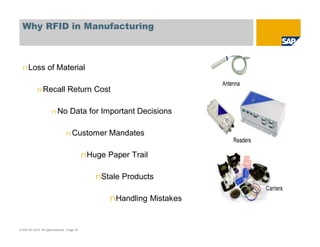
nLoss of Material
nRecall Return Cost
nNo Data for Important Decisions
nCustomer Mandates
nHuge Paper Trail
nStale Products
nHandling Mistakes
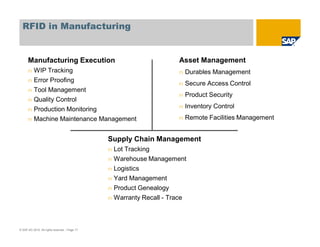
RFID in Manufacturing
Manufacturing Execution
n WIP Tracking
n Error Proofing
n Tool Management
n Quality Control
n Production Monitoring
n Machine Maintenance Management
© SAP AG 2010. All rights reserved. / Page 17
Asset Management
n Durables Management
n Secure Access Control
n Product Security
n Inventory Control
n Remote Facilities Management
Supply Chain Management
n Lot Tracking
n Warehouse Management
n Logistics
n Yard Management
n Product Genealogy
n Warranty Recall - Trace
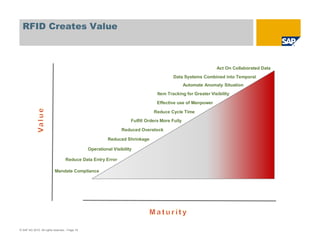
RFID Creates Value
© SAP AG 2010. All rights reserved. / Page 18
Mandate Compliance
Reduce Data Entry Error
Operational Visibility
Reduced Shrinkage
Reduced Overstock
Fulfill Orders More Fully
Reduce Cycle Time
Effective use of Manpower
Item Tracking for Greater Visibility
Automate Anomaly Situation
Data Systems Combined into Temporal
Act On Collaborated Data
© SAP AG 2009. All rights reserved. / Page 19
1. Trends and Challenges
2. Investments in Manufacturing
1. Evolution of Manufacturing Software
1. Manufacturing Execution
2. Manufacturing Integration and Intelligence
3. Lean Planning and Optimization
4. Supply Chain Management
5. Product Lifecycle Management
2. Supporting Technological Developments
1. Data Mining in Manufacturing
2. RFID
3. In Memory
3. Road Map and Summary
Agenda
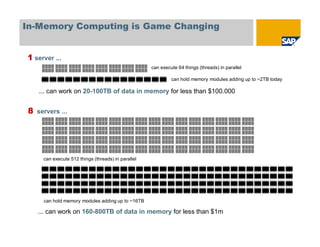
In-Memory Computing is Game Changing
1 server ...
can execute 64 things (threads) in parallel
A A A A A A A A A A A A A A A A can hold memory modules adding up to ~2TB today
8 servers ...
can execute 512 things (threads) in parallel
A A A A A A A A A A A A A A A A
can hold memory modules adding up to ~16TB
... can work on 160-800TB of data in memory for less than $1m
... can work on 20-100TB of data in memory for less than $100.000
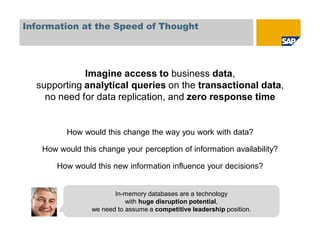
Information at the Speed of Thought
Imagine access to business data,
supporting analytical queries on the transactional data,
no need for data replication, and zero response time
How would this change the way you work with data?
How would this change your perception of information availability?
How would this new information influence your decisions?
In-memory databases are a technology
with huge disruption potential,
we need to assume a competitive leadership position.
In-memory databases are a technology
with huge disruption potential,
we need to assume a competitive leadership position.
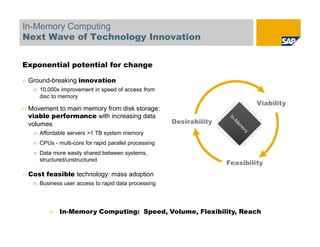
In-Memory Computing
Next Wave of Technology Innovation
Exponential potential for change
n Ground-breaking innovation
n 10,000x improvement in speed of access from
disc to memory
n Movement to main memory from disk storage:
viable performance with increasing data
volumes
n Affordable servers >1 TB system memory
n CPUs - multi-core for rapid parallel processing
n Data more easily shared between systems,
structured/unstructured
n Cost feasible technology: mass adoption
n Business user access to rapid data processing
è In-Memory Computing: Speed, Volume, Flexibility, Reach
Desirability
Viability
Feasibility
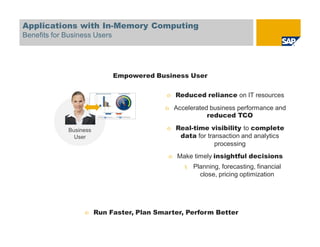
Applications with In-Memory Computing
Benefits for Business Users
Business
User
è Run Faster, Plan Smarter, Perform Better
Empowered Business User
è Reduced reliance on IT resources
è Accelerated business performance and
reduced TCO
è Real-time visibility to complete
data for transaction and analytics
processing
è Make timely insightful decisions
§ Planning, forecasting, financial
close, pricing optimization
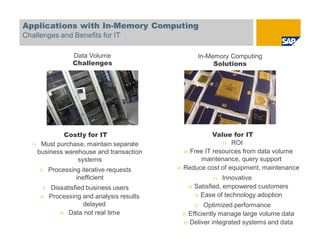
Applications with In-Memory Computing
Challenges and Benefits for IT
Data Volume
Challenges
In-Memory Computing
Solutions
Costly for IT
n Must purchase, maintain separate
business warehouse and transaction
systems
n Processing iterative requests
inefficient
¢ Dissatisfied business users
è Processing and analysis results
delayed
è Data not real time
Value for IT
n ROI
èFree IT resources from data volume
maintenance, query support
èReduce cost of equipment, maintenance
n Innovative
èSatisfied, empowered customers
èEase of technology adoption
n Optimized performance
èEfficiently manage large volume data
èDeliver integrated systems and data
© SAP AG 2009. All rights reserved. / Page 25
1. Trends and Challenges
2. Investments in Manufacturing
3. Road Map and Summary
Agenda
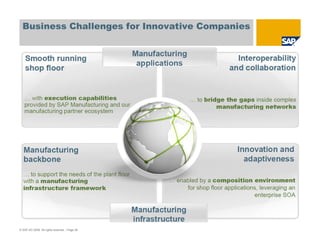
Business Challenges for Innovative Companies
© SAP AG 2009. All rights reserved. / Page 26
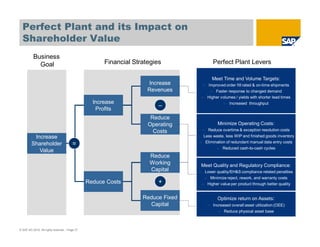
Perfect Plant and its Impact on
Shareholder Value
© SAP AG 2010. All rights reserved. / Page 27
Business
Goal Financial Strategies Perfect Plant Levers
Increase
Shareholder
Value
Increase
Profits
Reduce Costs
Increase
Revenues
Reduce
Operating
Costs
Reduce
Working
Capital
Reduce Fixed
Capital
–
+
=
Meet Time and Volume Targets:
n Improved order fill rated & on-time shipments
n Faster response to changed demand
n Higher volumes / yields with shorter lead times
n Increased throughput
Minimize Operating Costs:
n Reduce overtime & exception resolution costs
n Less waste, less WIP and finished goods inventory
n Elimination of redundant manual data entry costs
n Reduced cash-to-cash cycles
Meet Quality and Regulatory Compliance:
n Lower quality/EH&S compliance related penalties
n Minimize reject, rework, and warranty costs
n Higher value per product through better quality
Optimize return on Assets:
n Increased overall asset utilization (OEE)
n Reduce physical asset base
© SAP AG 2009. All rights reserved. / Page 28
Copyright 2010 SAP AG
All Rights Reserved
No part of this publication may be reproduced or transmitted in any form or for any purpose without the express permission of SAP AG. The information contained herein
may be changed without prior notice.
Some software products marketed by SAP AG and its distributors contain proprietary software components of other software vendors.
Microsoft, Windows, Excel, Outlook, and PowerPoint are registered trademarks of Microsoft Corporation.
IBM, DB2, DB2 Universal Database, System i, System i5, System p, System p5, System x, System z, System z10, System z9, z10, z9, iSeries, pSeries, xSeries, zSeries,
eServer, z/VM, z/OS, i5/OS, S/390, OS/390, OS/400, AS/400, S/390 Parallel Enterprise Server, PowerVM, Power Architecture, POWER6+, POWER6, POWER5+,
POWER5, POWER, OpenPower, PowerPC, BatchPipes, BladeCenter, System Storage, GPFS, HACMP, RETAIN, DB2 Connect, RACF, Redbooks, OS/2, Parallel Sysplex,
MVS/ESA, AIX, Intelligent Miner, WebSphere, Netfinity, Tivoli and Informix are trademarks or registered trademarks of IBM Corporation.
Linux is the registered trademark of Linus Torvalds in the U.S. and other countries.
Adobe, the Adobe logo, Acrobat, PostScript, and Reader are either trademarks or registered trademarks of Adobe Systems Incorporated in the United States and/or other
countries.
Oracle is a registered trademark of Oracle Corporation.
UNIX, X/Open, OSF/1, and Motif are registered trademarks of the Open Group.
Citrix, ICA, Program Neighborhood, MetaFrame, WinFrame, VideoFrame, and MultiWin are trademarks or registered trademarks of Citrix Systems, Inc.
HTML, XML, XHTML and W3C are trademarks or registered trademarks of W3C®, World Wide Web Consortium, Massachusetts Institute of Technology.
Java is a registered trademark of Sun Microsystems, Inc.
JavaScript is a registered trademark of Sun Microsystems, Inc., used under license for technology invented and implemented by Netscape.
SAP, R/3, SAP NetWeaver, Duet, PartnerEdge, ByDesign, SAP Business ByDesign, and other SAP products and services mentioned herein as well as their respective logos
are trademarks or registered trademarks of SAP AG in Germany and other countries.
Business Objects and the Business Objects logo, BusinessObjects, Crystal Reports, Crystal Decisions, Web Intelligence, Xcelsius, and other Business Objects products and
services mentioned herein as well as their respective logos are trademarks or registered trademarks of Business Objects S.A. in the United States and in other countries.
Business Objects is an SAP company.
All other product and service names mentioned are the trademarks of their respective companies. Data contained in this document serves informational purposes only.
National product specifications may vary.
These materials are subject to change without notice. These materials are provided by SAP AG and its affiliated companies ("SAP Group") for informational purposes only,
without representation or warranty of any kind, and SAP Group shall not be liable for errors or omissions with respect to the materials. The only warranties for SAP Group
products and services are those that are set forth in the express warranty statements accompanying such products and services, if any. Nothing herein should be construed
as constituting an additional warrant.

Latest_Trends_in_ERP___Manufacturing_v2

  • 1.
    Latest Trends inERP - A Manufacturing Perspective Trends, Challenges, Investments and Roadmap Debashis Majumder SAP India National Seminar on Leadership through Manufacturing Excellence, 02 September 2010, Kolkata
  • 2.
    © SAP AG2009. All rights reserved. / Page 2 1. Trends and Challenges 2. Investments in Manufacturing 3. Road Map and Summary Agenda
  • 3.
    Trends in Manufacturing ©SAP AG 2009. All rights reserved. / Page 3
  • 4.
    Flat World Dynamics ©SAP AG 2009. All rights reserved. / Page 4
  • 5.
    The Perfect Plant MasteringComplex Manufacturing Network Interdependencies © SAP AG 2009. All rights reserved. / Page 5
  • 6.
    The Perfect Plant Leveragesthe Synchronized Flow of Information with the Flow of Material © SAP AG 2009. All rights reserved. / Page 6
  • 7.
    Yesterday’s Manufacturing Solutions FallShort © SAP AG 2009. All rights reserved. / Page 7
  • 8.
    The Perfect Plant Engineering,Planning, and Execution Are Aligned © SAP AG 2009. All rights reserved. / Page 8
  • 9.
    © SAP AG2009. All rights reserved. / Page 9 1. Trends and Challenges 2. Investments in Manufacturing 1. Evolution of Manufacturing Software 2. Supporting Technological Developments 1. Data Mining in Manufacturing 2. RFID 3. In Memory 3. Road Map and Summary Agenda
  • 10.
    Manufacturing Software Evolution ©SAP AG 2010. All rights reserved. / Page 10 Manufacturing Execution •Business Processes and Software Functions •Improve Product quality and production •Speed up Throughput •Enable Preventative maintenance •Ensure Compliance •Flexible Production •Work-in-process engineering •Business Benefits •Improve control over manufacturing operations •Decrease costs and speed time to market •Meet highly specific and time-sensitive customer demands •Reduce compliance costs and risks Manufacturing Integration & Intelligence •Business Processes and Software Functions •Optimize Manufacturing asset utilization •Synchronized Business planning •Improved uptime and reliability •Business Benefits •Increased uptime •Greater product consistency •Lower costs •Optimized performance and reduced waste •Increased responsiveness to changing market Lean Planning and Optimization •Lean Planning •Pacemaker planning and heijunka scheduling •Material pull or kanban planning •Safety stock and buffers planning •Demand and collaborative planning •Lean Execution •Support different techniques for pull signal creation •Different flavors of kanban •Support for different replenishment flavors •RFID-enabled kanban •Manual and automatic supply to production •Operational method sheets •Production tracking and back flushing
  • 11.
    Other Supporting Applications SupplyChain Management © SAP AG 2010. All rights reserved. / Page 11 Planning • Features • Demand planning and forecasting • Safety stock planning • Supply network planning • Distribution planning • Strategic supply chain design • Key Benefits • Increase demand accuracy and order fulfillment satisfaction levels • Reduce inventory levels and increased inventory turns across the network • Increase profitability and productivity • Integrate sales and operations planning process Execution • Features • Order fulfillment • Procurement • Transportation • Warehousing • Real-world awareness • Key Benefits • Improved order, production, and execution tracking with RFID-enabled processes • Seamless integration and global visibility of different transportation process steps, and higher transparency • Improved warehouse efficiency and extend real-time visibility and control of warehouse operations • Reduced costs of goods sold throughout company Collaboration • Features • Suppliers Collaboration • Customers Collaboration • Contract Manufacturers Collaboration • Key Benefits • Streamline collaboration with suppliers, contract manufacturers, and customers • Significantly decrease procurement, sales, and inventory costs • Enhance supply chain visibility and increases adaptability of your supply network • Reduce inventory levels while managing variations in supply and demand • Improve communications and reduces errors and processing costs
  • 12.
    Other Supporting Applications IntegratedProduct Development © SAP AG 2010. All rights reserved. / Page 12 Collaborative Development • Product structure management and variant configuration • Material master management and document management • Development collaboration • Product costing • Quality engineering • Engineering change management • Manufacturing collaboration • Complaints and returns analysis Sharing Product Data for Component and Task Sourcing • Supplier identification and on-boarding • Collaborative bidding and purchase-order management • Spare parts management Synchronizing Design with Manufacturing • Prototyping and manufacturing ramp-up • Quality control • Quality improvement • Handover to manufacturing and service • Service ramp-up • Manufacturing process planning
  • 13.
    © SAP AG2009. All rights reserved. / Page 13 1. Trends and Challenges 2. Investments in Manufacturing 1. Evolution of Manufacturing Software 2. Supporting Technological Developments 1. Data Mining in Manufacturing 2. RFID 3. In Memory 3. Road Map and Summary Agenda
  • 14.
    Creating Value FromIncreasing Access to Granular Level Data © SAP AG 2010. All rights reserved. / Page 14 n Engineering Design n Engineering design is a multidisciplinary, multidimensional, and non-linear decision-making process where parameters, actions, and components are selected. This selection is often based on historical data, information, and knowledge. It is therefore a prime area for data mining applications n Manufacturing Systems n Data collection in manufacturing is common but its use tends to be limited to rather few applications. Machine learning and computational intelligence tools provide excellent potential for better control of manufacturing systems, especially in complex manufacturing environments where detection of the causes of problems is difficult n Decision Support Systems n Decisions are made based on a combination of judgment and knowledge from various domains. Decision support, knowledge management, and processing are interdependent activities in many organizations. The knowledge extracted from databases can be integrated with existing expert systems n Shop Floor Control and Layout n The shop floor control and layout problems are concerned with the efficient and effective utilization of resources, at the lowest level of control in manufacturing. A vast amount of data is recorded during the operation of a shop floor, often to ensure that parts and production steps can be traced n Fault Detection and Quality Improvement n Data mining can help in identifying the patterns that lead toward potential failure of manufacturing equipment. This methodology helps in identifying not only the defective products but can also simultaneously determine the significant factors that influence the success or failure of the process n Data Mining in Maintenance n Preventive maintenance is of key importance in process and manufacturing engineering. Databases containing the events of failure of the machines and the behavior of the relevant equipment at the time of the failure can be used in the design of the maintenance management systems
  • 15.
    © SAP AG2009. All rights reserved. / Page 15 1. Trends and Challenges 2. Investments in Manufacturing 1. Evolution of Manufacturing Software 1. Manufacturing Execution 2. Manufacturing Integration and Intelligence 3. Lean Planning and Optimization 4. Supply Chain Management 5. Product Lifecycle Management 2. Supporting Technological Developments 1. Data Mining in Manufacturing 2. RFID 3. In Memory 3. Road Map and Summary Agenda
  • 16.
    Why RFID inManufacturing © SAP AG 2010. All rights reserved. / Page 16 nLoss of Material nRecall Return Cost nNo Data for Important Decisions nCustomer Mandates nHuge Paper Trail nStale Products nHandling Mistakes
  • 17.
    RFID in Manufacturing ManufacturingExecution n WIP Tracking n Error Proofing n Tool Management n Quality Control n Production Monitoring n Machine Maintenance Management © SAP AG 2010. All rights reserved. / Page 17 Asset Management n Durables Management n Secure Access Control n Product Security n Inventory Control n Remote Facilities Management Supply Chain Management n Lot Tracking n Warehouse Management n Logistics n Yard Management n Product Genealogy n Warranty Recall - Trace
  • 18.
    RFID Creates Value ©SAP AG 2010. All rights reserved. / Page 18 Mandate Compliance Reduce Data Entry Error Operational Visibility Reduced Shrinkage Reduced Overstock Fulfill Orders More Fully Reduce Cycle Time Effective use of Manpower Item Tracking for Greater Visibility Automate Anomaly Situation Data Systems Combined into Temporal Act On Collaborated Data
  • 19.
    © SAP AG2009. All rights reserved. / Page 19 1. Trends and Challenges 2. Investments in Manufacturing 1. Evolution of Manufacturing Software 1. Manufacturing Execution 2. Manufacturing Integration and Intelligence 3. Lean Planning and Optimization 4. Supply Chain Management 5. Product Lifecycle Management 2. Supporting Technological Developments 1. Data Mining in Manufacturing 2. RFID 3. In Memory 3. Road Map and Summary Agenda
  • 20.
    In-Memory Computing isGame Changing 1 server ... can execute 64 things (threads) in parallel A A A A A A A A A A A A A A A A can hold memory modules adding up to ~2TB today 8 servers ... can execute 512 things (threads) in parallel A A A A A A A A A A A A A A A A A A A A A A A A A A A A A A A A A A A A A A A A A A A A A A A A A A A A A A A A A A A A A A A A A A A A A A A A A A A A A A A A A A A A A A A A A A A A A A A A A A A A A A A A A A A A A A A A A A A A A A A A A A A A A A A A can hold memory modules adding up to ~16TB ... can work on 160-800TB of data in memory for less than $1m ... can work on 20-100TB of data in memory for less than $100.000
  • 21.
    Information at theSpeed of Thought Imagine access to business data, supporting analytical queries on the transactional data, no need for data replication, and zero response time How would this change the way you work with data? How would this change your perception of information availability? How would this new information influence your decisions? In-memory databases are a technology with huge disruption potential, we need to assume a competitive leadership position. In-memory databases are a technology with huge disruption potential, we need to assume a competitive leadership position.
  • 22.
    In-Memory Computing Next Waveof Technology Innovation Exponential potential for change n Ground-breaking innovation n 10,000x improvement in speed of access from disc to memory n Movement to main memory from disk storage: viable performance with increasing data volumes n Affordable servers >1 TB system memory n CPUs - multi-core for rapid parallel processing n Data more easily shared between systems, structured/unstructured n Cost feasible technology: mass adoption n Business user access to rapid data processing è In-Memory Computing: Speed, Volume, Flexibility, Reach Desirability Viability Feasibility
  • 23.
    Applications with In-MemoryComputing Benefits for Business Users Business User è Run Faster, Plan Smarter, Perform Better Empowered Business User è Reduced reliance on IT resources è Accelerated business performance and reduced TCO è Real-time visibility to complete data for transaction and analytics processing è Make timely insightful decisions § Planning, forecasting, financial close, pricing optimization
  • 24.
    Applications with In-MemoryComputing Challenges and Benefits for IT Data Volume Challenges In-Memory Computing Solutions Costly for IT n Must purchase, maintain separate business warehouse and transaction systems n Processing iterative requests inefficient ¢ Dissatisfied business users è Processing and analysis results delayed è Data not real time Value for IT n ROI èFree IT resources from data volume maintenance, query support èReduce cost of equipment, maintenance n Innovative èSatisfied, empowered customers èEase of technology adoption n Optimized performance èEfficiently manage large volume data èDeliver integrated systems and data
  • 25.
    © SAP AG2009. All rights reserved. / Page 25 1. Trends and Challenges 2. Investments in Manufacturing 3. Road Map and Summary Agenda
  • 26.
    Business Challenges forInnovative Companies © SAP AG 2009. All rights reserved. / Page 26
  • 27.
    Perfect Plant andits Impact on Shareholder Value © SAP AG 2010. All rights reserved. / Page 27 Business Goal Financial Strategies Perfect Plant Levers Increase Shareholder Value Increase Profits Reduce Costs Increase Revenues Reduce Operating Costs Reduce Working Capital Reduce Fixed Capital – + = Meet Time and Volume Targets: n Improved order fill rated & on-time shipments n Faster response to changed demand n Higher volumes / yields with shorter lead times n Increased throughput Minimize Operating Costs: n Reduce overtime & exception resolution costs n Less waste, less WIP and finished goods inventory n Elimination of redundant manual data entry costs n Reduced cash-to-cash cycles Meet Quality and Regulatory Compliance: n Lower quality/EH&S compliance related penalties n Minimize reject, rework, and warranty costs n Higher value per product through better quality Optimize return on Assets: n Increased overall asset utilization (OEE) n Reduce physical asset base
  • 28.
    © SAP AG2009. All rights reserved. / Page 28 Copyright 2010 SAP AG All Rights Reserved No part of this publication may be reproduced or transmitted in any form or for any purpose without the express permission of SAP AG. The information contained herein may be changed without prior notice. Some software products marketed by SAP AG and its distributors contain proprietary software components of other software vendors. Microsoft, Windows, Excel, Outlook, and PowerPoint are registered trademarks of Microsoft Corporation. IBM, DB2, DB2 Universal Database, System i, System i5, System p, System p5, System x, System z, System z10, System z9, z10, z9, iSeries, pSeries, xSeries, zSeries, eServer, z/VM, z/OS, i5/OS, S/390, OS/390, OS/400, AS/400, S/390 Parallel Enterprise Server, PowerVM, Power Architecture, POWER6+, POWER6, POWER5+, POWER5, POWER, OpenPower, PowerPC, BatchPipes, BladeCenter, System Storage, GPFS, HACMP, RETAIN, DB2 Connect, RACF, Redbooks, OS/2, Parallel Sysplex, MVS/ESA, AIX, Intelligent Miner, WebSphere, Netfinity, Tivoli and Informix are trademarks or registered trademarks of IBM Corporation. Linux is the registered trademark of Linus Torvalds in the U.S. and other countries. Adobe, the Adobe logo, Acrobat, PostScript, and Reader are either trademarks or registered trademarks of Adobe Systems Incorporated in the United States and/or other countries. Oracle is a registered trademark of Oracle Corporation. UNIX, X/Open, OSF/1, and Motif are registered trademarks of the Open Group. Citrix, ICA, Program Neighborhood, MetaFrame, WinFrame, VideoFrame, and MultiWin are trademarks or registered trademarks of Citrix Systems, Inc. HTML, XML, XHTML and W3C are trademarks or registered trademarks of W3C®, World Wide Web Consortium, Massachusetts Institute of Technology. Java is a registered trademark of Sun Microsystems, Inc. JavaScript is a registered trademark of Sun Microsystems, Inc., used under license for technology invented and implemented by Netscape. SAP, R/3, SAP NetWeaver, Duet, PartnerEdge, ByDesign, SAP Business ByDesign, and other SAP products and services mentioned herein as well as their respective logos are trademarks or registered trademarks of SAP AG in Germany and other countries. Business Objects and the Business Objects logo, BusinessObjects, Crystal Reports, Crystal Decisions, Web Intelligence, Xcelsius, and other Business Objects products and services mentioned herein as well as their respective logos are trademarks or registered trademarks of Business Objects S.A. in the United States and in other countries. Business Objects is an SAP company. All other product and service names mentioned are the trademarks of their respective companies. Data contained in this document serves informational purposes only. National product specifications may vary. These materials are subject to change without notice. These materials are provided by SAP AG and its affiliated companies ("SAP Group") for informational purposes only, without representation or warranty of any kind, and SAP Group shall not be liable for errors or omissions with respect to the materials. The only warranties for SAP Group products and services are those that are set forth in the express warranty statements accompanying such products and services, if any. Nothing herein should be construed as constituting an additional warrant.