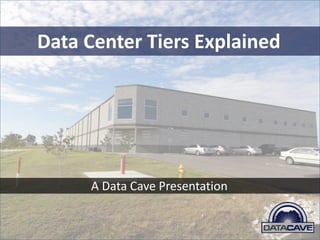
Data Center Tiers Explained
A Data Cave Presentation
Why do we
need Tiers?
Some background
Why do we have tiers? What do they indicate?
‱ With so many data centers of
varying sizes, a standard was
needed that could be used to
consistently identify a data
center’s overall capabilities
and level of service.
‱ The 4-Tier ranking system was
established in 2005 to be this
unique standard for the data
center industry.
The criteria for each of the 4 tiers
primarily focuses on a data
center’s:
‱ Infrastructure
‱ Levels of redundancy
‱ Promised uptime level
Breaking down
the 4 Tiers
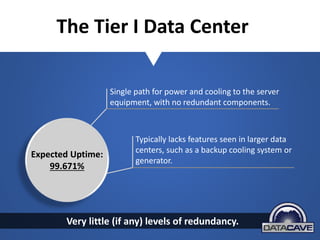
The Tier I Data Center
Expected Uptime:
99.671%
Single path for power and cooling to the server
equipment, with no redundant components.
Typically lacks features seen in larger data
centers, such as a backup cooling system or
generator.
Very little (if any) levels of redundancy.
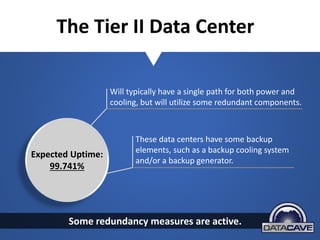
The Tier II Data Center
Expected Uptime:
99.741%
Will typically have a single path for both power and
cooling, but will utilize some redundant components.
These data centers have some backup
elements, such as a backup cooling system
and/or a backup generator.
Some redundancy measures are active.
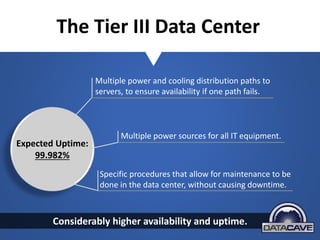
The Tier III Data Center
Expected Uptime:
99.982%
Multiple power and cooling distribution paths to
servers, to ensure availability if one path fails.
Multiple power sources for all IT equipment.
Considerably higher availability and uptime.
Specific procedures that allow for maintenance to be
done in the data center, without causing downtime.
The Tier IV Data Center
Expected Uptime:
99.995%
Fully meets all requirements for Tiers I-III.
Fully fault tolerant infrastructure; it can
function normally even in the event of 1 or
more equipment failures.
A truly maximum level of uptime.
Redundancy in everything: Multiple cooling units,
backup generators, power sources, chillers, etc.
What
Represents
Tier IV
What Tier IV Represents
A Tier IV ranking indicates that a data center can
maintain a truly maximum uptime level through its:
‱ Redundant components and supporting hardware
‱ Facility’s physical construction and security
‱ Fully fault tolerant infrastructure
‱ Internal processes/procedures
With uptime levels of 99.995%, a Tier IV data center could
experience up to 26 minutes of downtime annually.
Compare that to a Tier I data center: At 99.671% uptime, they can
see up to 1,729 minutes of downtime annually!
Fun fact:
Data Center Tiers Explained
For more data center insights, visit
us at www.thedatacave.com, and
check out our Blog! We write about
all kinds of useful tech topics.

Data Center Tiers Explained

  • 1.
    Data Center TiersExplained A Data Cave Presentation
  • 2.
  • 3.
    Some background Why dowe have tiers? What do they indicate? ‱ With so many data centers of varying sizes, a standard was needed that could be used to consistently identify a data center’s overall capabilities and level of service. ‱ The 4-Tier ranking system was established in 2005 to be this unique standard for the data center industry. The criteria for each of the 4 tiers primarily focuses on a data center’s: ‱ Infrastructure ‱ Levels of redundancy ‱ Promised uptime level
  • 4.
  • 5.
    The Tier IData Center Expected Uptime: 99.671% Single path for power and cooling to the server equipment, with no redundant components. Typically lacks features seen in larger data centers, such as a backup cooling system or generator. Very little (if any) levels of redundancy.
  • 6.
    The Tier IIData Center Expected Uptime: 99.741% Will typically have a single path for both power and cooling, but will utilize some redundant components. These data centers have some backup elements, such as a backup cooling system and/or a backup generator. Some redundancy measures are active.
  • 7.
    The Tier IIIData Center Expected Uptime: 99.982% Multiple power and cooling distribution paths to servers, to ensure availability if one path fails. Multiple power sources for all IT equipment. Considerably higher availability and uptime. Specific procedures that allow for maintenance to be done in the data center, without causing downtime.
  • 8.
    The Tier IVData Center Expected Uptime: 99.995% Fully meets all requirements for Tiers I-III. Fully fault tolerant infrastructure; it can function normally even in the event of 1 or more equipment failures. A truly maximum level of uptime. Redundancy in everything: Multiple cooling units, backup generators, power sources, chillers, etc.
  • 9.
  • 10.
    What Tier IVRepresents A Tier IV ranking indicates that a data center can maintain a truly maximum uptime level through its: ‱ Redundant components and supporting hardware ‱ Facility’s physical construction and security ‱ Fully fault tolerant infrastructure ‱ Internal processes/procedures
  • 11.
    With uptime levelsof 99.995%, a Tier IV data center could experience up to 26 minutes of downtime annually. Compare that to a Tier I data center: At 99.671% uptime, they can see up to 1,729 minutes of downtime annually! Fun fact:
  • 12.
    Data Center TiersExplained For more data center insights, visit us at www.thedatacave.com, and check out our Blog! We write about all kinds of useful tech topics.