01/30/17 Introduction 1
Introduction to DBMS
• Purpose of Database Systems
• View of Data
• Data Models
• Data Definition Language
• Data Manipulation Language
• Transaction Management
• Storage Management
• Database Administrator
• Database Users
• Overall System Structure
01/30/17 Introduction 2
Database Management System
(DMBS)
• Collection of interrelated data
• Set of programs to access the data
• DMBS contains information about a
particular enterprise
• DBMS provides an environment that it both
convenient and efficient to use
01/30/17 Introduction 3
Purpose of Database Systems
• Data redundancy and inconsistency
• Difficulty in accessing data
• Data isolation – multiple files and formats
• Integrity problems
• Atomicity of updates
• Concurrent access by multiple users
• Security problems
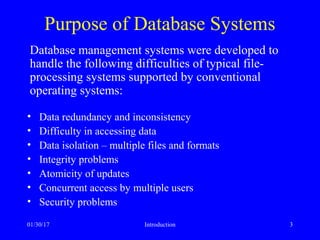
Database management systems were developed to
handle the following difficulties of typical file-
processing systems supported by conventional
operating systems:
01/30/17 Introduction 4
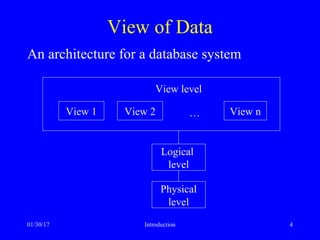
View of Data
An architecture for a database system
View 1
Physical
level
Logical
level
View 2 View n…
View level
01/30/17 Introduction 5
Levels of Abstraction
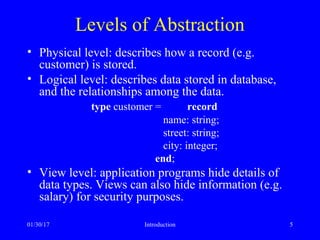
• Physical level: describes how a record (e.g.
customer) is stored.
• Logical level: describes data stored in database,
and the relationships among the data.
type customer = record
name: string;
street: string;
city: integer;
end;
• View level: application programs hide details of
data types. Views can also hide information (e.g.
salary) for security purposes.
01/30/17 Introduction 6
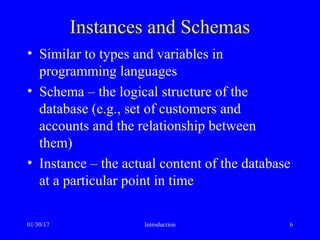
Instances and Schemas
• Similar to types and variables in
programming languages
• Schema – the logical structure of the
database (e.g., set of customers and
accounts and the relationship between
them)
• Instance – the actual content of the database
at a particular point in time
01/30/17 Introduction 7
Data Independence
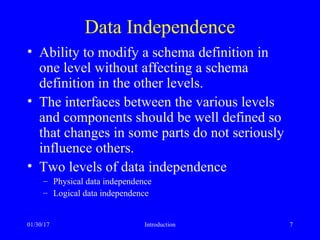
• Ability to modify a schema definition in
one level without affecting a schema
definition in the other levels.
• The interfaces between the various levels
and components should be well defined so
that changes in some parts do not seriously
influence others.
• Two levels of data independence
– Physical data independence
– Logical data independence
01/30/17 Introduction 8
Data Models
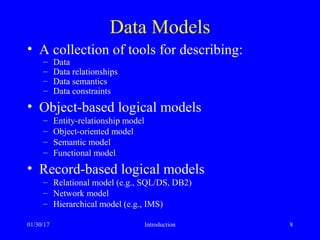
• A collection of tools for describing:
– Data
– Data relationships
– Data semantics
– Data constraints
• Object-based logical models
– Entity-relationship model
– Object-oriented model
– Semantic model
– Functional model
• Record-based logical models
– Relational model (e.g., SQL/DS, DB2)
– Network model
– Hierarchical model (e.g., IMS)
01/30/17 Introduction 9
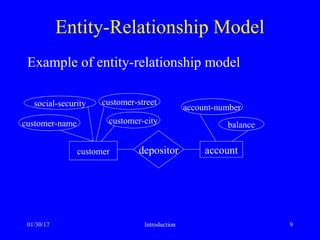
Entity-Relationship Model
Example of entity-relationship model
customer accountdepositor
social-security customer-street
customer-name
account-number
balancecustomer-city
01/30/17 Introduction 10
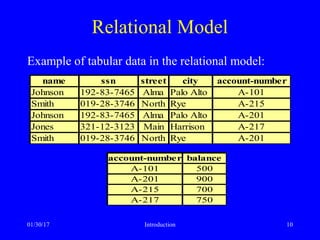
Relational Model
Example of tabular data in the relational model:
name ssn street city account-number
Johnson 192-83-7465 Alma Palo Alto A-101
Smith 019-28-3746 North Rye A-215
Johnson 192-83-7465 Alma Palo Alto A-201
Jones 321-12-3123 Main Harrison A-217
Smith 019-28-3746 North Rye A-201
account-number balance
A-101 500
A-201 900
A-215 700
A-217 750
01/30/17 Introduction 11
Data Definition Language (DDL)
• Specification notation for defining the database
schema
• DDL compiler generates a set of tables stored in a
data dictionary
• Data dictionary contains metadata (data about
data)
• Data storage and definition language – special
type of DDL in which the storage structure and
access methods used by the database system are
specified
01/30/17 Introduction 12
Data Manipulation Language (DML)
• Language for accessing and manipulating
the data organized by the appropriate data
model
• Two classes of languages
– Procedural – user specifies what data is
required and how to get those data
– Nonprocedural – user specifies what data is
required without specifying how to get those
data
01/30/17 Introduction 13
Transaction Management
• A transaction is a collection of operations that
performs a single logical function in a database
application.
• Transaction-management component ensures that
the database remains in a consistent (correct) state
despite system failures (e.g. power failures and
operating system crashes) and transaction failures.
• Concurrency-control manager controls the
interaction among the concurrent transactions, to
ensure the consistency of the database.
01/30/17 Introduction 14
Storage Management
• A storage manager is a program module that
provides the interface between the low-level data
stored in the database and the application
programs and queries submitted to the system.
• The storage manager is responsible for the
following tasks:
– Interaction with the file manager
– Efficient storing, retrieving, and updating of data
01/30/17 Introduction 15
Database Administrator
• Coordinates all the activities of the database system; the
database administrator has a good understanding of the
enterprise’s information resources and needs:
• Database administrator’s duties include:
– Schema definition
– Storage structure and access method definition
– Schema and physical organization modification
– Granting user authority to access the database
– Specifying integrity constraints
– Acting as liaison with users
– Monitoring performance and responding to changes in
requirements
01/30/17 Introduction 16
Database Users
• Users are differentiated by the way they
expect to interact with the system.
• Application programmers: interact with system
through DML calls.
• Specialized users: write specialized database
applications that do not fit into the traditional data
processing framework
• Sophisticated users: form requests in a database
query language.
• Naive users: invoke one of the permanent
application programs that have been written
previously
01/30/17 Introduction 17
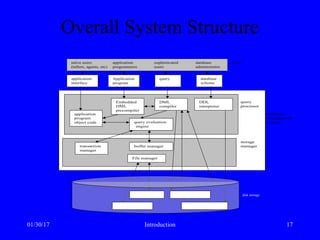
Overall System Structure
naïve users application sophisticated database
(tellers, agents, etc) programmers users administrator
application
interface
Application
program
query database
scheme
users
application
program
object code query evaluation
engine
Embedded
DML
precompiler
DML
compiler
DDL
interpreter
transaction
manager
buffer manager
query
processor
storage
manager
database-
management
system
File manager
indices Statistical data
Data files Data dictionary
disk storage

Data base management system (dbms)

  • 1.
    01/30/17 Introduction 1 Introductionto DBMS • Purpose of Database Systems • View of Data • Data Models • Data Definition Language • Data Manipulation Language • Transaction Management • Storage Management • Database Administrator • Database Users • Overall System Structure
  • 2.
    01/30/17 Introduction 2 DatabaseManagement System (DMBS) • Collection of interrelated data • Set of programs to access the data • DMBS contains information about a particular enterprise • DBMS provides an environment that it both convenient and efficient to use
  • 3.
    01/30/17 Introduction 3 Purposeof Database Systems • Data redundancy and inconsistency • Difficulty in accessing data • Data isolation – multiple files and formats • Integrity problems • Atomicity of updates • Concurrent access by multiple users • Security problems Database management systems were developed to handle the following difficulties of typical file- processing systems supported by conventional operating systems:
  • 4.
    01/30/17 Introduction 4 Viewof Data An architecture for a database system View 1 Physical level Logical level View 2 View n… View level
  • 5.
    01/30/17 Introduction 5 Levelsof Abstraction • Physical level: describes how a record (e.g. customer) is stored. • Logical level: describes data stored in database, and the relationships among the data. type customer = record name: string; street: string; city: integer; end; • View level: application programs hide details of data types. Views can also hide information (e.g. salary) for security purposes.
  • 6.
    01/30/17 Introduction 6 Instancesand Schemas • Similar to types and variables in programming languages • Schema – the logical structure of the database (e.g., set of customers and accounts and the relationship between them) • Instance – the actual content of the database at a particular point in time
  • 7.
    01/30/17 Introduction 7 DataIndependence • Ability to modify a schema definition in one level without affecting a schema definition in the other levels. • The interfaces between the various levels and components should be well defined so that changes in some parts do not seriously influence others. • Two levels of data independence – Physical data independence – Logical data independence
  • 8.
    01/30/17 Introduction 8 DataModels • A collection of tools for describing: – Data – Data relationships – Data semantics – Data constraints • Object-based logical models – Entity-relationship model – Object-oriented model – Semantic model – Functional model • Record-based logical models – Relational model (e.g., SQL/DS, DB2) – Network model – Hierarchical model (e.g., IMS)
  • 9.
    01/30/17 Introduction 9 Entity-RelationshipModel Example of entity-relationship model customer accountdepositor social-security customer-street customer-name account-number balancecustomer-city
  • 10.
    01/30/17 Introduction 10 RelationalModel Example of tabular data in the relational model: name ssn street city account-number Johnson 192-83-7465 Alma Palo Alto A-101 Smith 019-28-3746 North Rye A-215 Johnson 192-83-7465 Alma Palo Alto A-201 Jones 321-12-3123 Main Harrison A-217 Smith 019-28-3746 North Rye A-201 account-number balance A-101 500 A-201 900 A-215 700 A-217 750
  • 11.
    01/30/17 Introduction 11 DataDefinition Language (DDL) • Specification notation for defining the database schema • DDL compiler generates a set of tables stored in a data dictionary • Data dictionary contains metadata (data about data) • Data storage and definition language – special type of DDL in which the storage structure and access methods used by the database system are specified
  • 12.
    01/30/17 Introduction 12 DataManipulation Language (DML) • Language for accessing and manipulating the data organized by the appropriate data model • Two classes of languages – Procedural – user specifies what data is required and how to get those data – Nonprocedural – user specifies what data is required without specifying how to get those data
  • 13.
    01/30/17 Introduction 13 TransactionManagement • A transaction is a collection of operations that performs a single logical function in a database application. • Transaction-management component ensures that the database remains in a consistent (correct) state despite system failures (e.g. power failures and operating system crashes) and transaction failures. • Concurrency-control manager controls the interaction among the concurrent transactions, to ensure the consistency of the database.
  • 14.
    01/30/17 Introduction 14 StorageManagement • A storage manager is a program module that provides the interface between the low-level data stored in the database and the application programs and queries submitted to the system. • The storage manager is responsible for the following tasks: – Interaction with the file manager – Efficient storing, retrieving, and updating of data
  • 15.
    01/30/17 Introduction 15 DatabaseAdministrator • Coordinates all the activities of the database system; the database administrator has a good understanding of the enterprise’s information resources and needs: • Database administrator’s duties include: – Schema definition – Storage structure and access method definition – Schema and physical organization modification – Granting user authority to access the database – Specifying integrity constraints – Acting as liaison with users – Monitoring performance and responding to changes in requirements
  • 16.
    01/30/17 Introduction 16 DatabaseUsers • Users are differentiated by the way they expect to interact with the system. • Application programmers: interact with system through DML calls. • Specialized users: write specialized database applications that do not fit into the traditional data processing framework • Sophisticated users: form requests in a database query language. • Naive users: invoke one of the permanent application programs that have been written previously
  • 17.
    01/30/17 Introduction 17 OverallSystem Structure naïve users application sophisticated database (tellers, agents, etc) programmers users administrator application interface Application program query database scheme users application program object code query evaluation engine Embedded DML precompiler DML compiler DDL interpreter transaction manager buffer manager query processor storage manager database- management system File manager indices Statistical data Data files Data dictionary disk storage