Dash7 Alliance Protocol
ISO/IEC 18000-7
The Dash7 Alliance Protocol is based on the ISO/IEC 18000-7

ISO/IEC 18000 is an international standard that describes a series
of diverse RFID technologies, each utilizing a unique frequency
range.
ISO/IEC 18000-7 describes the parameters for active air interface
communications at 433 MHz (2008 - 2009)

DASH7 Alliance Protocol

2
DASH7 Alliance Protocol
Active RFID Standard for 433 MHz.
•
•
•
•

Build on top of asynchronous WSN MAC.
High level functionality optimized for RFID.
Defines full functional RFID tag.
Can be extended to non RFID applications.

Supports Tag to Tag communication.
DASH7 Alliance Protocol is designed to support fixed and mobile nodes
that need to upload or retrieve small chunks of information

DASH7 Alliance Protocol

3
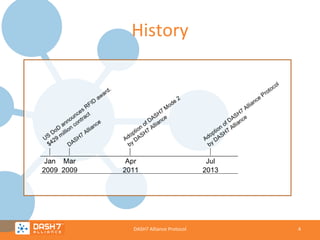
History

DASH7 Alliance Protocol

4
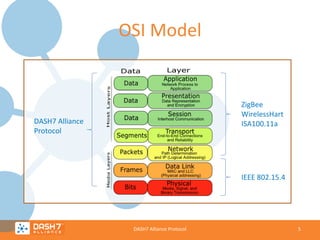
OSI Model

ZigBee
WirelessHart
ISA100.11a

DASH7 Alliance
Protocol

IEEE 802.15.4

DASH7 Alliance Protocol

5
Wireless Available Solutions

DASH7 Alliance Protocol

6
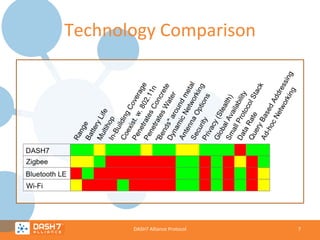
Technology Comparison

DASH7 Alliance Protocol

7
Node Types

Transmit

Receive

Complete
Feature set

Blinker

X

X

Subcontroller

X

X

X

Gateway

X

X

X

Always-on
Receive

X

Endpoint

Wake-on
Scan Cycle

DASH7 Alliance Protocol

X
X
X

8
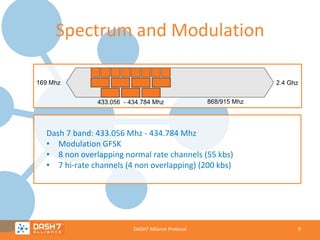
Spectrum and Modulation

Dash 7 band: 433.056 Mhz - 434.784 Mhz
• Modulation GFSK
• 8 non overlapping normal rate channels (55 kbs)
• 7 hi-rate channels (4 non overlapping) (200 kbs)

DASH7 Alliance Protocol

9
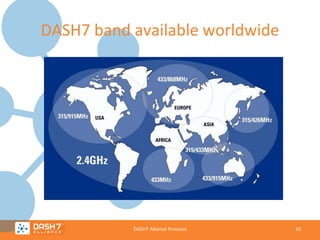
DASH7 band available worldwide

DASH7 Alliance Protocol

10
433MHz band regulations
Unlicensed ISM/SRD bands
USA/Canada
• 260-470 MHz (FCC Part 15.231; 15.205)

Europe:
• 433.050 - 434.790 MHz (ETSI EN 300 220)

DASH7 Alliance Protocol

11
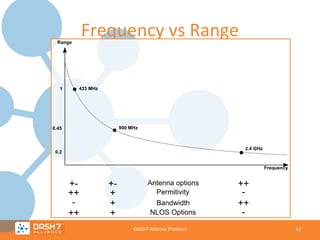
Frequency vs Range

DASH7 Alliance Protocol

12
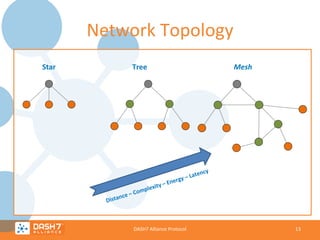
Network Topology
Star

Tree

DASH7 Alliance Protocol

Mesh

13
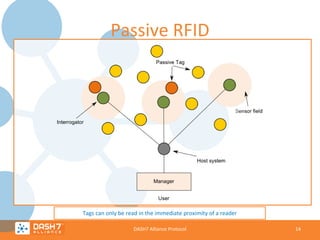
Passive RFID

Tags can only be read in the immediate proximity of a reader
DASH7 Alliance Protocol

14
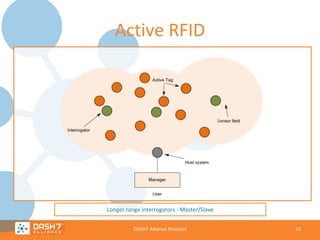
Active RFID

Longer range interrogators - Master/Slave
DASH7 Alliance Protocol

15
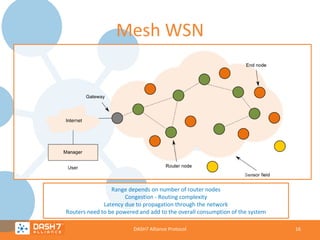
Mesh WSN

Range depends on number of router nodes
Congestion - Routing complexity
Latency due to propagation through the network
Routers need to be powered and add to the overall consumption of the system
DASH7 Alliance Protocol

16
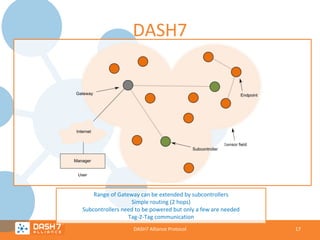
DASH7

Range of Gateway can be extended by subcontrollers
Simple routing (2 hops)
Subcontrollers need to be powered but only a few are needed
Tag-2-Tag communication
DASH7 Alliance Protocol

17
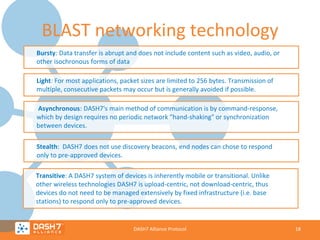
BLAST networking technology
Bursty: Data transfer is abrupt and does not include content such as video, audio, or
other isochronous forms of data
Light: For most applications, packet sizes are limited to 256 bytes. Transmission of
multiple, consecutive packets may occur but is generally avoided if possible.
Asynchronous: DASH7's main method of communication is by command-response,
which by design requires no periodic network "hand-shaking" or synchronization
between devices.
Stealth: DASH7 does not use discovery beacons, end nodes can chose to respond
only to pre-approved devices.
Transitive: A DASH7 system of devices is inherently mobile or transitional. Unlike
other wireless technologies DASH7 is upload-centric, not download-centric, thus
devices do not need to be managed extensively by fixed infrastructure (i.e. base
stations) to respond only to pre-approved devices.

DASH7 Alliance Protocol

18
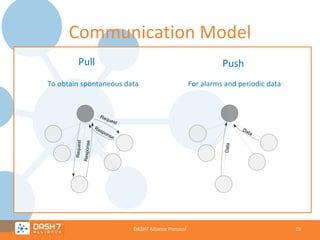
Communication Model
Pull

Push

To obtain spontaneous data

DASH7 Alliance Protocol

For alarms and periodic data

19
Asynchronous communication
DASH7 supports asynchronous communication using the
advertisement protocol

DASH7 Alliance Protocol

20
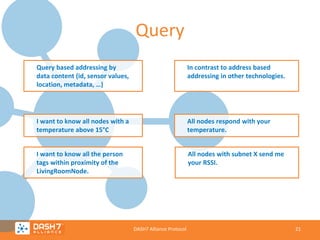
Query
Query based addressing by
data content (id, sensor values,
location, metadata, …)

In contrast to address based
addressing in other technologies.

I want to know all nodes with a
temperature above 15°C

All nodes respond with your
temperature.

I want to know all the person
tags within proximity of the
LivingRoomNode.

All nodes with subnet X send me
your RSSI.

DASH7 Alliance Protocol

21
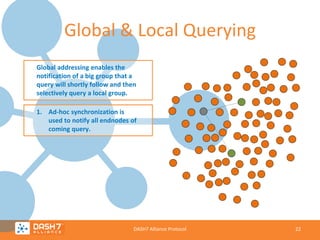
Global & Local Querying
Global addressing enables the
notification of a big group that a
query will shortly follow and then
selectively query a local group.
1. Ad-hoc synchronization is
used to notify all endnodes of
coming query.

DASH7 Alliance Protocol

22
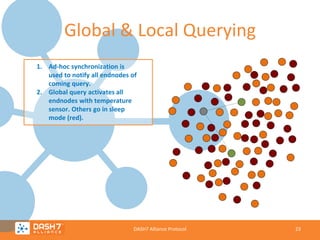
Global & Local Querying
1. Ad-hoc synchronization is
used to notify all endnodes of
coming query.
2. Global query activates all
endnodes with temperature
sensor. Others go in sleep
mode (red).

DASH7 Alliance Protocol

23
Global & Local Querying
1. Ad-hoc synchronization is
used to notify all endnodes of
coming query.
2. Global query activates all
endnodes with temperature
sensor. Others go in sleep
mode (red).
3. Local query asks response of
all endnodes with T > 25°
(yellow). Other go in sleep
mode till next local query
period (orange).

DASH7 Alliance Protocol

24
Global & Local Querying
1. Ad-hoc synchronization is
used to notify all endnodes of
coming query.
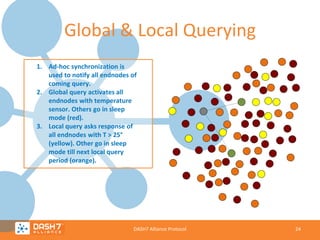
2. Global query activates all
endnodes with temperature
sensor. Others go in sleep
mode (red).
3. Local query asks response of
all endnodes with T > 25°
(yellow). Other go in sleep
mode till next local query
period (orange).
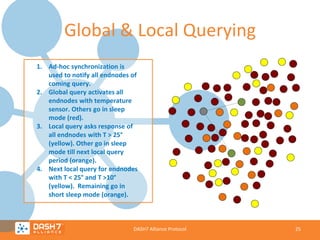
4. Next local query for endnodes
with T < 25° and T >10°
(yellow). Remaining go in
short sleep mode (orange).

DASH7 Alliance Protocol

25
Global & Local Querying
1. Ad-hoc synchronization is
used to notify all endnodes of
coming query.
2. Global query activates all
endnodes with temperature
sensor. Others go in sleep
mode (red).
3. Local query asks response of
all endnodes with T > 25°
(yellow). Other go in sleep
mode till next local query
period (orange).
4. Next local query for endnodes
with T < 25° and T >10°
(yellow). Remaining go in
short sleep mode (orange).
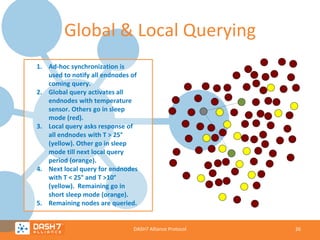
5. Remaining nodes are queried.

DASH7 Alliance Protocol

26
Tag to Tag communication
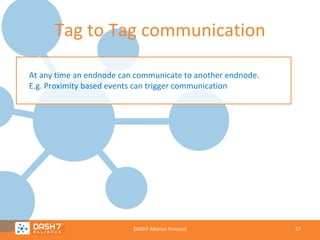
At any time an endnode can communicate to another endnode.
E.g. Proximity based events can trigger communication

DASH7 Alliance Protocol

27
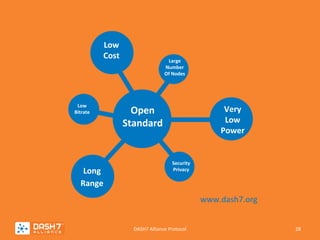
Low
Cost

Low
Bitrate

Long
Range

Large
Number
Of Nodes

Very
Low
Power

Open
Standard

Security
Privacy

www.dash7.org

DASH7 Alliance Protocol

28

DASH7 Alliance Protocol Technical Presentation

  • 1.
  • 2.
    ISO/IEC 18000-7 The Dash7Alliance Protocol is based on the ISO/IEC 18000-7 ISO/IEC 18000 is an international standard that describes a series of diverse RFID technologies, each utilizing a unique frequency range. ISO/IEC 18000-7 describes the parameters for active air interface communications at 433 MHz (2008 - 2009) DASH7 Alliance Protocol 2
  • 3.
    DASH7 Alliance Protocol ActiveRFID Standard for 433 MHz. • • • • Build on top of asynchronous WSN MAC. High level functionality optimized for RFID. Defines full functional RFID tag. Can be extended to non RFID applications. Supports Tag to Tag communication. DASH7 Alliance Protocol is designed to support fixed and mobile nodes that need to upload or retrieve small chunks of information DASH7 Alliance Protocol 3
  • 4.
  • 5.
  • 6.
  • 7.
  • 8.
  • 9.
    Spectrum and Modulation Dash7 band: 433.056 Mhz - 434.784 Mhz • Modulation GFSK • 8 non overlapping normal rate channels (55 kbs) • 7 hi-rate channels (4 non overlapping) (200 kbs) DASH7 Alliance Protocol 9
  • 10.
    DASH7 band availableworldwide DASH7 Alliance Protocol 10
  • 11.
    433MHz band regulations UnlicensedISM/SRD bands USA/Canada • 260-470 MHz (FCC Part 15.231; 15.205) Europe: • 433.050 - 434.790 MHz (ETSI EN 300 220) DASH7 Alliance Protocol 11
  • 12.
    Frequency vs Range DASH7Alliance Protocol 12
  • 13.
  • 14.
    Passive RFID Tags canonly be read in the immediate proximity of a reader DASH7 Alliance Protocol 14
  • 15.
    Active RFID Longer rangeinterrogators - Master/Slave DASH7 Alliance Protocol 15
  • 16.
    Mesh WSN Range dependson number of router nodes Congestion - Routing complexity Latency due to propagation through the network Routers need to be powered and add to the overall consumption of the system DASH7 Alliance Protocol 16
  • 17.
    DASH7 Range of Gatewaycan be extended by subcontrollers Simple routing (2 hops) Subcontrollers need to be powered but only a few are needed Tag-2-Tag communication DASH7 Alliance Protocol 17
  • 18.
    BLAST networking technology Bursty:Data transfer is abrupt and does not include content such as video, audio, or other isochronous forms of data Light: For most applications, packet sizes are limited to 256 bytes. Transmission of multiple, consecutive packets may occur but is generally avoided if possible. Asynchronous: DASH7's main method of communication is by command-response, which by design requires no periodic network "hand-shaking" or synchronization between devices. Stealth: DASH7 does not use discovery beacons, end nodes can chose to respond only to pre-approved devices. Transitive: A DASH7 system of devices is inherently mobile or transitional. Unlike other wireless technologies DASH7 is upload-centric, not download-centric, thus devices do not need to be managed extensively by fixed infrastructure (i.e. base stations) to respond only to pre-approved devices. DASH7 Alliance Protocol 18
  • 19.
    Communication Model Pull Push To obtainspontaneous data DASH7 Alliance Protocol For alarms and periodic data 19
  • 20.
    Asynchronous communication DASH7 supportsasynchronous communication using the advertisement protocol DASH7 Alliance Protocol 20
  • 21.
    Query Query based addressingby data content (id, sensor values, location, metadata, …) In contrast to address based addressing in other technologies. I want to know all nodes with a temperature above 15°C All nodes respond with your temperature. I want to know all the person tags within proximity of the LivingRoomNode. All nodes with subnet X send me your RSSI. DASH7 Alliance Protocol 21
  • 22.
    Global & LocalQuerying Global addressing enables the notification of a big group that a query will shortly follow and then selectively query a local group. 1. Ad-hoc synchronization is used to notify all endnodes of coming query. DASH7 Alliance Protocol 22
  • 23.
    Global & LocalQuerying 1. Ad-hoc synchronization is used to notify all endnodes of coming query. 2. Global query activates all endnodes with temperature sensor. Others go in sleep mode (red). DASH7 Alliance Protocol 23
  • 24.
    Global & LocalQuerying 1. Ad-hoc synchronization is used to notify all endnodes of coming query. 2. Global query activates all endnodes with temperature sensor. Others go in sleep mode (red). 3. Local query asks response of all endnodes with T > 25° (yellow). Other go in sleep mode till next local query period (orange). DASH7 Alliance Protocol 24
  • 25.
    Global & LocalQuerying 1. Ad-hoc synchronization is used to notify all endnodes of coming query. 2. Global query activates all endnodes with temperature sensor. Others go in sleep mode (red). 3. Local query asks response of all endnodes with T > 25° (yellow). Other go in sleep mode till next local query period (orange). 4. Next local query for endnodes with T < 25° and T >10° (yellow). Remaining go in short sleep mode (orange). DASH7 Alliance Protocol 25
  • 26.
    Global & LocalQuerying 1. Ad-hoc synchronization is used to notify all endnodes of coming query. 2. Global query activates all endnodes with temperature sensor. Others go in sleep mode (red). 3. Local query asks response of all endnodes with T > 25° (yellow). Other go in sleep mode till next local query period (orange). 4. Next local query for endnodes with T < 25° and T >10° (yellow). Remaining go in short sleep mode (orange). 5. Remaining nodes are queried. DASH7 Alliance Protocol 26
  • 27.
    Tag to Tagcommunication At any time an endnode can communicate to another endnode. E.g. Proximity based events can trigger communication DASH7 Alliance Protocol 27
  • 28.