Assessing and Promoting
Assessingand Promoting
Better Sleep in Elders
Better Sleep in Elders
Joe Lasek, MD
Joe Lasek, MD
Medical Director, Counseling Service of Addison
Medical Director, Counseling Service of Addison
County
County
Clinical Assistant Professor, UVM College of Medicine
Clinical Assistant Professor, UVM College of Medicine
2.
Objectives
Objectives
• Briefly reviewepidemiology of sleep
Briefly review epidemiology of sleep
problems in the elderly
problems in the elderly
• Review sleep changes in elderly
Review sleep changes in elderly
• Briefly review insomnia evaluation
Briefly review insomnia evaluation
• Briefly review pharmacologic
Briefly review pharmacologic
interventions for insomnia in the elderly
interventions for insomnia in the elderly
• Review non-pharmacologic
Review non-pharmacologic
interventions for insomnia in the elderly
interventions for insomnia in the elderly
3.
Epidemiology of SleepProblems
Epidemiology of Sleep Problems
for Elders
for Elders
• Up to 80% of elderly report sleep changes
Up to 80% of elderly report sleep changes
(increases as a function of age, higher in
(increases as a function of age, higher in
institutional settings)
institutional settings)
• When defined as diff falling or staying asleep
When defined as diff falling or staying asleep
or non restorative: 60-90% report problems
or non restorative: 60-90% report problems
• When defined more strictly, i.e. chronic
When defined more strictly, i.e. chronic
insomnia that causes distress or impairment:
insomnia that causes distress or impairment:
12-20%
12-20%
• 6-29% report hypersomnia
6-29% report hypersomnia
• Women report more sleep problems than men
Women report more sleep problems than men
(lower melatonin levels, >vasomotor sx)
(lower melatonin levels, >vasomotor sx)
4.
Impact of Insomniain the
Impact of Insomnia in the
Elder Population
Elder Population
• Independent predictor of:
Independent predictor of:
– Cognitive decline (effect bidirectional:
Cognitive decline (effect bidirectional:
cognitive decline predicts worsening sleep)
cognitive decline predicts worsening sleep)
– Falls
Falls
– Increased 2 year mortality
Increased 2 year mortality
• Significant contributor to caregiver
Significant contributor to caregiver
burden, often a reason for
burden, often a reason for
institutionalization
institutionalization
5.
Risk Factors forDeveloping
Risk Factors for Developing
Dementia
Dementia
• Daytime sleepiness
Daytime sleepiness
• Restless sleep
Restless sleep
• Increased use of sleep medication
Increased use of sleep medication
• Sleep problems may be the single
Sleep problems may be the single
strongest predictor of Alzheimer’s
strongest predictor of Alzheimer’s
• Also predictive of Parkinson’s and
Also predictive of Parkinson’s and
Huntington’s
Huntington’s
6.
Types of Insomnia
Typesof Insomnia
• Primary Insomnia (minority of cases)
Primary Insomnia (minority of cases)
• Adjustment Insomnia (due to stress)
Adjustment Insomnia (due to stress)
• Inadequate Sleep Hygiene
Inadequate Sleep Hygiene
• Insomnia due to a Drug or Substance
Insomnia due to a Drug or Substance
• Insomnia due to a Psychiatric Disorder
Insomnia due to a Psychiatric Disorder
• Insomnia due to a Medical Condition
Insomnia due to a Medical Condition
– Pain Disorders
Pain Disorders
– Ocular Disorders: Macular degeneration/
Ocular Disorders: Macular degeneration/
cataracts/diabetes
cataracts/diabetes
7.
Primary Sleep Disorders
PrimarySleep Disorders
• All of the following more common with age
All of the following more common with age
• All impact sleep and have specific
All impact sleep and have specific
treatment
treatment
• Obstructive Sleep Apnea (OSA)
Obstructive Sleep Apnea (OSA)
• Restless Leg Syndrome (RLS)
Restless Leg Syndrome (RLS)
• Periodic Limb Movements of Sleep (PLMS)
Periodic Limb Movements of Sleep (PLMS)
• REM Sleep Behavior Disorder (RSBD)
REM Sleep Behavior Disorder (RSBD)
8.
Dementia and ObstructiveSleep
Dementia and Obstructive Sleep
Apnea (OSA)
Apnea (OSA)
• Prevalence of OSA in dementia: 33%-70%
Prevalence of OSA in dementia: 33%-70%
• 90% of patients with mod-severe Alzheimer’s
90% of patients with mod-severe Alzheimer’s
have >5 apneic events/hr
have >5 apneic events/hr
• OSA increases risk of dementia and vice versa
OSA increases risk of dementia and vice versa
• Persistent hypoxia (low oxygen) from apnea
Persistent hypoxia (low oxygen) from apnea
intensifies cognitive/mood symptoms (less
intensifies cognitive/mood symptoms (less
effective clearance of B-amyloid?)
effective clearance of B-amyloid?)
• Increased cardio-pulmonary disease
Increased cardio-pulmonary disease
• Treatment: CPAP, dental appliance, surgery
Treatment: CPAP, dental appliance, surgery
9.
Sleep Changes asWe Age
Sleep Changes as We Age
• Advanced sleep phase (“Early to bed,
Advanced sleep phase (“Early to bed,
early to rise”)
early to rise”)
• Longer time to sleep
Longer time to sleep
• Increasingly fragmented sleep
Increasingly fragmented sleep
• Decreased sleep efficiency (more time
Decreased sleep efficiency (more time
awake in bed)
awake in bed)
• Decreased slow wave (restorative) sleep
Decreased slow wave (restorative) sleep
& decreased REM sleep
& decreased REM sleep
10.
Neurobiology of Sleep
Neurobiologyof Sleep
Changes
Changes
• Circadian rhythm changes (sleep phase shifts
Circadian rhythm changes (sleep phase shifts
earlier bc of earlier melatonin production)
earlier bc of earlier melatonin production)
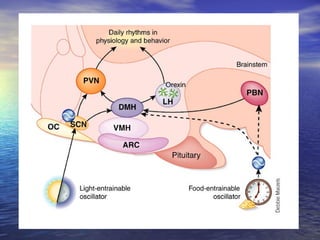
• Decreased neuron activity in supra-chiasmatic
Decreased neuron activity in supra-chiasmatic
nucleus (SCN)- central circadian pacemaker
nucleus (SCN)- central circadian pacemaker
(decreased variability in core temperature)
(decreased variability in core temperature)
• Decreased pineal gland-SCN connections
Decreased pineal gland-SCN connections
• Decreased light transmission (pupils smaller,
Decreased light transmission (pupils smaller,
lenses cloudier, decreased retina receptors)
lenses cloudier, decreased retina receptors)
• Decreased pineal gland melatonin production
Decreased pineal gland melatonin production
12.
Sleep Problems inDementia
Sleep Problems in Dementia
• Progressively decreased REM & slow wave sleep
Progressively decreased REM & slow wave sleep
• Decreased efficiency: 40% of time in bed may be
Decreased efficiency: 40% of time in bed may be
spent awake
spent awake
• Daytime sleepiness
Daytime sleepiness
• Nighttime confusion/agitation (sundowning)
Nighttime confusion/agitation (sundowning)
• Nighttime waking/wandering (rated most
Nighttime waking/wandering (rated most
distressing symptom by caregivers)
distressing symptom by caregivers)
• Irregular Sleep Wake Disorder (ISWD): normal
Irregular Sleep Wake Disorder (ISWD): normal
amount of sleep dispersed in 3 or more variable
amount of sleep dispersed in 3 or more variable
periods through out day
periods through out day
13.
Neurobiology of insomniain
Neurobiology of insomnia in
dementia
dementia
• Progressive damage to Supra
Progressive damage to Supra
Chiasmatic Nucleus & SCN-pineal gland
Chiasmatic Nucleus & SCN-pineal gland
pathways (greater melatonin decrease)
pathways (greater melatonin decrease)
• Progressive damage to basal forebrain
Progressive damage to basal forebrain
and reticular formation in brainstem
and reticular formation in brainstem
(part of central circadian rhythm
(part of central circadian rhythm
pacemaker)
pacemaker)
Medications Can Cause
MedicationsCan Cause
Insomnia
Insomnia
• Any med can cause SEs & worsen sleep
Any med can cause SEs & worsen sleep
• Antidepressants (prozac, zoloft, effexor,
Antidepressants (prozac, zoloft, effexor,
cymbalta, wellbutrin)
cymbalta, wellbutrin)
• Beta-blockers (propranolol, atenolol, metoprolol)
Beta-blockers (propranolol, atenolol, metoprolol)
• Bronchodilators (albuterol)
Bronchodilators (albuterol)
• Pro-Cholinergics (aricept)
Pro-Cholinergics (aricept)
• Corticosteroids (prednisone)
Corticosteroids (prednisone)
• Diuretics (lasix, hydrochlorothiazide)
Diuretics (lasix, hydrochlorothiazide)
• Stimulants/decongestants (amphetamine,
Stimulants/decongestants (amphetamine,
pseudophedrine)
pseudophedrine)
16.
Delirium: get helpquick!
Delirium: get help quick!
• Sudden change in mental status
Sudden change in mental status
• Confusion (disorientation) about time or place
Confusion (disorientation) about time or place
• Changes in alertness, level of consciousness (usually
Changes in alertness, level of consciousness (usually
more alert in the morning, less alert at night)
more alert in the morning, less alert at night)
• Changes in sleep patterns, drowsiness
Changes in sleep patterns, drowsiness
• Changes in attention, memory; disorganized thought
Changes in attention, memory; disorganized thought
• Perceptual disturbances (visual, tactile > auditory)
Perceptual disturbances (visual, tactile > auditory)
• Emotional or personality changes (increased paranoia)
Emotional or personality changes (increased paranoia)
• Changes in movement (either slowed or hyperactive)
Changes in movement (either slowed or hyperactive)
• Treatment: Always due to a medical condition
Treatment: Always due to a medical condition
requiring emergent medical treatment
requiring emergent medical treatment
17.
Depression, Sleep &Cognition
Depression, Sleep & Cognition
• Mood affected by sleep and sleep/cognition
Mood affected by sleep and sleep/cognition
worsen with depressed mood
worsen with depressed mood
• MDD occurs in 4% of elders (dep sx occur in
MDD occurs in 4% of elders (dep sx occur in
up to 16% of elderly) and up to 18% of those
up to 16% of elderly) and up to 18% of those
with Alzheimer’s
with Alzheimer’s
• Non-depressed elders with insomnia have up
Non-depressed elders with insomnia have up
to 2x risk of developing depression (though
to 2x risk of developing depression (though
only study with objective measures showed
only study with objective measures showed
no relationship)
no relationship)
18.
Depression, Sleep &Cognition
Depression, Sleep & Cognition
• Studies show that circadian rhythm &
Studies show that circadian rhythm &
sleep disrupted in those with depression
sleep disrupted in those with depression
– Delayed sleep onset
Delayed sleep onset
– Early morning awakening
Early morning awakening
– Decreased slow wave sleep
Decreased slow wave sleep
– Decreased REM latency (unique to
Decreased REM latency (unique to
depression)
depression)
• Better sleep quality post-treatment
Better sleep quality post-treatment
associated with lower relapse
associated with lower relapse
Evaluating Insomnia
Evaluating Insomnia
•Quantity of sleep alone does not
Quantity of sleep alone does not
constitute insomnia
constitute insomnia
• DSM-IV diagnosis for primary insomnia is
DSM-IV diagnosis for primary insomnia is
a subjective clinical diagnosis
a subjective clinical diagnosis
• Ideally, diagnosis would be subjective and
Ideally, diagnosis would be subjective and
objective
objective
• Referral for a sleep study should be
Referral for a sleep study should be
reserved for special cases (eg confirm
reserved for special cases (eg confirm
OSA)
OSA)
21.
An Approach toEvaluating
An Approach to Evaluating
Chronic Insomnia (>4 weeks)
Chronic Insomnia (>4 weeks)
• Medical/Psychiatric Evaluation
Medical/Psychiatric Evaluation
– Medical problems that may impact sleep
Medical problems that may impact sleep
– Psychiatric sx that may impact sleep: depression, anxiety, etc
Psychiatric sx that may impact sleep: depression, anxiety, etc
• Carefully review
Carefully review
– Sleep patterns (time to bed, lights out, wake up,
Sleep patterns (time to bed, lights out, wake up,
etc)
etc)
– Sleep hygiene (habits that may effect sleep)
Sleep hygiene (habits that may effect sleep)
– Substance use (drugs, caffeine, alcohol, nicotine)
Substance use (drugs, caffeine, alcohol, nicotine)
– Medication use
Medication use
– Sources of increased stress
Sources of increased stress
22.
First things first:gather info
First things first: gather info
• Start with a 2 week sleep diary
Start with a 2 week sleep diary
– Dr. L’s version (see handout)
Dr. L’s version (see handout)
– http://yoursleep.aasmnet.org/pdf/sleepdiar
y.pdf
• Have caregiver provide collateral if
Have caregiver provide collateral if
available
available
23.
First steps intreatment
First steps in treatment
• Diagnose and treat underlying conditions
Diagnose and treat underlying conditions
– Medication side effects
Medication side effects
– Infection
Infection
– Depression/anxiety
Depression/anxiety
– Pain
Pain
– Incontinence
Incontinence
• Treat primary sleep disorders when present
Treat primary sleep disorders when present
– OSA: CPAP (at least 5 hrs/night) may slow
OSA: CPAP (at least 5 hrs/night) may slow
progression of cognitive impairment in dementia
progression of cognitive impairment in dementia
– RLS/RSBD: standard medications, start lower and
RLS/RSBD: standard medications, start lower and
go slower
go slower
24.
Make the environmentsafe
Make the environment safe
• Remove dangerous objects
Remove dangerous objects
• Generally: avoid bed rails
Generally: avoid bed rails
• Lock door and windows
Lock door and windows
• Use gates to block off dangerous areas
Use gates to block off dangerous areas
(e.g. stairs)
(e.g. stairs)
• Use night light if needed
Use night light if needed
25.
Cognitive Behavioral
Cognitive Behavioral
Therapiesvs Medications
Therapies vs Medications
• Medications appear to interfere with
Medications appear to interfere with
the effectiveness of CBT (especially
the effectiveness of CBT (especially
BZDs and BZD receptor drugs)
BZDs and BZD receptor drugs)
• CBT effective in helping taper
CBT effective in helping taper
medications (including in older patients)
medications (including in older patients)
• CBT as effective in secondary insomnia
CBT as effective in secondary insomnia
as in primary insomnia
as in primary insomnia
26.
Sleep Medication
Sleep Medication
•Up to 36% of patients with insomnia &
Up to 36% of patients with insomnia &
cognitive impairment use sedatives
cognitive impairment use sedatives
• Some studies: no effect (some limited effect)
Some studies: no effect (some limited effect)
• Sedating medications increase risks
Sedating medications increase risks
– Daytime sleepiness
Daytime sleepiness
– Cognitive impairment (including risk for dementia)
Cognitive impairment (including risk for dementia)
– Falls/accidents/broken hips
Falls/accidents/broken hips
– All cause mortality
All cause mortality
• If using sedatives, should be low doses &
If using sedatives, should be low doses &
time-limited
time-limited
27.
CBT in Elders
CBTin Elders
• Substantial evidence that CBT most effective
Substantial evidence that CBT most effective
– Cognitive restructuring: decatastrophizing insomnia
Cognitive restructuring: decatastrophizing insomnia
– Sleep scheduling: regular wake and sleep time
Sleep scheduling: regular wake and sleep time
– Stimulus control: bed only for sleep
Stimulus control: bed only for sleep
– Relaxation training
Relaxation training
– Sleep hygiene (more on this in a moment)
Sleep hygiene (more on this in a moment)
• Less effective for advanced sleep phase probs
Less effective for advanced sleep phase probs
• Social rhythm therapy:
Social rhythm therapy: Regular scheduling of
Regular scheduling of
sleep, meals, social activity, etc.
sleep, meals, social activity, etc.
28.
Melatonin
Melatonin
• May helpwith sleep, behavioral problems and
May help with sleep, behavioral problems and
cognitive impairment (largest clinical trial showed
cognitive impairment (largest clinical trial showed
no benefit)
no benefit)
• May have benefit in sundowning
May have benefit in sundowning
• May reduce neurotoxicity of B-amyloid
May reduce neurotoxicity of B-amyloid
• Less effective in late Alzheimer’s
Less effective in late Alzheimer’s
• One study with BZDs: BZD dose decreased 25-66%
One study with BZDs: BZD dose decreased 25-66%
• One study: helped sleep in Alzheimer’s/depression
One study: helped sleep in Alzheimer’s/depression
• Min. benefit in Inconsistent Sleep-Wake Disorder
Min. benefit in Inconsistent Sleep-Wake Disorder
• Dose 0.5 mg – 3mg 1-4 hours before bed
Dose 0.5 mg – 3mg 1-4 hours before bed
• If not effective, stop it
If not effective, stop it
29.
Light
Light
• In elders,melatonin peaks earlier in day
In elders, melatonin peaks earlier in day
• Elders go to sleep and awaken earlier
Elders go to sleep and awaken earlier
– Exposure to bright early morning light
Exposure to bright early morning light
accentuates earlier phase
accentuates earlier phase
– Avoiding early light can be helpful
Avoiding early light can be helpful
• Brighter light in afternoon in or out of
Brighter light in afternoon in or out of
home helps
home helps
• Keep bedroom as dark as possible for
Keep bedroom as dark as possible for
sleep
sleep
30.
Light Therapy
Light Therapy
•1000 to 2500 lux light for 60 min/d maximally
1000 to 2500 lux light for 60 min/d maximally
suppresses melatonin
suppresses melatonin
• Bright light (2500-10000 lux) for 1 hr between
Bright light (2500-10000 lux) for 1 hr between
7-9pm helps delay sleep phase in those with
7-9pm helps delay sleep phase in those with
Advanced Sleep Phase D.O.
Advanced Sleep Phase D.O.
• In ISWD in those with dementia, morning
In ISWD in those with dementia, morning
bright light (2500-5000 lux) for 2 hrs over 4
bright light (2500-5000 lux) for 2 hrs over 4
wks found to be beneficial
wks found to be beneficial
• In double blind RCT elderly pts with MDD with
In double blind RCT elderly pts with MDD with
no other tx: 7500 lux for 1 hr for 3 wks
no other tx: 7500 lux for 1 hr for 3 wks
improved mood, sleep efficiency and
improved mood, sleep efficiency and
melatonin circadian rhythm
melatonin circadian rhythm
31.
Exercise
Exercise
• Evidence fromstudies:
Evidence from studies:
– Improves health/stamina
Improves health/stamina
– Improves functional independence
Improves functional independence
– Improves depression
Improves depression
– Delays institutionalization
Delays institutionalization
• One study on tai chi: improved sleep quality
One study on tai chi: improved sleep quality
• Many studies showing positive effects on
Many studies showing positive effects on
sleep
sleep
• Ideally during morning or about 4-5 hrs
Ideally during morning or about 4-5 hrs
before bedtime (in natural light) to maximize
before bedtime (in natural light) to maximize
rise & then fall in body temperature
rise & then fall in body temperature
32.
Sleep Hygiene
Sleep Hygiene
•Stay out of bed until ready to turn off lights
Stay out of bed until ready to turn off lights
• Limit caffeine to 1 cup of coffee before noon
Limit caffeine to 1 cup of coffee before noon
• Avoid alcohol and nicotine
Avoid alcohol and nicotine
• Minimize time in front of TV especially within
Minimize time in front of TV especially within
4 hrs of bedtime
4 hrs of bedtime
• Avoid sugar, liquids and big meals within 2
Avoid sugar, liquids and big meals within 2
hrs of bed
hrs of bed
• A small snack of complex carbs with protein
A small snack of complex carbs with protein
can help sleep (1 hr before sleep)
can help sleep (1 hr before sleep)
33.
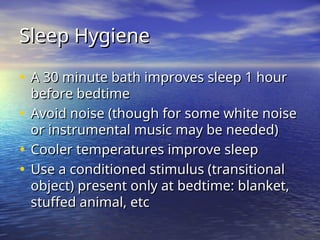
Sleep Hygiene
Sleep Hygiene
•A 30 minute bath improves sleep 1 hour
A 30 minute bath improves sleep 1 hour
before bedtime
before bedtime
• Avoid noise (though for some white noise
Avoid noise (though for some white noise
or instrumental music may be needed)
or instrumental music may be needed)
• Cooler temperatures improve sleep
Cooler temperatures improve sleep
• Use a conditioned stimulus (transitional
Use a conditioned stimulus (transitional
object) present only at bedtime: blanket,
object) present only at bedtime: blanket,
stuffed animal, etc
stuffed animal, etc
34.
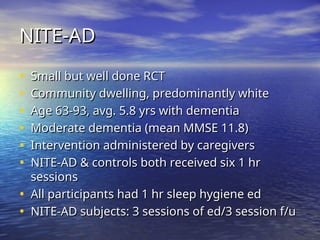
NITE-AD
NITE-AD
• Small butwell done RCT
Small but well done RCT
• Community dwelling, predominantly white
Community dwelling, predominantly white
• Age 63-93, avg. 5.8 yrs with dementia
Age 63-93, avg. 5.8 yrs with dementia
• Moderate dementia (mean MMSE 11.8)
Moderate dementia (mean MMSE 11.8)
• Intervention administered by caregivers
Intervention administered by caregivers
• NITE-AD & controls both received six 1 hr
NITE-AD & controls both received six 1 hr
sessions
sessions
• All participants had 1 hr sleep hygiene ed
All participants had 1 hr sleep hygiene ed
• NITE-AD subjects: 3 sessions of ed/3 session f/u
NITE-AD subjects: 3 sessions of ed/3 session f/u
35.
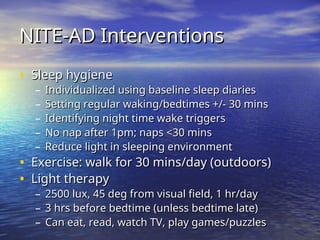
NITE-AD Interventions
NITE-AD Interventions
•Sleep hygiene
Sleep hygiene
– Individualized using baseline sleep diaries
Individualized using baseline sleep diaries
– Setting regular waking/bedtimes +/- 30 mins
Setting regular waking/bedtimes +/- 30 mins
– Identifying night time wake triggers
Identifying night time wake triggers
– No nap after 1pm; naps <30 mins
No nap after 1pm; naps <30 mins
– Reduce light in sleeping environment
Reduce light in sleeping environment
• Exercise: walk for 30 mins/day (outdoors)
Exercise: walk for 30 mins/day (outdoors)
• Light therapy
Light therapy
– 2500 lux, 45 deg from visual field, 1 hr/day
2500 lux, 45 deg from visual field, 1 hr/day
– 3 hrs before bedtime (unless bedtime late)
3 hrs before bedtime (unless bedtime late)
– Can eat, read, watch TV, play games/puzzles
Can eat, read, watch TV, play games/puzzles
36.
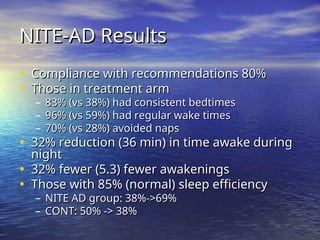
NITE-AD Results
NITE-AD Results
•Compliance with recommendations 80%
Compliance with recommendations 80%
• Those in treatment arm
Those in treatment arm
– 83% (vs 38%) had consistent bedtimes
83% (vs 38%) had consistent bedtimes
– 96% (vs 59%) had regular wake times
96% (vs 59%) had regular wake times
– 70% (vs 28%) avoided naps
70% (vs 28%) avoided naps
• 32% reduction (36 min) in time awake during
32% reduction (36 min) in time awake during
night
night
• 32% fewer (5.3) fewer awakenings
32% fewer (5.3) fewer awakenings
• Those with 85% (normal) sleep efficiency
Those with 85% (normal) sleep efficiency
– NITE AD group: 38%->69%
NITE AD group: 38%->69%
– CONT: 50% -> 38%
CONT: 50% -> 38%
37.
NITE-AD Results
NITE-AD Results
•Significantly more exercise
Significantly more exercise
• Decreased depression
Decreased depression
• Decreased daytime sleepiness
Decreased daytime sleepiness
• At 6 month f/u: NITE AD less time awake, fewer
At 6 month f/u: NITE AD less time awake, fewer
awakenings, more exercise & less depression
awakenings, more exercise & less depression
• NITE AD caregivers: improved sleep time/sleep
NITE AD caregivers: improved sleep time/sleep
efficiency, decreased awakenings at 2 & 6 months
efficiency, decreased awakenings at 2 & 6 months
• May have delayed institutionalization
May have delayed institutionalization
• Intervention appeared to help those with more
Intervention appeared to help those with more
problems at beginning
problems at beginning
38.
Depression Treatment
Depression Treatment
•Sometimes treating depression with
Sometimes treating depression with
therapy or medication will improve sleep
therapy or medication will improve sleep
• May consider sedating antidepressants
May consider sedating antidepressants
(mirtazapine, trazodone, tricyclic
(mirtazapine, trazodone, tricyclic
antidepressants) but all have risks
antidepressants) but all have risks
• May temporarily add low dose, short
May temporarily add low dose, short
acting BZD medications (zolpidem,
acting BZD medications (zolpidem,
zaleplon) but risky
zaleplon) but risky
39.
Conclusions
Conclusions
• Insomnia inelderly is a significant, pervasive and
Insomnia in elderly is a significant, pervasive and
progressive health related problem
progressive health related problem
• Insomnia has predictable underlying
Insomnia has predictable underlying
neurobiologic causes but is very responsive to
neurobiologic causes but is very responsive to
environmental conditions even in dementia
environmental conditions even in dementia
• Insomnia requires prompt, thorough evaluation
Insomnia requires prompt, thorough evaluation
• Ideally, CBT and environmental interventions are
Ideally, CBT and environmental interventions are
first line treatment for most forms of insomnia
first line treatment for most forms of insomnia
• CBT safer & more efficacious than medication for
CBT safer & more efficacious than medication for
treatment of insomnia medium & long term
treatment of insomnia medium & long term
40.
Resources
Resources
• Exercise Guide:
ExerciseGuide:
http://www.nia.nih.gov/health/publicati
on/exercise-physical-activity
• Activities Guide:
Activities Guide:
https://www.alz.org/national/document
s/brochure_activities.pdf
• The 36-Hour Day: A Family Guide to
The 36-Hour Day: A Family Guide to
Caring for People Who Have Alzheimer
Caring for People Who Have Alzheimer
Disease, Related Dementias, and
Disease, Related Dementias, and
Memory Loss
Memory Loss
41.
Sources
Sources
Costa et al.Aging, circadian rhythms &
Costa et al. Aging, circadian rhythms &
depressive disorders: a review. Am J
depressive disorders: a review. Am J
Neurodegener Dis. 2013; 2(4): 228-46
Neurodegener Dis. 2013; 2(4): 228-46
McCurry et al. Nighttime Insomnia Treatmennt
McCurry et al. Nighttime Insomnia Treatmennt
and Education for Alz Dis: a RCT. J Am Geriatr
and Education for Alz Dis: a RCT. J Am Geriatr
Soc. 2005; 53 (5): 793-802.
Soc. 2005; 53 (5): 793-802.
Shub et al. Non-pharmacologic treatment of
Shub et al. Non-pharmacologic treatment of
insomnia in persons with dementia.
insomnia in persons with dementia.
Geriatrics; 64(2): 22-26.
Geriatrics; 64(2): 22-26.


![Sleep disorders [autosaved]](https://cdn.slidesharecdn.com/ss_thumbnails/sleepdisordersautosaved-180531135608-thumbnail.jpg?width=640&height=640&fit=bounds)


