Overview
0 Four Domains
   0 Planning and Preparation
   0 Classroom Environment
   0 Instruction
   0 Professional Responsibilities
     0 Each Domain contains 5-6 distinct Components
     0 Each Component contains 2-5 Essential Elements
Why have a Framework?
0 Defines expertise and procedures
0 Distinguishes novice from advanced teachers
0 Communicates professionalism to t he broader
  community
0 Develops a common language for professional
  conversations (What is good teaching?)
0 Provides a tool for self assessment
Current Teaching Standards
0 NCATE – National Council for Accreditation of Teacher
  Education
0 IPTS – Illinois Professional Teaching Standards
0 INTASC – Interstate New Teacher Assessment and
  Support Consortiuum
  0 See Comparison, page 8-9
Using the Frameworks
0 Higher Ed – Preparing New Teachers
0 PreK-12
   0 Recruiting & Hiring
   0 Focusing School Improvement Efforts
   0 Communicating with the Larger Community
0 Our New Teacher Learning Team
  0 Road Map for Novice Teachers
  0 Guidance for More Experienced Teachers
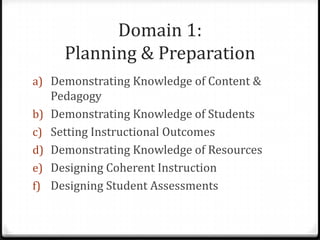
Domain 1:
     Planning & Preparation
a) Demonstrating Knowledge of Content &
   Pedagogy
b) Demonstrating Knowledge of Students
c) Setting Instructional Outcomes
d) Demonstrating Knowledge of Resources
e) Designing Coherent Instruction
f) Designing Student Assessments
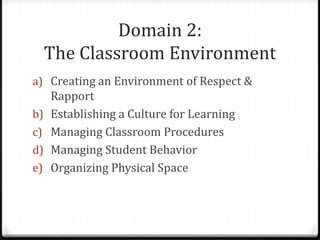
Domain 2:
  The Classroom Environment
a) Creating an Environment of Respect &
   Rapport
b) Establishing a Culture for Learning
c) Managing Classroom Procedures
d) Managing Student Behavior
e) Organizing Physical Space
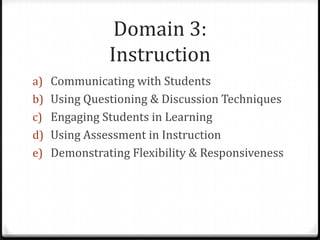
Domain 3:
             Instruction
a) Communicating with Students
b) Using Questioning & Discussion Techniques
c) Engaging Students in Learning
d) Using Assessment in Instruction
e) Demonstrating Flexibility & Responsiveness
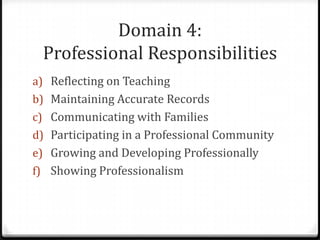
Domain 4:
 Professional Responsibilities
a) Reflecting on Teaching
b) Maintaining Accurate Records
c) Communicating with Families
d) Participating in a Professional Community
e) Growing and Developing Professionally
f) Showing Professionalism
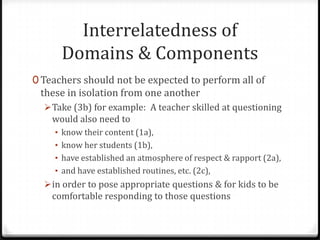
Interrelatedness of
      Domains & Components
0 Teachers should not be expected to perform all of
 these in isolation from one another
   Take (3b) for example: A teacher skilled at questioning
    would also need to
    • know their content (1a),
    • know her students (1b),
    • have established an atmosphere of respect & rapport (2a),
    • and have established routines, etc. (2c),
   in order to pose appropriate questions & for kids to be
    comfortable responding to those questions
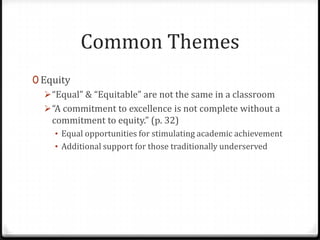
Common Themes
0 Equity
    “Equal” & “Equitable” are not the same in a classroom
    “A commitment to excellence is not complete without a
     commitment to equity.” (p. 32)
     • Equal opportunities for stimulating academic achievement
     • Additional support for those traditionally underserved
Common Themes
0 Cultural Competence
    Teachers must remain aware of and respectful to
     students’ cultures and backgrounds.
    Materials & examples employed must not refer to
     items/traditions unfamiliar to students without full
     explanations
Common Themes
0 High Expectations
   Beware of Self-fulfilling Prophecies
   Communicate & Cultivate an expectation of high yet
    achievable expectations for each child
   High expectations are grounded in clear and open
    standards for achievement
   Embedded in this is the culture of hard work &
    perseverance
Common Themes
0 Developmental Appropriateness
   How student understand a concept is influenced by
    their cognitive structures at the time they are
    introduced to it. (p. 34)
     • Know where your students are
     • Meet them at their level
     • Provide experiences to appropriately challenge them to
      grow
Common Themes
0 Attention to Individual Students, including those with
 special needs
   Skilled teachers design activities that are challenging on
    a number of different levels simultaneously (p. 35)
Common Themes
0 Appropriate Use of Technology
    Technology = Tools
    Not every child has access to technology tools
    Knowing concepts is important, Knowing how to select
     & use tools related to those concepts is also (equally?)
     important
    Staying abreast of technology developments is very
     important to a teacher’s professional development
Common Themes
0 Student Assumptions of Responsibility
    Part of being in charge is to enlist student energy in
     ensuring the success of the entire class
    Proficient teachers guide student energies into
     meaningful learning experiences
    Teachers should recognize & use student contributions
     to produce knowledge
    The hallmark of a community of learners is that every
     individual is highly engaged and invested in an endeavor
     (p. 38)

Danielson intro

  • 2.
    Overview 0 Four Domains 0 Planning and Preparation 0 Classroom Environment 0 Instruction 0 Professional Responsibilities 0 Each Domain contains 5-6 distinct Components 0 Each Component contains 2-5 Essential Elements
  • 3.
    Why have aFramework? 0 Defines expertise and procedures 0 Distinguishes novice from advanced teachers 0 Communicates professionalism to t he broader community 0 Develops a common language for professional conversations (What is good teaching?) 0 Provides a tool for self assessment
  • 4.
    Current Teaching Standards 0NCATE – National Council for Accreditation of Teacher Education 0 IPTS – Illinois Professional Teaching Standards 0 INTASC – Interstate New Teacher Assessment and Support Consortiuum 0 See Comparison, page 8-9
  • 5.
    Using the Frameworks 0Higher Ed – Preparing New Teachers 0 PreK-12 0 Recruiting & Hiring 0 Focusing School Improvement Efforts 0 Communicating with the Larger Community 0 Our New Teacher Learning Team 0 Road Map for Novice Teachers 0 Guidance for More Experienced Teachers
  • 6.
    Domain 1: Planning & Preparation a) Demonstrating Knowledge of Content & Pedagogy b) Demonstrating Knowledge of Students c) Setting Instructional Outcomes d) Demonstrating Knowledge of Resources e) Designing Coherent Instruction f) Designing Student Assessments
  • 7.
    Domain 2: The Classroom Environment a) Creating an Environment of Respect & Rapport b) Establishing a Culture for Learning c) Managing Classroom Procedures d) Managing Student Behavior e) Organizing Physical Space
  • 8.
    Domain 3: Instruction a) Communicating with Students b) Using Questioning & Discussion Techniques c) Engaging Students in Learning d) Using Assessment in Instruction e) Demonstrating Flexibility & Responsiveness
  • 9.
    Domain 4: ProfessionalResponsibilities a) Reflecting on Teaching b) Maintaining Accurate Records c) Communicating with Families d) Participating in a Professional Community e) Growing and Developing Professionally f) Showing Professionalism
  • 10.
    Interrelatedness of Domains & Components 0 Teachers should not be expected to perform all of these in isolation from one another  Take (3b) for example: A teacher skilled at questioning would also need to • know their content (1a), • know her students (1b), • have established an atmosphere of respect & rapport (2a), • and have established routines, etc. (2c),  in order to pose appropriate questions & for kids to be comfortable responding to those questions
  • 11.
    Common Themes 0 Equity  “Equal” & “Equitable” are not the same in a classroom  “A commitment to excellence is not complete without a commitment to equity.” (p. 32) • Equal opportunities for stimulating academic achievement • Additional support for those traditionally underserved
  • 12.
    Common Themes 0 CulturalCompetence  Teachers must remain aware of and respectful to students’ cultures and backgrounds.  Materials & examples employed must not refer to items/traditions unfamiliar to students without full explanations
  • 13.
    Common Themes 0 HighExpectations  Beware of Self-fulfilling Prophecies  Communicate & Cultivate an expectation of high yet achievable expectations for each child  High expectations are grounded in clear and open standards for achievement  Embedded in this is the culture of hard work & perseverance
  • 14.
    Common Themes 0 DevelopmentalAppropriateness  How student understand a concept is influenced by their cognitive structures at the time they are introduced to it. (p. 34) • Know where your students are • Meet them at their level • Provide experiences to appropriately challenge them to grow
  • 15.
    Common Themes 0 Attentionto Individual Students, including those with special needs  Skilled teachers design activities that are challenging on a number of different levels simultaneously (p. 35)
  • 16.
    Common Themes 0 AppropriateUse of Technology  Technology = Tools  Not every child has access to technology tools  Knowing concepts is important, Knowing how to select & use tools related to those concepts is also (equally?) important  Staying abreast of technology developments is very important to a teacher’s professional development
  • 17.
    Common Themes 0 StudentAssumptions of Responsibility  Part of being in charge is to enlist student energy in ensuring the success of the entire class  Proficient teachers guide student energies into meaningful learning experiences  Teachers should recognize & use student contributions to produce knowledge  The hallmark of a community of learners is that every individual is highly engaged and invested in an endeavor (p. 38)