How to reference Harvard system
Why Reference? If you use someone else’s work Text Image Video Sound Quote You must acknowledge that it is their work Otherwise you are plagiarising
Harvard referencing style You will use this at university* *Note: this is a very simplified version of Harvard referencing compared to what you will use at University 2 main processes Citing  part  of the details of the reference in the  body  of the essay Citing the  full  details of the reference in the bibliography at the  end  of the essay You MUST do both
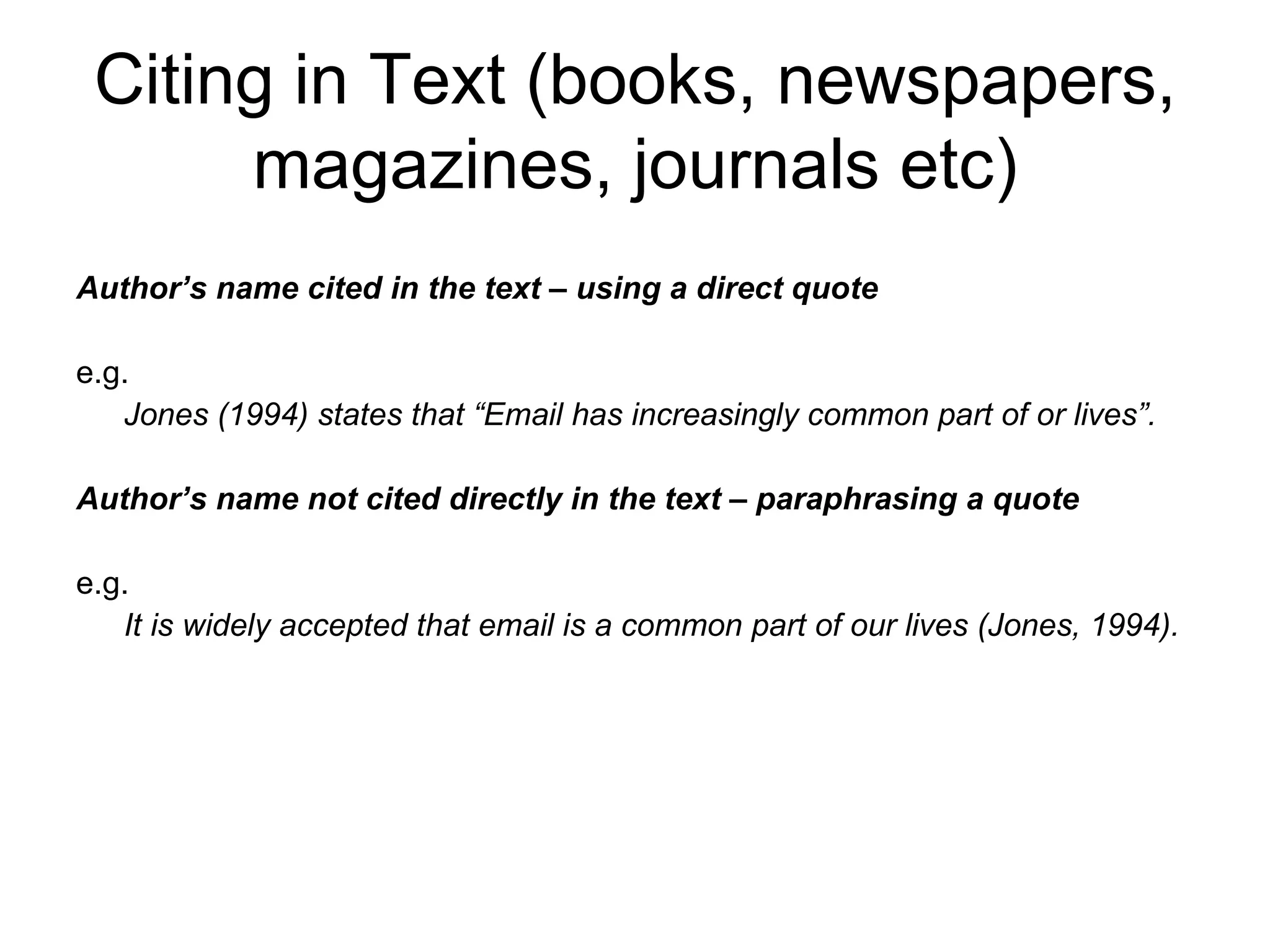
Citing in Text (books, newspapers, magazines, journals etc) Author’s name cited in the text – using a direct quote  e.g.  Jones (1994) states that “Email has increasingly common part of or lives”.   Author’s name not cited directly in the text – paraphrasing a quote e.g. It is widely accepted that email is a common part of our lives (Jones, 1994).
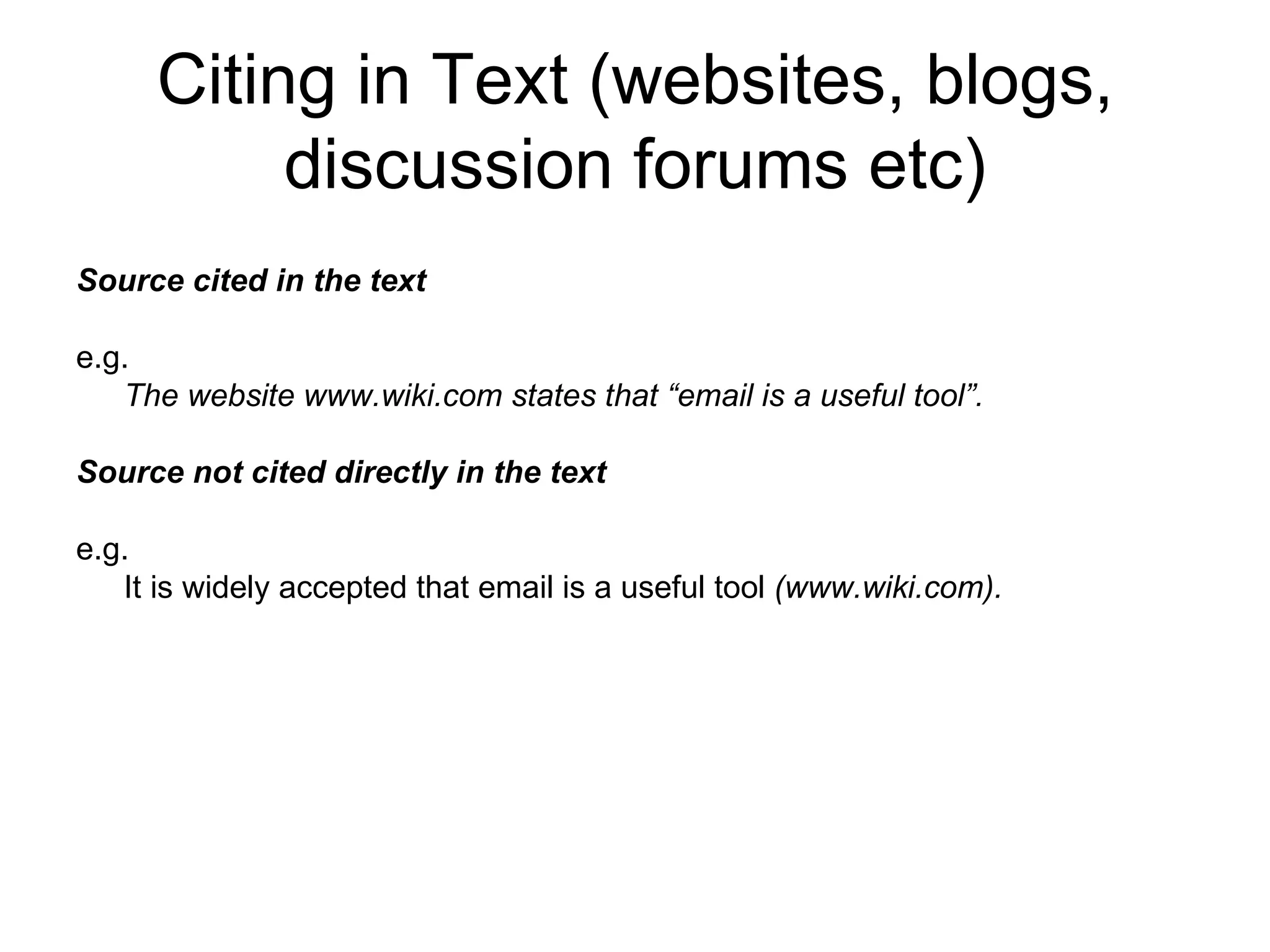
Citing in Text (websites, blogs, discussion forums etc) Source cited in the text  e.g.  The website www.wiki.com states that “email is a useful tool”.   Source not cited directly in the text  e.g. It is widely accepted that email is a useful tool  (www.wiki.com).
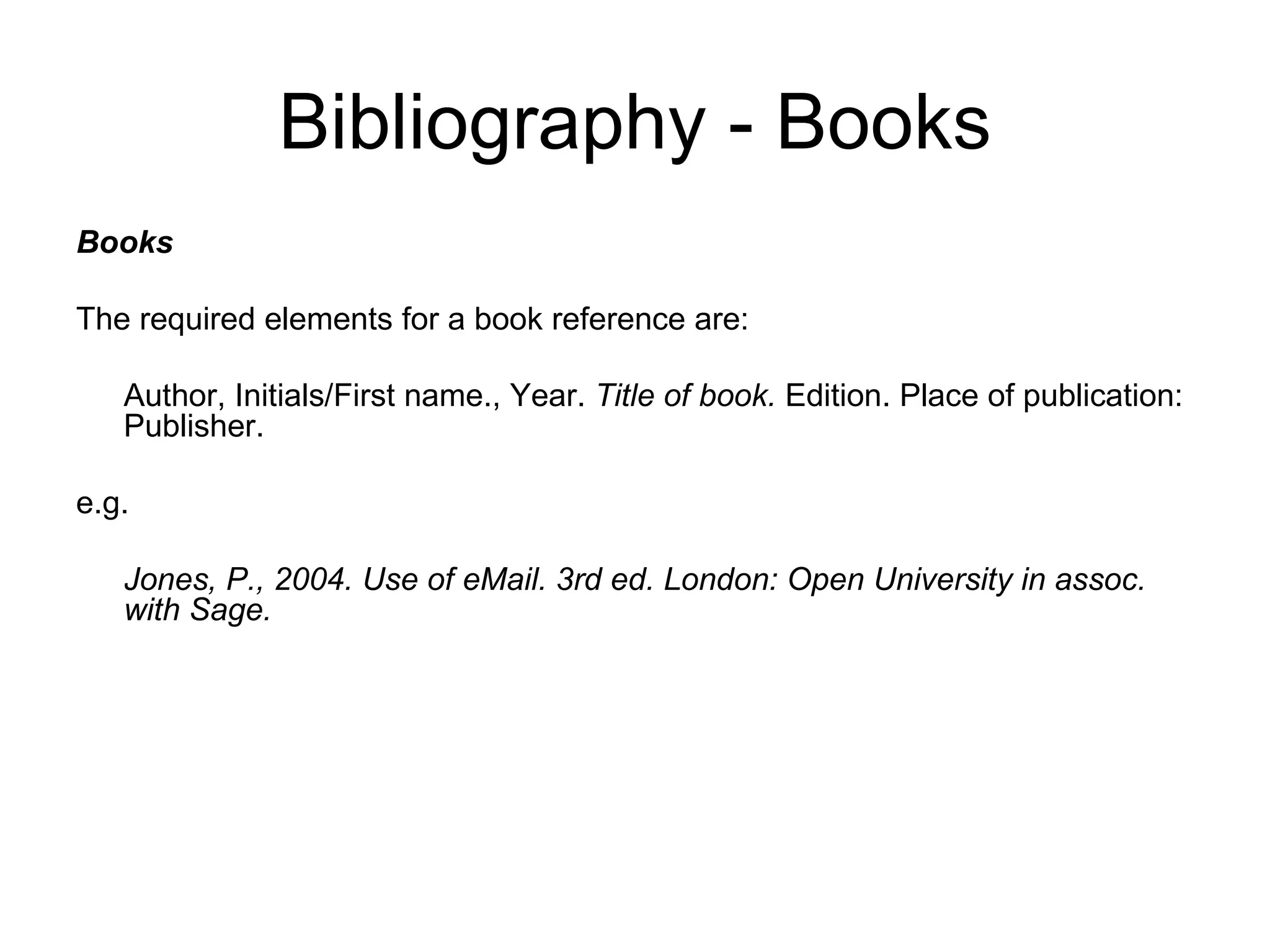
Bibliography - Books Books  The required elements for a book reference are:  Author, Initials/First name., Year.  Title of book.  Edition. Place of publication: Publisher.  e.g. Jones, P., 2004. Use of eMail. 3rd ed. London: Open University in assoc. with Sage.
Bibliography - Journals Journal articles from an electronic source  For journal articles from an electronic source the required elements for a reference are:  Author, Initials., Year. Title of article.  Full Title of Journal,  [type of medium] Volume number (Issue/Part number), Page numbers if availalble. Available at: include web site address/URL(Uniform Resource Locator) and additional details of access, such as the routing from the home page of the source. [Accessed date].  e.g. Smith, J.M., 2008. How eMail has changed the world. Computer Science Quarterly, [Online]. 40 (1), Available at: Oxford Publishing  http://www.oxpub/articles   [Accessed 12 June 2009].
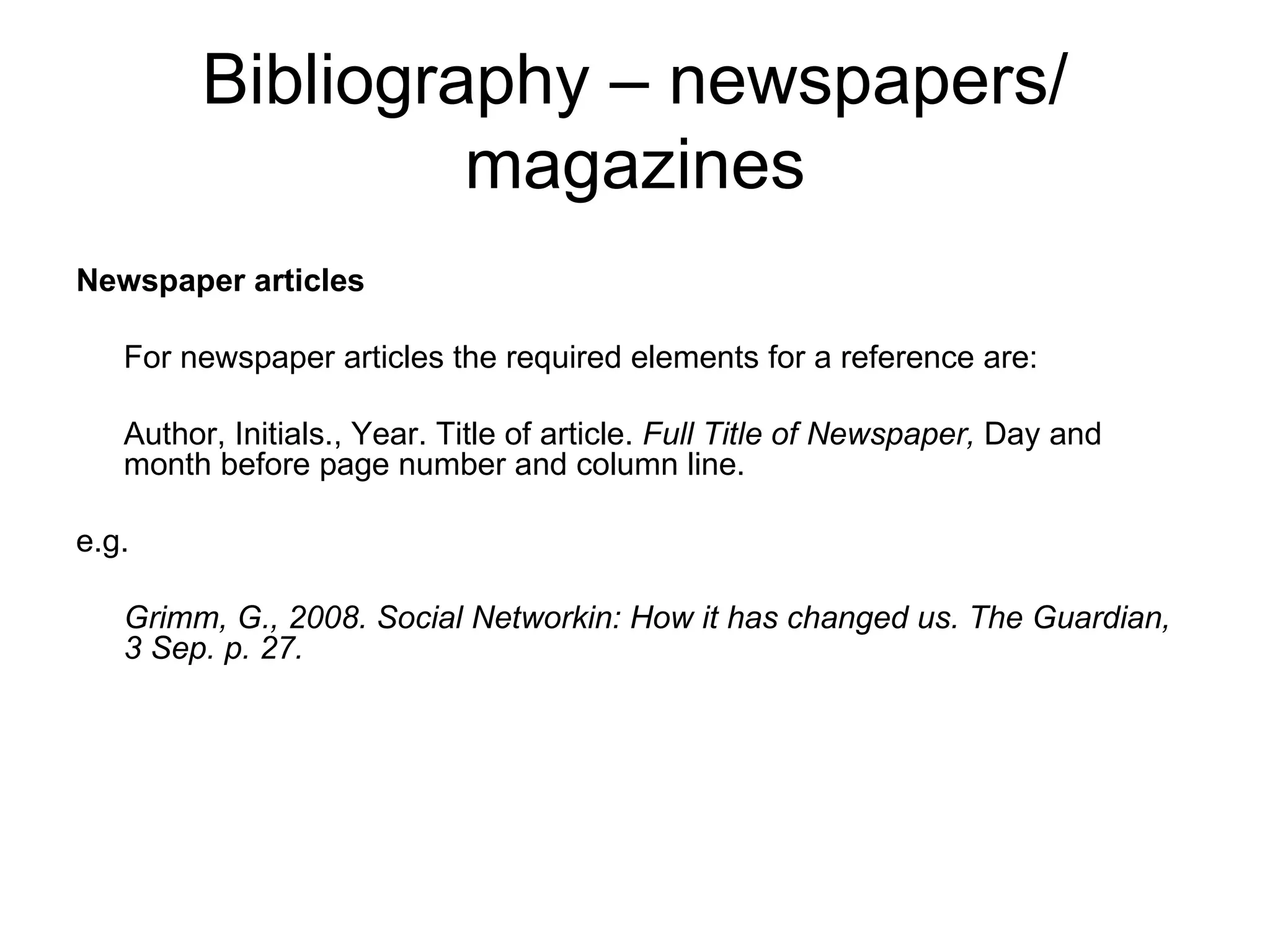
Bibliography – newspapers/ magazines Newspaper articles  For newspaper articles the required elements for a reference are:  Author, Initials., Year. Title of article.  Full Title of Newspaper,  Day and month before page number and column line.  e.g. Grimm, G., 2008. Social Networkin: How it has changed us. The Guardian, 3 Sep. p. 27.
Bibliography – Online newspaper / magazines Online newspaper articles  For newspaper articles found in online newspapers, the required elements for a reference are:  Author or corporate author, Year. Title of document or page . Name of newspaper,  [type of medium] additional date information. Available at: include web site address/URL(Uniform Resource Locator) and additional details of access, such as the routing from the home page of the source.[Accessed date].  e.g. Smith, F., 2008. “Blogs are the Future”. Times Online, [internet] 1 May. Available at:  http://www.timesonline.co.uk/0,,11-1527-7886.html   [Accessed 7 May 2007].  It is good practice to keep in your files a copy of the front page of any website you use.
Bibliography – DVD / broadcasts DVD or film The required elements for a reference are:  Full title of DVD or video.  Year of distribution. [Medium] Director (if relevant) Country or origin: Film studio or maker. (Other relevant details).  e.g. The Information Age. 2009 [DVD] London: Channel 4 Films. Broadcasts For a broadcast the suggested elements should include:  Series title and episode name and number if relevant , Year of broadcast. [Medium] Broadcasting organisation and Channel, date and time of transmission.  e.g. The Internet Revolution , 2010. [TV programme] BBC, BBC2, 30 January 2010 20.00.
Bibliography – Webpages Websites  For websites found on the world wide web the required elements for a reference are:  Authorship or Source, Year.  Title of web document or web page . [Medium] (date of update) Available at: include web site address/URL(Uniform Resource Locator) and additional details such as access or routing from the home page of the source. [Accessed date].  e.g. Wikipedia, 2009.  What does the internet do?  [Online] (Updated 16 Jan 2009) Available at:  http://www.wikipedia.com/internet  [Accessed 1 February 2010].  The title of a web page is normally the main heading on the page.  It is   good practice to keep a copy of the front page of any website you use.
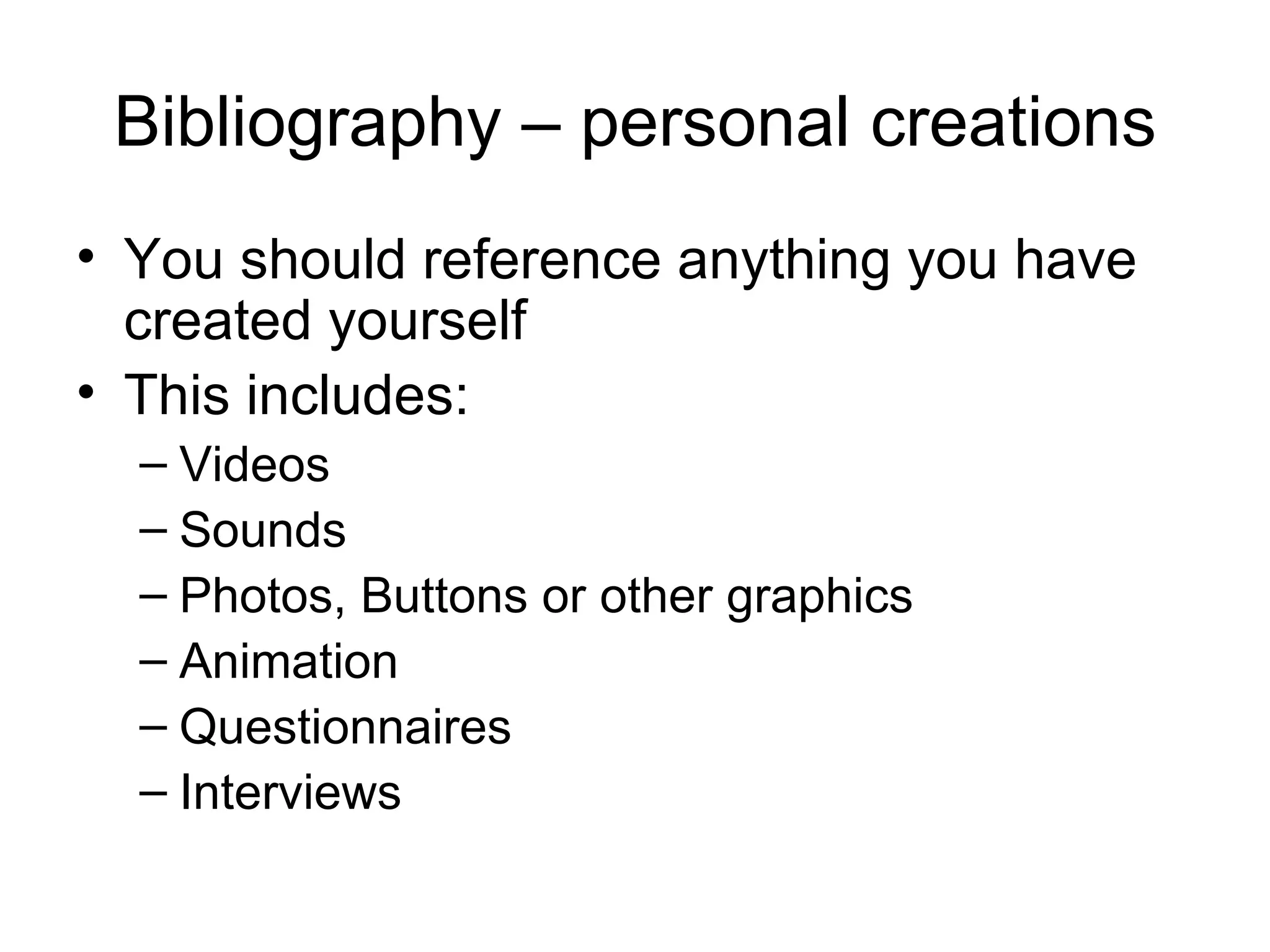
Bibliography – personal creations You should reference anything you have created yourself This includes: Videos Sounds Photos, Buttons or other graphics Animation Questionnaires Interviews

How To Reference

  • 1.
    How to referenceHarvard system
  • 2.
    Why Reference? Ifyou use someone else’s work Text Image Video Sound Quote You must acknowledge that it is their work Otherwise you are plagiarising
  • 3.
    Harvard referencing styleYou will use this at university* *Note: this is a very simplified version of Harvard referencing compared to what you will use at University 2 main processes Citing part of the details of the reference in the body of the essay Citing the full details of the reference in the bibliography at the end of the essay You MUST do both
  • 4.
    Citing in Text(books, newspapers, magazines, journals etc) Author’s name cited in the text – using a direct quote e.g. Jones (1994) states that “Email has increasingly common part of or lives”. Author’s name not cited directly in the text – paraphrasing a quote e.g. It is widely accepted that email is a common part of our lives (Jones, 1994).
  • 5.
    Citing in Text(websites, blogs, discussion forums etc) Source cited in the text e.g. The website www.wiki.com states that “email is a useful tool”. Source not cited directly in the text e.g. It is widely accepted that email is a useful tool (www.wiki.com).
  • 6.
    Bibliography - BooksBooks The required elements for a book reference are: Author, Initials/First name., Year. Title of book. Edition. Place of publication: Publisher. e.g. Jones, P., 2004. Use of eMail. 3rd ed. London: Open University in assoc. with Sage.
  • 7.
    Bibliography - JournalsJournal articles from an electronic source For journal articles from an electronic source the required elements for a reference are: Author, Initials., Year. Title of article. Full Title of Journal, [type of medium] Volume number (Issue/Part number), Page numbers if availalble. Available at: include web site address/URL(Uniform Resource Locator) and additional details of access, such as the routing from the home page of the source. [Accessed date]. e.g. Smith, J.M., 2008. How eMail has changed the world. Computer Science Quarterly, [Online]. 40 (1), Available at: Oxford Publishing http://www.oxpub/articles [Accessed 12 June 2009].
  • 8.
    Bibliography – newspapers/magazines Newspaper articles For newspaper articles the required elements for a reference are: Author, Initials., Year. Title of article. Full Title of Newspaper, Day and month before page number and column line. e.g. Grimm, G., 2008. Social Networkin: How it has changed us. The Guardian, 3 Sep. p. 27.
  • 9.
    Bibliography – Onlinenewspaper / magazines Online newspaper articles For newspaper articles found in online newspapers, the required elements for a reference are: Author or corporate author, Year. Title of document or page . Name of newspaper, [type of medium] additional date information. Available at: include web site address/URL(Uniform Resource Locator) and additional details of access, such as the routing from the home page of the source.[Accessed date]. e.g. Smith, F., 2008. “Blogs are the Future”. Times Online, [internet] 1 May. Available at: http://www.timesonline.co.uk/0,,11-1527-7886.html [Accessed 7 May 2007]. It is good practice to keep in your files a copy of the front page of any website you use.
  • 10.
    Bibliography – DVD/ broadcasts DVD or film The required elements for a reference are: Full title of DVD or video. Year of distribution. [Medium] Director (if relevant) Country or origin: Film studio or maker. (Other relevant details). e.g. The Information Age. 2009 [DVD] London: Channel 4 Films. Broadcasts For a broadcast the suggested elements should include: Series title and episode name and number if relevant , Year of broadcast. [Medium] Broadcasting organisation and Channel, date and time of transmission. e.g. The Internet Revolution , 2010. [TV programme] BBC, BBC2, 30 January 2010 20.00.
  • 11.
    Bibliography – WebpagesWebsites For websites found on the world wide web the required elements for a reference are: Authorship or Source, Year. Title of web document or web page . [Medium] (date of update) Available at: include web site address/URL(Uniform Resource Locator) and additional details such as access or routing from the home page of the source. [Accessed date]. e.g. Wikipedia, 2009. What does the internet do? [Online] (Updated 16 Jan 2009) Available at: http://www.wikipedia.com/internet [Accessed 1 February 2010]. The title of a web page is normally the main heading on the page. It is good practice to keep a copy of the front page of any website you use.
  • 12.
    Bibliography – personalcreations You should reference anything you have created yourself This includes: Videos Sounds Photos, Buttons or other graphics Animation Questionnaires Interviews